VST-SMASH: VST Survey of Mass Assembly and Structural Hierarchy II. Exploring dwarf galaxies in the vicinity of NGC 5068 and of the two galaxies NGC 5084 and NGC 5087 at the edges of the Virgo Supercluster
Pith reviewed 2026-06-26 14:06 UTC · model grok-4.3
The pith
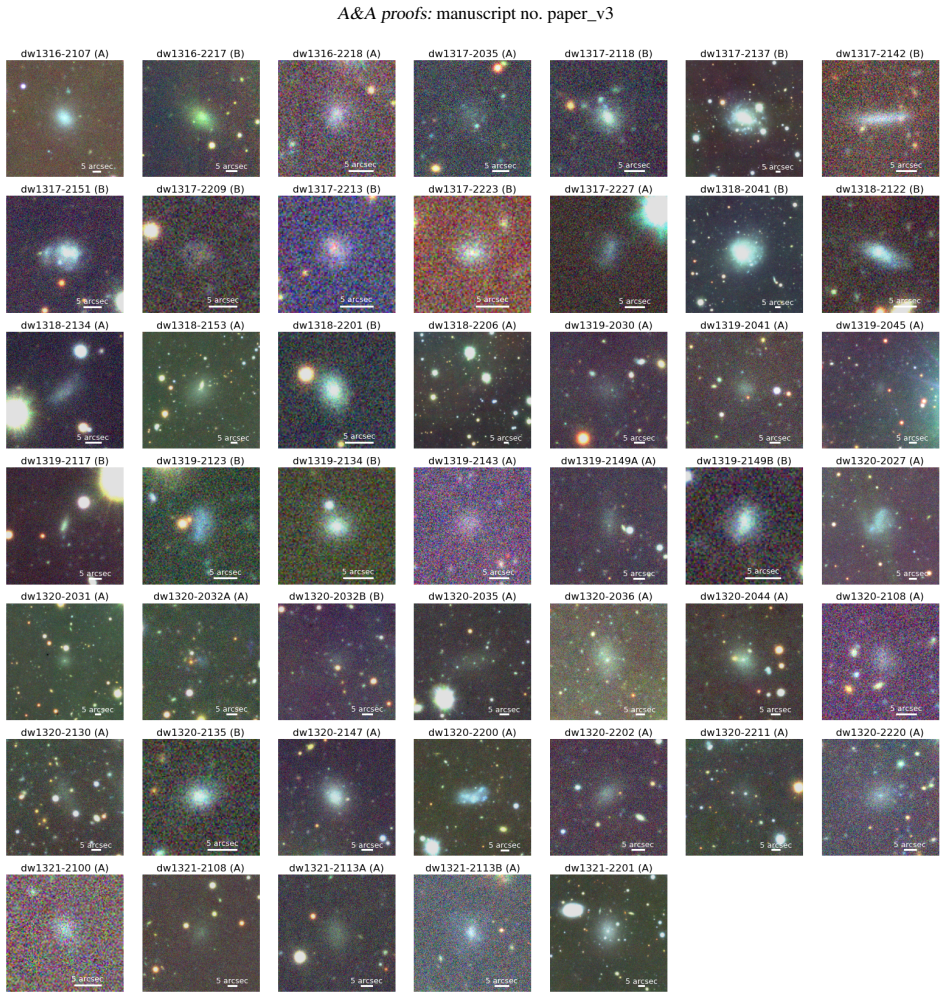
Deep imaging of fields around NGC 5068 and two Virgo-edge galaxies reveals 47 dwarf candidates, ten times the number previously known.
A machine-rendered reading of the paper's core claim, the machinery that carries it, and where it could break.
Core claim
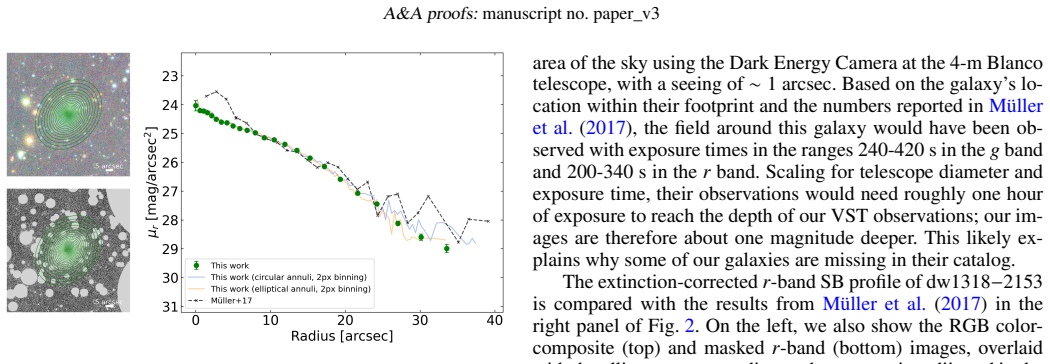
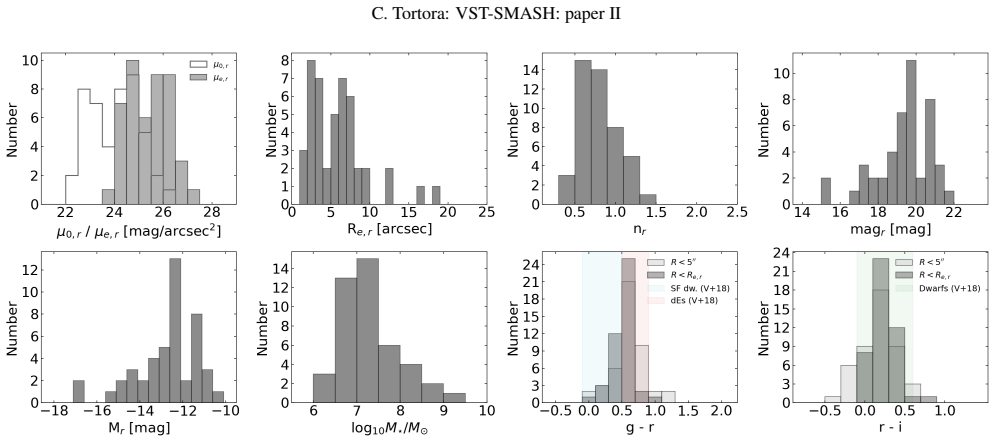
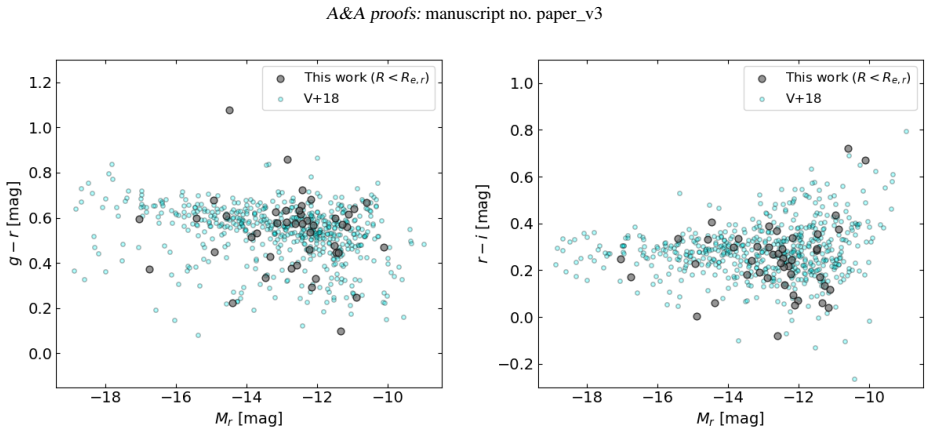
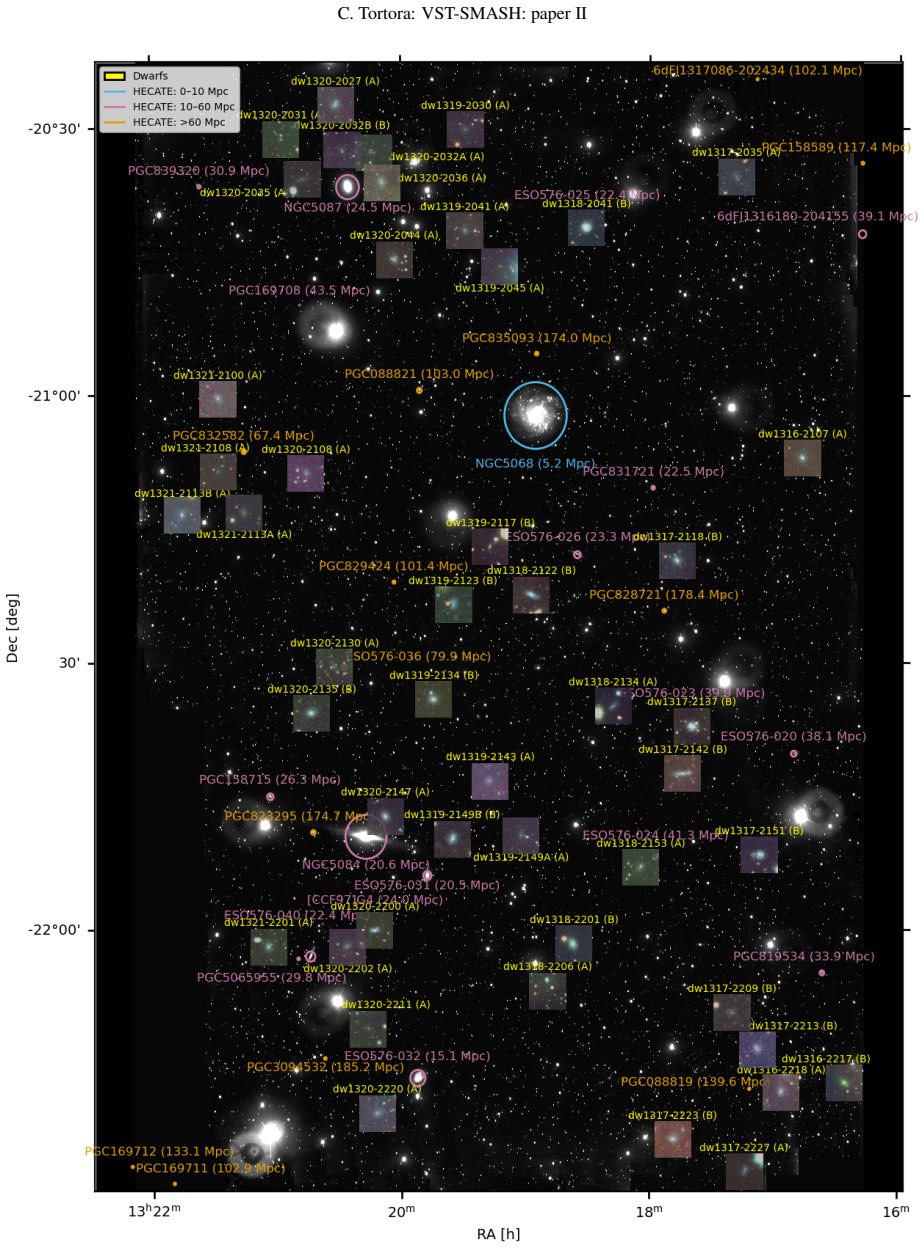
Using VST-SMASH imaging that reaches g- and r-band surface-brightness limits of approximately 30 mag arcsec^{-2}, a two-step visual inspection isolates 47 dwarf-galaxy candidates whose median colors are g-r = 0.57 and r-i = 0.24. Surface photometry and one-dimensional Sersic fits yield n < 2 profiles and scaling relations consistent with literature dwarfs. Spatial offsets relative to the three host galaxies indicate that many candidates occupy physically plausible distances from NGC 5068, NGC 5084, and NGC 5087.
What carries the argument
Two-step visual inspection of ultra-deep, wide-field VST imaging to select low-surface-brightness dwarf candidates without spectroscopic distances.
If this is right
- The new sample increases the known dwarf population in these fields by roughly an order of magnitude.
- Color gradients and structural parameters of the candidates are statistically consistent with those of previously studied dwarfs.
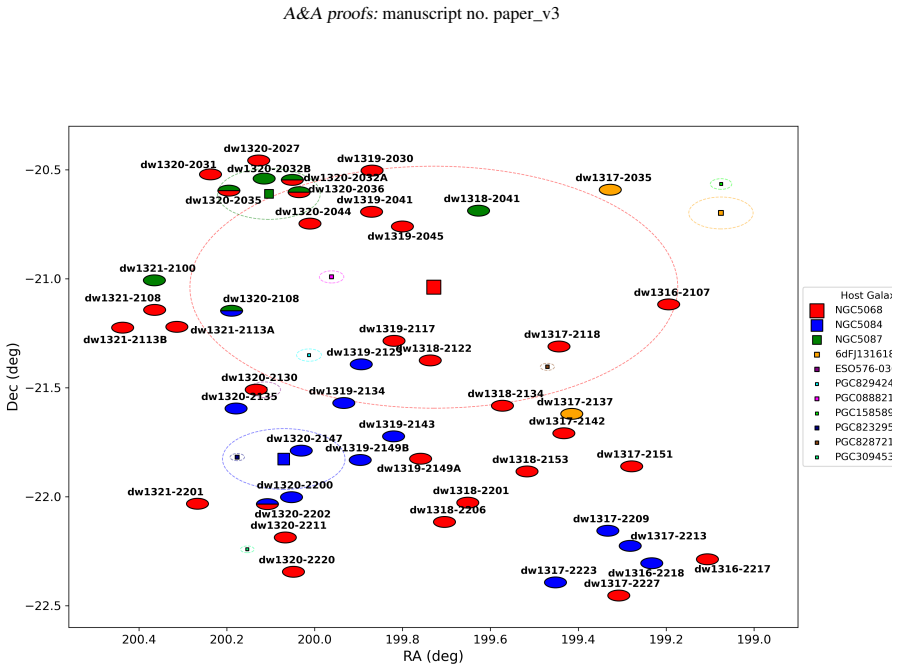
- Projected positions allow reasonable associations of many candidates with NGC 5068, NGC 5084, or NGC 5087 as hosts.
- The enlarged candidate list enables future statistical comparisons of satellite counts and spatial distributions with cosmological predictions.
Where Pith is reading between the lines
- If distances are confirmed, the sample can be used to test whether these hosts show the same satellite-plane alignments reported around other nearby galaxies.
- An order-of-magnitude increase in known dwarfs around a single host would tighten constraints on the faint end of the satellite luminosity function at distances less than 11 Mpc.
- The same imaging depth and inspection method could be applied to additional fields in the VST-SMASH footprint to build a more complete census of dwarfs around other nearby galaxies.
Load-bearing premise
Visual inspection alone can reliably separate true dwarf galaxies at the distance of the target hosts from background galaxies and imaging artifacts.
What would settle it
Spectroscopic redshifts for a sizable fraction of the 47 candidates that place them well beyond 11 Mpc would show that most are background contaminants rather than satellites.
Figures
read the original abstract
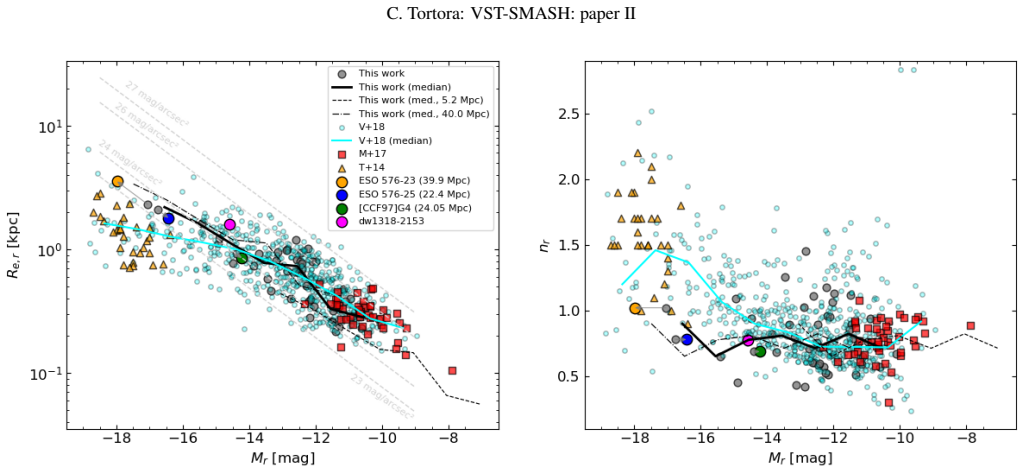
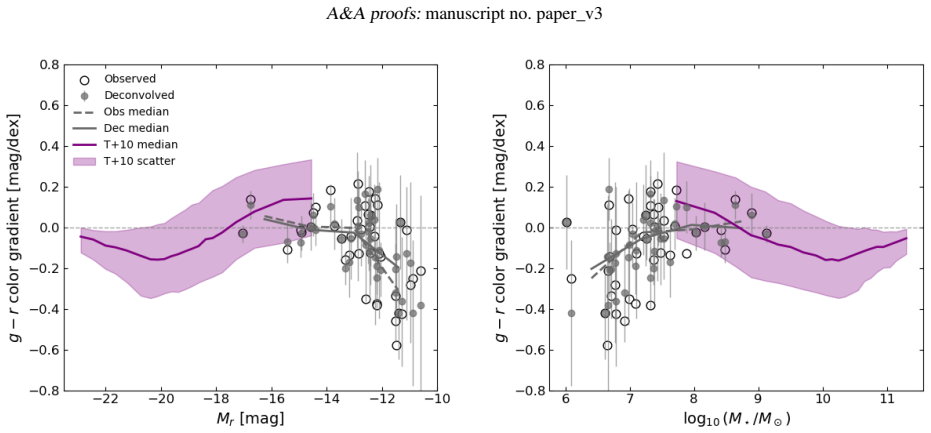
We present a study of dwarf galaxy candidates in the deepest optical imaging yet obtained of the field surrounding the nearby galaxies NGC 5068 and NGC 5084/NGC 5087, the latter two located in the peripheries of the Virgo Supercluster. This field, covering $\sim 2.6$ deg$^2$, was observed as part of the multi-band, wide-field and very deep data from VST-SMASH, a distance-limited program ($D < 11$ Mpc) that reaches $g$- and $r$-band surface brightness depths of $\mu \sim 30$ mag arcsec$^{-2}$. Using a two-step visual inspection procedure, we identify 47 dwarf galaxy candidates and perform the surface photometry of the sample and the fitting procedure with 1D S\'ersic model on their profiles. Only 4 galaxies were previously reported in the literature, augmenting by one order of magnitude the number of dwarfs discovered in these regions. The colors (median $g-r = 0.57$ and $r-i = 0.24$ mag) and structural properties of the dwarf candidates are consistent with the literature, as are their scaling relations with effective radius, S\'ersic index ($n < 2$), and absolute magnitude. We also investigate their central colour gradients, which exhibit significant scatter, and discuss them within the broader context of galaxy formation. We finally analyze their spatial distribution relative to potential host galaxies. We identify reasonable associations with NGC 5084, NGC 5087, and NGC 5068 as likely hosts for a significant fraction of the sample. Several candidates are at physically credible distances from NGC~5068, despite what their offset size-luminosity relation alone might indicate. Future spectroscopic and deeper imaging follow-up is required to determine distances and velocities, enabling robust association with hosts, studies of satellite distributions and counts, and comparisons with cosmological expectations for planes of satellites and dark matter models. (abridged)
Editorial analysis
A structured set of objections, weighed in public.
Referee Report
Summary. The paper presents deep VST-SMASH multi-band imaging (~2.6 deg², μ~30 mag arcsec^{-2}) of fields around NGC 5068 and NGC 5084/NGC 5087. Using a two-step visual inspection, the authors identify 47 dwarf galaxy candidates (only 4 previously known), perform surface photometry and 1D Sérsic fits, report median colors (g-r=0.57, r-i=0.24) and structural parameters (n<2) consistent with literature dwarfs, examine central color gradients and spatial distributions, and suggest associations with the target hosts while calling for spectroscopic confirmation.
Significance. If the visual classification isolates galaxies at D≲11 Mpc, the work would increase the known dwarf population in these regions by an order of magnitude, supplying new targets for satellite-system studies, planes-of-satellites tests, and comparisons with cosmological expectations. The achieved surface-brightness depth and the application of standard photometry/Sérsic procedures are strengths; the paper explicitly notes the need for follow-up distances.
major comments (1)
- [Abstract / candidate selection] Abstract and candidate-selection section: the headline result (47 candidates, order-of-magnitude increase) rests on the two-step visual inspection separating true dwarfs at the target distances from background LSB contaminants or artifacts at comparable surface brightness. No completeness or contamination estimates (e.g., via injected sources or comparison fields) are referenced, and the text defers robust association and confirmation to future spectroscopy. This is a load-bearing uncertainty for the central claim.
minor comments (1)
- The manuscript would benefit from explicit reference to the exact criteria or decision tree used in the second step of the visual inspection.
Simulated Author's Rebuttal
We thank the referee for their constructive review, recognition of the survey depth, and identification of the key uncertainty in candidate selection. We respond to the single major comment below and have made targeted revisions to strengthen the discussion of limitations without altering the core results.
read point-by-point responses
-
Referee: [Abstract / candidate selection] Abstract and candidate-selection section: the headline result (47 candidates, order-of-magnitude increase) rests on the two-step visual inspection separating true dwarfs at the target distances from background LSB contaminants or artifacts at comparable surface brightness. No completeness or contamination estimates (e.g., via injected sources or comparison fields) are referenced, and the text defers robust association and confirmation to future spectroscopy. This is a load-bearing uncertainty for the central claim.
Authors: We agree that the visual classification is central to the reported increase in candidates and that quantitative completeness/contamination estimates would reduce uncertainty. Section 3 details the two-step procedure (initial visual search followed by independent verification using morphology, color consistency with the red sequence, and exclusion of artifacts), which is a standard approach for LSB dwarf searches where automated detection is unreliable. We did not perform artificial source injections or comparison-field analyses, as these are resource-intensive for the complex VST background and were beyond the scope of this discovery paper. We have revised the abstract, Section 3, and conclusions to more explicitly quantify the reliance on visual inspection, discuss likely contaminant classes, and reiterate that all associations remain tentative pending spectroscopy. The reported structural parameters and colors provide internal consistency checks with the known dwarf population, supporting the sample's value as a candidate catalog for follow-up studies. revision: partial
Circularity Check
No circularity: direct observational catalog from visual inspection
full rationale
The paper's central result (identification of 47 dwarf candidates via two-step visual inspection, with photometry and Sersic fits) is obtained directly from the VST imaging data. No equations, fitted parameters, or predictions are presented that reduce by construction to the inputs. Properties are reported as measured and noted as consistent with external literature, without any load-bearing self-citation chain or ansatz smuggling. The work explicitly defers confirmation to future spectroscopy, confirming the derivation chain is self-contained against the raw observations rather than tautological.
Axiom & Free-Parameter Ledger
axioms (1)
- domain assumption Visual inspection by the team correctly identifies genuine dwarf galaxies at the distance of the target hosts.
Reference graph
Works this paper leans on
-
[1]
Amorín, R., Aguerri, J. A. L., Muñoz-Tuñón, C., & Cairós, L. M. 2009, A&A, 501, 75
2009
-
[2]
& Tosi, M
Annibali, F. & Tosi, M. 2022, Nature Astronomy, 6, 48
2022
-
[3]
2024, A&A, 683, A182
Baes, M., Mosenkov, A., Kelly, R., et al. 2024, A&A, 683, A182
2024
-
[4]
2018, SEP: Source Extraction and Photometry, Astrophysics Source Code Library, record ascl:1811.004
Barbary, K. 2018, SEP: Source Extraction and Photometry, Astrophysics Source Code Library, record ascl:1811.004
2018
-
[5]
R., Schlegel, D
Blanton, M. R., Schlegel, D. J., Strauss, M. A., et al. 2005, AJ, 129, 2562
2005
-
[6]
2008, ApJ, 674, 742
Boselli, A., Boissier, S., Cortese, L., & Gavazzi, G. 2008, ApJ, 674, 742
2008
-
[7]
Bullock, J. S. & Boylan-Kolchin, M. 2017, ARA&A, 55, 343
2017
-
[8]
1983, AJ, 88, 804
Caldwell, N. 1983, AJ, 88, 804
1983
-
[9]
1993, MNRAS, 265, 1013
Caon, N., Capaccioli, M., & D’Onofrio, M. 1993, MNRAS, 265, 1013
1993
-
[10]
2015, Astronomy & Astrophysics, 581, A10
Capaccioli, M., Spavone, M., Grado, A., et al. 2015, Astronomy & Astrophysics, 581, A10
2015
-
[11]
2015, A&A, 581, A10
Capaccioli, M., Spavone, M., Grado, A., et al. 2015, A&A, 581, A10
2015
-
[12]
C., & Quinn, P
Carignan, C., Cote, S., Freeman, K. C., & Quinn, P. J. 1997, AJ, 113, 1585
1997
-
[13]
S., et al
Cautun, M., Bose, S., Frenk, C. S., et al. 2015, MNRAS, 452, 3838
2015
-
[14]
2003, PASP, 115, 763
Chabrier, G. 2003, PASP, 115, 763
2003
-
[15]
D., & Tully, R
Chiboucas, K., Karachentsev, I. D., & Tully, R. B. 2009, AJ, 137, 3009
2009
-
[16]
& Carraro, G
Chiosi, C. & Carraro, G. 2002, MNRAS, 335, 335 Crnojevi´c, D., Sand, D. J., Spekkens, K., et al. 2014, ApJL, 795, L35 Crnojevi´c, D., Sand, D. J., Spekkens, K., et al. 2016, ApJ, 823, 19
2002
-
[17]
2025, arXiv e-prints, arXiv:2510.11800 de Boer, T
Cruz, A., Brooks, A., Lisanti, M., et al. 2025, arXiv e-prints, arXiv:2510.11800 de Boer, T. J. L., Tolstoy, E., Saha, A., et al. 2011, A&A, 528, A119
arXiv 2025
-
[18]
2015, Monthly Notices of the Royal Astronomical Society, 446, 120
Duc, P.-A., Cuillandre, J.-C., Karabal, E., et al. 2015, Monthly Notices of the Royal Astronomical Society, 446, 120
2015
-
[19]
Eigenthaler, P., Grebel, E. K., Brewer, B. J., et al. 2018, The Astrophysical Jour- nal, 855, 142 Euclid Collaboration: Mellier, Y ., Abdurro’uf, Acevedo Barroso, J. A., et al. 2025, A&A, 697, A1 Euclid Collaboration: Quilley, L., Damjanov, I., de Lapparent, V ., et al. 2025, arXiv e-prints, arXiv:2503.15309
arXiv 2018
-
[20]
2012, The Astrophysical Journal Supplement Series, 200, 4
Ferrarese, L., Côté, P., Cuillandre, J.-C., et al. 2012, The Astrophysical Journal Supplement Series, 200, 4
2012
-
[21]
2012, MNRAS, 422, 1231
Governato, F., Zolotov, A., Pontzen, A., et al. 2012, MNRAS, 422, 1231
2012
-
[22]
Graham, A. W. & Guzmán, R. 2003, AJ, 125, 2936
2003
-
[23]
R., Duc, P.-A., et al
Habas, R., Marleau, F. R., Duc, P.-A., et al. 2020, Monthly Notices of the Royal Astronomical Society, 491, 1901
2020
-
[24]
2024, PASJ, 76, 733
Homma, D., Chiba, M., Komiyama, Y ., et al. 2024, PASJ, 76, 733
2024
-
[25]
K., Annibali, F., Cuillandre, J.-C., et al
Hunt, L. K., Annibali, F., Cuillandre, J.-C., et al. 2025, A&A, 697, A9
2025
-
[26]
A., Lewis, G
Ibata, R. A., Lewis, G. F., Conn, A. R., et al. 2013, Nature, 493, 62
2013
-
[27]
2016, ApJ, 820, 42
Iodice, E., Capaccioli, M., Grado, A., et al. 2016, ApJ, 820, 42
2016
-
[28]
2016, A&A, 588, A89
Javanmardi, B., Martínez-Delgado, D., Kroupa, P., et al. 2016, A&A, 588, A89
2016
-
[29]
Karachentsev, I. D. & Kroupa, P. 2024, MNRAS, 528, 2805
2024
-
[30]
D., Makarov, D
Karachentsev, I. D., Makarov, D. I., & Kaisina, E. I. 2013, AJ, 145, 101
2013
-
[31]
2014, ApJS, 215, 22
Kim, S., Rey, S.-C., Jerjen, H., et al. 2014, ApJS, 215, 22
2014
-
[32]
V ., Valenzuela, O., & Prada, F
Klypin, A., Kravtsov, A. V ., Valenzuela, O., & Prada, F. 1999, ApJ, 522, 82
1999
-
[33]
Koleva, M., Prugniel, P., De Rijcke, S., & Zeilinger, W. W. 2011, MNRAS, 417, 1643
2011
-
[34]
E., Belokurov, V ., Torrealba, G., & Evans, N
Koposov, S. E., Belokurov, V ., Torrealba, G., & Evans, N. W. 2015, ApJ, 805, 130
2015
-
[35]
J., et al
Kovlakas, K., Zezas, A., Andrews, J. J., et al. 2021, MNRAS, 506, 1896 La Marca, A., Iodice, E., Cantiello, M., et al. 2022a, A&A, 665, A105 La Marca, A., Peletier, R., Iodice, E., et al. 2022b, A&A, 659, A92
2021
-
[36]
2025, MNRAS, 544, 3936
Lazar, I., Kaviraj, S., Martin, G., et al. 2025, MNRAS, 544, 3936
2025
-
[37]
& Cooper, A
Liao, L.-W. & Cooper, A. P. 2023, MNRAS, 518, 3999
2023
-
[38]
R., Fekete, G., et al
Lupton, R., Blanton, M. R., Fekete, G., et al. 2004, PASP, 116, 133
2004
-
[39]
2014, A&A, 570, A13
Makarov, D., Prugniel, P., Terekhova, N., Courtois, H., & Vauglin, I. 2014, A&A, 570, A13
2014
-
[40]
R., Habas, R., Carollo, D., et al
Marleau, F. R., Habas, R., Carollo, D., et al. 2025b, arXiv e-prints, arXiv:2503.15335
-
[41]
2001, ApJ, 559, 754
Mayer, L., Governato, F., Colpi, M., et al. 2001, ApJ, 559, 754
2001
-
[42]
McConnachie, A. W. 2012, AJ, 144, 4
2012
-
[43]
J., Bullock, J
Mercado, F. J., Bullock, J. S., Boylan-Kolchin, M., et al. 2021, MNRAS, 501, 5121
2021
-
[44]
2014, ApJ, 787, 37
Merritt, A., van Dokkum, P., Abraham, R., & Zhang, J. 2014, ApJ, 787, 37
2014
-
[45]
J., Zwaan, M
Meyer, M. J., Zwaan, M. A., Webster, R. L., et al. 2004, MNRAS, 350, 1195
2004
-
[46]
1999, ApJL, 524, L19 Müller, O., Jerjen, H., & Binggeli, B
Moore, B., Ghigna, S., Governato, F., et al. 1999, ApJL, 524, L19 Müller, O., Jerjen, H., & Binggeli, B. 2015, A&A, 583, A79 Müller, O., Jerjen, H., & Binggeli, B. 2017, A&A, 597, A7 Müller, O., Pawlowski, M. S., Jerjen, H., & Lelli, F. 2018, Science, 359, 534 Muñoz, R. P., Eigenthaler, P., Puzia, T. H., et al. 2015, The Astrophysical Journal Letters, 813, L15
1999
-
[47]
Oke, J. B. & Gunn, J. E. 1983, ApJ, 266, 713
1983
-
[48]
A., Navarro, J
Oman, K. A., Navarro, J. F., Fattahi, A., et al. 2015, MNRAS, 452, 3650
2015
-
[49]
J., & Thuan, T
Papaderos, P., Loose, H.-H., Fricke, K. J., & Thuan, T. X. 1996, A&A, 314, 59
1996
-
[50]
2023, ApJS, 265, 57
Paudel, S., Yoon, S.-J., Yoo, J., et al. 2023, ApJS, 265, 57
2023
-
[51]
Pawlowski, M. S. 2023, in Memorie della Societa Astronomica Italiana, V ol. 94, 55
2023
-
[52]
S., Famaey, B., Jerjen, H., et al
Pawlowski, M. S., Famaey, B., Jerjen, H., et al. 2015, MNRAS, 453, 1047
2015
-
[53]
S., Ibata, R
Pawlowski, M. S., Ibata, R. A., Bullock, J. S., et al. 2014, MNRAS, 442, 2362
2014
-
[54]
S., Müller, O., Taibi, S., et al
Pawlowski, M. S., Müller, O., Taibi, S., et al. 2024, A&A, 688, A153
2024
-
[55]
S., Pflamm-Altenburg, J., & Kroupa, P
Pawlowski, M. S., Pflamm-Altenburg, J., & Kroupa, P. 2012, MNRAS, 423, 1109
2012
-
[56]
& Governato, F
Pontzen, A. & Governato, F. 2012, MNRAS, 421, 3464
2012
-
[57]
R., Habas, R., et al
Poulain, M., Marleau, F. R., Habas, R., et al. 2021, Monthly Notices of the Royal Astronomical Society, 506, 5494
2021
-
[58]
J., Davies, J
Prole, D. J., Davies, J. I., Keenan, O. C., & Davies, L. J. M. 2018, Monthly Notices of the Royal Astronomical Society, 478, 667
2018
-
[59]
2023, A&A, 670, L20
Ragusa, R., Iodice, E., Spavone, M., et al. 2023, A&A, 670, L20
2023
-
[60]
2022, Frontiers in Astronomy and Space Sciences, 9, 852810
Ragusa, R., Mirabile, M., Spavone, M., et al. 2022, Frontiers in Astronomy and Space Sciences, 9, 852810
2022
-
[61]
2021, A&A, 651, A39
Ragusa, R., Spavone, M., Iodice, E., et al. 2021, A&A, 651, A39
2021
-
[62]
2026, arXiv e-prints, arXiv:2604.07083
Ragusa, R., Tortora, C., Hunt, L., et al. 2026, arXiv e-prints, arXiv:2604.07083
Pith/arXiv arXiv 2026
-
[63]
Sales, L. V . & Navarro, J. F. 2023, Nature Astronomy, 7, 376
2023
-
[64]
2023, Nature Astronomy, 7, 481
Sawala, T., Cautun, M., Frenk, C., et al. 2023, Nature Astronomy, 7, 481
2023
-
[65]
Schlafly, E. F. & Finkbeiner, D. P. 2011, ApJ, 737, 103
2011
-
[66]
Schombert, J. M. 2006, AJ, 131, 296
2006
-
[67]
2024, ApJ, 976, 253
Seo, C., Yoon, S.-J., Paudel, S., An, S.-H., & Moon, J.-S. 2024, ApJ, 976, 253
2024
-
[68]
Simon, J. D. & Geha, M. 2007, ApJ, 670, 313
2007
-
[69]
R., et al
Spavone, M., Capaccioli, M., Napolitano, N. R., et al. 2017, Astronomy & As- trophysics, 603, A38
2017
-
[70]
R., et al
Spavone, M., Capaccioli, M., Napolitano, N. R., et al. 2017, Galaxies, 5, 31
2017
- [71]
-
[72]
A., & van Dokkum, P
Tal, T., Wake, D. A., & van Dokkum, P. G. 2012, ApJ, 751, L5 Article number, page 14 of 21 C. Tortora: VST-SMASH: paper II
2012
-
[73]
2024, A&A, 682, A4
Thuruthipilly, H., Junais, Pollo, A., et al. 2024, A&A, 682, A4
2024
-
[74]
F., et al
Toloba, E., Guhathakurta, P., Peletier, R. F., et al. 2014, ApJS, 215, 17
2014
- [75]
-
[76]
R., Cardone, V
Tortora, C., Napolitano, N. R., Cardone, V . F., et al. 2010, MNRAS, 407, 144
2010
-
[77]
2024, The Messenger, 193, 31
Tortora, C., Ragusa, R., Gatto, M., et al. 2024, The Messenger, 193, 31
2024
-
[78]
2021, A&A, 654, A40
Trujillo, I., D’Onofrio, M., Zaritsky, D., et al. 2021, A&A, 654, A40
2021
-
[79]
2018, A&A, 620, A165
Venhola, A., Peletier, R., Laurikainen, E., et al. 2018, A&A, 620, A165
2018
-
[80]
2019, A&A, 625, A143
Venhola, A., Peletier, R., Laurikainen, E., et al. 2019, A&A, 625, A143
2019
discussion (0)
Sign in with ORCID, Apple, or X to comment. Anyone can read and Pith papers without signing in.