Semi-local Floquet theory for active azimuthal magnetic modulation of Hall-thruster high-frequency instabilities
Pith reviewed 2026-06-26 13:05 UTC · model grok-4.3
The pith
Azimuthal magnetic modulation redistributes unstable growth in Hall thrusters but does not produce stable Bloch intervals.
A machine-rendered reading of the paper's core claim, the machinery that carries it, and where it could break.
Core claim
In the cold-ion semi-local Floquet model, prescribed azimuthal magnetic modulation broadens the coupled spectrum and redistributes unstable growth among modified-two-stream-like and cyclotron-resonant ranges. No tested case produces a finite stable Bloch interval, so the modulation is better interpreted as a spectral-redistribution mechanism than as a robust linear stabilization mechanism by itself.
What carries the argument
The semi-local Floquet matrix dispersion relation obtained by coupling sidebands with sinusoidal magnetic modulation, with stability judged by the upper growth envelope over the Bloch zone.
Load-bearing premise
The uniform kinetic response remains a valid local spectral kernel when the magnetic field is modulated sinusoidally in azimuth.
What would settle it
A simulation or experiment showing a finite interval of Bloch wave numbers with zero growth rate under the prescribed sinusoidal azimuthal magnetic modulation would falsify the conclusion that no stable Bloch interval exists.
Figures


read the original abstract
A semi-local Floquet extension of a uniform-field kinetic electron drift instability (EDI) dispersion relation is developed to assess prescribed azimuthal magnetic-field modulation as a linear pre-screening tool for Hallthruster high-frequency instabilities. The uniform kinetic response is used as a local spectral kernel, while a sinusoidal magnetic modulation couples Floquet sidebands and replaces the scalar dispersion condition by a finite matrix dispersion problem. The numerical procedure combines scalar uniform-field predictors, determinant correction, singular-value diagnostics, sideband-weight analysis, and truncation checks. Because a single Floquet root contains multiple physical wave numbers, stability is assessed with the upper growth envelope over the Bloch zone rather than with an individual projected azimuthal wave-number branch. Parameter scans over modulation wavelength and amplitude show that sinusoidal azimuthal magnetic modulation broadens the coupled spectrum and redistributes unstable growth among low-wave-number modified-two-stream-like and cyclotron-resonant ranges. Some long-wavelength, moderate-to-large-amplitude cases reduce integrated positive growth measures, but these reductions are not accompanied by robust suppression of the peak growth envelope. No tested case produces a finite stable Bloch interval. Within the present cold-ion semi-local Floquet model, prescribed azimuthal magnetic modulation is therefore better interpreted as a spectral-redistribution mechanism than as a robust linear stabilization mechanism by itself.
Editorial analysis
A structured set of objections, weighed in public.
Referee Report
Summary. The manuscript develops a semi-local Floquet extension of the uniform-field kinetic electron drift instability (EDI) dispersion relation for Hall-thruster high-frequency instabilities. The uniform kinetic response serves as a fixed local spectral kernel while a sinusoidal azimuthal magnetic modulation couples Floquet sidebands, converting the scalar dispersion condition into a finite matrix problem solved via scalar predictors, determinant correction, singular-value diagnostics, sideband-weight analysis, and truncation checks. Parameter scans over modulation wavelength and amplitude indicate that the modulation broadens the coupled spectrum and redistributes unstable growth among modified-two-stream-like and cyclotron-resonant ranges; some long-wavelength cases reduce integrated positive growth measures, but none produce a finite stable Bloch interval. The central conclusion is that prescribed azimuthal magnetic modulation functions as a spectral-redistribution mechanism rather than a robust linear stabilization mechanism within the cold-ion semi-local model.
Significance. If the conclusions hold under the stated approximations, the work supplies a concrete numerical framework for evaluating magnetic modulation as a pre-screening tool and demonstrates that sideband coupling alone does not yield stable Bloch intervals. The explicit combination of scalar uniform-field predictors with matrix diagnostics and the use of the upper growth envelope over the Bloch zone constitute reproducible methodological strengths that could be extended to more complete operators.
major comments (2)
- [Abstract] Abstract (model description and paragraph describing the extension): the semi-local construction fixes the uniform-field EDI response as the local spectral kernel while allowing the sinusoidal |B| modulation to enter solely through Floquet sideband coupling. This omits local shifts in cyclotron frequency, drift speed, and growth rate that would arise from position-dependent |B|; for the moderate-to-large amplitudes scanned, such shifts are expected to modify the base dispersion surface itself, so the reported absence of any finite stable Bloch interval may be an artifact of the kernel choice rather than a property of the full linear operator.
- [Abstract] Abstract (numerical procedure and parameter scans): no quantitative growth-rate values, convergence tests with respect to truncation order, or direct comparisons against the known uniform-field EDI limits are supplied. Without these data it is not possible to verify that the upper growth envelope remains positive for all tested cases or that the reported reductions in integrated growth are statistically meaningful.
Simulated Author's Rebuttal
We thank the referee for the thorough review and constructive feedback on our manuscript. We respond to each major comment below, indicating where revisions have been made to improve clarity and provide supporting data.
read point-by-point responses
-
Referee: [Abstract] Abstract (model description and paragraph describing the extension): the semi-local construction fixes the uniform-field EDI response as the local spectral kernel while allowing the sinusoidal |B| modulation to enter solely through Floquet sideband coupling. This omits local shifts in cyclotron frequency, drift speed, and growth rate that would arise from position-dependent |B|; for the moderate-to-large amplitudes scanned, such shifts are expected to modify the base dispersion surface itself, so the reported absence of any finite stable Bloch interval may be an artifact of the kernel choice rather than a property of the full linear operator.
Authors: The referee correctly notes that the semi-local model holds the uniform-field EDI kernel fixed and incorporates modulation exclusively through Floquet coupling. This is the deliberate construction of the semi-local approximation, as stated in the title and throughout the text, to isolate sideband-coupling effects for pre-screening purposes. A position-dependent treatment of cyclotron frequency and drift speed would indeed modify the base dispersion and requires a different (fully local) formulation outside the scope of this work. The reported absence of a finite stable Bloch interval is therefore a result within the stated semi-local model. We have revised the abstract to explicitly restate the fixed-kernel assumption and added a short paragraph in the conclusions discussing this modeling choice and its implications. revision: yes
-
Referee: [Abstract] Abstract (numerical procedure and parameter scans): no quantitative growth-rate values, convergence tests with respect to truncation order, or direct comparisons against the known uniform-field EDI limits are supplied. Without these data it is not possible to verify that the upper growth envelope remains positive for all tested cases or that the reported reductions in integrated growth are statistically meaningful.
Authors: We agree that quantitative benchmarks strengthen the presentation. The revised manuscript now includes: (i) a table of representative maximum growth rates for the scanned modulation amplitudes and wavelengths, (ii) convergence plots of the upper growth envelope versus truncation order N showing stabilization for N ≥ 5, and (iii) direct overlay comparisons of the modulated results against the uniform-field EDI dispersion relation. These additions confirm that the upper growth envelope remains positive for all tested cases and that the reductions in integrated growth are larger than the observed numerical variation. revision: yes
Circularity Check
No significant circularity; derivation uses external uniform kernel to build and solve independent matrix problem
full rationale
The paper constructs a semi-local Floquet model by taking an external uniform-field EDI dispersion relation as the fixed local spectral kernel and then forming a new matrix dispersion problem whose off-diagonal entries arise solely from the prescribed sinusoidal B modulation. Stability conclusions (absence of finite stable Bloch intervals, redistribution rather than stabilization) are obtained from numerical determinant scans and envelope analysis over modulation parameters; these outputs are not algebraically identical to the input kernel by construction, nor are they obtained by fitting parameters to the target data and relabeling the fit as a prediction. No self-citation is invoked as a load-bearing uniqueness theorem, no ansatz is smuggled via prior work, and no known empirical pattern is merely renamed. The central claim therefore rests on an independent numerical solution of the extended operator rather than on a definitional reduction to the paper's own inputs.
Axiom & Free-Parameter Ledger
axioms (2)
- domain assumption The uniform kinetic response can be used as a local spectral kernel for the azimuthally modulated case
- domain assumption Cold-ion approximation is appropriate for the high-frequency EDI analysis
Reference graph
Works this paper leans on
-
[1]
Hereϕ 0 is a constant complex amplitude of this trial plane wave
Fourier correspondence Consider a single plane wave, ϕ(y) =ϕ 0eikyy. Hereϕ 0 is a constant complex amplitude of this trial plane wave. Taking a derivative gives ∂ ∂y eikyy = ikyeikyy. Therefore, −i ∂ ∂y eikyy =k yeikyy. Thus the operator−i∂ y acts on a plane wave exactly as multiplication by its wave number. This is the basic correspondence ky ↔ −i∂ y. Fo...
-
[2]
A perturbation can be written ϕ1(y, t) = ˜ϕei(kyy−ωt) , whereϕ 1 is the first-order electrostatic potential pertur- bation,tis time, and ˜ϕis a constant complex amplitude
Uniform problem and scalark y In a uniform magnetic field, the system is homogeneous iny. A perturbation can be written ϕ1(y, t) = ˜ϕei(kyy−ωt) , whereϕ 1 is the first-order electrostatic potential pertur- bation,tis time, and ˜ϕis a constant complex amplitude. Since the coefficients of the linearized problem do not de- pend ony, a singlek y is not couple...
-
[3]
The key identity is cos(KBy)eikyy = 1 2 ei(ky+KB )y + 1 2 ei(ky−KB )y
Periodic problem and operator form For a periodically modulated magnetic field, B(y) =B 0[1 +ϵ B cos(KBy)], a single plane wave is no longer closed under the action of the periodic coefficient. The key identity is cos(KBy)eikyy = 1 2 ei(ky+KB )y + 1 2 ei(ky−KB )y. Thus the periodic magnetic field couplesk y tok y +K B andk y −K B. Repeated coupling genera...
-
[4]
In the uniform problem one writes ϕ1(y, t) = ˜ϕei(kyy−ωt)
Meaning ofϕ(y) The functionϕ(y) is the azimuthal eigenfunction of the electrostatic potential perturbation. In the uniform problem one writes ϕ1(y, t) = ˜ϕei(kyy−ωt) . In the nonuniform periodic problem one writes instead ϕ1(y, t) =ϕ(y)e −iωt. If thexandzdirections are still treated as homogeneous, the perturbation may be written ϕ1(x, y, z, t) =ϕ(y)e i(k...
-
[5]
The sideband wave numbers are kyℓ =q+ℓK B
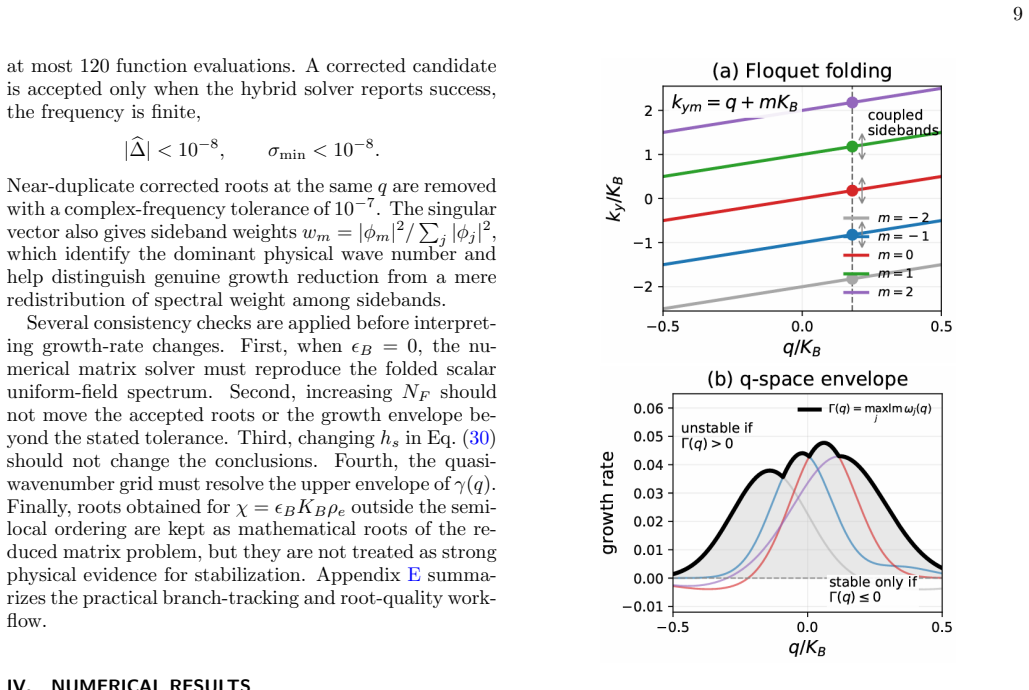
Connection to the Floquet expansion BecauseB(y) is periodic, the eigenfunction is ex- panded as ϕ(y) =e iqy ∞X ℓ=−∞ ϕℓeiℓKB y = ∞X ℓ=−∞ ϕℓei(q+ℓKB )y. The sideband wave numbers are kyℓ =q+ℓK B. On each sideband, −i∂yei(q+ℓKB )y = (q+ℓK B)ei(q+ℓKB )y. Thus, within the Floquet basis, the operator−i∂ y is equivalent to multiplication by the sideband wave num...
-
[6]
Define em(y) =e i(q+mKB )y, k ym =q+mK B
Sideband basis Write the Floquet expansion as ϕ(y) = ∞X m=−∞ ϕmei(q+mKB )y. Define em(y) =e i(q+mKB )y, k ym =q+mK B. Heree m(y) is them-th Floquet basis function andk ym is its physical azimuthal wave number. The indexmlabels 17 the input sideband. After the operator acts one m, the result is projected onto the output sideband eℓ(y) =e i(q+ℓKB )y. Heree ...
-
[7]
The output remains the same sideband
Uniform part The uniform-field part of the operator acts as D0(ω,−i∂ y;B 0)em =D 0(ω, kym;B 0)em. The output remains the same sideband. Projection onto eℓ contributes only whenℓ=m, so the uniform part is diagonal: D(0) ℓm =D 0(ω, kym;B 0)δℓm
-
[8]
For compactness define C(−i∂ y) = ∂D0(ω,−i∂ y;B) ∂B B0
First-order magnetic part The first-order term is δB(y) ∂D0(ω,−i∂ y;B) ∂B B0 . For compactness define C(−i∂ y) = ∂D0(ω,−i∂ y;B) ∂B B0 . HereC(−i∂ y) is the magnetic-derivative operator ob- tained from the uniform response. In the semi-local ma- trix construction,C(−i∂ y) acts on the input sideband first. Therefore, C(−i∂ y)em =C mem, C m = ∂D0(ω, kym;B) ∂...
-
[9]
Using the definition ofC m, D(1) ℓm = Cm LB Z LB 0 e−i(q+ℓKB )yδB(y)e i(q+mKB )ydy
Projection integral The first-order matrix element is D(1) ℓm = 1 LB Z LB 0 e−i(q+ℓKB )y [δB(y)C(−i∂ y)]e i(q+mKB )ydy. Using the definition ofC m, D(1) ℓm = Cm LB Z LB 0 e−i(q+ℓKB )yδB(y)e i(q+mKB )ydy. Substitution ofδBgives D(1) ℓm = ϵBB0 2 Cm " 1 LB Z LB 0 ei(m−ℓ+1)KB ydy + 1 LB Z LB 0 ei(m−ℓ−1)KB ydy # . The Fourier orthogonality relation 1 LB Z LB 0...
-
[10]
The matrix equation has the schematic nearest-neighbor form D(0) −1 C0 0 C−1 D(0) 0 C1 0C 0 D(0) 1 ϕ−1 ϕ0 ϕ1 = 0 0 0
Minimal three-sideband example Keeping onlym=−1,0,1, the eigenfunction is ϕ(y) =ϕ −1ei(q−KB )y +ϕ 0eiqy +ϕ 1ei(q+KB )y. The matrix equation has the schematic nearest-neighbor form D(0) −1 C0 0 C−1 D(0) 0 C1 0C 0 D(0) 1 ϕ−1 ϕ0 ϕ1 = 0 0 0 . HereD (0) m denotes the uniform-field response of sideband m, andC m denotes the nearest...
-
[11]
Practical interpretation The practical solution procedure is:
-
[12]
choose a Floquet quasi-wavenumberq
-
[13]
choose a finite sideband setm=−N F , . . . , NF
-
[14]
solve detD F (ω, q) = 0 for the complex eigenfre- quencyω
-
[15]
The uniform-field problem asks for roots of a scalar func- tionD 0(ω, ky)
repeat overqin the first Brillouin zone. The uniform-field problem asks for roots of a scalar func- tionD 0(ω, ky). The periodic-field problem asks for roots of a determinant because the eigenmode contains multi- ple coupled sidebands. Appendix E: Numerical root tracking and quality diagnostics This appendix gives the practical numerical workflow used to ...
-
[16]
scalar uniform-field roots of the diagonal sidebands D0(ω, kym;B 0) = 0
-
[17]
optionally, the previously accepted root at neigh- boringq, when a continuation run is requested
-
[18]
near-duplicate predictors removed within a complex-frequency tolerance of 10 −10. Each predictor is corrected by solving Eq. (32). The cor- rected candidate is then evaluated with the normalized determinant in Eq. (31) and the smallest singular value in Eq. (33). Candidates with non-finite frequency, large determinant residual, large singular value, or fa...
discussion (0)
Sign in with ORCID, Apple, or X to comment. Anyone can read and Pith papers without signing in.