Hilbert's 16th problem for arrangements of curves on a surface
Pith reviewed 2026-06-26 12:57 UTC · model grok-4.3
The pith
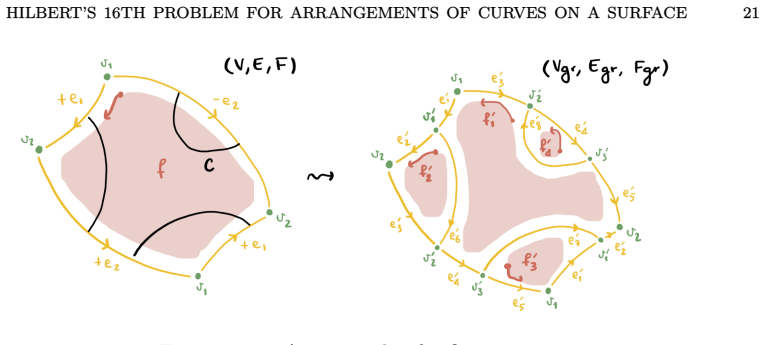
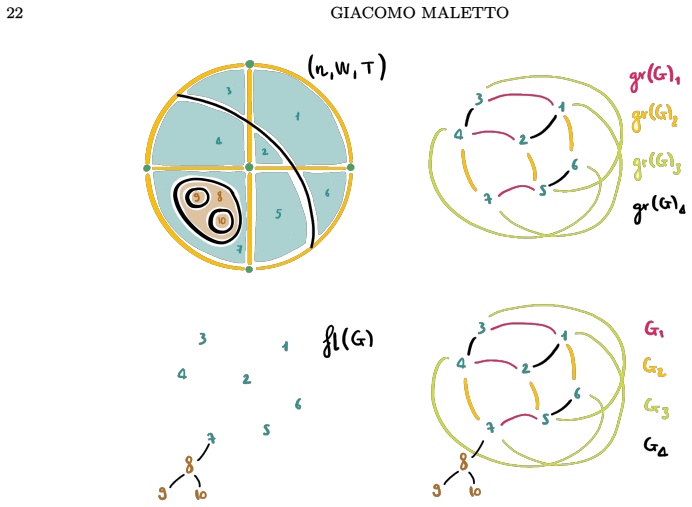
A triple of numbers, Dyck words and trees encodes every topological type of a curve crossing a fixed arrangement on a real surface.
A machine-rendered reading of the paper's core claim, the machinery that carries it, and where it could break.
Core claim
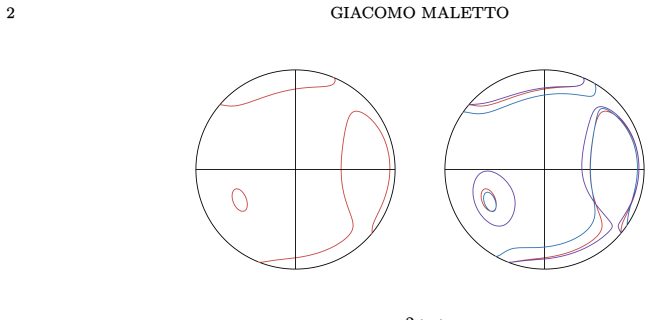
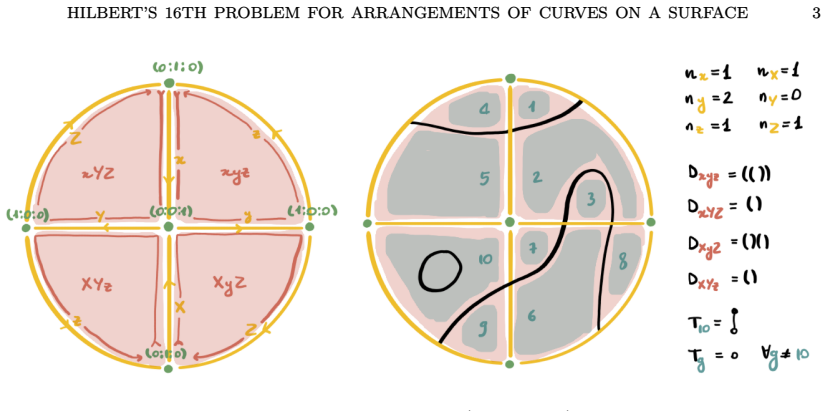
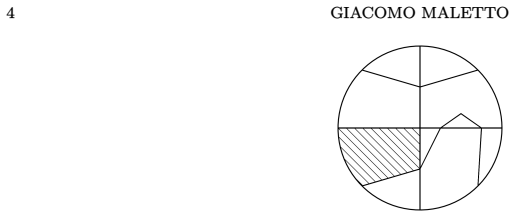
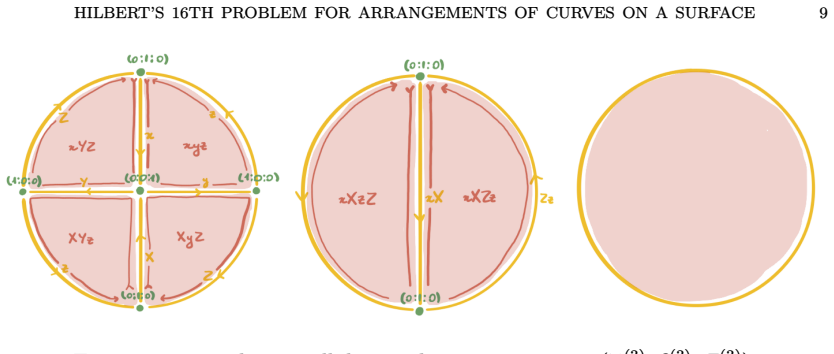
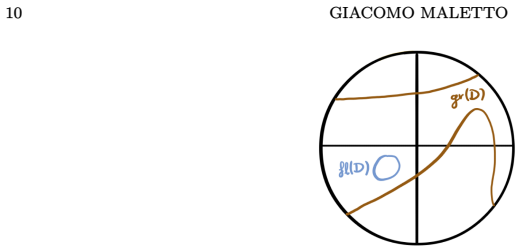
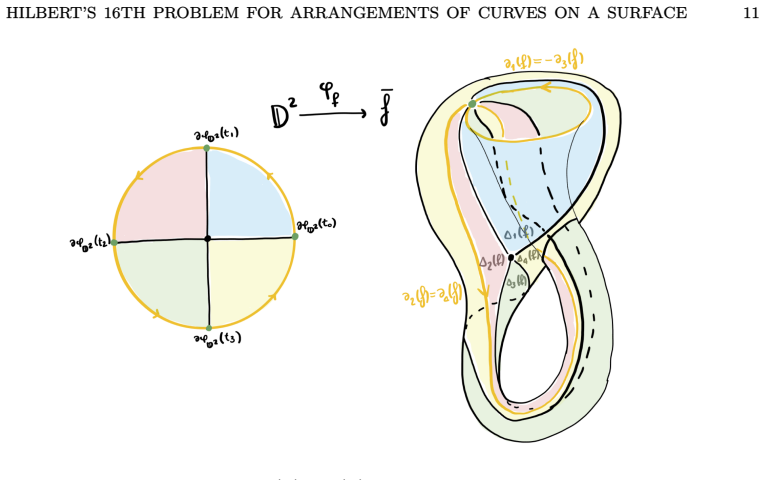
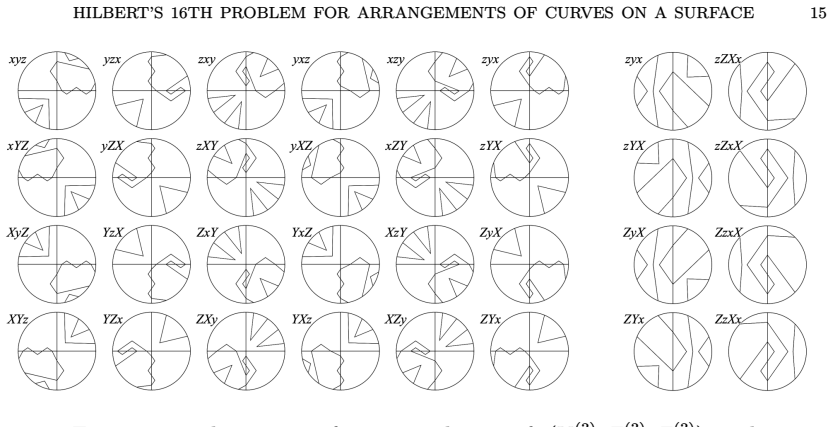
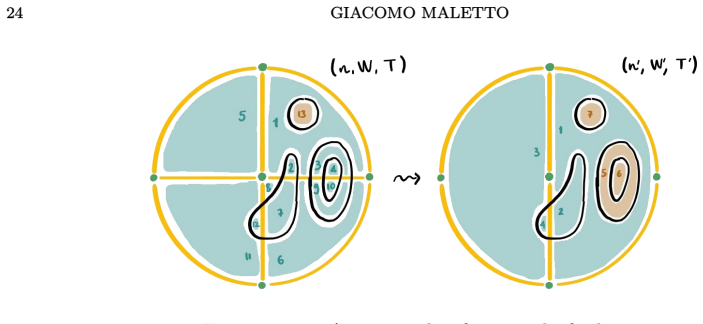
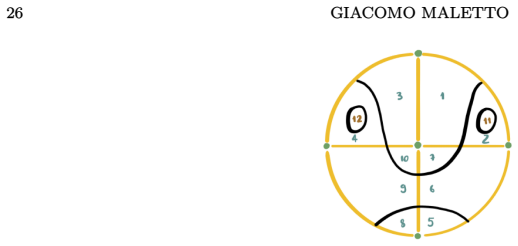
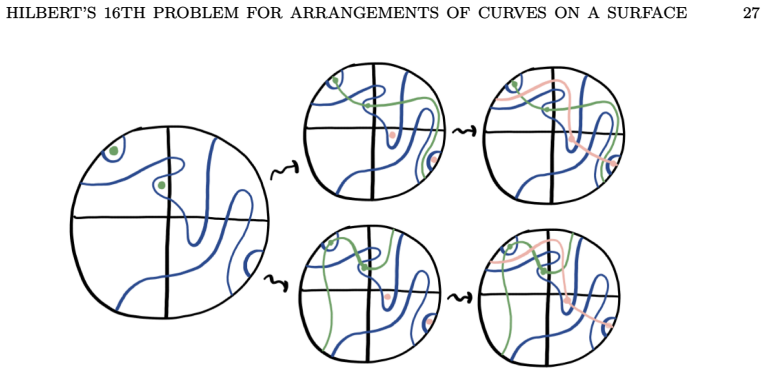
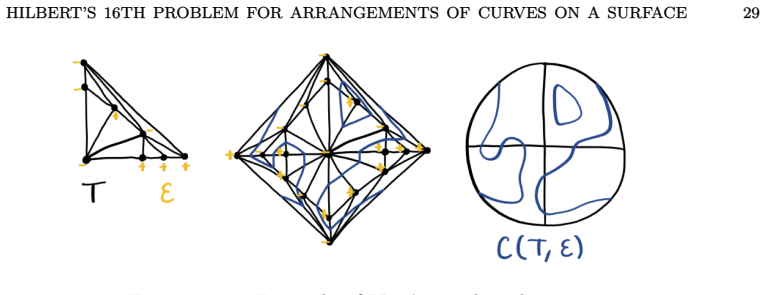
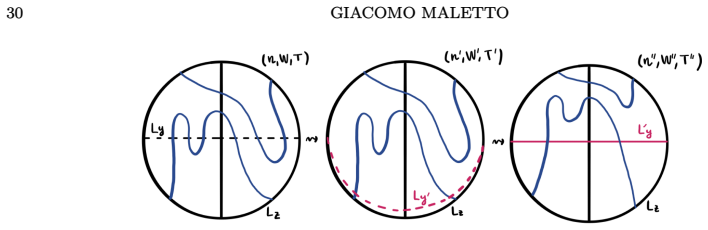
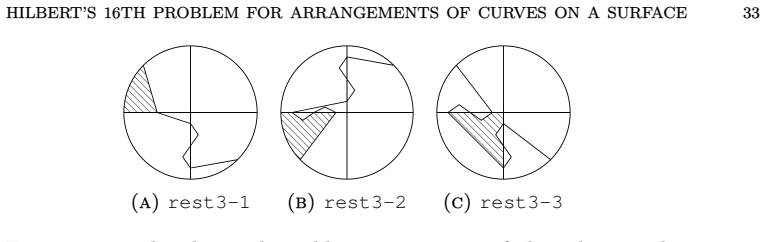
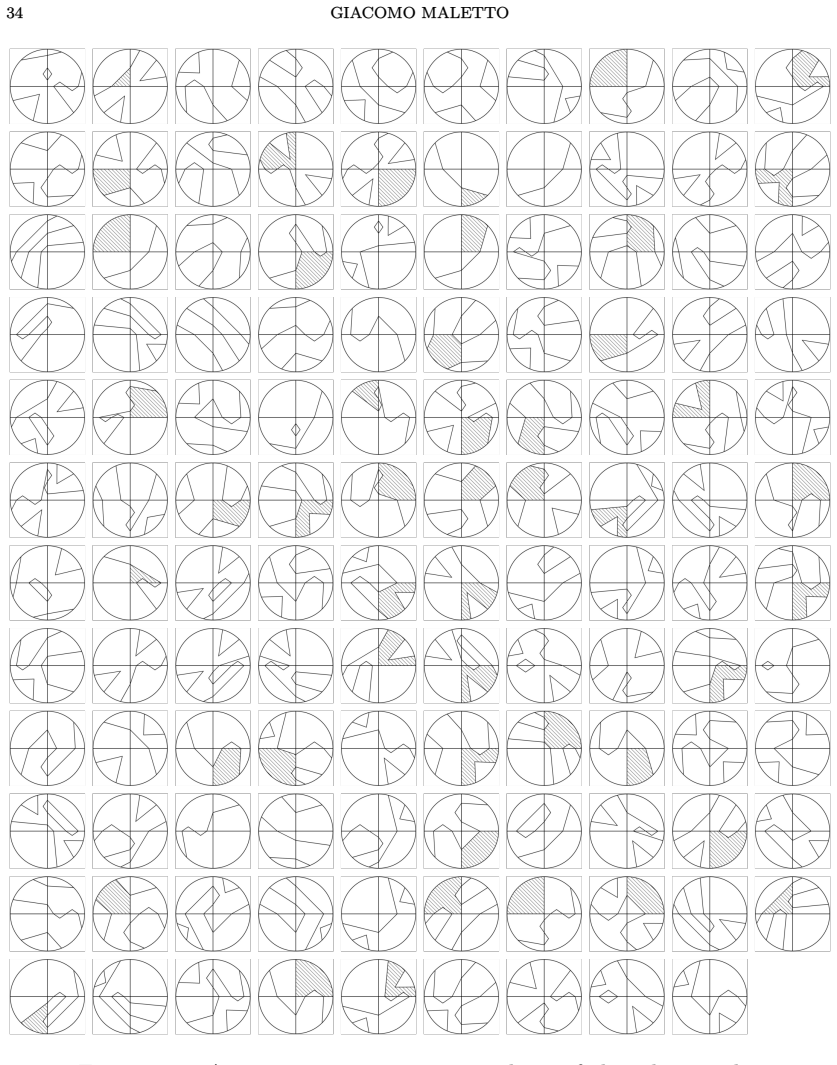
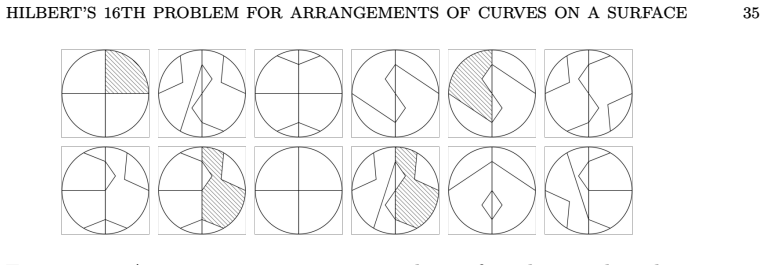
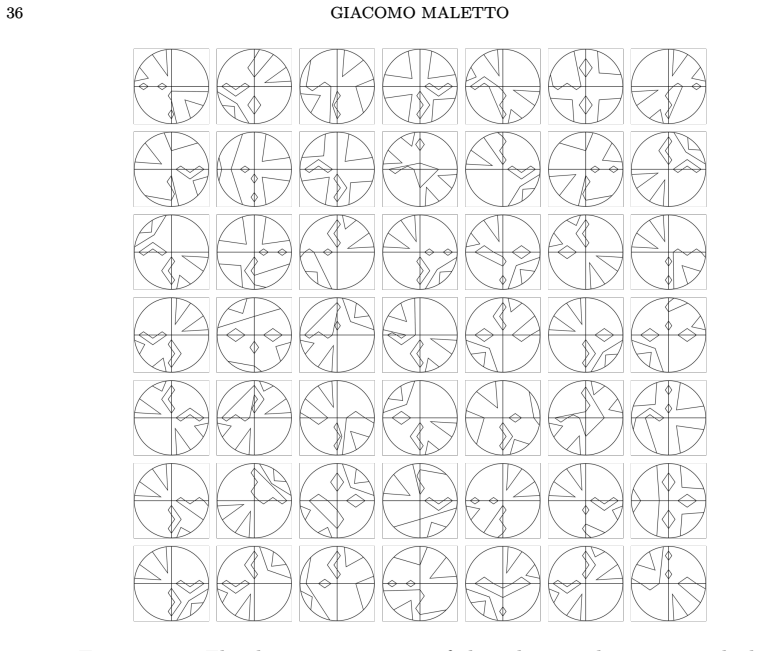
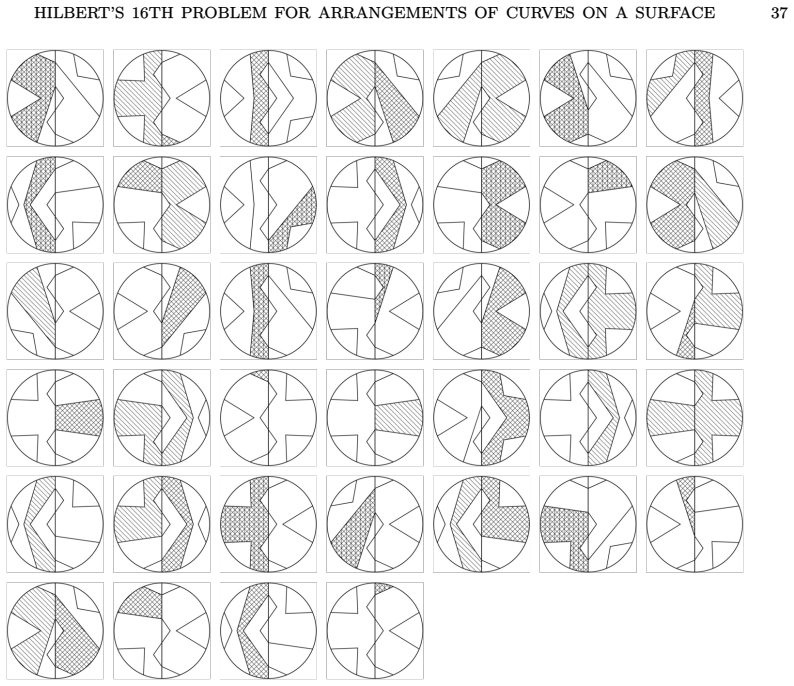
Every topological type of a curve transverse to a fixed cellular arrangement of curves on a compact real surface is captured exactly by a triple (n, W, T), where n is the vector of intersection numbers, W is a collection of Dyck words, and T is a collection of rooted trees; this triple is used to enumerate all realizable arrangements of three lines plus a cubic (complete) or quartic (partial) by eliminating impossible intersection data and constructing the rest via patchworking.
What carries the argument
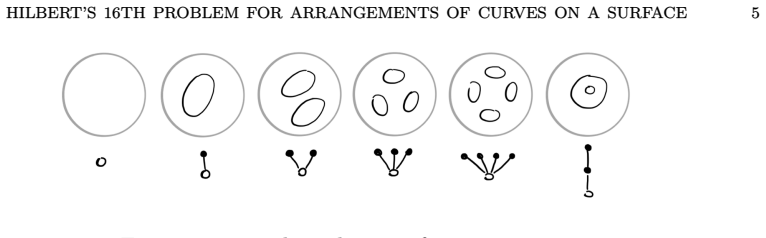
The triple (n, W, T) that records intersection numbers, crossing sequences as Dyck words, and nesting of regions as rooted trees.
If this is right
- All topological types of three lines plus a cubic are listed by exhaustive search over admissible triples.
- Bézout-type numerical obstructions eliminate many candidate triples before construction begins.
- Viro patchworking supplies explicit realizations for the triples that survive the obstructions.
- A computer library can enumerate and store the complete set of admissible triples for low-degree cases.
- The same encoding applies directly to any fixed cellular arrangement on a compact surface.
Where Pith is reading between the lines
- The method could be extended to count arrangements of four lines with a cubic or to surfaces of higher genus by enlarging the fixed arrangement.
- If the encoding is complete, it supplies a decision procedure for the existence question in the generalized Hilbert problem for any fixed degree and number of components.
- The tree component of the triple may reveal new combinatorial invariants that distinguish isotopic classes even when intersection numbers agree.
Load-bearing premise
The triple (n, W, T) records every possible topological type of a transverse curve without omissions or duplicates.
What would settle it
Discovery of two distinct triples that describe the same topological type, or of a realizable curve whose crossing data cannot be written as any triple (n, W, T).
Figures
read the original abstract
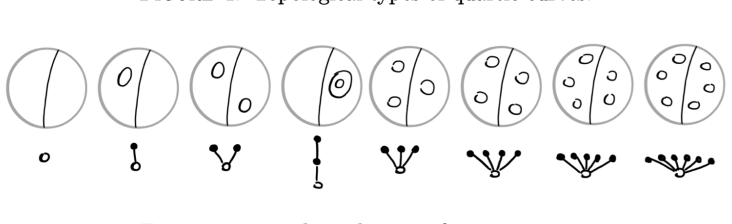
We introduce a combinatorial structure $(n,W,T)$ encoding the topological type of a curve transverse to a fixed cellular arrangement of curves on a compact real surface, in terms of intersection numbers, Dyck words and rooted trees. We apply this formalism to analyze a natural generalization of Hilbert's 16th problem to arrangements of curves. We obtain a complete classification of arrangements of three lines and a cubic, and a partial classification of arrangements of three lines and a quartic. This is achieved using B\'ezout-type obstructions, Viro's patchworking and translations, and by developing the Julia library NWT to handle large databases of curves.
Editorial analysis
A structured set of objections, weighed in public.
Referee Report
Summary. The manuscript introduces a combinatorial structure (n,W,T) encoding the topological type of a curve transverse to a fixed cellular arrangement of curves on a compact real surface, expressed via intersection numbers, Dyck words, and rooted trees. It uses this to provide a complete classification of arrangements of three lines and a cubic curve, and a partial classification for three lines and a quartic, leveraging Bézout-type obstructions, Viro's patchworking, and the Julia library NWT for database management.
Significance. Should the (n,W,T) structure prove to be a faithful and complete invariant, and the enumerations exhaustive, this represents a systematic advancement in the study of real curve arrangements on surfaces, extending ideas from Hilbert's 16th problem. The development and use of the NWT library for handling large numbers of curves is a strength, providing a tool for verification and extension of the results.
minor comments (2)
- [Introduction] A brief comparison with existing classifications for lower degree cases would help contextualize the new results.
- Ensure that all figures illustrating the patchworking constructions are clearly labeled with the corresponding (n,W,T) values.
Simulated Author's Rebuttal
We thank the referee for their positive assessment of the manuscript and for recommending minor revision. The report accurately summarizes our contributions regarding the (n,W,T) encoding and its applications to Hilbert's 16th problem for curve arrangements. Since no specific major comments or points of criticism were raised, we have no point-by-point rebuttals to provide at this stage.
Circularity Check
No significant circularity; classification uses external theorems
full rationale
The paper defines the combinatorial structure (n,W,T) as an encoding of topological types for curves transverse to a fixed arrangement, then enumerates admissible tuples, applies Bézout-type obstructions, and realizes examples via Viro patchworking. These filtering and realization steps rely on standard external results (Bézout theorem, Viro's patchworking) rather than reducing to the paper's own fitted quantities or self-citations. The Julia library NWT is an implementation aid, not a load-bearing derivation step. No quoted equation or claim shows a prediction or classification that is equivalent to its inputs by construction.
Axiom & Free-Parameter Ledger
axioms (3)
- standard math Standard properties of intersection numbers and topology on compact real surfaces
- standard math Bézout's theorem supplies valid obstructions to realizability
- domain assumption Viro's patchworking can realize prescribed topological types
invented entities (1)
-
(n,W,T) combinatorial structure
no independent evidence
Reference graph
Works this paper leans on
-
[1]
Béguin, S
F. Béguin, S. Crovisier, and F. Le Roux. Fixed point sets of isotopies on surfaces.Journal of the European Mathematical Society (EMS Publishing), 22(6), 2020
2020
-
[2]
A. I. Degtyarev.Topology of algebraic curves: an approach via dessins d’enfants, volume 44. Walter de Gruyter, 2012
2012
-
[3]
A. I. Degtyarev, I. Itenberg, and V. I. Zvonilov. Real trigonal curves and real elliptic surfaces of type i.arXiv preprint arXiv:1102.3414, 2011
Pith/arXiv arXiv 2011
-
[4]
A. I. Degtyarev and V. I. Zvonilov. Rigid isotopy classification of real algebraic curves of bidegree (3, 3) on quadrics.Mathematical Notes, 66(6):670–674, 1999
1999
-
[5]
Folkman and J
J. Folkman and J. Lawrence. Oriented matroids.Journal of Combinatorial Theory, Series B, 25(2):199–236, 1978
1978
-
[6]
I. M. Gelfand, M. M. Kapranov, and A. V. Zelevinsky.Discriminants, Resultants, and Multidimensional Determinants. Birkhäuser, 1994
1994
-
[7]
Gondran and M
M. Gondran and M. Minoux.Graphs, dioids and semirings: new models and algorithms. Springer, 2008
2008
-
[8]
D. R. Grayson and M. E. Stillman. Macaulay2, a software system for research in algebraic geometry, version 1.25.11. Available athttp://www2.macaulay2.com
-
[9]
Hatcher.Algebraic Topology
A. Hatcher.Algebraic Topology. Cambridge University Press, Cambridge, 2002
2002
-
[10]
D. Hilbert. Mathematical problems.Bulletin of the American Mathematical Society, 8:437–479, 1902
1902
-
[11]
M. W. Hirsch.Differential topology. Springer Science & Business Media, 2012
2012
-
[12]
W. R. Inc. Mathematica, Version 14.2.0.0. Champaign, IL, 2026
2026
-
[13]
Maclagan and B
D. Maclagan and B. Sturmfels.Introduction to tropical geometry, volume 161. American Mathematical Soc., 2015
2015
-
[14]
G. Maletto. NWT.https://doi.org/10.5281/zenodo.20742383, 2026
-
[15]
Manzaroli
M. Manzaroli. Real algebraic curves of bidegree (5, 5) on the quadric ellipsoid.St. Petersburg Mathematical Journal, 32(2):279–306, 2021
2021
-
[16]
Manzaroli
M. Manzaroli. Real algebraic curves on real del Pezzo surfaces.International Mathematics Research Notices, 2022(2):1350–1413, 2022
2022
-
[17]
S. Y. Orevkov. Classification of flexible m-curves of degree 8 up to isotopy.Geometric & Functional Analysis GAFA, 12(4):723–755, 2002
2002
-
[18]
Plaumann, B
D. Plaumann, B. Sturmfels, and C. Vinzant. Quartic curves and their bitangents.Journal of Symbolic Computation, 46(6):712–733, 2011
2011
-
[19]
V. A. Rokhlin. Complex topological characteristics of real algebraic curves.Russian Mathematical Surveys, 33(5):85–98, 1978
1978
-
[20]
Stillman
M. Stillman. Topcom: AMacaulay2package. Version 0.95. AMacaulay2package available at https://github.com/Macaulay2/M2/tree/stable/M2/Macaulay2/packages
-
[21]
Julia, Version 1.12.6, 2026
The Julia Language Contributors. Julia, Version 1.12.6, 2026
2026
-
[22]
Thomassen
C. Thomassen. The Jordan-Schönflies theorem and the classification of surfaces.The American Mathematical Monthly, 99(2):116–130, 1992
1992
-
[23]
C. D. Toth, J. O’Rourke, and J. E. Goodman.Handbook of discrete and computational geometry. CRC press, 2017
2017
-
[24]
O. Viro. Curves of degree 7, curves of degree 8 and the Ragsdale conjecture. InDokl. Akad. Nauk SSSR, volume 254, pages 1305–1310, 1980
1980
-
[25]
O. Viro. Patchworking real algebraic varieties.arXiv preprint math/0611382, 2006
Pith/arXiv arXiv 2006
-
[26]
O. Viro. From the sixteenth Hilbert problem to tropical geometry.Japanese Journal of Mathematics, 3(2):185–214, 2008
2008
-
[27]
G. Wilson. Hilbert’s sixteenth problem.Topology, 17(1):53–73, 1978
1978
-
[28]
V. I. Zvonilov. Isotopies of real trigonal curves on hirzebruch surfaces.Journal of Mathematical Sciences, 113(6):804–809, 2003
2003
-
[29]
V. I. Zvonilov. Chambers and walls in spaces of real algebraic curves of small degrees.arXiv e-prints, pages arXiv–2510, 2025
2025
discussion (0)
Sign in with ORCID, Apple, or X to comment. Anyone can read and Pith papers without signing in.