State-Space Abstractions for Parametric Timed Games
Pith reviewed 2026-06-26 12:33 UTC · model grok-4.3
The pith
A general abstraction framework for Parametric Timed Games preserves correctness of parameter synthesis and winning strategies when using standard reductions.
A machine-rendered reading of the paper's core claim, the machinery that carries it, and where it could break.
Core claim
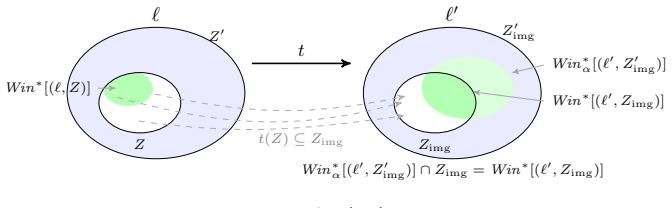
We define a general abstraction framework for Parametric Timed Games, instantiate it with each of the aforementioned abstractions, and prove that the framework preserves correctness of parameter synthesis and winning strategies.
What carries the argument
A general abstraction framework for Parametric Timed Games that supports lifting existing abstractions while maintaining properties for parameter synthesis and strategy existence.
If this is right
- The abstractions significantly improve scalability on production cell and adversarial IoT benchmarks.
- Instances previously intractable for existing techniques become solvable.
- Correctness holds simultaneously for parameter synthesis and for existence of winning strategies.
- The same framework applies uniformly to the four listed abstractions.
Where Pith is reading between the lines
- The framework could serve as a template for adding new abstractions beyond the four tested here.
- Similar lifting arguments might apply to other parametric game models that combine timing and discrete choices.
- The resulting smaller state spaces could be combined with existing on-the-fly or symbolic techniques for further gains.
Load-bearing premise
Abstractions developed for non-game parametric timed automata can be lifted to the two-player game setting while preserving the necessary properties for both parameter synthesis and strategy existence.
What would settle it
A concrete Parametric Timed Game example in which applying one of the abstractions (such as zone merging) produces a different set of valid parameters or a different winning strategy than the unabstracted model.
Figures
read the original abstract
Synthesizing controllers for real-time systems under both timing uncertainty and adversarial environments requires exploring prohibitively large symbolic state spaces. While zone inclusion checking has been applied to Parametric Timed Games, more aggressive abstractions from the Parametric Timed Automata and Timed Games literature -- double inclusion, zone merging, hull abstractions, and location-based abstraction -- have not yet been lifted to the parametric game setting. We define a general abstraction framework for Parametric Timed Games, instantiate it with each of the aforementioned abstractions, and prove that the framework preserves correctness of parameter synthesis and winning strategies. Experimental results on an established production cell benchmark and a novel adversarial IoT case study show that the abstractions significantly improve scalability, solving instances previously intractable for existing techniques.
Editorial analysis
A structured set of objections, weighed in public.
Referee Report
Summary. The paper defines a general abstraction framework for Parametric Timed Games, instantiates it with double inclusion, zone merging, hull, and location-based abstractions from the PTA and TG literature, and supplies explicit proofs that the framework preserves correctness for both parameter synthesis and winning strategies. Experiments on a production cell benchmark and a novel adversarial IoT case study demonstrate improved scalability over prior techniques.
Significance. If the proofs hold, the work is significant: it directly lifts established state-space abstractions to the two-player parametric game setting while preserving the required properties for synthesis and strategies. The explicit proofs and the resolution of the lifting question from non-game PTA/TG settings constitute a clear technical advance, with the reported scalability gains on established and new benchmarks indicating practical utility for controller synthesis under timing uncertainty and adversaries.
minor comments (1)
- The experimental section would benefit from a brief table or paragraph clarifying which specific parameter domains or instance sizes became newly solvable due to each abstraction.
Simulated Author's Rebuttal
We thank the referee for their positive assessment and recommendation to accept. The review accurately captures the contributions of the general abstraction framework, the correctness proofs for parameter synthesis and strategies, and the experimental improvements on the production cell and IoT benchmarks.
Circularity Check
No significant circularity in derivation chain
full rationale
The paper defines a general abstraction framework for Parametric Timed Games, instantiates it with abstractions (double inclusion, zone merging, hull, location-based) drawn from prior PTA/TG literature, and supplies explicit proofs that the framework preserves correctness of parameter synthesis and winning strategies. These steps are self-contained mathematical arguments and do not reduce by construction to fitted parameters, self-definitions, or load-bearing self-citations. The central claims rest on independent proofs rather than renaming or smuggling ansatzes via author-overlapping citations. This matches the default expectation of a non-circular theoretical contribution.
Axiom & Free-Parameter Ledger
axioms (1)
- standard math Standard properties of zone abstractions and inclusion in timed automata
Reference graph
Works this paper leans on
-
[1]
Rajeev Alur and David L. Dill. A theory of timed automata.Theoretical Computer Science, 126(2):183–235, 1994
1994
-
[2]
Henzinger, and Moshe Y
Rajeev Alur, Thomas A. Henzinger, and Moshe Y. Vardi. Parametric real-time reasoning. InSTOC, pages 592–601. ACM, 1993
1993
-
[3]
IMITATOR 3: Synthesis of timing parameters beyond decidability
´Etienne Andr´ e. IMITATOR 3: Synthesis of timing parameters beyond decidability. InCAV (1), volume 12759 ofLecture Notes in Computer Science, pages 552–565. Springer, 2021
2021
-
[4]
Merge and conquer: State merging in parametric timed automata
´Etienne Andr´ e, Laurent Fribourg, and Romain Soulat. Merge and conquer: State merging in parametric timed automata. InATVA, Lecture Notes in Computer Science, pages 381–396. Springer, 2013
2013
-
[5]
´Etienne Andr´ e, Didier Lime, and Olivier H. Roux. Integer-complete synthesis for bounded parametric timed automata. InRP, volume 9328 ofLecture Notes in Computer Science, pages 7–19. Springer, 2015
2015
-
[6]
Efficient convex zone merging in parametric timed automata
´Etienne Andr´ e, Dylan Marinho, Laure Petrucci, and Jaco van de Pol. Efficient convex zone merging in parametric timed automata. InFORMATS, volume 13465 ofLecture Notes in Computer Science, pages 200–218. Springer, 2022
2022
-
[7]
Zone extrapolations in parametric timed au- tomata
Johan Arcile and ´Etienne Andr´ e. Zone extrapolations in parametric timed au- tomata. InNFM, Lecture Notes in Computer Science, pages 451–469. Springer, 2022
2022
-
[8]
Hill, and Enea Zaffanella
Roberto Bagnara, Patricia M. Hill, and Enea Zaffanella. The parma polyhedra library: Toward a complete set of numerical abstractions for the analysis and ver- ification of hardware and software systems.Sci. Comput. Program., 72(1-2):3–21, 2008
2008
-
[9]
Approximate reachability analysis of timed automata
Felice Balarin. Approximate reachability analysis of timed automata. InRTSS, pages 52–61. IEEE Computer Society, 1996
1996
-
[10]
Lower and upper bounds in zone based abstractions of timed automata
Gerd Behrmann, Patricia Bouyer, Kim Guldstrand Larsen, and Radek Pel´ anek. Lower and upper bounds in zone based abstractions of timed automata. InTACAS, Lecture Notes in Computer Science, pages 312–326. Springer, 2004
2004
-
[11]
LTL parameter synthe- sis of parametric timed automata
Peter Bezdek, Nikola Benes, Jiri Barnat, and Ivana Cern´ a. LTL parameter synthe- sis of parametric timed automata. InSEFM, Lecture Notes in Computer Science, pages 172–187. Springer, 2016
2016
-
[12]
Efficient on-the-fly algorithms for the analysis of timed games
Franck Cassez, Alexandre David, Emmanuel Fleury, Kim Guldstrand Larsen, and Didier Lime. Efficient on-the-fly algorithms for the analysis of timed games. In CONCUR, Lecture Notes in Computer Science, pages 66–80. Springer, 2005
2005
-
[13]
Abstract interpretation: A unified lattice model for static analysis of programs by construction or approximation of fixpoints
Patrick Cousot and Radhia Cousot. Abstract interpretation: A unified lattice model for static analysis of programs by construction or approximation of fixpoints. InPOPL, pages 238–252. ACM, 1977
1977
-
[14]
Automatic discovery of linear restraints among variables of a program
Patrick Cousot and Nicolas Halbwachs. Automatic discovery of linear restraints among variables of a program. InPOPL, pages 84–96. ACM Press, 1978
1978
-
[15]
Mikael B. Dahlsen-Jensen, Laure Petrucci, and J.C. van de Pol. Artifact for ”state-space abstractions for parametric timed games”. Zenodo, 10.5281/zen- odo.19680181, April 2026
-
[16]
On-the-fly algorithm for reachability in parametric timed games
Mikael Bisgaard Dahlsen-Jensen, Baptiste Fievet, Laure Petrucci, and Jaco van de Pol. On-the-fly algorithm for reachability in parametric timed games. InTACAS (3), Lecture Notes in Computer Science, pages 194–212. Springer, 2024
2024
-
[17]
Controller synthesis for parametric timed games
Mikael Bisgaard Dahlsen-Jensen, Baptiste Fievet, Laure Petrucci, and Jaco van de Pol. Controller synthesis for parametric timed games. InQEST+FORMATS, Lecture Notes in Computer Science, pages 314–332. Springer, 2025. 17
2025
-
[18]
Three-valued abstrac- tions of games: Uncertainty, but with precision
Luca de Alfaro, Patrice Godefroid, and Radha Jagadeesan. Three-valued abstrac- tions of games: Uncertainty, but with precision. InLICS, pages 170–179. IEEE Computer Society, 2004
2004
-
[19]
David L. Dill. Timing assumptions and verification of finite-state concurrent sys- tems. InAutomatic Verification Methods for Finite State Systems, Lecture Notes in Computer Science, pages 197–212. Springer, 1989
1989
-
[20]
Henzinger, Rupak Majumdar, Freddy Y
Thomas A. Henzinger, Rupak Majumdar, Freddy Y. C. Mang, and Jean-Fran¸ cois Raskin. Abstract interpretation of game properties. InSAS, Lecture Notes in Computer Science, pages 220–239. Springer, 2000
2000
-
[21]
Vaandrager
Thomas Hune, Judi Romijn, Mari¨ elle Stoelinga, and Frits W. Vaandrager. Lin- ear parametric model checking of timed automata. InTACAS, Lecture Notes in Computer Science, pages 189–203. Springer, 2001
2001
-
[22]
Jensen, Kim G
Nicolaj Ø. Jensen, Kim G. Larsen, Didier Lime, and Jir´ ı Srba. On-the-fly symbolic algorithm for timed ATL with abstractions. InCONCUR, volume 348 ofLIPIcs, pages 25:1–25:19. Schloss Dagstuhl - Leibniz-Zentrum f¨ ur Informatik, 2025
2025
-
[23]
Aleksandra Jovanovic, S´ ebastien Faucou, Didier Lime, and Olivier H. Roux. Real- time control with parametric timed reachability games. InIFAC WODES, pages 323–330. Elseviers, 2012
2012
-
[24]
Aleksandra Jovanovic, Didier Lime, and Olivier H. Roux. A game approach to the parametric control of real-time systems.Int. J. Control, 92(9):2025–2036, 2019
2025
-
[25]
UPPAAL in a nutshell
Kim Guldstrand Larsen, Paul Pettersson, and Wang Yi. UPPAAL in a nutshell. Int. J. Softw. Tools Technol. Transf., 1(1-2):134–152, 1997
1997
-
[26]
production cell
Claus Lewerentz and Thomas Lindner.Case study “production cell”: A compara- tive study in formal specification and verification, pages 388–416. Springer Berlin Heidelberg, Berlin, Heidelberg, 1995
1995
-
[27]
On the synthesis of discrete con- trollers for timed systems
Oded Maler, Amir Pnueli, and Joseph Sifakis. On the synthesis of discrete con- trollers for timed systems. In Ernst W. Mayr and Claude Puech, editors,STACS 95, pages 229–242, Berlin, Heidelberg, 1995. Springer Berlin Heidelberg
1995
-
[28]
The octagon abstract domain
Antoine Min´ e. The octagon abstract domain. InWCRE, page 310. IEEE Computer Society, 2001
2001
-
[29]
Synthia: Verification and synthesis for timed automata
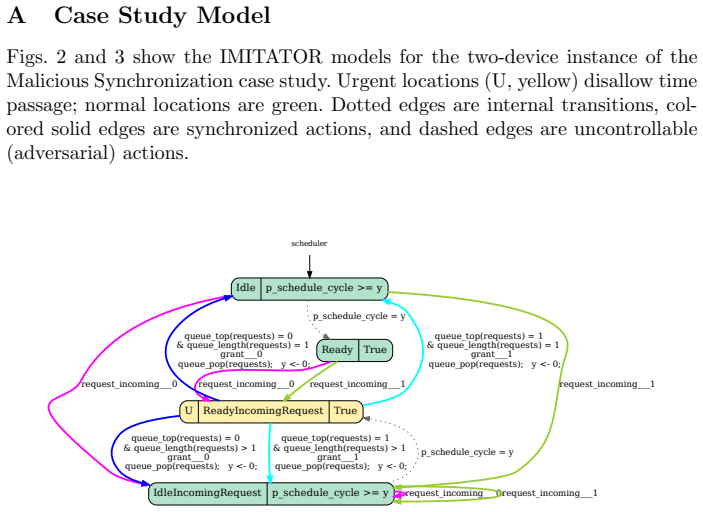
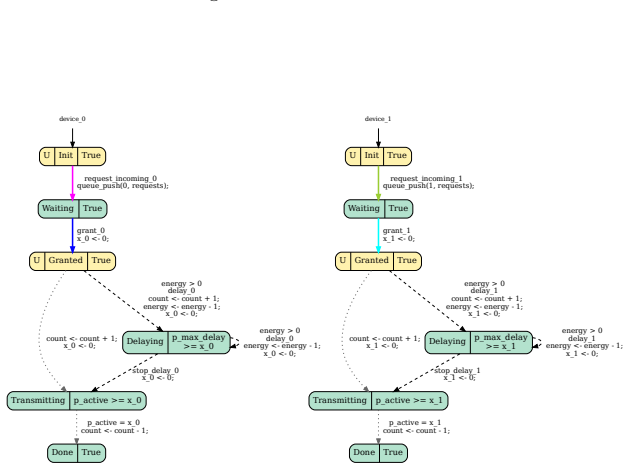
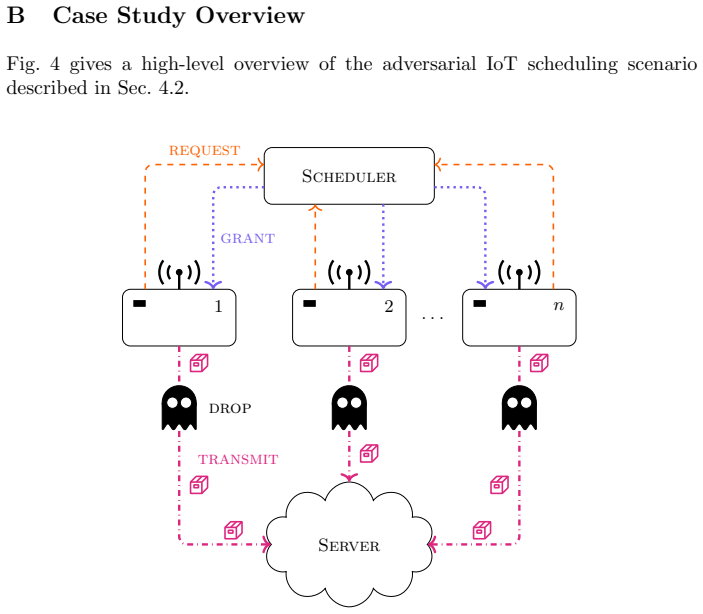
Hans-J¨ org Peter, R¨ udiger Ehlers, and Robert Mattm¨ uller. Synthia: Verification and synthesis for timed automata. InCAV, Lecture Notes in Computer Science, pages 649–655. Springer, 2011. 18 A Case Study Model Figs. 2 and 3 show the IMITATOR models for the two-device instance of the Malicious Synchronization case study. Urgent locations (U, yellow) dis...
2011
discussion (0)
Sign in with ORCID, Apple, or X to comment. Anyone can read and Pith papers without signing in.