On the stellar parameter dependence of the combined Fe I and Fe II chromospheric emission-line in the wings of the Ca II K line
Pith reviewed 2026-06-26 12:04 UTC · model grok-4.3
The pith
The iron-blend emission in Ca II K wings scales proportionally with Ca II K flux and shares its effective-temperature dependence in G and K giants.
A machine-rendered reading of the paper's core claim, the machinery that carries it, and where it could break.
Core claim
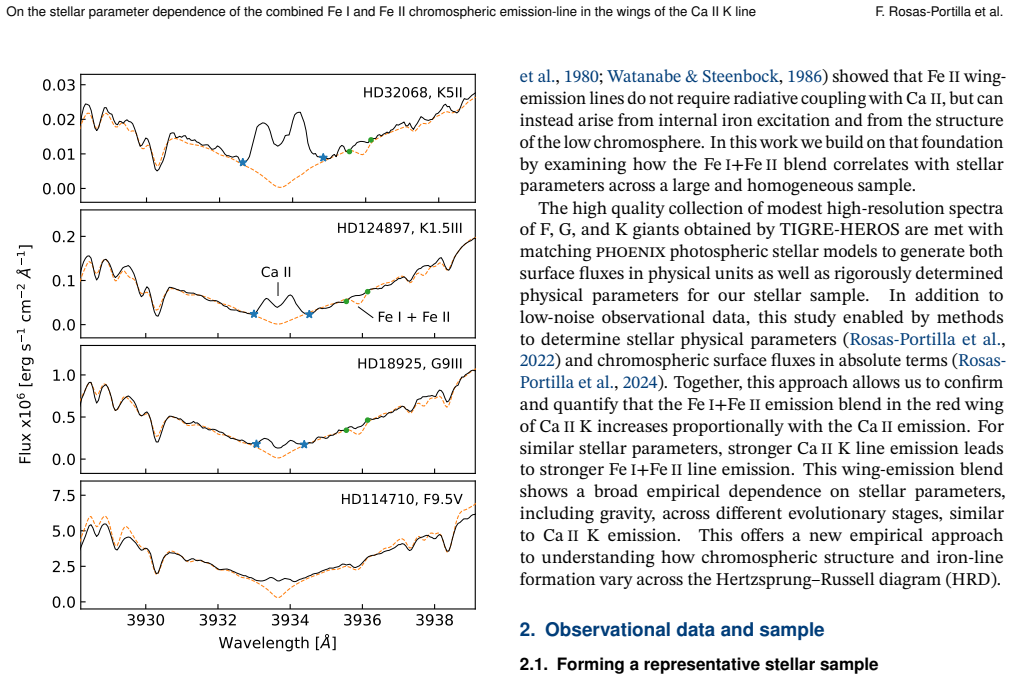
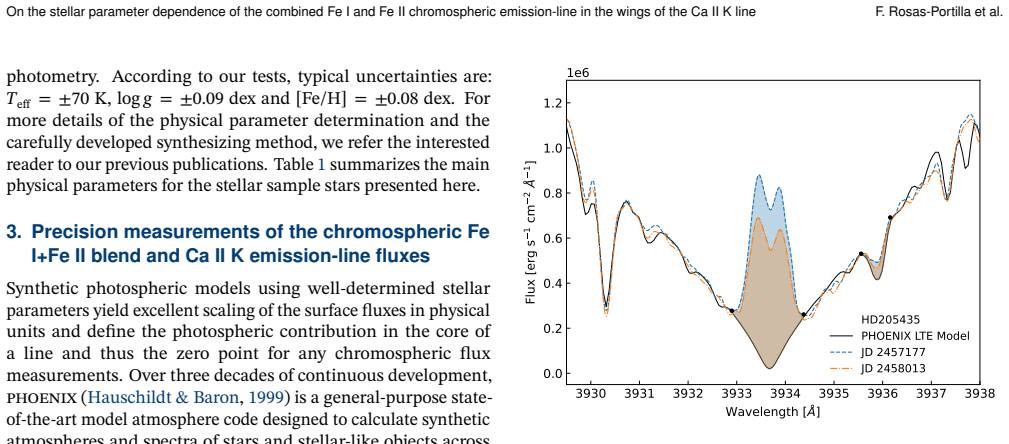
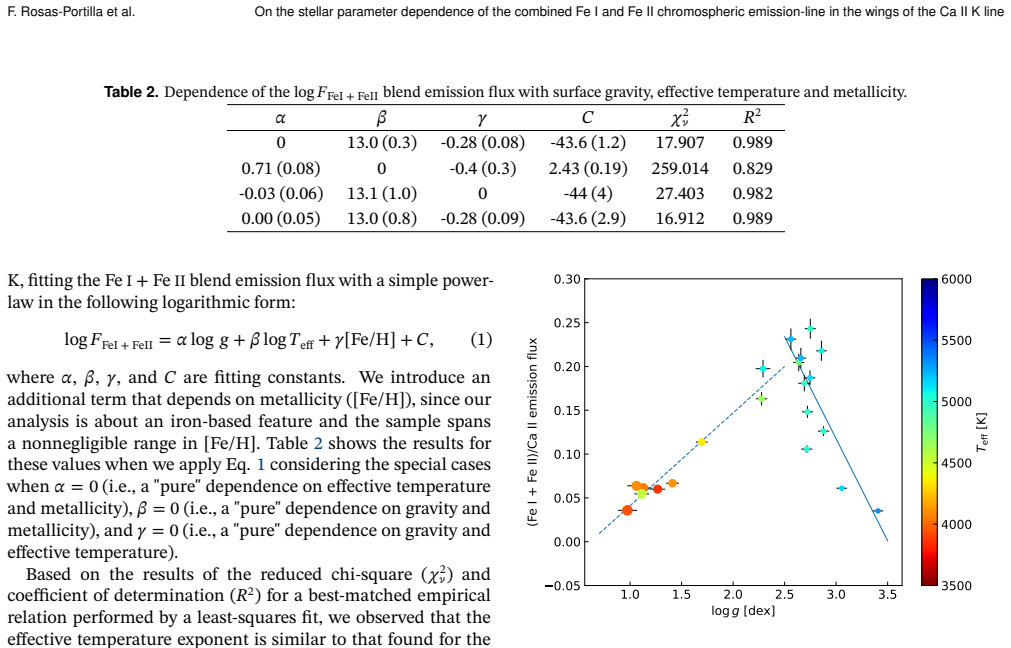
The iron-blend emission shows a proportionality with the Ca II K flux for stars with similar stellar parameters and also for individual stars observed at different epochs. Its effective-temperature exponent statistically matches the exponent found for Ca II K; together with a metallicity dependence this indicates that the iron-blend may act as an indirect tracer of chromospheric thermal conditions. The chromospheric emission flux ratio (Fe I + Fe II)/Ca II K exhibits a distinct slope change around log g approximately 2.5 dex, causing the gravity dependence to differ for stars above and below that threshold and suggesting a transition between regimes where the two diagnostics probe similar ph
What carries the argument
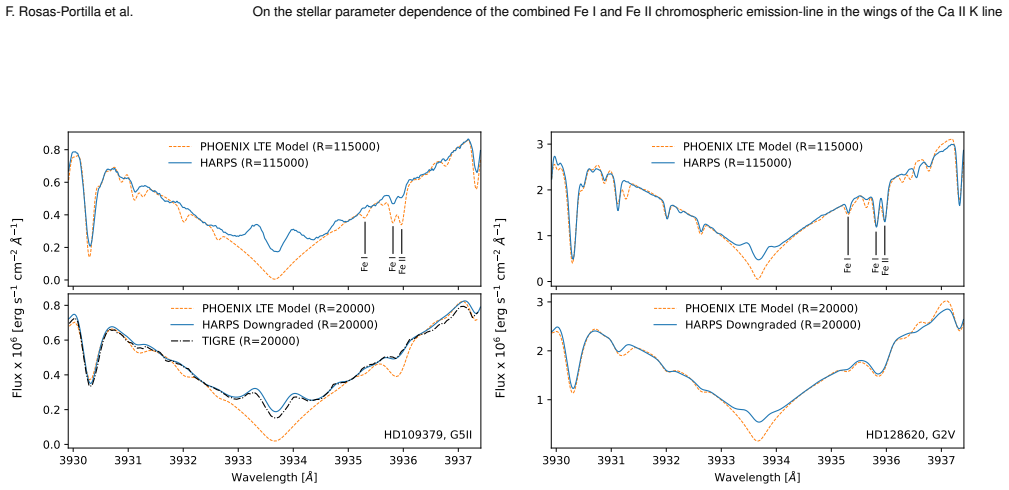
The combined Fe I + Fe II emission blend located in the wings of the Ca II K line, compared directly to the Ca II K core flux after conversion to absolute values via PHOENIX model fits.
If this is right
- Both the iron blend and Ca II K respond to the same underlying chromospheric conditions across the sample.
- The iron blend can function as a supplementary activity indicator when Ca II K data are incomplete or affected by other factors.
- The change in slope at log g approximately 2.5 marks a shift in how the two diagnostics sample the lower chromosphere and its extension.
- The matching temperature exponent and metallicity term together imply that the iron blend indirectly registers chromospheric thermal structure.
Where Pith is reading between the lines
- The log g break could be tested with higher-resolution spectra to see whether it coincides with changes in line-formation height.
- If the relations hold in larger samples they would allow activity studies of evolved stars where only the iron blend is measurable.
- The metallicity term suggests the blend might help separate temperature from abundance effects in chromospheric diagnostics.
Load-bearing premise
The PHOENIX model fits supply stellar parameters and absolute fluxes that accurately reflect the true photospheric and chromospheric properties of the 21 observed giants.
What would settle it
A set of observations in which the iron-blend flux fails to remain proportional to Ca II K flux for stars of matched parameters, or in which the (Fe I + Fe II)/Ca II K ratio shows no slope break near log g = 2.5, would falsify the reported relations.
Figures
read the original abstract
We present an analysis of the chromospheric emission of Fe I + Fe II in the wing of the Ca II K line of 21 G and K giant stars. Stellar parameters and absolute chromospheric fluxes were obtained by comparison with PHOENIX models. The iron-blend emission shows a proportionality with the Ca II K flux for stars with similar stellar parameters and also for individual stars observed at different epochs, confirming that both diagnostics seems to respond to the same underlying chromospheric conditions. We found a dependence of the iron-blend emission on stellar parameters by fitting a power-law relation. The exponent of the effective temperature statistically matches with that found for Ca II K; which, together with a metallicity dependence, indicate that the iron-blend may act as an indirect tracer of chromospheric thermal conditions. The chromospheric emission flux ratio (Fe I + Fe II)/Ca II K exhibits a distinct slope change around log g approx. 2.5 dex; which causes the gravity dependence to be different for stars with gravities lower and higher than 2.5 dex. This behavior suggests a transition between regimes where the two diagnostics probe similar physical conditions and where they begin to diverge in the sensitivity to the chromospheric extension. We discuss the implications of this behavior for the thermal structure of the lower chromosphere and for the formation heights of both diagnostics.
Editorial analysis
A structured set of objections, weighed in public.
Referee Report
Summary. The paper analyzes the combined Fe I + Fe II chromospheric emission in the wings of Ca II K for 21 G/K giant stars. Stellar parameters and absolute fluxes are derived via comparison to PHOENIX models. It reports proportionality between the iron-blend and Ca II K fluxes (both across similar-parameter stars and within multi-epoch observations of individuals), power-law fits showing a Teff exponent that statistically matches prior Ca II K results plus a metallicity term, and a change in slope of the (Fe I + Fe II)/Ca II K ratio near log g ≈ 2.5 that alters the gravity dependence above and below this value. The authors interpret these as evidence that the iron blend traces the same chromospheric conditions as Ca II K, with a transition in formation regimes.
Significance. If the central relations hold after addressing the analysis gaps, the work would strengthen the case for the iron blend as a complementary, parameter-sensitive chromospheric diagnostic in giants and would highlight a possible gravity-dependent shift in lower-chromosphere thermal structure. The multi-epoch proportionality and the reported Teff-exponent agreement are potentially useful for activity studies, provided the model-derived quantities are shown to be robust.
major comments (3)
- [Abstract] Abstract: the reported power-law exponents (including the Teff match) and the log g ≈ 2.5 break point are obtained by fitting the identical 21-star dataset used to assert proportionality; no independent physical model or external calibration is supplied to predict the transition, rendering the gravity-regime claim circular.
- [Abstract] Abstract / results on fits: no error bars, covariance estimates, or formal significance tests are described for the Teff exponent match or the slope-change detection after propagating uncertainties in the PHOENIX-derived parameters (Teff, log g, [Fe/H]); the small sample (~1 dex in log g) makes the break particularly sensitive to even modest systematic offsets.
- [Methods] Methods on parameter derivation: absolute fluxes and stellar parameters rest entirely on PHOENIX grid comparison without reported external validation (e.g., asteroseismology, interferometry) or sensitivity tests to alternate model grids, microturbulence, or NLTE effects; such systematics would directly shift both the normalization used for proportionality checks and the location of the reported log g = 2.5 threshold.
minor comments (2)
- [Abstract] Abstract contains a grammatical error: 'both diagnostics seems' should read 'both diagnostics seem'.
- [Abstract] No description is given of how outliers or epoch-to-epoch variability were identified and treated in the proportionality checks or power-law fits.
Simulated Author's Rebuttal
We thank the referee for the thorough and constructive report. The comments highlight important limitations in the current analysis regarding statistical rigor, model validation, and the empirical nature of the reported relations. We address each point below and have revised the manuscript accordingly where feasible, adding error analysis, sensitivity tests, and clearer caveats on the observational basis of the findings.
read point-by-point responses
-
Referee: [Abstract] Abstract: the reported power-law exponents (including the Teff match) and the log g ≈ 2.5 break point are obtained by fitting the identical 21-star dataset used to assert proportionality; no independent physical model or external calibration is supplied to predict the transition, rendering the gravity-regime claim circular.
Authors: We agree that the analysis is entirely empirical and that the power-law fits and break point are derived from the same 21-star sample used to demonstrate proportionality. The multi-epoch observations of individual stars provide an independent check on the proportionality within stars, but the parameter dependencies and break remain sample-based. We do not claim an a priori physical model predicting the transition at log g ≈ 2.5; rather, we report the observed change in slope as suggestive of differing formation regimes. In revision we have modified the abstract and discussion sections to explicitly state that the gravity-regime interpretation is an empirical inference from the data and to remove any implication of a predicted transition. revision: partial
-
Referee: [Abstract] Abstract / results on fits: no error bars, covariance estimates, or formal significance tests are described for the Teff exponent match or the slope-change detection after propagating uncertainties in the PHOENIX-derived parameters (Teff, log g, [Fe/H]); the small sample (~1 dex in log g) makes the break particularly sensitive to even modest systematic offsets.
Authors: This is a valid criticism. The original manuscript did not propagate parameter uncertainties into the fits or report formal significance for the break. In the revised version we have (i) added Monte Carlo realizations that incorporate the reported uncertainties on Teff, log g and [Fe/H] from the PHOENIX fits, (ii) included bootstrap-derived error bars and covariance matrices for the power-law exponents, and (iii) performed an F-test comparing single-slope versus broken-slope models to assess the statistical significance of the log g ≈ 2.5 break. These additions are now described in the Methods and Results sections. revision: yes
-
Referee: [Methods] Methods on parameter derivation: absolute fluxes and stellar parameters rest entirely on PHOENIX grid comparison without reported external validation (e.g., asteroseismology, interferometry) or sensitivity tests to alternate model grids, microturbulence, or NLTE effects; such systematics would directly shift both the normalization used for proportionality checks and the location of the reported log g = 2.5 threshold.
Authors: We acknowledge the reliance on a single model grid. In the revised manuscript we have added (i) a sensitivity analysis varying microturbulence by ±0.5 km s⁻¹ and comparing results with an alternate grid (ATLAS9) for a subset of stars, and (ii) a discussion of possible NLTE effects on the iron lines and Ca II K, noting that any systematic shift would affect absolute fluxes but is unlikely to erase the observed proportionality or the relative change in slope. Full external validation (asteroseismology or interferometry) is not available for this specific sample and would require new observations; we have therefore added an explicit limitations paragraph stating that the reported log g threshold should be regarded as model-dependent pending independent parameter confirmation. revision: partial
Circularity Check
No significant circularity; empirical fits on observed sample
full rationale
The paper derives stellar parameters and absolute fluxes via PHOENIX model comparison, then reports empirical power-law fits and a log g break identified in the same 21-star dataset. These are presented as fitted relations and observed behaviors, not as first-principles predictions or derivations claimed to be independent of the inputs. No self-definitional equations, fitted inputs renamed as predictions, or load-bearing self-citations appear in the provided text. The analysis is self-contained as standard observational fitting against model grids.
Axiom & Free-Parameter Ledger
free parameters (3)
- power-law exponent for Teff
- metallicity coefficient
- log g = 2.5 break point
axioms (2)
- domain assumption PHOENIX model atmospheres accurately reproduce the photospheric contribution and allow reliable subtraction to isolate chromospheric emission.
- domain assumption The 21 G and K giants form a representative sample for the claimed parameter dependences.
Reference graph
Works this paper leans on
-
[1]
, year = 2017, month = aug, volume =
Stellar Model Chromospheres and Spectroscopic Diagnostics. , year = 2017, month = aug, volume =. doi:10.1146/annurev-astro-091916-055327 , adsurl =
-
[2]
, year = 1913, month = oct, volume =
On the reversal of the calcium lines H and K in stellar spectra. , year = 1913, month = oct, volume =. doi:10.1086/142037 , adsurl =
-
[3]
, year = 1957, month = may, volume =
H and K Emission in Late-Type Stars: Dependence of Line Width on Luminosity and Related Topics. , year = 1957, month = may, volume =. doi:10.1086/146339 , adsurl =
-
[4]
, year = 1967, month = feb, volume =
Distance of the Hyades and Relation between Luminosity and CA II Emission-Line Widths. , year = 1967, month = feb, volume =. doi:10.1086/128434 , adsurl =
-
[5]
A possible width-luminosity correlation of the Ca II K _ 1 and Mg II k _ 1 features. , keywords =. doi:10.1086/181724 , adsurl =
-
[6]
Chromospheric scaling laws, width-luminosity correlations, and the Wilson-Bappu effect. , keywords =. doi:10.1086/156873 , adsurl =
-
[7]
Dependence of the Wilson-Bappu effect on stellar atmospheric parameters. , keywords =. doi:10.1093/mnras/199.4.1101 , adsurl =
-
[8]
Wilson-Bappu Effect: Extended to Surface Gravity
Wilson-Bappu Effect: Extended to Surface Gravity. , keywords =. doi:10.1088/0004-6256/146/4/73 , archivePrefix =. 1307.0592 , primaryClass =
work page internal anchor Pith review Pith/arXiv arXiv doi:10.1088/0004-6256/146/4/73
-
[9]
, keywords =
The Wilson-Bappu effect and other CA II H and K line parameters relationships in chromospherically active binaries. , keywords =
-
[10]
Stellar activity of evolved, cool giants - old questions revisited. , keywords =. doi:10.1093/mnras/sty1942 , adsurl =
-
[11]
, year = 1973, month = apr, volume =
A study of Ca II K _ 2 and H _ alpha line widths in late type stars. , year = 1973, month = apr, volume =
1973
-
[12]
, year = 1974, month = sep, volume =
On a possible generalization of the Wilson-Bappu effect. , year = 1974, month = sep, volume =
1974
-
[13]
The [Fe/H] Dependence on the Ca {\sc ii}-$M_V$ Relationship
The [Fe/H] Dependence on the Ca ii- M _ V Relationship. , keywords =. doi:10.1086/668845 , archivePrefix =. 1210.6300 , primaryClass =
work page internal anchor Pith review Pith/arXiv arXiv doi:10.1086/668845
-
[14]
, keywords =
Analysis of shapes of CA II and MG II emission cores in late type stars. , keywords =
-
[15]
Outer atmospheres of cool stars. I. The sharp division into solar-type and non-solar-type stars. , keywords =. doi:10.1086/182924 , adsurl =
-
[16]
Kurucz, R. L. , keywords =
-
[17]
Carbon and Nitrogen Abundances in Metal-Poor Stars
-
[18]
Astronomische Nachrichten , keywords =
TIGRE: A new robotic spectroscopy telescope at Guanajuato, Mexico. Astronomische Nachrichten , keywords =. doi:10.1002/asna.201412116 , adsurl =
-
[19]
Magnetic structure in cool stars. XI. Relations between radiative fluxes mesuring stellar activity, and evidence for two components in stellar chromospheres. , keywords =
-
[20]
Fundamental Astronomy
-
[21]
and Mihalas, D
Hubeny, I. and Mihalas, D. , title =. 2014 , isbn =
2014
-
[22]
Nominal values for selected solar and planetary quantities: IAU 2015 Resolution B3
Nominal Values for Selected Solar and Planetary Quantities: IAU 2015 Resolution B3. , keywords =. doi:10.3847/0004-6256/152/2/41 , archivePrefix =. 1605.09788 , primaryClass =
work page internal anchor Pith review Pith/arXiv arXiv doi:10.3847/0004-6256/152/2/41 2015
-
[23]
A new extensive library of PHOENIX stellar atmospheres and synthetic spectra
A new extensive library of PHOENIX stellar atmospheres and synthetic spectra. , keywords =. doi:10.1051/0004-6361/201219058 , archivePrefix =. 1303.5632 , primaryClass =
work page internal anchor Pith review Pith/arXiv arXiv doi:10.1051/0004-6361/201219058
-
[24]
Memorie della Societa Astronomica Italiana Supplementi , keywords =
Cool stellar atmospheres with PHOENIX. Memorie della Societa Astronomica Italiana Supplementi , keywords =
-
[25]
Basic Computations and Summary of the Results
Structure of the Solar Chromosphere. Basic Computations and Summary of the Results. , year = 1973, month = sep, volume =. doi:10.1086/152353 , adsurl =
-
[26]
Carroll, B. W. and Ostlie, D. A. , title =. 2017 , isbn =
2017
-
[27]
Chromospheric Activity in Cool Stars: Open Questions
Schr. Chromospheric Activity in Cool Stars: Open Questions. New Quests in Stellar Astrophysics III: A Panchromatic View of Solar-Like Stars, With and Without Planets , year = 2013, volume =
2013
-
[28]
P \' e rdidas Radiativas de la Crom \' o sfera
P. P \' e rdidas Radiativas de la Crom \' o sfera
-
[29]
The Sun as a Guide to Stellar Physics , year = 2019, isbn =
Stellar and Solar Chromospheres and Attendant Phenomena. The Sun as a Guide to Stellar Physics , year = 2019, isbn =
2019
-
[30]
Observations of Stellar Chromospheres. Philosophical Transactions of the Royal Society of London Series A , year = 1971, month = jul, volume =. doi:10.1098/rsta.1971.0073 , adsurl =
-
[31]
Model Solar Chromosphere with Prescribed Heating. , keywords =. doi:10.1086/168083 , adsurl =
-
[32]
, year = 1970, month = nov, volume =
Measurement of K-line absolute magnitudes. , year = 1970, month = nov, volume =. doi:10.1086/111054 , adsurl =
-
[33]
Stellar chromospheres. IAU Colloq. 51: Stellar Turbulence , year = 1980, editor =. doi:10.1007/3-540-09737-6_35 , adsurl =
-
[34]
Radiative Processes in Astrophysics
-
[35]
, title = "
Guerra-Olvera, C. , title = "
-
[36]
The Magnetic Fields at the Surface of Active Single G-K Giants
The magnetic fields at the surface of active single G-K giants. , keywords =. doi:10.1051/0004-6361/201424579 , archivePrefix =. 1411.6230 , primaryClass =
work page internal anchor Pith review Pith/arXiv arXiv doi:10.1051/0004-6361/201424579
-
[37]
Magnetic activity and evolution of the four Hyades K giants. , keywords =. doi:10.1093/mnras/stz3476 , archivePrefix =. 1912.03638 , primaryClass =
-
[38]
Summary of the contents and survey properties
Gaia Early Data Release 3. Summary of the contents and survey properties. , keywords =. doi:10.1051/0004-6361/202039657 , archivePrefix =. 2012.01533 , primaryClass =
-
[39]
The Gaia mission. , keywords =. doi:10.1051/0004-6361/201629272 , archivePrefix =. 1609.04153 , primaryClass =
work page internal anchor Pith review Pith/arXiv arXiv doi:10.1051/0004-6361/201629272
-
[40]
A critical test of stellar evolution and convective core `overshooting' by means of zeta Aurigae systems. , keywords =. doi:10.1093/mnras/285.4.696 , adsurl =
-
[41]
Gaia Early Data Release 3. The astrometric solution. , keywords =. doi:10.1051/0004-6361/202039709 , archivePrefix =. 2012.03380 , primaryClass =
-
[42]
Transformations from Theoretical Hertzsprung-Russell Diagrams to Color-Magnitude Diagrams: Effective Temperatures, B-V Colors, and Bolometric Corrections. , keywords =. doi:10.1086/177785 , adsurl =
-
[43]
The PASTEL catalogue: 2016 version
The PASTEL catalogue: 2016 version. , keywords =. doi:10.1051/0004-6361/201628497 , archivePrefix =. 1605.07384 , primaryClass =
work page internal anchor Pith review Pith/arXiv arXiv doi:10.1051/0004-6361/201628497 2016
-
[44]
The Biggest, Baddest, Coolest Stars , year = 2009, editor =
The Wilson-Bappu Effect - 50 Years Later. The Biggest, Baddest, Coolest Stars , year = 2009, editor =
2009
-
[45]
On the use of empirical bolometric corrections for stars
On the Use of Empirical Bolometric Corrections for Stars. , keywords =. doi:10.1088/0004-6256/140/5/1158 , archivePrefix =. 1008.3913 , primaryClass =
work page internal anchor Pith review Pith/arXiv arXiv doi:10.1088/0004-6256/140/5/1158
-
[46]
The Absolute Magnitude of the Sun in Several Filters
The Absolute Magnitude of the Sun in Several Filters. , keywords =. doi:10.3847/1538-4365/aabfdf , archivePrefix =. 1804.07788 , primaryClass =
work page internal anchor Pith review Pith/arXiv arXiv doi:10.3847/1538-4365/aabfdf
-
[47]
Further critical tests of stellar evolution by means of double-lined eclipsing binaries. , keywords =. doi:10.1093/mnras/289.4.869 , adsurl =
-
[48]
Stellar evolution models for Z = 0.0001 to 0.03. , keywords =. doi:10.1046/j.1365-8711.1998.01658.x , adsurl =
-
[49]
Wilson stars tell us about solar activity?
What do the Mt. Wilson stars tell us about solar activity?. , keywords =. doi:10.1051/0004-6361/201219830 , adsurl =
-
[50]
Fast synthetic spectral fitting for large stellar samples: a critical test with 25 bright stars of known rotation. , keywords =. doi:10.1093/mnras/staa2261 , adsurl =
-
[51]
Determining stellar atmospheric parameters and chemical abundances of FGK stars with iSpec
Determining stellar atmospheric parameters and chemical abundances of FGK stars with iSpec. , keywords =. doi:10.1051/0004-6361/201423945 , archivePrefix =. 1407.2608 , primaryClass =
work page internal anchor Pith review Pith/arXiv arXiv doi:10.1051/0004-6361/201423945
-
[52]
The Gaia FGK Benchmark Stars - High resolution spectral library
The Gaia FGK benchmark stars. High resolution spectral library. , keywords =. doi:10.1051/0004-6361/201323153 , archivePrefix =. 1403.3090 , primaryClass =
work page internal anchor Pith review Pith/arXiv arXiv doi:10.1051/0004-6361/201323153
-
[53]
Modern stellar spectroscopy caveats
Modern stellar spectroscopy caveats. , keywords =. doi:10.1093/mnras/stz549 , archivePrefix =. 1902.09558 , primaryClass =
work page internal anchor Pith review Pith/arXiv arXiv doi:10.1093/mnras/stz549 1902
-
[54]
A grid of MARCS model atmospheres for late-type stars. I. Methods and general properties. , keywords =. doi:10.1051/0004-6361:200809724 , archivePrefix =. 0805.0554 , primaryClass =
work page internal anchor Pith review Pith/arXiv arXiv doi:10.1051/0004-6361:200809724
-
[55]
The Solar Chemical Composition. , keywords =. doi:10.1007/s11214-007-9173-7 , adsurl =
-
[56]
Direct detection of a magnetic field in the photosphere of the single M giant EK Bootis. How common is magnetic activity among M giants?. , keywords =. doi:10.1051/0004-6361/201014503 , archivePrefix =. 1009.2001 , primaryClass =
work page internal anchor Pith review Pith/arXiv arXiv doi:10.1051/0004-6361/201014503 2001
-
[57]
, year = 1981, month = dec, volume =
Spanish Translation of Modern Astronomical Terminology. , year = 1981, month = dec, volume =
1981
-
[58]
Near-infrared narrow-band photometry of M-giant and Mira stars: models meet observations
Near-infrared narrow-band photometry of M-giant and Mira stars: models meet observations. , keywords =. doi:10.48550/arXiv.astro-ph/9710157 , archivePrefix =. astro-ph/9710157 , primaryClass =
work page internal anchor Pith review Pith/arXiv arXiv doi:10.48550/arxiv.astro-ph/9710157
-
[59]
Turbospectrum: Code for spectral synthesis
-
[60]
Accuracy of atmospheric parameters of FGK dwarfs determined by spectrum fitting
Accuracy of atmospheric parameters of FGK dwarfs determined by spectrum fitting. , keywords =. doi:10.1093/mnras/stv2725 , archivePrefix =. 1511.06134 , primaryClass =
work page internal anchor Pith review Pith/arXiv arXiv doi:10.1093/mnras/stv2725
-
[61]
, year = 1997, month = jan, volume =
High Resolution Spectral Atlas of Telluric Lines. , year = 1997, month = jan, volume =. doi:10.1023/A:1001197016750 , adsurl =
-
[62]
, year = 2000, month = mar, volume =
The New `High Resolution Spectral Atlas of Telluric Lines'. , year = 2000, month = mar, volume =. doi:10.1023/A:1002095404664 , adsurl =
-
[63]
, keywords =
VALD: The Vienna Atomic Line Data Base. , keywords =
-
[64]
Gaia FGK Benchmark Stars - Metallicity
Gaia FGK benchmark stars: Metallicity. , keywords =. doi:10.1051/0004-6361/201322440 , archivePrefix =. 1309.1099 , primaryClass =
work page internal anchor Pith review Pith/arXiv arXiv doi:10.1051/0004-6361/201322440
-
[65]
Gaia FGK Benchmark Stars: Effective temperatures and surface gravities
Gaia FGK benchmark stars: Effective temperatures and surface gravities. , keywords =. doi:10.1051/0004-6361/201526319 , archivePrefix =. 1506.06095 , primaryClass =
work page internal anchor Pith review Pith/arXiv arXiv doi:10.1051/0004-6361/201526319
-
[66]
Gaia FGK benchmark stars: abundances of alpha and iron-peak elements
Gaia FGK benchmark stars: abundances of and iron-peak elements. , keywords =. doi:10.1051/0004-6361/201526604 , archivePrefix =. 1507.00027 , primaryClass =
work page internal anchor Pith review Pith/arXiv arXiv doi:10.1051/0004-6361/201526604
-
[67]
Gaia FGK Benchmark Stars: New Candidates At Low-Metallicities
Gaia FGK benchmark stars: new candidates at low metallicities. , keywords =. doi:10.1051/0004-6361/201628268 , archivePrefix =. 1605.08229 , primaryClass =
work page internal anchor Pith review Pith/arXiv arXiv doi:10.1051/0004-6361/201628268
-
[68]
Gaia FGK Benchmark stars: Opening the black box of stellar element abundance determination
Gaia FGK benchmark stars: opening the black box of stellar element abundance determination. , keywords =. doi:10.1051/0004-6361/201629833 , archivePrefix =. 1612.05013 , primaryClass =
work page internal anchor Pith review Pith/arXiv arXiv doi:10.1051/0004-6361/201629833
-
[69]
, year = 1970, month = apr, volume =
The Solar H and K Lines. , year = 1970, month = apr, volume =. doi:10.1086/128904 , adsurl =
-
[70]
Resonance line transfer with partial redistribution. VI. The Ca II K-line in solar-type stars. , keywords =. doi:10.1086/153877 , adsurl =
-
[71]
2014 , pages =
The Instrumental Line-Profile of TIGRE/HEROS. 2014 , pages =
2014
-
[72]
, keywords =
Observational tests of the shock heating theory for late-type stellar chromospheres. , keywords =
-
[73]
Numerical Solution of the Expanding Stellar Atmosphere Problem
Numerical solution of the expanding stellar atmosphere problem. Journal of Computational and Applied Mathematics , keywords =. doi:10.48550/arXiv.astro-ph/9808182 , archivePrefix =. astro-ph/9808182 , primaryClass =
work page internal anchor Pith review Pith/arXiv arXiv doi:10.48550/arxiv.astro-ph/9808182
-
[74]
, year = 1981, month = oct, volume =
Activity Cycles in Other Stars. , year = 1981, month = oct, volume =
1981
-
[75]
CA II H and K Measurements Made at Mount Wilson Observatory, 1966--1983. , keywords =. doi:10.1086/191572 , adsurl =
-
[76]
Chromospheric Variations in Main-Sequence Stars. II. , keywords =. doi:10.1086/175072 , adsurl =
-
[77]
Patterns of Variation among Sun-like Stars. , keywords =. doi:10.1086/313135 , adsurl =
-
[78]
Patterns of photometric and chromospheric variation among Sun-like stars: A 20-year perspective
Patterns of Photometric and Chromospheric Variation among Sun-like Stars: A 20 Year Perspective. , keywords =. doi:10.1086/516752 , archivePrefix =. astro-ph/0703408 , primaryClass =
work page internal anchor Pith review Pith/arXiv arXiv doi:10.1086/516752
-
[79]
Frontiers in Astronomy and Space Sciences , keywords =
Eight Years of TIGRE Robotic Spectroscopy: Operational Experience and Selected Scientific Results. Frontiers in Astronomy and Space Sciences , keywords =. doi:10.3389/fspas.2022.912546 , archivePrefix =. 2206.02832 , primaryClass =
-
[80]
Chromospheric variations in main-sequence stars. , keywords =. doi:10.1086/156618 , adsurl =
discussion (0)
Sign in with ORCID, Apple, or X to comment. Anyone can read and Pith papers without signing in.