DC Link Capacitor Ripple Constraints Limit the Benefits of Utility-Owned Four-Wire Power Converters
Pith reviewed 2026-06-26 11:52 UTC · model grok-4.3
The pith
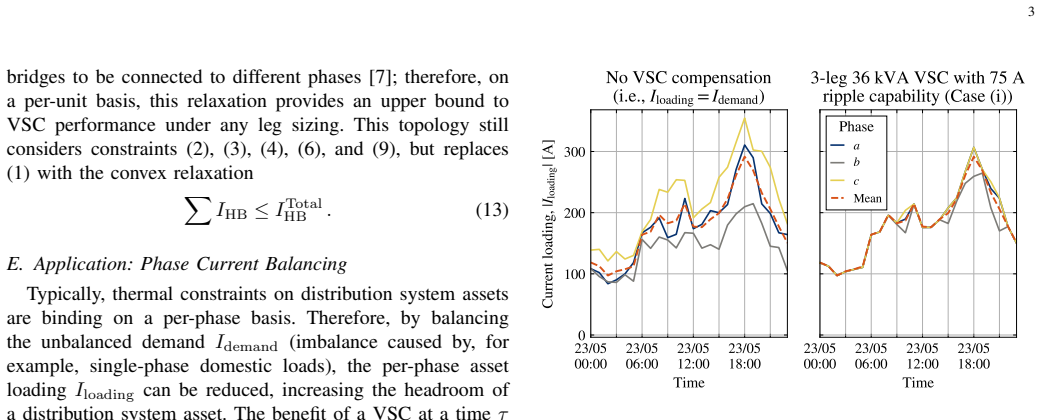
DC link capacitor thermal limits substantially reduce the headroom benefits of four-wire power converters during unbalanced operation.
A machine-rendered reading of the paper's core claim, the machinery that carries it, and where it could break.
Core claim
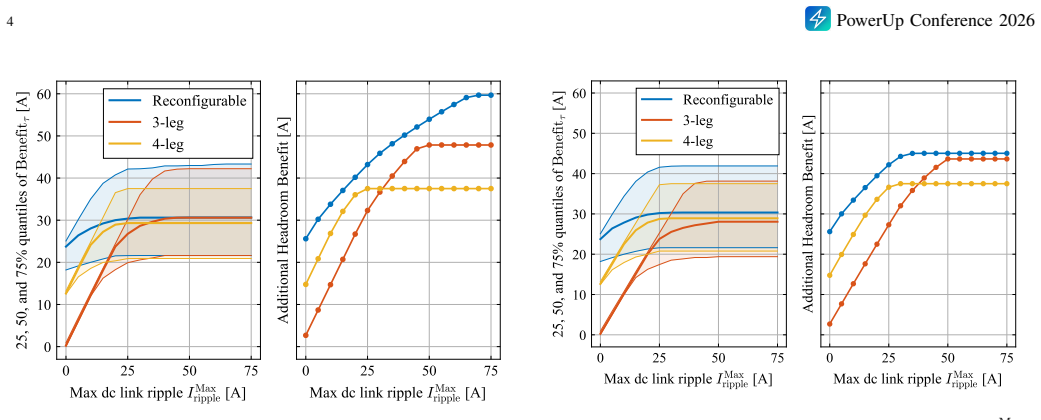
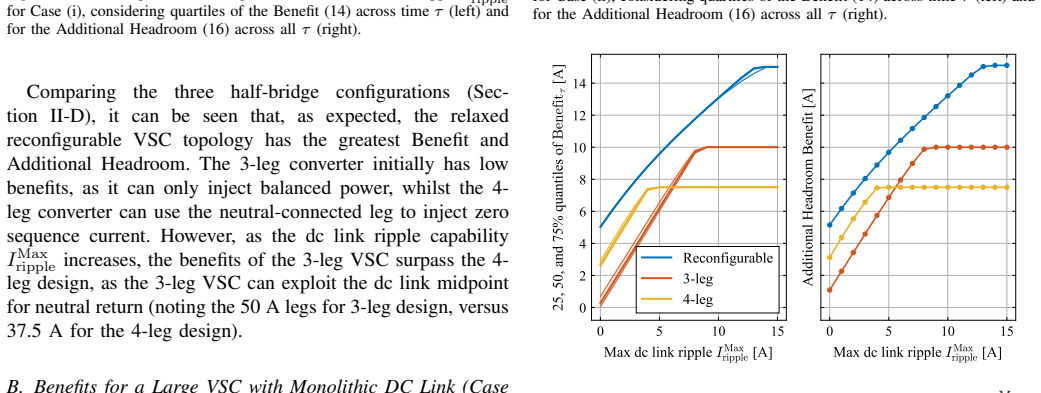
Thermal limits of dc link capacitors can result in substantially diminished benefits of these converters under unbalanced operation, due to constraints on neutral current and double-line frequency power ripple. Considering nine voltage source converter topologies with varying ripple capabilities, the upper bound on additional headroom released increases by more than 80% compared to a no-ripple case for the application of phase current unbalance mitigation.
What carries the argument
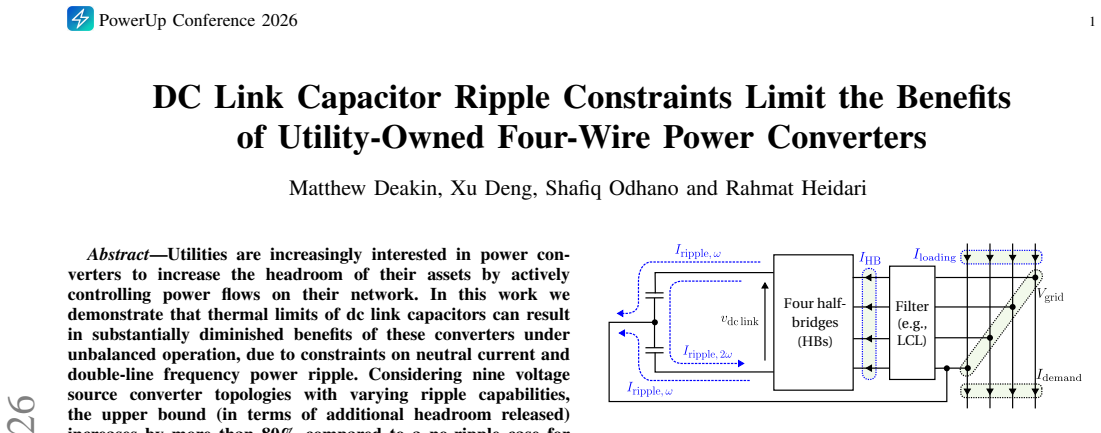
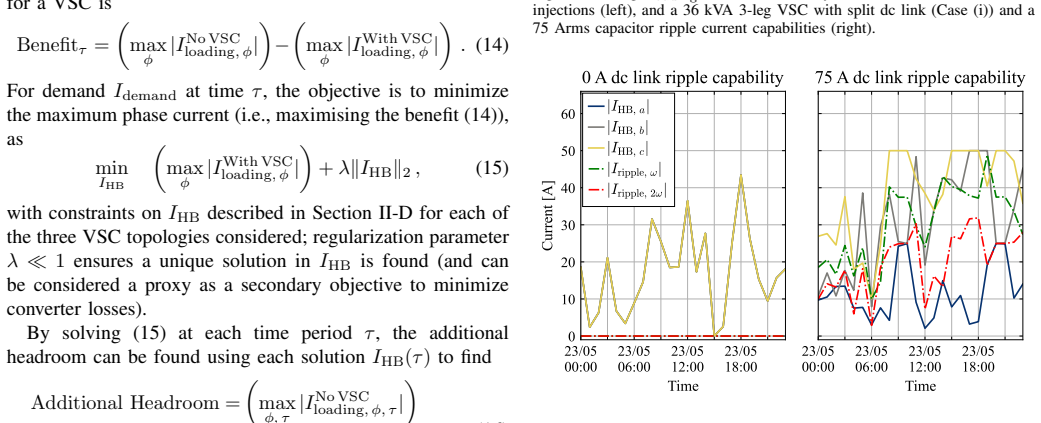
Thermal limits of DC link capacitors arising from ripple currents, which directly constrain neutral current and thereby limit unbalance mitigation capability in four-wire voltage source converters.
If this is right
- The additional headroom that four-wire converters can release for phase unbalance mitigation is substantially lower once capacitor ripple is included.
- Converter topologies with greater ripple tolerance release more headroom than those with poorer tolerance.
- Utilities must derate converter ratings for unbalanced operation based on capacitor thermal limits rather than ideal ripple-free ratings.
- Planning studies that omit ripple constraints will overstate the network benefits of these devices.
Where Pith is reading between the lines
- The economic justification for installing four-wire converters may weaken once realistic unbalanced performance is used in cost-benefit calculations.
- Similar ripple constraints could reduce benefits in other unbalanced grid services such as voltage support or loss minimization.
- Hardware tests that vary capacitor sizing or cooling would tighten the bound on achievable headroom.
Load-bearing premise
The modeled ripple capabilities of the nine converter topologies directly set their thermal limits without other unaccounted operational constraints.
What would settle it
Direct measurement of DC link capacitor temperature rise and sustained neutral current under controlled unbalanced load on a physical four-wire converter would show whether the modeled ripple constraints match real thermal behavior.
Figures
read the original abstract
Utilities are increasingly interested in power converters to increase the headroom of their assets by actively controlling power flows on their network. In this work we demonstrate that thermal limits of dc link capacitors can result in substantially diminished benefits of these converters under unbalanced operation, due to constraints on neutral current and double-line frequency power ripple. Considering nine voltage source converter topologies with varying ripple capabilities, the upper bound (in terms of additional headroom released) increases by more than 80% compared to a no-ripple case for the application of phase current unbalance mitigation.
Editorial analysis
A structured set of objections, weighed in public.
Referee Report
Summary. The paper analyzes thermal constraints on DC-link capacitors arising from neutral current and double-line-frequency ripple in nine four-wire voltage-source converter topologies. It concludes that these limits substantially diminish the additional headroom utilities can release under unbalanced operation for phase-current unbalance mitigation, while reporting that the upper bound on that headroom increases by more than 80% relative to an idealized no-ripple case.
Significance. If the quantitative comparison holds, the work supplies a concrete, topology-dependent bound on the practical benefit of utility-owned converters for unbalance mitigation, which could influence both hardware selection and operational limits in distribution planning.
major comments (1)
- [Abstract] Abstract: the opening claim that ripple constraints produce 'substantially diminished benefits' is in direct tension with the quantitative statement that 'the upper bound on additional headroom released increases by more than 80% compared to a no-ripple case.' Because both the headline percentage and the nine-topology comparison rest on the same definition of 'upper bound,' this internal inconsistency is load-bearing for the central claim and must be resolved with an explicit definition of the metric and a clear statement of whether the ripple limits raise or lower achievable headroom.
Simulated Author's Rebuttal
We thank the referee for their thorough review and for highlighting the inconsistency in the abstract. We agree that the wording requires clarification to resolve the apparent tension between the claims of diminished benefits and the reported increase in the upper bound. We will revise the manuscript accordingly.
read point-by-point responses
-
Referee: [Abstract] Abstract: the opening claim that ripple constraints produce 'substantially diminished benefits' is in direct tension with the quantitative statement that 'the upper bound on additional headroom released increases by more than 80% compared to a no-ripple case.' Because both the headline percentage and the nine-topology comparison rest on the same definition of 'upper bound,' this internal inconsistency is load-bearing for the central claim and must be resolved with an explicit definition of the metric and a clear statement of whether the ripple limits raise or lower achievable headroom.
Authors: We acknowledge this inconsistency in the abstract. The manuscript's core contribution is to show that DC-link capacitor ripple constraints substantially diminish the benefits of four-wire converters for unbalance mitigation. The quantitative claim regarding the 'upper bound' appears to have been misphrased in the abstract; the intent is that the constraints limit the additional headroom, with the no-ripple case permitting more than 80% greater headroom. We will revise the abstract to provide an explicit definition of the upper bound metric and to state clearly that the ripple limits lower the achievable headroom by more than 80% compared to the no-ripple case. This clarification will be applied consistently to the nine-topology comparison as well. revision: yes
Circularity Check
No significant circularity detected
full rationale
The abstract and provided excerpts present a topology comparison across nine VSC designs, with the headline percentage derived from modeled ripple capabilities under thermal constraints versus a no-ripple baseline. No load-bearing step reduces a prediction to a fitted parameter by construction, invokes self-citation for a uniqueness theorem, or renames a known result via new coordinates. The derivation chain relies on external modeling of capacitor limits and neutral-current constraints rather than self-referential definitions or ansatzes smuggled through prior author work. This is the normal case of a self-contained engineering comparison.
Axiom & Free-Parameter Ledger
Reference graph
Works this paper leans on
-
[1]
Two-stage bidirectional inverter equiv- alent circuit model for distribution grid steady-state analysis and opti- mization,
E. O. Badmus and A. Pandey, “Two-stage bidirectional inverter equiv- alent circuit model for distribution grid steady-state analysis and opti- mization,” 2026. IEEE Transactions on Power Systems (in press)
2026
-
[2]
Improved algebraic inverter modeling for four-wire power flow optimization,
R. Heidari and F. Geth, “Improved algebraic inverter modeling for four-wire power flow optimization,”Electric Power Systems Research, vol. 234, p. 110825, 2024
2024
-
[3]
V oltage ripple model and ca- pacitor sizing for the three-phase four-wire converter used for power redistribution,
I. Ziyat, J. Wang, and P. R. Palmer, “V oltage ripple model and ca- pacitor sizing for the three-phase four-wire converter used for power redistribution,”IEEE Journal of Emerging and Selected Topics in Power Electronics, vol. 12, no. 2, pp. 1437–1445, 2023
2023
-
[4]
M. Deakin, R. Heidari, and X. Deng, “Power converter DC link ripple and network unbalance as active constraints in distribution system optimal power flow.” https://doi.org/10.48550/arXiv.2512.18293, 2025
-
[5]
SiC-based EV charger for DC bus second-order ripple reduction,
M. Blas-Perez, P. Yang, W. Ming, and C. E. Ugalde-Loo, “SiC-based EV charger for DC bus second-order ripple reduction,”IEEE Transactions on Transportation Electrification, vol. 10, no. 3, pp. 6853–6866, 2023
2023
-
[6]
Multiplexing power converters for cost-effective and flexi- ble soft open points,
M. Deakin, “Multiplexing power converters for cost-effective and flexi- ble soft open points,”IEEE Transactions on Smart Grid, vol. 15, no. 1, pp. 260–271, 2023
2023
-
[7]
Reconfigurable power converters with in- creased utilization for unbalanced power distribution system applica- tions,
M. Deakin and X. Deng, “Reconfigurable power converters with in- creased utilization for unbalanced power distribution system applica- tions,” in13th International Conference on Power Electronics, Machines and Drives (PEMD 2024), vol. 2024, pp. 96–103, IET, 2024
2024
-
[8]
LV load monitor data
National Grid Electricity Distribution, “LV load monitor data.” https://connecteddata.nationalgrid.co.uk/dataset/lv-load-monitor-data,
-
[9]
A rewriting system for convex optimization problems,
A. Agrawal, R. Verschueren, S. Diamond, and S. Boyd, “A rewriting system for convex optimization problems,”Journal of Control and Decision, vol. 5, no. 1, pp. 42–60, 2018
2018
-
[10]
CVXPY: A Python-embedded modeling lan- guage for convex optimization,
S. Diamond and S. Boyd, “CVXPY: A Python-embedded modeling lan- guage for convex optimization,”Journal of Machine Learning Research, vol. 17, no. 83, pp. 1–5, 2016
2016
discussion (0)
Sign in with ORCID, Apple, or X to comment. Anyone can read and Pith papers without signing in.