Computing the Hamiltonian compression factors of cubic graphs
Pith reviewed 2026-06-26 11:56 UTC · model grok-4.3
The pith
An algorithm computes the Hamiltonian compression factor, the largest rotational automorphism order preserving a Hamiltonian cycle, for cubic edge-transitive graphs up to 10,000 vertices.
A machine-rendered reading of the paper's core claim, the machinery that carries it, and where it could break.
Core claim
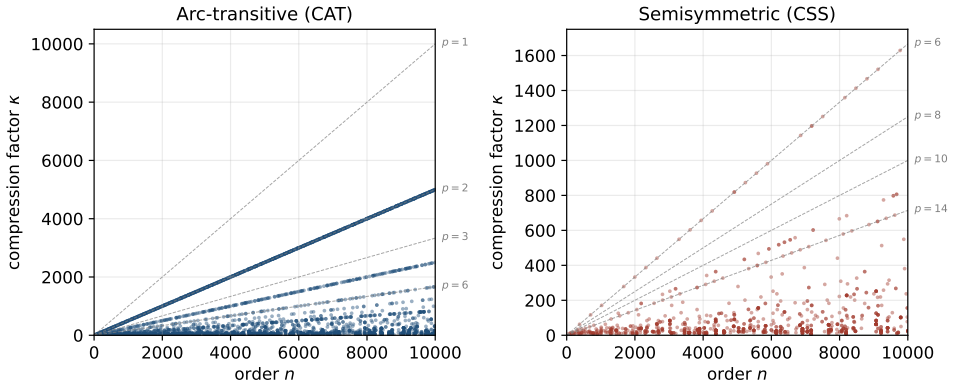
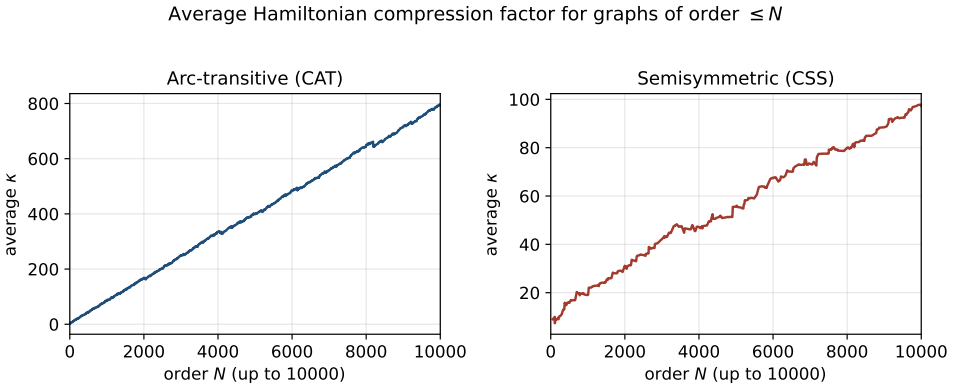
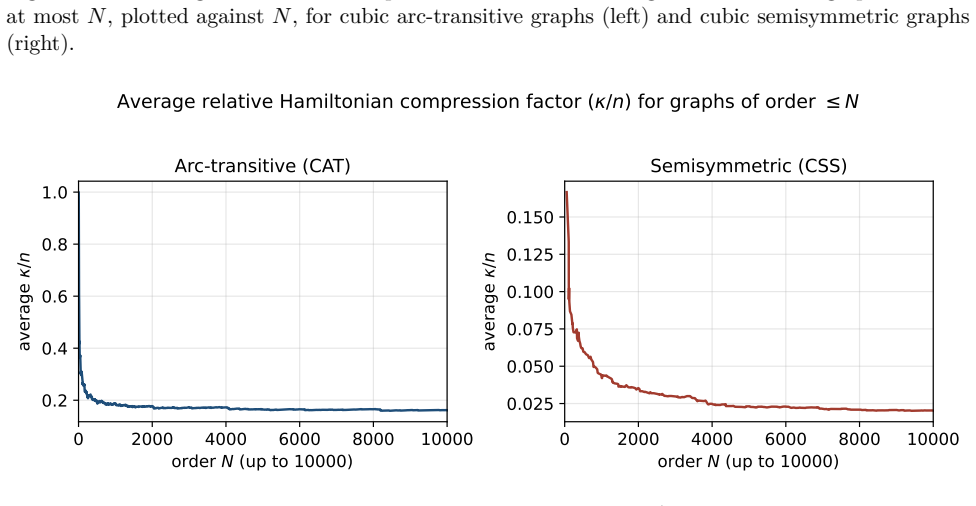
The authors claim that their algorithm successfully computes the Hamiltonian compression factors of all cubic edge-transitive graphs on up to 10,000 vertices except two non-Hamiltonian ones, giving exact values in most cases and lower bounds for 98 graphs, while also producing shortest LCF codes for each.
What carries the argument
The algorithm for computing Hamiltonian cycles invariant under a rotational automorphism, which determines the largest order of such an automorphism.
If this is right
- The Hamiltonian compression factor is now known exactly for the great majority of cubic edge-transitive graphs with up to 10,000 vertices.
- Shortest LCF codes are determined for all Hamiltonian graphs in this class.
- Lower bounds on the compression factor are established for 98 graphs, the smallest with 2304 vertices.
- Two graphs are confirmed to have no Hamiltonian cycle.
Where Pith is reading between the lines
- The results could serve as a benchmark for testing new algorithms on larger or different graph classes.
- Knowing these factors might help in understanding the relationship between edge-transitivity and Hamiltonian properties in cubic graphs.
- If extended, the approach might apply to finding other types of symmetric cycles in graphs.
Load-bearing premise
The algorithm correctly finds the largest order of an automorphism that preserves a Hamiltonian cycle and rotates on it, assuming the input collection of all cubic edge-transitive graphs is complete and accurate.
What would settle it
Finding a cubic edge-transitive graph on at most 10,000 vertices missing from the computation, or discovering a Hamiltonian cycle with a higher rotational order in one of the 98 graphs than the reported lower bound.
Figures
read the original abstract
We present an algorithm for computing Hamiltonian cycles that are invariant under a graph automorphism acting on them as a rotation. We also present an application of this algorithm for computing the Hamiltonian compression factor of a graph, that is, the largest order of an automorphism preserving some Hamiltonian cycle and acting on it as a rotation. As an example, we compute the Hamiltonian compression factors of all cubic edge-transitive graphs on up to $10{,}000$ vertices, with the exception of two graphs, which are not Hamiltonian, and $98$ graphs (the smallest having $2304$ vertices) for which only a lower bound for the compression factor is given. As a byproduct, we obtain shortest LCF codes for each of these graphs (except for the two non-Hamiltonian ones; for the $98$ unresolved graphs, the codes obtained are the shortest among those we found).
Editorial analysis
A structured set of objections, weighed in public.
Referee Report
Summary. The paper presents an algorithm for computing Hamiltonian cycles invariant under a graph automorphism that acts as a rotation on the cycle. It applies this to compute the Hamiltonian compression factor (largest order of such an automorphism) for all cubic edge-transitive graphs on at most 10,000 vertices, reporting exact values except for two non-Hamiltonian graphs and 98 graphs (smallest 2304 vertices) where only lower bounds are obtained. Shortest LCF codes are obtained as a byproduct for the resolved cases.
Significance. If the algorithm is correct and the input list of graphs is complete, the work provides a large-scale computational enumeration of Hamiltonian compression factors in cubic edge-transitive graphs, together with explicit lower bounds and LCF codes. This constitutes a concrete data point for the field and could support further theoretical work on rotational symmetries of Hamiltonian cycles. The explicit flagging of the two non-Hamiltonian graphs and the 98 unresolved cases is a positive feature.
major comments (2)
- [Abstract (algorithm description)] The manuscript states that an algorithm is presented for finding rotationally invariant Hamiltonian cycles, but provides no pseudocode, complexity analysis, or verification on small known graphs (e.g., the Petersen graph or other cubic edge-transitive graphs with known compression factors). This detail is load-bearing for assessing the reliability of the exact values and lower bounds reported for graphs up to 10,000 vertices.
- [Abstract (application to graph list)] The input list of cubic edge-transitive graphs is described as external and complete, yet no reference, citation, or verification step is given confirming that the classification up to 10,000 vertices matches the current state of the literature or that the two non-Hamiltonian exceptions were independently confirmed.
minor comments (1)
- [Abstract] The abstract mentions 'shortest LCF codes' as a byproduct but does not clarify the precise definition of 'shortest' used or how ties are broken when multiple codes of the same length exist.
Simulated Author's Rebuttal
We thank the referee for their constructive comments. We address each major comment below and will revise the manuscript accordingly to improve clarity and verifiability.
read point-by-point responses
-
Referee: [Abstract (algorithm description)] The manuscript states that an algorithm is presented for finding rotationally invariant Hamiltonian cycles, but provides no pseudocode, complexity analysis, or verification on small known graphs (e.g., the Petersen graph or other cubic edge-transitive graphs with known compression factors). This detail is load-bearing for assessing the reliability of the exact values and lower bounds reported for graphs up to 10,000 vertices.
Authors: We agree that the current manuscript provides insufficient detail on the algorithm for independent assessment. In the revised version we will add explicit pseudocode, a complexity analysis, and verification results on small graphs including the Petersen graph (where the compression factor is 5) and other known cubic edge-transitive graphs with established values. revision: yes
-
Referee: [Abstract (application to graph list)] The input list of cubic edge-transitive graphs is described as external and complete, yet no reference, citation, or verification step is given confirming that the classification up to 10,000 vertices matches the current state of the literature or that the two non-Hamiltonian exceptions were independently confirmed.
Authors: We acknowledge the absence of a specific citation or verification statement for the graph list. The revised manuscript will include a reference to the source of the complete enumeration of cubic edge-transitive graphs and a note confirming the two non-Hamiltonian exceptions via independent literature results. revision: yes
Circularity Check
No significant circularity
full rationale
The paper presents a search algorithm that enumerates Hamiltonian cycles fixed by rotational automorphisms of maximal order and applies it directly to an external, pre-classified list of cubic edge-transitive graphs. All reported compression factors (or lower bounds) are explicit outputs of this enumeration; no parameters are fitted to the target values, no quantity is defined in terms of itself, and no load-bearing step reduces to a self-citation or ansatz imported from the authors' prior work. The two non-Hamiltonian exceptions and the 98 unresolved cases are explicitly flagged, confirming that the derivation chain remains self-contained against external graph data.
Axiom & Free-Parameter Ledger
axioms (2)
- standard math Cubic graphs are 3-regular graphs whose automorphism groups act transitively on edges.
- domain assumption The listed graphs up to 10,000 vertices exhaust the cubic edge-transitive graphs in that range.
Reference graph
Works this paper leans on
-
[1]
Bosma, J
W. Bosma, J. Cannon, C. Playoust, The Magma algebra system. I. The user language, J. Sym- bolic Comp.24(1997), 235–265
1997
-
[2]
Bouwer (ed.),The Foster Census, Charles Babbage Research Centre, Winnipeg, 1988
I.Z. Bouwer (ed.),The Foster Census, Charles Babbage Research Centre, Winnipeg, 1988
1988
-
[3]
Conder, Trivalent (cubic) symmetric graphs on up to 10000 vertices,https://www.math
M. Conder, Trivalent (cubic) symmetric graphs on up to 10000 vertices,https://www.math. auckland.ac.nz/~conder/symmcubic10000list.txt(accessed 12th June 2026)
2026
-
[4]
Conder, Trivalent (cubic) semi-symmetric graphs on up to 10000 vertices,https://www
M. Conder, Trivalent (cubic) semi-symmetric graphs on up to 10000 vertices,https://www. math.auckland.ac.nz/~conder/SemisymmCubic10000.txt(accessed 12th June 2026)
2026
-
[5]
Algebra685(2026), 703–737
M.ConderandP.Potočnik, Edge-transitivecubicgraphs: analysis, cataloguingandenumeration, J. Algebra685(2026), 703–737
2026
-
[6]
Conder and P
M. Conder and P. Potočnik, Census of cubic edge-transitive graphs,https://fostercensus. graphsym.net(accessed 17th May 2026)
2026
-
[7]
M. Conder, P. Potočnik, G. Potočnik,Census of cubic edge-transitive graphs and their optimal LCF codes, Zenodo (2026).https://doi.org/10.5281/zenodo.20609902
-
[8]
Eppstein, The traveling salesman problem for cubic graphs,J
D. Eppstein, The traveling salesman problem for cubic graphs,J. Graph Alg. Appl.11(2007), 61–81
2007
-
[9]
Frucht, A canonical representation of trivalent Hamiltonian graphs,J
R. Frucht, A canonical representation of trivalent Hamiltonian graphs,J. Graph Theory1(1977), 45–60
1977
-
[10]
org(accessed 17th May 2026)
The GAP Group, GAP – Groups, Algorithms, and Programming,https://www.gap-system. org(accessed 17th May 2026). 11
2026
-
[11]
Goldschmidt, Automorphisms of trivalent graphs,Ann
D. Goldschmidt, Automorphisms of trivalent graphs,Ann. Math.111(1980), 377–406
1980
-
[12]
Gregor, A
P. Gregor, A. Merino, T. Mütze, The Hamilton compression of highly symmetric graphs,Annals Combin.28(2024), 379–437
2024
-
[13]
Kutnar, D
K. Kutnar, D. Marušič, A. S. Razafimahatratra, Infinite families of vertex-transitive graphs with prescribed Hamilton compression,Annals Combin.28(2024), 1243–1255
2024
-
[14]
McKay,Nauty package,https://pallini.di.uniroma1.it(accessed 17th May 2026)
B. McKay,Nauty package,https://pallini.di.uniroma1.it(accessed 17th May 2026)
2026
-
[15]
Potočnik, P
P. Potočnik, P. Spiga, G. Verret, On the order of arc-stabilisers in arc-transitive graphs with prescribed local group,Trans. Amer. Math. Soc.366(2014), 3729–3745
2014
-
[16]
Potočnik, P
P. Potočnik, P. Spiga, G. Verret, Bounding the order of the vertex-stabiliser in3-valent vertex- transitive and4-valent arc-transitive graphs,J. Combin. Theory, Ser. B.111(2015), 148–180
2015
-
[17]
Rubin, A search procedure for Hamilton paths and circuits,J
F. Rubin, A search procedure for Hamilton paths and circuits,J. ACM21(1974), 576–580
1974
-
[18]
Tutte, A family of cubical graphs,Proc
W. Tutte, A family of cubical graphs,Proc. Cambridge Philos. Soc.43(1947), 459–474. 12
1947
discussion (0)
Sign in with ORCID, Apple, or X to comment. Anyone can read and Pith papers without signing in.