Complex organic molecules in the young hot core RCW 120 S2
Pith reviewed 2026-06-26 11:52 UTC · model grok-4.3
The pith
Observations of RCW 120 S2 show complex organic molecule abundances that largely match hot-core chemical models, with methanol underabundant and CH3CN overabundant due to beam averaging effects.
A machine-rendered reading of the paper's core claim, the machinery that carries it, and where it could break.
Core claim
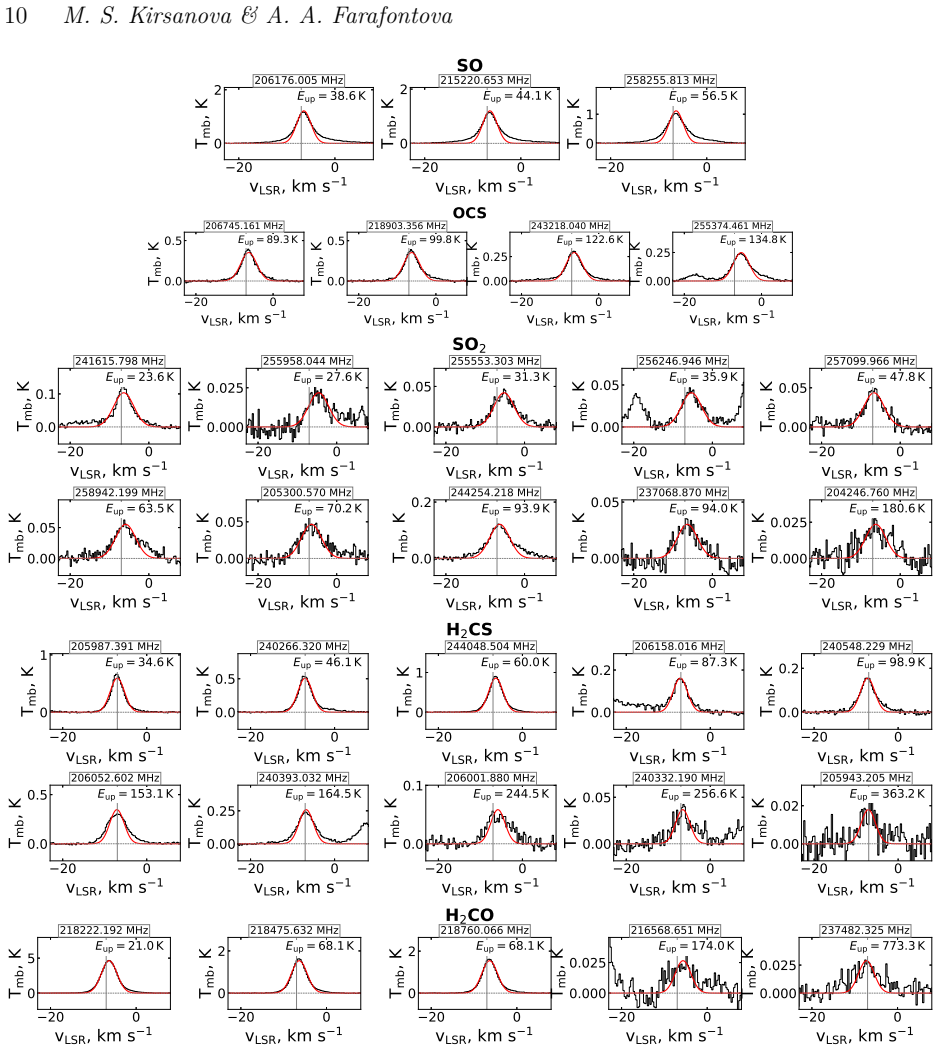
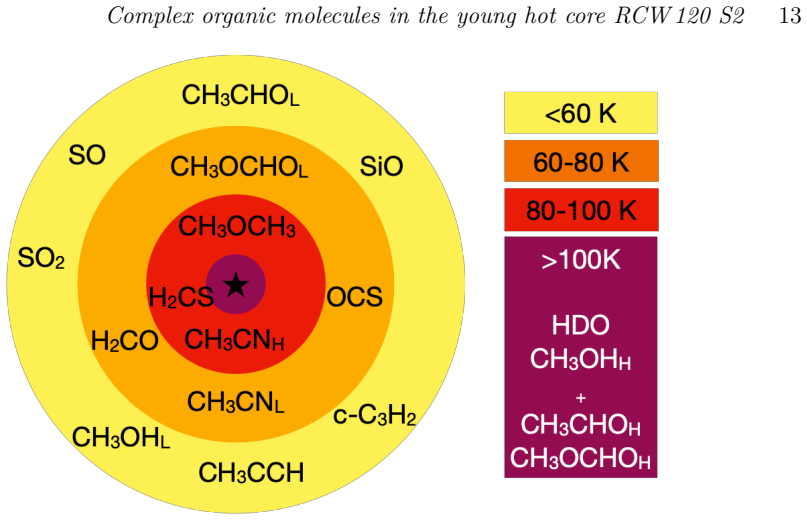
APEX observations at 1.3 mm detect CH3OH, CH3CHO, CH3OCHO and CH3OCH3 in RCW120 S2 along with other species. Derived gas temperatures range from 20-300 K and H2 densities from 10^4-10^7 cm^{-3}. The emission traces a stratified envelope with cooler less dense outer gas traced by SO, SO2 and c-C3H2 and warmer denser inner gas traced by H2CO, OCS and low-excitation CH3CN. High-excitation lines from CH3OH, CH3CN, HDO and CH3OCH3 indicate hot gas. Relative abundances of COMs generally agree with hot-core models except for underabundant methanol and overabundant CH3CN, which the authors attribute to the need for interferometric observations to resolve the true filling factor and radial gradients.
What carries the argument
Beam-averaged column densities and excitation temperatures from single-dish spectra compared directly to predictions from astrochemical hot-core models, with discrepancies ascribed to unresolved source filling factor and radial gradients.
If this is right
- The core contains a chemically rich environment typical of young high-mass star formation with a clear temperature and density gradient from outer to inner layers.
- Most detected complex organic molecules have abundances consistent with standard hot-core chemical evolution.
- Discrepancies in specific species like methanol and CH3CN arise from spatial averaging in the single-dish beam.
- Interferometric observations at intermediate spatial scales are needed to obtain accurate abundances free of beam dilution effects.
Where Pith is reading between the lines
- Similar methanol underabundances reported in other single-dish hot-core studies may reflect the same unresolved structure rather than true chemical differences.
- Resolved maps could show that inner zones have higher COM abundances, tightening constraints on the timescale for complex molecule formation.
- Applying the same modeling approach to additional young hot cores would test whether the observed abundance pattern is common at this evolutionary stage.
Load-bearing premise
Single-dish beam-averaged column densities and excitation temperatures can be directly compared to chemical models without detailed correction for the unknown source filling factor and radial temperature gradient inside the beam.
What would settle it
Interferometric mapping at scales smaller than the APEX beam that measures the actual filling factor and radial abundance gradients and yields methanol and CH3CN abundances that match model predictions without discrepancy.
Figures

read the original abstract
We analyse physical and chemical structure of the hot molecular core RCW120 S2, based on high-sensitivity (2-4 mK) APEX observations at 1.3 mm. The analysis reveals a rich molecular inventory, including complex organic molecules (COMs) such as CH$_3$OH, CH$_3$CHO, CH$_3$OCHO and CH$_3$OCH. We derive gas temperatures (20-300 K), H$_2$ densities (10$^4$-10$^7$cm$^{-3}$), and molecular column densities. The detected emission probes a radially stratified envelope, with cooler (<= 60 K) and less dense (10$^4$-10$^5$cm$^{-3}$) outer layers traced by SO, SO2, and c-C$_3$H$_2$, while warmer (60-100 K) and denser (10$^5$-10$^7$cm$^{-3}$) inner regions are traced by H$_2$CO, OCS, and low-excitation CH$_3$CN. The hot gas (<= 100 K) exhibits broad (8-10 km/s) lines from high-excitation CH$_3$OH, CH$_3$CN, HDO, and CH$_3$OCH$_3$. Relative molecular abundances of COMs generally agree with astrochemical hot-core models, while methanol appears underabundant and CH$_3$CN overabundant compared to predictions. We attribute these discrepancies to the need for interferometric observations at intermediate spatial scales to resolve the core's true filling factor and radial gradients.
Editorial analysis
A structured set of objections, weighed in public.
Referee Report
Summary. The paper reports high-sensitivity APEX 1.3 mm observations of the young hot core RCW 120 S2, detecting a rich inventory of complex organic molecules including CH3OH, CH3CHO, CH3OCHO, and CH3OCH3. Physical parameters (T = 20–300 K, n(H2) = 10^4–10^7 cm^{-3}) and beam-averaged column densities are derived from multiple tracers, revealing a radially stratified envelope with cooler outer layers traced by SO/SO2/c-C3H2 and warmer inner gas traced by H2CO/OCS/CH3CN plus a hot component with broad high-excitation lines. Relative COM abundances are compared to astrochemical hot-core models and found to be generally consistent, with noted underabundance of CH3OH and overabundance of CH3CN; these discrepancies are attributed to unresolved filling factor and radial gradients.
Significance. The high-sensitivity single-dish spectra and the clear identification of stratified physical conditions traced by different molecules provide useful observational constraints on the structure of a young hot core. The detection of multiple COMs adds to the sample of sources with characterized organic chemistry. If the model comparison can be placed on a firmer footing by addressing beam effects, the work would offer testable benchmarks for hot-core chemical networks.
major comments (1)
- [Abstract and model comparison section] Abstract (final paragraph) and the model-comparison discussion: the central claim that relative COM abundances 'generally agree' with hot-core models rests on direct use of beam-averaged column densities. No quantitative test is shown that plausible source filling factors or radial temperature/density gradients would leave the relative abundances (and the specific CH3OH/CH3CN discrepancies) unchanged; the attribution to filling factor therefore remains an untested premise rather than a demonstrated result.
minor comments (2)
- [Abstract] Abstract: 'CH3OCH' is presumably CH3OCH3; consistent nomenclature should be used throughout.
- [Methods / Results] The manuscript does not specify the exact line-selection criteria, optical-depth checks, or error-propagation method used to obtain the quoted T, n, and N values; adding a short methods subsection would improve reproducibility.
Simulated Author's Rebuttal
We thank the referee for their constructive comments. We address the major comment on the model comparison below and have revised the manuscript to clarify the limitations of the beam-averaged analysis.
read point-by-point responses
-
Referee: [Abstract and model comparison section] Abstract (final paragraph) and the model-comparison discussion: the central claim that relative COM abundances 'generally agree' with hot-core models rests on direct use of beam-averaged column densities. No quantitative test is shown that plausible source filling factors or radial temperature/density gradients would leave the relative abundances (and the specific CH3OH/CH3CN discrepancies) unchanged; the attribution to filling factor therefore remains an untested premise rather than a demonstrated result.
Authors: We agree that the manuscript uses beam-averaged column densities for the model comparison without performing a quantitative test of how filling factors or gradients would affect the relative abundances. The observed radial stratification is inferred from the different excitation conditions traced by various species, but this does not constitute a direct test of the impact on COM ratios. In the revised manuscript we have updated the abstract and model-comparison section to state that the agreement with models is qualitative, to present the CH3OH underabundance and CH3CN overabundance as possible consequences of beam dilution and unresolved structure, and to emphasize that interferometric observations are required for a quantitative assessment. This change makes the evidential basis explicit without overstating the result. revision: yes
Circularity Check
No circularity: observational quantities compared to external models
full rationale
The paper derives temperatures (20-300 K), densities (10^4-10^7 cm^-3), and column densities directly from APEX 1.3 mm spectra of RCW120 S2, then compares relative COM abundances to independent astrochemical hot-core models. Discrepancies (methanol underabundant, CH3CN overabundant) are noted and attributed to unresolved filling factor and gradients, but the comparison itself uses uncorrected beam-averaged values against external benchmarks with no internal fitting of parameters that are then relabeled as predictions. No self-citations, self-definitional steps, or ansatz smuggling appear in the provided text. The chain is observation-to-derivation-to-external-comparison and remains self-contained.
Axiom & Free-Parameter Ledger
Reference graph
Works this paper leans on
-
[1]
Protostars and Planets IV , year = 2000, editor =
Hot Molecular Cores and the Earliest Phases of High-Mass Star Formation. Protostars and Planets IV , year = 2000, editor =
2000
-
[2]
, keywords =
Massive Stars: Their Environment and Formation. , keywords =
-
[3]
Protostars and Planets V , year = 2007, editor =
The Formation of Massive Stars. Protostars and Planets V , year = 2007, editor =
2007
-
[4]
, year = 2009, month = sep, volume =
Complex Organic Interstellar Molecules. , year = 2009, month = sep, volume =
2009
-
[5]
Science with a Next Generation Very Large Array , year = 2018, editor =
Complex Organic Molecules in Hot Molecular Cores/Corinos: Physics and Chemistry. Science with a Next Generation Very Large Array , year = 2018, editor =
2018
-
[6]
A search for hot cores by using C _ 2 H _ 5 CN, CH _ 3 OCHO, and CH _ 3 OH lines
ATOMS: ALMA Three-millimeter Observations of Massive Star-forming regions - VIII. A search for hot cores by using C _ 2 H _ 5 CN, CH _ 3 OCHO, and CH _ 3 OH lines. , keywords =
-
[7]
, keywords =
The methyl cyanide hot and warm cores in Orion : statistical equilibrium excitation models of a symmetric-top molecule. , keywords =
-
[8]
, keywords =
Formaldehyde as a Probe of Physical Conditions in Dense Molecular Clouds. , keywords =
-
[9]
Methanol as a diagnostic tool of interstellar clouds. I. Model calculations and application to molecular clouds. , keywords =
-
[10]
Sulfur-bearing molecules in a sample of early star-forming cores , DOI= "10.1051/0004-6361/202452350", journal =
-
[11]
Protostars and Planets II , year = 1985, editor =
Molecular cloud cores. Protostars and Planets II , year = 1985, editor =
1985
-
[12]
, keywords =
Self-similar collapse of isothermal spheres and star formation. , keywords =
-
[13]
An observational and modeling case study of the AFGL 2591 VLA 3 hot core
Chemical complexity in high-mass star formation. An observational and modeling case study of the AFGL 2591 VLA 3 hot core. , keywords =
-
[14]
INASAN Science Reports , keywords =
Comparison of methods for estimation of physical parameters of molecular clumps using methanol lines. INASAN Science Reports , keywords =. doi:10.51194/INASAN.2025.10.1.002 , adsurl =
-
[15]
Shu, F. H. and Adams, F. C. and Lizano, S. , title =. Annual Review of Astronomy and Astrophysics , year =
-
[16]
Farafontova, A. A. and Kirsanova, M. S. and Salii, S. V. , year=. MOLLId: Software for Automatic Identification of Molecules and Its Application to the Spectra of Protostars from the Region RCW 120 , volume=. Astrophysical Bulletin , publisher=. doi:10.1134/s1990341325600498 , number=
-
[17]
Astrophysical Bulletin , keywords =
Chemical Differentiation and Gas Kinematics around Massive Young Stellar Objects in RCW 120. Astrophysical Bulletin , keywords =
-
[18]
Modern Star Astronomy , year = 2018, volume =
Updated Base of Methanol Energy Level Populations. Modern Star Astronomy , year = 2018, volume =
2018
-
[19]
and Bronfman, L
Figueira, M. and Bronfman, L. and Zavagno, A. and Louvet, F. and Lo, N. and Finger, R. and Rodón, J. , year=. ALMA observations of RCW 120 Fragmentation at 0.01 pc scale , volume=. Astronomy & Astrophysics , publisher=
-
[20]
, keywords =
The Atacama Pathfinder EXperiment (APEX) - a new submillimeter facility for southern skies -. , keywords =
-
[21]
, keywords =
Star formation around RCW 120, the perfect bubble. , keywords =
-
[22]
, keywords =
High-Temperature Molecular Cores near Massive Stars and Application to the Orion Hot Core. , keywords =
-
[23]
With diagnostic plots to interpret observed line intensity ratios
A computer program for fast non-LTE analysis of interstellar line spectra. With diagnostic plots to interpret observed line intensity ratios. , keywords =
-
[24]
The Astrophysical Journal , year =
M Osorio , title =. The Astrophysical Journal , year =
-
[25]
The warm-up phase in massive star-forming cores around RCW 120. , keywords =. doi:10.1093/mnras/stab499 , archivePrefix =. 2102.09145 , primaryClass =
-
[26]
and Viti, S
Calcutt, H. and Viti, S. and Codella, C. and Beltrán, M. T. and Fontani, F. and Woods, P. M. , title =. Monthly Notices of the Royal Astronomical Society , year =
-
[27]
and van Dishoeck, E
Herbst, E. and van Dishoeck, E. F. , title =. Annual Review of Astronomy and Astrophysics , year =
-
[28]
and Garrod, R
Herbst, E. and Garrod, R. T. , title =. ACS Earth and Space Chemistry , year =
-
[29]
Physical and chemical complexity in high-mass star-forming regions with ALMA. I. Overview and evolutionary trends of physical properties. , keywords =. doi:10.1051/0004-6361/202245249 , archivePrefix =. 2304.07237 , primaryClass =
-
[30]
The Physical and Chemical Structure of Hot Molecular Cores
The physical and chemical structure of hot molecular cores. , keywords =. doi:10.1051/0004-6361:20031646 , archivePrefix =. astro-ph/0311246 , primaryClass =
work page internal anchor Pith review Pith/arXiv arXiv doi:10.1051/0004-6361:20031646
-
[31]
Molecular Cloud Cores and Bimodal Star Formation. , keywords =. doi:10.1086/167640 , adsurl =
-
[32]
Density Structure and Star Formation in Dense Cores with Thermal and Nonthermal Motions. , keywords =. doi:10.1086/171744 , adsurl =
-
[33]
Gravitational Collapse and Star Formation in Logotropic and Non-Isothermal Spheres
Gravitational Collapse and Star Formation in Logotropic and Nonisothermal Spheres. , keywords =. doi:10.1086/303657 , archivePrefix =. astro-ph/9609080 , primaryClass =
work page internal anchor Pith review Pith/arXiv arXiv doi:10.1086/303657
-
[34]
, year = 1969, month = jan, volume =
Numerical calculations of the dynamics of collapsing proto-star. , year = 1969, month = jan, volume =. doi:10.1093/mnras/145.3.271 , adsurl =
-
[35]
Structure and Evolution of the Envelopes of Deeply Embedded Massive Young Stars
Structure and Evolution of the Envelopes of Deeply Embedded Massive Young Stars. , keywords =. doi:10.1086/309011 , archivePrefix =. astro-ph/0001527 , primaryClass =
work page internal anchor Pith review Pith/arXiv arXiv doi:10.1086/309011
-
[36]
Star formation triggered by the Galactic H II region RCW 120. First results from the Herschel Space Observatory. , keywords =. doi:10.1051/0004-6361/201014623 , archivePrefix =. 1005.1615 , primaryClass =
work page internal anchor Pith review Pith/arXiv arXiv doi:10.1051/0004-6361/201014623
-
[37]
Collisional Excitation of Interstellar Methyl Cyanide. , keywords =. doi:10.1086/164605 , adsurl =
-
[38]
The Distribution and Excitation of CH$_3$CN in a Solar Nebula Analog
The Distribution and Excitation of CH _ 3 CN in a Solar Nebula Analog. , keywords =. doi:10.3847/1538-4357/aac169 , archivePrefix =. 1805.01458 , primaryClass =
work page internal anchor Pith review Pith/arXiv arXiv doi:10.3847/1538-4357/aac169
-
[39]
Astrophysical Bulletin , keywords =
Gas-phase and Surface Chemistry in the Massive Star-Forming Region RCW 120. Astrophysical Bulletin , keywords =. doi:10.1134/S1990341325600073 , adsurl =
-
[40]
Astronomy Letters , keywords =
Deuterated Water Abundance in the Young Hot Core RCW 120 S2. Astronomy Letters , keywords =. doi:10.1134/S1063773725700252 , archivePrefix =. 2505.21945 , primaryClass =
-
[41]
CH _ 3 CN Observations toward Southern Massive Star-forming Regions. , keywords =. doi:10.1086/427187 , adsurl =
-
[42]
Tracking the dynamical, chemical and spectral evolution of molecular cores with PrestaLine: Gorynych. arXiv e-prints , keywords =. doi:10.48550/arXiv.2602.12792 , archivePrefix =. 2602.12792 , primaryClass =
-
[43]
Complex Chemistry in Star-Forming Regions: An Expanded Gas-Grain Warm-up Chemical Model
Complex Chemistry in Star-forming Regions: An Expanded Gas-Grain Warm-up Chemical Model. , keywords =. doi:10.1086/588035 , archivePrefix =. 0803.1214 , primaryClass =
work page internal anchor Pith review Pith/arXiv arXiv doi:10.1086/588035
-
[44]
A three-phase chemical model of hot cores: the formation of glycine
A Three-phase Chemical Model of Hot Cores: The Formation of Glycine. , keywords =. doi:10.1088/0004-637X/765/1/60 , archivePrefix =. 1302.0688 , primaryClass =
work page internal anchor Pith review Pith/arXiv arXiv doi:10.1088/0004-637x/765/1/60
-
[45]
Formation of Complex Organic Molecules in Prestellar Cores: The Role of Nondiffusive Grain Chemistry. , keywords =. doi:10.3847/1538-4357/adea73 , archivePrefix =. 2507.00338 , primaryClass =
-
[46]
The rotational excitation of methanol by molecular hydrogen. , keywords =. doi:10.1111/j.1365-2966.2010.16671.x , adsurl =
-
[47]
Models of class II methanol masers based on improved molecular data. , keywords =. doi:10.1111/j.1365-2966.2005.09077.x , archivePrefix =. astro-ph/0504194 , primaryClass =
-
[48]
Weak Maser Emission of Methyl Formate toward Sagittarius B2(N) in the Green Bank Telescope PRIMOS Survey. , keywords =. doi:10.1088/0004-637X/783/2/72 , archivePrefix =. 1401.1136 , primaryClass =
work page internal anchor Pith review Pith/arXiv arXiv doi:10.1088/0004-637x/783/2/72
-
[49]
An atomic and molecular database for analysis of submillimetre line observations
An atomic and molecular database for analysis of submillimetre line observations. , keywords =. doi:10.1051/0004-6361:20041729 , archivePrefix =. astro-ph/0411110 , primaryClass =
work page internal anchor Pith review Pith/arXiv arXiv doi:10.1051/0004-6361:20041729
-
[50]
Analytical methods for measuring the parameters of interstellar gas using methanol observations. Astronomy Reports , keywords =. doi:10.1134/S1063772916080047 , archivePrefix =. 1710.07605 , primaryClass =
work page internal anchor Pith review Pith/arXiv arXiv doi:10.1134/s1063772916080047
-
[51]
Astronomy Reports , year = 2006, month = dec, volume =
Methanol and other molecular tracers of outflows and dense gas in the molecular cloud G345.01+1.79. Astronomy Reports , year = 2006, month = dec, volume =. doi:10.1134/S1063772906120031 , adsurl =
discussion (0)
Sign in with ORCID, Apple, or X to comment. Anyone can read and Pith papers without signing in.