Saturation numbers for joins of graphs and characterization of extremal graphs
Pith reviewed 2026-06-26 11:47 UTC · model grok-4.3
The pith
Saturation number of K1 joined to F equals n-1 plus sat(n-1,F) when F contains a matching plus any isolates, but the equality fails for F equal to K_{p-1} union one isolate when p is at least 4.
A machine-rendered reading of the paper's core claim, the machinery that carries it, and where it could break.
Core claim
The authors prove that sat(n, K1 ∨ (K_{p-1} ∪ K1)) admits an explicit closed form for every p, that this form differs from n-1 + sat(n-1, K_{p-1} ∪ K1) when p ≥ 4, and that the equality sat(n, K1 ∨ F) = n-1 + sat(n-1, F) together with the full list of extremal graphs holds for every q ≥ 1 when F is K2 ∪ qK1 or 2K2 ∪ qK1.
What carries the argument
The recursive comparison sat(n, K1 ∨ F) versus n-1 + sat(n-1, F), whose equality or failure is decided by whether the isolated vertices in F permit every minimum saturated graph on n-1 vertices to be extended by a single universal vertex without creating an earlier copy of the join.
If this is right
- sat(n, K1 ∨ (K2 ∪ qK1)) equals n-1 plus the saturation number of K2 ∪ qK1 on n-1 vertices.
- sat(n, K1 ∨ (2K2 ∪ qK1)) equals n-1 plus the saturation number of 2K2 ∪ qK1 on n-1 vertices.
- All minimum saturated graphs are obtained by taking a minimum saturated graph on the non-isolated part and adding a universal vertex together with the appropriate isolated vertices.
- The recursive upper bound is not tight once the non-isolated part of F becomes a clique on three or more vertices plus an isolate.
Where Pith is reading between the lines
- The equality appears to require that F contain at most two edges outside its isolated vertices.
- The same case-analysis technique may apply to other F whose components are paths or cycles of bounded length plus isolates.
- The explicit lists of extremal graphs supply concrete constructions that can be checked directly against the saturation definition.
Load-bearing premise
The graphs F under consideration have only a very small number of edges or a single clique plus isolates, so that every possible way an added edge could create a forbidden join can be enumerated by cases.
What would settle it
An n-vertex graph with strictly fewer than the claimed number of edges that contains no copy of K1 ∨ F yet becomes a copy of K1 ∨ F upon addition of any missing edge, for one of the families where equality is asserted.
Figures
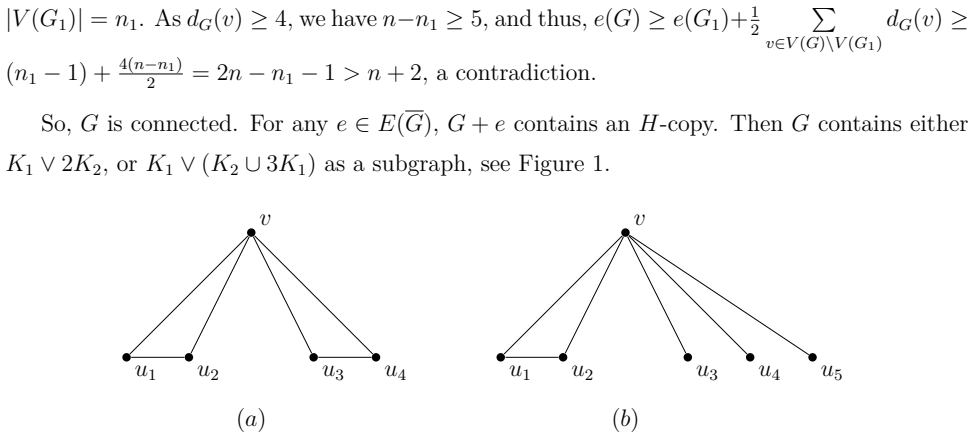
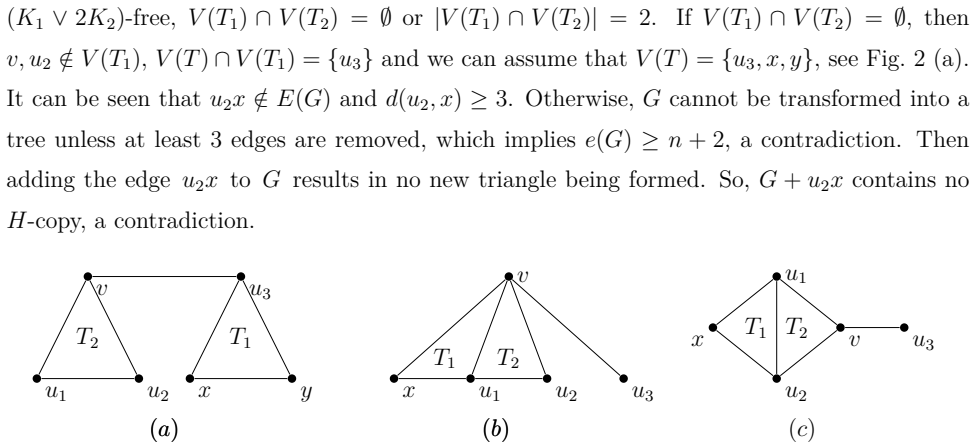
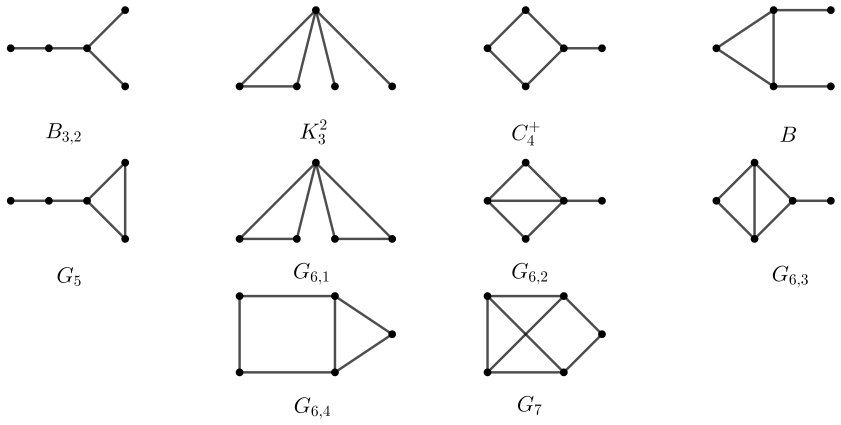
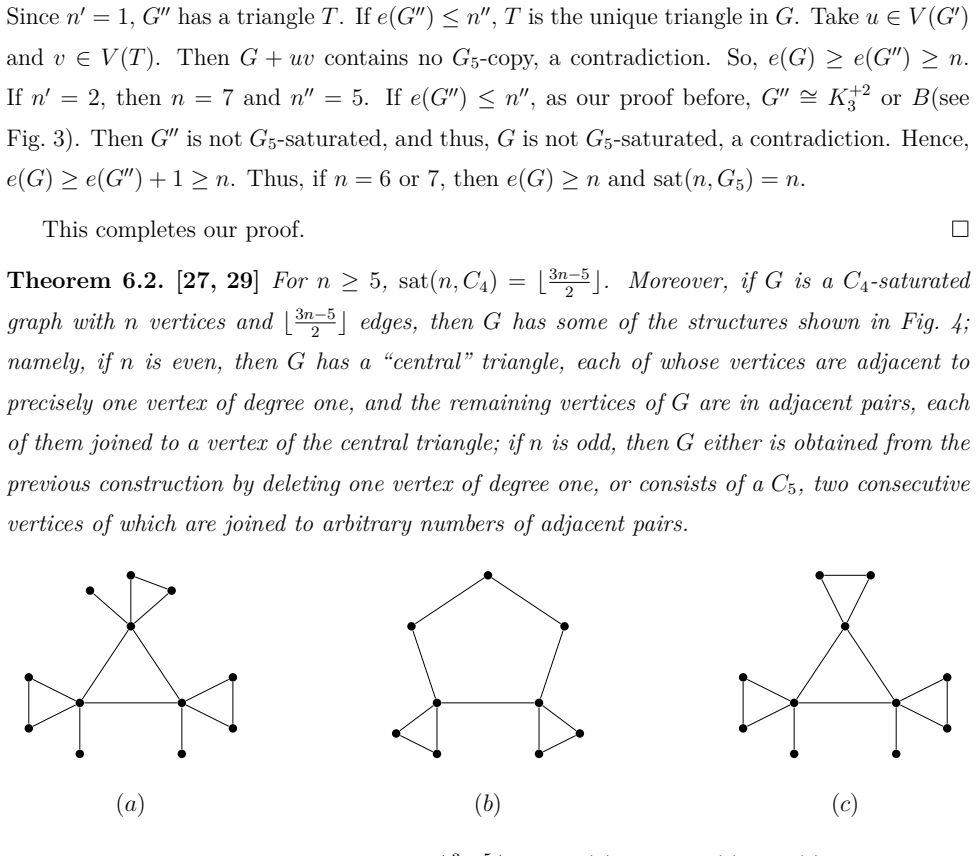
read the original abstract
A graph $G$ is $H$-saturated if $G$ contains no $H$-copy as a subgraph, but adding any edge between two non-adjacent vertices in $G$ creates a copy of $H$. The saturation number $\mathrm{sat}(n,H)$ is the minimum number of edges in an $n$-vertex $H$-saturated graph. Saturation number for the join of a vertex and a graph $F$, denoted by $K_1\vee F$, has received considerable attention. Cameron and Puleo [Discrete Math. 345 (2022), 112867] showed that $\mathrm{sat}(n,K_1 \vee F)\le n-1+\mathrm{sat}(n-1, F)$ for all $n > |V(F)|$. A natural question is to ask when the above equality holds. Existing results for $\mathrm{sat}(n,K_1 \vee F)$ always constrain that a non-empty graph $F$ contains no isolated vertex. In this paper, we investigate the saturation number of $K_1\vee F$ when a non-empty graph $F$ contains an isolated vertex. We first determine the saturation number for $K_1\vee F$ when $F=K_{p-1}\cup K_1$. When $p=3$, we extend the result to any number of isolated vertices, and determine the saturation number for $K_1\vee F$ when $F=K_{2}\cup qK_1$, or $F=2K_{2}\cup qK_1$ for any $q\ge 1$. Moreover, all minimum saturated graphs are fully characterized. In our results, $\mathrm{sat}(n,K_1 \vee F)= n-1+\mathrm{sat}(n-1, F)$ holds when $F=K_2\cup qK_1$, or $F=2K_2\cup qK_1$ for any $q\ge 1$; but fails when $F=K_{p-1}\cup K_1$ for $p\ge 4$.
Editorial analysis
A structured set of objections, weighed in public.
Referee Report
Summary. The paper determines the saturation numbers sat(n, K_1 ∨ F) and fully characterizes the extremal graphs for three families of F containing isolated vertices: F = K_{p-1} ∪ K_1 (p fixed), F = K_2 ∪ q K_1 (any q ≥ 1), and F = 2K_2 ∪ q K_1 (any q ≥ 1). It proves that the recursive relation sat(n, K_1 ∨ F) = n-1 + sat(n-1, F) holds exactly for the latter two families and fails for the first family when p ≥ 4, extending prior work of Cameron and Puleo that assumed F has no isolated vertices.
Significance. If the determinations and characterizations hold, the results supply exact closed-form saturation numbers together with complete lists of minimum saturated graphs for joins involving graphs with isolates. This clarifies the boundary of the Cameron-Puleo inequality and demonstrates that exhaustive structural case analysis can succeed for these restricted families, advancing the theory of saturation numbers for non-complete forbidden subgraphs.
minor comments (2)
- The statement of the main theorems could explicitly reference the prior Cameron-Puleo bound in the introduction to make the improvement clearer.
- Notation for the join K_1 ∨ F is consistent, but a short reminder of the definition of saturation (no H-subgraph but every added edge creates one) would aid readers unfamiliar with the area.
Simulated Author's Rebuttal
We thank the referee for the positive assessment of our manuscript and for recommending acceptance. We appreciate the recognition of how our results clarify the boundary of the Cameron-Puleo relation for graphs F containing isolated vertices.
Circularity Check
No significant circularity
full rationale
The paper determines sat(n, K1 ∨ F) and characterizes extremal graphs for three explicit families of F (K_{p-1} ∪ K1, K2 ∪ qK1, 2K2 ∪ qK1) via exhaustive case analysis on the structure of minimum H-saturated graphs. It builds on the external inequality sat(n, K1 ∨ F) ≤ n-1 + sat(n-1, F) from Cameron-Puleo (different authors) and reports when equality holds or fails, without any self-definitional reductions, fitted parameters renamed as predictions, self-citation load-bearing steps, or imported uniqueness theorems. All claims rest on direct structural enumeration for the chosen F, making the derivation self-contained against external benchmarks.
Axiom & Free-Parameter Ledger
axioms (1)
- standard math Standard definitions of H-saturated graphs, saturation number sat(n,H), and the join operation K1 ∨ F from extremal graph theory.
Reference graph
Works this paper leans on
-
[1]
Cameron and G.J
A. Cameron and G.J. Puleo, A lower bound on the saturation number, and graphs for which it is sharp, Discrete Math. 345 (2022) 112867
2022
-
[2]
S. Cao, H. Lei, X. Lian, S. Yao, and J. Zhang, Saturation number for tPk with k < 6, Discrete Appl. Math. 325 (2023) 108–119
2023
-
[3]
Chen and X
F. Chen and X. Yuan, Some results on the saturation number for unions of cliques, Discrete Math. 347 (2024) 113868
2024
-
[4]
G. Chen, R. Faudree, and R. Gould, Saturation numbers of books, Electron. J. Combin. 15 (2008) #R118
2008
-
[5]
Chen, Minimum C5-saturated graphs
Y. Chen, Minimum C5-saturated graphs. J. Graph Theory 61(2) (2009) 111–126
2009
-
[6]
Chen, All minimum C5-saturated graphs, J
Y. Chen, All minimum C5-saturated graphs, J. Graph Theory 67(1) (2011) 9–26
2011
-
[7]
Chen, Minimum K2,3-saturated graphs, J
Y. Chen, Minimum K2,3-saturated graphs, J. Graph Theory 76(4)(2014) 309–322
2014
-
[8]
Chen, J.R
G. Chen, J.R. Faudree, R.J. Faudree, R.J. Gould, M.S. Jacobson, and C. Magnant, Results and problems on saturation numbers for linear forests, Bull. Inst. Combin. Appl. 75 (2015) 29–46
2015
-
[9]
Currie, J.R
B.L. Currie, J.R. Faudree, R.J. Faudree, and J.R. Schmitt, A survey of minimum saturated graphs, Electron. J. Comb. (2021) #DS19
2021
-
[10]
Erdős, A
P. Erdős, A. Hajnal, and J.W. Moon, A problem in graph theory, Amer. Math. Monthly 71 (1964) 1107–1110
1964
-
[11]
Fan and C
Q. Fan and C. Wang, Saturation numbers for linear forests P5 ∪ tP2, Graphs Combin. 31 (2015) 2193–2200
2015
-
[12]
Faudree, R.J
J. Faudree, R.J. Faudree, R.J. Gould, and M.S. Jacobson, Saturation numbers for trees, Electron. J. Comb. 16 (2009) #R91. 17
2009
-
[13]
Faudree, R.J
J.R. Faudree, R.J. Faudree, and J.R. Schmitt, A survey of minimum saturated graphs, Electron. J. Comb. 18 (2011) #DS19
2011
-
[14]
Faudree, M
R.J. Faudree, M. Ferrara, R.J. Gould, and M.S. Jacobson, tKp-saturated graphs of minimum size, Discrete Math. 309 (2009) 5870–5876
2009
-
[15]
Faudree and R.J
R.J. Faudree and R.J. Gould, Saturation numbers for nearly complete graphs, Graphs Comb. 29 (2013) 429–448
2013
-
[16]
He and M
Z. He and M. Lu, Saturation number of tKl,l,l in the complete tripartite graph, Electron. J. Comb. 28 (2021) #P4.20
2021
-
[17]
Z. He, M. Lu, and Z. Lv, Minimum tP3-saturation graphs, Discrete Appl. Math. 327(2023) 148– 156
2023
-
[18]
S. Hu, Z. Luo, and Y. Peng, Saturation numbers of joins of graphs, Discrete Appl. Math. 357 (2024) 300–309
2024
-
[19]
J. Hu, S. Ji, and Q. Cui, (K1 ∨ Pt)-saturated graphs with minimum number of edges. J. Combin. Optim. 49 (2025) 23
2025
-
[20]
Hua and Y
X. Hua and Y. Peng, Minimum bull-saturated graphs, Discrete Math. 349 (2026) 114674
2026
-
[21]
Hua and Y
X. Hua and Y. Peng, Saturation numbers for joins of graphs, Manuscript
-
[22]
Huang, H
S. Huang, H. Lei, Y. Shi, and J. Zhang, The saturation number of K3,3, Discrete Math. 347 (2024) 113794
2024
-
[23]
Kászonyi and Z
L. Kászonyi and Z. Tuza, Saturated graphs with minimal number of edges, J. Graph Theory, 10(2) (1986) 203–210
1986
-
[24]
Y. Lan, Y. Shi, Y. Wang, and J. Zhang, The saturation number of C6, Discrete Math. 348 (2025)114504
2025
-
[25]
Z. Lv, Z. He, and M. Lu, Saturation numbers for disjoint stars, J. Combin. Optim. 45 (2023) 11
2023
-
[26]
Y. Ma, X. Hou, D. Hei, and J. Gao, Minimizing the number of edges in C≥r-saturated graphs, Discrete Math. 344 (2021) 112565
2021
-
[27]
L.T. Ollmann, K2,2-saturated graphs with a minimal number of edges, Proceedings of the Third Southeastern Conference on Combinatorics, Graph Theory, and Computing, Florida Atlantic University, Boca Raton, FL, (1972) 367–392. 18
1972
-
[28]
N. Song, J. Hu, S. Ji, and Q. Cui, The saturation number of W4, Discrete Math. 349 (2026) 115107
2026
-
[29]
Tuza, C4-saturated graphs of minimum size, Acta
Z. Tuza, C4-saturated graphs of minimum size, Acta. Univ. Carolin. Math. Phys. 30 (1989) 161–167
1989
-
[30]
Y. Qiu, Z. He, M. Lu, and Y. Xu, The saturation number of wheels, Discrete Appl. Math. 379 (2026) 542–550
2026
-
[31]
H. Zhu, R. Hao, and Z. He, Minimum saturated graphs for unions of cliques, Discrete Math. 348 (2025) 114530. 19
2025
discussion (0)
Sign in with ORCID, Apple, or X to comment. Anyone can read and Pith papers without signing in.