Foreign co-affiliations and performance measurement of universities and the National Academy of Sciences of Ukraine, 2020-2023
Pith reviewed 2026-06-26 09:45 UTC · model grok-4.3
The pith
Foreign co-affiliations inflate citation counts for Ukrainian universities and NASU institutes compared with purely domestic articles.
A machine-rendered reading of the paper's core claim, the machinery that carries it, and where it could break.
Core claim
Articles that include foreign co-affiliations deliver citation impact comparable to internationally co-authored work and substantially higher than purely domestic publications; this holds for both universities and NASU institutes, with the share of such articles rising in 2022–2023 across all fields. The presence of these articles therefore raises measured institutional and national performance while the underlying domestic capacity remains unchanged, creating a misleading picture that impedes reform. Evaluation should therefore apply a two-level distinction: first between authorship types and second among foreign co-affiliation subtypes according to duration and actual contribution.
What carries the argument
foreign co-affiliations, defined as articles listing at least one author with a foreign institutional address, contrasted with purely domestic articles.
If this is right
- Raw citation-based rankings will continue to overstate the output of institutions that rely heavily on foreign co-affiliations.
- Reform efforts that use unadjusted metrics will target the wrong problems in the domestic research base.
- A two-level evaluation scheme separating authorship types and foreign-co-affiliation subtypes would produce more accurate institutional comparisons.
- The performance gap between NASU institutes and universities is smaller than unadjusted numbers suggest.
Where Pith is reading between the lines
- The same measurement issue could appear in any country where international links substitute for weak local infrastructure.
- Policy makers might test whether requiring disclosure of the duration and contribution share of each foreign affiliation changes institutional rankings.
- Long-term tracking could reveal whether the rise in foreign co-affiliations during the invasion years persists or reverses once conditions stabilize.
Load-bearing premise
Citation differences between foreign-co-affiliated and domestic articles are caused mainly by the foreign affiliation itself rather than by differences in research topic, quality, or other unmeasured factors.
What would settle it
A matched comparison of articles on the same topics that still finds no citation gap once foreign co-affiliation status is removed.
Figures

read the original abstract
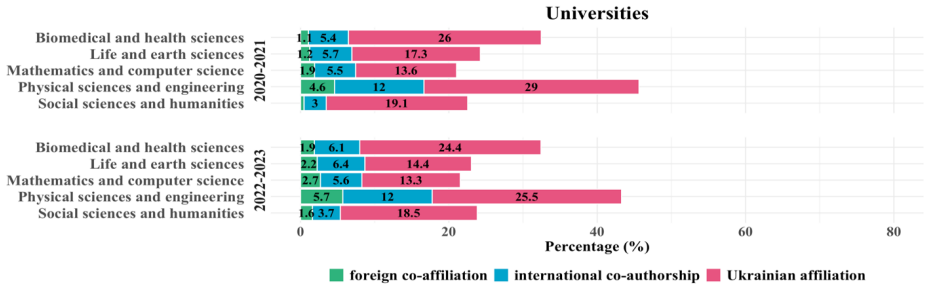
This study examines the role of foreign co-affiliations in shaping the research performance of Ukrainian universities and research institutes of the National Academy of Sciences of Ukraine (NASU) before and during Russias full-scale invasion. In 2023, the share of articles with foreign co-affiliations was higher for NASU (17.1 percent) than for universities (10.6 percent), reflecting NASUs research-oriented profile and strong focus on physical sciences & engineering. In 2022 and 2023, this share increased across all disciplines in both types of institutions. The largest shares of articles with foreign co-affiliations involved institutions in advanced science systems such as Germany and China, as well as neighboring Poland, Czechia, and Slovakia. Articles with foreign co-affiliations showed citation impact comparable to internationally co-authored articles and substantially outperformed purely domestic publications.On the one hand, articles with foreign co-affiliations ensure research continuity and enhance the citation visibility of a resource-constrained and war-affected national science system. On the other hand, they distort the measurement of the national and institutional research performance, thereby hindering reform of the national science system. Reliance solely on international links cannot substitute for a strong domestic base. Evaluation frameworks in Ukraine and other countries could be improved through a two-level differentiation, distinguishing first between types of authorship and second among types of foreign co-affiliations, taking into account their duration and the extent of the affiliated scholars' actual contributions. Although this lies beyond the primary scope of the present study, the findings highlight that the institutional divide between NASU and universities in Ukraine is not justified by research performance.
Editorial analysis
A structured set of objections, weighed in public.
Referee Report
Summary. This study examines the role of foreign co-affiliations in publications from Ukrainian universities and NASU institutes from 2020-2023. It reports that the share of such articles was higher for NASU (17.1% in 2023) than universities (10.6%), increased during the full-scale invasion, with leading partners in Germany, China, Poland, Czechia and Slovakia. Articles with foreign co-affiliations show citation impact comparable to internationally co-authored work and substantially higher than purely domestic publications. The authors conclude that these affiliations ensure continuity but distort national and institutional performance metrics, hindering reform, and recommend a two-level differentiation in evaluation frameworks distinguishing authorship types and foreign co-affiliation characteristics.
Significance. If the empirical claims hold after addressing potential selection biases, the work would provide timely evidence on how international links affect measured performance in a war-affected system, with policy relevance for Ukraine and comparable contexts. The proposed two-level evaluation differentiation could be a constructive contribution to scientometric practice. However, the significance is constrained by the absence of details needed to substantiate the distortion interpretation.
major comments (2)
- [Abstract] Abstract: The central claim that foreign co-affiliations distort performance measurement rests on the reported citation advantage over domestic articles, yet the text supplies no data source, total sample size, handling of multiple affiliations, field-normalization procedure, or statistical tests. This absence renders the shares, comparisons, and distortion conclusion unverifiable.
- [Abstract] Abstract (paragraph on citation impact comparison): The assertion that the citation advantage primarily reflects the presence of foreign co-affiliations (rather than selection on topic, quality, or other factors) is not supported by any controls, matching, or regression analysis. Without such isolation the causal interpretation required for the distortion claim and the policy recommendation remains open to the alternative that higher-impact work is preferentially routed into foreign collaborations.
minor comments (1)
- [Abstract] Abstract: 'Russias full-scale invasion' is missing the possessive apostrophe.
Simulated Author's Rebuttal
We thank the referee for these insightful comments, which help improve the clarity and verifiability of our work. We respond to each major comment in turn.
read point-by-point responses
-
Referee: [Abstract] Abstract: The central claim that foreign co-affiliations distort performance measurement rests on the reported citation advantage over domestic articles, yet the text supplies no data source, total sample size, handling of multiple affiliations, field-normalization procedure, or statistical tests. This absence renders the shares, comparisons, and distortion conclusion unverifiable.
Authors: We agree that additional details are needed in the abstract for verifiability. The full paper uses data from the Scopus database. We will revise the abstract to specify the data source, report the total sample size, describe the approach to multiple affiliations, outline the field-normalization procedure, and indicate the statistical tests applied. This will make the abstract self-contained while the detailed methods remain in the main text. revision: yes
-
Referee: [Abstract] Abstract (paragraph on citation impact comparison): The assertion that the citation advantage primarily reflects the presence of foreign co-affiliations (rather than selection on topic, quality, or other factors) is not supported by any controls, matching, or regression analysis. Without such isolation the causal interpretation required for the distortion claim and the policy recommendation remains open to the alternative that higher-impact work is preferentially routed into foreign collaborations.
Authors: Our analysis is observational and compares citation metrics across different authorship categories without employing matching or regression controls to isolate causal effects. We will revise the manuscript to avoid implying a primary causal role for foreign co-affiliations and instead present the findings as descriptive associations. We will also add a note in the discussion acknowledging potential selection biases as an alternative explanation. The policy recommendation for differentiated evaluation frameworks is grounded in the observed patterns and the inclusion of these articles in national metrics, rather than a strict causal claim. revision: partial
Circularity Check
No circularity; empirical counts from publication records with no derivations or self-referential steps
full rationale
The paper reports shares of articles with foreign co-affiliations and citation comparisons drawn directly from publication records for Ukrainian institutions. No equations, fitted parameters, predictions derived from inputs, or load-bearing self-citations appear in the provided text or abstract. The central observations (e.g., higher shares for NASU, citation advantages) rest on straightforward enumeration rather than any chain that reduces to its own inputs by construction. This is a standard descriptive empirical study with no circularity patterns matching the enumerated kinds.
Axiom & Free-Parameter Ledger
axioms (1)
- domain assumption Citation counts serve as a reasonable proxy for research visibility and impact
Reference graph
Works this paper leans on
-
[1]
Andrason, A., & Brink, J. V. D. (2023). Publishing (mal) practices and their (re) colonizing effects: Double affiliations in academic publishing. Journal of Education (University of KwaZulu - Natal), (91), 70-93. Åslund, A. (2001). Ukraine’s return to Economic Growth. Post-Soviet Geography and Economics, 42(5), 313-328. Åslund, A. (2000). Why has Ukraine ...
-
[2]
Gingras, Y. (2014). The abuses of research evaluation. University World News https://www.universityworldnews.com/post.php?story=20140204141307557 Josephson, P. R., & Egorov, I. (1997). The Deceptive Promise of Reform: Ukrainian Science in Crisis. Minerva, 35(4), 321–347. Halevi, G., Rogers, G., Guerrero-Bote, V. P., & De-Moya-Anegón, F. (2023). Multi-affi...
-
[3]
Hottenrott, H., & Lawson, C. (2022). What is behind multiple institutional affiliations in academia?. Science and Public Policy, 49(3), 382-402. Hunter, R. S., Oswald, A. J., & Charlton, B. G. (2009). The elite brain drain. The Economic Journal, 119(538), F231–F251. Kiselyova, Y., & Ivashchenko, V. (2024). To live your life not in vain”. Ukrainian academi...
discussion (0)
Sign in with ORCID, Apple, or X to comment. Anyone can read and Pith papers without signing in.