Stateful Pricing and Allocation for Repeated Constrained DER Coordination in Distribution Networks
Pith reviewed 2026-06-26 09:57 UTC · model grok-4.3
The pith
The Automatic Market Maker uses stateful fairness states and bilateral prices to allocate scarce network capacity more efficiently than equal-allocation dynamic operating envelopes in repeated DER coordination.
A machine-rendered reading of the paper's core claim, the machinery that carries it, and where it could break.
Core claim
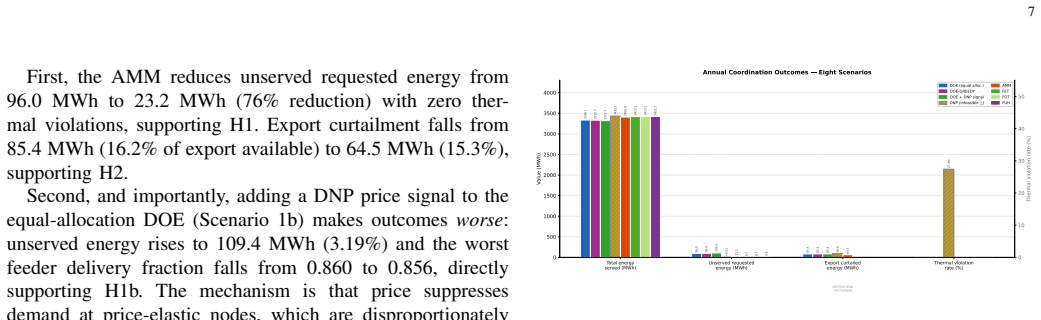
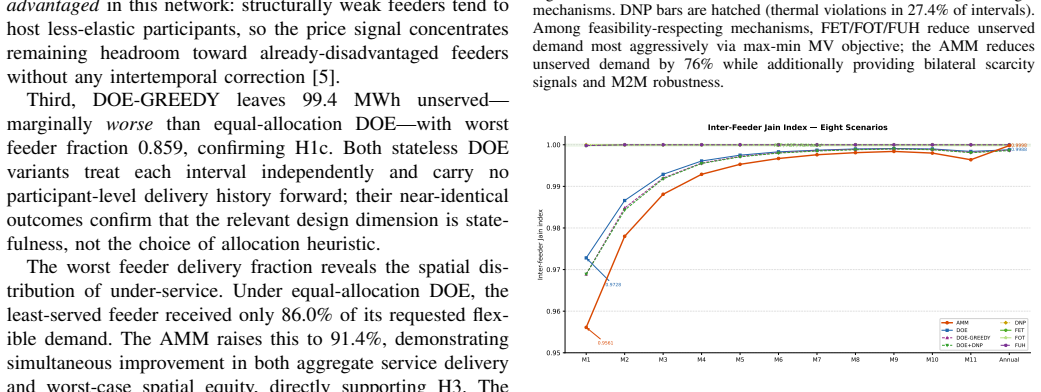
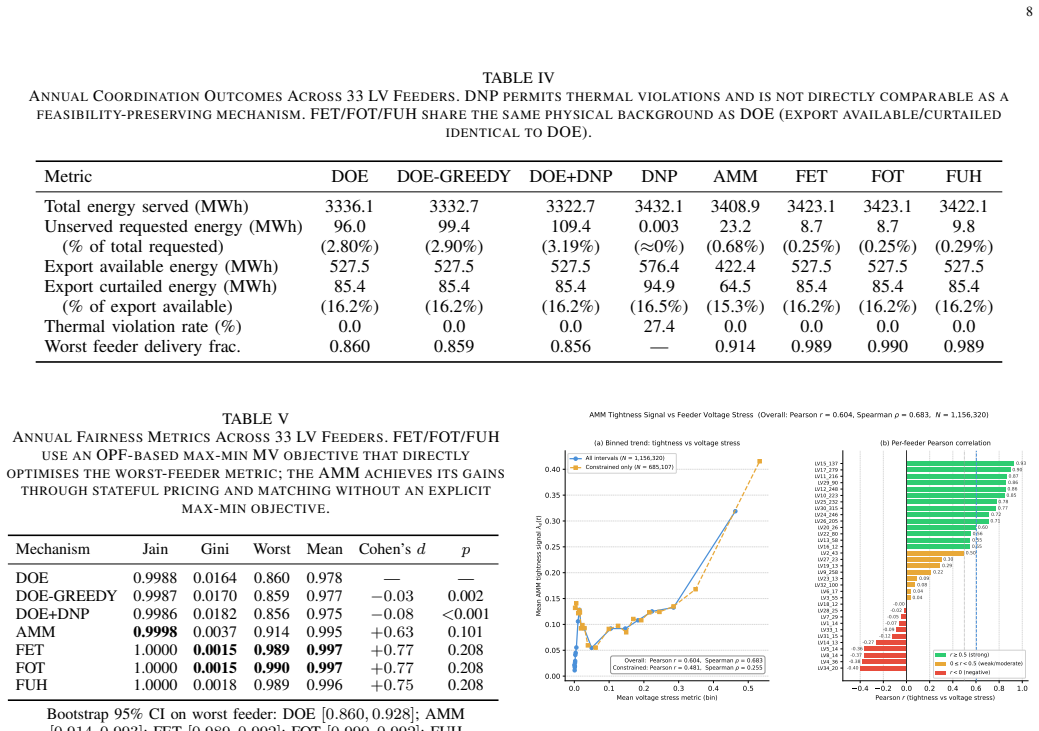
The paper claims that the stateful Automatic Market Maker mechanism, by integrating dual fairness states for import and export, bounded bilateral prices driven by a voltage-aware deficit signal, and feasibility-constrained matching within a two-tier MV/LV architecture, delivers superior performance in repeated constrained DER coordination. It reduces unserved flexible demand by 76 percent from 96.0 MWh to 23.2 MWh with zero thermal violations, lowers export curtailment from 85.4 MWh to 64.5 MWh, and attains an annual inter-feeder Jain index of 0.9998, outperforming DOE variants from month 6 onward while providing bilateral scarcity signals and real-time operation unlike offline max-min DOE f
What carries the argument
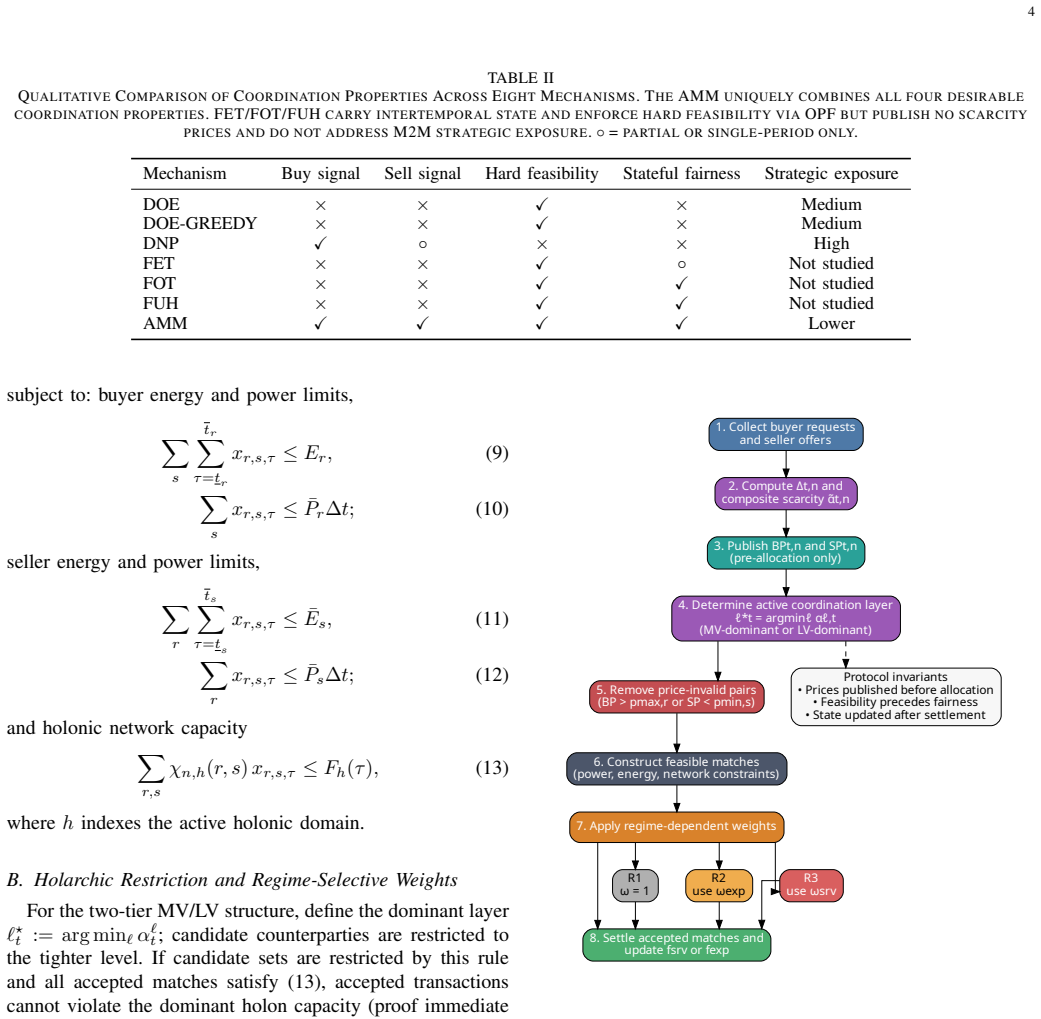
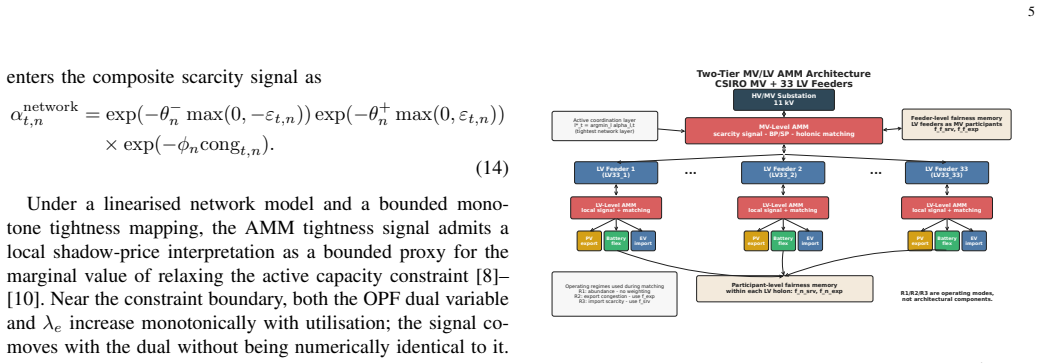
The Automatic Market Maker (AMM), a stateful cyber-physical coordination layer that combines dual fairness states, bounded bilateral prices driven by a voltage-aware deficit signal, and feasibility-constrained matching for additive DER access.
If this is right
- The AMM reduces unserved flexible demand by 76 percent (96.0 MWh to 23.2 MWh) with zero thermal violations.
- Export curtailment drops from 85.4 MWh to 64.5 MWh.
- An annual inter-feeder Jain index of 0.9998 is reached, outperforming all DOE variants from month 6 onward.
- Near-identical performance between DOE and DOE-GREEDY confirms that heuristic choice alone does not improve repeated constrained outcomes.
- AMM supplies bilateral scarcity signals, real-time operation, and participant-level intertemporal correction that the compared DOE formulations lack.
Where Pith is reading between the lines
- The AMM's real-time bilateral signals could be combined with the explicit max-min MV objectives of FET/FOT/FUH methods to address both equity and operational needs.
- The voltage-aware deficit signal may require recalibration when applied to networks with different topologies or sensor placements.
- Field trials would be needed to check whether actual participant responses to the bounded prices match the modeled behavior.
- Similar stateful price-and-allocation layers could be tested for other repeated resource constraints such as water or gas networks.
Load-bearing premise
The CSIRO MV+33LV feeder dataset and the voltage-aware deficit signal used to drive prices accurately represent real network physics and participant behavior without unmodeled dynamics or measurement errors that would invalidate the feasibility guarantees.
What would settle it
A live network deployment that records thermal violations or unserved flexible demand exceeding 23.2 MWh under AMM operation would falsify the feasibility and performance claims.
Figures
read the original abstract
Distribution networks with high penetrations of distributed energy resources (DERs) must repeatedly allocate limited network capability in two directions: under import scarcity, which flexible demand is served, and under export congestion, which generation is curtailed. Dynamic operating envelopes (DOEs) enforce hard feasibility bounds but lack intertemporal correction, while dynamic network prices (DNPs) provide an allocative signal but cannot guarantee constraint satisfaction. This paper develops a stateful cyber-physical coordination mechanism, termed an Automatic Market Maker (AMM), as an additive coordination layer for machine-to-machine DER access. The mechanism combines dual fairness states for import and export, bounded bilateral prices driven by a voltage-aware deficit signal, and feasibility-constrained matching within a two-tier MV/LV architecture. Experiments on the CSIRO MV+33LV feeder dataset compare five mechanisms and benchmark the fair-over-time DOE formulations of Moring et al. (FET, FOT, FUH). Relative to equal-allocation DOE, the AMM reduces unserved flexible demand by 76% (96.0 MWh to 23.2 MWh) with zero thermal violations and reduces export curtailment from 85.4 MWh to 64.5 MWh. Near-identical DOE and DOE-GREEDY performance confirms that heuristic choice alone does not improve repeated constrained outcomes. The AMM reaches an annual inter-feeder Jain index of 0.9998, outperforming all DOE variants from month 6 onwards. Direct benchmarking against FET/FOT/FUH shows that these mechanisms achieve higher worst-feeder equity through an explicit max-min MV objective, but operate offline over predetermined horizons and do not provide bilateral scarcity signals, real-time operation, or participant-level intertemporal correction. The two approaches address different objectives and may be combined in future work.
Editorial analysis
A structured set of objections, weighed in public.
Referee Report
Summary. The paper proposes an Automatic Market Maker (AMM) as a stateful cyber-physical coordination layer for repeated DER allocation under import scarcity and export congestion in distribution networks. It integrates dual fairness states, bounded bilateral prices driven by a voltage-aware deficit signal, and feasibility-constrained matching within a two-tier MV/LV architecture. On the CSIRO MV+33LV feeder dataset, the AMM is shown to reduce unserved flexible demand by 76% (96.0 MWh to 23.2 MWh) with zero thermal violations, cut export curtailment from 85.4 MWh to 64.5 MWh, and achieve an annual inter-feeder Jain index of 0.9998, outperforming equal-allocation DOE and other variants while noting that FET/FOT/FUH address different objectives.
Significance. If the central claims hold, the work provides a practical real-time mechanism that improves allocative efficiency and fairness over static DOE approaches while enforcing constraints, with concrete numerical gains on a realistic MV+33LV dataset. The stateful design with bilateral scarcity signals and intertemporal correction addresses a clear gap between offline DOE formulations and operational needs in high-DER networks.
major comments (2)
- [Experimental evaluation (CSIRO MV+33LV results)] The performance claims (76% unserved-demand reduction, zero thermal violations, and export-curtailment improvement) and the feasibility guarantees rest on the voltage-aware deficit signal computed from network state. The CSIRO MV+33LV experiments report no injection of sensor noise, communication delay, or topology error, so it remains untested whether small deviations from true physics would produce allocations that violate limits even though the nominal simulation shows none.
- [Mechanism description] The exact formulation of the feasibility-constrained matching step and the derivation of the bounded bilateral prices from the deficit signal are not presented with sufficient detail to allow verification that the mechanism indeed enforces hard constraints under the two-tier architecture.
minor comments (1)
- [Abstract] The abstract notes that near-identical DOE and DOE-GREEDY performance confirms heuristic choice alone does not improve outcomes; a short parenthetical on the specific heuristic used in DOE-GREEDY would aid clarity.
Simulated Author's Rebuttal
We thank the referee for the constructive feedback and the recommendation for major revision. The comments identify key areas where additional clarity and discussion will strengthen the manuscript. We address each point below and commit to revisions that improve verifiability without altering the core claims or results.
read point-by-point responses
-
Referee: [Experimental evaluation (CSIRO MV+33LV results)] The performance claims (76% unserved-demand reduction, zero thermal violations, and export-curtailment improvement) and the feasibility guarantees rest on the voltage-aware deficit signal computed from network state. The CSIRO MV+33LV experiments report no injection of sensor noise, communication delay, or topology error, so it remains untested whether small deviations from true physics would produce allocations that violate limits even though the nominal simulation shows none.
Authors: We agree this is a valid concern for deployment. The reported results and zero-violation guarantee hold under the nominal physics model used for the CSIRO MV+33LV dataset, with the feasibility-constrained matching step designed to enforce limits when the deficit signal is accurate. We will revise the experimental section to explicitly state the perfect-information assumption and add a dedicated paragraph in the discussion acknowledging that robustness to sensor noise, delays, and topology errors remains untested. We will also outline how conservative margins could be applied to the voltage-aware deficit signal in practice. A full stochastic sensitivity study lies beyond the current scope. revision: partial
-
Referee: [Mechanism description] The exact formulation of the feasibility-constrained matching step and the derivation of the bounded bilateral prices from the deficit signal are not presented with sufficient detail to allow verification that the mechanism indeed enforces hard constraints under the two-tier architecture.
Authors: We concur that greater mathematical detail is needed for independent verification. In the revised manuscript we will expand the mechanism section to include the precise optimization formulation of the feasibility-constrained matching step at both MV and LV tiers, together with the explicit derivation showing how the voltage-aware deficit signal produces the bounded bilateral prices while preserving hard constraint satisfaction. These additions will make the two-tier enforcement logic fully verifiable from the text. revision: yes
Circularity Check
No significant circularity; claims rest on external simulation benchmarks
full rationale
The paper defines the AMM mechanism via explicit components (dual fairness states, voltage-aware deficit signal, feasibility-constrained matching in two-tier architecture) and evaluates it through simulation on the external CSIRO MV+33LV dataset against independent DOE baselines from Moring et al. No equations reduce a claimed prediction or result to a fitted parameter or self-referential definition by construction. Citations to prior DOE work are external and non-load-bearing for the core performance numbers. The derivation chain is therefore self-contained against external benchmarks.
Axiom & Free-Parameter Ledger
axioms (2)
- domain assumption Voltage-aware deficit signal correctly captures binding network constraints for price formation
- domain assumption Two-tier MV/LV architecture allows independent feasibility-constrained matching at each level
invented entities (1)
-
Automatic Market Maker (AMM)
no independent evidence
Reference graph
Works this paper leans on
-
[1]
S. Sweeney, “Programmable fairness in electricity markets: A cost- causation-consistent alternative to marginal pricing,”Energy Econ., vol. 158, art. no. 109345, 2026, doi: 10.1016/j.eneco.2026.109345
-
[2]
Dynamic operat- ing envelopes in Australian distribution networks: Field trial report,
Australian Renewable Energy Agency (ARENA), “Dynamic operat- ing envelopes in Australian distribution networks: Field trial report,” ARENA, Sydney, Australia, Tech. Rep., 2021
2021
-
[3]
Ensuring equity when trading distributed energy resources via dynamic operating envelopes,
K. Petrouet al., “Ensuring equity when trading distributed energy resources via dynamic operating envelopes,”Appl. Energy, vol. 285, p. 116419, 2021
2021
-
[4]
Basic methodology for calculating dynamic operating envelopes,
A. Guinman and P. Kilby, “Basic methodology for calculating dynamic operating envelopes,” inProc. CIGRE Cairns Int. Symp., paper 123, SC C6, Sep. 2023
2023
-
[5]
Model-free dynamic operating envelopes to support increased penetration of distributed energy resources and reduced curtailment,
P. Kilby, H. Bissett, B. Smith, and B. Banfield, “Model-free dynamic operating envelopes to support increased penetration of distributed energy resources and reduced curtailment,” inProc. CIGRE Session, Paris, France, paper 12365, SC C6, PS2, Aug. 2026 (to appear; pre- print accepted)
2026
-
[6]
Dynamic network prices for prosumer-aware hosting capacity management,
J. Zhanget al., “Dynamic network prices for prosumer-aware hosting capacity management,”arXiv preprintarXiv:2602.12573, 2026
arXiv 2026
-
[7]
Combinatorial information market design,
R. Hanson, “Combinatorial information market design,”Inf. Syst. Fron- tiers, vol. 5, no. 1, pp. 107–119, 2003
2003
-
[8]
F. C. Schweppe, M. C. Caramanis, R. D. Tabors, and R. E. Bohn,Spot Pricing of Electricity. Norwell, MA: Kluwer Academic, 1988
1988
-
[9]
Contract networks for electric power transmission,
W. W. Hogan, “Contract networks for electric power transmission,”J. Regulatory Econ., vol. 4, no. 3, pp. 211–242, 1992
1992
-
[10]
Rate control for communication networks: Shadow prices, proportional fairness and stability,
F. P. Kelly, A. K. Maulloo, and D. K. H. Tan, “Rate control for communication networks: Shadow prices, proportional fairness and stability,”J. Oper. Res. Soc., vol. 49, no. 3, pp. 237–252, 1998
1998
-
[11]
A society of devices: Integrating intelligent distributed resources with transactive energy,
K. Kok and S. Widergren, “A society of devices: Integrating intelligent distributed resources with transactive energy,”IEEE Power Energy Mag., vol. 14, no. 3, pp. 34–45, 2016
2016
-
[12]
An open source platform for collaborating on smart grid research,
R. C. Dugan and T. E. McDermott, “An open source platform for collaborating on smart grid research,” inProc. IEEE PES General Meeting, 2011, pp. 1–7
2011
-
[13]
Fair-over-time distributed energy resource coordination,
H. Moring, X. Farrell, and J. L. Mathieu, “Fair-over-time distributed energy resource coordination,” inProc. 60th Annual Allerton Conf. Communication, Control, and Computing, Monticello, IL, USA, 2024, pp. 1–8
2024
-
[14]
Using OPF- based operating envelopes to facilitate residential DER services,
M. Z. Liu, L. F. Ochoa, P. K. C. Wong, and J. Theunissen, “Using OPF- based operating envelopes to facilitate residential DER services,”IEEE Trans. Smart Grid, vol. 13, no. 6, pp. 4494–4504, 2022
2022
-
[15]
Ensuring distribution network integrity using dynamic operating limits for prosumers,
K. Petrouet al., “Ensuring distribution network integrity using dynamic operating limits for prosumers,”IEEE Trans. Smart Grid, vol. 12, no. 5, pp. 3877–3888, 2021
2021
-
[16]
Allocation of dynamic operating envelopes in dis- tribution networks: Technical and equitable perspectives,
M. R. Alamet al., “Allocation of dynamic operating envelopes in dis- tribution networks: Technical and equitable perspectives,”IEEE Trans. Sustain. Energy, vol. 15, no. 1, pp. 173–186, 2023
2023
-
[17]
Fairness-aware distributed energy coordination for voltage regulation in power distribution systems,
S. Poudelet al., “Fairness-aware distributed energy coordination for voltage regulation in power distribution systems,”IEEE Trans. Sustain. Energy, vol. 14, no. 3, pp. 1866–1880, 2023
2023
-
[18]
Grid-aware aggregation and realtime disaggregation of distributed energy resources in radial networks,
N. Nazir and M. Almassalkhi, “Grid-aware aggregation and realtime disaggregation of distributed energy resources in radial networks,”IEEE Trans. Power Syst., vol. 37, no. 3, pp. 1706–1717, 2022
2022
-
[19]
Fair operating envelopes under uncertainty using chance constrained optimal power flow,
Y . Yi and G. Verbi ˇc, “Fair operating envelopes under uncertainty using chance constrained optimal power flow,”Electr. Power Syst. Res., vol. 213, p. 108465, 2022
2022
-
[20]
Review on fairness in local energy systems,
J. Soareset al., “Review on fairness in local energy systems,”Appl. Energy, vol. 374, p. 123933, 2024
2024
-
[21]
A quantitative measure of fairness and discrimination for resource allocation in shared computer systems,
R. Jain, D.-M. Chiu, and W. R. Hawe, “A quantitative measure of fairness and discrimination for resource allocation in shared computer systems,” DEC Tech. Rep. TR-301, 1984
1984
discussion (0)
Sign in with ORCID, Apple, or X to comment. Anyone can read and Pith papers without signing in.