Optimisation of tipping pathways in a spatially heterogeneous world
Pith reviewed 2026-06-26 06:55 UTC · model grok-4.3
The pith
Small local modifications can prevent tipping or confine collapse in spatially extended bistable systems.
A machine-rendered reading of the paper's core claim, the machinery that carries it, and where it could break.
Core claim
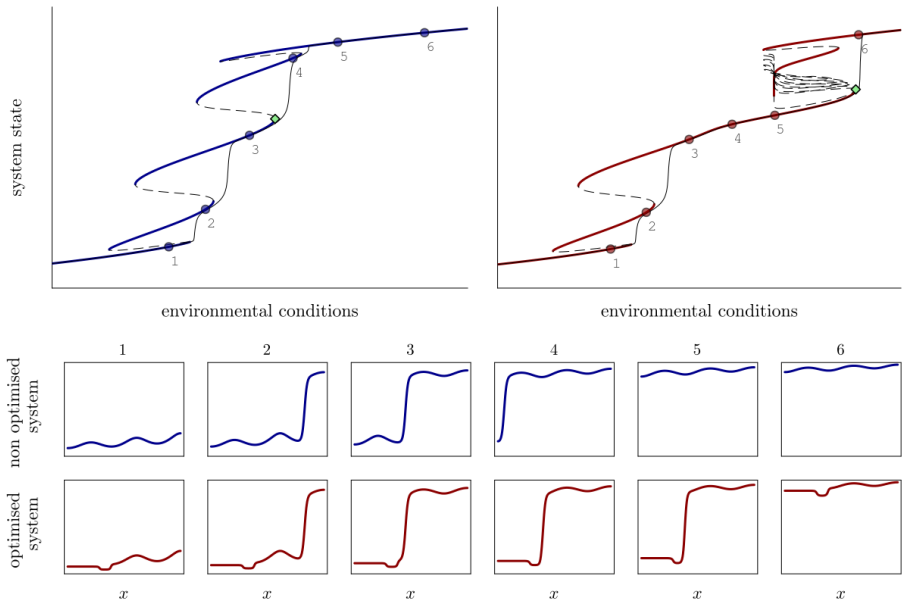
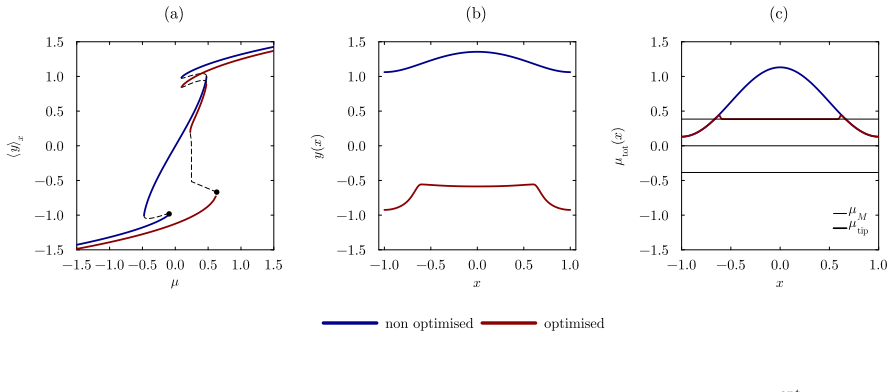
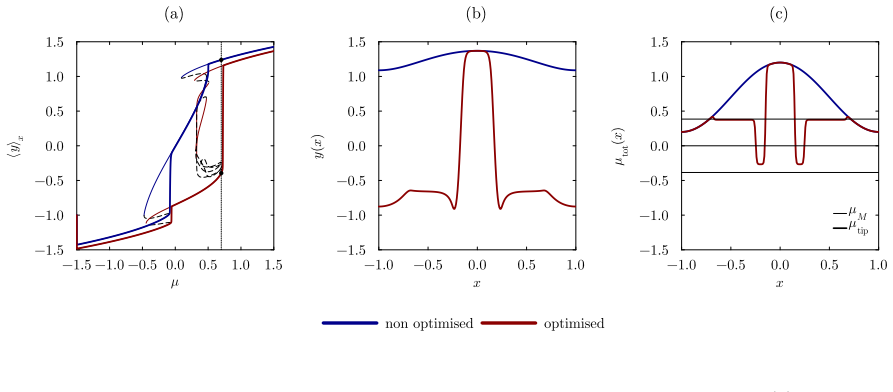
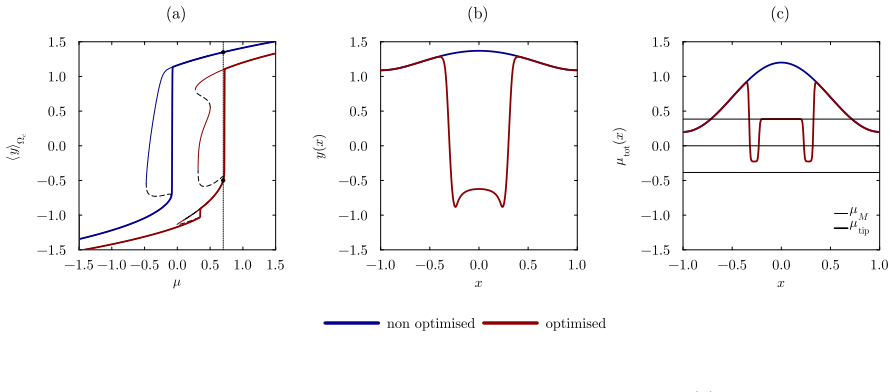
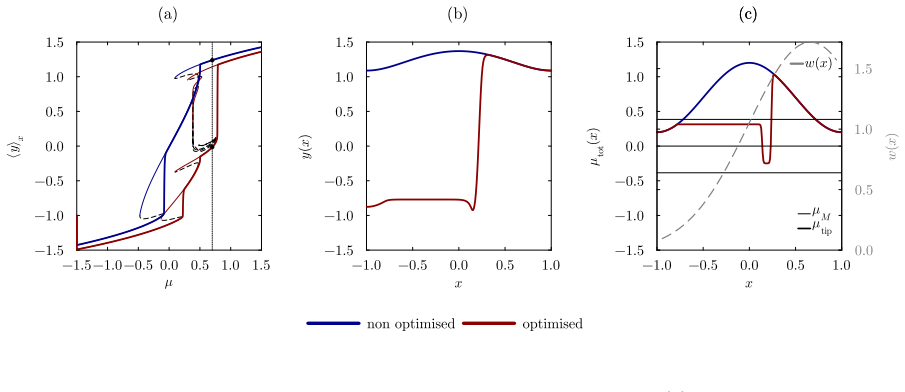
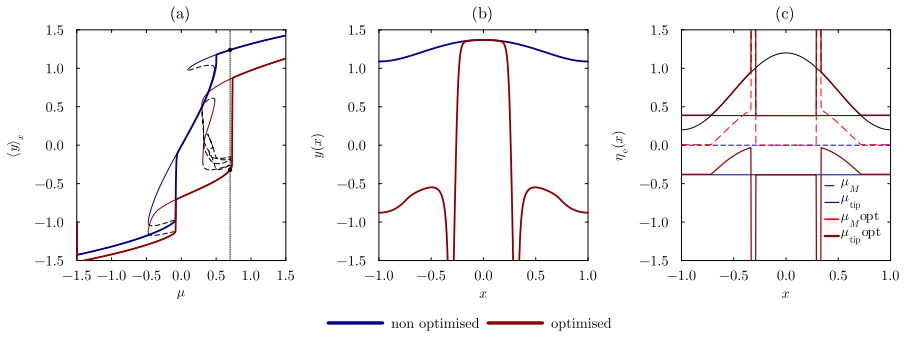
A constrained optimisation framework applied to the one-dimensional Allen-Cahn equation identifies spatial interventions that shift local tipping thresholds and control front dynamics, enabling the prevention of tipping, the induction of recovery of the desirable state, or the confinement of collapse to limited regions of the domain.
What carries the argument
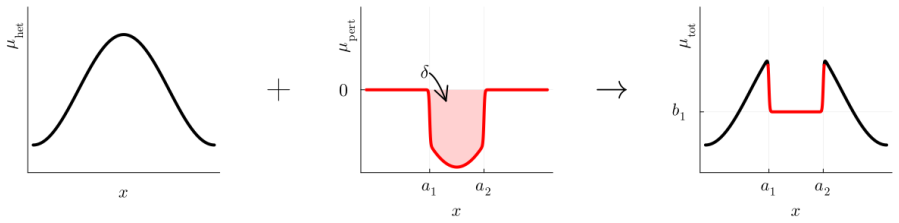
The constrained optimisation framework for spatial interventions in the Allen-Cahn model, which acts by shifting local tipping thresholds and controlling front dynamics under dynamical and resource constraints.
If this is right
- Optimal interventions can prevent tipping from occurring in the system.
- Interventions can induce recovery of the desirable state.
- Collapse can be confined to limited regions of the domain rather than spreading everywhere.
Where Pith is reading between the lines
- The framework could be tested in higher-dimensional spatial models or real ecological data to see if local interventions scale similarly.
- Similar optimisation approaches might apply to other gradient systems or non-gradient tipping models.
- Resource constraints in the optimisation could be calibrated to actual intervention costs in applications like habitat management.
Load-bearing premise
The one-dimensional Allen-Cahn equation with spatial heterogeneity captures the essential spatial tipping processes that occur in gradient systems.
What would settle it
A simulation or real-world observation where small-scale local modifications fail to influence large-scale tipping, front propagation, or state coexistence as the optimisation predicts.
Figures
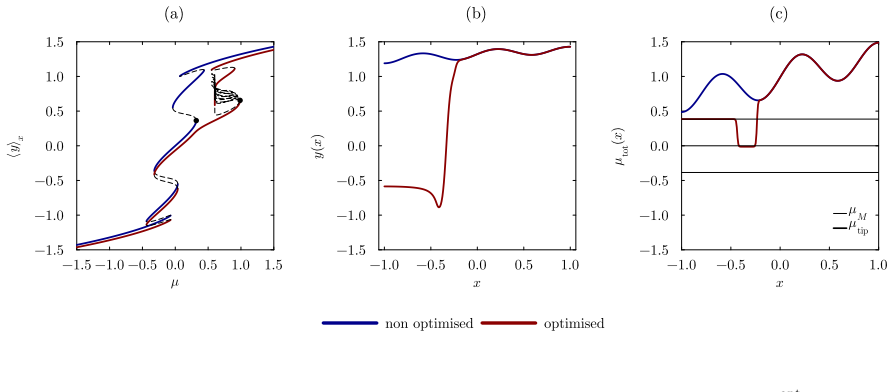
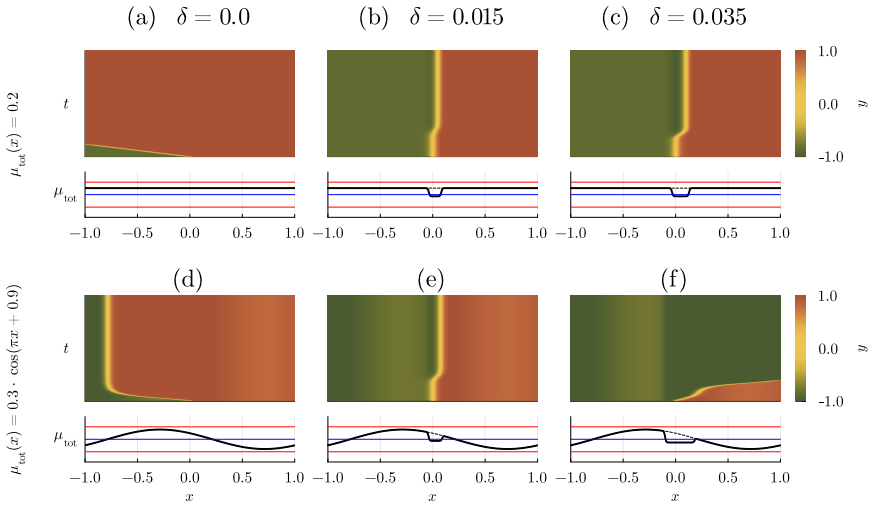
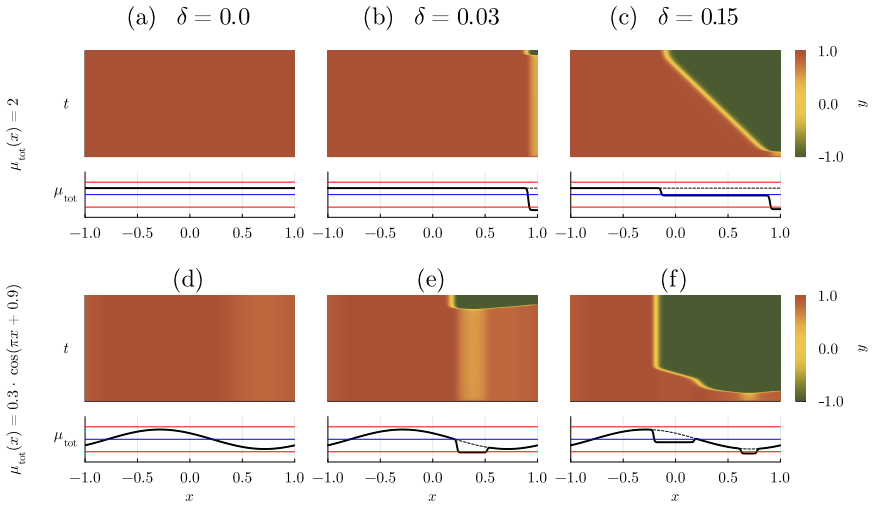
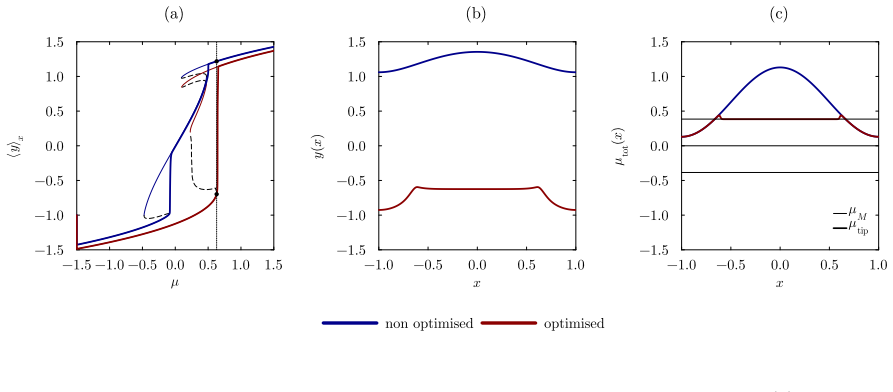
read the original abstract
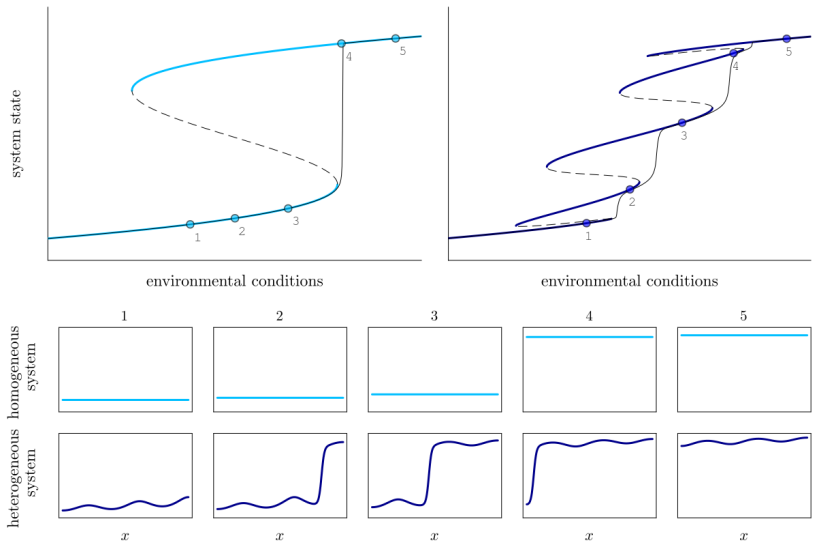
In spatially extended systems, tipping does not necessarily lead to a uniform, abrupt transition typical of low-dimensional conceptual climate models. Instead, spatially structured forms of tipping can emerge, for example, through front propagation and pinning, coexistence between alternative states, and pattern formation. Tipping can therefore remain partial or spatially heterogeneous rather than affecting the entire system. Existing work on spatial tipping in conceptual models remains mostly descriptive, and a general framework to influence tipping dynamics through spatial interventions is still lacking. Here, we introduce a constrained optimisation framework that systematically identifies spatial interventions designed to maximise resilience or promote recovery of a desirable state, subject to dynamical and resource constraints. The framework is general and applicable to a broad class of spatially extended systems. We illustrate it using the one-dimensional Allen-Cahn equation with spatial heterogeneity, a minimal bistable model in which the key spatial tipping processes in gradient systems can be analysed explicitly. In this setting, optimisation acts by shifting local tipping thresholds and controlling front dynamics. Our results show that small-scale local, targeted modifications can determine large-scale system outcomes: optimal interventions can prevent tipping, induce recovery of the desirable state, or confine collapse to limited regions of the domain.
Editorial analysis
A structured set of objections, weighed in public.
Referee Report
Summary. The manuscript introduces a constrained optimisation framework to systematically identify spatial interventions that maximise resilience or promote recovery of a desirable state in spatially extended systems, subject to dynamical and resource constraints. The framework is illustrated using the one-dimensional Allen-Cahn equation with spatial heterogeneity, where optimisation shifts local tipping thresholds and controls front dynamics; the central claim is that small-scale local modifications can prevent tipping, induce recovery, or confine collapse to limited regions.
Significance. If the mathematical results hold, the work supplies a general, optimisation-based approach to influencing spatial tipping that goes beyond the mostly descriptive literature on front propagation and pinning in bistable systems. The explicit analysis permitted by the gradient structure of the Allen-Cahn model is a clear strength, enabling direct control of front dynamics rather than reliance on numerical fitting.
minor comments (2)
- [Abstract] Abstract: the claim that the framework is 'general and applicable to a broad class' would be strengthened by a brief statement of the precise class of systems (e.g., gradient systems with explicit front speeds) for which the optimisation is currently derived.
- The manuscript would benefit from an explicit statement of the resource constraint functional and the numerical scheme used to solve the resulting optimal-control problem, even if only in a dedicated methods subsection.
Simulated Author's Rebuttal
We thank the referee for their positive evaluation and recommendation of minor revision. The referee's summary accurately reflects the scope and contribution of our constrained optimisation framework for spatial tipping in heterogeneous bistable systems, and we appreciate the emphasis placed on the explicit analysis permitted by the gradient structure of the Allen-Cahn equation.
Circularity Check
No significant circularity
full rationale
The paper introduces a constrained optimisation framework and applies it to the standard one-dimensional Allen-Cahn equation with spatial heterogeneity, described as a minimal bistable model permitting explicit analysis of front dynamics. The abstract and provided text present the model and its gradient structure as external inputs, with optimisation acting on tipping thresholds and front propagation without any reduction of predictions to fitted parameters by construction, self-definitional steps, or load-bearing self-citations. The derivation chain remains self-contained against the external model.
Axiom & Free-Parameter Ledger
axioms (1)
- domain assumption The Allen-Cahn equation with spatial heterogeneity captures the key spatial tipping processes in gradient systems.
Reference graph
Works this paper leans on
-
[1]
Lenton, Hermann Held, Elmar Kriegler, Jim W
Timothy M. Lenton, Hermann Held, Elmar Kriegler, Jim W. Hall, Wolfgang Lucht, Stefan Rahmstorf, and Hans Joachim Schellnhuber. “Tipping elements in the Earth’s climate system”. In:Proceedings of the National Academy of Sciences105.6 (2008), pp. 1786– 1793.doi:https://doi.org/10.1073/pnas.0705414105
-
[2]
Contribution of Working Groups I, II and III to the Sixth Assessment Report of the Intergovernmental Panel on Climate Change
IPCC.Climate Change 2023: Synthesis Report. Contribution of Working Groups I, II and III to the Sixth Assessment Report of the Intergovernmental Panel on Climate Change. Geneva, Switzerland: Intergovernmental Panel on Climate Change, 2023.doi:10.59327/ IPCC/AR6-9789291691647
2023
-
[3]
Climate tipping points–too risky to bet against
Timothy M. Lenton, Johan Rockstr¨ om, Owen Gaffney, Stefan Rahmstorf, Katherine Richard- son, Will Steffen, and Hans Joachim Schellnhuber. “Climate tipping points–too risky to bet against”. In:Nature575.7784 (2019), pp. 592–595
2019
-
[4]
Catastrophic shifts in ecosystems
Marten Scheffer, Stephen R. Carpenter, Jonathan A. Foley, Carl Folke, and Brian Walker. “Catastrophic shifts in ecosystems”. In:Nature413.6856 (2001), pp. 591–596.doi:10. 1038/35098000
2001
-
[5]
Exceeding 1.5°C global warming could trigger multiple climate tipping points
David I. Armstrong McKay, Arie Staal, Jesse F. Abrams, Ricarda Winkelmann, Boris Sakschewski, Sina Loriani, Ingo Fetzer, Sarah E. Cornell, Johan Rockstr¨ om, and Timo- thy M. Lenton. “Exceeding 1.5°C global warming could trigger multiple climate tipping points”. In:Science377.6611 (2022), eabn7950.doi:10.1126/science.abn7950
-
[6]
CRC Press, 2015
Ehud Meron.Nonlinear Physics of Ecosystems. CRC Press, 2015
2015
-
[7]
Rethinking tipping points in spatial ecosystems
Swarnendu Banerjee, Mara Baudena, Paul Carter, Robbin Bastiaansen, Arjen Doelman, and Max Rietkerk. “Rethinking tipping points in spatial ecosystems”. In:The American Naturalist207.4 (2026), pp. 483–502.doi:10.1086/739177
-
[8]
Gradual regime shifts in spatially extended ecosystems
Golan Bel, Aric Hagberg, and Ehud Meron. “Gradual regime shifts in spatially extended ecosystems”. In:Theoretical Ecology5.4 (2012), pp. 591–604.doi:10.1007/s12080-011- 0149-6
-
[9]
Regime shifts by front dynamics
Yuval R. Zelnik and Ehud Meron. “Regime shifts by front dynamics”. In:Ecological Indi- cators94 (2018), pp. 544–552.issn: 1470-160X.doi:10.1016/j.ecolind.2017.10.068. 20
-
[10]
Bistability, wave pinning and localisation in natural reaction–diffusion systems
Alan R. Champneys, Fahad Al Saadi, Victor F. Bre˜ na-Medina, Verˆ onica A. Grieneisen, Athanasius F. M. Mar´ ee, Nicolas Verschueren, and Bert Wuyts. “Bistability, wave pinning and localisation in natural reaction–diffusion systems”. In:Physica D: Nonlinear Phenom- ena416 (2021), p. 132735.issn: 0167-2789.doi:10.1016/j.physd.2020.132735
-
[11]
Beyond Turing: The response of ecosystems to environmental change
Koen Siteur, Maarten B. Eppinga, Derek Karssenberg, Mara Baudena, and Max Rietkerk. “Beyond Turing: The response of ecosystems to environmental change”. In:Ecological Complexity20 (2014), pp. 21–30
2014
-
[12]
Fragmented tipping in a spatially heterogeneous world
Robbin Bastiaansen, Henk Dijkstra, and Anna S. von der Heydt. “Fragmented tipping in a spatially heterogeneous world”. In:Environmental Research Letters17 (Apr. 2022), p. 045006.doi:10.1088/1748-9326/ac59a8
-
[13]
Regular pattern formation in real ecosystems
Max Rietkerk and Johan van de Koppel. “Regular pattern formation in real ecosystems”. In:Trends in Ecology and Evolution23.3 (2008), pp. 169–175.issn: 0169-5347.doi:10. 1016/j.tree.2007.10.013
2008
-
[14]
Evasion of tipping in complex systems through spatial pattern formation
Max Rietkerk, Robbin Bastiaansen, Swarnendu Banerjee, Johan van de Koppel, Mara Bau- dena, and Arjen Doelman. “Evasion of tipping in complex systems through spatial pattern formation”. In:Science374.6564 (2021), eabj0359.doi:10.1126/science.abj0359
-
[15]
High-integrity human intervention in ecosystems: Tracking self-organization modes
Yuval R. Zelnik, Yair Mau, Moshe Shachak, and Ehud Meron. “High-integrity human intervention in ecosystems: Tracking self-organization modes”. In:PLOS Computational Biology17.9 (Oct. 2021), pp. 1–23.doi:10.1371/journal.pcbi.1009427
-
[16]
Exploiting delayed transitions to sustain semiarid ecosystems after catastrophic shifts
B. Vidiella, J. Sardany´ es, and R. Sol´ e. “Exploiting delayed transitions to sustain semiarid ecosystems after catastrophic shifts”. In:Journal of the Royal Society Interface15.143 (2018), p. 20180083.doi:10.1098/rsif.2018.0083
-
[17]
Self- organization of vegetation in arid ecosystems
Max Rietkerk, Maarten C. Boerlijst, Frank van Langevelde, Raf HilleRisLambers, Jo- han van de Koppel, Lalit Kumar, Herbert H. T. Prins, and Andr´ e M. de Roos. “Self- organization of vegetation in arid ecosystems”. In:The American Naturalist160.4 (2002), pp. 524–530.doi:10.1086/342078
-
[18]
Pattern formation–a missing link in the study of ecosystem response to environmental changes
Ehud Meron. “Pattern formation–a missing link in the study of ecosystem response to environmental changes”. In:Mathematical Biosciences271 (2016), pp. 1–18.doi:10 . 1016/j.mbs.2015.10.015
2016
-
[19]
From Patterns to Function in Living Systems: Dryland Ecosystems as a Case Study
Ehud Meron. “From Patterns to Function in Living Systems: Dryland Ecosystems as a Case Study”. In:Annual Review of Condensed Matter Physics9 (2018), pp. 79–103.doi: 10.1146/annurev-conmatphys-033117-053959
-
[20]
Johannes Lohmann, Henk A. Dijkstra, Markus Jochum, Valerio Lucarini, and Peter D. Ditlevsen. “Multistability and intermediate tipping of the Atlantic Ocean Circulation”. In: Science Advances10.12 (2024), eadi4253.doi:10.1126/sciadv.adi4253
-
[21]
Marine ice sheet dynamics: the impacts of ice-shelf buttressing
Samuel S. Pegler. “Marine ice sheet dynamics: the impacts of ice-shelf buttressing”. In: Journal of Fluid Mechanics857 (2018), pp. 605–647.doi:10.1017/jfm.2018.741
-
[22]
Resilience of dynamical systems
Hana Krakovsk´ a, Christian K¨ uhn, and Iacopo P. Longo. “Resilience of dynamical systems”. In:European Journal of Applied Mathematics35.1 (2024), pp. 155–200.doi:10.1017/ S0956792523000141
2024
-
[23]
Resilience and stability of ecological systems
C. S. Holling. “Resilience and stability of ecological systems”. In:Annual Review of Ecology and Systematics4 (1973), pp. 1–23
1973
-
[24]
Metastable patterns in solutions ofu t =ϵ 2uxx −f(u)
J. Carr and R. L. Pego. “Metastable patterns in solutions ofu t =ϵ 2uxx −f(u)”. In: Communications on Pure and Applied Mathematics42.5 (1989), pp. 523–576.doi:10. 1002/cpa.3160420502
1989
-
[25]
Kaper.Multi-front dynamics in spatially inhomogeneous Allen-Cahn equations
Robbin Bastiaansen, Arjen Doelman, and Tasso J. Kaper.Multi-front dynamics in spatially inhomogeneous Allen-Cahn equations. 2025. arXiv:2501.16195 [math.DS]. 21
arXiv 2025
-
[26]
Conditional nonlinear optimal perturbation and its applications
M. Mu, W. S. Duan, and B. Wang. “Conditional nonlinear optimal perturbation and its applications”. In:Nonlinear Processes in Geophysics10.6 (2003), pp. 493–501.doi:10. 5194/npg-10-493-2003.url:https://npg.copernicus.org/articles/10/493/2003/
2003
-
[27]
An adjoint-free method to determine conditional nonlinear optimal perturbations
Aleid Oosterwijk, Henk A. Dijkstra, and Tristan van Leeuwen. “An adjoint-free method to determine conditional nonlinear optimal perturbations”. In:Computers and Geosciences 106 (2017), pp. 190–199.issn: 0098-3004.doi:10.1016/j.cageo.2017.06.014
-
[28]
Ground state structures in ordered binary alloys with second neighbor interactions
S. M. Allen and J. W. Cahn. “Ground state structures in ordered binary alloys with second neighbor interactions”. In:Acta Metallurgica20.3 (1972), pp. 423–433.doi:10. 1016/0001-6160(72)90037-5
1972
-
[29]
A. J. Bray. “Theory of phase-ordering kinetics”. In:Advances in Physics43.3 (June 1994), pp. 357–459.issn: 1460-6976.doi:10.1080/00018739400101505
-
[30]
Algorithm 733: TOMP–Fortran modules for optimal control calculations
Dieter Kraft. “Algorithm 733: TOMP–Fortran modules for optimal control calculations”. In:ACM Transactions on Mathematical Software20 (1994), pp. 262–281.doi:10.1145/ 192115.192124
arXiv 1994
-
[31]
Johnson.NLopt: nonlinear optimization library
Steven G. Johnson.NLopt: nonlinear optimization library. 2007.url:https://github. com/stevengj/nlopt(visited on 05/14/2026)
2007
-
[32]
Julia: A fresh ap- proach to numerical computing
Jeff Bezanson, Alan Edelman, Stefan Karpinski, and Viral B. Shah. “Julia: A fresh ap- proach to numerical computing”. In:SIAM Review59.1 (2017), pp. 65–98.doi:10.1137/ 141000671
2017
-
[33]
July 2020
Romain Veltz.BifurcationKit.jl. July 2020. hal:hal - 02902346.url:https : / / hal . archives-ouvertes.fr/hal-02902346
2020
-
[34]
Robbin Bastiaansen, Arjen Doelman, Maarten B. Eppinga, and Max Rietkerk. “The Ef- fect of Climate Change on the Resilience of Ecosystems with Adaptive Spatial Pattern Formation”. In:Ecology Letters23.3 (2020), pp. 414–429.doi:10.1111/ele.13449
-
[35]
Paul Carter, Arjen Doelman, Kaitlynn Lilly, Erin Obermayer, and Shreyas Rao. “Criteria for the (in)stability of planar interfaces in singularly perturbed 2-component reaction– diffusion equations”. In:Physica D: Nonlinear Phenomena444 (2023), p. 133596.doi: 10.1016/j.physd.2022.133596
-
[36]
Front Instabilities Can Reverse Desertification
Cristian Fernandez-Oto, Omer Tzuk, and Ehud Meron. “Front Instabilities Can Reverse Desertification”. In:Physical Review Letters122.4 (Jan. 2019), p. 048101.doi:10.1103/ PhysRevLett.122.048101
2019
-
[37]
Tr¨ oltzsch.Optimal Control of Partial Differential Equations: Theory, Methods, and Applications
F. Tr¨ oltzsch.Optimal Control of Partial Differential Equations: Theory, Methods, and Applications. Graduate Studies in Mathematics. American Mathematical Society, 2010. isbn: 978-0-8218-4904-0
2010
-
[38]
Sparse Optimal Control of the Schl¨ ogl and FitzHugh–Nagumo Systems
Eduardo Casas, Christopher Ryll, and Fredi Tr¨ oltzsch. “Sparse Optimal Control of the Schl¨ ogl and FitzHugh–Nagumo Systems”. In:Computational Methods in Applied Mathe- matics13.4 (2013), pp. 415–442.doi:10.1515/cmam-2013-0016. 22 A Additional optimisation variants Description: Additional numerical examples illustrating the flexibility of the proposed op...
discussion (0)
Sign in with ORCID, Apple, or X to comment. Anyone can read and Pith papers without signing in.