REVIEW 2 major objections 15 references
Wireless Personal Agent: Extending Wireless Intelligence from Networks to Terminals
T0 review · 2 major / 0 minor · reviewed 2026-06-26 · grok-4.3
Pith's one-line read WISPA decouples an offline LLM agent from an online executor to let terminals personalize wireless resource decisions from user traces.
desk verdict WISPA splits LLM work into offline reflection and online parameter use for terminal wireless decisions, but the single campus demo gives no baselines or validation that the parameters actually drive better choices. read the letter →
The pith
A machine-rendered reading of the paper's core claim, the machinery that carries it, and where it could break.
The reading
What carries the argument
The WISPA decoupling of offline LLM agent reflection, which extracts and refines interpretable preference parameters from terminal traces, from online deterministic resource execution that applies the parameters in real time.
What would settle it
Run a controlled test on the same terminal traces with known user intent labels and measure whether parameter updates from the LLM agent lead to access decisions that match the labeled intent or fail to show adaptation gains.
Extended reading notes
Core claim
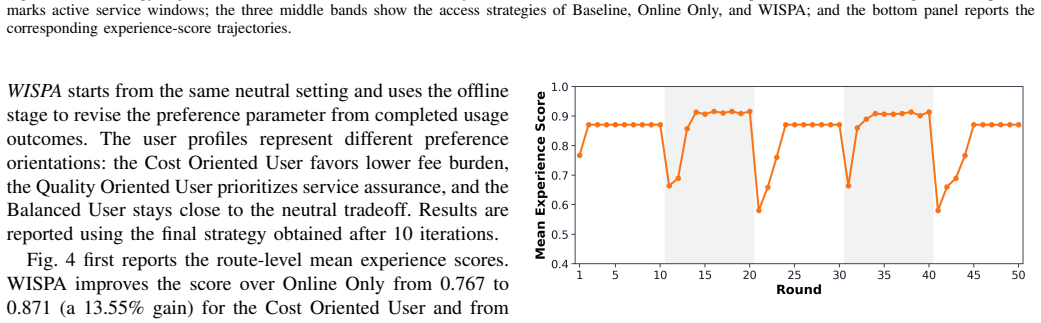
WISPA achieves automated terminal-side resource management by decoupling latency-sensitive online execution, which uses fixed preference parameters for decisions, from offline LLM agent reflection that analyzes traces, refines user profiles, and updates the parameters, enabling adaptation to individual behaviors as demonstrated in numerical results on a campus commute route.
Load-bearing premise
The offline LLM agent can reliably extract and refine interpretable preference parameters from terminal traces that then produce improved online decisions.
Editorial extensions
If this is right
- Terminals can execute resource decisions locally without running full LLM inference during operation.
- Access choices adapt automatically as user preferences evolve through periodic offline updates.
- Resource allocation incorporates user-perceived elements like cost and privacy alongside network metrics.
- The framework supports self-evolution of the agent based on long-term usage behavior.
Reading between the lines
- If the learned parameters prove stable, the same trace-to-parameter pipeline could extend to predicting and pre-allocating resources for recurring mobility patterns.
- Devices might reduce energy use by avoiding handoffs that conflict with learned cost or privacy preferences.
- Pairing terminal agents with network-side optimization could create feedback loops where device decisions inform and are informed by base-station policies.
Editorial analysis
A structured set of objections, weighed in public.
Referee Report
Summary. The manuscript proposes WISPA, a framework decoupling latency-sensitive online resource execution (using lightweight deterministic decisions driven by interpretable preference parameters) from offline LLM-based agent reflection that analyzes terminal traces, refines user profiles, and updates those parameters. It claims this enables automated terminal-side resource management that learns user-specific connection styles and adapts access decisions as preferences change, demonstrated via numerical results on a single campus commute route.
Significance. If the central claim holds with proper validation, the work could meaningfully extend wireless intelligence beyond network-side optimization to user-centric terminal adaptation incorporating context, mobility, cost, and privacy. However, the current evidence base—a single demonstration without reported baselines, error bars, trace collection details, or causal validation of LLM parameter updates—does not yet establish this extension.
major comments (2)
- [Abstract] Abstract: the claim that 'Numerical results show that WISPA learns user-specific connection styles and adapts access decisions as preferences change' is load-bearing for the central contribution, yet the abstract (and available description) supplies no baselines, error bars, data exclusion criteria, or metric demonstrating that offline LLM parameter updates causally reduce misalignment with user intent rather than merely correlating with traces.
- [Abstract] Abstract: the framework description states that the offline LLM 'analyzes terminal-side traces, refines user profiles, and updates online preference parameters,' but provides no mechanism for trace collection, no ground-truth user intent labels, and no validation that parameter updates improve decisions on held-out data; this creates a circularity risk where parameters are both derived from and evaluated on the same unspecified traces.
Simulated Author's Rebuttal
We thank the referee for the constructive feedback on the abstract claims and validation approach. We agree that the central contribution requires clearer support in the abstract and will revise to address concerns about evidence strength, trace details, and potential circularity while preserving the manuscript's focus on the decoupled framework. Point-by-point responses follow.
read point-by-point responses
-
Referee: [Abstract] Abstract: the claim that 'Numerical results show that WISPA learns user-specific connection styles and adapts access decisions as preferences change' is load-bearing for the central contribution, yet the abstract (and available description) supplies no baselines, error bars, data exclusion criteria, or metric demonstrating that offline LLM parameter updates causally reduce misalignment with user intent rather than merely correlating with traces.
Authors: We acknowledge the need for the abstract to be self-contained on this point. The manuscript's Section 4 reports results against static-parameter and non-adaptive baselines on the campus commute scenario, with figures including standard-deviation error bars across repeated runs; a misalignment metric (preference deviation score) is used to quantify adaptation after LLM updates. We will revise the abstract to briefly reference these elements and the observed improvement. On causality, the design shows before/after decision changes following preference shifts, though we agree this falls short of formal causal inference and will add a limitations discussion. revision: partial
-
Referee: [Abstract] Abstract: the framework description states that the offline LLM 'analyzes terminal-side traces, refines user profiles, and updates online preference parameters,' but provides no mechanism for trace collection, no ground-truth user intent labels, and no validation that parameter updates improve decisions on held-out data; this creates a circularity risk where parameters are both derived from and evaluated on the same unspecified traces.
Authors: Trace collection is performed via on-device logging of connection outcomes, mobility, and usage events during the simulated commute, with offline processing of aggregated summaries rather than raw replay. User intent is represented directly by the interpretable preference parameters, which serve as the ground truth in the scenario. We will add explicit description of the logging mechanism and profile refinement steps. Validation uses parameter updates applied to subsequent trace segments; we will clarify this separation to reduce circularity appearance and note the lack of formal held-out cross-validation as a limitation. revision: yes
Circularity Check
No circularity: framework decouples offline reflection from online execution with external empirical demonstration
full rationale
The abstract describes a decoupled architecture in which an offline LLM agent processes terminal traces to refine profiles and update interpretable preference parameters, while a lightweight online executor applies those parameters to make deterministic decisions. Numerical results are presented on a campus commute route to illustrate learning of user-specific styles and adaptation as preferences change. No equations, self-citations, or fitted-input-as-prediction steps appear in the provided text that would reduce the central claim to a tautology or to the same traces by construction. The derivation therefore remains self-contained against the external benchmark of observed adaptation on the reported scenario.
Assumptions & free parameters
free parameters (1)
- interpretable preference parameters
assumptions (1)
- domain assumption Terminal-side traces contain extractable user preference signals that an LLM can reliably refine into actionable parameters.
Cite this review
Pith. "Pith review of Wireless Personal Agent: Extending Wireless Intelligence from Networks to Terminals." pith.science (2026). https://pith.science/paper/CE56TEP4
@misc{pith2026260623255,
  author       = {Pith},
  title        = {Pith review of: Wireless Personal Agent: Extending Wireless Intelligence from Networks to Terminals},
  year         = {2026},
  howpublished = {\url{https://pith.science/paper/CE56TEP4}},
  note         = {Machine review of arXiv:2606.23255}
}
read the original abstract
Wireless networks are evolving from connectivity-oriented infrastructures into intelligent and personalized service platforms. Existing wireless intelligence remains centered on network-side optimization, improving objectives such as throughput, latency, and coverage. Nevertheless, besides network performance, wireless intelligence also depends on user-perceived experience via application context, mobility routine, service cost, privacy preference, and long-term usage behavior. This article proposes WISPA, a Wireless Intelligent Self-evolving Personal Agent framework for automated terminal-side resource management based on large language model (LLM)-based agent. To overcome the resource constraints on terminals, WISPA decouples the latency-sensitive online resource execution from offline LLM agent reflection. In this way, a lightweight online executor makes deterministic resource decisions using interpretable preference parameters; While an offline LLM agent analyzes terminal-side traces, refines user profiles, and updates online preference parameters for subsequent decisions. At last, we demonstrate the practical applicability and benefits of WISPA for terminal-side resource allocations on a campus commute route. Numerical results show that WISPA learns user-specific connection styles and adapts access decisions as preferences change.
Figures


Figures from the paper (3 more)


Reference graph
Works this paper leans on
-
[1]
Large language models for wireless communications: From adaptation to autonomy,
L. Liang, H. Ye, Y . Sheng, O. Wang, J. Wang, S. Jin, and G. Y . Li, “Large language models for wireless communications: From adaptation to autonomy,”IEEE Commun. Magazine, Early Access 2026
2026
-
[2]
Empowering wireless networks with artificial intelligence-generated graph,
J. Wang, Y . Liu, H. Du, D. Niyato, J. Kang, H. Zhou, and D. I. Kim, “Empowering wireless networks with artificial intelligence-generated graph,”IEEE Netw., Early Access 2026
2026
-
[3]
Large generative ai models for telecom: The next big thing?,
L. Bariah, Q. Zhao, H. Zou, Y . Tian, F. Bader, and M. Debbah, “Large generative ai models for telecom: The next big thing?,”IEEE Commun. Magazine, vol. 62, pp. 84–90, Nov. 2024
2024
-
[4]
Telco-RAG: Navigating the challenges of retrieval-augmented language models for telecommunications,
A.-L. Bornea, F. Ayed, A. De Domenico, N. Piovesan, and A. Maatouk, “Telco-RAG: Navigating the challenges of retrieval-augmented language models for telecommunications,”arXiv preprint arXiv:2404.15939, 2024
-
[5]
Evolved universal terrestrial radio access (E-UTRA); physical layer; measurements,
3GPP, “Evolved universal terrestrial radio access (E-UTRA); physical layer; measurements,” Technical Specification TS 36.214, 3rd Genera- tion Partnership Project, 2024
2024
-
[6]
V ocabulary for performance, quality of service and qual- ity of experience,
ITU-T, “V ocabulary for performance, quality of service and qual- ity of experience,” ITU-T Recommendation P.10/G.100, International Telecommunication Union, 2017
2017
-
[7]
A survey on large language model based autonomous agents,
L. Wang, C. Ma, X. Feng, Z. Zhang, H. Yang, J. Zhang, Z. Chen, J. Tang, X. Chen, Y . Lin,et al., “A survey on large language model based autonomous agents,”Frontiers of Computer Science, vol. 18, no. 6, pp. 1–26, 2024
2024
-
[8]
From large ai models to agentic ai: A tutorial on future intelligent communications,
F. Jiang, C. Pan, K. Wang, P. Michiardi, O. A. Dobre, and M. Debbah, “From large ai models to agentic ai: A tutorial on future intelligent communications,”IEEE J. Sel, Areas Commun., Early Access 2026
2026
Show all 15 references
-
[9]
A tutorial on cross-layer opti- mization in wireless networks,
X. Lin, N. B. Shroff, and R. Srikant, “A tutorial on cross-layer opti- mization in wireless networks,”IEEE J. Sel. areas Commun., vol. 24, pp. 1452–1463, Aug. 2006
2006
-
[10]
Artificial neural networks-based machine learning for wireless networks: A tutorial,
M. Chen, U. Challita, W. Saad, C. Yin, and M. Debbah, “Artificial neural networks-based machine learning for wireless networks: A tutorial,” IEEE Commun. Surv. Tut., vol. 21, no. 4, pp. 3039–3071, 2019
2019
-
[11]
Llm4cp: Adapting large language models for channel prediction,
B. Liu, X. Liu, S. Gao, X. Cheng, and L. Yang, “Llm4cp: Adapting large language models for channel prediction,”J. Commun. Information Netw., vol. 9, no. 2, pp. 113–125, 2024
2024
-
[12]
Wirelessagent: Large language model agents for intelligent wireless networks,
J. Tong, W. Guo, J. Shao, Q. Wu, Z. Li, Z. Lin, and J. Zhang, “Wirelessagent: Large language model agents for intelligent wireless networks,”China Commun., vol. 23, pp. 265–285, Mar. 2026
2026
-
[13]
A survey on mobile edge computing: The communication perspective,
Y . Mao, C. You, J. Zhang, K. Huang, and K. B. Letaief, “A survey on mobile edge computing: The communication perspective,”IEEE commun. sur. tut., vol. 19, no. 4, pp. 2322–2358, 2017
2017
-
[14]
System Architecture for the 5G System (5GS); Stage 2,
3GPP, “System Architecture for the 5G System (5GS); Stage 2,” Technical Specification TS 23.501, 3rd Generation Partnership Project (3GPP), Sept. 2023. Version 16.18.0, Release 16
2023
-
[15]
End-user multimedia QoS categories,
ITU-T, “End-user multimedia QoS categories,” ITU-T Recommendation G.1010, International Telecommunication Union, 2001
2001
Reviewed June 26, 2026 · model on record in the stance chip above.
Discussion (0). Sign in to comment.