From Lab to Landscape: Assessing the Impact of Pesticides on Pollinator Populations Based on Laboratory Data by Combining ALMaSS and BufferGUTS
Pith reviewed 2026-06-26 05:54 UTC · model grok-4.3
The pith
Coupling BufferGUTS to ALMaSS converts lab survival data into daily survival probabilities for landscape-scale bee population simulations.
A machine-rendered reading of the paper's core claim, the machinery that carries it, and where it could break.
Core claim
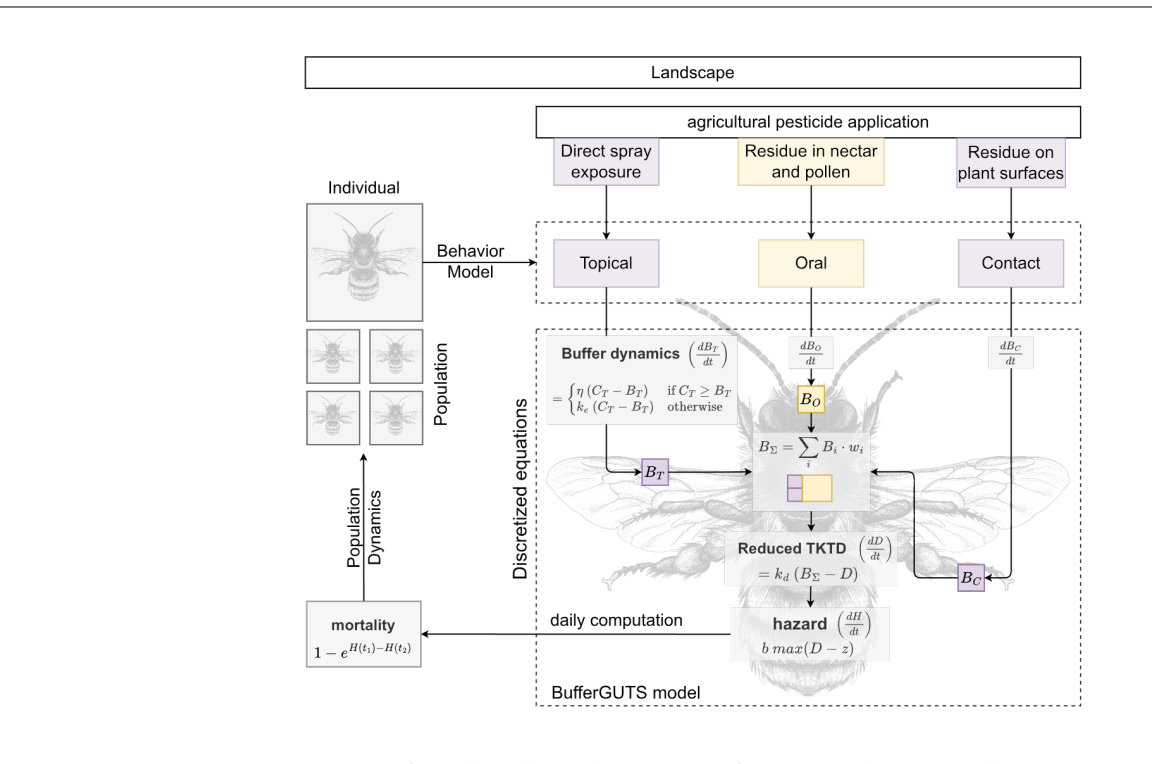
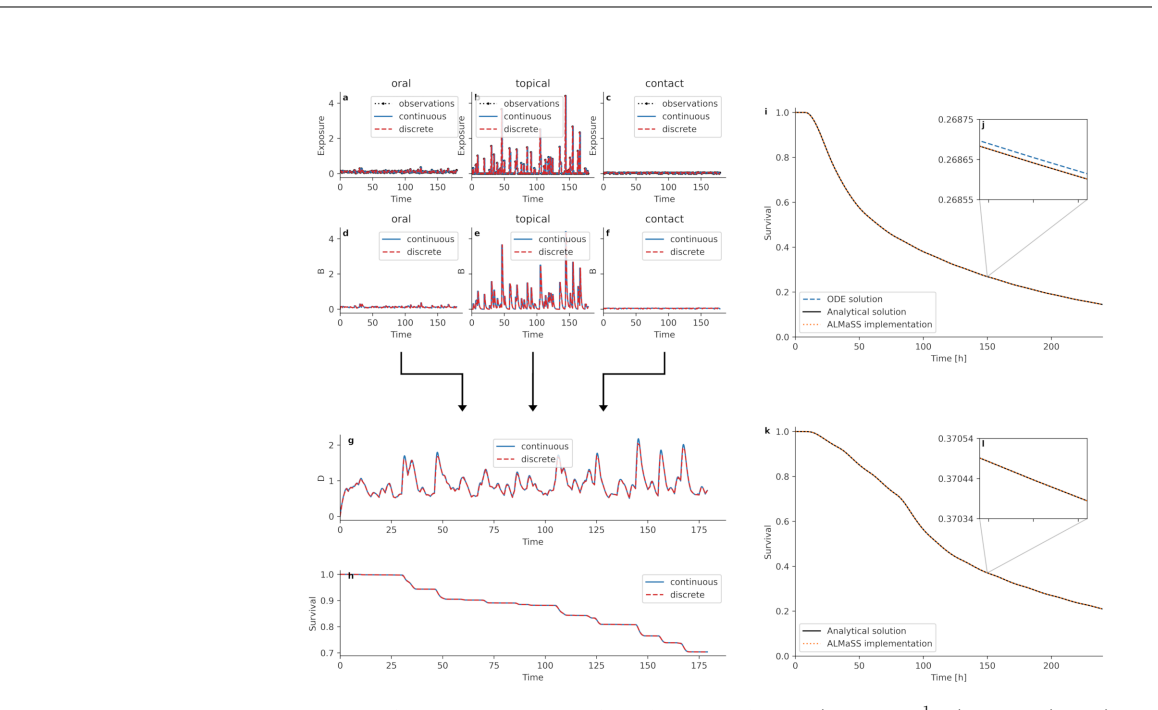
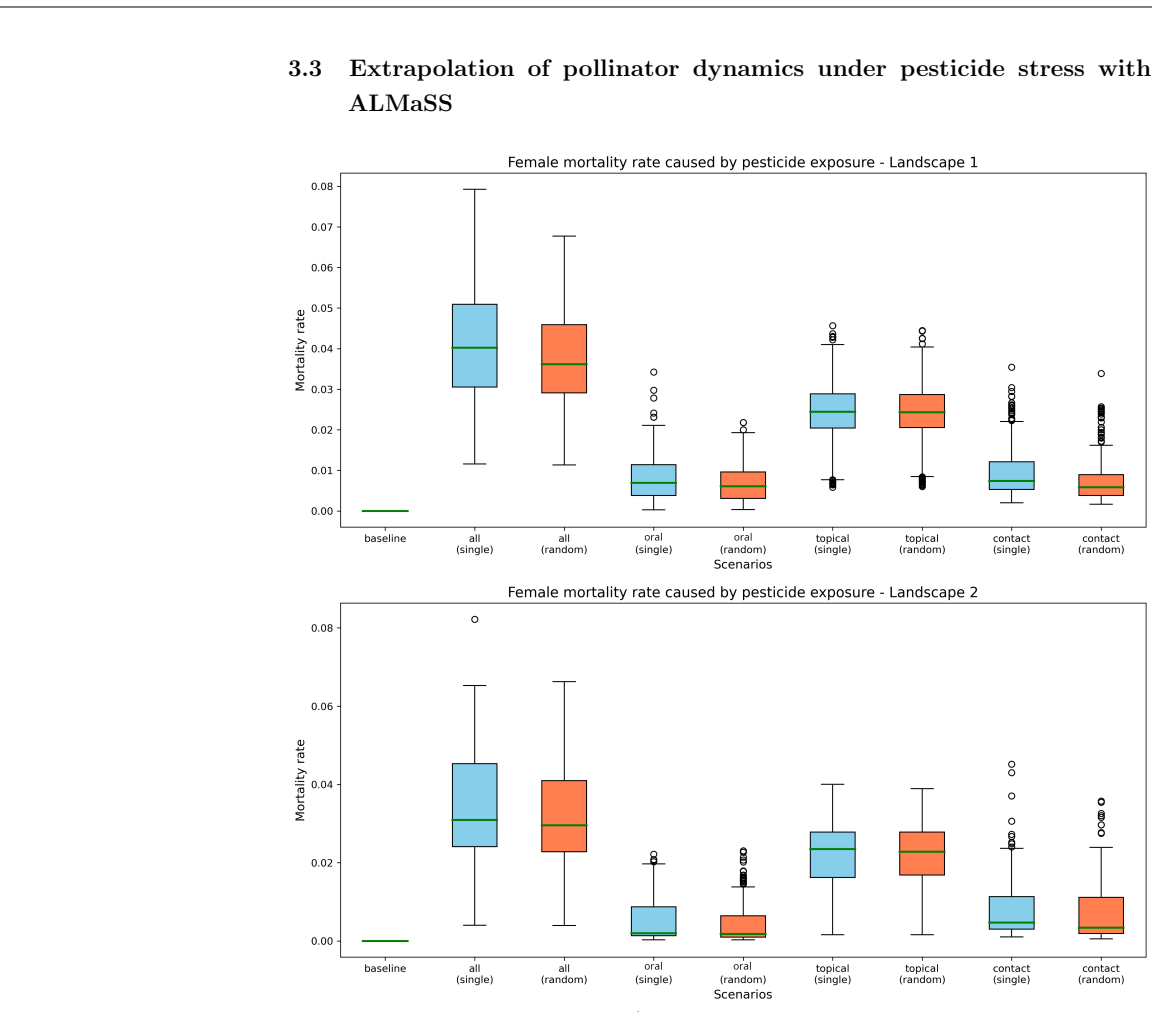
The integration of BufferGUTS into ALMaSS landscape simulation was achieved with high numerical precision, allowing for the calculation of daily survival probabilities for model organisms in the ALMaSS framework. Even extreme application rates only led to negligible population effects in ALMaSS simulations, but an exploratory analysis of pesticide-driven larval mortality showed that effects might be more severe when all life stages are considered.
What carries the argument
The parameter transfer step that takes BufferGUTS survival parameters calibrated on laboratory topical and oral exposure data and supplies them to ALMaSS model organisms to compute daily survival probabilities inside the landscape simulation.
If this is right
- Mechanistic models embedded in individual-based frameworks can combine exposure and effect data for systems-based environmental risk assessment.
- Current laboratory-derived thresholds may produce conservative estimates when only adult survival is modelled.
- Full consideration of larval mortality across life stages could reveal stronger population-level consequences than adult-only simulations.
- The approach demonstrates a pathway to bridge controlled experiments with landscape-scale risk assessments for next-generation ERA tools.
Where Pith is reading between the lines
- Extending the coupling to additional life stages or other non-target arthropods would test whether the negligible-effect result holds more generally.
- If real landscapes include repeated applications or multiple pesticides, the combined exposure could push outcomes beyond the single-product negligible range shown here.
- The high numerical precision of the integration suggests the main remaining uncertainty lies in the transferability of lab parameters rather than in the simulation mathematics.
Load-bearing premise
Parameters fitted to laboratory survival curves can be used directly in landscape simulations to represent actual field exposure and resulting population dynamics.
What would settle it
Population counts of Osmia bicornis in agricultural landscapes after documented sulfoxaflor applications at the modeled rates, compared against the ALMaSS predictions of negligible decline.
Figures
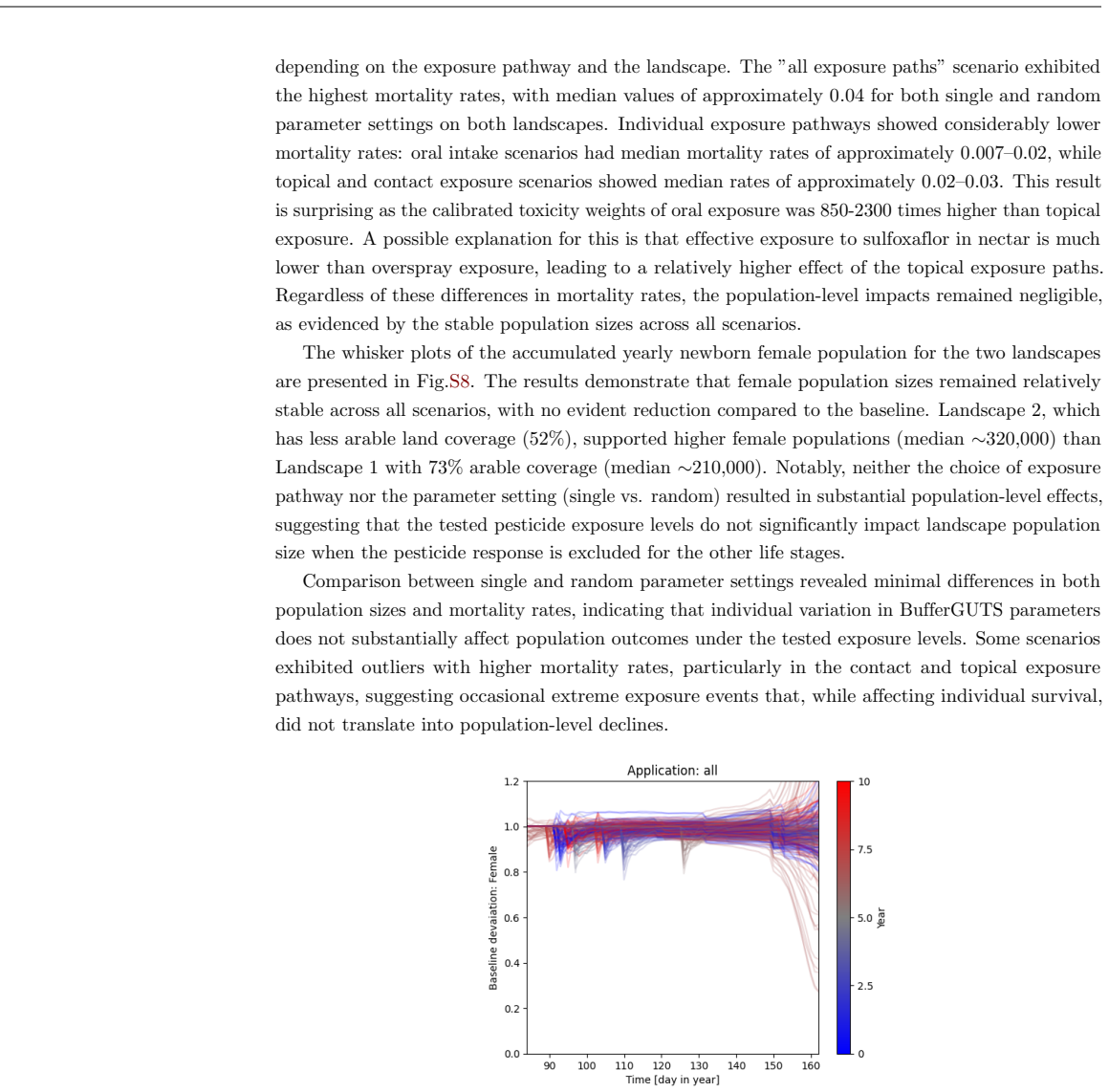
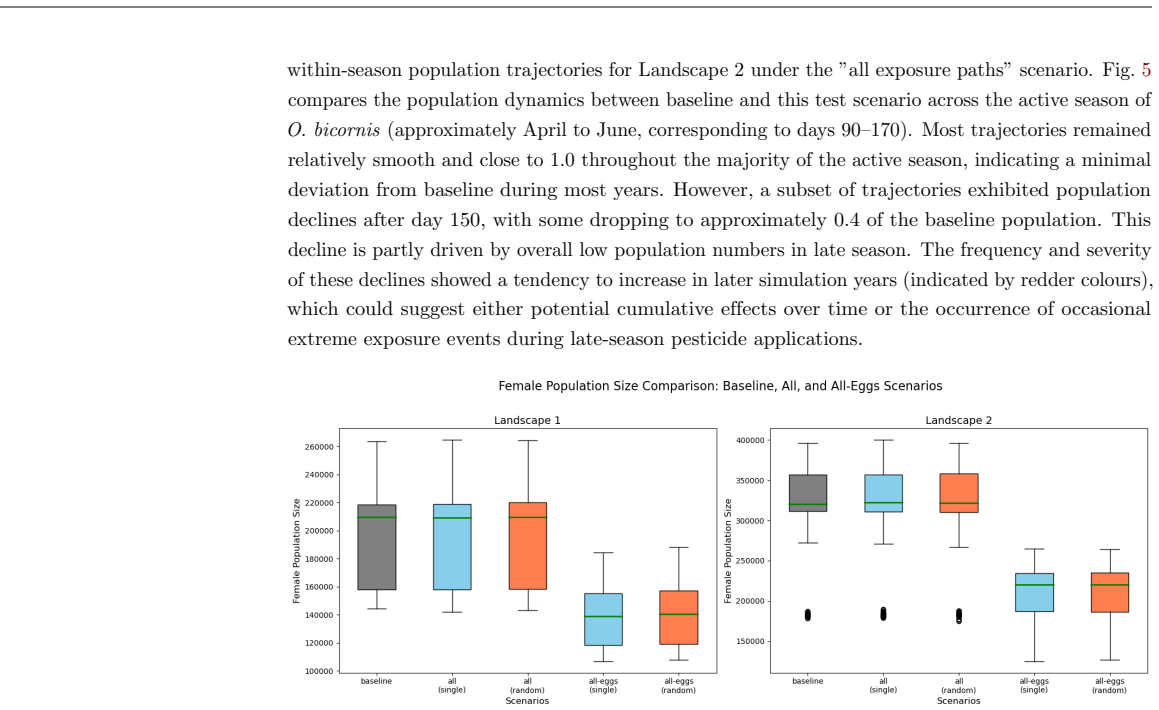
read the original abstract
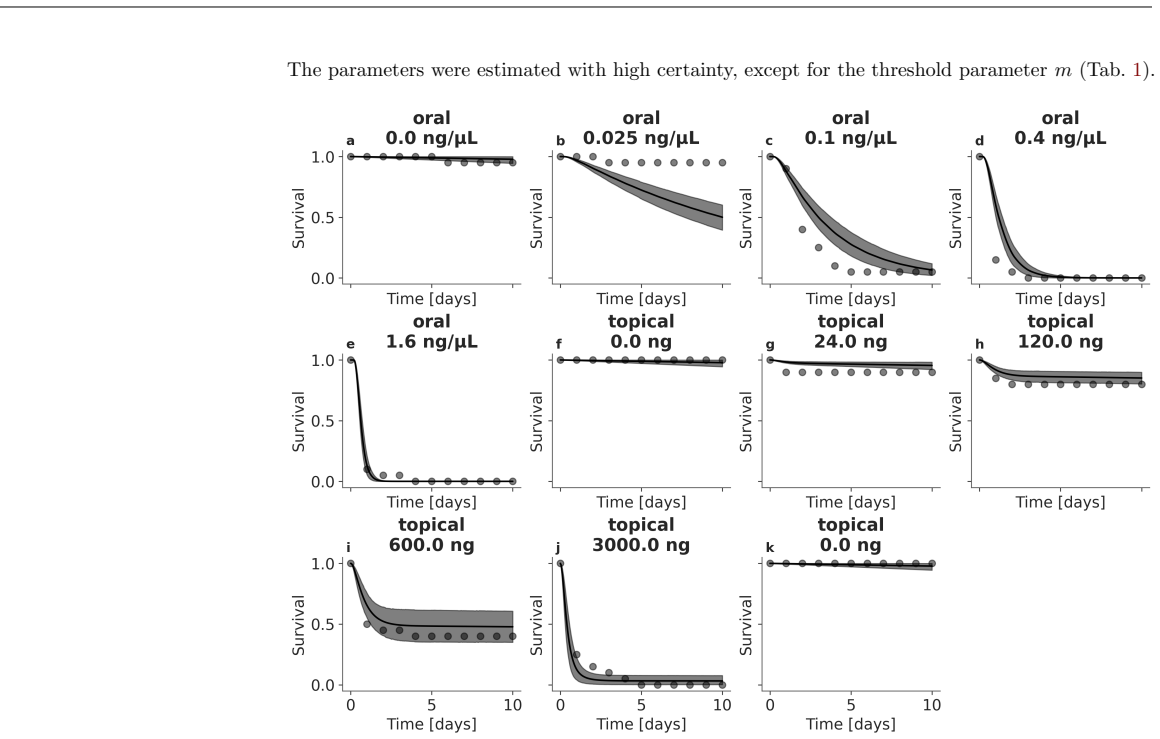
Pesticides are designed to eradicate pests from crops, fulfilling an important role in the current agricultural system. However, nature conservation requires that pesticide applications are protective for non-target organisms, which provide ecosystem services on the other hand. Environmental risk assessment (ERA) is supposed to strike this balance, but the current use of laboratory derived toxicity thresholds in the landscape context, without consideration of population and landscape dynamics might be too coarse to achieve this task. Here, we propose to overcome this limitation by coupling the Animal, Landscape, and Man Simulation System with the BufferGUTS model for non-target arthropods. We conducted a case study of the solitary bee Osmia bicornis exposed to the pesticide formulation Closer (a.i. sulfoxaflor) to assess the integration. Laboratory survival data of topical and oral exposure to Closer were used to calibrate BufferGUTS models. The resulting parameters were used to parametrise model organisms in ALMaSS simulations to extrapolate the effects of sulfoxaflor at different exposure levels on population dynamics. The integration of BufferGUTS into ALMaSS landscape simulation was achieved with high numerical precision, allowing for the calculation of daily survival probabilities for model organisms in the ALMaSS framework. We found that even extreme application rates only led to negligible population effects in ALMaSS simulations, but an exploratory analysis of pesticide-driven larval mortality showed that effects might be more severe when all life stages are considered. The work demonstrates how mechanistic modelling embedded into individual based modelling frameworks can support ERA by combining exposure and effect in systems-based ERA tools, bridging the gap between controlled laboratory experiments and realistic landscape-scale risk assessments for next generation ERA.
Editorial analysis
A structured set of objections, weighed in public.
Referee Report
Summary. The manuscript describes coupling the ALMaSS individual-based landscape model with the BufferGUTS toxicokinetic-toxicodynamic model to extrapolate laboratory survival data for Osmia bicornis exposed to sulfoxaflor (Closer) into landscape-scale population dynamics. Lab-derived topical and oral exposure data calibrate BufferGUTS parameters that are then used to set daily survival probabilities for ALMaSS model organisms; simulations at varying application rates report high numerical precision in the integration and negligible population-level effects, while an exploratory larval-mortality analysis indicates potentially stronger impacts when all life stages are considered.
Significance. If the parameter-transfer step is shown to be robust, the work would demonstrate a concrete route for embedding mechanistic effect models inside spatially explicit IBMs, thereby advancing systems-based ERA that links controlled dosing to realistic exposure and population processes. The explicit numerical-precision check and the authors' own caveat on omitted life stages are positive features.
major comments (2)
- [Methods (parameterisation of ALMaSS organisms) and Results (population-effect simulations)] The central claim of negligible population effects (even at extreme rates) rests on direct transfer of BufferGUTS parameters calibrated solely on laboratory topical/oral survival data into ALMaSS model organisms whose exposure is generated by landscape and behavior rules. No independent validation or sensitivity test of this transfer against variable field exposure is described; the reported numerical precision only confirms correct implementation of the survival function, not its ecological validity. This assumption is load-bearing for the extrapolation result.
- [Abstract and exploratory analysis paragraph] The exploratory larval-mortality analysis is presented as indicating potentially more severe effects, yet the main ALMaSS runs omit larval stages. Because the paper itself flags this incompleteness, the reported negligible effects cannot be taken as a comprehensive assessment of population consequences without a quantitative comparison of adult-only versus full-life-cycle scenarios.
minor comments (1)
- [Integration description] Clarify the exact mapping between BufferGUTS daily survival output and the ALMaSS individual mortality schedule (e.g., whether stochastic draws or deterministic thresholds are used).
Simulated Author's Rebuttal
We thank the referee for the constructive review and the opportunity to clarify aspects of our work on coupling BufferGUTS with ALMaSS. We respond point-by-point to the major comments below, indicating planned revisions where they strengthen the manuscript without altering its core scope as a case study of model integration.
read point-by-point responses
-
Referee: [Methods (parameterisation of ALMaSS organisms) and Results (population-effect simulations)] The central claim of negligible population effects (even at extreme rates) rests on direct transfer of BufferGUTS parameters calibrated solely on laboratory topical/oral survival data into ALMaSS model organisms whose exposure is generated by landscape and behavior rules. No independent validation or sensitivity test of this transfer against variable field exposure is described; the reported numerical precision only confirms correct implementation of the survival function, not its ecological validity. This assumption is load-bearing for the extrapolation result.
Authors: The manuscript presents a mechanistic coupling where BufferGUTS parameters, calibrated on lab survival data, determine daily survival probabilities within ALMaSS's spatially explicit exposure and behavior framework. The high numerical precision confirms faithful implementation of this transfer. We acknowledge that independent field validation of the transferred parameters would further support ecological validity, but such data are outside the scope of the current case study. In revision we will add a sensitivity analysis on the BufferGUTS parameters (e.g., varying LC50 and slope within reported confidence intervals) to test robustness of the negligible-effect conclusion under the modeled landscape exposures. revision: partial
-
Referee: [Abstract and exploratory analysis paragraph] The exploratory larval-mortality analysis is presented as indicating potentially more severe effects, yet the main ALMaSS runs omit larval stages. Because the paper itself flags this incompleteness, the reported negligible effects cannot be taken as a comprehensive assessment of population consequences without a quantitative comparison of adult-only versus full-life-cycle scenarios.
Authors: We agree that a side-by-side quantitative comparison would clarify the implications of the omitted larval stages. The main simulations are restricted to adult stages because the available lab data and current ALMaSS Osmia implementation focus on adults; the larval analysis is explicitly labeled exploratory. In the revised manuscript we will expand the exploratory section to include a direct quantitative comparison of population trajectories (e.g., abundance and extinction risk metrics) between the adult-only runs and scenarios that incorporate the larval-mortality effect sizes derived from the same BufferGUTS framework. revision: yes
- Independent field validation data for the BufferGUTS-to-ALMaSS parameter transfer under variable real-world exposures are not available within the present study.
Circularity Check
No circularity: lab calibration feeds forward into independent landscape simulation
full rationale
The derivation chain consists of (1) fitting BufferGUTS parameters to independent laboratory survival data for Osmia bicornis under controlled topical/oral dosing, then (2) embedding those fixed parameters into ALMaSS to compute daily survival probabilities under spatially explicit exposure generated by the landscape model. The reported 'high numerical precision' is an implementation verification of the coupling, not a fitted or self-referential result. No step renames a fitted quantity as a prediction, invokes self-citation for a uniqueness claim, or defines the output in terms of the input. The central simulation outcomes (negligible adult effects at extreme rates) are therefore not forced by construction from the calibration data.
Axiom & Free-Parameter Ledger
free parameters (1)
- BufferGUTS calibration parameters
axioms (1)
- domain assumption Laboratory toxicity parameters from BufferGUTS apply directly to field exposure conditions in the ALMaSS landscape model.
Reference graph
Works this paper leans on
-
[1]
More than 75 Percent Decline over 27 Years in Total Flying Insect Biomass in Protected Areas
Caspar A. Hallmann et al. “More than 75 Percent Decline over 27 Years in Total Flying Insect Biomass in Protected Areas”. In:PloS one12.10 (Jan. 2017), p. 0185809.doi: 10.1371/ journal.pone.0185809
2017
-
[2]
Insect Declines in the Anthropocene
David L. Wagner. “Insect Declines in the Anthropocene”. In:Annual review of entomology65 (Jan. 2020), pp. 457–480.issn: 0066-4170.doi:10.1146/annurev-ento-011019-025151
-
[3]
Arthropod Decline in Grasslands and Forests Is Associated with Landscape-Level Drivers
Sebastian Seibold et al. “Arthropod Decline in Grasslands and Forests Is Associated with Landscape-Level Drivers”. In:Nature574.7780 (Oct. 2019), pp. 671–674.issn: 0028-0836, 1476-4687.doi:10.1038/s41586-019-1684-3. (Visited on 11/27/2025)
-
[4]
Seed coating with a neonicotinoid insecticide negatively affects wild bees
Maj Rundl¨ of et al. “Seed coating with a neonicotinoid insecticide negatively affects wild bees”. In:Nature521.7550 (2015), pp. 77–80
2015
-
[5]
Safeguarding Pollinators and Their Values to Human Well-Being
Simon G. Potts et al. “Safeguarding Pollinators and Their Values to Human Well-Being”. In:Nature540.7632 (Dec. 2016), pp. 220–229.issn: 0028-0836, 1476-4687.doi: 10.1038/ nature20588. (Visited on 02/17/2026)
2016
-
[6]
Bee Declines Driven by Combined Stress from Parasites, Pesticides, and Lack of Flowers
Dave Goulson et al. “Bee Declines Driven by Combined Stress from Parasites, Pesticides, and Lack of Flowers”. In:Science347.6229 (Mar. 2015), p. 1255957.issn: 0036-8075, 1095-9203. doi:10.1126/science.1255957. (Visited on 02/17/2026)
-
[7]
The Environmental Risks of Neonicotinoid Pesticides: A Review of the Evidence Post 2013
Thomas James Wood and Dave Goulson. “The Environmental Risks of Neonicotinoid Pesticides: A Review of the Evidence Post 2013”. In:Environmental science and pollution research international24.21 (Jan. 2017), pp. 17285–17325.doi:10.1007/s11356-017-9240-x
-
[8]
No Net Insect Abundance and Diversity Declines across US Long Term Ecological Research Sites
Michael S. Crossley et al. “No Net Insect Abundance and Diversity Declines across US Long Term Ecological Research Sites”. In:Nature ecology & evolution4.10 (Jan. 2020), pp. 1368–1376. doi:10.1038/s41559-020-1269-4
-
[9]
A Balance of Winners and Losers in the Anthropocene
Maria Dornelas et al. “A Balance of Winners and Losers in the Anthropocene”. In:Ecology letters22.5 (Jan. 2019), pp. 847–854.doi:10.1111/ele.13242
-
[10]
Johan Axelman et al. “A systems-based analysis to rethink the European environmental risk assessment of regulated chemicals using pesticides as a pilot case”. In:Science of The Total Environment948 (2024), p. 174526.issn: 0048-9697.doi: https://doi.org/10.1016/j. scitotenv.2024.174526.url: https://www.sciencedirect.com/science/article/pii/ S00489697240467...
work page doi:10.1016/j 2024
-
[11]
Matthias A. Becher et al. “REVIEW: Towards a Systems Approach for Understanding Honeybee Decline: A Stocktaking and Synthesis of Existing Models”. In:Journal of Applied Ecology50.4 (Aug. 2013). Ed. by Ingolf Steffan-Dewenter, pp. 868–880.issn: 0021-8901, 1365-2664.doi: 10.1111/1365-2664.12112. (Visited on 02/24/2026)
-
[12]
Matthias A. Becher et al. “Bumble-BEEHA VE: A Systems Model for Exploring Multifactorial Causes of Bumblebee Decline at Individual, Colony, Population and Community Level”. In: Journal of Applied Ecology55.6 (Nov. 2018). Ed. by Jacqueline Beggs, pp. 2790–2801.issn: 0021-8901, 1365-2664.doi:10.1111/1365-2664.13165. (Visited on 02/24/2026)
-
[13]
SolBeePop: A Model of Solitary Bee Populations in Agricultural Landscapes
Amelie Schmolke, Nika Galic, and Silvia Hinarejos. “SolBeePop: A Model of Solitary Bee Populations in Agricultural Landscapes”. In:Journal of Applied Ecology60.12 (Dec. 2023), pp. 2573–2585.issn: 0021-8901, 1365-2664.doi: 10.1111/1365- 2664.14541 . (Visited on 02/23/2026)
-
[14]
Modelling skylarks (Alauda arvensis) to predict impacts of changes in land management and policy: development and testing of an agent-based model
Christopher J Topping, Peter Odderskær, and Johnny Kahlert. “Modelling skylarks (Alauda arvensis) to predict impacts of changes in land management and policy: development and testing of an agent-based model”. In:PLoS One8.6 (2013), e65803
2013
-
[15]
Spatial dynamic factors affecting population-level risk assessment for a terrestrial arthropod: an agent-based modeling approach
Chris J Topping and Malgorzata Lagisz. “Spatial dynamic factors affecting population-level risk assessment for a terrestrial arthropod: an agent-based modeling approach”. In:Human and Ecological Risk Assessment: An International Journal18.1 (2012), pp. 168–180
2012
-
[16]
ALMaSS Landscape and Farming Simulation: software classes and methods
Christopher John Topping and Xiaodong Duan. “ALMaSS Landscape and Farming Simulation: software classes and methods”. In:Food and Ecological Systems Modelling Journal5 (2024), e121215.doi: 10.3897/fmj.5.121215 . eprint: https://doi.org/10.3897/fmj.5.121215 . url:https://doi.org/10.3897/fmj.5.121215
-
[17]
Managing large and complex population op- erations with agent-based models: The ALMaSS Population Manager
Christopher John Topping and Xiaodong Duan. “Managing large and complex population op- erations with agent-based models: The ALMaSS Population Manager”. In:Food and Ecological Systems Modelling Journal5 (2024), e117593
2024
-
[18]
A general subpopulation model for the Animal Landscape and Man Simulation System (ALMaSS)
Xiaodong Duan and Christopher J. Topping. “A general subpopulation model for the Animal Landscape and Man Simulation System (ALMaSS)”. In:Food and Ecological Systems Modelling Journal5 (2024), e122467.doi: 10.3897/fmj.5.122467. eprint: https://doi.org/10.3897/ fmj.5.122467.url:https://doi.org/10.3897/fmj.5.122467
-
[19]
Apis RAM Formal Model Description
Xiaodong Duan et al. “Apis RAM Formal Model Description”. In:EFSA Supporting Publications 19.2 (2022), 7184E
2022
-
[20]
The Formal Model for the solitary bee Osmia bicornis L. agent-based model
El˙ zbieta Zi´ o lkowska et al. “The Formal Model for the solitary bee Osmia bicornis L. agent-based model”. In:Food and Ecological Systems Modelling Journal4 (2023)
2023
-
[21]
Christopher John Topping and Lars B. Pettersson. “The Formal Model for Noctua Pronuba (Lepidoptera, Noctuidae) Representing a Typical Agricultural-Landscape Night-Flying Moth Species for Pesticide Risk Assessment”. In:Food and Ecological Systems Modelling Journal6 (Dec. 2025), e165232.issn: 2815-3197.doi: 10.3897/fmj.6.165232. (Visited on 02/25/2026). 20/71
-
[22]
El˙ zbieta Zi´ o lkowska, Aleksandra Walczy´ nska, and Christopher John Topping. “The Formal Model for the Hoverfly Eristalis Tenax (Diptera, Syrphidae) Agent-Based Model in the Animal Landscape and Man Simulation System (ALMaSS)”. In:Food and Ecological Systems Modelling Journal6 (July 2025), e152847.issn: 2815-3197.doi: 10.3897/fmj.6.152847 . (Visited o...
-
[23]
Christopher John Topping and Xiaodong Duan. “The Formal Model for the Butterfly Pieris Napi (Lepidoptera, Pieridae) Agent-Based Model in the Animal Landscape and Man Simulation System (ALMaSS)”. In:Food and Ecological Systems Modelling Journal6 (Feb. 2025), e142802. issn: 2815-3197.doi:10.3897/fmj.6.142802. (Visited on 02/25/2026)
-
[24]
Trine Poulsen, Xiaodong Duan, and Christopher J. Topping. “Modelling dynamic pesticide amounts in multiple environmental compartments at landscape scales in ALMaSS”. In:Food and Ecological Systems Modelling Journal4 (2023), e107849.doi: 10.3897/fmj.4.107849. eprint: https://doi.org/10.3897/fmj.4.107849.url: https://doi.org/10.3897/fmj.4.107849
-
[25]
Environmental fate and exposure; neonicotinoids and fipronil
J-M Bonmatin et al. “Environmental fate and exposure; neonicotinoids and fipronil”. In: Environmental science and pollution research22 (2015), pp. 35–67
2015
-
[26]
Roman Ashauer and Beate I. Escher. “Advantages of Toxicokinetic and Toxicodynamic Mod- elling in Aquatic Ecotoxicology and Risk Assessment”. In:Journal of environmental monitoring : JEM12.11 (Jan. 2010), pp. 2056–61.issn: 1464-0325.doi:10.1039/c0em00234h
-
[27]
Tjalling Jager et al. “General Unified Threshold Model of Survival–a Toxicokinetic-Toxicodynamic Framework for Ecotoxicology”. In:Environmental science & technology45.7 (Jan. 1, 2011), pp. 2529–40.doi:10.1021/es103092a
-
[28]
Andreas Focks et al. “Calibration and Validation of Toxicokinetic-Toxicodynamic Models for Three Neonicotinoids and Some Aquatic Macroinvertebrates”. In:Ecotoxicology (London, England)27.7 (Jan. 2018), pp. 992–1007.doi:10.1007/s10646-018-1940-6
-
[29]
Joint Survival Modelling for Multiple Species Exposed to Toxicants
Alexander Singer, Dirk Nickisch, and Andr´ e Gergs. “Joint Survival Modelling for Multiple Species Exposed to Toxicants”. In:Science of The Total Environment857 (Jan. 2023), p. 159266. issn: 00489697.doi: 10 . 1016 / j . scitotenv . 2022 . 159266.url: https : / / linkinghub . elsevier.com/retrieve/pii/S0048969722063653(visited on 03/27/2024)
2023
-
[30]
Modelling Survival: Exposure Pattern, Species Sensitivity and Uncer- tainty
Roman Ashauer et al. “Modelling Survival: Exposure Pattern, Species Sensitivity and Uncer- tainty”. In:Scientific Reports6.1 (July 6, 2016), p. 29178.issn: 2045-2322.doi: 10.1038/ srep29178.url:https://www.nature.com/articles/srep29178(visited on 02/28/2024)
2016
-
[31]
Kristoffer Dalhoff et al. “Linking Morphology, Toxicokinetic, and Toxicodynamic Traits of Aquatic Invertebrates to Pyrethroid Sensitivity”. In:Environmental science & technology54.9 (Jan. 1, 2020), pp. 5687–5699.doi:10.1021/acs.est.0c00189
-
[32]
Nina Cedergreen et al. “Can Toxicokinetic and Toxicodynamic Modeling Be Used to Under- stand and Predict Synergistic Interactions Between Chemicals?” In:Environmental science & technology51.24 (Jan. 1, 2017), pp. 14379–14389.doi:10.1021/acs.est.7b02723
-
[33]
Sylvain Bart et al. “How to Analyse and Account for Interactions in Mixture Toxicity with Toxicokinetic-Toxicodynamic Models”. In:The Science of the total environment843 (Jan. 1, 2022), p. 157048.issn: 0048-9697.doi:10.1016/j.scitotenv.2022.157048. 21/71
-
[34]
Jan Baas et al. “BeeGUTS—A Toxicokinetic–Toxicodynamic Model for the Interpretation and Integration of Acute and Chronic Honey Bee Tests”. In:Environmental Toxicology and Chemistry41.9 (Sept. 2022), pp. 2193–2201.issn: 0730-7268, 1552-8618.doi: 10.1002/etc
work page doi:10.1002/etc 2022
-
[35]
(Visited on 03/19/2024)
2024
-
[36]
SolBeePopEcotox: A Population Model for Pesticide Risk Assessments of Solitary Bees
Amelie Schmolke et al. “SolBeePopEcotox: A Population Model for Pesticide Risk Assessments of Solitary Bees”. In:Environmental Toxicology and Chemistry43.12 (Dec. 2024), pp. 2645–2661. issn: 0730-7268, 1552-8618.doi:10.1002/etc.5990. (Visited on 02/23/2026)
-
[37]
Leonhard Urs B¨ urger and Andreas Focks. “From water to land—Usage of Generalized Unified Threshold models of Survival (GUTS) in an above-ground terrestrial context exemplified by honeybee survival data”. en. In:Environmental Toxicology and Chemistry44.2 (Feb. 2025), pp. 589–598.issn: 0730-7268, 1552-8618.doi: 10.1093/etojnl/vgae058 .url: https:// academi...
-
[38]
Leonhard U. B¨ urger, Florian Schunck, and Andreas Focks. “Combined Modeling of Multiple Ex- posure Routes for Terrestrial Arthropods Using the Toxicokinetic–Toxicodynamic BufferGUTS Model”. In:Environmental Science & Technology(July 2025), acs.est.5c03925.issn: 0013-936X, 1520-5851.doi:10.1021/acs.est.5c03925. (Visited on 07/31/2025)
-
[39]
Combined Effects of Commercial Insecticides on Survival of the Red Mason Bee Osmia Bicornis
Anna Misiewicz et al. “Combined Effects of Commercial Insecticides on Survival of the Red Mason Bee Osmia Bicornis”. In:Ecotoxicology and Environmental Safety304 (Oct. 2025), p. 119023.issn: 01476513.doi:10.1016/j.ecoenv.2025.119023. (Visited on 11/27/2025)
-
[40]
Interactive Effects of Two Commonly Used Insecticides on Survival of the Red Mason Bee (Osmia bicornis)
Maryellen Zbrozek. “Interactive Effects of Two Commonly Used Insecticides on Survival of the Red Mason Bee (Osmia bicornis)”. Krak´ ow, Poland: Institute of Environmental Sciences, Biology Faculty, Jagiellonian University, 2022
2022
-
[41]
Miller, Gail Gong, and Alvaro Mu˜ noz.Survival Analysis
Rupert G. Miller, Gail Gong, and Alvaro Mu˜ noz.Survival Analysis. Wiley classics library ed (Online-Ausg.) Wiley Series in Probability and Mathematical Statistics. New York: Wiley- Interscience, 1998.isbn: 978-1-118-03106-3 978-0-471-25548-2 978-0-471-09434-0
1998
-
[42]
Cham: Springer International Publishing, 2021.isbn: 978-3-030-33438-3 978-3-030-33439-0
John O’Quigley.Survival Analysis: Proportional and Non-Proportional Hazards Regression. Cham: Springer International Publishing, 2021.isbn: 978-3-030-33438-3 978-3-030-33439-0. doi:10.1007/978-3-030-33439-0. (Visited on 11/27/2024)
-
[43]
The No-U-Turn Sampler: Adaptively Setting Path Lengths in Hamiltonian Monte Carlo
Matthew D. Hoffman and Andrew Gelman.The No-U-Turn Sampler: Adaptively Setting Path Lengths in Hamiltonian Monte Carlo. en. arXiv:1111.4246 [cs, stat]. Nov. 2011.url: http://arxiv.org/abs/1111.4246(visited on 12/14/2023)
work page internal anchor Pith review Pith/arXiv arXiv 2011
-
[44]
Conclusion on the Peer Review of the Pesticide Risk Assessment of the Active Substance Sulfoxaflor
European Food Safety Authority. “Conclusion on the Peer Review of the Pesticide Risk Assessment of the Active Substance Sulfoxaflor”. In:EFSA Journal12.5 (May 2014).issn: 18314732, 18314732.doi:10.2903/j.efsa.2014.3692. (Visited on 11/04/2025)
-
[45]
Roman Ashauer. “Toxicokinetic–Toxicodynamic Modelling in an Individual Based Context— Consequences of Parameter Variability”. In:Ecological Modelling221.9 (May 2010), pp. 1325– 1328.issn: 03043800.doi:10.1016/j.ecolmodel.2010.01.015. (Visited on 02/17/2026)
-
[46]
Past Insecticide Exposure Reduces Bee Reproduction and Population Growth Rate
Clara Stuligross and Neal M. Williams. “Past Insecticide Exposure Reduces Bee Reproduction and Population Growth Rate”. In:Proceedings of the National Academy of Sciences of the United States of America118.48 (Jan. 2021).issn: 0027-8424.doi: 10.1073/pnas.2109909118. 22/71
-
[47]
Ngoc T. Phan et al. “Systemic Pesticides in a Solitary Bee Pollen Food Store Affect Larval Development and Increase Pupal Mortality”. In:Science of The Total Environment915 (Mar. 2024), p. 170048.issn: 00489697.doi: 10.1016/j.scitotenv.2024.170048 . (Visited on 11/28/2025)
-
[48]
Jaya Sravanthi Mokkapati, Agnieszka J. Bednarska, and Ryszard Laskowski. “The Develop- ment of the Solitary Bee Osmia Bicornis Is Affected by Some Insecticide Agrochemicals at Environmentally Relevant Concentrations”. In:Science of The Total Environment775 (June 2021), p. 145588.issn: 00489697.doi: 10.1016/j.scitotenv.2021.145588 . (Visited on 11/27/2025)
-
[49]
Julia D. Fine and Christopher A. Mullin. “Metabolism ofN-Methyl-2-Pyrrolidone in Honey Bee Adults and Larvae: Exploring Age Related Differences in Toxic Effects”. In:Environmental Science & Technology51.19 (Oct. 2017), pp. 11412–11422.issn: 0013-936X, 1520-5851.doi: 10.1021/acs.est.7b03291. (Visited on 06/22/2026)
-
[50]
Frank Maiwald et al. “Expression Profile of the Entire Detoxification Gene Inventory of the Western Honeybee, Apis Mellifera across Life Stages”. In:Pesticide Biochemistry and Physiology 192 (May 2023), p. 105410.issn: 00483575.doi: 10.1016/j.pestbp.2023.105410. (Visited on 06/22/2026)
-
[51]
Sinauer Associates Sunderland, MA, 2001
Hal Caswell.Matrix population models. Sinauer Associates Sunderland, MA, 2001
2001
-
[52]
S´ everine Suchail et al. “In VivoDistribution and Metabolisation Of 14 C-imidacloprid in Different Compartments ofApis MelliferaL”. In:Pest Management Science60.11 (Nov. 2004), pp. 1056–1062.issn: 1526-498X, 1526-4998.doi:10.1002/ps.895. (Visited on 06/20/2025)
-
[53]
Jean-Luc Brunet, Alexandra Badiou, and Luc P Belzunces. “In VivoMetabolic Fate of [14 C]-acetamiprid in Six Biological Compartments of the Honeybee,Apis MelliferaL”. In: Pest Management Science61.8 (Aug. 2005), pp. 742–748.issn: 1526-498X, 1526-4998.doi: 10.1002/ps.1046. (Visited on 06/20/2025)
-
[54]
Marion Zaworra et al. “Pharmacokinetics of Three Neonicotinoid Insecticides upon Contact Exposure in the Western Honey Bee,Apis Mellifera”. In:Chemical Research in Toxicology32.1 (Jan. 2019), pp. 35–37.issn: 0893-228X, 1520-5010.doi: 10.1021/acs.chemrestox.8b00315. (Visited on 06/24/2024)
-
[55]
Tjalling Jager. “Extending GUTS to Account for Oral Exposure in Bees: Preconditions, Model Options, and Evaluation of Published Approaches”. In:Ecological Modelling517 (July 2026), p. 111614.issn: 03043800.doi: 10.1016/j.ecolmodel.2026.111614. (Visited on 05/22/2026)
-
[56]
Plant Protection Product Residues in Plant Pollen and Nectar: A Review of Current Knowledge
Elena Zioga et al. “Plant Protection Product Residues in Plant Pollen and Nectar: A Review of Current Knowledge”. In:Environmental Research189 (Oct. 2020), p. 109873.issn: 00139351. doi:10.1016/j.envres.2020.109873. (Visited on 06/06/2025)
-
[57]
Pesticide Mixtures Detected in Crop and Non-Target Wild Plant Pollen and Nectar
Elena Zioga, Bl´ anaid White, and Jane C. Stout. “Pesticide Mixtures Detected in Crop and Non-Target Wild Plant Pollen and Nectar”. In:Science of The Total Environment879 (June 2023), p. 162971.issn: 00489697.doi: 10.1016/j.scitotenv.2023.162971 . (Visited on 06/06/2025). 23/71
-
[58]
Scientific Reports14(1), 23053 (2024)
Celeste Azpiazu et al. “Chronic Oral Exposure to Field-Realistic Pesticide Combinations via Pollen and Nectar: Effects on Feeding and Thermal Performance in a Solitary Bee”. In:Scientific Reports9.1 (Sept. 2019), p. 13770.issn: 2045-2322.doi: 10.1038/s41598- 019- 50255- 4 . (Visited on 06/06/2025)
-
[59]
Emilio Benfenati et al. “Integrating in silico models and read-across methods for predicting toxicity of chemicals: A step-wise strategy”. In:Environment international131 (Jan. 2019). Num Pages: 15, p. 105060.doi:10.1016/j.envint.2019.105060
-
[60]
Jochen P. Zubrod et al. “Bio-QSARs 2.0: Unlocking a new level of predictive power for machine learning-based ecotoxicity predictions by exploiting chemical and biological information”. en. In:Environment International186 (Apr. 2024), p. 108607.issn: 01604120.doi: 10 . 1016/j.envint.2024.108607 .url: https://linkinghub.elsevier.com/retrieve/pii/ S016041202...
-
[61]
Tjalling Jager and Roman Ashauer.Modelling Survival under Chemical Stress: A Comprehensive Guide to the GUTS Framework. 2nd ed. Leanpub, Jan. 2018.isbn: 978-1-9999705-1-2. 24/71 Supporting information S1 Model Description—A F ramework for integrating TKTD models into ALMaSS The buffers in the BufferGUTS models are the interfaces through which a given orga...
2018
-
[62]
The unit of the fixed buffer is also the unit of the aggregated buffer
-
[63]
""Bufferguts model used for visualizations and method development
Because the buffer will enter the sum unmodified, it should be the buffer that is most accurately described and matches the reality best. The approach requires experimental data for oral, contact and topical exposure paths. If such data are unavailable, either further assumptions to rescale the buffers before summing have to be taken, which heavily rely o...
2072
discussion (0)
Sign in with ORCID, Apple, or X to comment. Anyone can read and Pith papers without signing in.