Active galactic nucleus driven jet feedback in cosmologically forming cool-core galaxy clusters I: The effect of hierarchical assembly on intra-cluster medium properties
Pith reviewed 2026-06-26 08:03 UTC · model grok-4.3
The pith
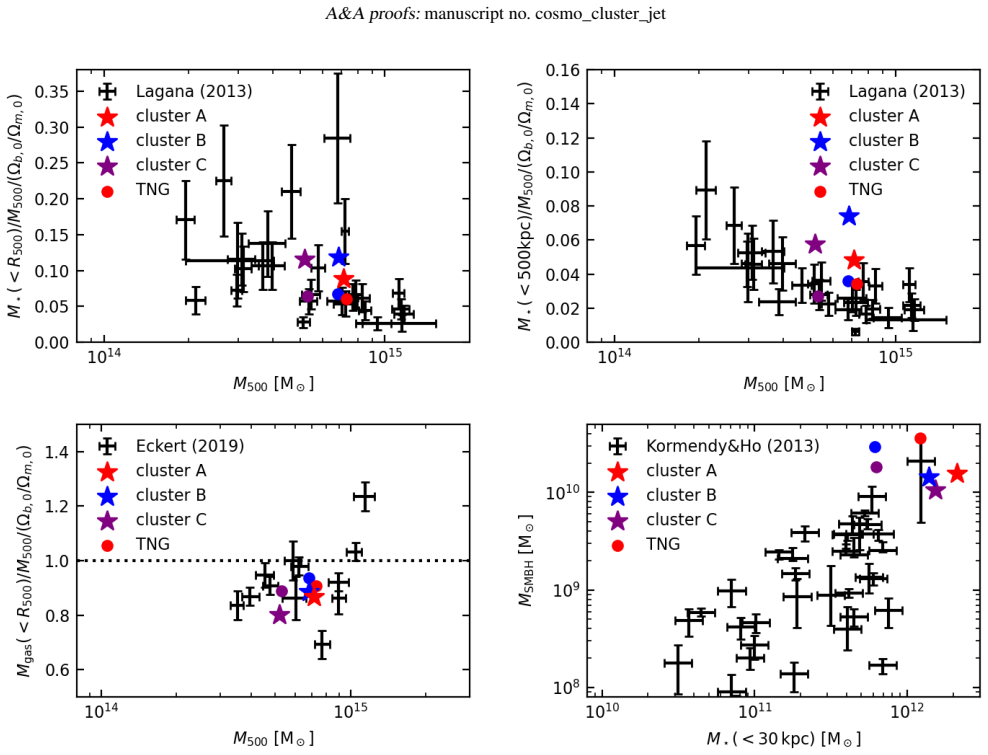
Cosmological simulations with explicit AGN jet feedback match observed stellar and gas fractions plus cool-core ICM profiles, while isolated runs and kinetic feedback models do not.
A machine-rendered reading of the paper's core claim, the machinery that carries it, and where it could break.
Core claim
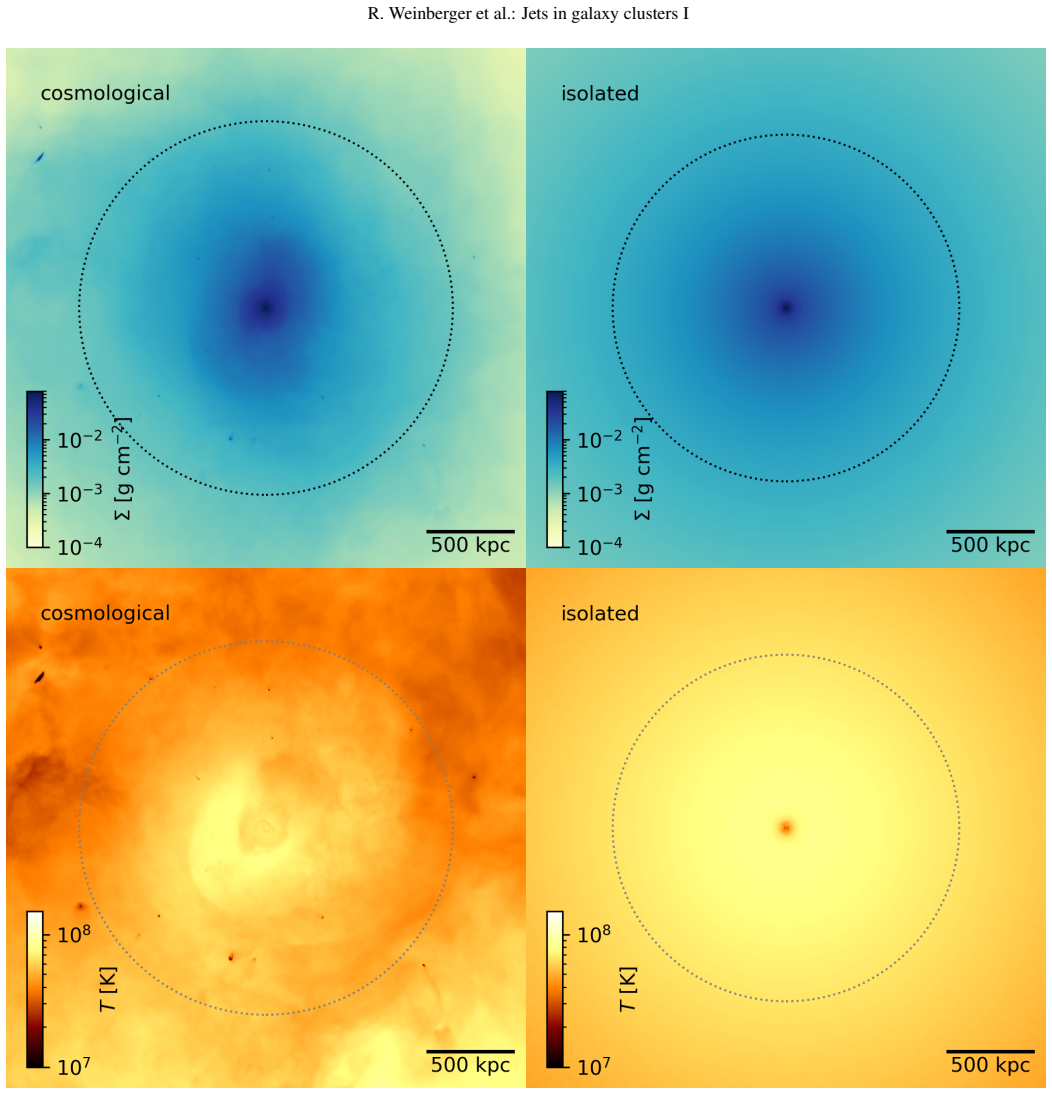
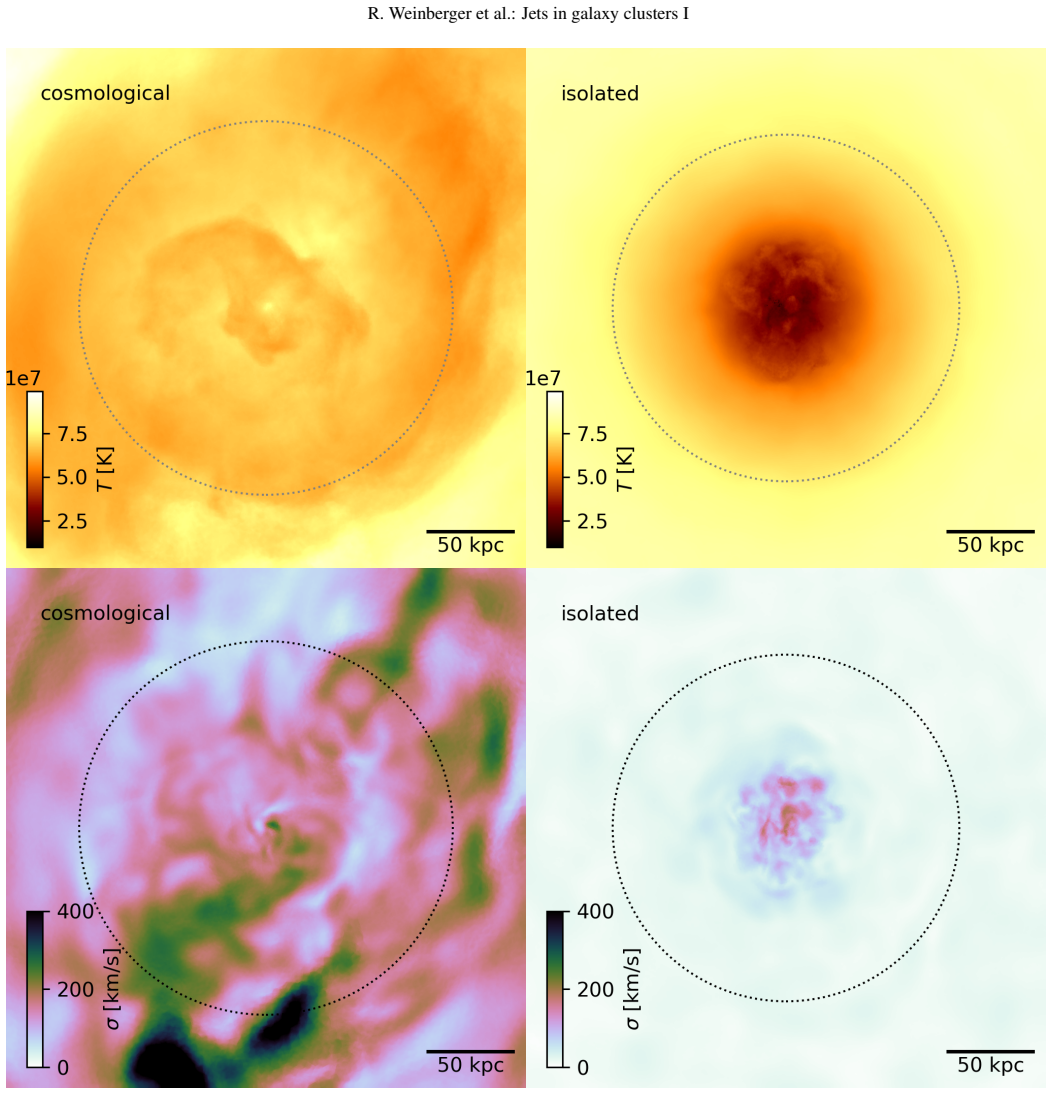
Hierarchical assembly produces velocity and multi-phase structure in the ICM that isolated simulations miss: gas at radii greater than 50 kpc is shaped by satellite galaxies, leading to non-thermal pressure support and warm-gas abundance that match recent observations only in the cosmological jet-feedback runs.
What carries the argument
Explicit AGN jet model implemented in cosmological zoom simulations, compared against the same model in isolated clusters and against kinetic AGN feedback in cosmological runs.
If this is right
- Stellar and gas mass fractions inside the simulated clusters agree with observed values.
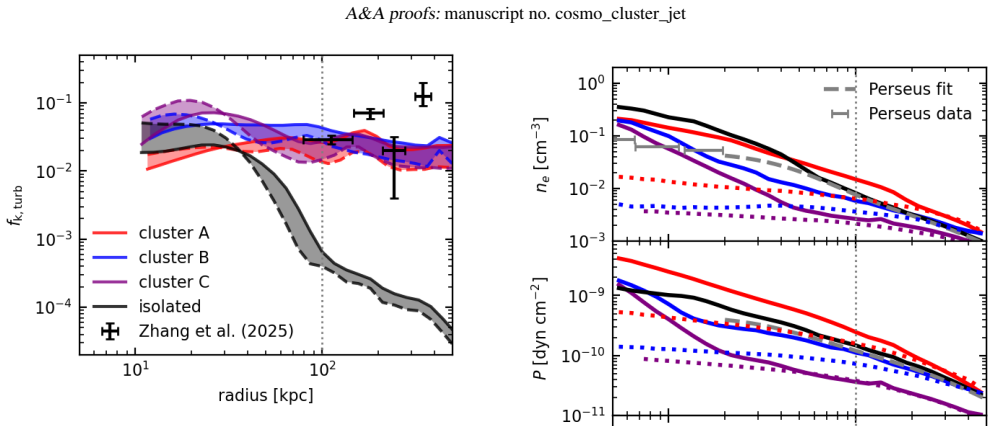
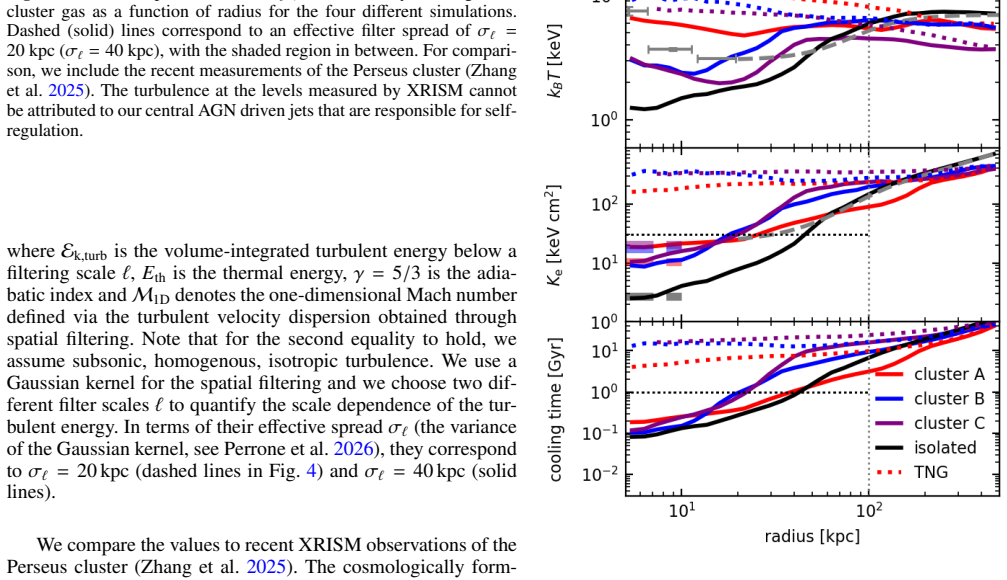
- Thermodynamic profiles of the ICM in the jet-feedback cosmological runs resemble those of local cool-core clusters.
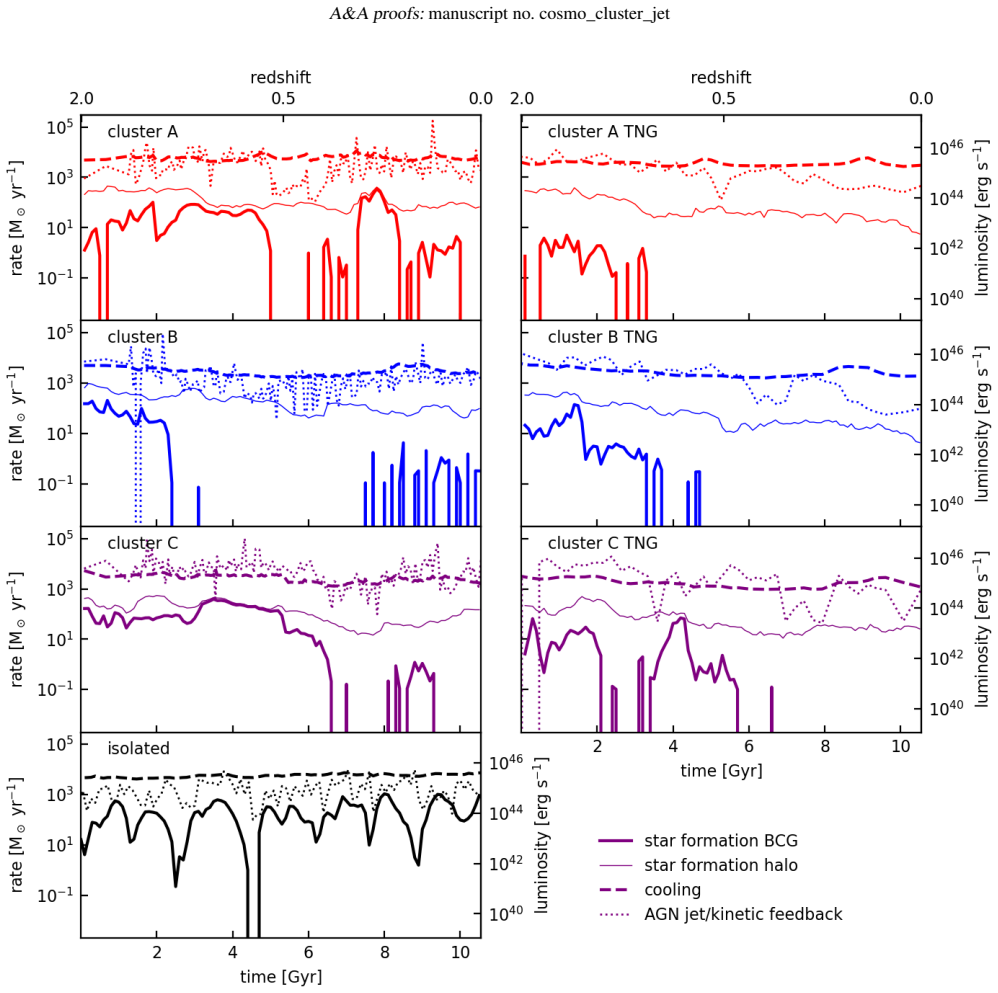
- AGN heating roughly balances cooling losses and star formation is strongly suppressed in every simulation setup.
- Non-thermal pressure support reaches observed levels only when cosmological assembly is included.
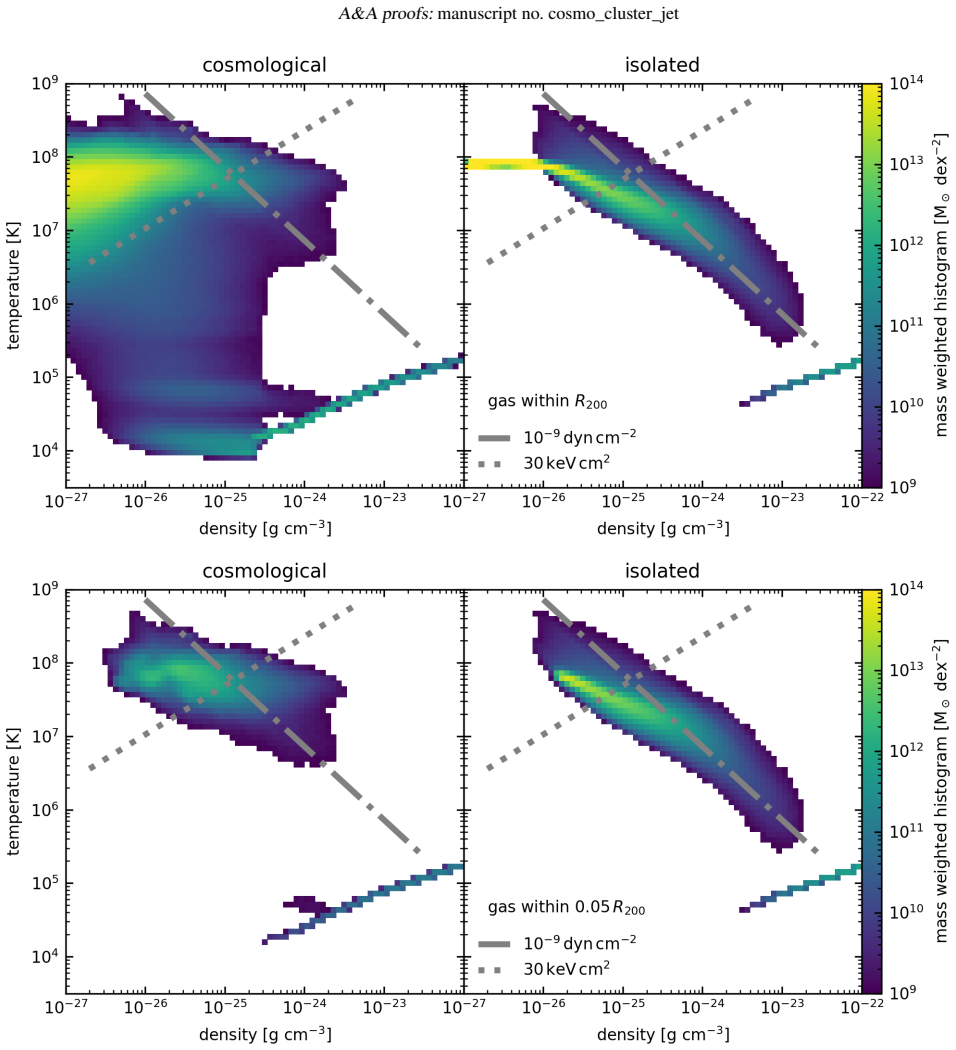
- Warm gas at temperatures below 10^5 K appears beyond the core region solely in the cosmological simulations.
Where Pith is reading between the lines
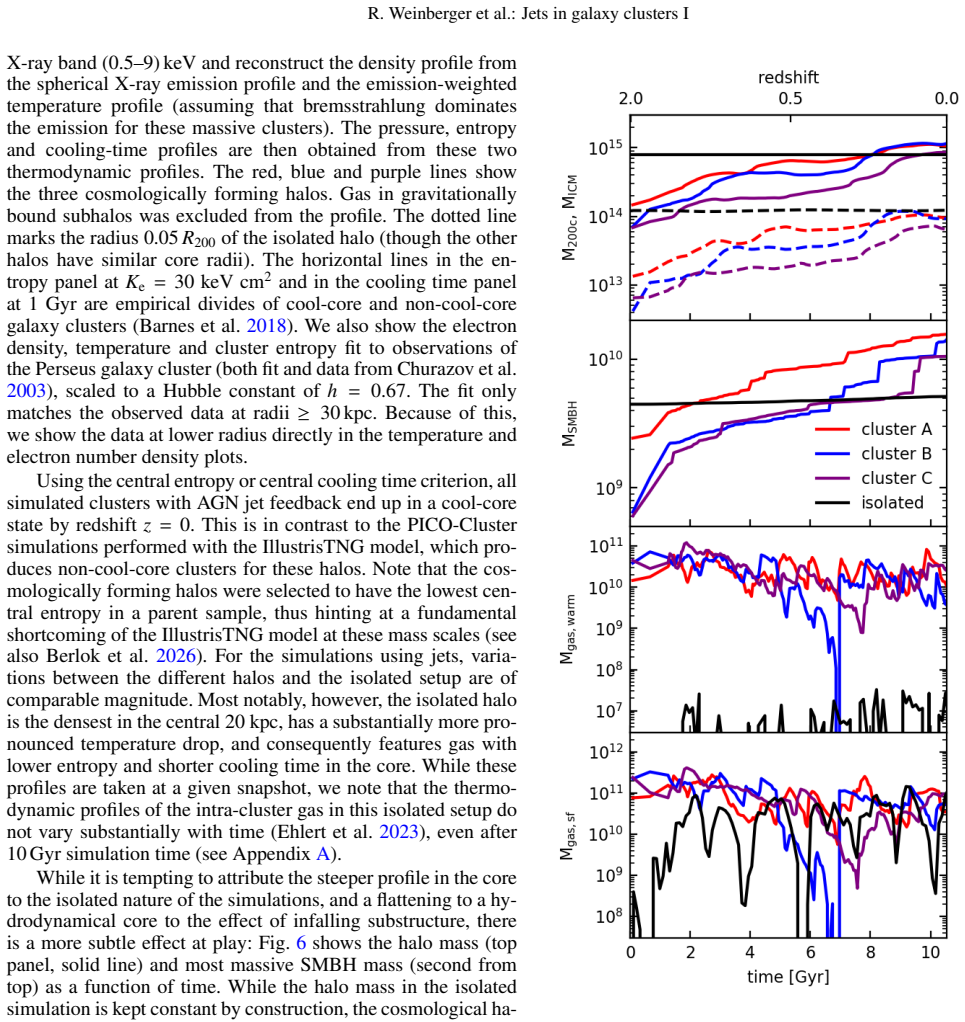
- Merger-driven growth of the central supermassive black hole changes the long-term self-regulation of jet feedback relative to isolated initial conditions.
- Dynamical modeling of the ICM for comparison with velocity or multi-phase observations must incorporate cosmological context to capture satellite-driven motions.
- Targeted observations of warm gas and non-thermal pressure in clusters with documented recent accretion events could directly test the assembly signature.
Load-bearing premise
The explicit jet feedback implementation and numerical resolution are realistic enough that differences between cosmological and isolated runs reflect genuine effects of hierarchical assembly rather than model or resolution artifacts.
What would settle it
If high-resolution X-ray or SZ observations of a statistical sample of cool-core clusters show no systematic difference in non-thermal pressure support or warm-gas content between systems with recent mergers and relaxed systems, the claimed impact of assembly would be ruled out.
Figures
read the original abstract
The atmospheres of cool-core galaxy clusters are excellent probes of astrophysical plasmas. However, how the interplay between assembly and active galactic nucleus (AGN) feedback leads to the observed gas profiles remains uncertain. We study the impact of hierarchical assembly on the intra-cluster medium (ICM) in cool-core galaxy clusters using hydrodynamic simulations as part of the PICO-Cluster project. We compare cosmological zoom simulations employing an explicit AGN jet model against PICO-Cluster simulations with IllustrisTNG kinetic AGN feedback, as well as against isolated galaxy cluster simulations using jet feedback. The stellar and gas fractions of our cosmological galaxy cluster simulations with jet feedback are in excellent agreement with observed galaxy clusters, and the ICM thermodynamic profiles resemble those of local cool-core galaxy clusters while those run with IllustrisTNG kinetic AGN feedback do not match these observations. In all simulations, cosmological and isolated, the AGN heating roughly balances the cooling losses, with star formation being significantly suppressed. The most notable differences between the cosmological and isolated simulations are the resulting velocity and multi-phase structure: gas at radii $> 50$ kpc is shaped by satellite galaxies rather than jet feedback originating form the central galaxy. This leads to significant differences in non-thermal pressure support, with only the cosmological simulations being consistent with recent observations. A second notable difference is the abundance of warm ($<10^5$ K) gas beyond the core region, which is absent in our isolated simulation. Our results highlight the need for taking cosmological assembly into account in comparisons of the ICM dynamics and its multi-phase nature, while self-regulation is altered by hierarchical assembly via merger-driven growth of the central supermassive black hole.
Editorial analysis
A structured set of objections, weighed in public.
Referee Report
Summary. The manuscript uses cosmological zoom simulations of cool-core galaxy clusters with an explicit AGN jet feedback model (PICO-Cluster project) and compares them to runs with IllustrisTNG kinetic AGN feedback as well as isolated cluster simulations with jet feedback. It claims that the cosmological jet runs produce stellar and gas fractions in excellent agreement with observations, ICM thermodynamic profiles resembling local cool-core clusters (unlike TNG), AGN heating balancing cooling with suppressed star formation, and that hierarchical assembly drives differences in velocity structure, non-thermal pressure support, and warm gas abundance at r > 50 kpc due to satellites rather than central jets, while also altering self-regulation via merger-driven BH growth.
Significance. If the quantitative comparisons hold, the result would underscore that cosmological assembly history must be included when modeling ICM dynamics, multi-phase structure, and non-thermal pressure, beyond the self-regulation achieved in isolated setups. The explicit jet model plus assembly context is presented as key to matching observations where TNG does not.
major comments (2)
- [Abstract] Abstract: The central claims that stellar/gas fractions are in 'excellent agreement' with observed clusters and that ICM thermodynamic profiles 'resemble' those of local cool-core clusters (while TNG runs 'do not match') provide no quantitative metrics, error bars, χ^{2} values, or details on how profiles were compared or selected. This absence directly affects evaluation of whether the jet model plus assembly outperforms TNG.
- [Abstract] Abstract and § (results on cosmological vs isolated): The attribution of velocity/multi-phase differences at r > 50 kpc and non-thermal pressure support to hierarchical assembly (satellites vs central jets) assumes the isolated jet runs are otherwise identical in effective resolution, refinement, and subgrid coupling at large radii. The text notes merger-driven BH growth alters self-regulation but does not quantify resolution convergence for infalling satellites or differences in BH seeding/growth between setups, which is load-bearing for isolating the assembly effect.
minor comments (1)
- [Abstract] The abstract states 'in all simulations, cosmological and isolated, the AGN heating roughly balances the cooling losses' without referencing the specific figure or section showing the balance (e.g., heating/cooling rate plots).
Simulated Author's Rebuttal
We thank the referee for their detailed and constructive report. We address each major comment below and outline the revisions we will make to strengthen the manuscript.
read point-by-point responses
-
Referee: [Abstract] Abstract: The central claims that stellar/gas fractions are in 'excellent agreement' with observed clusters and that ICM thermodynamic profiles 'resemble' those of local cool-core clusters (while TNG runs 'do not match') provide no quantitative metrics, error bars, χ^{2} values, or details on how profiles were compared or selected. This absence directly affects evaluation of whether the jet model plus assembly outperforms TNG.
Authors: We agree that quantitative support is needed to substantiate these claims. In the revised version we will add explicit metrics to the abstract and results section, including average fractional deviations from observed profiles, reduced χ² values for the thermodynamic profiles (density, temperature, entropy), and a brief description of the observational sample selection and comparison methodology. These additions will allow direct assessment of the jet+assembly model relative to TNG. revision: yes
-
Referee: [Abstract] Abstract and § (results on cosmological vs isolated): The attribution of velocity/multi-phase differences at r > 50 kpc and non-thermal pressure support to hierarchical assembly (satellites vs central jets) assumes the isolated jet runs are otherwise identical in effective resolution, refinement, and subgrid coupling at large radii. The text notes merger-driven BH growth alters self-regulation but does not quantify resolution convergence for infalling satellites or differences in BH seeding/growth between setups, which is load-bearing for isolating the assembly effect.
Authors: We acknowledge that a clearer demonstration of setup equivalence is required to isolate the assembly effect. The isolated runs employ the identical jet model, subgrid coupling, and central refinement strategy as the cosmological runs. In the revision we will add a new subsection that (i) reports resolution convergence tests for infalling satellites at r > 50 kpc, (ii) quantifies any differences in black-hole seeding and growth prescriptions between the two setups, and (iii) discusses how these factors affect the comparison. This will strengthen the attribution to hierarchical assembly while preserving the existing results. revision: yes
Circularity Check
No circularity: results are direct simulation outputs compared to external observations
full rationale
The paper reports outputs from hydrodynamic cosmological zoom simulations using an explicit AGN jet model, comparing stellar/gas fractions, ICM profiles, velocities, and multi-phase gas to external observations and to separate TNG and isolated runs. No equations, fitted parameters, or predictions are presented that reduce to the inputs by construction. Claims about the effect of hierarchical assembly rest on differences between simulation setups, not on self-referential definitions or self-citation chains. Comparisons to observations are independent and falsifiable.
Axiom & Free-Parameter Ledger
Reference graph
Works this paper leans on
-
[1]
R., et al
Andrade-Santos, F., Jones, C., Forman, W. R., et al. 2017, ApJ, 843, 76 Bahé, Y . M., Barnes, D. J., Dalla Vecchia, C., et al. 2017, MNRAS, 470, 4186
2017
-
[2]
J., Kay, S
Barnes, D. J., Kay, S. T., Bahé, Y . M., et al. 2017, MNRAS, 471, 1088
2017
-
[3]
J., V ogelsberger, M., Kannan, R., et al
Barnes, D. J., V ogelsberger, M., Kannan, R., et al. 2018, MNRAS, 481, 1809
2018
-
[4]
2020, A&A, 642, A37
Bassini, L., Rasia, E., Borgani, S., et al. 2020, A&A, 642, A37
2020
-
[5]
S., Dubois, Y ., Pellissier, A., et al
Beckmann, R. S., Dubois, Y ., Pellissier, A., et al. 2022, A&A, 665, A129
2022
-
[6]
Bellomi, E., ZuHone, J. A., Truong, N., et al. 2025, arXiv e-prints, arXiv:2512.12754
arXiv 2025
-
[7]
2024, The Journal of Open Source Software, 9, 6296 Berlok et al., T
Berlok, T., Jlassi, L., Puchwein, E., & Haugbølle, T. 2024, The Journal of Open Source Software, 9, 6296 Berlok et al., T. 2026, subm. to MNRAS
2024
-
[8]
K., Blecha, L., Kelley, L
Bhowmick, A. K., Blecha, L., Kelley, L. Z., et al. 2025, ApJ, 991, 81 Bîrzan, L., Rafferty, D. A., McNamara, B. R., Wise, M. W., & Nulsen, P. E. J. 2004, ApJ, 607, 800
2025
-
[9]
Bollati, F. & Weinberger, R. 2025, arXiv e-prints, arXiv:2508.16971
Pith/arXiv arXiv 2025
-
[10]
1952, MNRAS, 112, 195
Bondi, H. 1952, MNRAS, 112, 195
1952
-
[11]
Booth, C. M. & Schaye, J. 2009, MNRAS, 398, 53
2009
-
[12]
S., et al
Borodina, O., Ni, Y ., Bennett, J. S., et al. 2025, ApJ, 981, 149
2025
-
[13]
Bourne, M. A. & Sijacki, D. 2017, MNRAS, 472, 4707
2017
-
[14]
Bourne, M. A. & Sijacki, D. 2021, MNRAS, 506, 488
2021
-
[15]
A., Sijacki, D., & Puchwein, E
Bourne, M. A., Sijacki, D., & Puchwein, E. 2019, MNRAS, 490, 343
2019
-
[16]
Bourne, M. A. & Yang, H.-Y . K. 2023, Galaxies, 11, 73
2023
-
[17]
2026, arXiv e-prints, arXiv:2605.27503
Cammelli, V ., Gaspari, M., Piana, O., et al. 2026, arXiv e-prints, arXiv:2605.27503
Pith/arXiv arXiv 2026
- [18]
-
[19]
W., Donahue, M., V oit, G
Cavagnolo, K. W., Donahue, M., V oit, G. M., & Sun, M. 2009, ApJS, 182, 12
2009
-
[20]
2003, ApJ, 590, 225
Churazov, E., Forman, W., Jones, C., & Böhringer, H. 2003, ApJ, 590, 225
2003
-
[21]
K., Gronke, M., & Weinberger, R
Das, H. K., Gronke, M., & Weinberger, R. 2024, arXiv e-prints, arXiv:2412.03751
arXiv 2024
-
[22]
2010, MNRAS, 409, 985
Dubois, Y ., Devriendt, J., Slyz, A., & Teyssier, R. 2010, MNRAS, 409, 985
2010
-
[23]
Dunn, R. J. H. & Fabian, A. C. 2006, MNRAS, 373, 959
2006
-
[24]
2019, A&A, 621, A40
Eckert, D., Ghirardini, V ., Ettori, S., et al. 2019, A&A, 621, A40
2019
-
[25]
2018, MN- RAS, 481, 2878
Ehlert, K., Weinberger, R., Pfrommer, C., Pakmor, R., & Springel, V . 2018, MN- RAS, 481, 2878
2018
-
[26]
2023, MN- RAS, 518, 4622
Ehlert, K., Weinberger, R., Pfrommer, C., Pakmor, R., & Springel, V . 2023, MN- RAS, 518, 4622
2023
-
[27]
2021, MNRAS, 503, 1327
Ehlert, K., Weinberger, R., Pfrommer, C., & Springel, V . 2021, MNRAS, 503, 1327
2021
-
[28]
Fabian, A. C. 1994, ARA&A, 32, 277
1994
-
[29]
Fabian, A. C. 2012, ARA&A, 50, 455
2012
-
[30]
C., Ferland, G
Fabian, A. C., Ferland, G. J., Sanders, J. S., et al. 2022, MNRAS, 515, 3336
2022
-
[31]
C., Sanders, J
Fabian, A. C., Sanders, J. S., Ferland, G. J., et al. 2023, MNRAS, 521, 1794 Faucher-Giguère, C.-A., Lidz, A., Zaldarriaga, M., & Hernquist, L. 2009, ApJ, 703, 1416
2023
-
[32]
B., Tonnesen, S., DeFelippis, D., et al
Fielding, D. B., Tonnesen, S., DeFelippis, D., et al. 2020, ApJ, 903, 32
2020
-
[33]
2011, MNRAS, 411, 349
Gaspari, M., Melioli, C., Brighenti, F., & D’Ercole, A. 2011, MNRAS, 411, 349
2011
-
[34]
2024, MNRAS, 534, 957
Genina, A., Springel, V ., & Rantala, A. 2024, MNRAS, 534, 957
2024
-
[35]
W., Glines, F
Grete, P., O’Shea, B. W., Glines, F. W., et al. 2025, ApJ, 988, 155
2025
-
[36]
Guo, F. & Oh, S. P. 2008, MNRAS, 384, 251
2008
-
[37]
2006, MNRAS, 373, L65
Heinz, S., Brüggen, M., Young, A., & Levesque, E. 2006, MNRAS, 373, L65
2006
-
[38]
A., et al
Hlavacek-Larrondo, J., McDonald, M., Benson, B. A., et al. 2015, ApJ, 805, 35
2015
-
[39]
F., Quataert, E., Silich, E
Hopkins, P. F., Quataert, E., Silich, E. M., et al. 2025, The Open Journal of As- trophysics, 8, 54053
2025
-
[40]
S., Mittal, R., Reiprich, T
Hudson, D. S., Mittal, R., Reiprich, T. H., et al. 2010, A&A, 513, A37
2010
-
[41]
B., Smith, B
Hummels, C. B., Smith, B. D., Hopkins, P. F., et al. 2019, ApJ, 882, 156
2019
-
[42]
2026a, arXiv e-prints, arXiv:2601.10787
Jlassi, L., Weinberger, R., Pfrommer, C., et al. 2026a, arXiv e-prints, arXiv:2601.10787
-
[43]
2026b, arXiv e-prints, arXiv:2606.04084 Article number, page 14 of 17 R
Jlassi, L., Weinberger, R., Pfrommer, C., et al. 2026b, arXiv e-prints, arXiv:2606.04084 Article number, page 14 of 17 R. Weinberger et al.: Jets in galaxy clusters I
-
[44]
H., & Hernquist, L
Katz, N., Weinberg, D. H., & Hernquist, L. 1996, ApJS, 105, 19
1996
-
[45]
& Narayan, R
Kim, W.-T. & Narayan, R. 2003, ApJ, 596, L139
2003
-
[46]
Kormendy, J. & Ho, L. C. 2013, ARA&A, 51, 511 Laganá, T. F., Martinet, N., Durret, F., et al. 2013, A&A, 555, A66
2013
-
[47]
2026, A&A, 705, A41
Lehle, K., Ruszkowski, M., Nelson, D., Prunier, M., & Pillepich, A. 2026, A&A, 705, A41
2026
- [48]
-
[49]
L., Ruszkowski, M., et al
Li, Y ., Bryan, G. L., Ruszkowski, M., et al. 2015, ApJ, 811, 73
2015
-
[50]
Li, Y ., Ruszkowski, M., & Bryan, G. L. 2017, ApJ, 847, 106
2017
-
[51]
F., Kelley, L
Ma, L., Hopkins, P. F., Kelley, L. Z., & Faucher-Giguère, C.-A. 2023, MNRAS, 519, 5543
2023
-
[52]
2019, MN- RAS, 483, 2465
Martizzi, D., Quataert, E., Faucher-Giguère, C.-A., & Fielding, D. 2019, MN- RAS, 483, 2465
2019
-
[53]
McNamara, B. R., Fabian, A. C., Russell, H. R., et al. 2026, arXiv e-prints, arXiv:2604.19607
Pith/arXiv arXiv 2026
-
[54]
McNamara, B. R. & Nulsen, P. E. J. 2007, ARA&A, 45, 117
2007
-
[55]
McNamara, B. R. & Nulsen, P. E. J. 2012, New Journal of Physics, 14, 055023
2012
-
[56]
R., V oit, G
Meece, G. R., V oit, G. M., & O’Shea, B. W. 2017, ApJ, 841, 133
2017
-
[57]
2026, arXiv e-prints, arXiv:2603.26882
Meenakshi, M., Weinberger, R., Pfrommer, C., & Berlok, T. 2026, arXiv e-prints, arXiv:2603.26882
arXiv 2026
-
[58]
J., Jones, T
Mendygral, P. J., Jones, T. W., & Dolag, K. 2012, ApJ, 750, 166
2012
-
[59]
V ., Sutherland, R., & Wagner, A
Mukherjee, D., Bicknell, G. V ., Sutherland, R., & Wagner, A. 2016, MNRAS, 461, 967
2016
-
[60]
2024, A&A, 686, A157
Nelson, D., Pillepich, A., Ayromlou, M., et al. 2024, A&A, 686, A157
2024
-
[61]
2022, MNRAS, 513, 670
Ni, Y ., Di Matteo, T., Bird, S., et al. 2022, MNRAS, 513, 670
2022
-
[62]
2023, ApJ, 954, 56
Olivares, V ., Su, Y ., Forman, W., et al. 2023, ApJ, 954, 56
2023
-
[63]
2016, MNRAS, 455, 1134
Pakmor, R., Springel, V ., Bauer, A., et al. 2016, MNRAS, 455, 1134
2016
-
[64]
2023, MNRAS, 522, 721
Pellissier, A., Hahn, O., & Ferrari, C. 2023, MNRAS, 522, 721
2023
-
[65]
M., Berlok, T., Puchwein, E., & Pfrommer, C
Perrone, L. M., Berlok, T., Puchwein, E., & Pfrommer, C. 2026, arXiv e-prints, arXiv:2601.06250
arXiv 2026
-
[66]
Peterson, J. R. & Fabian, A. C. 2006, Phys. Rep., 427, 1
2006
-
[67]
R., Kahn, S
Peterson, J. R., Kahn, S. M., Paerels, F. B. S., et al. 2003, ApJ, 590, 207
2003
-
[68]
2019, MNRAS, 486, 101
Pfister, H., V olonteri, M., Dubois, Y ., Dotti, M., & Colpi, M. 2019, MNRAS, 486, 101
2019
-
[69]
2013, ApJ, 779, 10
Pfrommer, C. 2013, ApJ, 779, 10
2013
-
[70]
2018, MNRAS, 473, 4077 Planck Collaboration, Aghanim, N., Akrami, Y ., et al
Pillepich, A., Springel, V ., Nelson, D., et al. 2018, MNRAS, 473, 4077 Planck Collaboration, Aghanim, N., Akrami, Y ., et al. 2020, A&A, 641, A6
2018
-
[71]
V ., Schaye, J., & Schaller, M
Pontzen, A., Peiris, H. V ., Schaye, J., & Schaller, M. 2026, arXiv e-prints, arXiv:2605.16483
Pith/arXiv arXiv 2026
-
[72]
2024, arXiv e-prints, arXiv:2411.16555
Popesso, P., Biviano, A., Marini, I., et al. 2024, arXiv e-prints, arXiv:2411.16555
arXiv 2024
-
[73]
2025, MNRAS, 544, 4188
Prunier, M., Ubertosi, F., Hlavacek-Larrondo, J., & Pillepich, A. 2025, MNRAS, 544, 4188
2025
-
[74]
A., McNamara, B
Rafferty, D. A., McNamara, B. R., Nulsen, P. E. J., & Wise, M. W. 2006, ApJ, 652, 216
2006
-
[75]
L., Murante, G., Borgani, S., & Cui, W
Ragone-Figueroa, C., Granato, G. L., Murante, G., Borgani, S., & Cui, W. 2013, MNRAS, 436, 1750
2013
-
[76]
H., Rai ˇcevi´c, M., & Schaye, J
Rahmati, A., Pawlik, A. H., Rai ˇcevi´c, M., & Schaye, J. 2013, MNRAS, 430, 2427
2013
-
[77]
& Nelson, D
Ramesh, R. & Nelson, D. 2024, MNRAS, 528, 3320
2024
-
[78]
2026, arXiv e-prints, arXiv:2602.23416
Ramesh, R., Nelson, D., Fielding, D., & Brüggen, M. 2026, arXiv e-prints, arXiv:2602.23416
arXiv 2026
-
[79]
S., Balbus, S
Reynolds, C. S., Balbus, S. A., & Schekochihin, A. A. 2015, ApJ, 815, 41
2015
-
[80]
Russell, H. R., Nulsen, P. E. J., Fabian, A. C., et al. 2026, arXiv e-prints, arXiv:2604.14292
Pith/arXiv arXiv 2026
discussion (0)
Sign in with ORCID, Apple, or X to comment. Anyone can read and Pith papers without signing in.