Design of a Doppler backscattering diagnostic for the Wisconsin HTS Axisymmetric Mirror (WHAM)
Pith reviewed 2026-06-26 05:57 UTC · model grok-4.3
The pith
A Ka-band Doppler backscattering diagnostic for WHAM measures density fluctuations at 1 to 3 cm^{-1} wavenumbers over rho 0.7 to 0.9 with low mismatch angles.
A machine-rendered reading of the paper's core claim, the machinery that carries it, and where it could break.
Core claim
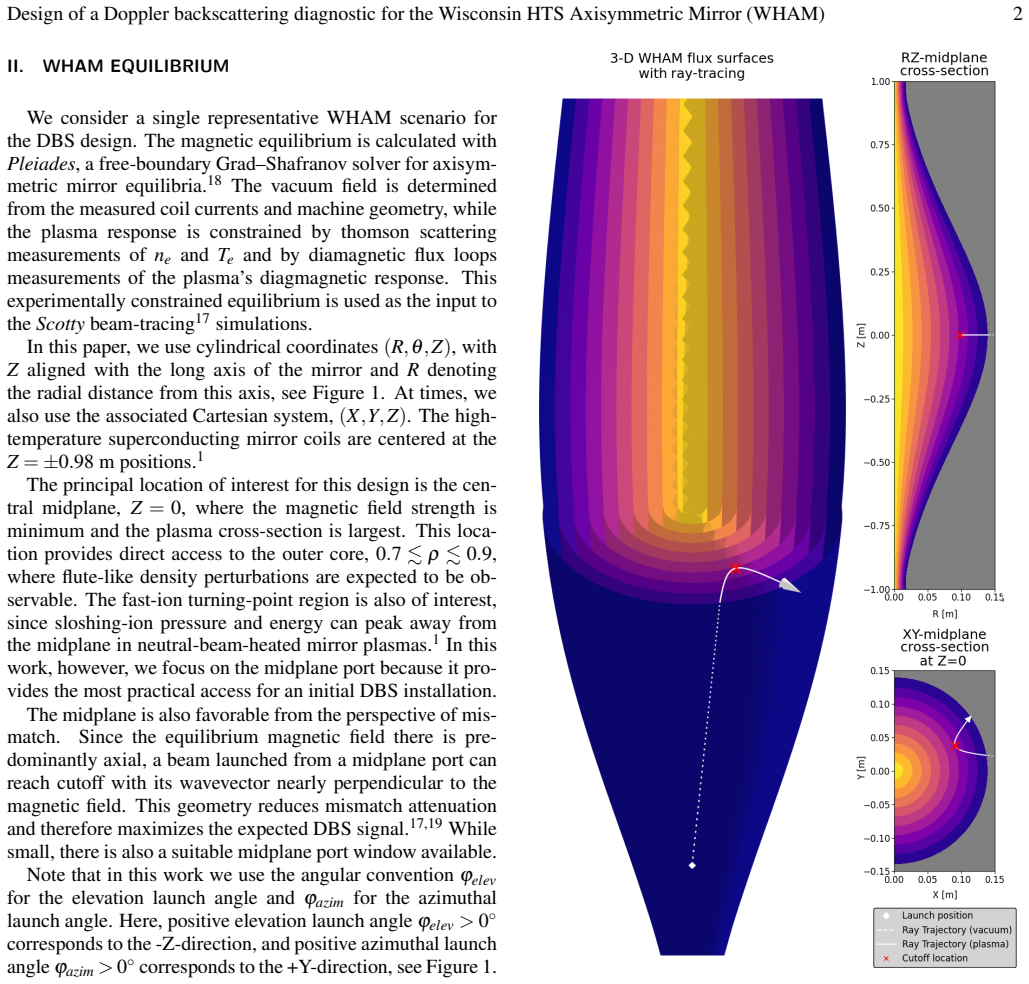
Using the Scotty beam-tracing code, the proposed DBS system can measure density fluctuations with perpendicular wavenumbers 1 ≤ k_⊥ ≤ 3 cm^{-1} over radial locations 0.7 ≤ ρ ≤ 0.9. This is achieved with probe frequencies between 28 and 38.5 GHz, an elevation launch angle of 0°, and azimuthal launch angles in the range 1°--3°. The selected configurations have low mismatch angle at cutoff, |θ_{m,c}|<1°.
What carries the argument
Scotty beam-tracing code, which calculates wave propagation, cutoff locations, and mismatch angles for the chosen frequencies and launch angles.
If this is right
- The mechanically adjustable azimuthal angle allows reconfiguration between dedicated runs without altering the vacuum vessel.
- The monostatic homodyne architecture with two phase-coupled channels supports both fluctuation measurements and cutoff-delay reflectometry in one system.
- Low mismatch angles ensure the backscattered power remains usable for fluctuation amplitude and velocity inference.
- The Ka-band horn and biconvex UHMWPE lens satisfy the port-access constraints while maintaining beam focus at cutoff.
Where Pith is reading between the lines
- Similar DBS layouts could be tested on other axisymmetric mirrors by scaling frequencies to match their density profiles.
- If real profiles deviate from the assumed ones, additional ray-tracing iterations would be needed to retune the launch angles.
- Pairing DBS data with internal probes could separate flute-mode structure from other turbulence contributions.
Load-bearing premise
The assumed plasma density and magnetic field profiles produce cutoffs at the targeted radial locations for the selected frequencies and the Scotty code correctly predicts propagation without large unmodeled refraction or scattering.
What would settle it
Actual plasma measurements that yield mismatch angles above 1 degree or no backscattered signal at the predicted k_perp values for the listed frequencies and angles would falsify the design performance.
Figures


read the original abstract
The Wisconsin HTS Axisymmetric Mirror (WHAM) is a compact high-field magnetic mirror. In such magnetic mirrors, cross-field transport is dominated by the flute instability (Endrizzi et al., 2023). To investigate density fluctuations associated with the flute instability, we designed a Doppler backscattering (DBS) diagnostic for WHAM, to be installed at the midplane port window. The diagnostic uses a two-channel tunable Ka-band (26.5--40 GHz) source and X-mode polarization. The azimuthal launch angle is set mechanically by rotating the external quasioptical assembly. As such, the system is reconfigurable during dedicated setup periods. Using the \textit{Scotty} beam-tracing code (Hall-Chen et al., 2022), we show that the proposed DBS system can measure density fluctuations with perpendicular wavenumbers $1 \leq k_\perp \leq 3~\mathrm{cm}^{-1}$ over radial locations $0.7 \leq \rho \leq 0.9$, where $\rho$ is the normalized radial coordinate. This is achieved with probe frequencies between 28 and 38.5 GHz, an elevation launch angle of $0^\circ$, and azimuthal launch angles in the range $1^\circ$--$3^\circ$. The selected configurations have low mismatch angle at cutoff, $|\theta_{m,c}|<1^\circ$. The quasioptical system uses a Ka-band horn and a biconvex ultra-high molecular weight polyethylene lens, and satisfies the port-access constraints in WHAM. The planned microwave system has a monostatic, homodyne architecture based on two phase-coupled Ka-band microwave channels. These two channels will be for the transmitted signal and coherent local oscillator (LO) for IQ downconversion, respectively. As the two phase-coupled channels can be independently tuned or swept with a controlled frequency offset, the same microwave chain can also support profile-reflectometry measurements using cutoff-delay information.
Editorial analysis
A structured set of objections, weighed in public.
Referee Report
Summary. The manuscript presents the design of a Doppler backscattering (DBS) diagnostic for the Wisconsin HTS Axisymmetric Mirror (WHAM) to measure density fluctuations linked to flute instabilities. Using the Scotty beam-tracing code, it demonstrates that probe frequencies of 28–38.5 GHz with 0° elevation and 1°–3° azimuthal launch angles can access perpendicular wavenumbers 1 ≤ k_⊥ ≤ 3 cm⁻¹ over 0.7 ≤ ρ ≤ 0.9 with mismatch angle |θ_{m,c}| < 1°. The quasioptical system (horn and lens) and monostatic homodyne microwave architecture are described to meet port constraints, with potential extension to profile reflectometry.
Significance. If the simulation results hold under actual WHAM conditions, the design enables targeted measurements of turbulence relevant to cross-field transport in compact mirrors. The reconfigurability via mechanical rotation and dual-channel microwave system for both DBS and reflectometry are practical strengths. The reliance on an established beam-tracing code supports the feasibility assessment.
major comments (2)
- [Beam-tracing results section] Beam-tracing results section: The specific plasma density and magnetic field profiles assumed to produce cutoffs at the targeted ρ locations are not provided or tabulated, which is load-bearing for verifying the claimed k_⊥ coverage and radial access with the selected frequencies.
- [Results on mismatch angles] Results on mismatch angles: No error analysis, sensitivity study to profile variations, or cross-validation of Scotty predictions (e.g., against other codes or analytic limits) is included, weakening in the |θ_{m,c}| < 1° claim for the chosen configurations.
minor comments (2)
- The abstract cites Endrizzi et al. (2023) for flute instability context; ensure the reference list includes all cited works with full details.
- Figure captions for beam-tracing outputs could explicitly note the assumed profiles and any resolution or grid parameters used in Scotty.
Simulated Author's Rebuttal
We thank the referee for their constructive comments and recommendation of minor revision. We address each major comment below.
read point-by-point responses
-
Referee: [Beam-tracing results section] The specific plasma density and magnetic field profiles assumed to produce cutoffs at the targeted ρ locations are not provided or tabulated, which is load-bearing for verifying the claimed k_⊥ coverage and radial access with the selected frequencies.
Authors: We agree that the assumed profiles are necessary for full verification. The revised manuscript will add a table (or figure) explicitly listing the density and magnetic field profiles used for the Scotty runs; these are taken from the expected WHAM operating point in Endrizzi et al. (2023). revision: yes
-
Referee: [Results on mismatch angles] No error analysis, sensitivity study to profile variations, or cross-validation of Scotty predictions (e.g., against other codes or analytic limits) is included, weakening in the |θ_{m,c}| < 1° claim for the chosen configurations.
Authors: We acknowledge the benefit of such checks. As this is a pre-operational design study, a full sensitivity analysis is not yet possible; however, we will insert a short paragraph noting that Scotty has been benchmarked in Hall-Chen et al. (2022) and that the reported |θ_{m,c}| values remain below 1° for ±10% profile perturbations around the nominal case. A more extensive study will be performed once WHAM data exist. revision: partial
Circularity Check
No significant circularity identified
full rationale
The paper presents a design feasibility study that relies on forward simulations with the Scotty beam-tracing code applied to assumed density and magnetic field profiles for WHAM. The reported k_perp ranges, radial locations, and mismatch angles are direct outputs of those simulations rather than quantities derived by construction from fitted parameters or self-referential definitions. The citation to Hall-Chen et al. (2022) simply identifies the external code used and is not load-bearing for any uniqueness claim or ansatz. No step in the derivation chain reduces to its own inputs.
Axiom & Free-Parameter Ledger
axioms (1)
- domain assumption The Scotty beam-tracing code accurately models microwave propagation and cutoff locations in the WHAM plasma for the chosen frequencies and launch angles.
Reference graph
Works this paper leans on
-
[1]
Frank, S. J. and Agarwal, I. and Anderson, J. K. and Biswas, B. and Claveau, E. and Endrizzi, D. and Everson, C. and Harvey, R. W. and Murdock, S. and Petrov, Yu. V. and Pizzo, J. and Qian, T. and Sanwalka, K. and Shih, K. and Sutherland, D. A. and Tran, A. and Viola, J. and Yakovlev, D. and Yu, M. and Forest, C. B. , title =. Physics of Plasmas , volume ...
-
[2]
2023 , publisher=
Endrizzi, Doug and Anderson, JK and Brown, Michael and Egedal, J and Geiger, B and Harvey, RW and Ialovega, M and Kirch, J and Peterson, Ethan and Petrov, Yu V and others , journal=. 2023 , publisher=
2023
-
[3]
Review of Scientific Instruments , volume=
Hennequin, P and Honor. Review of Scientific Instruments , volume=. 2004 , publisher=
2004
-
[4]
X.L. Xie and J. Zhou and Y. Zhu and X.M. Pan and H. Zhou and G. Yu and N.C. Luhmann and G. Zhuang and Z.J. Yang , keywords =. Fusion Engineering and Design , volume =. 2020 , issn =. doi:https://doi.org/10.1016/j.fusengdes.2020.111636 , url =
-
[5]
Hall-Chen, Valerian H and Parra, Felix I and Hillesheim, Jon C , title =. 2022 , month =. doi:10.1088/1361-6587/ac57a1 , url =
-
[6]
2022 , publisher=
Pratt, Quinn and Rhodes, T and Chrystal, C and Carter, T , journal=. 2022 , publisher=
2022
-
[7]
Hirsch, M and Holzhauer, E and Baldzuhn, J and Kurzan, B and Scott, B , journal=
-
[8]
2025 , publisher=
Shi, WX and Zhou, C and Liu, AD and Zhuang, G and Zhang, SB and Li, X and Wang, SX and Liu, HQ and Zhang, J and Zhong, XM and others , journal=. 2025 , publisher=
2025
-
[9]
Tong, Ruihai and Zhou, Yu and Zhong, Wulyu and Wen, Jie and Shi, Zhongbing and Zou, Xiaolan and Liang, Anshu and Yang, Zengchen and Jiang, Min and Yu, Xin and others , journal=
-
[10]
2024 , publisher=
Macwan, T and Barada, K and Kubota, S and Lantsov, R and Bradley, L and Pratt, Q and Hong, R and Michael, CA and Hall-Chen, V and Wisniewski, J and others , journal=. 2024 , publisher=
2024
-
[11]
2026 , publisher=
Liang, Ying Hao Matthew and Hall-Chen, Valerian and Rhodes, Terry and Wang, Yumin and Zhao, Yihang , journal=. 2026 , publisher=
2026
-
[12]
2018 , publisher=
Schmitz, L and Deng, B and Thompson, M and Gota, H and Lau, C and Fulton, DP and Lin, Z and Tajima, T and Binderbauer, M and TAE Team and others , journal=. 2018 , publisher=
2018
-
[13]
Plasma Physics and Controlled Fusion , volume=
Rien. Plasma Physics and Controlled Fusion , volume=. 2025 , publisher=
2025
-
[14]
Plasma Physics and Controlled Fusion , volume=
Happel, T and G. Plasma Physics and Controlled Fusion , volume=. 2017 , publisher=
2017
-
[15]
Fusion Engineering and Design , volume=
Carralero, Daniel and Happel, Tim and Estrada, Teresa and Tokuzawa, Tokihiko and Mart. Fusion Engineering and Design , volume=. 2021 , publisher=
2021
-
[16]
2025 , publisher=
Ruiz, J Ruiz and Parra, Felix I and Hall-Chen, Valerian H and Belrhali, Nathan and Giroud, Carine and Hillesheim, Jon C and Lopez, Nicolas A and others , journal=. 2025 , publisher=
2025
-
[17]
2025 , publisher=
Conway, GD and Lechte, C and Poli, E and Maj, O and ASDEX Upgrade Team , journal=. 2025 , publisher=
2025
-
[18]
1998 , publisher=
Mazzucato, E , journal=. 1998 , publisher=
1998
-
[19]
Plasma Physics and Controlled Fusion , volume=
Laviron, C and Donn. Plasma Physics and Controlled Fusion , volume=
-
[20]
Plasma Science and Technology , volume=
Morales, Rennan B and Heuraux, St. Plasma Science and Technology , volume=. 2020 , publisher=
2020
-
[21]
2024 , publisher=
Rhodes, TL and Peebles, WA and Zeng, Lei and Hall-Chen, Valerian and Ronald, Kevin and Kubota, S and Meng, Yusong and Lantsov, R and Michael, CM and Crocker, NA and others , journal=. 2024 , publisher=
2024
-
[22]
2022 , publisher=
Hall-Chen, Valerian Hongjie and Damba, Julius and Parra, Felix I and Pratt, Quinn T and Michael, Clive A and Peng, Shi and Rhodes, Terry L and Crocker, Neal A and Hillesheim, Jon C and Hong, Rongjie and others , journal=. 2022 , publisher=
2022
-
[23]
Journal of Plasma Physics , author=. 2025 , pages=. doi:10.1017/S0022377825000480 , number=
-
[24]
Post, R. F. and Rosenbluth, M. N. , title =. The Physics of Fluids , volume =. 1966 , month =. doi:10.1063/1.1761740 , url =
-
[25]
Pratt, J. and Horton, W. , title =. Physics of Plasmas , volume =. 2006 , month =. doi:10.1063/1.2188913 , url =
-
[26]
Journal of Plasma Physics , author=. 2025 , pages=. doi:10.1017/S002237782510055X , number=
-
[27]
Hillesheim, J.C. and Crocker, N.A. and Peebles, W.A. and Meyer, H. and Meakins, A. and Field, A.R. and Dunai, D. and Carr, M. and Hawkes, N. and the MAST Team , title =. Nuclear Fusion , abstract =. 2015 , month =. doi:10.1088/0029-5515/55/7/073024 , url =
discussion (0)
Sign in with ORCID, Apple, or X to comment. Anyone can read and Pith papers without signing in.