How is the free surface influence transported in turbulent open channel flows?
Pith reviewed 2026-06-25 22:56 UTC · model grok-4.3
The pith
The free-surface influence in open-channel turbulence is transported mainly through pressure transport and viscous diffusion across multiple scales.
A machine-rendered reading of the paper's core claim, the machinery that carries it, and where it could break.
Core claim
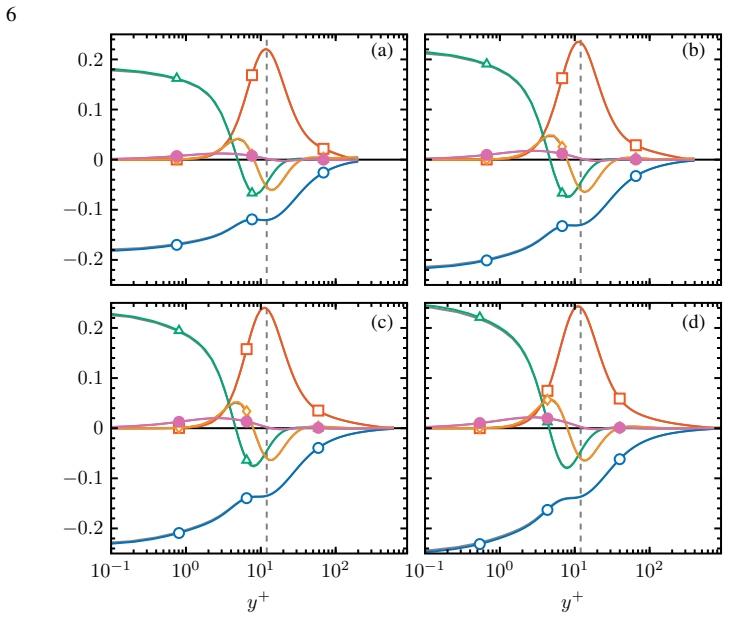
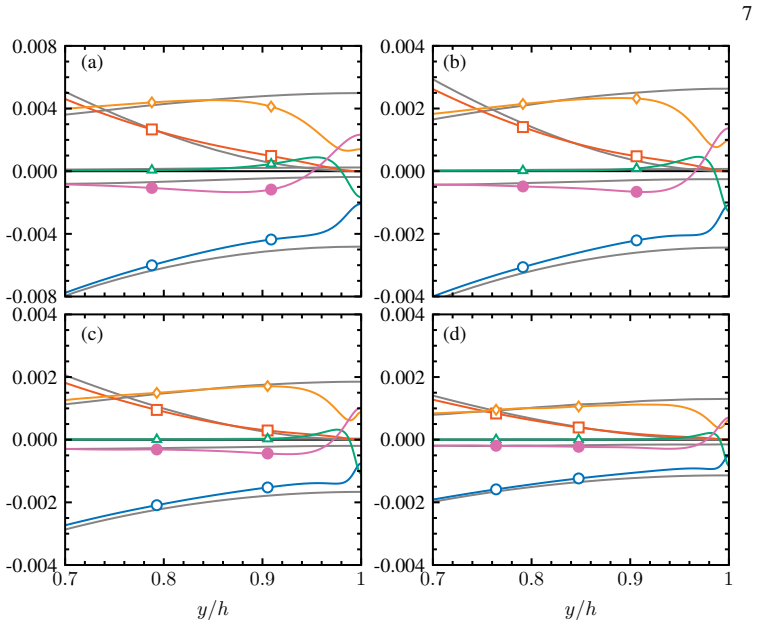
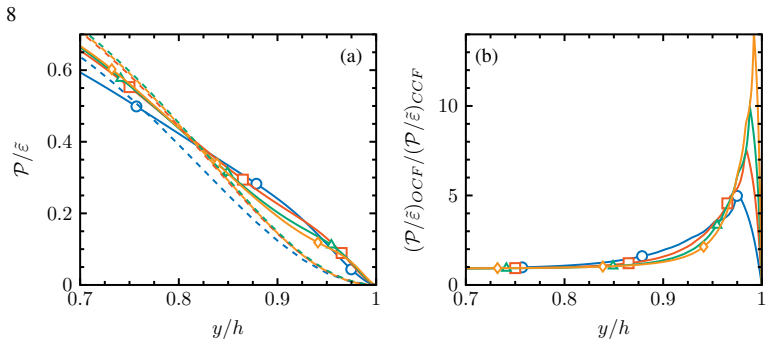
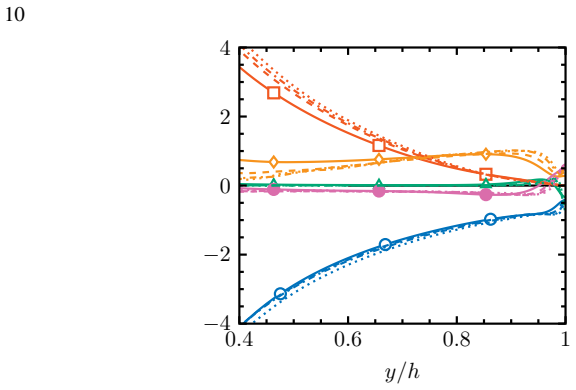
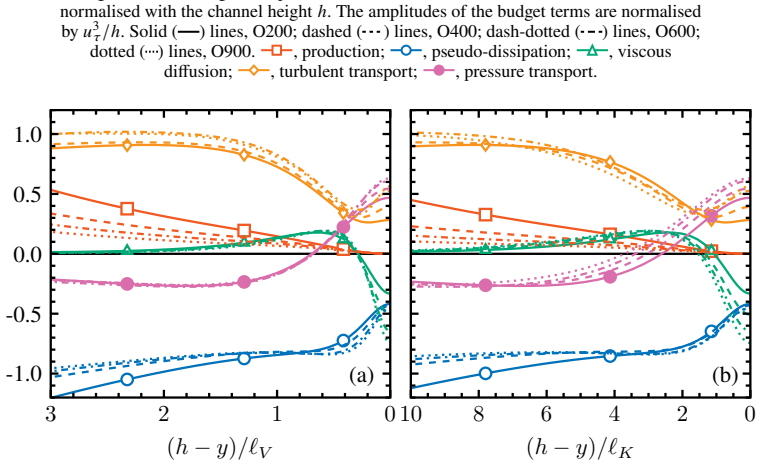
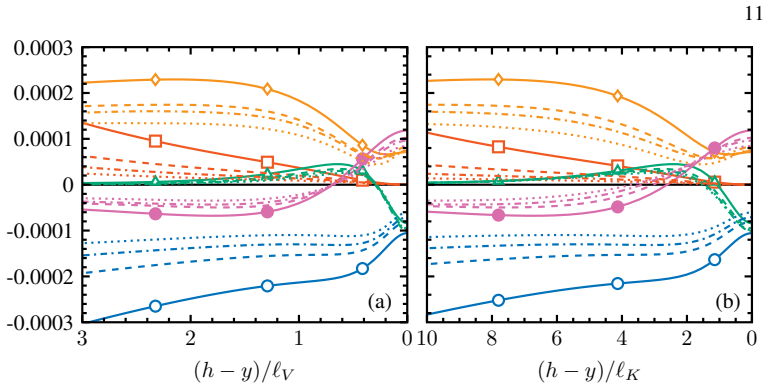
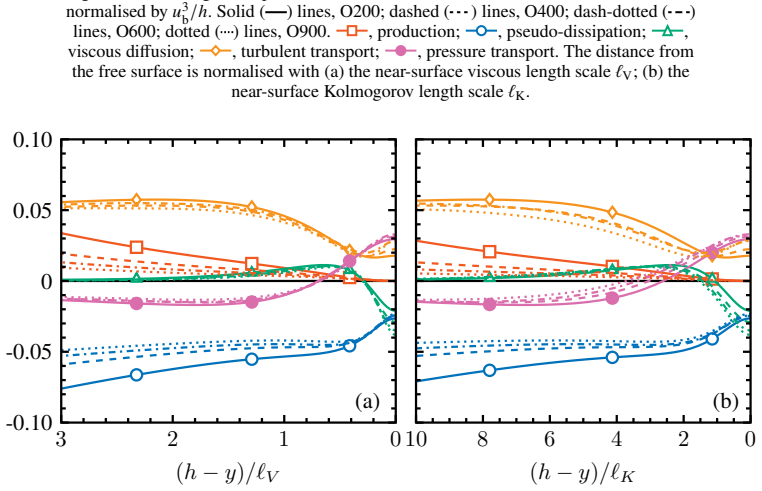
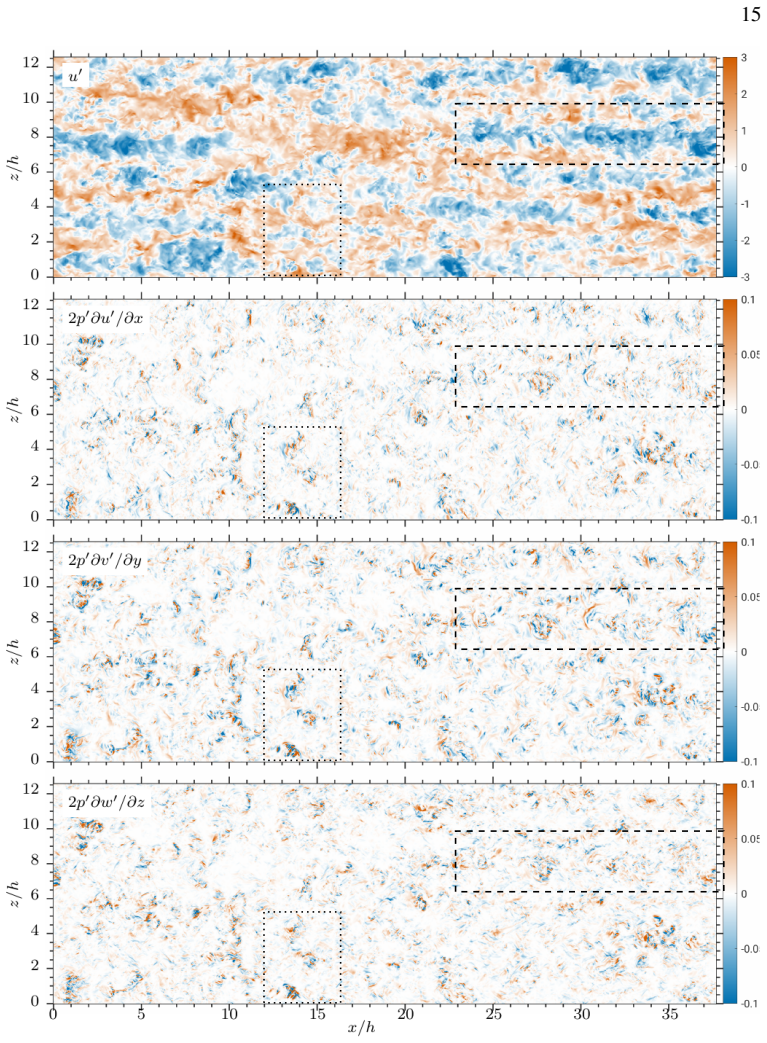
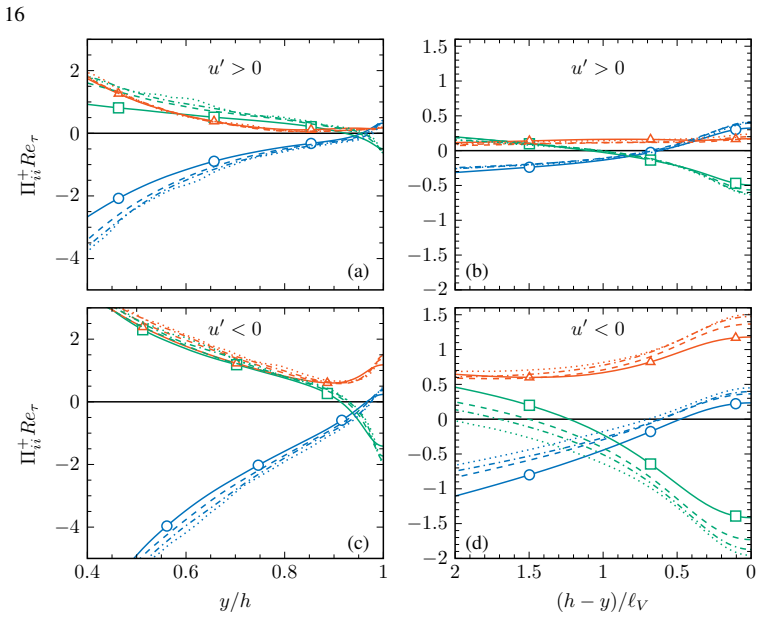
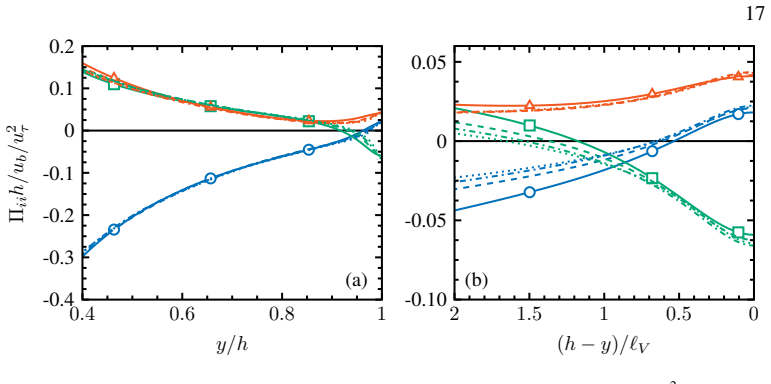
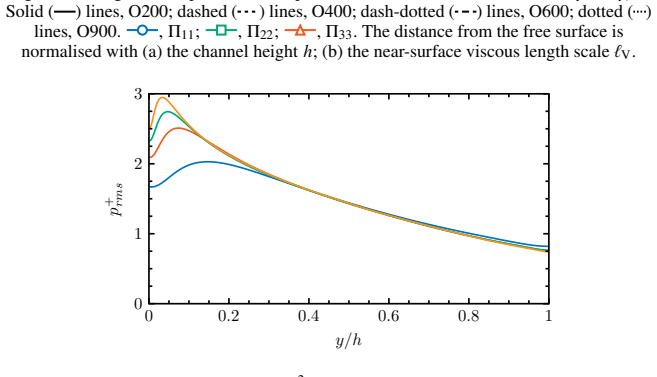
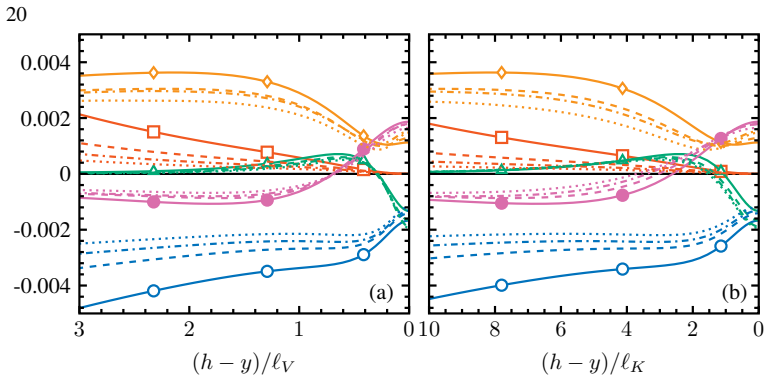
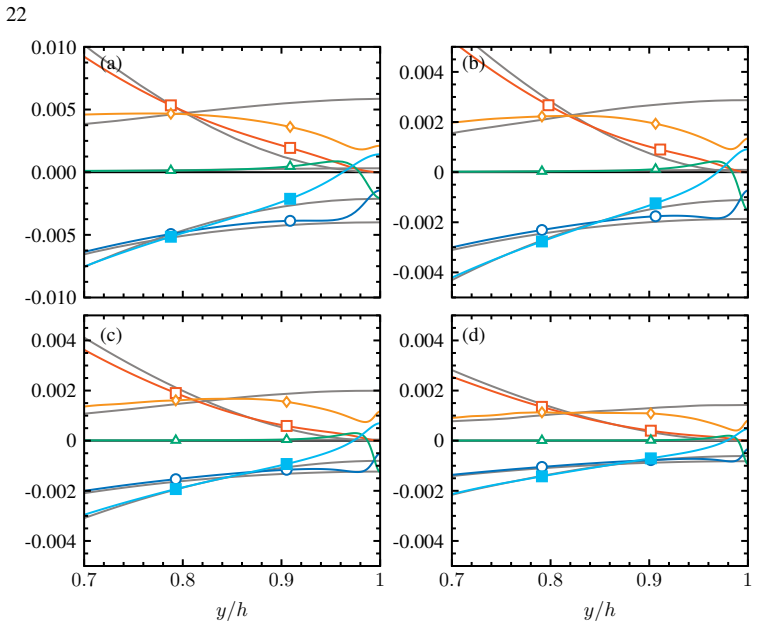
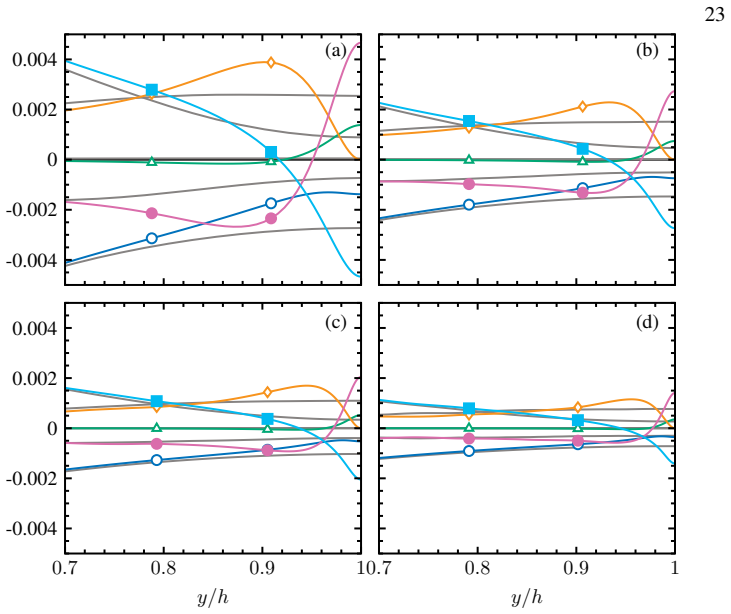
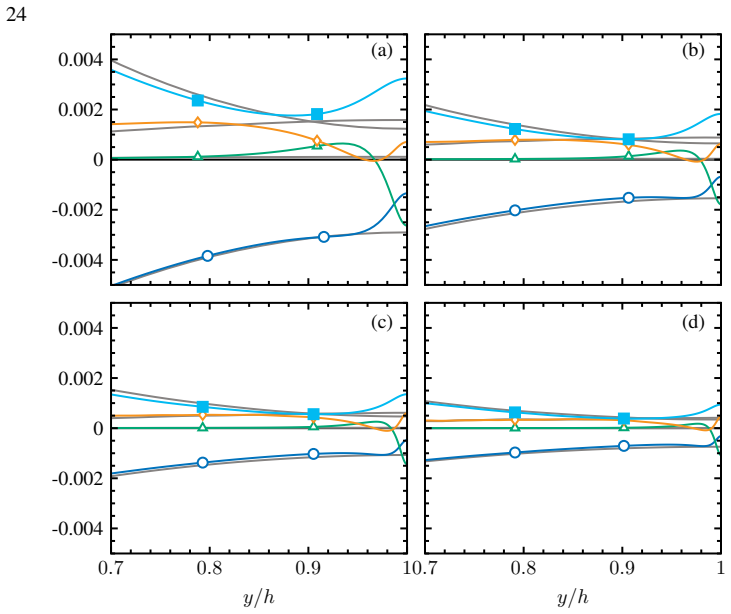
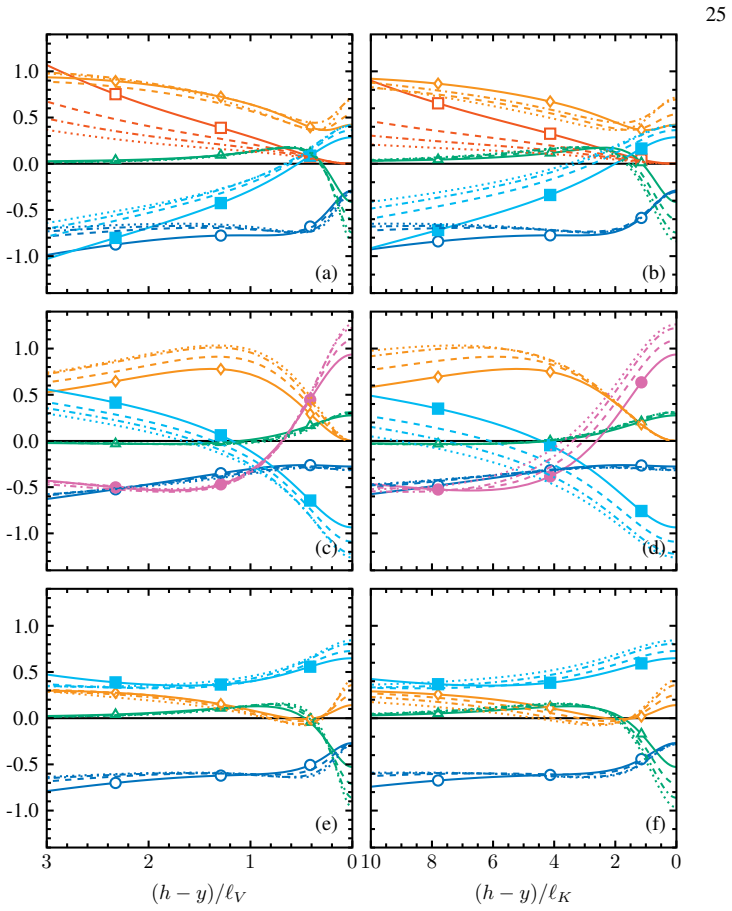
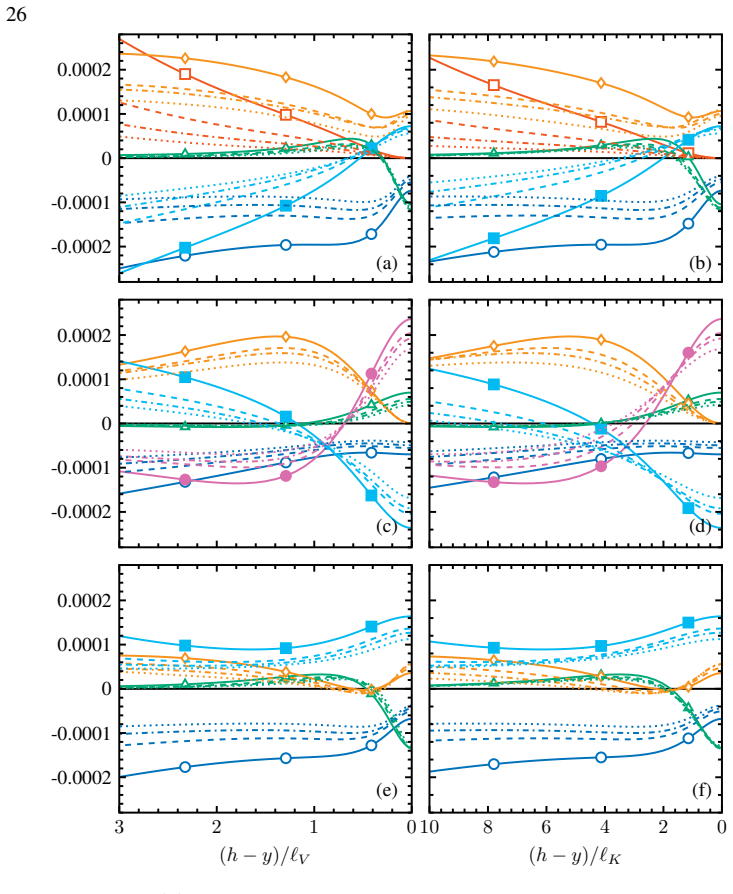
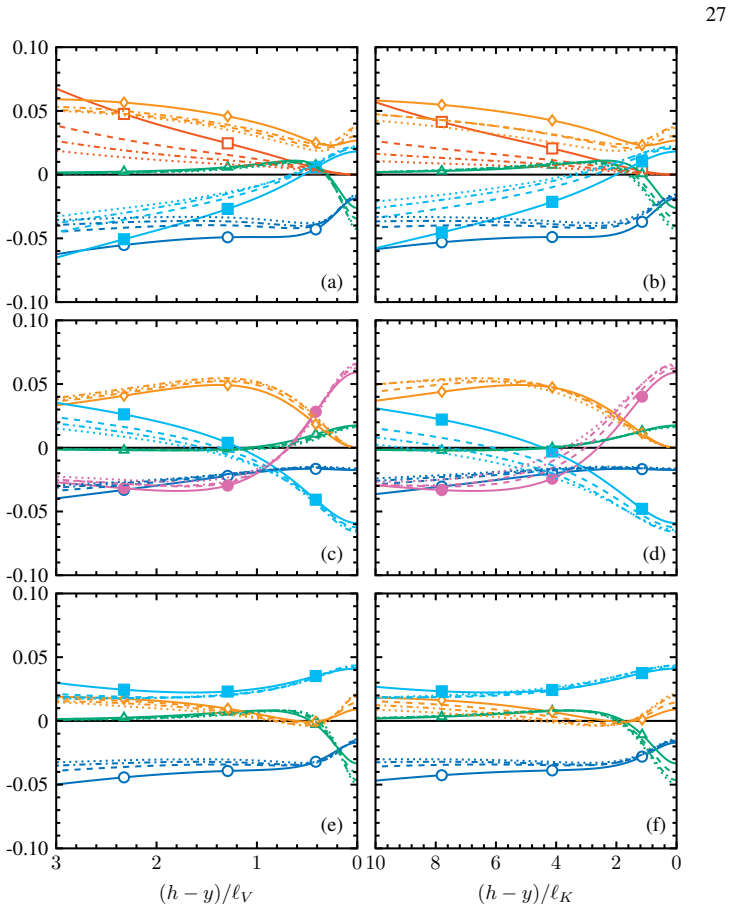
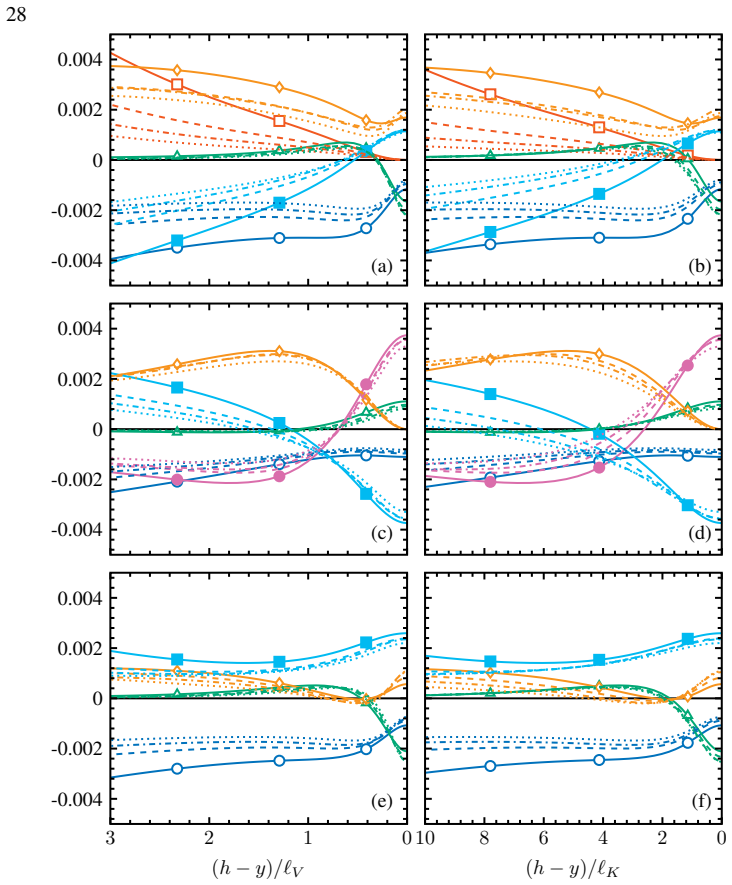
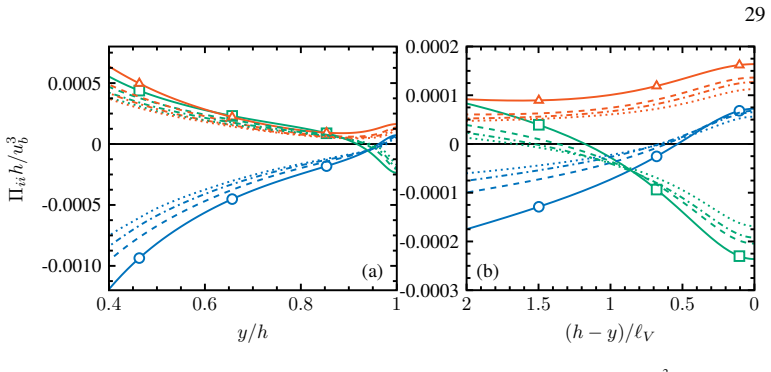
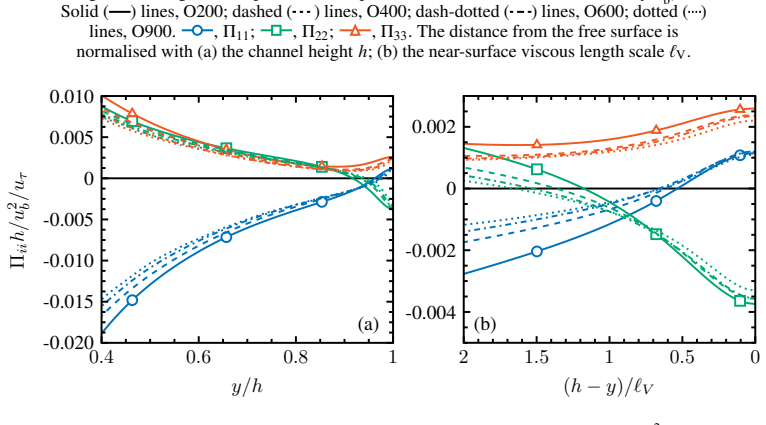
The free-surface influence is communicated primarily through transport terms. Near the free surface, pressure transport supplies energy towards the interface, whereas turbulent transport and dissipation are reduced; the resulting energy surplus is exported away from the surface predominantly by viscous diffusion. The near-surface budget terms do not exhibit a single universal similarity scaling: viscous diffusion is organised over the near-surface viscous scale, dissipation over the Kolmogorov sublayer scale, and pressure-related terms require the mixed velocity scale. The pressure-strain redistribution further reveals outer-inner coupling organised by low-velocity streaks.
What carries the argument
The turbulent kinetic energy budget terms obtained from matched open- and closed-channel direct numerical simulations, which isolate surface-induced differences in transport, production, and redistribution.
If this is right
- Surface effects extend into the outer layer through viscous diffusion rather than remaining confined near the interface.
- No single similarity scaling applies to the near-surface region; separate scales govern different budget terms.
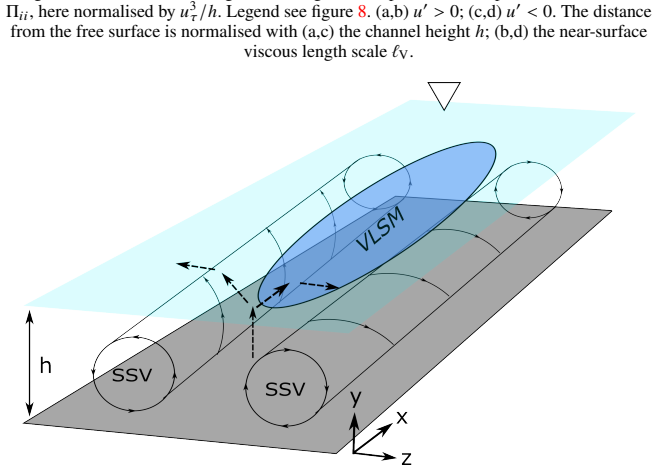
- Outer-layer very-large-scale motions organize the magnitude and direction of pressure-strain events at the surface.
- The overall process combines local kinematic constraints at the surface, Reynolds-number-dependent layers, and outer coherent motions.
Where Pith is reading between the lines
- If the multi-scale transport persists at higher Reynolds numbers, engineering models for open-channel mixing would need to incorporate outer-layer modulation of surface layers.
- The same transport pathways may operate in related free-surface flows such as wind-driven water bodies or shallow rivers.
- Direct comparison of the reported budget terms against field measurements at natural Reynolds numbers could test whether the DNS scale separation survives in real flows.
Load-bearing premise
That the TKE budget differences between the open- and closed-channel runs at Re_tau up to 900 cleanly isolate free-surface transport without contamination from domain-size effects or unaccounted statistics.
What would settle it
A simulation at Re_tau well above 900 in which all near-surface TKE budget terms collapse to a single scaling law instead of showing the reported separation into viscous, Kolmogorov, and mixed scales would falsify the multi-scale transport description.
Figures
read the original abstract
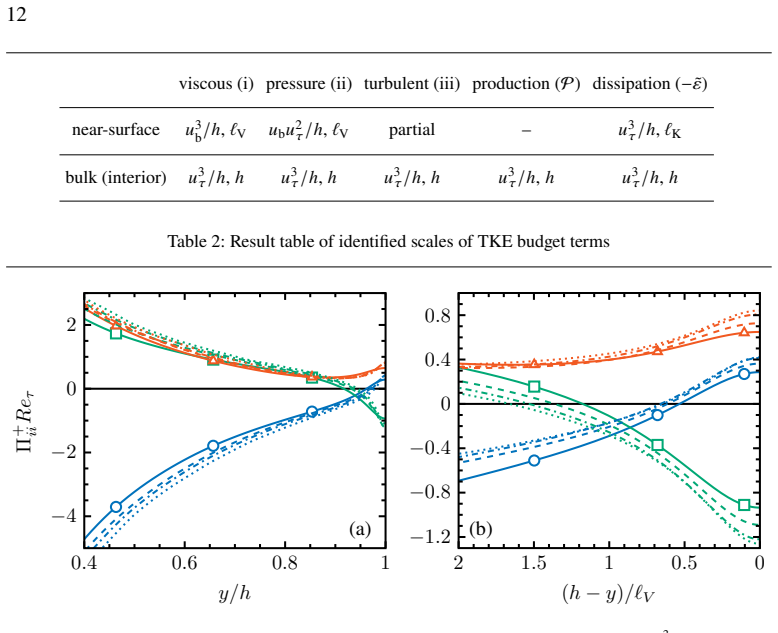
We investigate how the influence of a free surface is transported in turbulent open channel flow by analysing matched open- and closed-channel direct numerical simulations up to $Re_\mathrm{\tau} \approx 900$ in a domain large enough to accommodate very-large-scale motions (VLSMs). The turbulent kinetic energy (TKE) budget shows that the surface influence is communicated primarily through transport terms. Near the free surface, pressure transport supplies energy towards the interface, whereas turbulent transport and dissipation are reduced; the resulting energy surplus is exported away from the surface predominantly by viscous diffusion. The near-surface budget terms do not exhibit a single universal similarity scaling: viscous diffusion is organised over the near-surface viscous scale $\ell_\mathrm{V}$, dissipation over the Kolmogorov sublayer scale $\ell_\mathrm{K}$, and pressure-related terms require the mixed velocity scale $u_\mathrm{b} u_\mathrm{\tau}^2 /h$. The pressure-strain redistribution further reveals outer-inner coupling: although intense pressure-strain events remain small-scale, their magnitude and directional bias are organised by low-velocity VLSM streaks. The free-surface influence is therefore best understood as a coupled multi-scale process involving local kinematic constraints, Reynolds-number-dependent surface layers, and outer-layer coherent motions.
Editorial analysis
A structured set of objections, weighed in public.
Referee Report
Summary. The manuscript claims that free-surface influence in turbulent open channel flow is transported primarily via TKE budget transport terms, based on differences between matched open- and closed-channel DNS up to Re_τ ≈ 900 in a domain sized for VLSMs. Near the surface, pressure transport supplies energy to the interface while turbulent transport and dissipation are reduced, with the surplus exported by viscous diffusion. Budget terms lack a single universal scaling (viscous diffusion on ℓ_V, dissipation on ℓ_K, pressure terms on u_b u_τ²/h). Pressure-strain redistribution shows outer-inner coupling, with small-scale events organized in magnitude and bias by low-velocity VLSM streaks. The influence is therefore a coupled multi-scale process of local kinematics, Re-dependent layers, and outer coherent motions.
Significance. If the DNS budget differences robustly isolate surface-driven transport, the work clarifies that free-surface effects are not purely local but involve VLSM-mediated coupling across scales. The matched open/closed-channel setup and large domain (to accommodate VLSMs) are clear strengths, providing direct comparative evidence without ad-hoc parameters.
major comments (2)
- [TKE budget analysis] TKE budget analysis (abstract and results): the central claim that budget differences isolate free-surface transport rests on unshown numerical evidence; no quantitative error bars, grid-convergence studies, or explicit validation against established closed-channel benchmarks are reported, which is load-bearing because residual domain-size effects or higher-order contamination could produce similar imbalances without the claimed kinematic constraints.
- [Pressure-strain analysis] Pressure-strain and VLSM coupling (discussion): the interpretation that VLSM streaks organize the magnitude and directional bias of pressure-strain events assumes the chosen domain and Re_τ range fully eliminate box-size modulation of mean shear or unclosed correlations; without explicit checks this remains a correctness risk for the outer-inner coupling claim.
minor comments (1)
- [Abstract] The mixed velocity scale u_b u_τ²/h is introduced in the abstract without a preceding definition or reference, which reduces immediate clarity for readers.
Simulated Author's Rebuttal
We thank the referee for the careful and constructive report. We respond point-by-point to the major comments below and indicate where revisions will be made to address the concerns.
read point-by-point responses
-
Referee: [TKE budget analysis] TKE budget analysis (abstract and results): the central claim that budget differences isolate free-surface transport rests on unshown numerical evidence; no quantitative error bars, grid-convergence studies, or explicit validation against established closed-channel benchmarks are reported, which is load-bearing because residual domain-size effects or higher-order contamination could produce similar imbalances without the claimed kinematic constraints.
Authors: We agree that explicit documentation of numerical validation strengthens the central claim. The DNS were performed with resolutions sufficient to resolve the Kolmogorov scale, and the closed-channel cases were validated against established benchmarks (mean profiles and Reynolds stresses) at comparable Re_τ. Residuals in the TKE budget are below 1% of production. To make this evidence visible, we will add a dedicated numerical-methods subsection with quantitative comparisons, grid-convergence metrics, and error estimates in the revised manuscript. revision: yes
-
Referee: [Pressure-strain analysis] Pressure-strain and VLSM coupling (discussion): the interpretation that VLSM streaks organize the magnitude and directional bias of pressure-strain events assumes the chosen domain and Re_τ range fully eliminate box-size modulation of mean shear or unclosed correlations; without explicit checks this remains a correctness risk for the outer-inner coupling claim.
Authors: The domain was sized according to literature criteria for VLSM capture, and the mean shear and low-order statistics match those from smaller-domain closed-channel simulations, indicating negligible box-size modulation. Pressure-strain terms are obtained directly from the resolved fields. Nevertheless, to remove any ambiguity we will insert explicit checks (streamwise spectra, two-point correlations, and mean-shear comparisons with literature) in the revised discussion section. revision: yes
Circularity Check
No circularity: claims are direct DNS observations
full rationale
The paper's central claims derive from comparative analysis of TKE budget terms extracted from matched open- and closed-channel DNS at Re_τ up to 900. Differences in pressure transport, turbulent transport, viscous diffusion, dissipation, and pressure-strain events are reported as empirical findings and interpreted as evidence of multi-scale transport. No equations define a quantity in terms of itself, no fitted parameters are relabeled as predictions, and no load-bearing steps rely on self-citations or imported uniqueness theorems. The derivation chain consists of simulation data processing and direct comparison, remaining self-contained against external benchmarks without reduction to author-defined inputs.
Axiom & Free-Parameter Ledger
axioms (1)
- standard math Incompressible Navier-Stokes equations govern the velocity field
Reference graph
Works this paper leans on
-
[1]
How far does the influence of the free surface extend in turbulent open channel flow? , volume =
Bauer, Christian and Sakai, Yoshiyuki and Uhlmann, Markus , journal =. How far does the influence of the free surface extend in turbulent open channel flow? , volume =
-
[2]
Turbulence
Swean, T F and Leighton, R I and Handler, R A , booktitle =. Turbulence
-
[3]
Interaction of Vorticity with a Free Surface in Turbulent Open Channel Flow , volume =
Leighton, R I and Swean Jr, T F and Handler, R A and Swearingen, J D , booktitle =. Interaction of Vorticity with a Free Surface in Turbulent Open Channel Flow , volume =
-
[4]
Length Scales and the Energy Balance for Turbulence near a Free Surface , volume =
Handler, R A and Swean, T F and Leighton, R I and Swearingen, J D , journal =. Length Scales and the Energy Balance for Turbulence near a Free Surface , volume =. 1993 , abstract =. doi:10.2514/3.11883 , issn =
-
[5]
Direct Numerical Simulation of Three-Dimensional Open-Channel Flow with Zero-Shear Gas--Liquid Interface , volume =
Komori, Satoru and Nagaosa, Ryuichi and Murakami, Yasuhiro and Chiba, Satoshi and Ishii, Katsuya and Kuwahara, Kunio , journal =. Direct Numerical Simulation of Three-Dimensional Open-Channel Flow with Zero-Shear Gas--Liquid Interface , volume =. 1993 , doi =
1993
-
[6]
and Banerjee, S
Pan, Y. and Banerjee, S. , journal =. A Numerical Study of Free-Surface Turbulence in Channel Flow , volume =. 1995 , doi =
1995
-
[7]
Searching for the Log Law in Open Channel Flow , volume =
Pirozzoli, Sergio , journal =. Searching for the Log Law in Open Channel Flow , volume =. 2023 , abstract =. doi:10.1017/jfm.2023.616 , issn =
-
[8]
Direct Numerical Simulation of Turbulent Open Channel Flow , year =
Bauer, Christian , school =. Direct Numerical Simulation of Turbulent Open Channel Flow , year =
-
[9]
Contributions of Very Large-Scale Motions to Turbulence Statistics in Open Channel Flows , volume =
Duan, Yanchong and Chen, Qigang and Li, Danxun and Zhong, Qiang , journal =. Contributions of Very Large-Scale Motions to Turbulence Statistics in Open Channel Flows , volume =. 2020 , abstract =. doi:10.1017/jfm.2020.174 , issn =
-
[10]
Duan, Yanchong and Zhong, Qiang and Wang, Guiquan and Zhang, Peng and Li, Danxun , journal =. Contributions of Different Scales of Turbulent Motions to the Mean Wall-Shear Stress in Open Channel Flows at Low-to-Moderate. 2021 , abstract =. doi:10.1017/jfm.2021.236 , issn =
-
[11]
Pinelli, Michele and Herlina, H. and Wissink, J.G. and Uhlmann, M. , journal =. Direct Numerical Simulation of Turbulent Mass Transfer at the Surface of an Open Channel Flow , volume =. 2022 , abstract =. doi:10.1017/jfm.2021.1080 , issn =
-
[12]
Direct Numerical Simulation of Turbulent Open Channel Flows at Moderately High
Yao, Jie and Chen, Xi and Hussain, Fazle , journal =. Direct Numerical Simulation of Turbulent Open Channel Flows at Moderately High. 2022 , doi =
2022
-
[13]
Scaling of the Velocity Fluctuations in Turbulent Channels up to
Hoyas, Sergio and Jim. Scaling of the Velocity Fluctuations in Turbulent Channels up to. Phys. Fluids. , number =. 2006 , abstract =. doi:10.1063/1.2162185 , issn =
-
[14]
Scaling of turbulent kinetic energy and dissipation in turbulent wall-bounded flows , volume =
Wei, Tie , journal =. Scaling of turbulent kinetic energy and dissipation in turbulent wall-bounded flows , volume =. 2020 , doi =
2020
-
[15]
Bauer, C. and Sakai, Y. and Uhlmann, M. , booktitle =. Direct Numerical Simulation of Turbulent Open Channel Flow:. 2024 , abstract =. doi:10.1007/978-3-031-55924-2_42 , isbn =
-
[16]
Statistical Structure of High-
Calmet, Isabelle and Magnaudet, Jacques , journal =. Statistical Structure of High-. 2003 , doi =
2003
-
[17]
Turbulence Statistics in Fully Developed Channel Flow at Low
Kim, John and Moin, Parviz and Moser, Robert , journal =. Turbulence Statistics in Fully Developed Channel Flow at Low. 1987 , abstract =. doi:10.1017/S0022112087000892 , issn =
-
[18]
Mansour, N. N. and Kim, J. and Moin, Parviz , journal =. Reynolds-stress and dissipation-rate budgets in a turbulent channel flow , volume =. 1988 , doi =
1988
-
[19]
Reynolds Number Effects on the
Hoyas, Sergio and Jim. Reynolds Number Effects on the. Phys. Fluids. , number =. 2008 , doi =
2008
-
[20]
Data Underlying the Publication:
Bauer, Christian and Sakai, Yoshiyuki and Uhlmann, Markus , publisher =. Data Underlying the Publication:. 2023 , doi =
2023
-
[21]
Direct Numerical Simulation of Vortex Structures and Turbulent Scalar Transfer across a Free Surface in a Fully Developed Turbulence , volume =
Nagaosa, Ryuichi , journal =. Direct Numerical Simulation of Vortex Structures and Turbulent Scalar Transfer across a Free Surface in a Fully Developed Turbulence , volume =. 1999 , doi =
1999
-
[22]
and Yue, Dick K
Shen, Lian and Triantafyllou, George S. and Yue, Dick K. P. , journal =. Turbulent diffusion near a free surface , volume =. 2000 , url =
2000
-
[23]
Turbulent length scales and budgets of Reynolds stress-transport for open-channel flows; friction Reynolds numbers
Umair Ahmed and David Apsley and Timothy Stallard and Peter Stansby and Imran Afgan , journal =. Turbulent length scales and budgets of Reynolds stress-transport for open-channel flows; friction Reynolds numbers. 2021 , doi =
2021
-
[24]
Statistical Analysis of Turbulent Super-Streamwise Vortices Based on Observations of Streaky Structures near the Free Surface in the Smooth Open Channel Flow , volume =
Zhong, Qiang and Chen, Qigang and Wang, Hao and Li, Danxun and Wang, Xingkui , journal =. Statistical Analysis of Turbulent Super-Streamwise Vortices Based on Observations of Streaky Structures near the Free Surface in the Smooth Open Channel Flow , volume =. 2016 , doi =
2016
-
[25]
Scherer and M
M. Scherer and M. Uhlmann and A.G. Kidanemariam and M. Krayer , journal =. On the role of turbulent streaks in generating sediment ridges , volume =. 2022 , doi =
2022
discussion (0)
Sign in with ORCID, Apple, or X to comment. Anyone can read and Pith papers without signing in.