The lymph 2.0 library: p-adaptive algorithms and parallel assembly strategies for polytopal DG methods
Pith reviewed 2026-06-25 22:51 UTC · model grok-4.3
The pith
The lymph 2.0 library adds element-wise p-adaptivity via a posteriori indicators and a unified assembly framework that supports shared-memory parallelism for polytopal DG methods.
A machine-rendered reading of the paper's core claim, the machinery that carries it, and where it could break.
Core claim
The lymph 2.0 version supports discretizations with element-wise polynomial approximation degrees to enable p-adaptive strategies based on a posteriori error indicators, and introduces a unified assembly framework that abstracts the construction of discrete operators from the underlying physical model, thereby enabling shared-memory parallelism and reducing computational cost while preserving approximation accuracy.
What carries the argument
The unified assembly framework that abstracts discrete operator construction from the physical model, combined with p-adaptive strategies driven by a posteriori error indicators.
If this is right
- Element-wise variation of polynomial degree reduces degrees of freedom where local error is small.
- The assembly abstraction improves code modularity and supports parallel execution on shared-memory hardware.
- Approximation accuracy is maintained across the tested discretizations on polytopal meshes.
- The library becomes more maintainable and extensible for adding new physical models.
Where Pith is reading between the lines
- The same assembly abstraction could reduce development effort when porting the library to distributed-memory systems.
- p-adaptivity may allow higher effective resolution in applications with localized features such as boundary layers.
- The framework's separation of model and assembly could be reused to incorporate other error estimators without rewriting core code.
Load-bearing premise
The numerical examples provided are sufficient to confirm that the p-adaptive strategies and parallel assembly features perform reliably on representative problems without hidden implementation errors.
What would settle it
A test case on a polytopal mesh where applying the p-adaptive strategy either increases the total error for a given tolerance or the parallel assembly produces incorrect results or shows no reduction in runtime.
Figures
read the original abstract
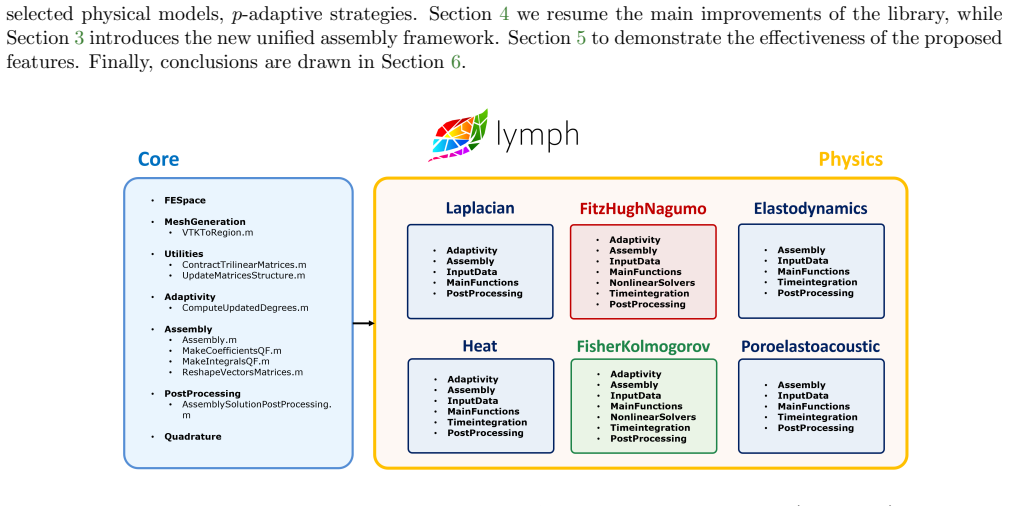
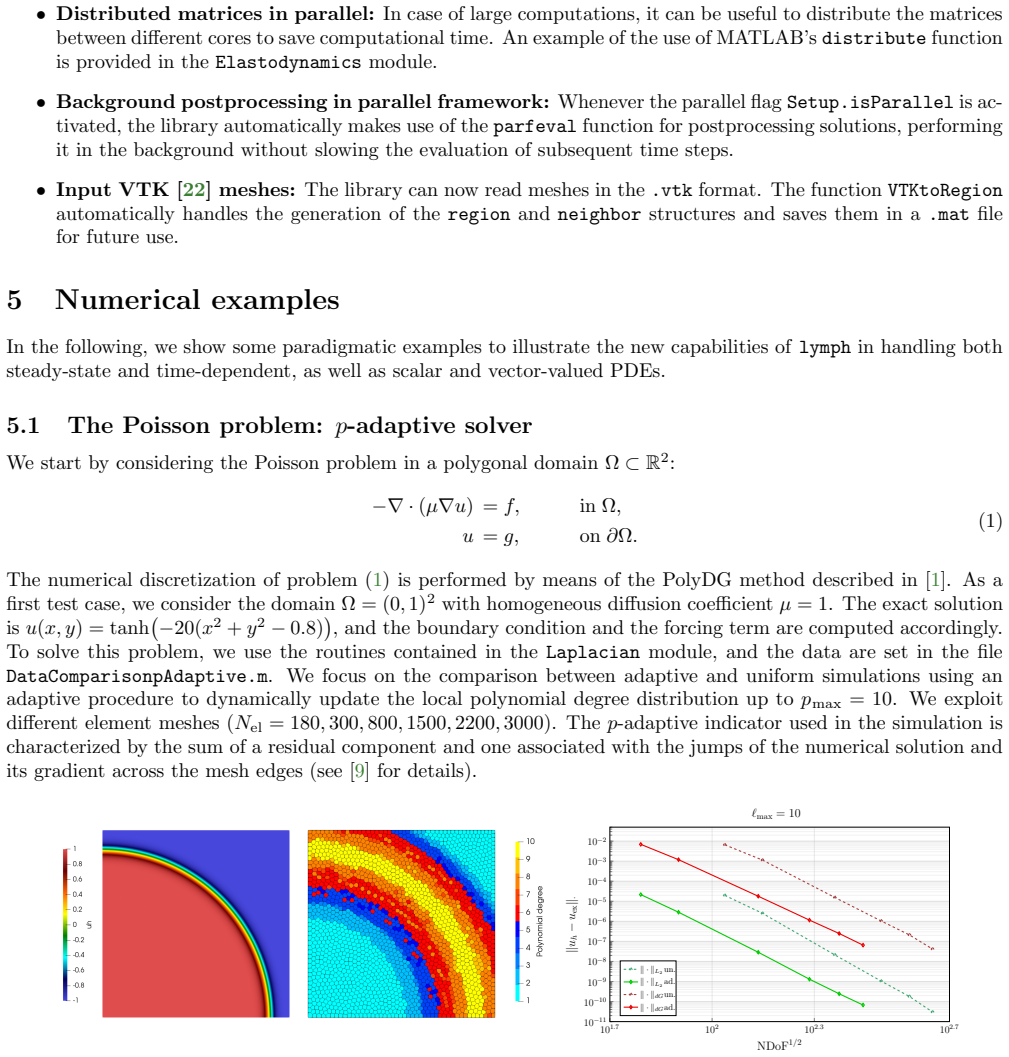
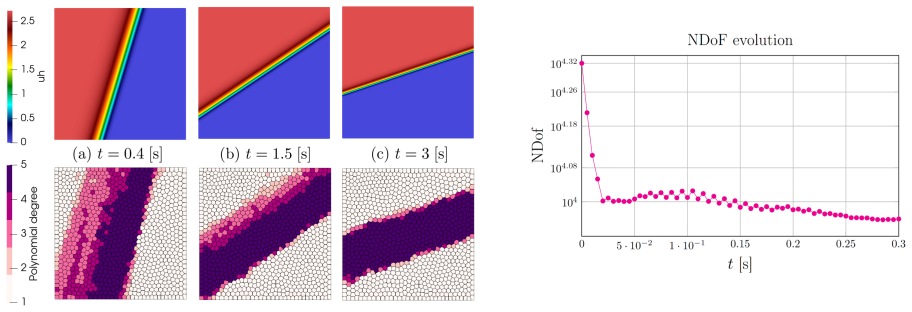
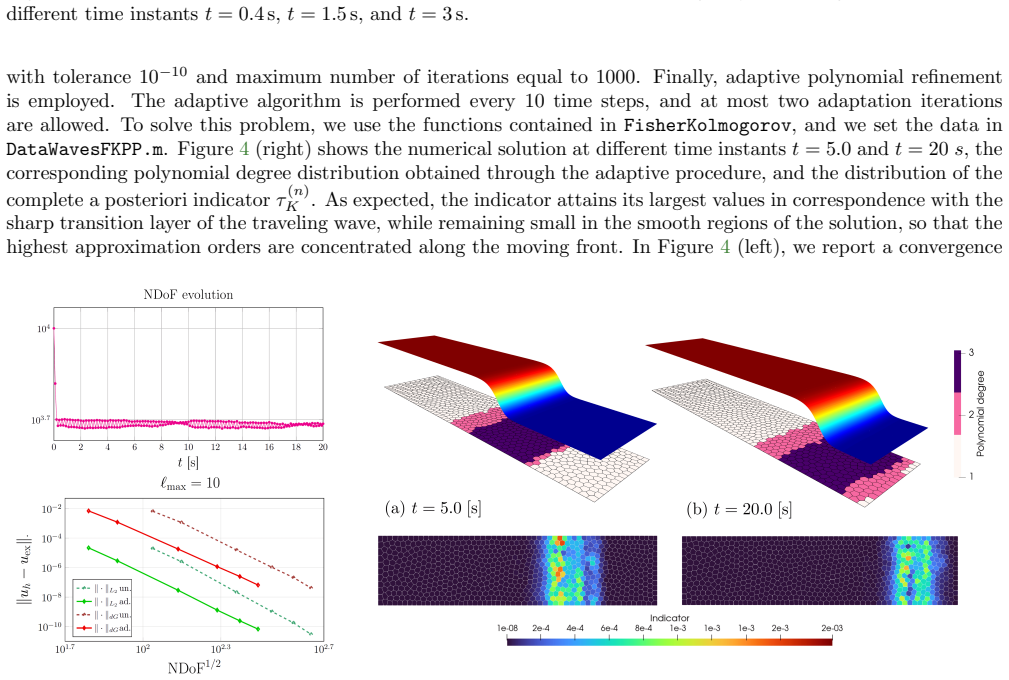
This work presents a new release of the lymph 2.0 library, an open-source MATLAB framework for high-order discontinuous Galerkin discretizations on general polytopal meshes. The lymph 2.0 version is extended to support discretizations with element-wise polynomial approximation degrees, which allows the design of $p$-adaptive strategies based on a posteriori error indicators. In addition, the library introduces a unified assembly framework that abstracts the construction of discrete operators from the underlying physical model, improving code modularity, parallelism, maintainability, and extensibility. Moreover, the proposed approach enables shared-memory parallelism through dedicated parallel tools. Several numerical examples demonstrate the effectiveness of the proposed developments in reducing the computational cost while preserving approximation accuracy.
Editorial analysis
A structured set of objections, weighed in public.
Referee Report
Summary. The manuscript describes lymph 2.0, an open-source MATLAB library extending the original lymph framework for high-order discontinuous Galerkin discretizations on general polytopal meshes. Key additions include element-wise varying polynomial degrees to enable p-adaptive strategies driven by a posteriori error indicators, and a unified assembly framework that abstracts discrete operator construction to support shared-memory parallelism, modularity, and extensibility. Several numerical examples are presented to demonstrate that these features reduce computational cost while preserving approximation accuracy.
Significance. If the numerical demonstrations hold with quantitative evidence, the library would offer a reproducible, extensible tool for adaptive high-order methods on complex geometries, addressing practical needs in polytopal DG computations. The open-source MATLAB implementation and focus on parallelism constitute clear strengths for community adoption and verification.
major comments (2)
- [Numerical examples] Numerical examples section: the central claim that p-adaptive strategies and the unified assembly reduce cost while preserving accuracy is load-bearing, yet the manuscript supplies no explicit quantitative baselines (e.g., total DOFs, wall-clock times, L2/H1 error norms) comparing adaptive versus uniform-p cases, nor parallel speedup curves versus serial execution or the prior lymph version. This omission prevents verification that the claimed benefits are realized without hidden regressions.
- [Unified assembly framework] Section describing the unified assembly framework: the abstraction of physical models into discrete operators is presented as enabling parallelism, but no algorithmic outline, pseudocode, or timing breakdown is given to show how shared-memory tools are invoked or how the framework avoids performance regressions relative to the original assembly. This detail is required to substantiate the modularity and parallelism claims.
minor comments (2)
- [Abstract] Abstract: the statement of effectiveness would be strengthened by naming the mesh dimensions, element types, and problem classes used in the examples.
- Notation: ensure consistent use of symbols for local polynomial degree p_K across sections describing the a posteriori indicators.
Simulated Author's Rebuttal
We thank the referee for the constructive comments on the lymph 2.0 manuscript. The feedback highlights areas where additional quantitative detail and implementation clarity will strengthen the presentation of the p-adaptive and parallel assembly features. We address each major comment below and will revise the manuscript accordingly.
read point-by-point responses
-
Referee: [Numerical examples] Numerical examples section: the central claim that p-adaptive strategies and the unified assembly reduce cost while preserving accuracy is load-bearing, yet the manuscript supplies no explicit quantitative baselines (e.g., total DOFs, wall-clock times, L2/H1 error norms) comparing adaptive versus uniform-p cases, nor parallel speedup curves versus serial execution or the prior lymph version. This omission prevents verification that the claimed benefits are realized without hidden regressions.
Authors: We acknowledge the referee's point that the numerical examples would be strengthened by explicit quantitative comparisons. The current examples demonstrate qualitative effectiveness of the p-adaptive strategies and assembly framework, but we agree that tables reporting total DOFs, L2/H1 error norms, wall-clock times for adaptive versus uniform-p cases, and parallel speedup curves (versus serial and the prior lymph version) are needed to fully substantiate the cost-reduction claims. We will add these quantitative baselines and speedup data in a revised numerical examples section. revision: yes
-
Referee: [Unified assembly framework] Section describing the unified assembly framework: the abstraction of physical models into discrete operators is presented as enabling parallelism, but no algorithmic outline, pseudocode, or timing breakdown is given to show how shared-memory tools are invoked or how the framework avoids performance regressions relative to the original assembly. This detail is required to substantiate the modularity and parallelism claims.
Authors: We agree that an algorithmic outline, pseudocode, and timing breakdown would better substantiate the claims for the unified assembly framework. The manuscript describes the abstraction and its benefits for modularity and shared-memory parallelism, but does not include these implementation details. We will add a dedicated subsection with pseudocode illustrating operator construction and parallel invocation, along with timing comparisons to the original assembly to demonstrate absence of regressions. revision: yes
Circularity Check
No circularity: software library description with empirical demonstrations
full rationale
This is a software release paper describing extensions to the lymph library for p-adaptive DG methods on polytopal meshes and a unified parallel assembly framework. The central claims concern code modularity, parallelism, and cost reduction demonstrated via numerical examples. No derivation chain, fitted parameters renamed as predictions, self-citations used as load-bearing uniqueness theorems, or ansatzes smuggled via prior work exist. The work is self-contained as an implementation description; numerical examples serve as external validation rather than self-referential fits. Score 0 is the appropriate default for such papers.
Axiom & Free-Parameter Ledger
Reference graph
Works this paper leans on
-
[1]
P. F. Antonietti, S. Bonetti, M. Botti, M. Corti, I. Fumagalli, and I. Mazzieri. lymph: discontinuous poLYtopal methods for Multi-PHysics differential problems.ACM Trans. Math. Softw., 51(1):1–22, 2025
2025
-
[2]
P. F. Antonietti, M. Botti, A. Cancrini, and I. Mazzieri. A polytopal discontinuous Galerkin method for the pseudo-stress formulation of the unsteady Stokes problem.Comput. Methods Appl. Mech. Engrg., 447:118404, 2025
2025
-
[3]
P. F. Antonietti, M. Corti, S. G´ omez, and I. Perugia. A structure-preserving LDG discretization of the Fisher- Kolmogorov equation for modeling neurodegenerative diseases.Math. Comput. Simul., 241:351–366, 2026. 10
2026
-
[4]
P. F. Antonietti, S. Giani, and P. Houston. hp-version composite discontinuous Galerkin methods for elliptic problems on complicated domains.SIAM J. Sci. Comput., 35(3):A1417–A1439, 2013
2013
-
[5]
P. F. Antonietti, P. Houston, and G. Pennesi. Fast numerical integration on polytopic meshes with applications to discontinuous Galerkin finite element methods.J. Sci. Comput., 77(3):1339–1370, Dec. 2018
2018
-
[6]
Beir˜ ao da Veiga, G
L. Beir˜ ao da Veiga, G. Manzini, and L. Mascotto. A posteriori error estimation and adaptivity inhpvirtual elements.Numer. Math., 143(1):139–175, 2019
2019
-
[7]
Bonetti and M
S. Bonetti and M. Corti. Unified discontinuous Galerkin analysis of a thermo/poro-viscoelasticity model.J. Sci. Comput., 105:11, 2025
2025
-
[8]
Botti, I
M. Botti, I. Fumagalli, and I. Mazzieri. Polytopal discontinuous Galerkin methods for low-frequency poroelas- ticity coupled to unsteady Stokes flow.Eng. Comput., 41:4173–4189, 2025
2025
-
[9]
Cangiani, Z
A. Cangiani, Z. Dong, and E. H. Georgoulis. A posteriori error estimates for discontinuous Galerkin methods on polygonal and polyhedral meshes.SIAM J. Numer. Anal., 61(5):2352–2380, 2023
2023
-
[10]
Cangiani, Z
A. Cangiani, Z. Dong, E. H. Georgoulis, and P. Houston.hp-Version Discontinuous Galerkin Methods on Polygonal and Polyhedral Meshes. Springer, 2017
2017
-
[11]
Cangiani, E
A. Cangiani, E. H. Georgoulis, and P. Houston. hp-version discontinuous Galerkin methods on polygonal and polyhedral meshes.Math. Models Methods Appl. Sci., 24(10):2009–2041, 2014
2009
-
[12]
Corti, F
M. Corti, F. Bonizzoni, L. Dede’, A. M. Quarteroni, and P. F. Antonietti. Discontinuous Galerkin methods for Fisher–Kolmogorov equation with application toα-synuclein spreading in Parkinson’s disease.Comput. Methods Appl. Mech. Eng., 417:116450, 2023
2023
-
[13]
R. A. Fisher. The wave of advance of advantageous genes.Ann. Eugen., 7:355–369, 1937
1937
-
[14]
FitzHugh
R. FitzHugh. Impulses and physiological states in theoretical models of nerve membrane.Biophys. J., 1(6):445– 466, 1961
1961
-
[15]
Houston, B
P. Houston, B. Senior, and E. S¨ uli. A posteriori error analysis for hp-version discontinuous Galerkin methods for second-order quasilinear elliptic problems.IMA J. Numer. Anal., 22(4):547–573, 2002
2002
-
[16]
Houston and T
P. Houston and T. P. Wihler. Anhp-adaptive Newton-discontinuous-Galerkin finite element approach for semilinear elliptic boundary value problems.Math. Comp., 87(314):2641–2674, 2018
2018
-
[17]
Kolmogorov, I
A. Kolmogorov, I. Petrovsky, and N. Piscounov. Study of the diffusion equation with growth of the quantity of matter and its application to a biological problem.Bull. Moscow Univ. Math. Mech., pages 1–25, 1937
1937
-
[18]
C. B. Leimer Saglio, S. Pagani, and P. F. Antonietti. A p-adaptive polytopal discontinuous Galerkin method for high-order approximation of brain electrophysiology.Comput. Methods Appl. Mech. Eng., 446:118249, 2025
2025
-
[19]
C. B. Leimer Saglio, S. Pagani, M. Corti, and P. F. Antonietti. A high-order discontinuous Galerkin method for the numerical modeling of epileptic seizures.Comput. Math. Appl., 205:112–131, 2026
2026
-
[20]
J. M. Melenk and B. I. Wohlmuth. On residual-based a posteriori error estimation inhp-FEM.Adv. Comput. Math., 15(1–4):311–331, 2001
2001
-
[21]
Nagumo, S
J. Nagumo, S. Arimoto, and S. Yoshizawa. An active pulse transmission line simulating nerve axon.Proc. IRE, 50(10):2061–2070, 1962
2061
-
[22]
Schroeder, K
W. Schroeder, K. Martin, and B. Lorensen.The Visualization Toolkit (4th ed.). Kitware, 2006. 11
2006
discussion (0)
Sign in with ORCID, Apple, or X to comment. Anyone can read and Pith papers without signing in.