Landmarking with Latent Class Mixed Models for Dynamic Prediction of Time-to-event Data with Heterogeneous Biomarker Trajectories
Pith reviewed 2026-06-25 22:25 UTC · model grok-4.3
The pith
A landmarking method paired with latent class mixed models captures hidden subgroups in biomarker trajectories to improve dynamic time-to-event predictions.
A machine-rendered reading of the paper's core claim, the machinery that carries it, and where it could break.
Core claim
The central claim is that embedding latent class mixed models inside a landmarking framework identifies latent subgroups in longitudinal biomarker data and yields more accurate dynamic predictions of time-to-event outcomes than standard landmarking, without sacrificing computational speed for large-scale applications.
What carries the argument
The integration of latent class mixed models within the landmarking procedure to partition patients into discrete classes based on biomarker trajectory patterns and to condition survival predictions on the assigned class at each landmark time.
If this is right
- Prediction error decreases relative to homogeneous landmarking when biomarker data contain latent classes.
- Computation remains feasible on datasets the size of typical electronic health records.
- The modular implementation allows users to combine the latent-class step with other survival or longitudinal specifications.
- Risk estimates can be refreshed at each new measurement time while respecting the class structure.
Where Pith is reading between the lines
- The same structure could be tested on other longitudinal covariates such as imaging or wearable sensor streams.
- Class-specific landmarking might reduce bias in settings where treatment effects differ across unobserved subgroups.
- Extending the approach to allow time-varying class membership could address cases where patients switch subgroups.
Load-bearing premise
Heterogeneity in biomarker trajectories is produced by a small number of discrete latent subgroups that latent class mixed models can reliably recover.
What would settle it
A simulation study or real dataset in which the proposed method shows no improvement in prediction metrics over standard landmarking when latent heterogeneity is known to be present, or in which the dynamic updating property is lost after class assignment.
Figures
read the original abstract
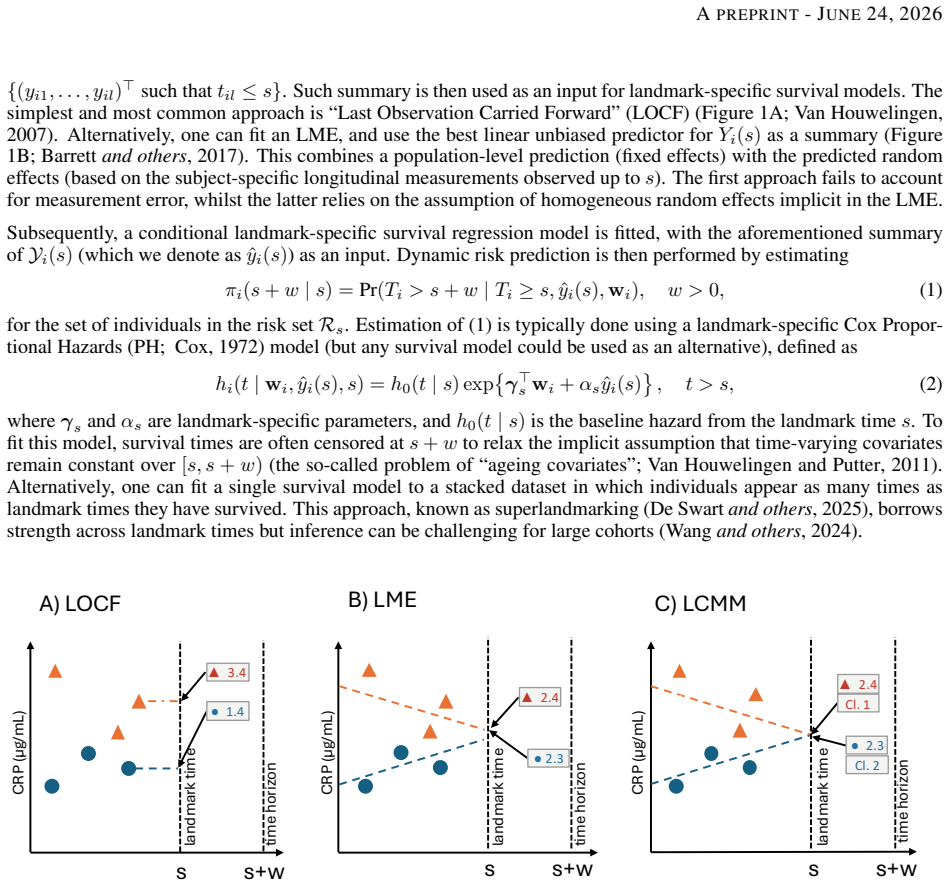
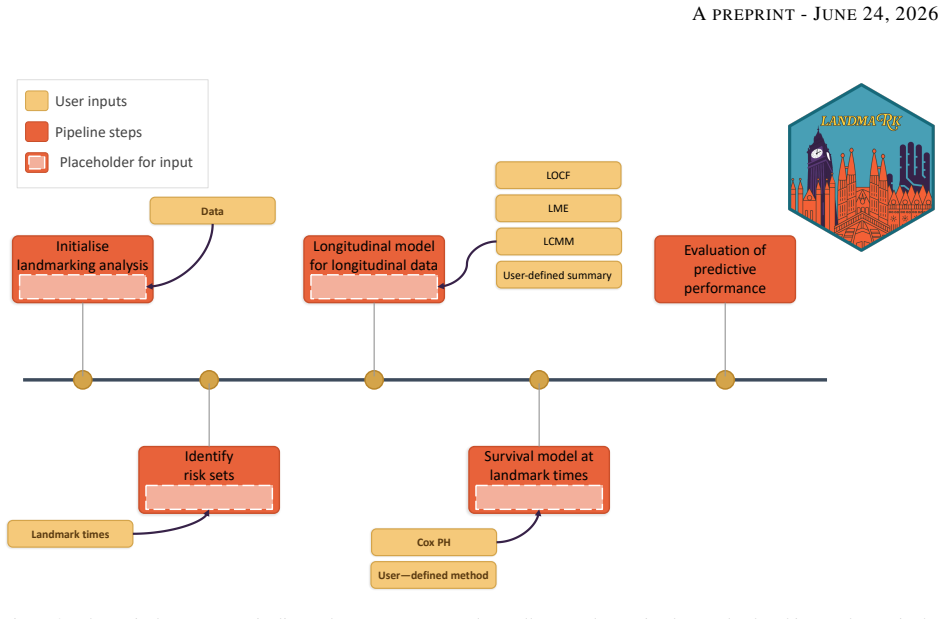
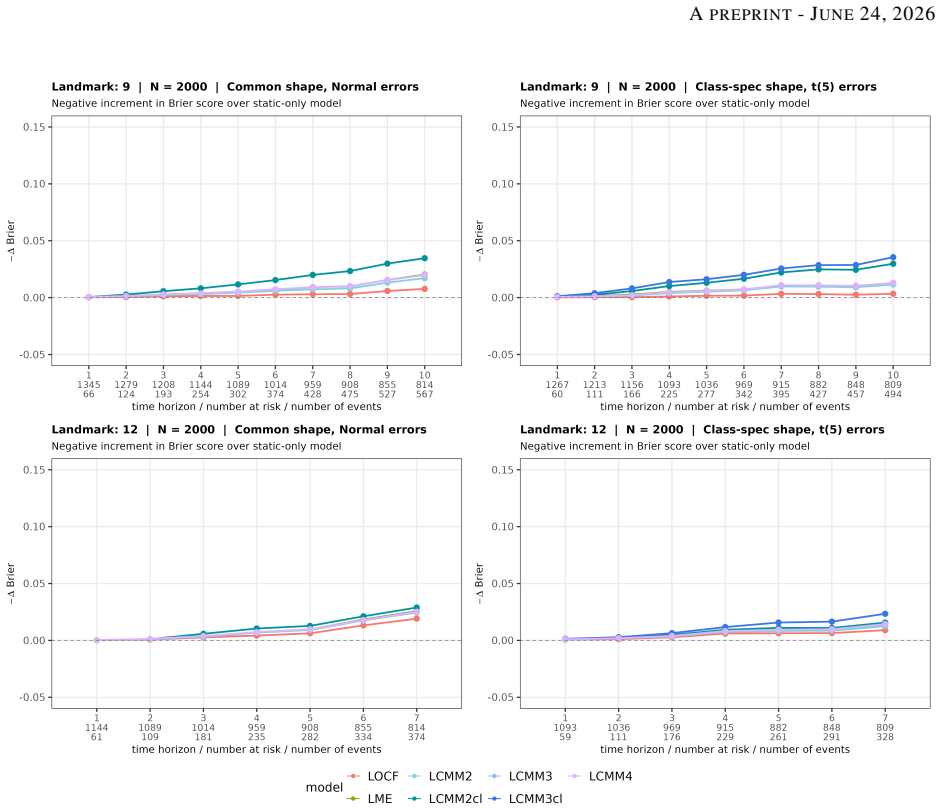
The increasing ability to securely access electronic health records (EHR) has created unprecedented opportunities to monitor the health trajectories of large heterogeneous patient populations throughout their lifetime. Repeated measurements of time-varying covariates (such as biomarkers measured via routine blood tests) can inform dynamic risk prediction of time-to-event outcomes, updating risk estimates as new information becomes available. Existing dynamic risk prediction approaches often assume homogeneous longitudinal trajectories across individuals. This assumption is not met when there is heterogeneity driven by latent subgroup structure (e.g. due to unobserved confounders), as is often the case with real-world biomedical data. At present, accounting for such heterogeneity is only available in joint latent class models for longitudinal and time-to-event data, but they are computationally intensive, often prohibitively so for large-scale data, such as those present in EHR settings. To address these challenges, we propose a novel landmarking approach that integrates latent class mixed models (LCMMs) to capture latent heterogeneity in longitudinal trajectories. Our method is implemented in a modular R package, landmaRk, which is available on CRAN and allows users to flexibly specify the components of a landmarking analysis, beyond our proposed approach. Through simulation studies, we demonstrate improvements in prediction performance in the presence of latent heterogeneity compared to traditional landmarking strategies, while remaining computationally efficient for large datasets. We also provide a proof-of-concept illustration using real data.
Editorial analysis
A structured set of objections, weighed in public.
Referee Report
Summary. The manuscript proposes integrating latent class mixed models (LCMMs) into a landmarking framework to account for latent heterogeneity in longitudinal biomarker trajectories when performing dynamic prediction of time-to-event outcomes. The approach is positioned as computationally efficient for large EHR-scale data relative to joint latent class models, is implemented in the modular landmaRk R package on CRAN, and is supported by simulation studies claiming improved prediction performance over standard landmarking under heterogeneity, plus a real-data illustration.
Significance. If the integration preserves unbiased dynamic updating and the simulation gains hold under realistic identifiability conditions, the method would offer a practical middle ground between homogeneous landmarking and fully joint models, enabling heterogeneity-aware predictions at scale in biomedical settings.
major comments (3)
- [§3] §3 (Method): The manuscript must specify whether the LCMM is refitted (or class posteriors re-estimated) using only data observed up to each landmark time t_LM, or whether a single baseline LCMM is used; without this, it is impossible to confirm that the dynamic-updating property of landmarking is retained and that the comparison to traditional landmarking remains valid.
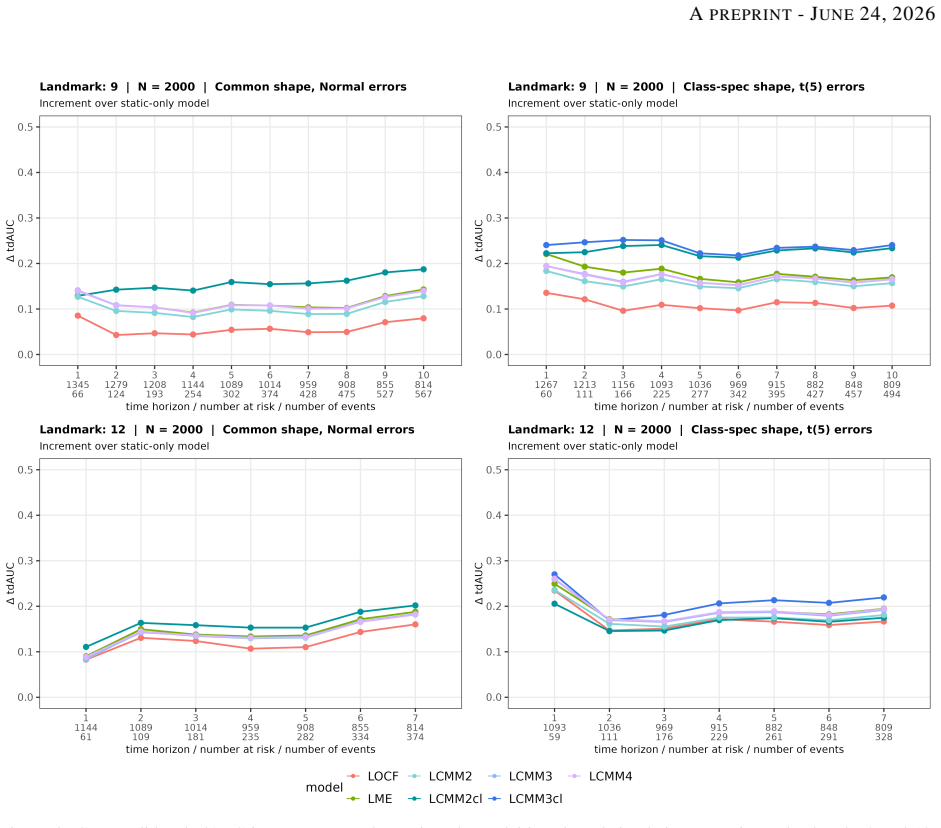
- [§4] §4 (Simulations): The reported performance gains rest on the assumption that latent classes remain identifiable and that class probabilities can be conditioned on accumulating longitudinal history without bias; the simulation design should include low-separation and misspecification scenarios to test whether the claimed improvements are robust or artifacts of strong class separation.
- [§3.2] §3.2 (Landmarking integration): The paper should provide the explicit form of the landmark-specific Cox model that incorporates the LCMM-derived class probabilities (or random effects), including how any uncertainty in class membership is propagated into the risk predictions; absence of this equation leaves the central claim of unbiased dynamic prediction unverified.
minor comments (2)
- The abstract and introduction should cite the specific prior landmarking literature (e.g., the original van Houwelingen or Rizopoulos formulations) against which the new method is compared.
- Figure captions in the simulation results should report the exact number of replications and the precise metric definitions (e.g., time-dependent AUC or Brier score) used for the performance comparisons.
Simulated Author's Rebuttal
We thank the referee for their constructive comments, which help clarify key aspects of our method. We address each major comment below and will revise the manuscript accordingly where revisions are needed.
read point-by-point responses
-
Referee: §3 (Method): The manuscript must specify whether the LCMM is refitted (or class posteriors re-estimated) using only data observed up to each landmark time t_LM, or whether a single baseline LCMM is used; without this, it is impossible to confirm that the dynamic-updating property of landmarking is retained and that the comparison to traditional landmarking remains valid.
Authors: We agree that explicit specification is required to verify the dynamic property. In the proposed framework, the LCMM is refitted at each landmark time t_LM using only the longitudinal data observed up to t_LM, with class posteriors re-estimated accordingly before being incorporated into the landmark-specific survival model. This mirrors the dynamic updating in standard landmarking and ensures valid comparisons. We will revise §3 to state this procedure clearly, including pseudocode for the per-landmark fitting step. revision: yes
-
Referee: §4 (Simulations): The reported performance gains rest on the assumption that latent classes remain identifiable and that class probabilities can be conditioned on accumulating longitudinal history without bias; the simulation design should include low-separation and misspecification scenarios to test whether the claimed improvements are robust or artifacts of strong class separation.
Authors: The current simulations focus on moderate-to-strong separation to illustrate potential gains when latent heterogeneity is detectable, as is common in proof-of-concept studies. We recognize that robustness under weaker conditions is important. In the revision we will add two new simulation scenarios: (i) low class separation (overlap in trajectories) and (ii) mild misspecification of the number of classes, reporting calibration, discrimination, and computational metrics for all methods. If performance gains diminish, we will qualify the claims accordingly. revision: yes
-
Referee: §3.2 (Landmarking integration): The paper should provide the explicit form of the landmark-specific Cox model that incorporates the LCMM-derived class probabilities (or random effects), including how any uncertainty in class membership is propagated into the risk predictions; absence of this equation leaves the central claim of unbiased dynamic prediction unverified.
Authors: We will add the explicit landmark-specific hazard in the revised §3.2: λ(t | t_LM, X, π) = λ0(t) exp(β'X + γ'π), where π denotes the vector of posterior class probabilities obtained from the LCMM fitted up to t_LM. Uncertainty in class membership is propagated by replacing the indicator of class membership with its posterior expectation E[I_c | data up to t_LM] inside the linear predictor; the resulting risk is the posterior-weighted average of class-specific risks. This formulation will be stated mathematically and accompanied by a short derivation showing that the dynamic property is preserved. revision: yes
Circularity Check
No significant circularity; method is a new proposal validated externally via simulation
full rationale
The paper proposes integrating LCMMs into landmarking as a computationally efficient alternative to joint latent class models for handling latent heterogeneity in dynamic prediction. The abstract and description frame this as a novel modular approach implemented in the landmaRk R package, with performance claims resting on simulation studies that compare against traditional landmarking (external benchmark) rather than any self-derived quantities. No equations, fitted parameters renamed as predictions, self-citation load-bearing uniqueness theorems, or ansatz smuggling are described. The derivation chain is self-contained against external benchmarks (simulations and real-data proof-of-concept), consistent with the provided reader's assessment of no visible circular reasoning.
Axiom & Free-Parameter Ledger
Reference graph
Works this paper leans on
-
[1]
Joint models for longitudinal and time-to-event data:
Rizopoulos, Dimitris , year =. Joint models for longitudinal and time-to-event data:
-
[2]
Position: Stop Chasing the C-index when Evaluating Survival Analysis Models
Lillelund, Christian Marius and Qi, Shi-ang and Greiner, Russell and Pedersen, Christian Fischer , month = may, year =. Position:. doi:10.48550/arXiv.2506.02075 , abstract =
work page internal anchor Pith review Pith/arXiv arXiv doi:10.48550/arxiv.2506.02075
-
[3]
Time-. Journal of the American Statistical Association , author =. 2013 , pages =. doi:10.1080/01621459.2013.778776 , language =
-
[4]
Journal of the Royal Statistical Society Series B: Statistical Methodology , author =
Modelling. Journal of the Royal Statistical Society Series B: Statistical Methodology , author =. 2008 , pages =. doi:10.1111/j.1467-9868.2008.00656.x , abstract =
-
[5]
A. Journal of the American Statistical Association , author =. 1999 , pages =. doi:10.1080/01621459.1999.10474144 , language =
-
[6]
Fitting the. Biometrics , author =. 2024 , pages =. doi:10.1093/biomtc/ujae018 , abstract =
-
[7]
Clinical Gastroenterology and Hepatology , author =
Normalization of. Clinical Gastroenterology and Hepatology , author =. 2021 , pages =. doi:10.1016/j.cgh.2020.08.022 , abstract =
-
[8]
doi:10.32614/CRAN.package.timeROC , author =
-
[9]
Statistics and Its Interface , author =
A semi-parametric joint latent class model with longitudinal and survival data , volume =. Statistics and Its Interface , author =. 2020 , pages =. doi:10.4310/SII.2020.v13.n3.a10 , language =
-
[10]
Primary. Hepatology , author =. 1994 , pages =. doi:10.1002/hep.1840200120 , abstract =
-
[11]
BMC Medical Research Methodology , author =
Revisiting methods for modeling longitudinal and survival data:. BMC Medical Research Methodology , author =. 2021 , pages =. doi:10.1186/s12874-021-01207-y , abstract =
-
[12]
Soutinho, Gustavo and Meira-Machado, Luis , year =
-
[13]
landpred:
Huynh, Dylan and Parast, Layla , year =. landpred:
-
[14]
landmulti:
Li, Wen and Wang, Qian , year =. landmulti:
-
[15]
landmix:
Garcia, Tanya and Parast, Layla , year =. landmix:
-
[16]
landest:
Parast, Layla , year =. landest:
-
[17]
Journal of the Royal Statistical Society Series A: Statistics in Society , author =
Dynamic. Journal of the Royal Statistical Society Series A: Statistics in Society , author =. 2021 , pages =. doi:10.1111/rssa.12611 , abstract =
-
[18]
Dynamic prediction in clinical survival analysis , publisher =
Van Houwelingen, Hans and Putter, Hein , year =. Dynamic prediction in clinical survival analysis , publisher =
-
[19]
Gerds, Thomas Alexander and Ohlendorff, Johan Sebastian and Ozenne, Brice , year =
-
[20]
Landmarking:
Barrott, Isobel and Barrett, Jessica , year =. Landmarking:
-
[21]
Regression
Cox, D R , year =. Regression. Journal of the Royal Statistical Society: Series B (Methodological) , publisher =
-
[22]
Rizopoulos, Dimitris and Miranda Afonso, Pedro and Papageorgiou, Grigorios , year =
-
[23]
Journal of Open Source Software , author =
Welcome to the. Journal of Open Source Software , author =. 2019 , pages =. doi:10.21105/joss.01686 , abstract =
-
[24]
Statistical Methods in Medical Research , author =
Dynamic prediction by landmarking with data from cohort subsampling designs , issn =. Statistical Methods in Medical Research , author =. 2025 , pages =. doi:10.1177/09622802251403279 , abstract =
-
[25]
Kidney International , author =
Progression of diabetic kidney disease and trajectory of kidney function decline in. Kidney International , author =. 2019 , pages =. doi:10.1016/j.kint.2018.08.026 , language =
-
[26]
Clinical Gastroenterology and Hepatology , author =
Large-scale clustering of longitudinal fecal calprotectin and. Clinical Gastroenterology and Hepatology , author =. 2025 , pages =. doi:10.1016/j.cgh.2025.12.022 , language =
-
[27]
Frontiers in Neurology , author =
A comparative study of methods for dynamic survival analysis , volume =. Frontiers in Neurology , author =. 2025 , pages =. doi:10.3389/fneur.2025.1504535 , abstract =
-
[28]
Barrett, Jessica K. and Sweeting, Michael J. and Wood, Angela M. , year =. Dynamic. Handbook of. doi:10.1016/bs.host.2017.05.004 , abstract =
-
[29]
Journal of Biomedical Informatics , author =
A pipeline for harmonising. Journal of Biomedical Informatics , author =. 2025 , pages =. doi:10.1016/j.jbi.2024.104771 , abstract =
-
[30]
International Journal of Epidemiology , author =
Reflection on modern methods:. International Journal of Epidemiology , author =. 2021 , pages =. doi:10.1093/ije/dyab047 , abstract =
-
[31]
Clinical Cancer Research , author =
Conditional. Clinical Cancer Research , author =. 2015 , pages =. doi:10.1158/1078-0432.CCR-14-2154 , abstract =
-
[32]
Fast and flexible inference for joint models of multivariate longitudinal and survival data using integrated nested. Biostatistics , author =. 2024 , pages =. doi:10.1093/biostatistics/kxad019 , abstract =
-
[33]
Biometrical Journal , author =
Dynamic prediction:. Biometrical Journal , author =. 2020 , pages =. doi:10.1002/bimj.201800248 , abstract =
-
[34]
Circulation: Cardiovascular Quality and Outcomes , author =
Landmark. Circulation: Cardiovascular Quality and Outcomes , author =. 2011 , pages =. doi:10.1161/CIRCOUTCOMES.110.957951 , abstract =
-
[35]
The Lancet Digital Health , author =
Evaluation of performance measures in predictive artificial intelligence models to support medical decisions: overview and guidance , issn =. The Lancet Digital Health , author =. 2025 , pages =. doi:10.1016/j.landig.2025.100916 , language =
-
[36]
Statistics in Medicine , author =
Assessment and comparison of prognostic classification schemes for survival data , volume =. Statistics in Medicine , author =. 1999 , pages =. doi:10.1002/(SICI)1097-0258(19990915/30)18:17/18<2529::AID-SIM274>3.0.CO;2-5 , abstract =
work page doi:10.1002/(sici)1097-0258(19990915/30)18:17/18 1999
-
[37]
The c-index is not proper for the evaluation of \ t\ -year predicted risks , volume =. Biostatistics , author =. 2019 , pages =. doi:10.1093/biostatistics/kxy006 , abstract =
-
[38]
New England Journal of Medicine , author =
A. New England Journal of Medicine , author =. 1994 , pages =. doi:10.1056/NEJM199403103301001 , abstract =
-
[39]
The American Statistician , author =
Separate and. The American Statistician , author =. 2004 , pages =. doi:10.1198/0003130042854 , language =
-
[40]
Serial platelet count as a dynamic prediction marker of hospital mortality among septic patients , volume =. Burns & Trauma , author =. 2024 , pages =. doi:10.1093/burnst/tkae016 , abstract =
-
[41]
BMC Medical Research Methodology , author =
External validation of a. BMC Medical Research Methodology , author =. 2013 , pages =. doi:10.1186/1471-2288-13-33 , abstract =
-
[42]
Statistics in Medicine , author =
Landmarking 2.0:. Statistics in Medicine , author =. 2022 , pages =. doi:10.1002/sim.9336 , abstract =
-
[43]
Health Care Management Science , author =
Using the landmark method for creating prediction models in large datasets derived from electronic health records , volume =. Health Care Management Science , author =. 2015 , pages =. doi:10.1007/s10729-014-9281-3 , abstract =
-
[44]
Big. Health Affairs , author =. 2014 , pages =. doi:10.1377/hlthaff.2014.0041 , abstract =
-
[45]
Longitudinal modeling of red blood cell distribution width dynamics and mortality risk in critically. PLOS One , author =. 2025 , pages =. doi:10.1371/journal.pone.0333605 , abstract =
-
[46]
International Journal of Bio-Medical Computing , author =
Calculating confidence intervals for summary measures of individual curves via nonlinear regression models , volume =. International Journal of Bio-Medical Computing , author =. 1996 , pages =. doi:10.1016/0020-7101(95)01152-8 , abstract =
-
[47]
Statistics in Medicine , author =
A refinement to the analysis of serial data using summary measures , volume =. Statistics in Medicine , author =. 1993 , pages =. doi:10.1002/sim.4780120105 , abstract =
-
[48]
Analysis of serial measurements in medical research , volume =
Matthews, J N S and Altman, Douglas G and Campbell, M J and Royston, Patrick , year =. Analysis of serial measurements in medical research , volume =
-
[49]
Kalbfleisch, John D. and Prentice, Ross L. , month = aug, year =. The. doi:10.1002/9781118032985 , language =
-
[50]
Statistics in Medicine , author =
Discovering subpopulation structure with latent class mixed models , volume =. Statistics in Medicine , author =. 2002 , pages =. doi:10.1002/sim.1027 , abstract =
-
[51]
A. Biometrics , author =. 1997 , pages =. doi:10.2307/2533118 , abstract =
-
[52]
Integrating latent classes in the
Andrinopoulou, Eleni-Rosalina and Nasserinejad, Kazem and Szczesniak, Rhonda and Rizopoulos, Dimitris , month = nov, year =. Integrating latent classes in the. Statistical Methods in Medical Research , publisher =. doi:10.1177/0962280220924680 , abstract =
-
[53]
BMC Medical Research Methodology , author =
Joint latent class model:. BMC Medical Research Methodology , author =. 2021 , pages =. doi:10.1186/s12874-021-01377-9 , abstract =
-
[54]
and McLean, Colin and Hall, Peter S
Sierra, Begoña B. and McLean, Colin and Hall, Peter S. and Vallejos, Catalina A. , year =. The. doi:10.48550/ARXIV.2508.14821 , abstract =
-
[55]
British Journal of Mathematical and Statistical Psychology , author =
Analysis of multivariate mixed longitudinal data:. British Journal of Mathematical and Statistical Psychology , author =. 2013 , pages =. doi:10.1111/bmsp.12000 , abstract =
-
[56]
A. Biometrics , author =. 2006 , pages =. doi:10.1111/j.1541-0420.2006.00573.x , abstract =
-
[57]
Disease. Gastroenterology , author =. 2022 , pages =. doi:10.1053/j.gastro.2022.01.024 , language =
-
[58]
Chen, Sida and Alvares, Danilo and Palma, Marco and Barrett, Jessica K. , month = oct, year =. Bayesian shared parameter joint models for heterogeneous populations , volume =. Statistics and Computing , publisher =. doi:10.1007/s11222-025-10647-1 , abstract =
-
[59]
Clinical Gastroenterology and Hepatology , author =
Longitudinal. Clinical Gastroenterology and Hepatology , author =. 2023 , pages =. doi:10.1016/j.cgh.2023.03.026 , language =
-
[60]
Frontiers in Big Data , author =
Disease. Frontiers in Big Data , author =. 2021 , pages =. doi:10.3389/fdata.2021.676168 , abstract =
-
[61]
Prediction. Epidemiology , author =. 2024 , pages =. doi:10.1097/EDE.0000000000001713 , abstract =
-
[62]
Individualized. JAMA , author =. doi:10.1001/jama.2025.14194 , abstract =
-
[63]
Journal of Biomedical Informatics , author =
Soft phenotyping for sepsis via. Journal of Biomedical Informatics , author =. 2024 , pages =. doi:10.1016/j.jbi.2024.104615 , abstract =
-
[64]
Scientific Data , author =. 2023 , pages =. doi:10.1038/s41597-022-01899-x , abstract =
-
[65]
Journal of the American Medical Informatics Association , author =. 2024 , pages =. doi:10.1093/jamia/ocae271 , abstract =
-
[66]
American Journal of Epidemiology , author =
Landmark. American Journal of Epidemiology , author =. 2018 , pages =. doi:10.1093/aje/kwy018 , language =
-
[67]
, language =
Analysis of survival by tumor response. , language =. Journal of clinical oncology , author =
-
[68]
Modelling. Biometrics , author =. 1994 , pages =. doi:10.2307/2533439 , abstract =
-
[69]
Journal of the American Statistical Association , author =
Modeling. Journal of the American Statistical Association , author =. 1993 , pages =. doi:10.2307/2290756 , language =
-
[70]
Statistics in Medicine , author =
Dynamic evaluation of short‐term prognosis after myocardial infarction , volume =. Statistics in Medicine , author =. 1985 , pages =. doi:10.1002/sim.4780040106 , abstract =
-
[71]
The American Journal of Cardiology , author =
Dynamic evaluation of prognosis from time-dependent variables in acute myocardial infarction , volume =. The American Journal of Cardiology , author =. 1983 , pages =. doi:10.1016/0002-9149(83)90190-X , language =
-
[72]
BMC Medical Research Methodology , author =. 2018 , pages =. doi:10.1186/s12874-018-0482-1 , abstract =
-
[73]
BMC Medical Research Methodology , author =
Random survival forests for dynamic predictions of a time-to-event outcome using a longitudinal biomarker , volume =. BMC Medical Research Methodology , author =. 2021 , pages =. doi:10.1186/s12874-021-01375-x , abstract =
-
[74]
and Williamson, Paula and Kolamunnage-Dona, Ruwanthi and Henderson, Robin and Hickey, Graeme L
Philipson, Pete and Sousa, Ines and Diggle, Peter J. and Williamson, Paula and Kolamunnage-Dona, Ruwanthi and Henderson, Robin and Hickey, Graeme L. , month = mar, year =. doi:10.32614/CRAN.package.joineR , abstract =
-
[75]
Journal of Statistical Software , author =
The. Journal of Statistical Software , author =. doi:10.18637/jss.v072.i07 , abstract =
-
[76]
doi:10.18637/jss.v035.i09 , abstract =
Journal of Statistical Software , author =. doi:10.18637/jss.v035.i09 , abstract =
-
[77]
Journal of Statistical Software , author =
Estimation of. Journal of Statistical Software , author =. doi:10.18637/jss.v078.i02 , abstract =
-
[78]
Journal of the American Statistical Association , author =
Latent. Journal of the American Statistical Association , author =. 2002 , pages =. doi:10.1198/016214502753479220 , language =
-
[79]
Statistics in Medicine , author =
A latent class mixed model for analysing biomarker trajectories with irregularly scheduled observations , volume =. Statistics in Medicine , author =. 2000 , pages =. doi:10.1002/(SICI)1097-0258(20000530)19:10<1303::AID-SIM424>3.0.CO;2-E , abstract =
-
[80]
Computational Statistics & Data Analysis , author =
Joint modelling of multivariate longitudinal outcomes and a time-to-event:. Computational Statistics & Data Analysis , author =. 2009 , pages =. doi:10.1016/j.csda.2008.10.017 , abstract =
discussion (0)
Sign in with ORCID, Apple, or X to comment. Anyone can read and Pith papers without signing in.