Only obscured yet luminous active galactic nuclei are closely associated with galaxy mergers: Direct observational evidence from type 2 active galactic nuclei
Pith reviewed 2026-06-25 23:34 UTC · model grok-4.3
The pith
Only active galactic nuclei that are both luminous and heavily dust-obscured show strong association with galaxy mergers.
A machine-rendered reading of the paper's core claim, the machinery that carries it, and where it could break.
Core claim
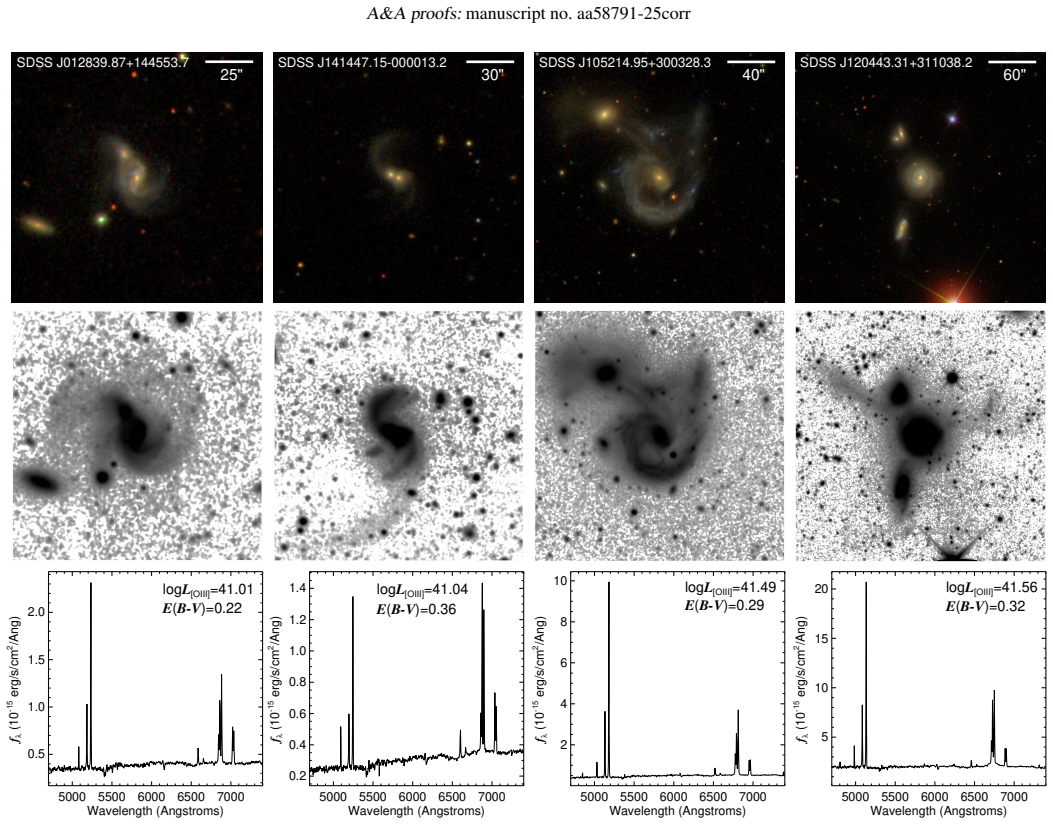
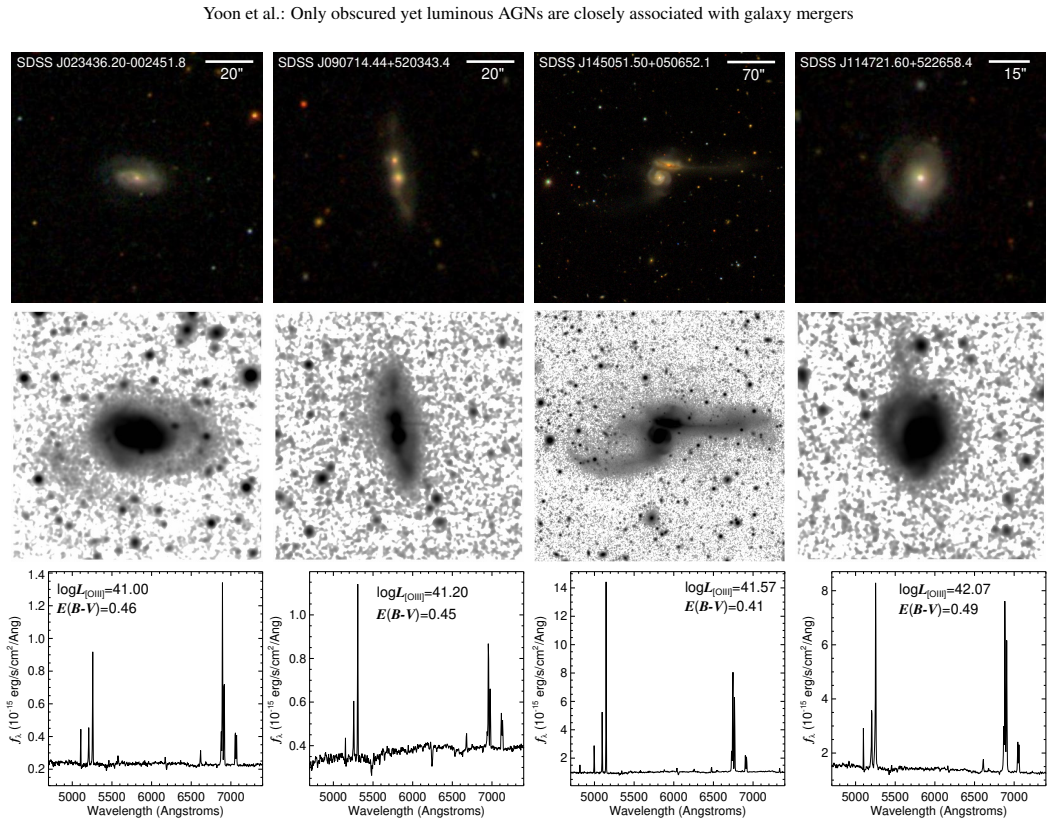
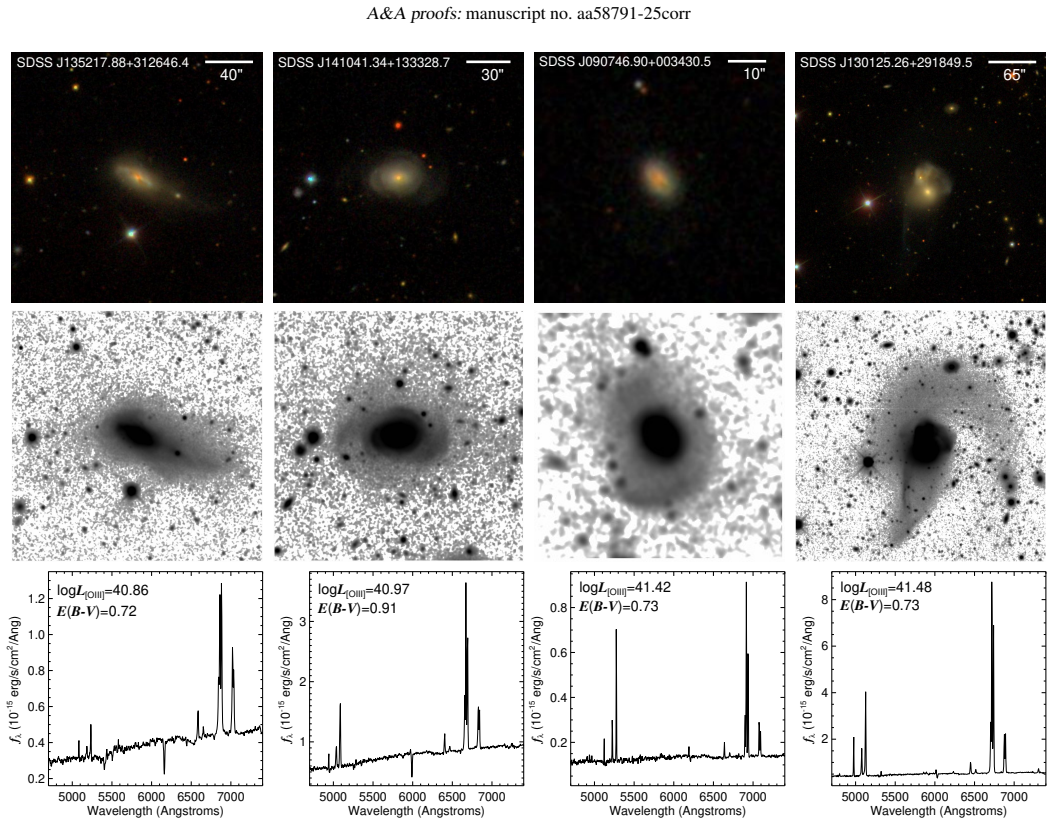
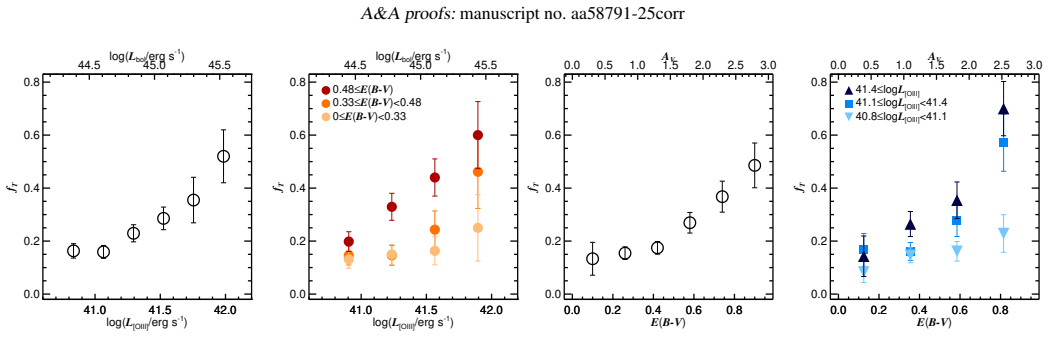
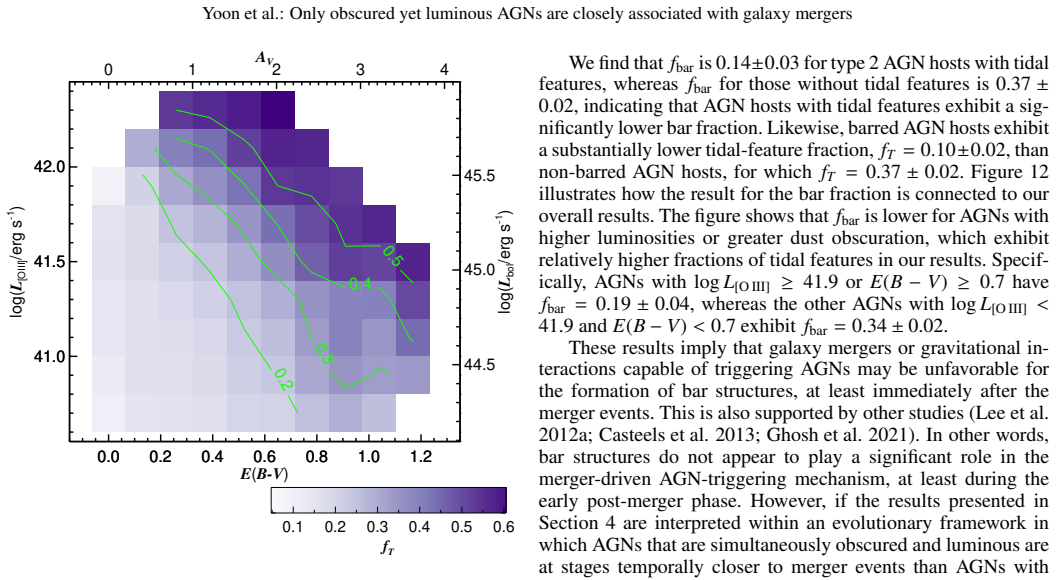
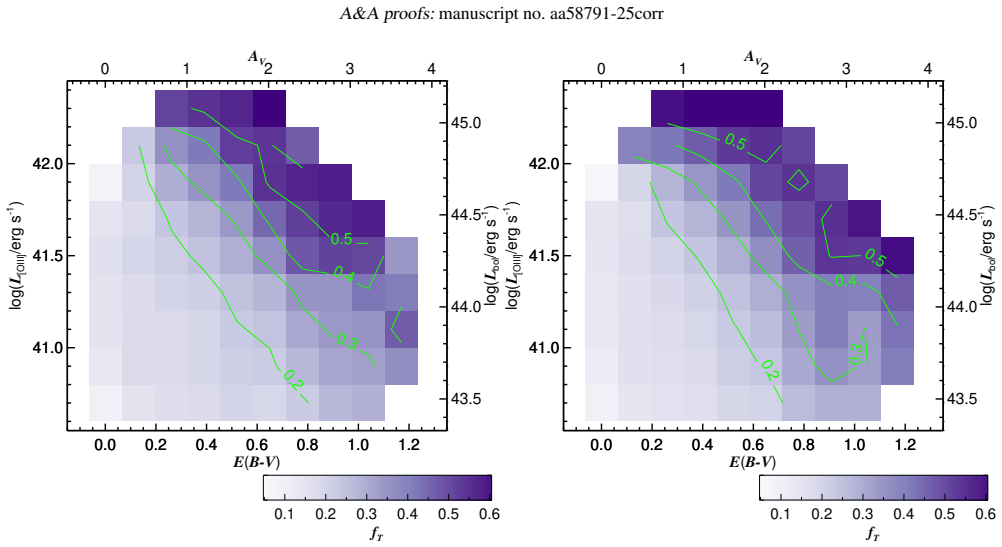
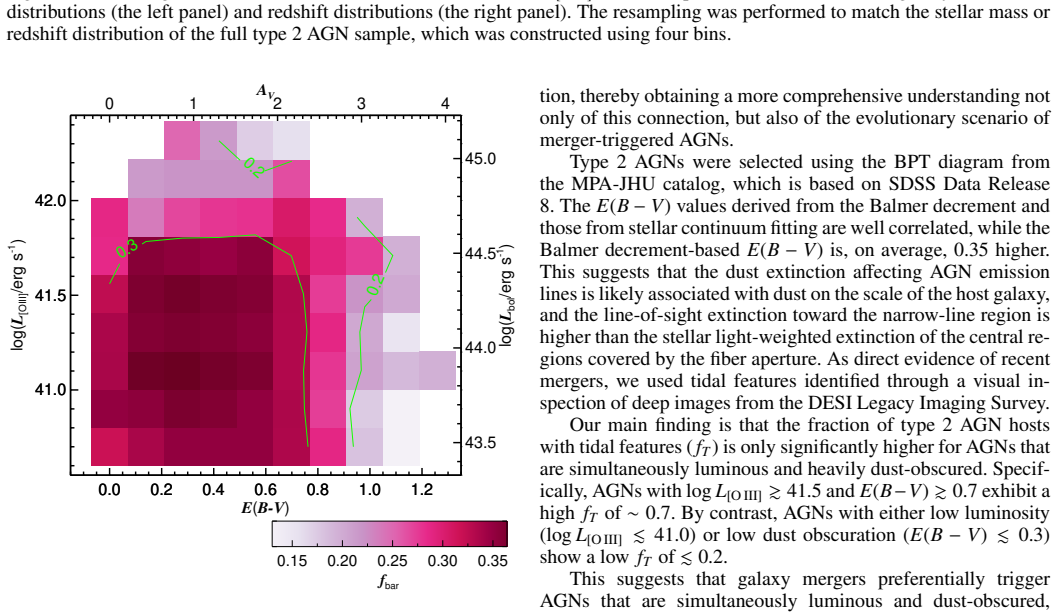
AGNs with log L_[O III] ≳41.5 and E(B-V)≳0.7 exhibit a high fraction of tidal features f_T of ∼0.7. In contrast, AGNs with either low luminosity (log L_[O III]≲41.0) or low dust obscuration (E(B-V)≲0.3) show a low f_T of ≲0.2. This indicates that galaxy mergers preferentially trigger AGNs that are simultaneously luminous and dust-obscured.
What carries the argument
The tidal feature fraction f_T, derived from deep imaging as direct evidence of mergers, examined as a function of internal-extinction-corrected [O III] luminosity and Balmer-decrement E(B-V).
If this is right
- AGNs that are luminous but not obscured do not show elevated merger rates.
- Obscured but low-luminosity AGNs also lack strong merger association.
- The result supports interpreting luminous obscured AGNs as temporally closer to merger events in an evolutionary sequence.
- Merger-driven triggering applies specifically to the combination of high luminosity and high obscuration.
Where Pith is reading between the lines
- If the trend holds, it implies that the merger-AGN connection is phase-specific rather than general.
- Future observations could check whether this pattern persists at higher redshifts where merger rates differ.
- Models of AGN feedback might need to account for why only the obscured luminous stage correlates with tidal features.
Load-bearing premise
The corrected [O III] luminosity reliably indicates the intrinsic AGN power and the E(B-V) from Balmer lines measures the dust relevant to the triggering process.
What would settle it
A large sample of either high-luminosity low-obscuration AGNs or low-luminosity high-obscuration AGNs with tidal feature fractions near 0.7 would falsify the claim.
Figures
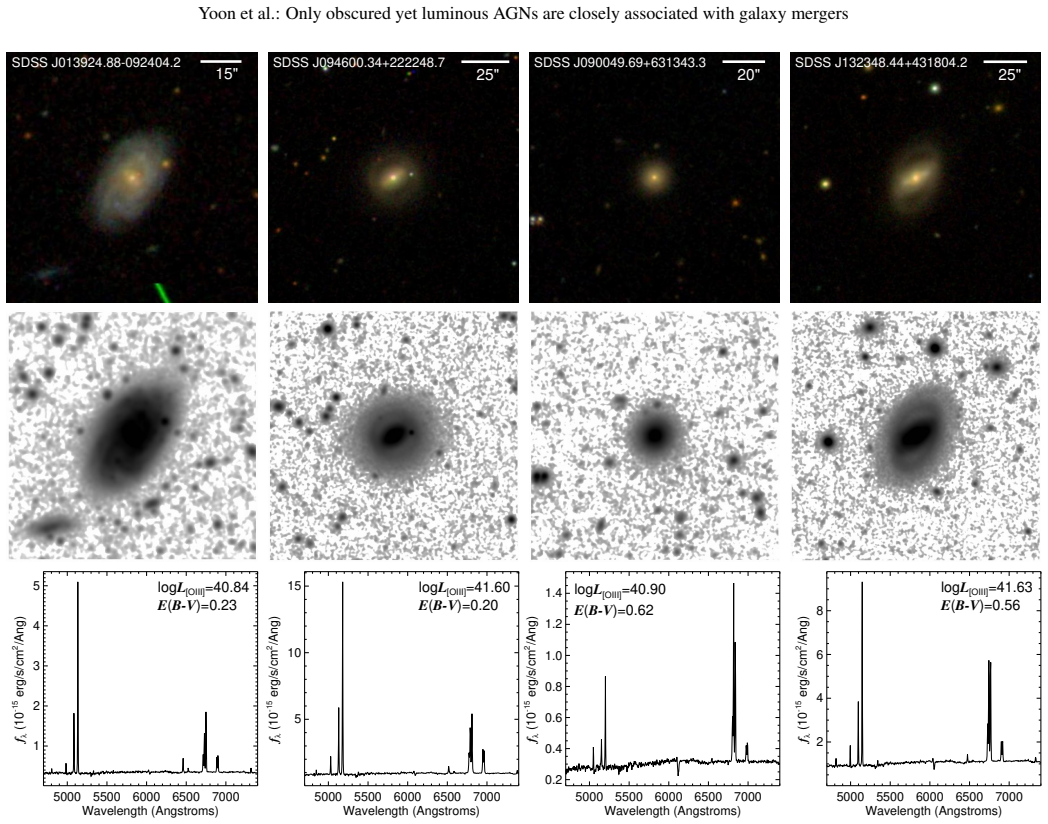
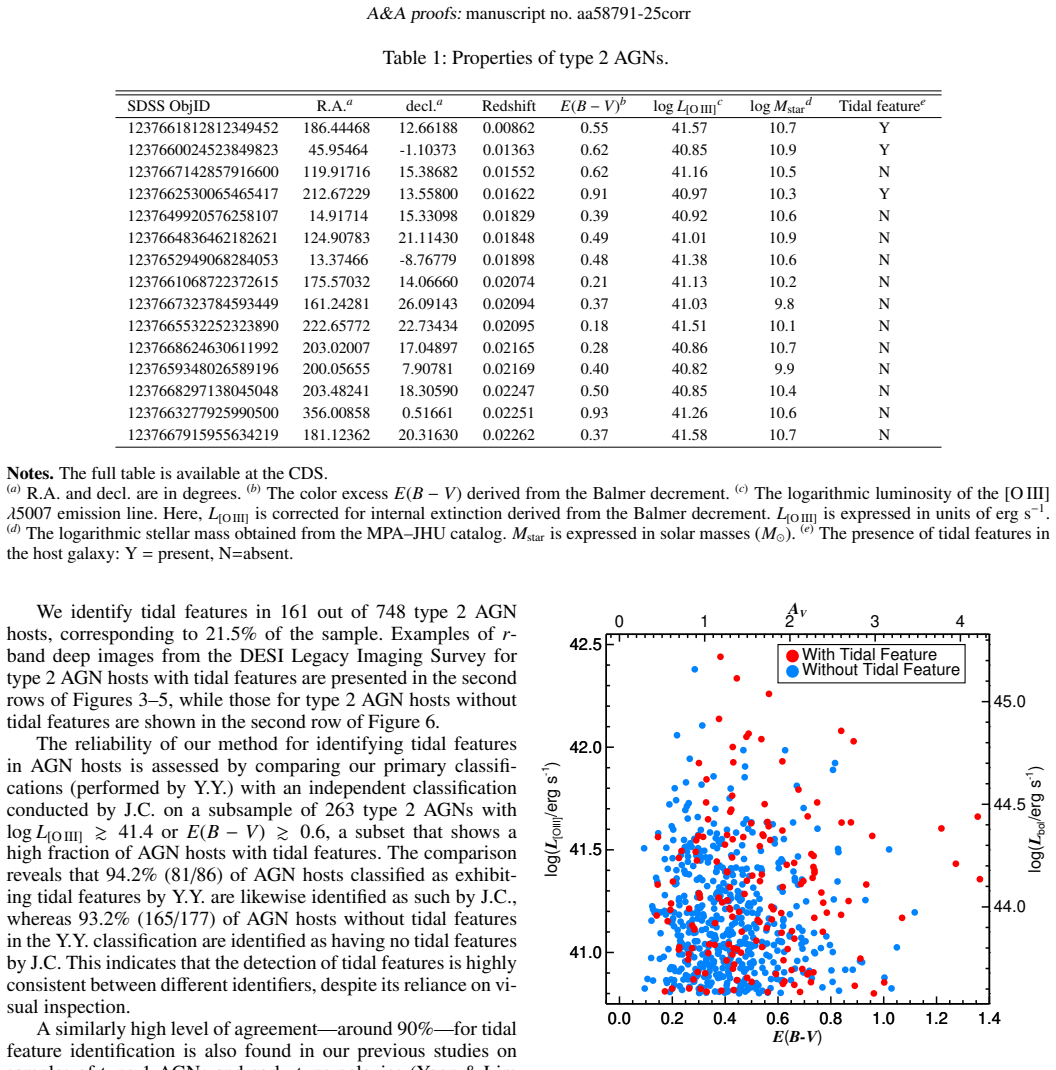
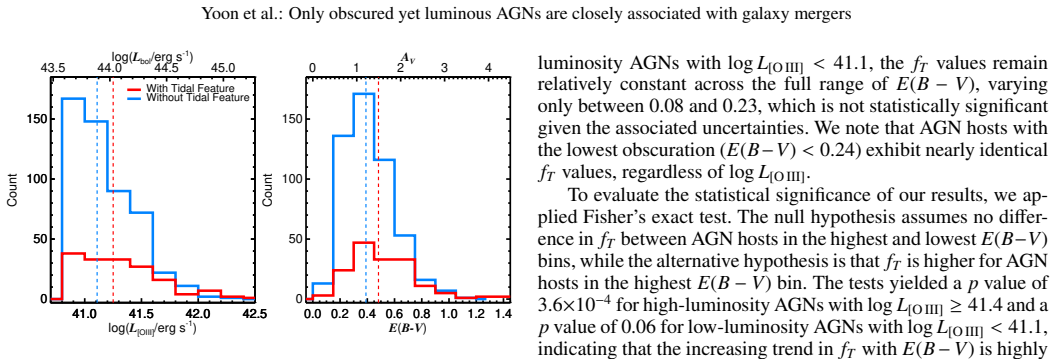
read the original abstract
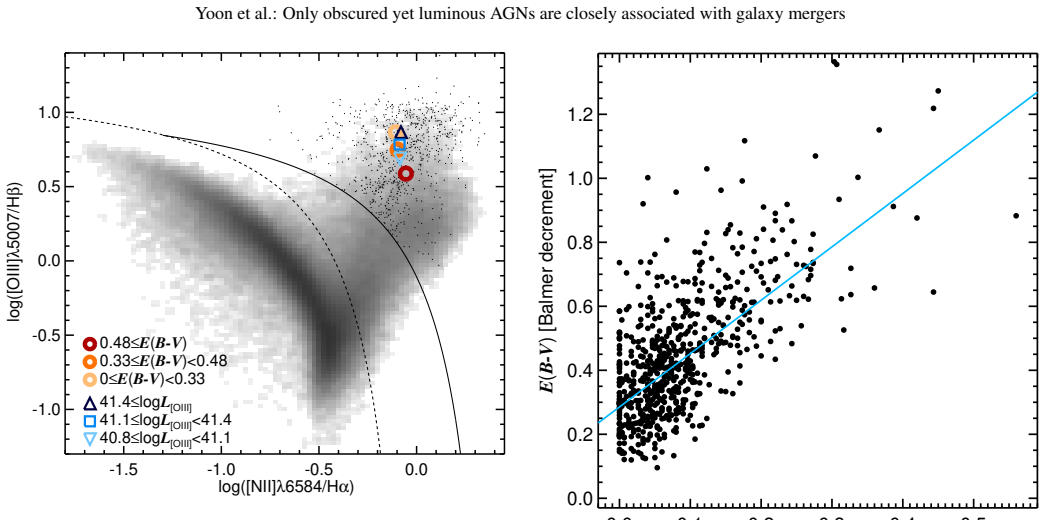
To establish a more comprehensive understanding of the connection between galaxy mergers and active galactic nuclei (AGNs), it is essential to disentangle the contributions of intrinsic AGN luminosity and dust extinction to the merger-AGN connection. Since tidal features identified in deep images serve as direct evidence of recent mergers, we studied the fraction of AGN hosts with tidal features ($f_T$) for a large sample of 748 type 2 AGNs at $z<0.063$. Specifically, we examined $f_T$ as a function of $E(B-V)$, derived from the Balmer decrement, and the internal-extinction-corrected luminosity of the [O III] $\lambda$5007 emission line ($L_{\text{[O III]}}$), which is a proxy for bolometric AGN luminosity. Our main finding is that $f_T$ is only significantly higher for AGNs that are simultaneously luminous and heavily dust-obscured. Specifically, AGNs with $\log L_{\text{[O III]}}\gtrsim41.5$ and $E(B-V)\gtrsim0.7$ exhibit a high $f_T$ of $\sim0.7$. In contrast, AGNs with either low luminosity ($\log L_{\text{[O III]}}\lesssim41.0$) or low dust obscuration ($E(B-V)\lesssim0.3$) show a low $f_T$ of $\lesssim0.2$. This trend suggests that galaxy mergers preferentially trigger AGNs that are simultaneously luminous and dust-obscured, whereas AGNs that are either luminous but unobscured or dust-obscured but less luminous are not strongly associated with merger-driven triggering. Based on several assumptions, our result can also be interpreted, despite certain caveats, within the framework of a merger-initiated evolution model for AGNs, suggesting that AGNs that are both obscured and luminous are temporally closer to merger events than those with lower luminosities and less dust obscuration.
Editorial analysis
A structured set of objections, weighed in public.
Referee Report
Summary. The paper reports an observational analysis of 748 type-2 AGNs at z<0.063, showing that the tidal-feature fraction f_T reaches ~0.7 only in the joint high-luminosity (log L_[O III] ≳41.5) and high-obscuration (E(B-V)≳0.7) bin, while AGNs with either low luminosity (log L_[O III]≲41.0) or low obscuration (E(B-V)≲0.3) exhibit f_T ≲0.2. The result is interpreted as evidence that galaxy mergers preferentially trigger AGNs that are simultaneously luminous and dust-obscured, consistent with a merger-driven evolutionary sequence.
Significance. If the central trend is robust, the work supplies direct morphological evidence (tidal features) that isolates the merger-AGN link to a specific region of the luminosity-obscuration plane, strengthening the case for merger-triggered fueling in the obscured luminous phase. The sample size of 748 objects and the explicit separation of luminosity and extinction effects are positive features; the result is falsifiable with independent merger indicators or alternative luminosity proxies.
major comments (2)
- [Abstract] Abstract and main results paragraph: the reported f_T values (~0.7 vs ≲0.2) are stated without accompanying uncertainties, binomial errors, or any statistical test (e.g., Fisher exact or Kolmogorov-Smirnov) comparing the high-high bin to the other three quadrants. Because the exclusivity of the high-high corner is the central claim, the absence of these quantities prevents verification that the difference is significant rather than a binning artifact.
- [Abstract / interpretation] The interpretation paragraph (final sentence of abstract and discussion): the claim that the Balmer-decrement E(B-V) and internal-extinction-corrected L_[O III] jointly trace the merger-relevant dust column and bolometric power rests on the assumptions that (i) the Balmer lines and [O III] arise from the same NLR gas with uniform covering factor and (ii) a foreground-screen geometry applies. No test against luminosity-dependent ionization or clumpy-torus geometries is presented; if either mapping varies systematically with L or E(B-V), the apparent exclusivity of the high-high bin could be an observational selection effect rather than a physical preference.
minor comments (2)
- [Abstract] The abstract does not specify the parent catalog, selection cuts, or redshift completeness for the 748-object sample; these details are required to assess whether the low-luminosity or low-E(B-V) bins are affected by Malmquist-type biases.
- [Methods] Notation for the corrected [O III] luminosity is introduced as L_[O III] without an explicit equation showing the extinction correction formula or the adopted intrinsic Balmer ratio; a short methods equation would improve reproducibility.
Simulated Author's Rebuttal
We thank the referee for the constructive comments on our manuscript. We address each major point below and have revised the manuscript accordingly where possible.
read point-by-point responses
-
Referee: [Abstract] Abstract and main results paragraph: the reported f_T values (~0.7 vs ≲0.2) are stated without accompanying uncertainties, binomial errors, or any statistical test (e.g., Fisher exact or Kolmogorov-Smirnov) comparing the high-high bin to the other three quadrants. Because the exclusivity of the high-high corner is the central claim, the absence of these quantities prevents verification that the difference is significant rather than a binning artifact.
Authors: We agree that the absence of uncertainties and statistical tests weakens the presentation of the central result. In the revised manuscript we have added binomial uncertainties to all quoted f_T values and included the outcome of a Fisher exact test comparing the high-luminosity/high-obscuration bin against the other three quadrants. These additions appear in both the abstract and the results section. revision: yes
-
Referee: [Abstract / interpretation] The interpretation paragraph (final sentence of abstract and discussion): the claim that the Balmer-decrement E(B-V) and internal-extinction-corrected L_[O III] jointly trace the merger-relevant dust column and bolometric power rests on the assumptions that (i) the Balmer lines and [O III] arise from the same NLR gas with uniform covering factor and (ii) a foreground-screen geometry applies. No test against luminosity-dependent ionization or clumpy-torus geometries is presented; if either mapping varies systematically with L or E(B-V), the apparent exclusivity of the high-high bin could be an observational selection effect rather than a physical preference.
Authors: The abstract already states that the interpretation rests on several assumptions and notes the presence of caveats. We have expanded the discussion section to address possible luminosity-dependent ionization effects and clumpy-torus geometries, citing supporting literature that indicates these factors are unlikely to produce the observed exclusivity of the high-high bin. A definitive test against all alternative geometries would require multi-wavelength data beyond the current optical sample; we therefore regard the revision as partial. revision: partial
Circularity Check
No circularity: purely observational binning of empirical fractions
full rationale
The paper reports an empirical correlation: f_T is measured directly from imaging for 748 type-2 AGNs and partitioned by observed Balmer-decrement E(B-V) and extinction-corrected [O III] luminosity. No equations, fitted parameters, or derivations are present that reduce a claimed prediction back to the input quantities by construction. The result is a set of binned fractions; the mapping from observables to physical interpretation is stated as an assumption rather than derived. No self-citation load-bearing steps or ansatz smuggling appear in the provided text. This is a standard observational correlation study whose central claim stands or falls on the data and the validity of the chosen tracers, not on internal definitional closure.
Axiom & Free-Parameter Ledger
axioms (3)
- domain assumption Tidal features identified in deep images serve as direct evidence of recent mergers.
- domain assumption Internal-extinction-corrected L_[O III] is a proxy for bolometric AGN luminosity.
- domain assumption E(B-V) derived from the Balmer decrement measures the relevant dust obscuration.
Reference graph
Works this paper leans on
-
[1]
2011, ApJS, 193, 2,
Aihara, H., Allende Prieto, C., An, D., et al. 2011, ApJS, 193, 2,
2011
-
[2]
2018, A&A, 618, A149
Alonso, S., Coldwell, G., Duplancic, F., et al. 2018, A&A, 618, A149. Alonso, M. S., Lambas, D. G., Tissera, P., et al. 2007, MNRAS, 375, 3,
2018
-
[3]
Araujo, B. L. C., Storchi-Bergmann, T., Rembold, S. B., et al. 2023, MNRAS, 522, 4,
2023
-
[4]
Arjona-Gálvez, E., Di Cintio, A., & Grand, R. J. J. 2024, A&A, 690, A286. Baldwin, J. A., Phillips, M. M., & Terlevich, R. 1981, PASP, 93,
2024
-
[5]
G., Hewett, P
Banerji, M., McMahon, R. G., Hewett, P. C., et al. 2012, MNRAS, 427, 3,
2012
-
[6]
Barnes, J. E. 1988, ApJ, 331,
1988
-
[7]
Barnes, J. E. & Hernquist, L. 1992, ARA&A, 30,
1992
-
[8]
H., et al
Berentzen, I., Athanassoula, E., Heller, C. H., et al. 2004, MNRAS, 347, 1,
2004
-
[9]
2020, MNRAS, 498, 2,
Bílek, M., Duc, P.-A., Cuillandre, J.-C., et al. 2020, MNRAS, 498, 2,
2020
-
[10]
2023, A&A, 672, A27
Bílek, M., Duc, P.-A., & Sola, E. 2023, A&A, 672, A27. Blandford, R., Meier, D., & Readhead, A. 2019, ARA&A, 57,
2023
-
[11]
G., Benson, A
Bower, R. G., Benson, A. J., Malbon, R., et al. 2006, MNRAS, 370, 2,
2006
-
[12]
H., Ellison, S
Byrne-Mamahit, S., Hani, M. H., Ellison, S. L., et al. 2023, MNRAS, 519, 4,
2023
-
[13]
R., V olonteri, M., Dotti, M., et al
Capelo, P. R., V olonteri, M., Dotti, M., et al. 2015, MNRAS, 447, 3,
2015
-
[14]
N., Urry, C
Cardamone, C. N., Urry, C. M., Damen, M., et al. 2008, ApJ, 680, 1,
2008
-
[15]
2012, MNRAS, 420, 3,
Carpineti, A., Kaviraj, S., Darg, D., et al. 2012, MNRAS, 420, 3,
2012
-
[16]
Casteels, K. R. V ., Bamford, S. P., Skibba, R. A., et al. 2013, MNRAS, 429, 2,
2013
-
[17]
2005, MNRAS, 359, 4,
Cattaneo, A., Combes, F., Colombi, S., et al. 2005, MNRAS, 359, 4,
2005
-
[18]
& Safarzadeh, M
Cen, R. & Safarzadeh, M. 2015, ApJ, 798, 2, L38. Chabrier, G. 2003, PASP, 115, 809,
2015
-
[19]
R., Athanassoula, E., et al
Cheung, E., Trump, J. R., Athanassoula, E., et al. 2015, MNRAS, 447, 1,
2015
-
[20]
S., Ostriker, J
Choi, E., Somerville, R. S., Ostriker, J. P., et al. 2024, ApJ, 964, 1,
2024
-
[21]
2023, A&A, 680, A82
Christensen, L., Jakobsen, P., Willott, C., et al. 2023, A&A, 680, A82. Cisternas, M., Jahnke, K., Inskip, K. J., et al. 2011, ApJ, 726, 2,
2023
-
[22]
2015, ApJ, 802, 2,
Cisternas, M., Sheth, K., Salvato, M., et al. 2015, ApJ, 802, 2,
2015
-
[23]
M., Nevin, R., Negus, J., et al
Comerford, J. M., Nevin, R., Negus, J., et al. 2024, ApJ, 963, 1,
2024
-
[24]
Comparat, J., Maraston, C., Goddard, D., et al. 2017, , arXiv:1711.06575. Conroy, C. & White, M. 2013, ApJ, 762, 2,
work page internal anchor Pith review Pith/arXiv arXiv 2017
-
[25]
Conselice, C. J. 2003, ApJS, 147, 1,
2003
-
[26]
2013, MNRAS, 431, 3,
Cotini, S., Ripamonti, E., Caccianiga, A., et al. 2013, MNRAS, 431, 3,
2013
-
[27]
M., Kraemer, S
Crenshaw, D. M., Kraemer, S. B., & Gabel, J. R. 2003, AJ, 126, 4,
2003
-
[28]
J., Springel, V ., White, S
Croton, D. J., Springel, V ., White, S. D. M., et al. 2006, MNRAS, 365, 1,
2006
-
[29]
L., Fumagalli, M., et al
Dalton, T., Morris, S. L., Fumagalli, M., et al. 2022, MNRAS, 513, 1,
2022
-
[30]
W., Kaviraj, S., Lintott, C
Darg, D. W., Kaviraj, S., Lintott, C. J., et al. 2010, MNRAS, 401, 3,
2010
-
[31]
J., Lang, D., et al
Dey, A., Schlegel, D. J., Lang, D., et al. 2019, AJ, 157, 5,
2019
-
[32]
2005, Nature, 433, 7026,
Di Matteo, T., Springel, V ., & Hernquist, L. 2005, Nature, 433, 7026,
2005
-
[33]
2018, MN- RAS, 476, 3,
Domínguez Sánchez, H., Huertas-Company, M., Bernardi, M., et al. 2018, MN- RAS, 476, 3,
2018
-
[34]
L., Kartaltepe, J., Kocevski, D., et al
Donley, J. L., Kartaltepe, J., Kocevski, D., et al. 2018, ApJ, 853, 1,
2018
-
[35]
2004, MNRAS, 355, 3,
Dovˇciak, M., Karas, V ., & Matt, G. 2004, MNRAS, 355, 3,
2004
-
[36]
2015, MNRAS, 446, 1,
Duc, P.-A., Cuillandre, J.-C., Karabal, E., et al. 2015, MNRAS, 446, 1,
2015
-
[37]
L., Mendel, J
Ellison, S. L., Mendel, J. T., Patton, D. R., et al. 2013, MNRAS, 435, 4,
2013
-
[38]
L., Viswanathan, A., Patton, D
Ellison, S. L., Viswanathan, A., Patton, D. R., et al. 2019, MNRAS, 487, 2,
2019
-
[39]
Euclid Collaboration, La Marca, A., Wang, L., et al. 2025, , arXiv:2503.15317. Feldmann, R., Mayer, L., & Carollo, C. M. 2008, ApJ, 684, 2,
-
[40]
Fitzpatrick, E. L. 1999, PASP, 111, 755,
1999
-
[41]
M., Impey, C
Gabor, J. M., Impey, C. D., Jahnke, K., et al. 2009, ApJ, 691, 1,
2009
-
[42]
A., Willett, K
Galloway, M. A., Willett, K. W., Fortson, L. F., et al. 2015, MNRAS, 448, 4,
2015
-
[43]
2021, MNRAS, 502, 2,
Ghosh, S., Saha, K., Di Matteo, P., et al. 2021, MNRAS, 502, 2,
2021
-
[44]
2015, ApJ, 806, 2,
Glikman, E., Simmons, B., Mailly, M., et al. 2015, ApJ, 806, 2,
2015
-
[45]
2012, ApJ, 757, 1,
Glikman, E., Urrutia, T., Lacy, M., et al. 2012, ApJ, 757, 1,
2012
-
[46]
D., Greene, J
Goulding, A. D., Greene, J. E., Bezanson, R., et al. 2018, PASJ, 70, S37. Halpern, J. P. & Steiner, J. E. 1983, ApJ, 269, L37. Heckman, T. M., Kauffmann, G., Brinchmann, J., et al. 2004, ApJ, 613, 1,
2018
-
[47]
M., Cortes-Suárez, E., Vázquez-Mata, J
Hernández-Toledo, H. M., Cortes-Suárez, E., Vázquez-Mata, J. A., et al. 2023, MNRAS, 523, 3,
2023
-
[48]
& Spergel, D
Hernquist, L. & Spergel, D. N. 1992, ApJ, 399, L117. Hirschmann, M., Somerville, R. S., Naab, T., et al. 2012, MNRAS, 426, 1,
1992
-
[49]
1971, ApJ, 168,
Hohl, F. 1971, ApJ, 168,
1971
-
[50]
2015, ApJ, 804, 1,
Hong, J., Im, M., Kim, M., et al. 2015, ApJ, 804, 1,
2015
-
[51]
F., Hernquist, L., Cox, T
Hopkins, P. F., Hernquist, L., Cox, T. J., et al. 2006, ApJS, 163, 1,
2006
-
[52]
F., Hernquist, L., Martini, P., et al
Hopkins, P. F., Hernquist, L., Martini, P., et al. 2005, ApJ, 625, 2, L71. Hopkins, P. F., Hernquist, L., Cox, T. J., et al. 2008, ApJS, 175, 2,
2005
-
[53]
Jaffarian, G. W. & Gaskell, C. M. 2020, MNRAS, 493, 1,
2020
-
[54]
Ji, I., Peirani, S., & Yi, S. K. 2014, A&A, 566, A97. Jiang, L., McGreer, I. D., Fan, X., et al. 2016, ApJ, 833, 2,
2014
-
[55]
D., Rix, H.-W., et al
Jogee, S., Barazza, F. D., Rix, H.-W., et al. 2004, ApJ, 615, 2, L105. Jovanovi´c, P. & Popovi´c, L. ˇC. 2008, Fortschritte der Physik, 56, 4-5,
2004
-
[56]
& Heckman, T
Kauffmann, G. & Heckman, T. M. 2009, MNRAS, 397, 1,
2009
-
[57]
M., Tremonti, C., et al
Kauffmann, G., Heckman, T. M., Tremonti, C., et al. 2003, MNRAS, 346, 4,
2003
-
[58]
2010, MNRAS, 406, 1,
Kaviraj, S. 2010, MNRAS, 406, 1,
2010
-
[59]
S., et al
Kaviraj, S., Tan, K.-M., Ellis, R. S., et al. 2011, MNRAS, 411, 4,
2011
-
[60]
J., Dopita, M
Kewley, L. J., Dopita, M. A., Sutherland, R. S., et al. 2001, ApJ, 556, 1,
2001
-
[61]
Kim, D. & Im, M. 2018, A&A, 610, A31. Kim, D., Im, M., Glikman, E., et al. 2015b, ApJ, 812, 1,
2018
-
[62]
2015a, ApJ, 813, 2, L35
Kim, Y ., Im, M., Jeon, Y ., et al. 2015a, ApJ, 813, 2, L35. Kim, Y ., Im, M., Jeon, Y ., et al. 2019, ApJ, 870, 2,
2019
-
[63]
2020, ApJ, 904, 2,
Kim, Y ., Im, M., Jeon, Y ., et al. 2020, ApJ, 904, 2,
2020
-
[64]
2024b, A&A, 690, A283
Kim, D., Kim, Y ., Im, M., et al. 2024b, A&A, 690, A283. Kocevski, D. D., Brightman, M., Nandra, K., et al. 2015, ApJ, 814, 2,
2015
-
[65]
D., Faber, S
Kocevski, D. D., Faber, S. M., Mozena, M., et al. 2012, ApJ, 744, 2,
2012
-
[66]
Kormendy, J. & Ho, L. C. 2013, ARA&A, 51, 1,
2013
-
[67]
J., Blecha, L., Bernhard, P., et al
Koss, M. J., Blecha, L., Bernhard, P., et al. 2018, Nature, 563, 7730,
2018
-
[68]
S., Reeves, J., et al
Laha, S., Reynolds, C. S., Reeves, J., et al. 2021, Nature Astronomy, 5,
2021
-
[69]
2024, A&A, 690, A326
La Marca, A., Margalef-Bentabol, B., Wang, L., et al. 2024, A&A, 690, A326. LaMassa, S. M., Heckman, T. M., Ptak, A., et al. 2009, ApJ, 705, 1,
2024
-
[70]
2003, A&A, 402,
Le Borgne, J.-F., Bruzual, G., Pelló, R., et al. 2003, A&A, 402,
2003
-
[71]
& Bryan, G
Li, Y . & Bryan, G. L. 2014, ApJ, 789, 2,
2014
-
[72]
2023, ApJ, 944, 2,
Li, W., Nair, P., Irwin, J., et al. 2023, ApJ, 944, 2,
2023
-
[73]
M., Primack, J., & Madau, P
Lotz, J. M., Primack, J., & Madau, P. 2004, AJ, 128, 1,
2004
-
[74]
2020, MNRAS, 493, 3,
Macconi, D., Torresi, E., Grandi, P., et al. 2020, MNRAS, 493, 3,
2020
-
[75]
2019, A&A, 632, A122
Mancillas, B., Duc, P.-A., Combes, F., et al. 2019, A&A, 632, A122. Maraston, C. & Strömbäck, G. 2011, MNRAS, 418, 4,
2019
-
[76]
2020, ApJ, 904, 1,
Marian, V ., Jahnke, K., Andika, I., et al. 2020, ApJ, 904, 1,
2020
-
[77]
2019, ApJ, 882, 2,
Marian, V ., Jahnke, K., Mechtley, M., et al. 2019, ApJ, 882, 2,
2019
-
[78]
McConnell, N. J. & Ma, C.-P. 2013, ApJ, 764, 2,
2013
-
[79]
A., et al
Mechtley, M., Jahnke, K., Windhorst, R. A., et al. 2016, ApJ, 830, 2,
2016
-
[80]
2014, A&A, 569, A37
Menci, N., Gatti, M., Fiore, F., et al. 2014, A&A, 569, A37. Moetazedian, R., Polyachenko, E. V ., Berczik, P., et al. 2017, A&A, 604, A75. Nair, P. B. & Abraham, R. G. 2010, ApJS, 186, 2,
2014
discussion (0)
Sign in with ORCID, Apple, or X to comment. Anyone can read and Pith papers without signing in.