All mixed identities are singular in groups with no algebraicity
Pith reviewed 2026-06-25 21:53 UTC · model grok-4.3
The pith
If a group admits an action with no algebraicity then all its mixed identities are singular.
A machine-rendered reading of the paper's core claim, the machinery that carries it, and where it could break.
Core claim
We show that if a group G admits an action with no algebraicity then all of its mixed identities are singular. More generally the same conclusion holds whenever G has an action satisfying certain geometric conditions. This recovers earlier results on infinite-dimensional general and projective linear groups and confirms the Bodirsky-Schneider-Thom conjecture for a large class of oligomorphic permutation groups.
What carries the argument
An action with no algebraicity (or satisfying the stated geometric conditions), which prevents the formation of non-singular mixed identities by forcing any candidate identity to collapse under the orbit-stabilizer geometry.
If this is right
- The automorphism group of (Q;<) has only singular mixed identities.
- Thompson's groups F, T and V each have only singular mixed identities.
- Grigorchuk's group has only singular mixed identities.
- Homeomorphism groups of any manifold of dimension at least 1 have only singular mixed identities.
- The infinite-dimensional general and projective linear groups have only singular mixed identities.
Where Pith is reading between the lines
- The geometric conditions on the action may be checkable directly for other well-studied groups whose lawlessness status was previously open.
- The result supplies a uniform route to strong lawlessness that could be applied to additional homeomorphism or diffeomorphism groups beyond manifolds.
- If the geometric conditions can be weakened while preserving the conclusion, the class of groups covered would enlarge further.
Load-bearing premise
The group possesses at least one action on a set whose orbits and stabilizers meet the no-algebraicity geometric conditions.
What would settle it
Exhibit a concrete group that admits a no-algebraicity action yet satisfies at least one non-singular mixed identity, or compute a specific mixed identity in the automorphism group of (Q;<) and show it fails to be singular.
Figures
read the original abstract
We show that if a group $G$ admits an action with no algebraicity then all of its mixed identities are singular. Previously, such groups were only known to be lawless by a theorem of Ab\'ert. Our result confirms, in particular, a conjecture of Bodirsky, Schneider, and Thom for a large class of oligomorphic permutation groups. It thereby not only subsumes numerous results from the literature in a simple uniform theorem, but also settles the question for prominent groups for which the conjecture was an open problem, such as the automorphism group of $(\mathbb{Q}; <)$. Outside the oligomorphic context, it moreover applies to much-investigated groups, e.g. to Thompson's groups $F$, $T$, and $V$, to Grigorchuk's group, and to the homeomorphism groups of any manifold of dimension $\geq 1$. More generally, we prove that all mixed identities of a group $G$ are singular as long as $G$ has an action satisfying certain geometric conditions. This additionally covers the infinite-dimensional general and projective linear groups, recovering e.g. results of Bradford, Schneider, and Thom.
Editorial analysis
A structured set of objections, weighed in public.
Referee Report
Summary. The paper proves that if a group G admits an action satisfying certain geometric conditions of no algebraicity, then every mixed identity of G is singular. This extends Abért's theorem that such groups are lawless, confirms the Bodirsky-Schneider-Thom conjecture for a broad class of oligomorphic permutation groups (including Aut(Q;<)), and applies the result to Thompson groups F/T/V, Grigorchuk's group, homeomorphism groups of manifolds, and infinite-dimensional linear groups, recovering prior results of Bradford-Schneider-Thom and others via a uniform argument.
Significance. If the central implication holds, the result supplies a single geometric hypothesis that subsumes many scattered theorems on the absence of non-singular mixed identities and settles several open cases for well-studied groups. The manuscript also supplies explicit verification of the geometric conditions for the listed families, which strengthens the applicability of the theorem beyond the oligomorphic setting.
major comments (2)
- [§3, Theorem 3.4] §3, Theorem 3.4: the reduction from the no-algebraicity action to singularity of mixed identities relies on the geometric conditions (A1)–(A3); it is not immediate from the statement whether these conditions are strictly weaker than those used by Abért for lawlessness, or whether the proof re-uses the same orbit-stabilizer arguments with only notational changes.
- [§5.2, Proposition 5.7] §5.2, Proposition 5.7 (oligomorphic case): the verification that the standard action on the Fraïssé limit satisfies the no-algebraicity conditions is sketched via a reference to a prior lemma; a self-contained check that the stabilizer of a finite tuple has no non-trivial algebraic relations would strengthen the claim.
minor comments (3)
- [§2.1] The definition of 'mixed identity' in §2.1 should explicitly contrast it with ordinary laws to avoid any ambiguity for readers outside the oligomorphic-group literature.
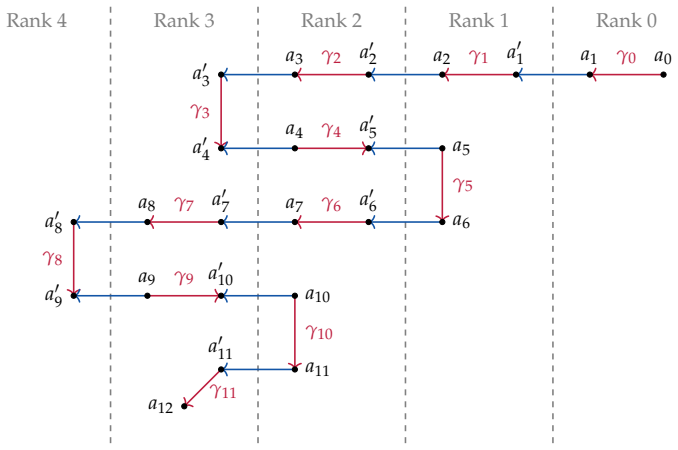
- [Figure 1] Figure 1 (schematic of the action) would benefit from a caption that states which geometric condition each arrow illustrates.
- [Corollary 6.3] The statement of Corollary 6.3 for Thompson's group V should include a one-sentence reminder of which action is being used, for quick reference.
Simulated Author's Rebuttal
We thank the referee for the careful reading, positive recommendation of minor revision, and constructive comments. We address the two major comments point by point below.
read point-by-point responses
-
Referee: [§3, Theorem 3.4] §3, Theorem 3.4: the reduction from the no-algebraicity action to singularity of mixed identities relies on the geometric conditions (A1)–(A3); it is not immediate from the statement whether these conditions are strictly weaker than those used by Abért for lawlessness, or whether the proof re-uses the same orbit-stabilizer arguments with only notational changes.
Authors: The conditions (A1)–(A3) are strictly weaker than Abért's hypotheses for lawlessness: they require only that stabilizers of finite tuples admit no non-trivial algebraic relations (in the sense relevant to mixed words), without the stronger global orbit-stabilizer control needed to rule out all laws. The argument in Theorem 3.4 re-uses the basic orbit-stabilizer idea but introduces new combinatorial reductions to handle the mixed-identity case (words involving both positive and negative letters). We will add a short comparative remark after the statement of Theorem 3.4 to make this distinction explicit. revision: yes
-
Referee: [§5.2, Proposition 5.7] §5.2, Proposition 5.7 (oligomorphic case): the verification that the standard action on the Fraïssé limit satisfies the no-algebraicity conditions is sketched via a reference to a prior lemma; a self-contained check that the stabilizer of a finite tuple has no non-trivial algebraic relations would strengthen the claim.
Authors: We agree that a self-contained verification would improve the exposition. In the revised version we will expand the proof of Proposition 5.7 to include a direct, self-contained argument showing that the pointwise stabilizer of any finite tuple in the Fraïssé limit has no non-trivial algebraic relations, rather than relying solely on the external reference. revision: yes
Circularity Check
No significant circularity
full rationale
The paper proves an implication: the existence of a group action satisfying stated geometric no-algebraicity conditions entails that every mixed identity is singular. This extends Abért's external theorem on lawlessness under the same hypothesis, with the geometric conditions then verified for listed families (oligomorphic groups, Thompson groups, Grigorchuk group, linear groups, etc.). No step reduces by construction to a fitted parameter, self-definition, or load-bearing self-citation chain; the central claim remains an independent extension of prior external results and is self-contained against the stated assumptions.
Axiom & Free-Parameter Ledger
Reference graph
Works this paper leans on
-
[1]
Group laws and free subgroups in topological groups
Miklós Abért. “Group laws and free subgroups in topological groups”. In:Bulletin of the London Math- ematical Society37.4 (2005), pp. 525–534
2005
-
[2]
Representation of order automorphisms by words
Samson A Adeleke and W Charles Holland. “Representation of order automorphisms by words”. In: Forum Mathematicum(1994)
1994
-
[3]
Samson A Adeleke and Peter M Neumann.Relations Related to Betweenness: Their Structure and Auto- morphisms: Their Structure and Automorphisms. Vol. 623. American Mathematical Soc., 1998
1998
-
[4]
Mixed identities in groups
Vladimir Sergeevich Anashin. “Mixed identities in groups”. In:Mathematical notes of the Academy of Sciences of the USSR24.1 (1978), pp. 514–520
1978
-
[5]
Algebraically determined topologies on permutation groups
Taras Banakh, Igor Guran, and Igor Protasov. “Algebraically determined topologies on permutation groups”. In:Topology and its Applications159.9 (2012), pp. 2258–2268
2012
-
[6]
A note on intrinsic topologies of groups
Serhii Bardyla, Luna Elliott, James Mitchell, and Yann Péresse. “A note on intrinsic topologies of groups”. In:arXiv preprint arXiv:2506.11500(2025)
arXiv 2025
-
[7]
A short proof of Rubin’s theorem
James Belk, Luna Elliott, and Francesco Matucci. “A short proof of Rubin’s theorem”. In:Israel Journal of Mathematics267.1 (2025), pp. 157–169
2025
-
[8]
Mixed identities for oligomorphic automor- phism groups
Manuel Bodirsky, Jakob Schneider, and Andreas Thom. “Mixed identities for oligomorphic automor- phism groups”. In:The Journal of Symbolic Logic(2025), pp. 1–23
2025
-
[9]
Non-singular word maps for linear groups
Henry Bradford, Jakob Schneider, and Andreas Thom. “Non-singular word maps for linear groups”. In:arXiv preprint arXiv:2311.03981(2023)
arXiv 2023
-
[10]
The length of mixed identities for finite groups
Henry Bradford, Jakob Schneider, and Andreas Thom. “The length of mixed identities for finite groups”. In:Journal of Algebra670 (2025), pp. 13–47
2025
-
[11]
Groups of piecewise linear homeomorphisms of the real line
Matthew G Brin and Craig C Squier. “Groups of piecewise linear homeomorphisms of the real line”. In:Inventiones mathematicae79.3 (1985), pp. 485–498
1985
-
[12]
The verbal topology of a group
Roger M Bryant. “The verbal topology of a group”. In:Journal of Algebra48.2 (1977), pp. 340–346
1977
-
[13]
Oligomorphic permutation groups
Peter J Cameron. “Oligomorphic permutation groups”. In:Perspectives in Mathematical Sciences II: Pure Mathematics. World Scientific, 2009, pp. 37–61
2009
-
[14]
Orbits of permutation groups on unordered sets, II
Peter J Cameron. “Orbits of permutation groups on unordered sets, II”. In:Journal of the London Math- ematical Society2.2 (1981), pp. 249–264
1981
-
[15]
Transitivity of permutation groups on unordered sets
Peter J Cameron. “Transitivity of permutation groups on unordered sets”. In:Mathematische Zeitschrift 148.2 (1976), pp. 127–139
1976
-
[16]
Introductory notes on Richard Thompson’s groups
James W Cannon, William J Floyd, and Walter Raymond Parry. “Introductory notes on Richard Thompson’s groups”. In:Enseign. Math.(2)42.3-4 (1996), p. 215
1996
-
[17]
Christian d’Elbée.Axiomatic Theory of Independence Relations in Model Theory. 2025. arXiv:2308.07064 [math.LO]
arXiv 2025
-
[18]
American Mathe- matical Society, 1985
Manfred Droste.Structure of partially ordered sets with transitive automorphism groups. American Mathe- matical Society, 1985
1985
-
[19]
Automatic continuity, unique Polish topologies, and Zariski topologies on monoids and clones
Luke Elliott, Julius Jonušas, Zachary Mesyan, J Mitchell, M Morayne, and Yann Peresse. “Automatic continuity, unique Polish topologies, and Zariski topologies on monoids and clones”. In:Transactions of the American Mathematical Society376.11 (2023), pp. 8023–8093
2023
-
[20]
Luna Elliott.The group Zariski topology is irreducible in MIF groups.Private communication. 2026
2026
-
[21]
Luna Elliott.The Zariski Topology on Homeomorphism groups. 2026. arXiv:2601.15185 [math.GR]. 16
Pith/arXiv arXiv 2026
-
[22]
Dense locally finite subgroups of automorphism groups of ultraextensive spaces
Mahmood Etedadialiabadi, Su Gao, François Le Maître, and Julien Melleray. “Dense locally finite subgroups of automorphism groups of ultraextensive spaces”. In:Advances in Mathematics391 (2021), p. 107966
2021
-
[23]
The small index property for infinite dimensional classical groups
David M Evans. “The small index property for infinite dimensional classical groups”. In:Journal of Algebra136.1 (1991), pp. 248–264
1991
-
[24]
The solution of sets of equations in groups
Murray Gerstenhaber and Oscar S Rothaus. “The solution of sets of equations in groups”. In:Proceed- ings of the National Academy of Sciences48.9 (1962), pp. 1531–1533
1962
-
[25]
Zaniar Ghadernezhad and Javier de la Nuez González.Group topologies on automorphism groups of homogeneous structures. Note: the ArXiv version of this paper contains results on mixed identites that are not in the published version, and which are submitted for publication for a paper with different title. 2019. arXiv:1909.03136 [math.LO]
arXiv 2019
-
[26]
Highly transitive representations of free groups and free products
Andrew M W Glass and Stephen H McCleary. “Highly transitive representations of free groups and free products”. In:Bulletin of the Australian Mathematical Society43.1 (1991), pp. 19–36
1991
-
[27]
Generalized group identities in classical groups
Igor Zakharovich Golubchik and Aleksandr Vasil’evich Mikhalev. “Generalized group identities in classical groups”. In:Zapiski Nauchnykh Seminarov POMI114 (1982), pp. 96–119
1982
-
[28]
Some topics in the dynamics of group actions on rooted trees
Rostislav I Grigorchuk. “Some topics in the dynamics of group actions on rooted trees”. In:Proceedings of the Steklov Institute of Mathematics273.1 (2011), pp. 64–175
2011
-
[29]
Transitivity degrees of countable groups and acylindrical hyperbolic- ity
Michael Hull and Denis Osin. “Transitivity degrees of countable groups and acylindrical hyperbolic- ity”. In:Israel Journal of Mathematics216.1 (2016), pp. 307–353
2016
-
[30]
Mixed identities, hereditarily separated actions and oscil- lation
Aleksander Ivanov and Roland Zarzycki. “Mixed identities, hereditarily separated actions and oscil- lation”. In:Journal of Group Theory28.3 (2025), pp. 585–623
2025
-
[31]
A mixed identity-free elementary amenable group
Bryan Jacobson. “A mixed identity-free elementary amenable group”. In:Communications in Algebra 49.1 (2021), pp. 235–241
2021
-
[32]
Springer, 2021
Sang-hyun Kim and Thomas Koberda.Structure and regularity of group actions on one-manifolds. Springer, 2021
2021
-
[33]
New topological methods to solve equations over groups
Anton Klyachko and Andreas Thom. “New topological methods to solve equations over groups”. In: Algebraic & Geometric Topology17.1 (2017), pp. 331–353
2017
-
[34]
Countable ultrahomogeneous undirected graphs
Alistair H Lachlan and Robert E Woodrow. “Countable ultrahomogeneous undirected graphs”. In: Transactions of the American Mathematical Society(1980), pp. 51–94
1980
-
[35]
Words and infinite permutations
Roger C Lyndon. “Words and infinite permutations”. In:Mots. Langue, Raisonnement, Calcul, Hermes, Paris(1990), pp. 143–152
1990
-
[36]
A survey of homogeneous structures
Dugald Macpherson. “A survey of homogeneous structures”. In:Discrete Mathematics311.15 (2011). Infinite Graphs: Introductions, Connections, Surveys, pp. 1599–1634.ISSN: 0012-365X
2011
-
[37]
Groups of automorphisms ofℵ 0-categorical structures
H Dugald Macpherson. “Groups of automorphisms ofℵ 0-categorical structures”. In:The Quarterly Journal of Mathematics37.4 (1986), pp. 449–465
1986
-
[38]
On unconditionally closed sets
Andrey A Markov. “On unconditionally closed sets”. In:Matematicheskii Sbornik18.1 (1946), pp. 3–28
1946
-
[39]
Representation of tree permutations by words
John A Maroli. “Representation of tree permutations by words”. In:Proceedings of the American Math- ematical Society110.4 (1990), pp. 859–869
1990
-
[40]
Representations of infinite permutations by words
Jan Mycielski. “Representations of infinite permutations by words”. In:Proceedings of the American Mathematical Society100.2 (1987), pp. 237–241
1987
-
[41]
The structure of finitary permutation groups
Peter M Neumann. “The structure of finitary permutation groups”. In:Archiv der Mathematik27.1 (1976), pp. 3–17
1976
-
[42]
Minimal and in- trinsic topologies on monoids of elementary embeddings
J de la Nuez Gonzalez, Zaniar Ghadernezhad, Paolo Marimon, and Michael Pinsker. “Minimal and in- trinsic topologies on monoids of elementary embeddings”. In:arXiv preprint arXiv:2603.28419(2026)
arXiv 2026
-
[43]
James G Oxley.Matroid theory. Vol. 3. Oxford University Press, USA, 2006
2006
-
[44]
Hyperlinear and Sofic Groups: A Brief Guide
Vladimir G Pestov. “Hyperlinear and Sofic Groups: A Brief Guide”. In:The Bulletin of Symbolic Logic 14.4 (2008), pp. 449–480.ISSN: 10798986
2008
-
[45]
Hyperlinear and sofic groups: a brief guide
Vladimir G Pestov. “Hyperlinear and sofic groups: a brief guide”. In:Bulletin of Symbolic Logic14.4 (2008), pp. 449–480
2008
-
[46]
On the Zariski topology on endomorphism monoids of omega-categorical structures
Michael Pinsker and Clemens Schindler. “On the Zariski topology on endomorphism monoids of omega-categorical structures”. In:The Journal of Symbolic Logic91.1 (2026), pp. 317–335
2026
-
[47]
On the reconstruction of topological spaces from their groups of homeomor- phisms
Matatyahu Rubin. “On the reconstruction of topological spaces from their groups of homeomor- phisms”. In:Transactions of the American Mathematical Society312.2 (1989), pp. 487–538. 17
1989
-
[48]
Laws with constants in Thompson’s group F
Piotr Słanina and Roland Zarzycki. “Laws with constants in Thompson’s group F”. In:Journal of Group Theory22.5 (2019), pp. 783–793
2019
-
[49]
Katrin Tent and Martin Ziegler.A course in model theory. 40. Cambridge University Press, 2012
2012
-
[50]
Generalized group identities in linear groups
George M Tomanov. “Generalized group identities in linear groups”. In:Mathematics of the USSR- Sbornik51.1 (1985), pp. 33–46
1985
-
[51]
Limits of Thompson’s group F
Roland Zarzycki. “Limits of Thompson’s group F”. In:Combinatorial and Geometric Group Theory: Dort- mund and Ottawa-Montreal Conferences. Springer. 2010, pp. 307–315. 18
2010
discussion (0)
Sign in with ORCID, Apple, or X to comment. Anyone can read and Pith papers without signing in.