Group-Level Treatment Effect Heterogeneity in Difference-in-Differences: A Balanced Approach
Pith reviewed 2026-06-25 21:22 UTC · model grok-4.3
The pith
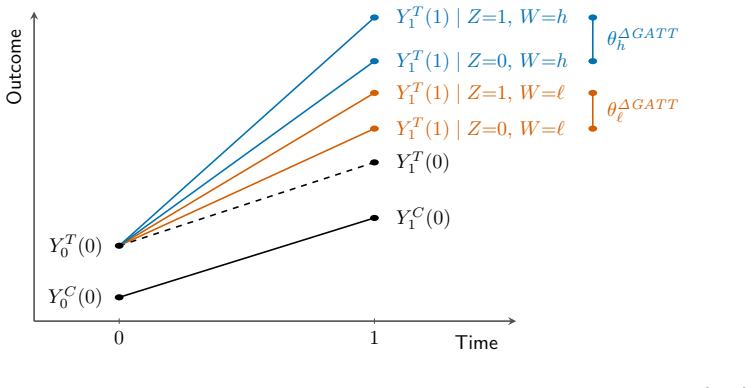
The Balanced Group Average Treatment Effect on the Treated isolates group-level treatment effect heterogeneity from covariate composition differences in difference-in-differences designs.
A machine-rendered reading of the paper's core claim, the machinery that carries it, and where it could break.
Core claim
The paper establishes that the Balanced Group Average Treatment Effect on the Treated (BGATT) recovers group-specific average treatment effects on the treated after removing differences in covariate distributions across groups. It is identified under the conditional parallel trends assumption and admits influence-function-based estimators that remain asymptotically normal when nuisance components are estimated with machine learning methods.
What carries the argument
The Balanced Group Average Treatment Effect on the Treated (BGATT), an estimand that rebalances group-specific treatment effects to hold covariate distributions fixed while preserving the average treatment effect on the treated interpretation for each group.
If this is right
- Group-specific effects and their differences can be estimated and tested with valid asymptotic inference even when covariates are high-dimensional.
- The estimand serves as a transparent, non-parametric target for comparing treatment responses across groups.
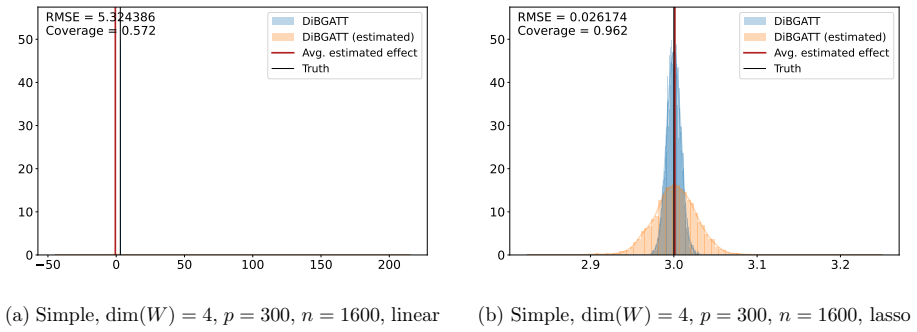
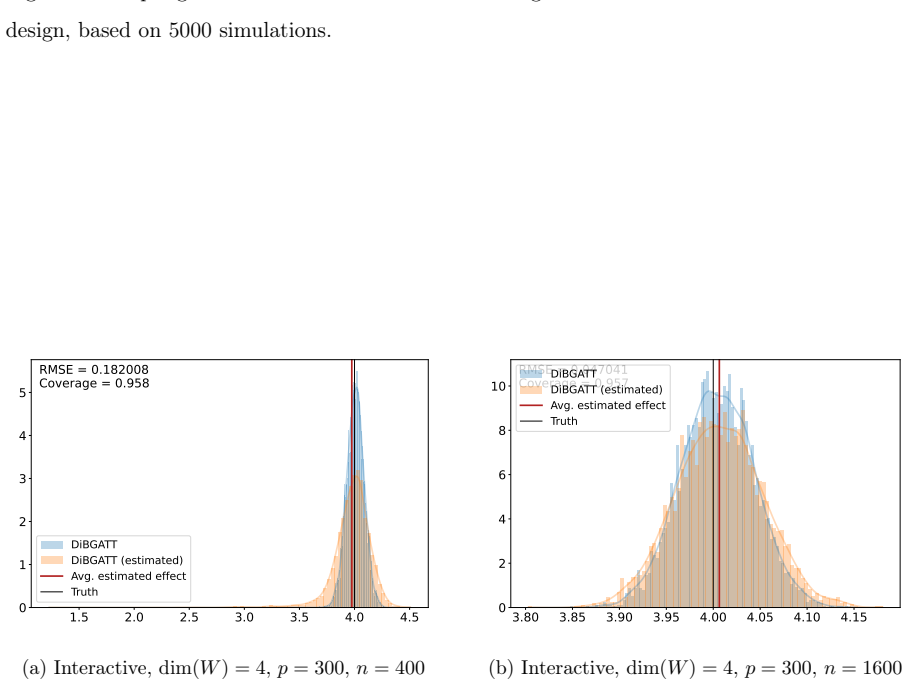
- Simulation evidence indicates favorable finite-sample coverage and bias properties under the stated conditions.
- Estimation remains feasible with flexible, data-driven nuisance estimators rather than parametric interaction models.
Where Pith is reading between the lines
- The same balancing idea could be applied to other panel or repeated cross-section designs that rely on parallel trends.
- Researchers studying equity could use BGATT to separate whether apparent group differences arise from response heterogeneity or from who happens to be in each group.
- Extensions to continuous or multi-valued treatments would require only replacing the binary treatment indicator in the influence function.
Load-bearing premise
Conditional parallel trends holds after conditioning on the observed covariates for the groups under study.
What would settle it
A Monte Carlo design in which groups differ sharply in covariate distributions, true group-level treatment effects are identical, and the estimator is applied; if BGATT still reports statistically significant differences across groups, the balancing claim fails.
Figures
read the original abstract
Understanding how treatment effects vary across groups is central to policy evaluation. In Difference-in-Differences designs, heterogeneity is often studied using subgroup or triple-difference analyses, which can suffer from conservative inference, reliance on parametric interaction structures, and sensitivity to differences in covariate distributions across groups. We propose the Balanced Group Average Treatment Effect on the Treated (BGATT), a new estimand that isolates heterogeneity in treatment responses from differences in covariate composition and is identified under standard conditional parallel-trends assumptions. BGATT provides a transparent target for comparing group-specific treatment effects. We derive an influence-function representation and develop estimators that are $\sqrt{n}$-consistent and asymptotically normal under flexible machine-learning estimation of high-dimensional nuisance components, enabling valid inference on both group-specific effects and differences across groups. Simulation evidence shows favorable finite-sample performance.
Editorial analysis
A structured set of objections, weighed in public.
Referee Report
Summary. The paper proposes the Balanced Group Average Treatment Effect on the Treated (BGATT) as a new estimand in Difference-in-Differences designs. BGATT isolates group-level treatment effect heterogeneity from differences in covariate composition across groups and is identified under standard conditional parallel-trends assumptions. The authors derive an influence-function representation and construct estimators that are root-n consistent and asymptotically normal when high-dimensional nuisance components are estimated via machine learning, enabling inference on both group-specific BGATTs and differences between them. Simulation evidence is provided to illustrate finite-sample performance.
Significance. If the identification, influence-function derivation, and asymptotic results hold, BGATT would offer a transparent target for group-level heterogeneity analysis in DiD settings that avoids confounding by covariate imbalance. The combination of an influence-function approach with flexible ML nuisance estimation is a strength, as is the focus on valid inference for both levels and contrasts. This could be useful for applied researchers comparing treatment responses across groups while maintaining interpretability.
major comments (2)
- [Identification section] Identification section (and abstract): BGATT is constructed by integrating group-specific conditional effects over a common covariate distribution rather than each group's own treated distribution. The manuscript does not explicitly state or verify the common-support/overlap condition on X across groups that is required for the balancing weights to be well-defined and for the common-distribution integral to be identified. Without this condition the central 'balanced' property is not guaranteed under the stated assumptions alone.
- [Asymptotic theory section] Section on asymptotic theory (influence function derivation): The abstract states that an influence function is derived and root-n consistency holds under standard rate conditions on nuisance estimators, but the provided text does not display the explicit regularity conditions, the form of the influence function, or the precise rate requirements. This makes it impossible to confirm that the central consistency claim is load-bearing and correctly derived rather than assumed.
minor comments (1)
- [Abstract] The abstract and introduction could briefly note whether the common-support condition is maintained or relaxed, to align reader expectations with the identification argument.
Simulated Author's Rebuttal
We thank the referee for the detailed and constructive comments. We address each major point below and will revise the manuscript to enhance clarity on the identification assumptions and the presentation of the asymptotic results.
read point-by-point responses
-
Referee: [Identification section] Identification section (and abstract): BGATT is constructed by integrating group-specific conditional effects over a common covariate distribution rather than each group's own treated distribution. The manuscript does not explicitly state or verify the common-support/overlap condition on X across groups that is required for the balancing weights to be well-defined and for the common-distribution integral to be identified. Without this condition the central 'balanced' property is not guaranteed under the stated assumptions alone.
Authors: We agree that the common-support condition is necessary for the balancing weights to be well-defined and for the BGATT to be identified. In the revised manuscript we will add an explicit overlap assumption requiring that the support of the covariate distribution is common across groups (i.e., the density of X is bounded away from zero on a common set). We will also verify that this condition, together with the conditional parallel-trends assumption, guarantees that the balancing weights exist and are bounded, thereby ensuring the central 'balanced' property of the estimand. revision: yes
-
Referee: [Asymptotic theory section] Section on asymptotic theory (influence function derivation): The abstract states that an influence function is derived and root-n consistency holds under standard rate conditions on nuisance estimators, but the provided text does not display the explicit regularity conditions, the form of the influence function, or the precise rate requirements. This makes it impossible to confirm that the central consistency claim is load-bearing and correctly derived rather than assumed.
Authors: We acknowledge that the current draft does not display the explicit influence function or the full set of regularity conditions in the main text. In the revision we will include the derivation of the influence function (in an appendix or the main text) and state the precise rate conditions on the nuisance estimators (e.g., o_p(n^{-1/4}) convergence) required for root-n consistency and asymptotic normality of the BGATT estimators. This will make the asymptotic claims fully transparent and verifiable. revision: yes
Circularity Check
No significant circularity; BGATT is a newly defined target parameter identified under external assumptions
full rationale
The paper defines BGATT directly from potential outcomes as a new estimand that reweights to isolate treatment heterogeneity from covariate composition differences. Identification is asserted under the standard conditional parallel trends assumption drawn from the existing DiD literature rather than derived from the paper's own fitted quantities or self-citations. No equations reduce the estimand or its estimator to a tautology by construction, and the central claim retains independent content as a proposed target for group-level comparisons. The derivation chain is therefore self-contained against external benchmarks.
Axiom & Free-Parameter Ledger
axioms (1)
- domain assumption Conditional parallel trends assumption holds after conditioning on observed covariates
Reference graph
Works this paper leans on
-
[1]
Hatamyar, Julia and Kreif, Noemi and Rocha, Rudi and Huber, Martin , journal=
-
[2]
2021 , publisher=
Callaway, Brantly and Sant’Anna, Pedro HC , journal=. 2021 , publisher=
2021
-
[3]
2020 , publisher=
Sant’Anna, Pedro HC and Zhao, Jun , journal=. 2020 , publisher=
2020
-
[4]
2025 , publisher=
Bearth, Nora and Lechner, Michael , journal=. 2025 , publisher=
2025
-
[5]
Zimmert, Michael , journal=
-
[6]
Huber, Martin , year=
-
[7]
2013 , publisher=
Hong, Seung-Hyun , journal=. 2013 , publisher=
2013
-
[8]
2020 , publisher=
Chang, Neng-Chieh , journal=. 2020 , publisher=
2020
-
[9]
Chernozhukov, Victor and Hansen, Christian and Kallus, Nathan and Spindler, Martin and Syrgkanis, Vasilis , journal=
-
[10]
The Econometrics Journal , volume=
Olden, Andreas and M. The Econometrics Journal , volume=. 2022 , publisher=
2022
-
[11]
Strezhnev, Anton , journal=
-
[12]
2005 , publisher=
Abadie, Alberto , journal=. 2005 , publisher=
2005
-
[13]
Sant'Anna, Pedro HC and Xu, Qi , journal=
-
[14]
Borusyak, Kirill and Jaravel, Xavier , year=
-
[15]
American Economic Review , volume=
De Chaisemartin, Cl. American Economic Review , volume=
-
[16]
2021 , publisher=
Goodman-Bacon, Andrew , journal=. 2021 , publisher=
2021
-
[17]
Journal of the Royal Statistical Society
Non-parametric methods for doubly robust estimation of continuous treatment effects , author=. Journal of the Royal Statistical Society. Series B (Statistical Methodology) , volume=. 2017 , publisher=
2017
-
[18]
Kennedy, Edward H , journal=
-
[19]
2023 , publisher=
Kennedy, Edward H , journal=. 2023 , publisher=
2023
-
[20]
The Econometrics Journal , volume =
Chernozhukov, Victor and Chetverikov, Denis and Demirer, Mert and Duflo, Esther and Hansen, Christian and Newey, Whitney and Robins, James , title =. The Econometrics Journal , volume =
-
[21]
2013 , journal=
Least squares after model selection in high-dimensional sparse models , author=. 2013 , journal=
2013
-
[22]
Luo, Ye and Spindler, Martin and K. High-Dimensional. arXiv preprint arXiv:1602.08927 , year=
-
[23]
Journal of the American Statistical Association , volume=
Estimation and inference of heterogeneous treatment effects using random forests , author=. Journal of the American Statistical Association , volume=. 2018 , publisher=
2018
-
[24]
arXiv preprint arXiv:1503.06388 , year=
Adaptive concentration of regression trees, with application to random forests , author=. arXiv preprint arXiv:1503.06388 , year=
-
[25]
The Annals of Statistics , volume=
Orthogonal statistical learning , author=. The Annals of Statistics , volume=. 2023 , publisher=
2023
-
[26]
Econometrica , volume=
Deep neural networks for estimation and inference , author=. Econometrica , volume=. 2021 , publisher=
2021
-
[27]
2020 , url =
Wager, Stefan , title =. 2020 , url =
2020
-
[28]
arXiv preprint arXiv:2202.02903 , year=
Difference in Differences with Time-Varying Covariates , author=. arXiv preprint arXiv:2202.02903 , year=
-
[29]
2024 , publisher=
Nie, Xinkun and Lu, Chen and Wager, Stefan , booktitle=. 2024 , publisher=
2024
-
[30]
2019 , publisher=
Li, Fan , journal=. 2019 , publisher=
2019
-
[31]
1974 , publisher=
Rubin, Donald B , journal=. 1974 , publisher=
1974
-
[32]
Mathematical Modelling , volume=
Robins,James , year=. Mathematical Modelling , volume=
-
[33]
2023 , institution=
Gavrilova, Evelina and Lang. 2023 , institution=
2023
-
[34]
2018 , publisher=
Wager, Stefan and Athey, Susan , journal=. 2018 , publisher=
2018
-
[35]
2015 , publisher=
Abrevaya, Jason and Hsu, Yu-Chin and Lieli, Robert P , journal=. 2015 , publisher=
2015
-
[36]
The Annals of Statistics , volume =
Athey, Susan and Tibshirani, Julie and Wager, Stefan , title =. The Annals of Statistics , volume =
-
[37]
Lechner, Michael , journal=
-
[38]
2021 , publisher=
Semenova, Vira and Chernozhukov, Victor , journal=. 2021 , publisher=
2021
-
[39]
2025 , publisher=
Zimmert, Michael and Lechner, Michael , journal=. 2025 , publisher=
2025
-
[40]
2022 , publisher=
Fan, Qingliang and Hsu, Yu-Chin and Lieli, Robert P and Zhang, Yichong , journal=. 2022 , publisher=
2022
-
[41]
Jacob, Daniel , journal=
-
[42]
Chernozhukov, Victor and Demirer, Mert and Duflo, Esther and Fernandez-Val, Ivan , year=
-
[43]
Baker, Andrew and Callaway, Brantly and Cunningham, Scott and Goodman-Bacon, Andrew and Sant'Anna, Pedro HC , journal=
-
[44]
AEA Papers and Proceedings , volume=
Child penalties across countries: Evidence and explanations , author=. AEA Papers and Proceedings , volume=. 2019 , organization=
2019
-
[45]
2023 , institution=
Child penalty estimation and mothers' age at first birth , author=. 2023 , institution=
2023
-
[46]
1994 , publisher=
Gruber, Jonathan , journal=. 1994 , publisher=
1994
-
[47]
Caron, Laura , journal=
-
[48]
Econometrica , pages=
On the role of the propensity score in efficient semiparametric estimation of average treatment effects , author=. Econometrica , pages=. 1998 , publisher=
1998
-
[49]
arXiv preprint arXiv:2508.17099 , year=
Challenges in Statistics: A Dozen Challenges in Causality and Causal Inference , author=. arXiv preprint arXiv:2508.17099 , year=
-
[50]
2024 , publisher=
Kennedy, Edward H , journal=. 2024 , publisher=
2024
-
[51]
Quantitative Economics , volume=
The influence function of semiparametric estimators , author=. Quantitative Economics , volume=. 2022 , publisher=
2022
-
[52]
The American Statistician , volume=
Demystifying statistical learning based on efficient influence functions , author=. The American Statistician , volume=. 2022 , publisher=
2022
-
[53]
2006 , publisher=
Semiparametric theory and missing data , author=. 2006 , publisher=
2006
-
[54]
arXiv preprint arXiv:2009.03151 , year=
Doubly robust semiparametric difference-in-differences estimators with high-dimensional data , author=. arXiv preprint arXiv:2009.03151 , year=
arXiv 2009
-
[55]
arXiv preprint arXiv:2506.17729 , year=
Efficient Difference-in-Differences and Event Study Estimators , author=. arXiv preprint arXiv:2506.17729 , year=
-
[56]
Ortiz-Villavicencio, Marcelo and Sant'Anna, Pedro HC , journal=
-
[57]
arXiv preprint arXiv:2602.23877 , year=
Huber, Martin and Oberh. arXiv preprint arXiv:2602.23877 , year=
-
[58]
2016 , publisher=
Berck, Peter and Villas-Boas, Sofia B , journal=. 2016 , publisher=
2016
-
[59]
1955 , publisher=
Kitagawa, Evelyn M , journal=. 1955 , publisher=
1955
-
[60]
1973 , publisher=
Oaxaca, Ronald , journal=. 1973 , publisher=
1973
-
[61]
1973 , publisher=
Blinder, Alan S , journal=. 1973 , publisher=
1973
-
[62]
1994 , publisher=
Oaxaca, Ronald L and Ransom, Michael R , journal=. 1994 , publisher=
1994
-
[63]
Callaway, Brantly and Goodman-Bacon, Andrew and Sant'Anna, Pedro HC , year=
-
[64]
2026 , publisher=
Imai, Shunsuke and Qin, Lei and Yanagi, Takahide , journal=. 2026 , publisher=
2026
discussion (0)
Sign in with ORCID, Apple, or X to comment. Anyone can read and Pith papers without signing in.