Reconstruction of chaotic systems in invariant jet space
Pith reviewed 2026-06-26 09:50 UTC · model grok-4.3
The pith
Jet-space reconstruction from time series exactly preserves the symmetry group of the original chaotic system.
A machine-rendered reading of the paper's core claim, the machinery that carries it, and where it could break.
Core claim
Switching from delay-coordinate space to jet space allows one to exactly preserve the symmetry group of the original system. This statement is rigorously justified by a theorem on the isomorphism of Lie algebras under jet prolongation. Numerical experiments on the Lorenz and Rössler systems confirm that jet-space reconstruction preserves geometry and symmetries, whereas Takens embedding distorts them. As quantitative metrics the paper uses a variational elastic energy functional and the correlation dimension. It is shown that jet-space reconstruction not only outperforms Takens embedding but in some cases yields more accurate estimates of invariants than projections of the original system.
What carries the argument
Jet space consisting of the signal together with its successive derivatives, equipped with the jet prolongation that maps the original Lie algebra of symmetries isomorphically onto the prolonged algebra.
If this is right
- Jet-space reconstruction supplies a coordinate-invariant criterion for classifying strange attractors.
- The same construction can serve as a basis for detecting hidden attractors.
- In some cases jet-space estimates of invariants such as correlation dimension are more accurate than those obtained from projections of the original system.
- A variational elastic energy functional together with correlation dimension quantify the geometric preservation achieved.
Where Pith is reading between the lines
- The isomorphism may allow inference of unknown symmetry groups directly from observed time series once reconstructed in jet space.
- Higher-order jets could extend the method to systems governed by higher-order differential equations.
- Direct comparison with other derivative-based embeddings could test whether the Lie-algebraic preservation is unique to jet prolongation.
Load-bearing premise
Derivatives computed from noisy or discrete time series do not introduce artifacts that break the Lie algebra isomorphism guaranteed by the jet prolongation theorem.
What would settle it
Compute the Lie algebra of symmetries in the original continuous system, in the jet-space reconstruction, and in a Takens delay embedding; the jet-space version must match the original exactly while the Takens version does not.
Figures
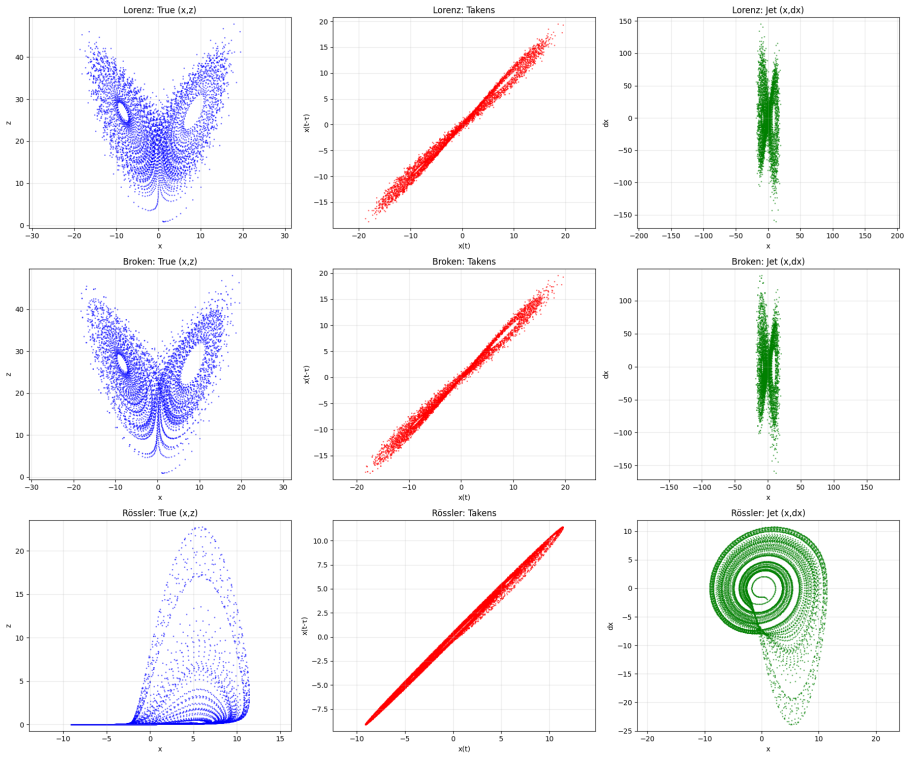
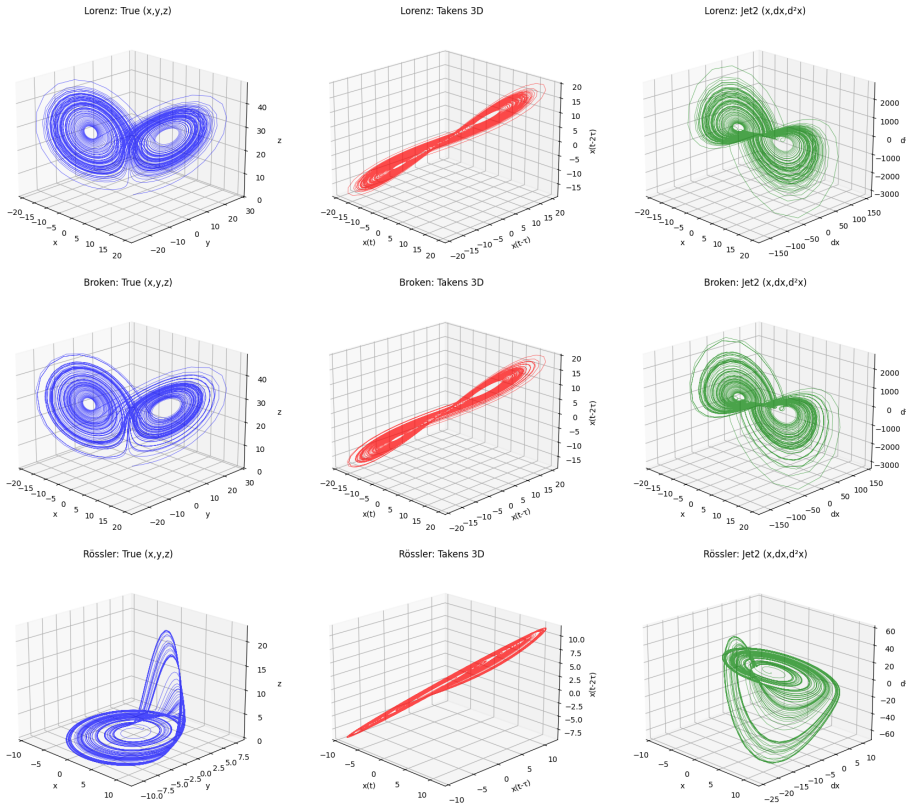
read the original abstract
Takens' theorem is the gold standard for attractor reconstruction from time series, but it guarantees only topological equivalence and does not preserve metric or group properties such as symmetries. We show that switching from delay-coordinate space to jet space (signal and its derivatives) allows one to exactly preserve the symmetry group of the original system. This statement is rigorously justified by a theorem on the isomorphism of Lie algebras under jet prolongation. Numerical experiments on the Lorenz and R\"ossler systems confirm that jet-space reconstruction preserves geometry and symmetries, whereas Takens embedding distorts them. As quantitative metrics we use a variational elastic energy functional and the correlation dimension. It is shown that jet-space reconstruction not only outperforms Takens embedding but in some cases yields more accurate estimates of invariants than projections of the original system. The proposed approach provides a coordinate-invariant criterion for the classification of strange attractors and can serve as a basis for detecting hidden attractors.
Editorial analysis
A structured set of objections, weighed in public.
Referee Report
Summary. The paper claims that reconstructing chaotic attractors in jet space (the signal and its successive derivatives) exactly preserves the original system's symmetry group, in contrast to Takens delay-coordinate embedding which only guarantees topological equivalence. This is justified by a theorem asserting isomorphism of the Lie algebras under jet prolongation. Numerical experiments on the Lorenz and Rössler systems are reported to confirm superior preservation of geometry and symmetries, measured by a variational elastic energy functional and correlation dimension; in some cases jet-space estimates of invariants are claimed to be more accurate than those from the original system projections.
Significance. If the central claim of exact symmetry preservation holds under the paper's reconstruction pipeline, the work would provide a coordinate-invariant method for classifying strange attractors and detecting hidden ones, extending Takens' theorem with group-theoretic structure. The explicit theorem on Lie-algebra isomorphism and the direct comparison against Takens embedding using quantitative metrics constitute clear strengths.
major comments (3)
- [Theorem section] § on the jet-prolongation theorem (likely §2–3): the stated isomorphism holds for smooth vector fields with exact derivatives, yet the reconstruction obtains jet coordinates by numerical differentiation of discrete time series. No error analysis or bound is given showing that truncation/round-off errors preserve the exact commutation relations [X,Y]=Z required for the Lie-algebra structure.
- [Numerical experiments] Numerical experiments section: preservation of symmetries is assessed only via elastic energy and correlation dimension; the paper does not verify that the prolonged vector-field brackets remain closed under the specific differentiation operator (finite differences, splines, or filters) actually employed on the Lorenz and Rössler time series.
- [Abstract and results] Abstract and results: the claim that jet-space reconstruction 'in some cases yields more accurate estimates of invariants than projections of the original system' is load-bearing for the practical advantage but lacks a precise definition of the projection operator and the quantitative criterion used to declare superiority.
minor comments (2)
- [Methods] Notation for jet coordinates and the elastic-energy functional should be introduced with explicit formulas in the main text rather than deferred to an appendix.
- [Abstract] The abstract states a theorem but does not indicate whether the proof is self-contained or relies on a cited reference; a brief statement of the theorem's hypotheses would improve clarity.
Simulated Author's Rebuttal
We thank the referee for the careful reading and constructive major comments. We address each point below and indicate where revisions will be made to strengthen the manuscript.
read point-by-point responses
-
Referee: [Theorem section] § on the jet-prolongation theorem (likely §2–3): the stated isomorphism holds for smooth vector fields with exact derivatives, yet the reconstruction obtains jet coordinates by numerical differentiation of discrete time series. No error analysis or bound is given showing that truncation/round-off errors preserve the exact commutation relations [X,Y]=Z required for the Lie-algebra structure.
Authors: The theorem in §§2–3 is stated for exact jet coordinates obtained from smooth vector fields, where the Lie-algebra isomorphism follows directly from the properties of jet prolongation. The numerical experiments use consistent differentiation schemes (finite differences or splines) on sampled data. We acknowledge that an explicit a-priori bound on how truncation and round-off errors affect bracket closure is absent. In the revision we will add a short paragraph discussing consistency of the numerical differentiation in the small-step limit and referencing standard approximation theory results that guarantee the brackets converge to their exact values for sufficiently smooth signals and adequate sampling. revision: yes
-
Referee: [Numerical experiments] Numerical experiments section: preservation of symmetries is assessed only via elastic energy and correlation dimension; the paper does not verify that the prolonged vector-field brackets remain closed under the specific differentiation operator (finite differences, splines, or filters) actually employed on the Lorenz and Rössler time series.
Authors: We agree that direct numerical verification of bracket closure under the concrete differentiation operator strengthens the empirical support. The revised manuscript will include an additional figure or table that recomputes the Lie brackets of the reconstructed vector fields on the Lorenz and Rössler attractors using exactly the same differentiation routine employed in the jet-space reconstruction, confirming that the structure constants remain close to the analytic values within the observed numerical tolerance. revision: yes
-
Referee: [Abstract and results] Abstract and results: the claim that jet-space reconstruction 'in some cases yields more accurate estimates of invariants than projections of the original system' is load-bearing for the practical advantage but lacks a precise definition of the projection operator and the quantitative criterion used to declare superiority.
Authors: The projection operator is the natural truncation map that discards all derivatives of order greater than zero, recovering the original state-space coordinates. Superiority is quantified by comparing the variational elastic energy (lower is better) and the correlation dimension (closer to the known analytic value is better) between the jet-space reconstruction, the Takens embedding, and this projected original system. We will insert explicit definitions of both the projection and the two quantitative criteria, together with the numerical thresholds applied, into the abstract and the results section. revision: yes
Circularity Check
No significant circularity; central claim rests on external theorem
full rationale
The paper's key assertion—that jet-space reconstruction exactly preserves the original symmetry group—is justified by invoking a theorem on Lie algebra isomorphism under jet prolongation. No quoted text or equation in the provided material shows this theorem being derived from the paper's own data, fits, or prior self-citations that would reduce the result to a tautology. Numerical experiments (elastic energy, correlation dimension on Lorenz/Rössler) serve as confirmation rather than the load-bearing justification. The derivation chain therefore remains self-contained against external mathematical benchmarks and does not exhibit any of the enumerated circularity patterns.
Axiom & Free-Parameter Ledger
axioms (1)
- domain assumption The isomorphism of Lie algebras under jet prolongation holds for the vector fields of the reconstructed chaotic systems.
Reference graph
Works this paper leans on
-
[1]
Takens, Detecting strange attractors in turbulence, in:Dynamical Systems and Turbulence, Warwick 1980, Springer, 1981, pp
F. Takens, Detecting strange attractors in turbulence, in:Dynamical Systems and Turbulence, Warwick 1980, Springer, 1981, pp. 366–381
1980
-
[2]
Broomhead, G.P
D.S. Broomhead, G.P. King, Extracting qualitative dynamics from experimental data,Physica D20(1986) 217–236
1986
-
[3]
Kantz, T
H. Kantz, T. Schreiber,Nonlinear Time Series Analysis, Cambridge University Press, 1997
1997
-
[4]
Sauer, J.A
T. Sauer, J.A. Yorke, M. Casdagli, Embedology,J. Stat. Phys.65(1991) 579–616
1991
-
[5]
Cross, R
D.J. Cross, R. Gilmore, Equivariant differential embeddings,J. Math. Phys.51 (2010) 092706
2010
-
[6]
King, I.N
G.P. King, I.N. Stewart, Phase space reconstruction for symmetric dynamical sys- tems,Physica D58(1992) 216–228
1992
-
[7]
King, I.N
G.P. King, I.N. Stewart, Symmetric dynamics and reconstruction, in: D.S. Broom- head, A. Isichenko (Eds.),Proc. of the 1991 Summer School on Nonlinear Dynamics, 1992
1991
-
[8]
E.V. Nikulchev, Invariant geometric methods of qualitative theory of modelling and control of systems with nonlinear dynamics, Doctoral thesis, Moscow State University of Instrument Engineering and Informatics, 2006
2006
-
[9]
E.V. Nikulchev, Development of mathematical methods and models for ensuring control quality in multi-criteria systems, PhD thesis, Moscow State University of Instrument Engineering and Informatics, 2000
2000
-
[10]
Nikulchev,Geometric Approach to Modelling Nonlinear Systems from Experi- mental Data, M.: MGUP, 2007, 162 p
E.V. Nikulchev,Geometric Approach to Modelling Nonlinear Systems from Experi- mental Data, M.: MGUP, 2007, 162 p. 17
2007
-
[11]
Nikulchev, Geometric method of reconstructing evolution equations from exper- imental data, in:Evolution Equations, Nova Science Publishers, 2011, pp
E.V. Nikulchev, Geometric method of reconstructing evolution equations from exper- imental data, in:Evolution Equations, Nova Science Publishers, 2011, pp. 373–400
2011
-
[12]
Nikulchev, Robust chaos generation on the basis of symmetry violations in at- tractors,2014 2nd International Conference on Emission Electronics (ICEE), IEEE,
E.V. Nikulchev, Robust chaos generation on the basis of symmetry violations in at- tractors,2014 2nd International Conference on Emission Electronics (ICEE), IEEE,
2014
-
[13]
doi:10.1109/Emission.2014.6893972
-
[14]
Leonov, N.V
G.A. Leonov, N.V. Kuznetsov, Hidden attractors in dynamical systems: from hidden oscillations in Hilbert–Kolmogorov–Aizerman problems to hidden chaotic attractor in Chua circuits,Int. J. Bifurc. Chaos23(2013) 1330002
2013
-
[15]
Leonov, N.V
G.A. Leonov, N.V. Kuznetsov, Analytical and numerical methods for the study of attractors in dynamical systems, in:Proc. of the 2014 International Conference on Nonlinear Dynamics, 2014
2014
-
[16]
P. Calvo-Barl´ es, S.G. Rodrigo, L. Martin-Moreno, Learning finite symmetry groups of dynamical systems via equivariance detection,arXiv:2503.03014, 2024
arXiv 2024
-
[17]
L. Hu, Y. Li, Z. Lin, Explicit Discovery of Nonlinear Symmetries from Dynamic Data,ICML, 2025
2025
-
[18]
Machado, M
G.F. Machado, M. Jones, Sparse Identification of Nonlinear Dynamics with Side Information (SINDy-SI),American Control Conference (ACC), 2024, pp. 2879–2884
2024
-
[19]
SINDy-SI: Sparse Identification of Nonlinear Dynamics with Side Information,arXiv, 2024
2024
-
[20]
Latent LieGAN: discovering symmetries of nonlinear group actions,ICML, 2024
2024
-
[21]
Muriel, J.L
C. Muriel, J.L. Romero, Prolongations of vector fields and the invariants-by- derivation property,Theoret. and Math. Phys.133(2002) 1565–1575
2002
-
[22]
Olver,Applications of Lie Groups to Differential Equations, Springer, 1993
P.J. Olver,Applications of Lie Groups to Differential Equations, Springer, 1993
1993
-
[23]
Lorenz, Deterministic nonperiodic flow,J
E.N. Lorenz, Deterministic nonperiodic flow,J. Atmos. Sci.20(1963) 130–141
1963
-
[24]
R¨ ossler, An equation for continuous chaos,Phys
O.E. R¨ ossler, An equation for continuous chaos,Phys. Lett. A57(1976) 397–398
1976
-
[25]
Grassberger, I
P. Grassberger, I. Procaccia, Characterization of strange attractors,Phys. Rev. Lett. 50(1983) 346–349
1983
-
[26]
Navarrete, D
P. Navarrete, D. Viswanath, Delay embedding of periodic orbits using a fixed obser- vation function,Physica D356–357(2018) 18–31. 18
2018
discussion (0)
Sign in with ORCID, Apple, or X to comment. Anyone can read and Pith papers without signing in.