Deep Imaging of Grus II and Horologium II: Structure and Extent of Two Ultra-Faint Milky Way Satellites
Pith reviewed 2026-06-25 23:19 UTC · model grok-4.3
The pith
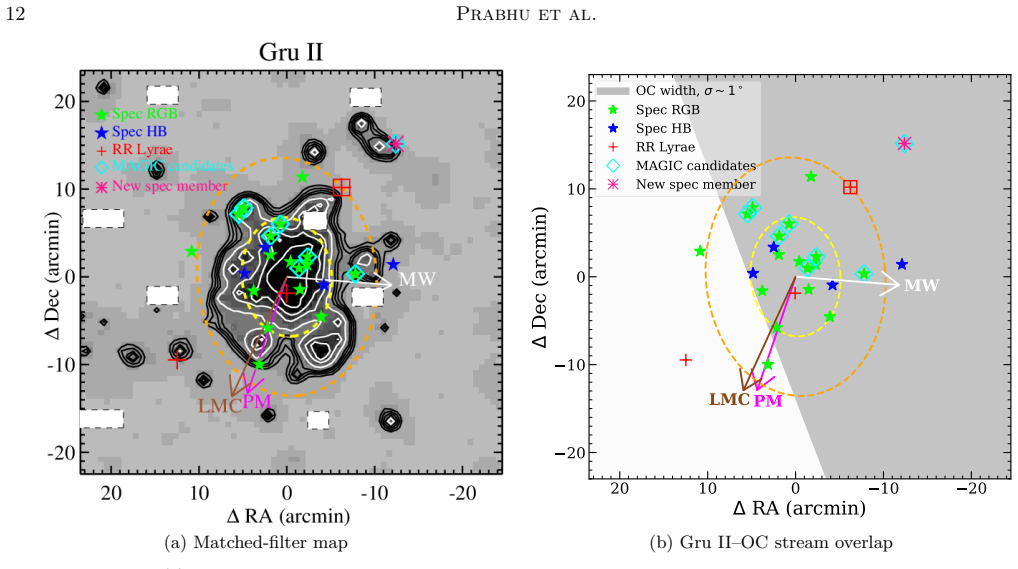
Deep imaging shows Grus II has asymmetric clumps and a confirmed distant member star, indicating possible tidal disturbance, while Horologium II appears regular and compact.
A machine-rendered reading of the paper's core claim, the machinery that carries it, and where it could break.
Core claim
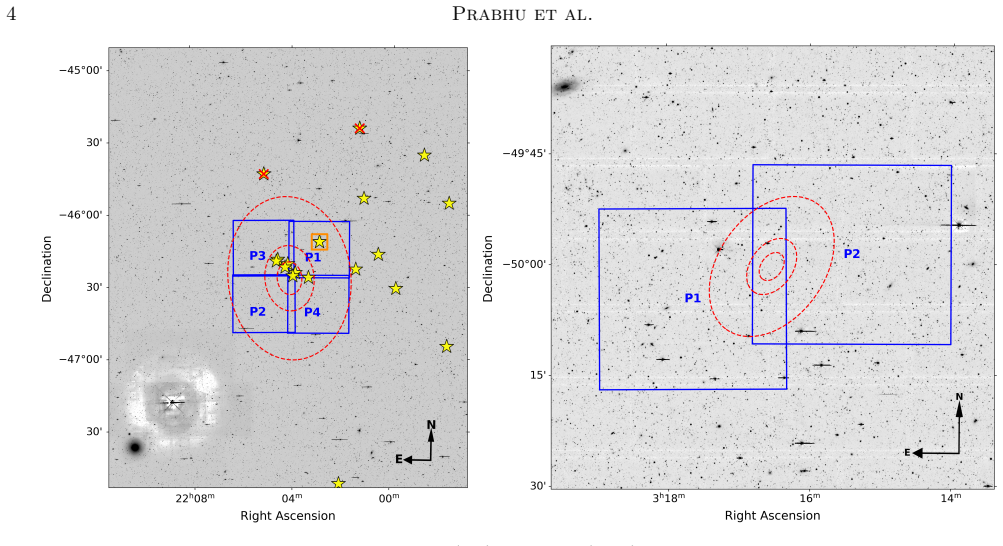
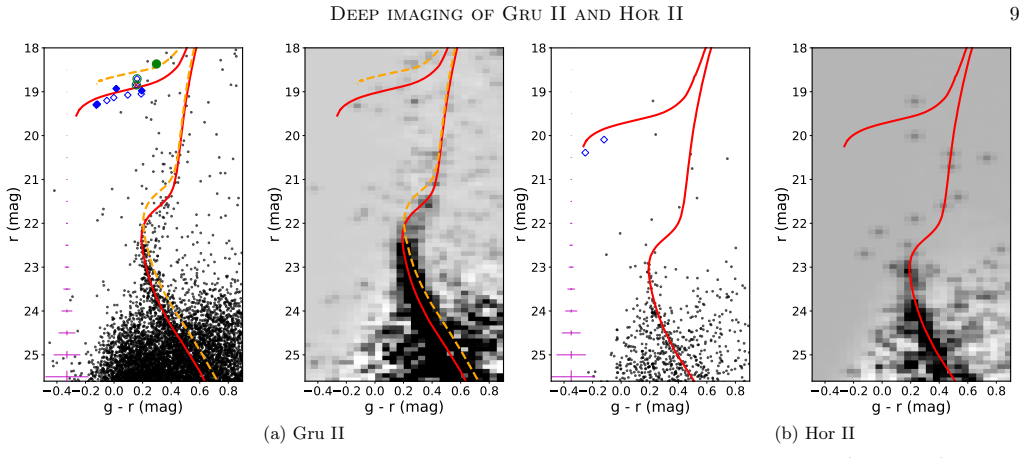
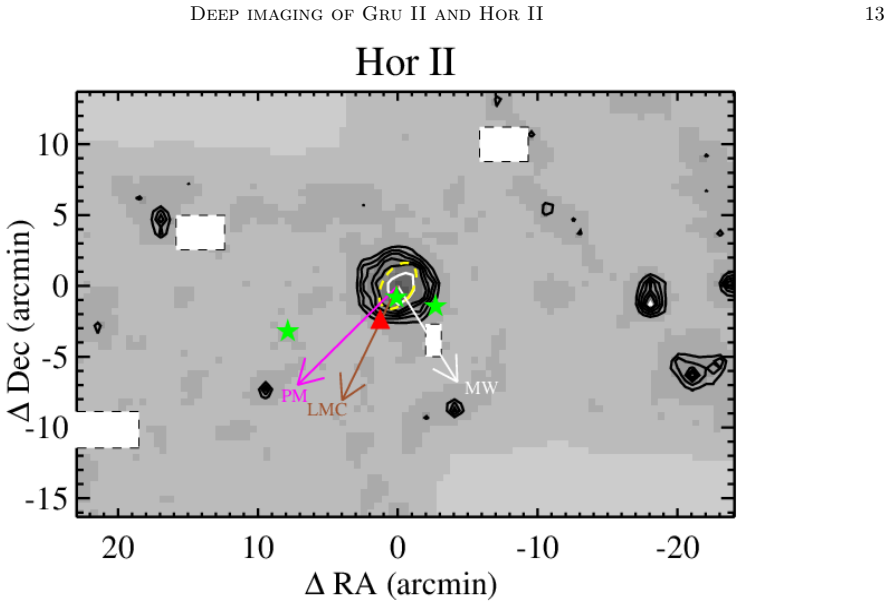
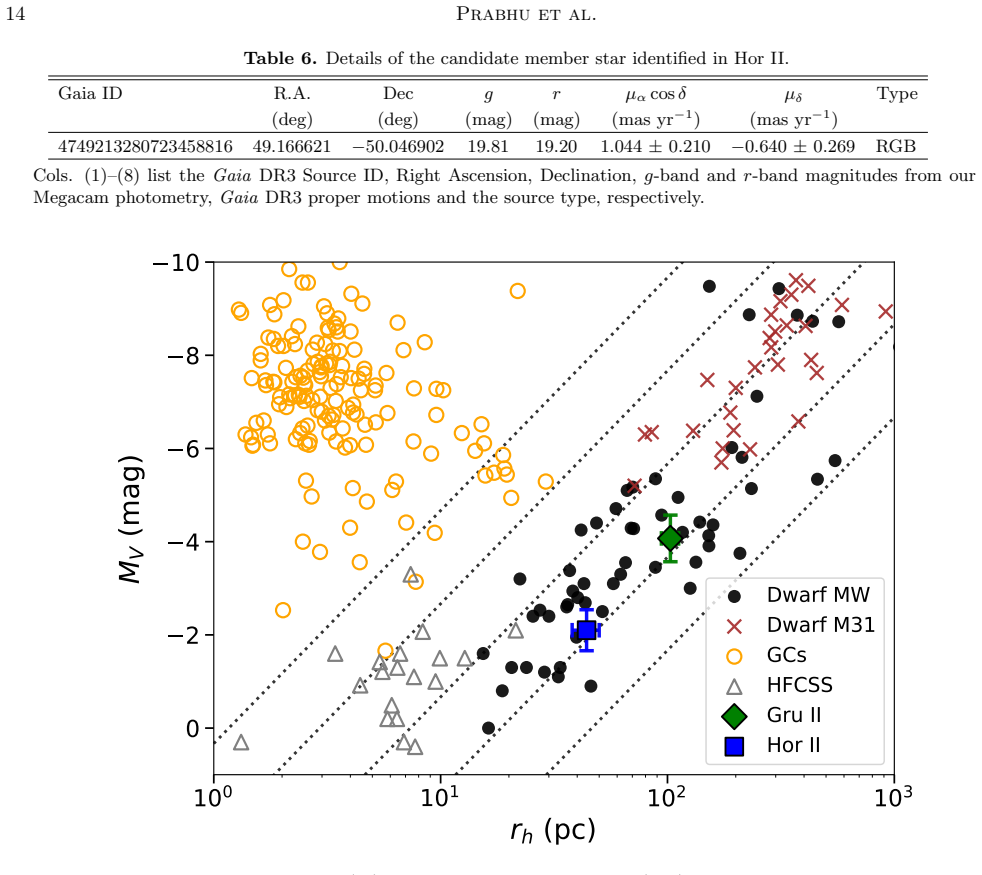
Deep Magellan/Megacam photometry three magnitudes fainter than discovery data yields Grus II at 52.3 kpc with half-light radius 103 pc, ellipticity 0.25, and absolute magnitude -4.07, featuring multi-directional clumps and a new spectroscopically confirmed member beyond three half-light radii. Horologium II is placed at 72.4 kpc with radius 44 pc, ellipticity 0.32, and magnitude -2.10 and shows a regular morphology with no detected extended structure. Both systems follow the typical size-luminosity relation for Milky Way ultra-faint dwarfs and contain old, very metal-poor populations.
What carries the argument
Wide-field color-magnitude diagram fitting combined with spatial mapping to extract structural parameters and flag potential tidal features, plus spectroscopic membership confirmation for an outer star.
If this is right
- Grus II may not be in dynamical equilibrium, so mass estimates based on its current size could be biased.
- The size-luminosity placement of both galaxies remains typical even after deeper measurements.
- Horologium II shows no evidence of Milky Way influence at the achieved surface-brightness limit.
- Additional member stars at large radii in Grus II support the need for wider searches around other ultra-faint systems.
Where Pith is reading between the lines
- If the clumps represent stripped material, the original orbit and mass of Grus II could be reconstructed from the spatial distribution of those stars.
- Proper-motion data on the outer member and clumps could test whether Grus II recently passed close to the Milky Way.
- Applying the same imaging depth to other ultra-faint candidates might uncover a larger population of tidally affected dwarfs.
- The half-light radius of Grus II might increase if more faint members exist beyond the current survey area.
Load-bearing premise
The observed clumps and the distant member star in Grus II trace genuine tidal disturbance instead of line-of-sight overlaps, detection limits, or unrelated foreground stars.
What would settle it
Radial velocity or proper-motion measurements showing that stars in the clumps and the outer member have velocities or motions inconsistent with orbital membership in Grus II would rule out the tidal interpretation.
Figures
read the original abstract
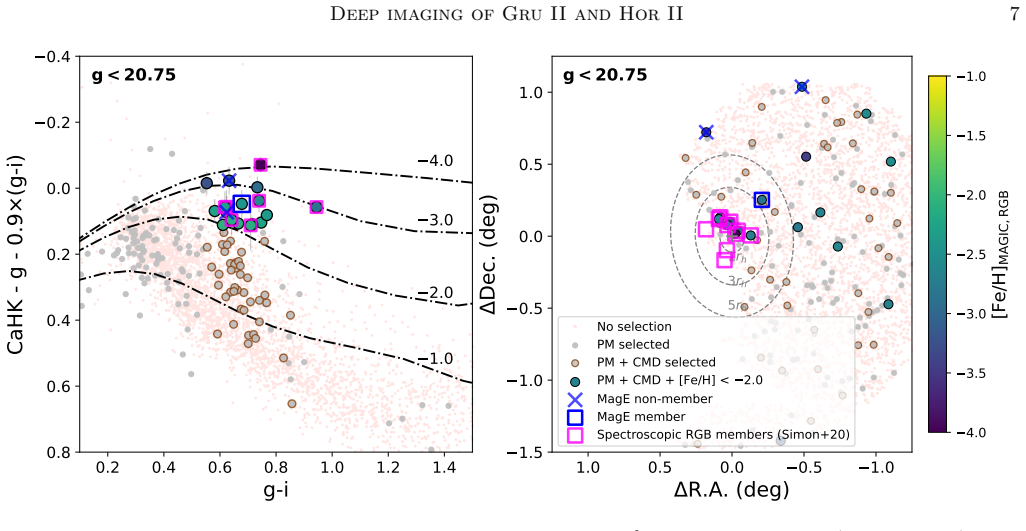
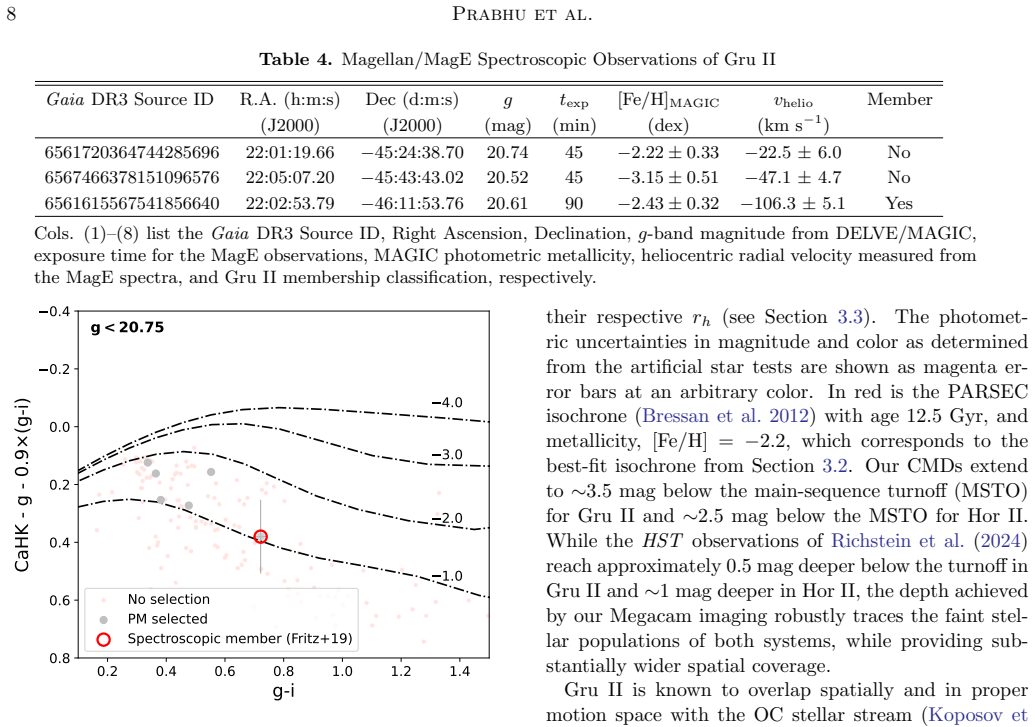
We present deep, wide-field Magellan/Megacam imaging of the ultra-faint Milky Way (MW) satellites Grus II (Gru II) and Horologium II (Hor II), with the aim of deriving improved constraints on their distances, luminosities, and structural parameters, while also searching for possible signs of tidal disturbance. Our photometry reaches approximately 3 magnitudes deeper than the discovery data, enabling robust measurements of these quantities. Both systems exhibit color-magnitude diagrams consistent with old ($\sim$12.5 Gyr), very metal-poor stellar populations. We find Gru II to be at a distance of $52.3 \pm 1.9$ kpc, with a half-light radius of $6.8 \pm 0.5$ arcmin (103 $\pm$ 9 pc), ellipticity $\epsilon = 0.25 \pm 0.07$, and absolute magnitude $M_V = -4.07 \pm 0.50$ mag. Hor II is further away at a distance of $72.4^{+5.9}_{-5.5}$ kpc and more compact, with $r_h = 2.1 \pm 0.2$ arcmin (44$^{+6}_{-5}$ pc), $\epsilon = 0.32^{+0.20}_{-0.16}$, and $M_V = -2.10 \pm 0.44$ mag. Both galaxies lie within the typical size-luminosity locus of MW ultra-faint dwarfs. Gru II shows an asymmetric morphology including multi-directional clumpy features, some of which may be suggestive of tidal disturbance. We further identify and spectroscopically confirm a new distant member just outside $3r_h$ in Gru II, providing independent evidence for member stars at large projected radii. In contrast, Hor II appears regular, with no significant extended structure detected to the surface-brightness limits of our data.
Editorial analysis
A structured set of objections, weighed in public.
Referee Report
Summary. The manuscript reports deep Magellan/Megacam photometry of the ultra-faint Milky Way satellites Grus II and Horologium II, reaching ~3 mag deeper than discovery data. It derives distances (52.3 ± 1.9 kpc for Gru II; 72.4^{+5.9}_{-5.5} kpc for Hor II), structural parameters (r_h = 103 ± 9 pc and 44^{+6}_{-5} pc; ellipticities 0.25 ± 0.07 and 0.32^{+0.20}_{-0.16}; M_V = -4.07 ± 0.50 and -2.10 ± 0.44), and CMDs consistent with old (~12.5 Gyr), metal-poor populations. Gru II is described as having asymmetric, multi-directional clumpy morphology suggestive of tidal disturbance, with a spectroscopically confirmed member outside 3 r_h; Hor II appears regular with no extended structure detected.
Significance. If robust, the work supplies improved photometric constraints on two low-luminosity satellites that populate the faint end of the size-luminosity relation. The deeper CMDs strengthen the old, metal-poor population assignment, and the extended member in Gru II provides an independent datum on spatial extent. These measurements are useful for satellite census and dynamical studies of the Milky Way halo.
major comments (2)
- [Abstract] Abstract (morphology and member-identification paragraph): the interpretation that the observed multi-directional clumps and the distant spectroscopically confirmed member constitute evidence for tidal disturbance is load-bearing for the central claim of extended structure in Gru II, yet no quantitative test (artificial-star completeness maps, control-field subtraction, or Monte-Carlo realization of expected field distribution) is described to exclude line-of-sight projection, spatially varying incompleteness, or residual foreground contamination.
- [Abstract] Abstract (structural-parameter paragraph): the half-light radius, ellipticity, and luminosity for both systems rest on standard CMD fitting and spatial modeling, but without explicit description of background-subtraction method, completeness corrections, or the functional form used for the density profile, it is not possible to verify that the quoted uncertainties fully capture systematic contributions at the faint end.
minor comments (2)
- Notation for half-light radius is inconsistent between r_h and rh across the abstract; adopt a single symbol and define it once.
- The ellipticity uncertainty for Hor II is reported asymmetrically while that for Gru II is symmetric; state whether this follows from the fitting procedure or from the data.
Simulated Author's Rebuttal
We thank the referee for their careful reading and constructive comments. We address each major comment below and have revised the manuscript to provide the requested methodological details and quantitative tests.
read point-by-point responses
-
Referee: [Abstract] Abstract (morphology and member-identification paragraph): the interpretation that the observed multi-directional clumps and the distant spectroscopically confirmed member constitute evidence for tidal disturbance is load-bearing for the central claim of extended structure in Gru II, yet no quantitative test (artificial-star completeness maps, control-field subtraction, or Monte-Carlo realization of expected field distribution) is described to exclude line-of-sight projection, spatially varying incompleteness, or residual foreground contamination.
Authors: The manuscript already employs control fields for background estimation and artificial-star tests for completeness, with the distant member independently confirmed by spectroscopy. We agree, however, that the abstract's interpretation would benefit from explicit statistical tests. The revised version adds a new subsection describing Monte Carlo realizations of the expected field distribution (incorporating the measured completeness map) to quantify the significance of the clumps and the probability of a chance projection for the outer member. revision: yes
-
Referee: [Abstract] Abstract (structural-parameter paragraph): the half-light radius, ellipticity, and luminosity for both systems rest on standard CMD fitting and spatial modeling, but without explicit description of background-subtraction method, completeness corrections, or the functional form used for the density profile, it is not possible to verify that the quoted uncertainties fully capture systematic contributions at the faint end.
Authors: Structural parameters were obtained via maximum-likelihood fitting of an exponential density profile after subtracting a uniform background measured in control fields and applying completeness corrections derived from artificial-star tests. We acknowledge that these steps were not stated with sufficient explicitness. The revised manuscript expands the methods section to detail the background-subtraction procedure, the completeness map construction, the adopted functional form, and an assessment of how residual systematics enter the reported uncertainties. revision: yes
Circularity Check
No circularity: pure observational measurements from imaging data
full rationale
The paper is a standard observational campaign deriving distances, half-light radii, ellipticities, and luminosities directly from Magellan/Megacam photometry and CMD fitting on the observed stars. Structural parameters are obtained by fitting the spatial distribution of photometrically selected members; no equations reduce a fitted quantity to itself by construction, no predictions are made from prior fits on the same data, and no self-citation chains or ansatzes are invoked to justify the core results. The morphology discussion (asymmetric clumps in Gru II) is an interpretive claim based on the images themselves rather than a derived quantity. The work is self-contained against external benchmarks such as the discovery photometry and standard isochrone libraries.
Axiom & Free-Parameter Ledger
axioms (1)
- domain assumption Color-magnitude diagrams are well-described by old (~12.5 Gyr), very metal-poor isochrones with negligible contamination or multiple populations
Reference graph
Works this paper leans on
-
[1]
doi:10.1086/300727 Beers, T. C. & Christlieb, N. 2005, ARA&A, 43, 1, 531. doi:10.1146/annurev.astro.42.053102.134057 Belokurov, V., Evans, N. W., Irwin, M. J., et al. 2007, ApJ, 658, 1, 337. doi:10.1086/511302 Belokurov, V., Walker, M. G., Evans, N. W., et al. 2010, ApJL, 712, L103. doi:10.1088/2041-8205/712/1/L103 Belokurov, V., Irwin, M. J., Koposov, S....
doi:10.1086/300727 2005
-
[2]
doi:10.1146/annurev-astro-091916-055313 Cantu, S. A., Pace, A. B., Marshall, J., et al. 2021, ApJ, 916, 81. doi:10.3847/1538-4357/ac0443 Carlin, J. L., Sand, D. J., Mu˜ noz, R. R., et al. 2017, AJ, 154, 267. doi:10.3847/1538-3881/aa94d0 Casey, Q. O., Mutlu-Pakdil, B., Sand, D. J., et al. 2025, ApJ, 984, 2, 148. doi:10.3847/1538-4357/adc67e Cerny, W., Pace...
-
[3]
doi:10.3847/1538-4357/aca1c3 Cerny, W., Mart´ ınez-V´ azquez, C. E., Drlica-Wagner, A., et al. 2023, ApJ, 953, 1. doi:10.3847/1538-4357/acdd78 Cerny, W., Drlica-Wagner, A., Li, T. S., et al. 2023, ApJL, 953, L21. doi:10.3847/2041-8213/aced84 Cerny, W., Chiti, A., Geha, M., et al. 2025, ApJ, 979, 2,
-
[4]
doi:10.3847/1538-4357/ad8eba Cerny, W., Li, T. S., Pace, A. B., et al. 2026, arXiv:2602.17652. doi:10.48550/arXiv.2602.17652 Chiti, A., Simon, J. D., Frebel, A., et al. 2018, ApJ, 856, 2,
-
[5]
doi:10.3847/1538-4357/aab663 Chiti, A., Frebel, A., Jerjen, H., et al. 2020, ApJ, 891, 1, 8. doi:10.3847/1538-4357/ab6d72 Chiti, A., Frebel, A., Simon, J. D., et al. 2021a, Nature Astronomy, 5, 392. doi:10.1038/s41550-020-01285-w Chiti, A., Frebel, A., Mardini, M. K., et al. 2021b, ApJS, 254, 2, 31. doi:10.3847/1538-4365/abf73d Chiti, A., Placco, V. M., P...
-
[6]
doi:10.3847/1538-4357/aaed1f Coleman, M. G., de Jong, J. T. A., Martin, N. F., et al. 2007b, ApJL, 668, L43 Collins, M. L. M., Charles, E. J. E., Mart´ ınez-Delgado, D., et al. 2022, MNRAS, 515, 1, L72. doi:10.1093/mnrasl/slac063 Collins, M. L. M., Karim, N., Martinez-Delgado, D., et al. 2024, MNRAS, 528, 2, 2614. doi:10.1093/mnras/stae199 Conn, B. C., Je...
-
[7]
doi:10.3847/1538-4357/aa9eda Conroy, C., Naidu, R. P., Zaritsky, D., et al. 2019, ApJ, 887, 2, 237. doi:10.3847/1538-4357/ab5710 Correa Magnus, L. & Vasiliev, E. 2022, MNRAS, 511, 2,
-
[8]
doi:10.1093/mnras/stab3726 Crnojevi´ c, D., Sand, D. J., Zaritsky, D., et al. 2016, ApJL, 824, L14. doi:10.3847/2041-8205/824/1/L14 Deras, D., Cadelano, M., Ferraro, F. R., et al. 2023, ApJ, 942, 2, 104. doi:10.3847/1538-4357/aca9ce Dey, A., Schlegel, D. J., Lang, D., et al. 2019, AJ, 157, 5,
-
[9]
doi:10.3847/1538-3881/ab089d Dotter, A., Chaboyer, B., Jevremovi´ c, D., et al. 2008, ApJS, 178, 89. doi:10.1086/589654 Drlica-Wagner, A., Bechtol, K., Rykoff, E. S., et al. 2015, ApJ, 813, 109. doi:10.1088/0004-637X/813/2/109 Drlica-Wagner, A., Bechtol, K., Allam, S., et al. 2016, ApJL, 833, L5. doi:10.3847/2041-8205/833/1/L5 Drlica-Wagner, A., Ferguson,...
-
[10]
I/358 Gaia Collaboration, Vallenari, A., Brown, A. G. A., et al. 2023, A&A, 674, A1. doi:10.1051/0004-6361/202243940 Gieles, M., Erkal, D., Antonini, F., et al. 2021, Nature Astronomy, 5, 957. doi:10.1038/s41550-021-01392-2 Gonz´ alez-Morales, A. X., Marsh, D. J. E., Pe˜ narrubia, J., et al. 2017, MNRAS, 472, 1346. doi:10.1093/mnras/stx1941 Grillmair, C. ...
-
[11]
doi:10.3847/1538-4357/ad0cf7 Higgs, C. R., McConnachie, A. W., Annau, N., et al. 2021, MNRAS, 503, 1, 176. doi:10.1093/mnras/stab002 Homma, D., Chiba, M., Okamoto, S., et al. 2018, PASJ, 70, S18. doi:10.1093/pasj/psx050 Homma, D., Chiba, M., Komiyama, Y., et al. 2019, PASJ, 71, 94. doi:10.1093/pasj/psz076 Homma, D., Chiba, M., Komiyama, Y., et al. 2023, a...
-
[12]
doi:10.3847/1538-4357/ac1869 Keller, S. C., Schmidt, B. P., Bessell, M. S., et al. 2007, PASA, 24, 1. doi: 10.1071/AS07001 Deep imaging of Gru II and Hor II21 Kelson, D. D. 2003, PASP, 115, 808, 688. doi:10.1086/375502 Kim, D. & Jerjen, H. 2015, ApJL, 808, L39. doi:10.1088/2041-8205/808/2/L39 Kim, D., Jerjen, H., Milone, A. P., et al. 2015, ApJ, 803, 2,
-
[13]
E., Belokurov, V., Torrealba, G., et al
doi:10.1088/0004-637X/803/2/63 Koposov, S. E., Belokurov, V., Torrealba, G., et al. 2015, ApJ, 805, 130. doi:10.1088/0004-637X/805/2/130 Koposov, S. E., Casey, A. R., Belokurov, V., et al. 2015b, ApJ, 811, 62 Koposov, S. E., Belokurov, V., & Torrealba, G. 2017, MNRAS, 470, 2702 Koposov, S. E., Walker, M. G., Belokurov, V., et al. 2018, MNRAS, 479, 5343. d...
-
[14]
doi:10.1111/j.1365-2966.2005.09806.x McConnachie, A. W. 2012, AJ, 144, 4. doi:10.1088/0004-6256/144/1/4 McLeod, B., Geary, J., Conroy, M., et al. 2015, PASP, 127,
-
[15]
doi:10.1086/680687 McNanna, M., Bechtol, K., Mau, S., et al. 2024, ApJ, 961,
doi:10.1086/680687 2024
-
[16]
doi:10.3847/1538-4357/ad07d0 Moskowitz, A. G. & Walker, M. G. 2020, ApJ, 892, 27. doi:10.3847/1538-4357/ab7459 Mu˜ noz, R. R., Majewski, S. R., & Johnston, K. V. 2008, ApJ, 679, 346. doi:10.1086/587125 Mu˜ noz, R. R., Geha, M., & Willman, B. 2010, AJ, 140,
-
[17]
doi:10.1088/0004-6256/140/1/138 Mu˜ noz, R. R., Cˆ ot´ e, P., Santana, F. A., et al. 2018, ApJ, 860, 66. doi:10.3847/1538-4357/aac16b Mutlu-Pakdil, B., Sand, D. J., Carlin, J. L., et al. 2018, ApJ, 863, 25. doi:10.3847/1538-4357/aacd0e Mutlu-Pakdil, B., Sand, D. J., Crnojevi´ c, D., et al. 2020, ApJ, 902, 106. doi:10.3847/1538-4357/abb40b Ou, X., Chiti, A...
-
[18]
doi:10.33232/001c.144859 Pallanca, C., Leanza, S., Ferraro, F. R., et al. 2023, ApJ, 950, 2, 138. doi:10.3847/1538-4357/accce9 Pe˜ narrubia, J., Navarro, J. F., & McConnachie, A. W. 2008, ApJ, 673, 226. doi:10.1086/523686 Pe˜ narrubia, J., Errani, R., Walker, M. G., et al. 2024, MNRAS, 533, 3263. doi:10.1093/mnras/stae1961 Pietrinferni, A., Cassisi, S., S...
-
[19]
doi:10.1088/0004-637X/756/1/79 Santos-Santos, I. M. E., Fattahi, A., Sales, L. V., et al. 2021, MNRAS, 504, 3, 4551. doi:10.1093/mnras/stab1020 Sato, K. S., Okamoto, S., Yagi, M., et al. 2025, ApJL, 993, 1, L7. doi:10.3847/2041-8213/ae0cb3 Schlafly, E. F. & Finkbeiner, D. P. 2011, ApJ, 737, 103. doi:10.1088/0004-637X/737/2/103 Schlegel, D. J., Finkbeiner,...
-
[20]
doi:10.3847/1538-4357/ab7ccb Simpson, J. D. & Martell, S. L. 2019, MNRAS, 490, 1, 741. doi:10.1093/mnras/stz2611 Slater, C. T., Bell, E. F., Martin, N. F., et al. 2015, ApJ, 806, 2, 230. doi:10.1088/0004-637X/806/2/230 Smith, S. E. T., Jensen, J., Roediger, J., et al. 2023, AJ, 166, 76. doi:10.3847/1538-3881/acdd77 Smith, S. E. T., McConnachie, A. W., Gwy...
-
[21]
Y., de Boer, T., Pieres, A., et al
doi:10.1086/592076 Wang, M. Y., de Boer, T., Pieres, A., et al. 2019, ApJ, 881,
doi:10.1086/592076 2019
-
[22]
doi:10.3847/1538-4357/ab31a9 Weinberg, D. H., Bullock, J. S., Governato, F., et al. 2015, Proceedings of the National Academy of Science, 112, 12249. doi:10.1073/pnas.1308716112 Wetzel, A. R., Hopkins, P. F., Kim, J.-. hoon ., et al. 2016, ApJL, 827, L23. doi:10.3847/2041-8205/827/2/L23 Deep imaging of Gru II and Hor II23 Youakim, K., Starkenburg, E., Mar...
discussion (0)
Sign in with ORCID, Apple, or X to comment. Anyone can read and Pith papers without signing in.