Radio emission from ultra-diffuse galaxies residing in galaxy clusters
Pith reviewed 2026-06-25 22:59 UTC · model grok-4.3
The pith
Stacking sets 1.5 μJy limit on radio emission from Coma UDGs
A machine-rendered reading of the paper's core claim, the machinery that carries it, and where it could break.
Core claim
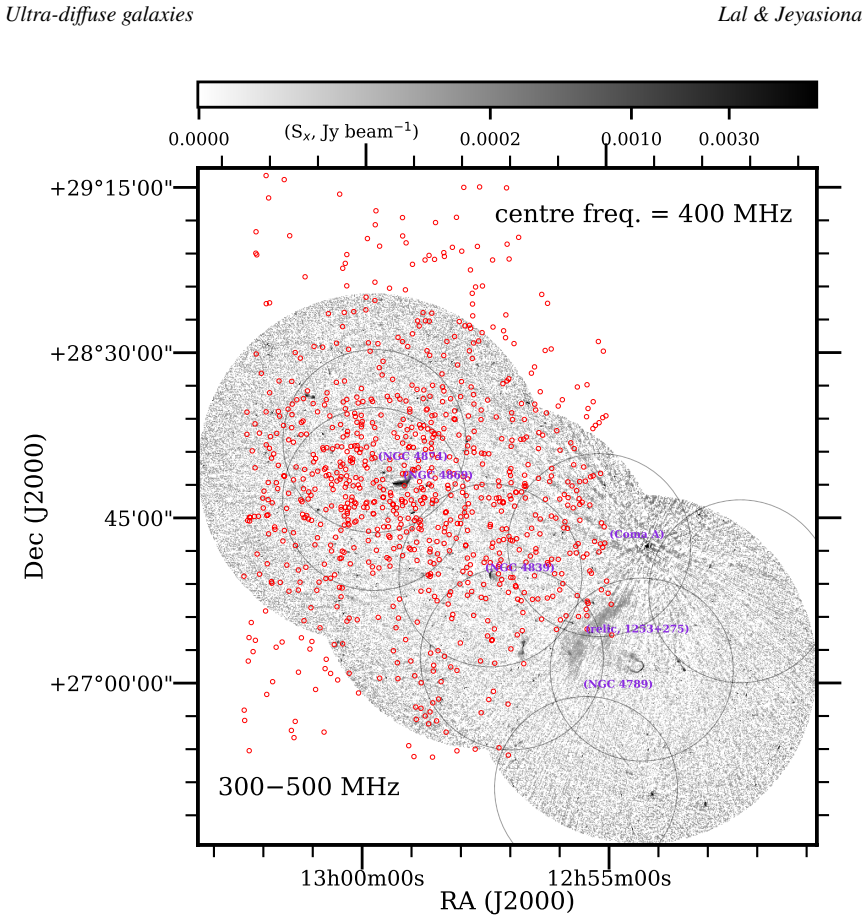
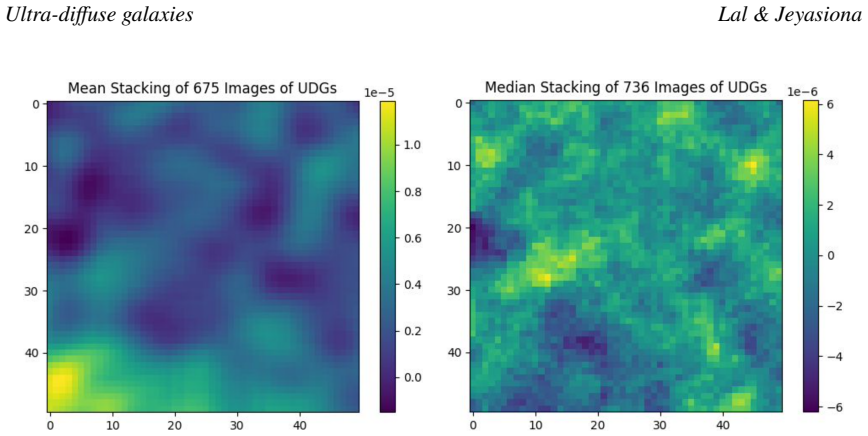
Using upgraded GMRT band-3 data, the study finds no radio detections for any of the 854 UDGs in the Coma cluster. The median stacking analysis sets a 5-sigma upper limit of about 1.5 microJansky on the mean radio flux, which corresponds to star-formation rates of at most 0.001 solar masses per year for systems at Coma distances.
What carries the argument
Median stacking of the radio images for the complete sample of cataloged ultra-diffuse galaxies.
If this is right
- The average radio emission from UDGs is constrained to levels implying SFRs ≲ 10^{-3} M_⊙ yr^{-1} in Coma-like environments.
- The observations provide the most stringent limit to date on the mean radio properties of this galaxy population.
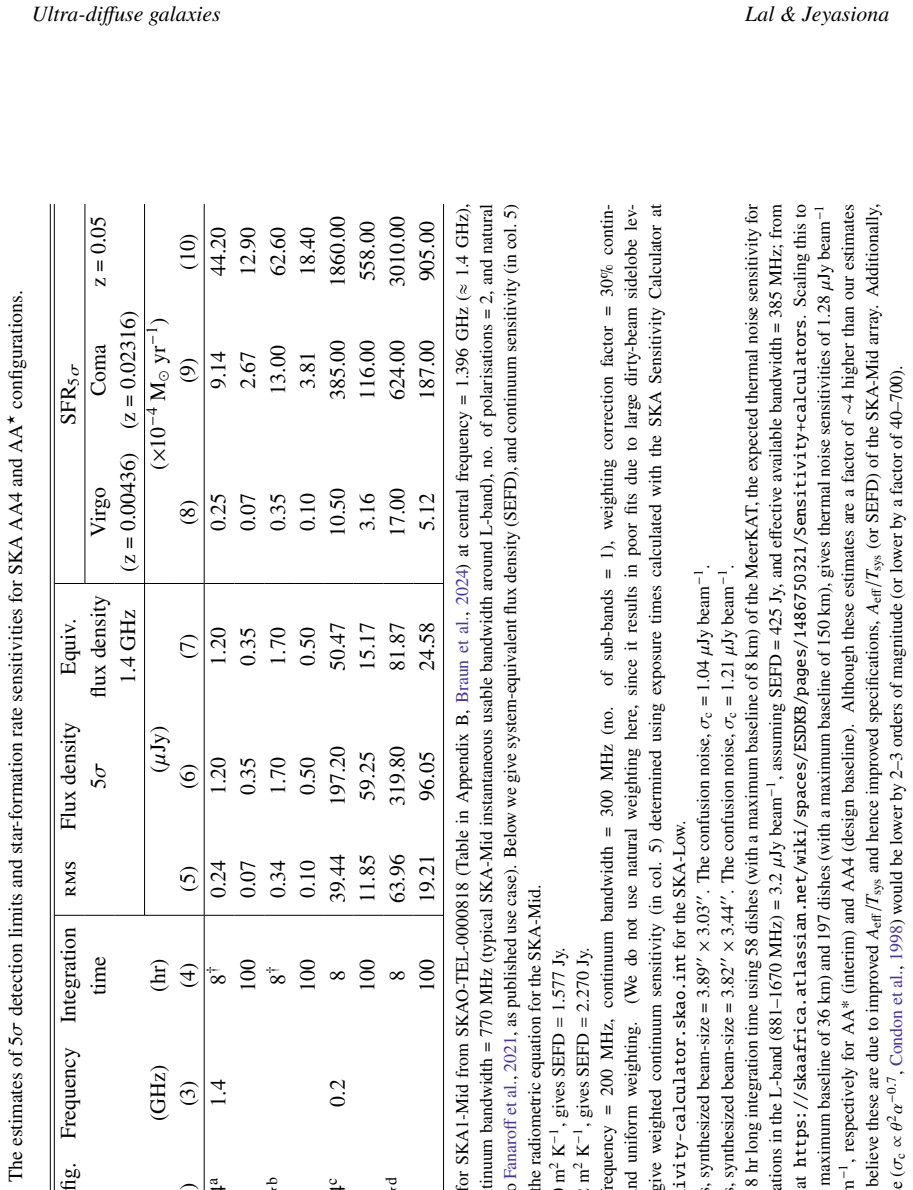
- Upcoming SKA configurations will enable detection of UDGs with even lower star formation rates down to 10^{-4} M_⊙ yr^{-1}.
Where Pith is reading between the lines
- If valid, this limit suggests that UDGs are predominantly passive systems with minimal residual star formation or AGN activity.
- Similar non-detections in other clusters would indicate that environmental effects universally suppress radio emission in UDGs.
- The assumption that radio-SFR relations hold could be tested by cross-checking with other SFR indicators like UV or H-alpha emission.
Load-bearing premise
Standard radio-to-star-formation-rate scaling relations remain accurate when applied to ultra-diffuse galaxies in cluster settings.
What would settle it
Detection of stacked radio emission significantly above 1.5 μJy from a similar population of UDGs would indicate higher average activity than reported.
Figures
read the original abstract
Ultra-diffuse galaxies (UDGs), defined by their extremely low surface brightness ($g$-band $\mu \gtrsim 24$ mag arcsec$^{-2}$) and large effective radii (3--10 arcsec), remain one of the most puzzling galaxy populations in the nearby Universe \citep{vanDokkum2015}. Predominantly found in dense environments, UDGs in the Coma cluster show a preferential alignment of their major axes toward the cluster centre, suggesting strong environmental influence on their formation and evolution. Using high-sensitivity, low-frequency radio data from the upgraded Giant Metrewave Radio Telescope (GMRT), a pathfinder instrument we examined all 854 UDGs cataloged in Coma cluster \citep{Yagi2016}. Despite the unprecedented depth of these observations, no individual detections were made. A median stacking analysis in the upgraded GMRT band-3 achieved a 5 $\times$ \textsc{rms} upper limit $\simeq$1.5~$\mu$Jy, providing the most stringent constraint yet on the average (mean) radio emission from UDGs, corresponding to star-formation rates $\lesssim$10$^{-3}$~M$_\odot$~yr$^{-1}$ for Coma-cluster-like systems and $\lesssim$10$^{-1}$~M$_\odot$~yr$^{-1}$ at $z \sim 0.05$. Looking ahead, the Square Kilometre Array (SKA) will transform the study of such faint galaxies. While the early AA$^\star$ configuration will deliver sensitivities comparable to the upgraded GMRT, the AA4 design baseline will achieve sub-$\mu$Jy \textsc{rms} levels at matched frequencies ($\nu \sim 200$~MHz--1.4~GHz), enabling detections of UDGs with star formation rates as low as 10$^{-4}$--10$^{-3}$~M$_\odot$~yr$^{-1}$ within Virgo and Coma distances. Such capabilities will allow robust discrimination between quenched, dark-matter-dominated systems and those sustaining weak residual star formation or low-luminosity nuclear activity.
Editorial analysis
A structured set of objections, weighed in public.
Referee Report
Summary. The manuscript reports non-detections of radio emission from all 854 catalogued UDGs in the Coma cluster using upgraded GMRT band-3 observations. No individual sources are detected. A median stacking analysis produces a 5×rms upper limit of ≃1.5 μJy on the mean radio flux, which the authors convert via standard radio-SFR relations into limits of SFR ≲10^{-3} M_⊙ yr^{-1} for Coma-like systems and ≲10^{-1} M_⊙ yr^{-1} at z∼0.05. The paper also outlines SKA prospects for detecting even lower SFR levels.
Significance. If the stacking upper limit is robust, the work supplies the tightest existing constraint on average radio emission from UDGs and supports the picture of highly quenched systems in cluster environments. The large sample size and use of median stacking on new low-frequency data are clear strengths. The numerical SFR bounds, however, rest on an untested extrapolation of scaling relations.
major comments (1)
- [Abstract] Abstract, final paragraph: The conversion of the 1.5 μJy 5×rms limit into SFR ≲10^{-3} M_⊙ yr^{-1} (Coma) and ≲10^{-1} M_⊙ yr^{-1} (z∼0.05) assumes that standard L_{1.4 GHz}–SFR or q_TIR calibrations calibrated on higher-surface-brightness field/group galaxies remain valid for cluster UDGs. The manuscript provides no discussion of possible systematic offsets arising from low gas densities, ram-pressure stripping, or altered magnetic-field strengths in these systems; this assumption is load-bearing for the quoted numerical SFR bounds.
minor comments (1)
- [Abstract] Abstract: the description of data reduction, source subtraction, and rms measurement is absent, making independent verification of the 1.5 μJy limit impossible from the abstract alone (though these details presumably appear in the methods section of the full manuscript).
Simulated Author's Rebuttal
We thank the referee for their careful reading of the manuscript and for highlighting an important point regarding the interpretation of our radio stacking limits. We respond to the major comment below.
read point-by-point responses
-
Referee: [Abstract] Abstract, final paragraph: The conversion of the 1.5 μJy 5×rms limit into SFR ≲10^{-3} M_⊙ yr^{-1} (Coma) and ≲10^{-1} M_⊙ yr^{-1} (z∼0.05) assumes that standard L_{1.4 GHz}–SFR or q_TIR calibrations calibrated on higher-surface-brightness field/group galaxies remain valid for cluster UDGs. The manuscript provides no discussion of possible systematic offsets arising from low gas densities, ram-pressure stripping, or altered magnetic-field strengths in these systems; this assumption is load-bearing for the quoted numerical SFR bounds.
Authors: We agree with the referee that the manuscript does not discuss potential systematic offsets in the radio-SFR relation for cluster UDGs. The quoted SFR values are derived from standard calibrations applied to the measured radio flux upper limit, as is conventional for non-detections in the literature. However, we acknowledge that environmental effects such as ram-pressure stripping, reduced gas densities, or modified magnetic fields could in principle alter the relation. In the revised version we will (i) add a short qualifying clause to the abstract and (ii) insert a dedicated paragraph in the discussion section that explicitly addresses these possible systematics, notes that any such offsets would render our SFR upper limits more conservative, and highlights the need for future empirical calibration at these surface-brightness levels. This addresses the load-bearing nature of the assumption while preserving the primary result, which is the radio flux limit itself. revision: yes
Circularity Check
No circularity; direct observational upper limit with external standard calibration
full rationale
The paper's core result is a new median-stack 5×rms flux upper limit of ≃1.5 μJy from upgraded GMRT band-3 data on 854 Coma UDGs, with no individual detections. This is a direct empirical measurement. The translation to SFR ≲10^{-3} M_⊙ yr^{-1} invokes standard radio-SFR scaling relations calibrated on other galaxy populations; these are external literature calibrations, not fitted or redefined inside the paper. No equations reduce the reported limit to a prior result by construction, no self-citation chains justify uniqueness or ansatzes, and no renaming of known patterns occurs. The derivation chain is self-contained against external benchmarks.
Axiom & Free-Parameter Ledger
axioms (1)
- domain assumption Standard radio continuum to star-formation-rate scaling relations calibrated on other galaxies apply to UDGs
Reference graph
Works this paper leans on
-
[1]
F.X.Anetal
arXiv search: Report number AASKAII/Algera01. F.X.Anetal. InAdvancingAstrophysicswiththeSKA–II(AASKAII).2026. arXivsearch: Report number AASKAII/FangxiaAn01. R.D.Baldi,A.Capetti,andG.Giovannini. MNRAS,482(2):2294–2304,Jan.2019. doi: 10.1093/ mnras/sty2703. C. E. Barbosa et al. ApJS, 247(2):46, Apr
2026
-
[2]
doi: 10.3847/1538-4365/ab7660. J. A. Benavides et al.Nature Astronomy, 5:1255–1260, Sept
-
[3]
doi: 10.1093/mnras/stad1053. P. Bontempi et al. MNRAS, 426(1):588–594, Oct
-
[4]
doi: 10.1111/j.1365-2966.2012.21786.x. T. Bourke et al. Advancing astrophysics with the square kilometre array (aaska14),
-
[5]
doi: 10.22323/1.215.0174. R. Braun et al. Anticipated ska1 science performance. Technical Report SKAO-TEL-0000818, SKA Observatory,
-
[6]
doi: 10.1093/mnras/stz383. J. J. Condon et al. AJ, 115(5):1693–1716, May
-
[7]
doi: 10.1086/300337. A. Di Cintio et al. MNRAS, 466(1):L1–L6, Mar
-
[8]
doi: 10.1093/mnrasl/slw210. Euclid Collaboration et al. A&A, 697:A1, May
-
[9]
doi: 10.1051/0004-6361/202450810. B. Fanaroff et al. MNRAS, 505(4):6003–6016, Aug
-
[10]
doi: 10.1093/mnras/stab1540. C. Fielder et al. AJ, 168(5):212, Nov
-
[11]
doi: 10.3847/1538-3881/ad74f6. J. S. Gannon et al. MNRAS, 502(3):3144–3157, Apr
-
[12]
doi: 10.1093/mnras/stab277. J. S. Gannon et al. MNRAS, 510(1):946–958, Feb
-
[13]
doi: 10.1093/mnras/stab3297. J. S. Gannon et al. MNRAS, 531(1):1856–1869, June
-
[14]
doi: 10.1093/mnras/stae1287. J. R. Gott, III, M. S. Vogeley, S. Podariu, and B. Ratra. ApJ, 549(1):1–17, Mar
-
[15]
doi: 10.1086/319055. M.J.Hardcastleetal. InAdvancingAstrophysicswiththeSKA–II(AASKAII).2026. arXivsearch: Report number AASKAII/Hardcastle01. L. C. Ho, A. V. Filippenko, and W. L. W. Sargent. ApJ, 487(2):579–590, Oct
-
[16]
doi: 10.3847/1538-4357/ab536c. M. G. Jones et al. ApJ, 919(2):72, Oct
-
[17]
doi: 10.3847/1538-4357/ac0975. A. Karunakaran et al. ApJ, 975(1):91, Nov
-
[18]
2024, , 975, 91, 10.3847/1538-4357/ad77cf
doi: 10.3847/1538-4357/ad77cf. J.Koda,M.Yagi,H.Yamanoi,andY.Komiyama.TheAstrophysicalJournalLetters,807:L2,2015. doi: 10.1088/2041-8205/807/1/L2. D. V. Lal and L. C. Ho. AJ, 139(3):1089–1105, Mar
-
[19]
doi: 10.1088/0004-6256/139/3/1089. D. V. Lal, P. Shastri, and D. C. Gabuzda. ApJ, 731(1):68, Apr
-
[20]
doi: 10.1088/0004-637X/ 731/1/68. D. V. Lal et al. ApJ, 934(2):170, Aug
-
[21]
doi: 10.3847/1538-4357/ac7a9b. J. Li et al. ApJ, 955(1):1, Sept
-
[22]
doi: 10.3847/1538-4357/ace829. 14 Ultra-diffuse galaxies Lal & Jeyasiona M. Magliocchetti et al.arXiv e-prints, art. arXiv:2511.02970, Nov
-
[23]
doi: 10.48550/arXiv. 2511.02970. N. A. Makda, S.-L. Blyth, and R. E. Skelton. MNRAS, Oct
work page internal anchor Pith review doi:10.48550/arxiv
-
[24]
doi: 10.1093/mnras/staf1850. G. Martin et al. MNRAS, 485(1):796–818, May
-
[25]
doi: 10.1093/mnras/stz356. D. Martínez-Delgado et al. AJ, 151(4):96, Apr
-
[26]
doi: 10.3847/0004-6256/151/4/96. G. Mazzolari et al. InAdvancing Astrophysics with the SKA – II (AASKAII)
-
[27]
doi: 10.1088/2041-8205/809/2/L21. K. Motiwala et al. ApJ, 989(1):86, Aug
-
[28]
doi: 10.3847/1538-4357/ade9a0. E. J. Murphy et al. ApJ, 737(2):67, Aug
-
[29]
doi: 10.1088/0004-637X/737/2/67. E.Papastergis, E.A.K.Adams,andA.J.Romanowsky. A&A,601:L10, May2017. doi: 10.1051/ 0004-6361/201730795. G. L. Pilbratt et al. A&A, 518:L1, July
-
[30]
doi: 10.1051/0004-6361/201014759. J. Román and I. Trujillo. MNRAS, 468(1):703–716, June 2017a. doi: 10.1093/mnras/stx438. J. Román and I. Trujillo. MNRAS, 468(4):4039–4047, July 2017b. doi: 10.1093/mnras/stx694. Y. Rong et al. MNRAS, 470(4):4231–4240, Oct
-
[31]
doi: 10.1093/mnras/stx1440. L. V. Sales et al. MNRAS, 494(2):1848–1858, May
-
[32]
doi: 10.1093/mnras/staa854. T. C. Scott et al. MNRAS, 503(3):3953–3964, May
-
[33]
doi: 10.1093/mnras/stab390. T. W. Shimwell et al. A&A, 659:A1, Mar
-
[34]
doi: 10.1051/0004-6361/202142484. M. F. Struble. MNRAS, 473(4):4686–4691, Feb
-
[35]
doi: 10.1093/mnras/stx1785. M. Tremmel et al. MNRAS, 497(3):2786–2810, Sept
-
[36]
doi: 10.1093/mnras/staa2015. J. S. Ulvestad and L. C. Ho. ApJ, 562(2):L133–L136, Dec
-
[37]
doi: 10.1086/338254. J. S. Ulvestad and L. C. Ho. ApJ, 581(2):925–931, Dec
-
[38]
doi: 10.1086/344442. R. F. J. van der Burg, A. Muzzin, and H. Hoekstra. A&A, 590:A20, May
-
[39]
doi: 10.1051/0004-6361/201731335. P. van Dokkum et al. Nature, 605(7910):435–439, May
-
[40]
doi: 10.1038/s41586-022-04665-6. P. G. van Dokkum et al. ApJ, 798(2):L45, Jan
-
[41]
doi: 10.1088/2041-8205/798/2/L45. J. D. Van Nest et al. ApJ, 926(1):92, Feb
-
[42]
doi: 10.3847/1538-4357/ac43b7. R. L. White et al. ApJ, 654(1):99–114, Jan
-
[43]
15 Ultra-diffuse galaxies Lal & Jeyasiona M
doi: 10.1086/507700. 15 Ultra-diffuse galaxies Lal & Jeyasiona M. Yagi, J. Koda, Y. Komiyama, and H. Yamanoi. ApJS, 225(1):11, July
-
[44]
doi: 10.3847/1538-4365/aaefe9. D. Zaritsky et al. ApJS, 257(2):60, Dec
-
[45]
doi: 10.3847/1538-4365/ac2607. H. Zheng, S. Liao, L. Gao, and F. Jiang.arXiv e-prints, art. arXiv:2504.14973, Apr
-
[46]
doi: 10.48550/arXiv.2504.14973. Y. Zheng et al. ApJ, 960(1):55, Jan
-
[47]
doi: 10.3847/1538-4357/acfe6b. 16
discussion (0)
Sign in with ORCID, Apple, or X to comment. Anyone can read and Pith papers without signing in.