Standing oscillations in a resonant sunspot atmosphere captured by integral field spectroscopy
Pith reviewed 2026-06-25 22:12 UTC · model grok-4.3
The pith
Near-zero phase differences at a sunspot umbral centre indicate standing waves from resonance-cavity dynamics.
A machine-rendered reading of the paper's core claim, the machinery that carries it, and where it could break.
Core claim
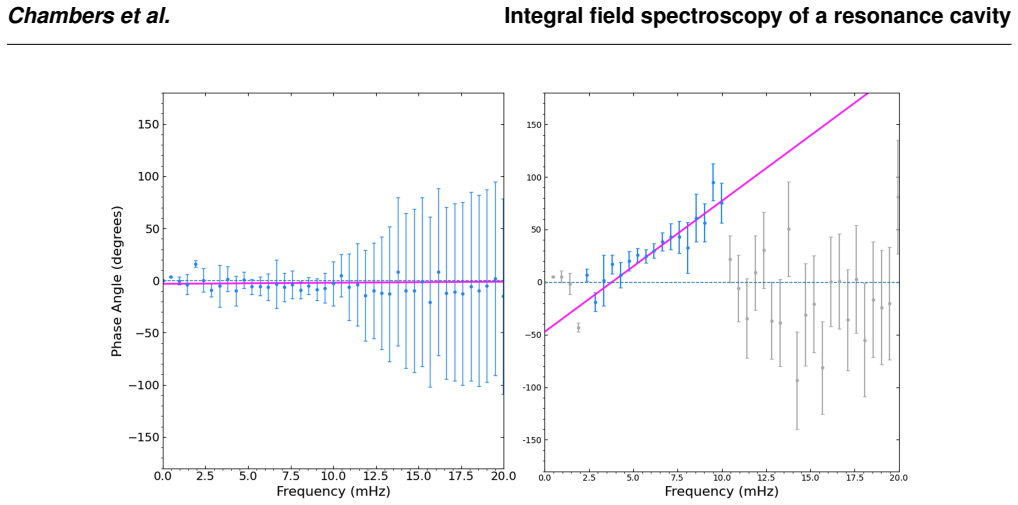
Using the FRANCIS integral field unit, the authors map phase spectra of ~5.5 mHz oscillations across formation heights of the Na I D1 wing (~355 km), D1 core (~750 km), and D2 core (~850 km) in a sunspot umbra. Propagating modes with energy fluxes of ~1.3 imes 10^4 W m^{-2} falling to ~3.1 imes 10^3 W m^{-2} appear at the boundary, implying a damping length of ~363 km. In contrast, near-zero phase differences dominate regions of enhanced chromospheric power at the umbral centre, evidencing standing-wave behaviour and resonance-cavity dynamics.
What carries the argument
Wavelet cross-correlation of line-core and bisector Doppler velocities to produce phase spectra versus height, classifying the ~5.5 mHz oscillations as propagating or standing-like.
If this is right
- Standing-wave signatures confirm that resonance cavities can form in sunspot atmospheres and trap ~5 mHz power.
- Energy flux damps over a distance comparable to the local density scale height at the umbra-penumbra boundary.
- The Na I D1/D2 doublet provides a new diagnostic window on resonance-cavity behaviour previously limited to Ca II and He I lines.
- Integral field units enable spatially resolved mapping of wave mode type and energy flux across sunspot structures.
Where Pith is reading between the lines
- The same phase-difference technique could be applied to other strongly magnetised regions to test whether resonance cavities are widespread.
- If standing modes systematically reduce net upward energy transport, models of chromospheric and coronal heating would need to account for this trapping effect.
- Future observations at higher cadence or in additional spectral lines could isolate the precise resonant frequencies supported by the cavity.
Load-bearing premise
The formation heights estimated by the RH1.5D code for the Na I D1 wing, D1 core, and D2 core accurately map the observed Doppler velocity oscillations to distinct atmospheric layers.
What would settle it
If phase differences measured at the umbral centre remain significantly non-zero when the same sunspot is observed simultaneously in lines whose formation heights have been verified by independent methods, the standing-wave and resonance-cavity interpretation would be ruled out.
Figures
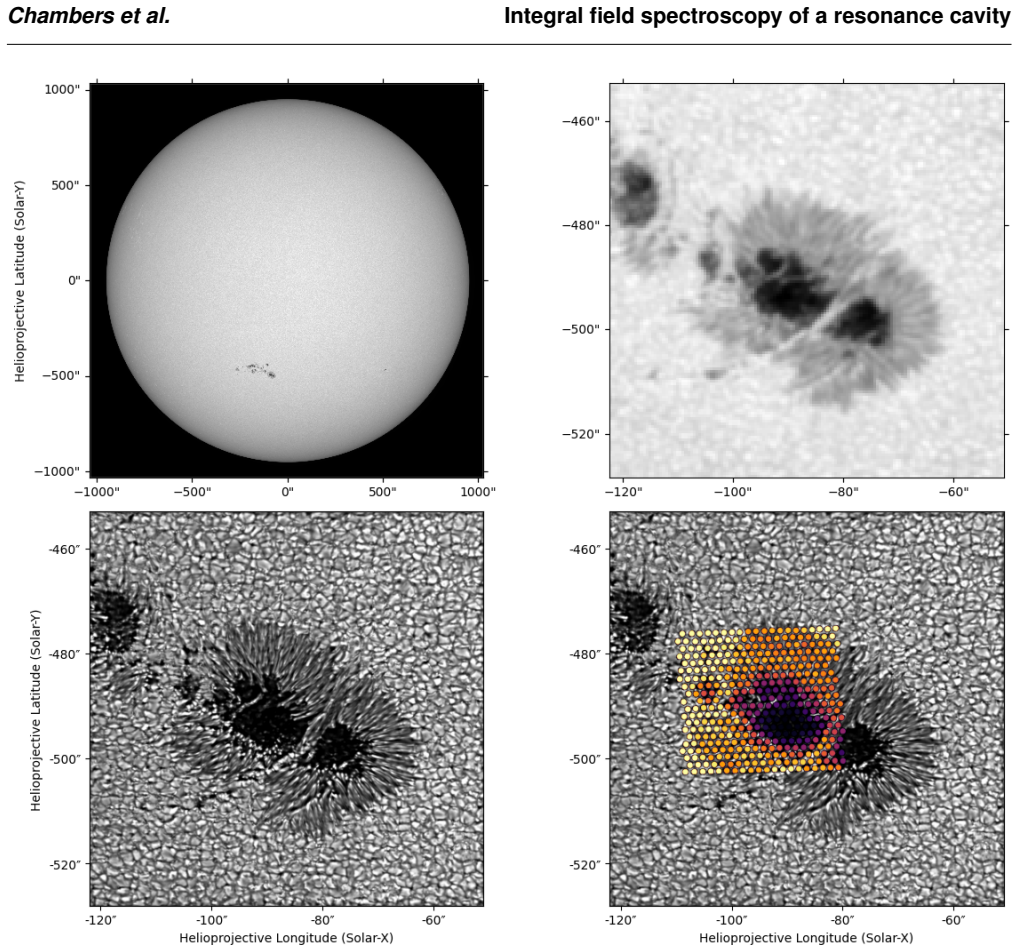
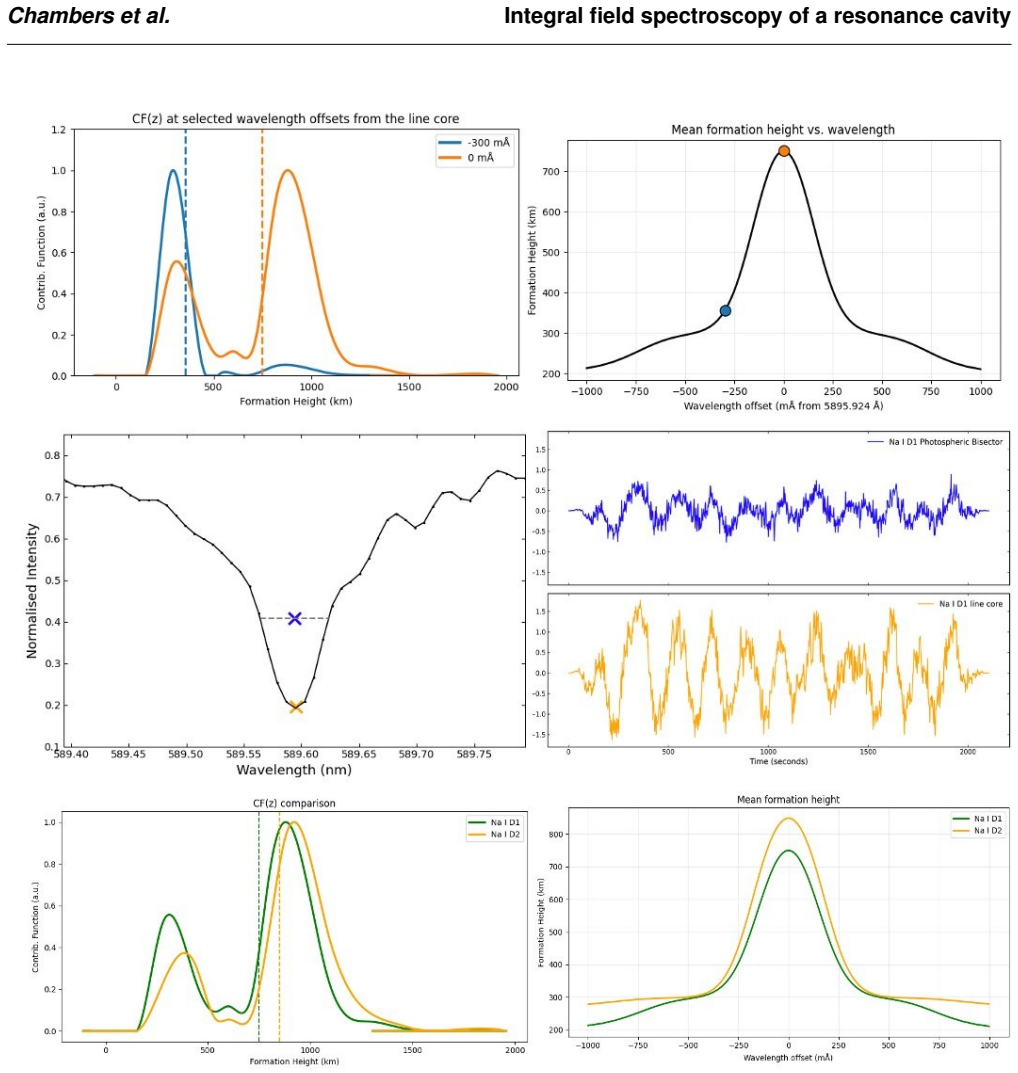
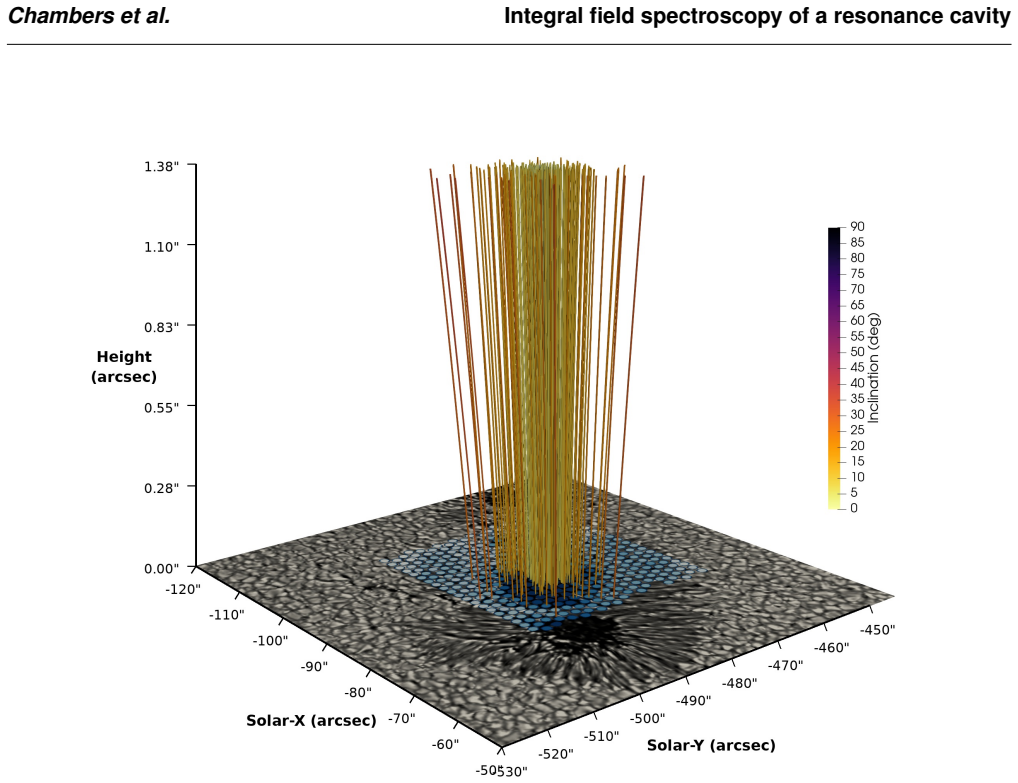
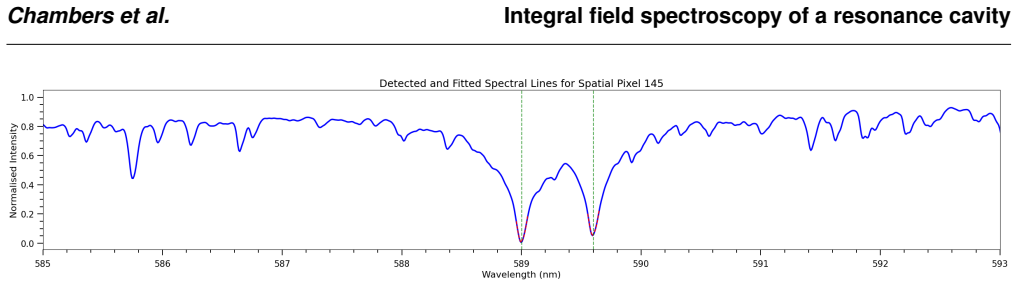
read the original abstract
The solar atmosphere is replete with magnetohydrodynamic wave activity, with magnetic structures such as sunspots channelling wave energy flux efficiently into the outer atmosphere. Steep density and temperature gradients between the photosphere and chromosphere provide ideal conditions for magnetoacoustic resonance cavities, amplifying $\sim 5$ mHz oscillatory power in sunspot atmospheres. However, diagnosis of such cavities has largely been limited to lines such as Ca II H/K and He I 10830 \r{A}, with no evidence yet from layers probed by the Na I D$_1$/D$_2$ doublet. Here we use the newly commissioned integral field unit FRANCIS to examine oscillations spanning the formation heights of the Na I D$_1$/D$_2$ lines and determine whether propagating and/or standing modes are present within a sunspot umbra. The RH1.5D code estimated formation heights for three windows: the Na I D$_1$ wing (core $-300$ m\r{A}; $\approx 355$ km), the Na I D$_1$ core ($\approx 750$ km), and the Na I D$_2$ core ($\approx 850$ km). Wavelet cross-correlation of line-core and bisector Doppler velocities yielded phase spectra versus height, classifying the dominant $\sim 5.5$ mHz oscillations as propagating or standing-like. At the umbra-penumbra boundary we find propagating modes with energy fluxes of $\sim 1.3 \times 10^{4}$ W m$^{-2}$ in the upper photosphere, falling to $\sim 3.1 \times 10^{3}$ W m$^{-2}$ in the lower chromosphere, implying a damping length $L_d \approx 363$ km, comparable to the local density scale height. In contrast, near-zero phase differences dominate regions of enhanced chromospheric power at the umbral centre, evidencing standing-wave behaviour and resonance-cavity dynamics. These results demonstrate the suitability of solar integral field units for mapping sunspot wave properties, with the Na I D$_1$/D$_2$ lines offering a novel diagnostic of resonance cavities and energy flux.
Editorial analysis
A structured set of objections, weighed in public.
Referee Report
Summary. The manuscript reports integral-field spectroscopic observations of a sunspot umbra with the FRANCIS IFU targeting the Na I D1/D2 lines. RH1.5D is used to assign formation heights of ≈355 km (D1 wing), ≈750 km (D1 core) and ≈850 km (D2 core). Wavelet cross-correlation of Doppler velocities yields phase spectra versus height; at the umbra-penumbra boundary the dominant 5.5 mHz power is classified as propagating with energy fluxes falling from 1.3×10^4 to 3.1×10^3 W m^{-2} (damping length ≈363 km), while near-zero phase differences at the umbral centre are interpreted as standing waves evidencing a resonance cavity.
Significance. If the height-to-phase mapping is robust, the work supplies the first Na I D-line evidence for standing magnetoacoustic modes inside a sunspot resonance cavity and demonstrates the diagnostic value of a new integral-field unit for spatially resolved wave studies. The concrete damping-length comparison to the local scale height is a falsifiable quantitative result.
major comments (2)
- [formation heights / RH1.5D] The formation-height estimates (abstract and §3) rest exclusively on RH1.5D 1.5D non-LTE contribution functions. In a several-kG umbral field, Zeeman broadening, magneto-optical effects and possible 3D radiative-transfer departures are omitted; a 100 km shift or reordering of the contribution functions would invalidate the height calibration that underpins the standing-versus-propagating classification.
- [phase spectra and velocity extraction] The central claim that near-zero phase differences at the umbral centre indicate standing waves (abstract and results) is presented without reported uncertainties on the phase spectra, without statistical significance tests on the phase values, and without explicit description of the bisector velocity extraction procedure or its sensitivity to line-profile asymmetries.
minor comments (2)
- [energy flux estimates] Energy-flux and damping-length values are quoted to two significant figures without accompanying uncertainties or sensitivity tests to the assumed density stratification.
- [abstract] The abstract contains several LaTeX rendering artifacts (e.g., \r{A}) that should be cleaned for the published version.
Simulated Author's Rebuttal
We thank the referee for the constructive and detailed report. We address each major comment below, indicating planned revisions where appropriate. The responses focus on strengthening the manuscript through added discussion and methodological details without altering the core observational results.
read point-by-point responses
-
Referee: The formation-height estimates (abstract and §3) rest exclusively on RH1.5D 1.5D non-LTE contribution functions. In a several-kG umbral field, Zeeman broadening, magneto-optical effects and possible 3D radiative-transfer departures are omitted; a 100 km shift or reordering of the contribution functions would invalidate the height calibration that underpins the standing-versus-propagating classification.
Authors: We acknowledge that the formation heights rely on 1.5D RH1.5D calculations and omit full Zeeman broadening, magneto-optical effects, and 3D radiative transfer in the strong umbral field. The phase-difference measurements are direct and model-independent; the standing-wave classification at the umbral centre follows from near-zero phases across the sampled windows, while propagating behaviour at the boundary follows from non-zero phases. We will add a dedicated paragraph in §3 discussing these limitations, their possible impact on absolute heights, and relevant literature on magnetic effects in Na I formation. The damping-length result remains independent of the precise height scale. revision: partial
-
Referee: The central claim that near-zero phase differences at the umbral centre indicate standing waves (abstract and results) is presented without reported uncertainties on the phase spectra, without statistical significance tests on the phase values, and without explicit description of the bisector velocity extraction procedure or its sensitivity to line-profile asymmetries.
Authors: We agree that these elements are missing from the current text. The bisector velocity extraction will be described explicitly, including the chosen bisector levels and tests of sensitivity to profile asymmetries. Uncertainties on the phase spectra will be reported, and statistical significance will be assessed via coherence thresholds and Monte Carlo realisations. These additions will be included in a revised methods/results section. revision: yes
Circularity Check
No circularity; derivation uses direct observations and independent radiative-transfer heights
full rationale
The paper measures Doppler velocities from Na I D1/D2 spectra, computes wavelet phase spectra between formation layers, and classifies modes by whether phase difference is near zero (standing) or nonzero (propagating). Formation heights are taken from the external RH1.5D code; energy fluxes employ standard density assumptions. No parameter is fitted to the target conclusion, no self-citation chain supports a load-bearing uniqueness claim, and the standing-wave inference follows from standard wave kinematics applied to the measured phases. The derivation is therefore self-contained against external benchmarks.
Axiom & Free-Parameter Ledger
axioms (2)
- domain assumption The RH1.5D radiative transfer code provides accurate formation heights for the Na I D1 wing, D1 core, and D2 core in the solar atmosphere.
- domain assumption Phase differences obtained from wavelet cross-correlation of line-core and bisector Doppler velocities reliably distinguish propagating from standing magnetoacoustic modes.
Reference graph
Works this paper leans on
-
[1]
Philosophical Transactions of the Royal Society of London Series A , keywords =
High-resolution wave dynamics in the lower solar atmosphere. Philosophical Transactions of the Royal Society of London Series A , keywords =. doi:10.1098/rsta.2020.0169 , archivePrefix =. 2011.13940 , primaryClass =
-
[2]
Frontiers in Astronomy and Space Sciences , year = 2026, month = apr, volume =
Adaptive multi-line fitting for stable line-core intensity and Doppler velocity. Frontiers in Astronomy and Space Sciences , year = 2026, month = apr, volume =
2026
-
[3]
Multiwavelength studies of MHD waves in the solar chromosphere: An overview of recent results
Multiwavelength Studies of MHD Waves in the Solar Chromosphere. An Overview of Recent Results. , keywords =. doi:10.1007/s11214-015-0141-3 , archivePrefix =. 1503.01769 , primaryClass =
work page internal anchor Pith review Pith/arXiv arXiv doi:10.1007/s11214-015-0141-3
-
[4]
Propagating Wave Phenomena Detected in Observations and Simulations of the Lower Solar Atmosphere
Propagating Wave Phenomena Detected in Observations and Simulations of the Lower Solar Atmosphere. , keywords =. doi:10.1088/0004-637X/746/2/183 , archivePrefix =. 1201.1981 , primaryClass =
work page internal anchor Pith review Pith/arXiv arXiv doi:10.1088/0004-637x/746/2/183 1981
-
[5]
Speckle interferometry with adaptive optics corrected solar data. , keywords =. doi:10.1051/0004-6361:200809894 , adsurl =
-
[6]
Advancements in Adaptive Optics , year = 2004, editor =
Recent advances in solar adaptive optics. Advancements in Adaptive Optics , year = 2004, editor =. doi:10.1117/12.551764 , adsurl =
-
[7]
Wave Propagation in a Magnetic Cylinder. , keywords =. doi:10.1007/BF00196186 , adsurl =
-
[8]
Tu, Hua-Tian and Jiang, An-Qing and Chen, Jian-Ke and Lu, Wei-Jie and Zang, Kai-Yan and Tang, Hao-Qi and Yoshie, Osamu and Xiang, Xiao-Dong and Lee, Young-Pak and Zhao, Hai-Bin and Zheng, Yu-Xiang and Wang, Song-You and Guo, Junpeng and Zhang, Rong-Jun and Li, Jing and Yang, Yue-Mei and Lynch, W. D. and Chen, Liang-Yao , Da =. A coma-free super-high resol...
-
[9]
William T. Foreman , journal =. Lens Correction of Astigmatism in a Czerny-Turner Spectrograph , volume =. 1968 , url =. doi:10.1364/AO.7.001053 , abstract =
-
[10]
Kye-Sung Lee and Kevin P. Thompson and Jannick P. Rolland , journal =. Broadband astigmatism-corrected Czerny--Turner spectrometer , volume =. 2010 , url =. doi:10.1364/OE.18.023378 , abstract =
-
[11]
Tracing the Chromospheric and Coronal Magnetic Field with AIA, IRIS, IBIS, and ROSA Data
Tracing the Chromospheric and Coronal Magnetic Field with AIA, IRIS, IBIS, and ROSA Data. , keywords =. doi:10.3847/0004-637X/826/1/61 , archivePrefix =. 1602.02119 , primaryClass =
work page internal anchor Pith review Pith/arXiv arXiv doi:10.3847/0004-637x/826/1/61
-
[12]
An Inside Look at Sunspot Oscillations with Higher Azimuthal Wavenumbers
An Inside Look at Sunspot Oscillations with Higher Azimuthal Wavenumbers. , keywords =. doi:10.3847/1538-4357/aa73d6 , archivePrefix =. 1705.06282 , primaryClass =
work page internal anchor Pith review Pith/arXiv arXiv doi:10.3847/1538-4357/aa73d6
-
[13]
Alfv\'en Wave Dissipation in the Solar Chromosphere
Alfv \'e n wave dissipation in the solar chromosphere. Nature Physics , keywords =. doi:10.1038/s41567-018-0058-3 , archivePrefix =. 1810.07712 , primaryClass =
work page internal anchor Pith review Pith/arXiv arXiv doi:10.1038/s41567-018-0058-3
-
[14]
The Magnetic Response of the Solar Atmosphere to Umbral Flashes
The Magnetic Response of the Solar Atmosphere to Umbral Flashes. , keywords =. doi:10.3847/1538-4357/aab366 , archivePrefix =. 1803.00018 , primaryClass =
work page internal anchor Pith review Pith/arXiv arXiv doi:10.3847/1538-4357/aab366
-
[15]
Magnetohydrodynamic Nonlinearities in Sunspot Atmospheres: Chromospheric Detections of Intermediate Shocks. , keywords =. doi:10.3847/1538-4357/ab7a90 , archivePrefix =. 2002.12368 , primaryClass =
-
[16]
Propagating Spectropolarimetric Disturbances in a Large Sunspot
Propagating Spectropolarimetric Disturbances in a Large Sunspot. , keywords =. doi:10.3847/1538-4357/aaec7b , archivePrefix =. 1810.12595 , primaryClass =
work page internal anchor Pith review Pith/arXiv arXiv doi:10.3847/1538-4357/aaec7b
-
[17]
Magnetohydrodynamic Wave Mode Identification in Circular and Elliptical Sunspot Umbrae: Evidence for High-order Modes. , keywords =. doi:10.3847/1538-4357/ac51d9 , archivePrefix =. 2202.00624 , primaryClass =
-
[18]
Philosophical Transactions of the Royal Society of London Series A , keywords =
The dynamics of 3-min wavefronts and their relation to sunspot magnetic fields. Philosophical Transactions of the Royal Society of London Series A , keywords =. doi:10.1098/rsta.2020.0180 , archivePrefix =. 2007.09369 , primaryClass =
-
[19]
Spectropolarimetric Investigation of the Propagation of Magnetoacoustic Waves and Shock Formation in Sunspot Atmospheres. , keywords =. doi:10.1086/500185 , archivePrefix =. astro-ph/0512096 , primaryClass =
work page internal anchor Pith review Pith/arXiv arXiv doi:10.1086/500185
-
[20]
Observations of Sunspot Oscillations in G Band and CaII H Line with Solar Optical Telescope on Hinode. , keywords =. doi:10.1093/pasj/59.sp3.S631 , archivePrefix =. 0709.0569 , primaryClass =
work page internal anchor Pith review Pith/arXiv arXiv doi:10.1093/pasj/59.sp3.s631
-
[21]
Photospheric Origin of Three-minute Oscillations in a Sunspot. , keywords =. doi:10.3847/1538-4357/836/1/18 , adsurl =
-
[22]
Multi-height observations of magnetoacoustic cut-off frequency in a sunspot atmosphere
Multi-height observations of magnetoacoustic cut-off frequency in a sunspot atmosphere. , keywords =. doi:10.1051/0004-6361/201220208 , archivePrefix =. 1211.5196 , primaryClass =
work page internal anchor Pith review Pith/arXiv arXiv doi:10.1051/0004-6361/201220208
-
[23]
Nature Astronomy , year = 2023, month = jul, volume =
Transverse oscillations and an energy source in a strongly magnetized sunspot. Nature Astronomy , year = 2023, month = jul, volume =. doi:10.1038/s41550-023-01973-3 , adsurl =
-
[24]
Spatial Distribution of the Origin of Umbral Waves in a Sunspot Umbra. , keywords =. doi:10.3847/1538-4357/ab91b8 , archivePrefix =. 2005.04202 , primaryClass =
-
[25]
Why Do Chromospheric Oscillations in Sunspot Umbrae Appear to Propagate Downward?. , keywords =. doi:10.3847/2041-8213/acba7d , adsurl =
-
[26]
Height-dependent Slow Magnetoacoustic Wave Amplitude and Energy Flux in Sunspot Atmospheres. , keywords =. doi:10.3847/1538-4357/add336 , archivePrefix =. 2504.15030 , primaryClass =
-
[27]
Oscillations above sunspots from the temperature minimum to the corona
Oscillations above sunspots from the temperature minimum to the corona. , keywords =. doi:10.1051/0004-6361/201220548 , archivePrefix =. 1305.4718 , primaryClass =
work page internal anchor Pith review Pith/arXiv arXiv doi:10.1051/0004-6361/201220548
-
[28]
Spatial structure of resonance cavities in sunspots. , keywords =. doi:10.1093/mnras/stae575 , adsurl =
-
[29]
A novel approach to identify resonant MHD wave modes in solar pores and sunspot umbrae: B - analysis. , keywords =. doi:10.1051/0004-6361/202140429 , archivePrefix =. 2103.11639 , primaryClass =
-
[30]
Downflowing umbral flashes as evidence of standing waves in sunspot umbrae. , keywords =. doi:10.1051/0004-6361/202039966 , archivePrefix =. 2101.04188 , primaryClass =
-
[31]
Observations of umbral flashes in the resonant sunspot chromosphere. , keywords =. doi:10.1051/0004-6361/202452317 , archivePrefix =. 2411.16467 , primaryClass =
-
[32]
Wave propagation in a solar quiet region and the influence of the magnetic canopy
Wave propagation in a solar quiet region and the influence of the magnetic canopy. , keywords =. doi:10.1051/0004-6361/201527053 , archivePrefix =. 1511.08618 , primaryClass =
work page internal anchor Pith review Pith/arXiv arXiv doi:10.1051/0004-6361/201527053
-
[33]
, keywords =
Observations of low wavenumber nonradial eigenmodes of the sun. , keywords =
-
[34]
The vertical propagation of waves in the solar atmosphere. I. Observations of phase delay. , keywords =. doi:10.1086/157219 , adsurl =
-
[35]
IV - Evanescent waves of small amplitude
Dynamics of the solar atmosphere. IV - Evanescent waves of small amplitude. , keywords =
-
[36]
Structure and Dynamics of Isolated Internetwork Ca II H Bright Points Observed by Sunrise
Structure and dynamics of isolated internetwork Ca II H bright points observed by SUNRISE. , keywords =. doi:10.1051/0004-6361/201220089 , archivePrefix =. 1211.4836 , primaryClass =
work page internal anchor Pith review Pith/arXiv arXiv doi:10.1051/0004-6361/201220089
-
[37]
High-frequency Oscillations in Small Magnetic Elements Observed with Sunrise/SuFI
High-frequency Oscillations in Small Magnetic Elements Observed with Sunrise/SuFI. , keywords =. doi:10.3847/1538-4365/229/1/10 , archivePrefix =. 1611.09302 , primaryClass =
work page internal anchor Pith review Pith/arXiv arXiv doi:10.3847/1538-4365/229/1/10
-
[38]
A search for mode coupling in magnetic bright points. , keywords =. doi:10.1051/0004-6361/202451199 , archivePrefix =. 2409.11553 , primaryClass =
-
[39]
Can Instrumental Effects Obscure the True Photospheric Wave Spectrum?. , keywords =. doi:10.3847/1538-4357/ae331b , archivePrefix =. 2601.02155 , primaryClass =
-
[40]
Modeling the Effects of a Light Bridge on Properties of Magnetohydrodynamic Waves in Solar Pores. , keywords =. doi:10.3847/1538-4357/ad7958 , archivePrefix =. 2409.15106 , primaryClass =
-
[41]
Sausage, kink, and fluting magnetohydrodynamic wave modes identified in solar magnetic pores by Solar Orbiter/PHI. , keywords =. doi:10.1051/0004-6361/202449685 , archivePrefix =. 2404.18717 , primaryClass =
-
[42]
The Propagation of Coherent Waves Across Multiple Solar Magnetic Pores. , keywords =. doi:10.3847/1538-4357/ac91ca , archivePrefix =. 2209.06280 , primaryClass =
-
[43]
The dynamics of small-scale magnetic fields modulated by the solar cycle. , keywords =. doi:10.1051/0004-6361/202453536 , archivePrefix =. 2502.19011 , primaryClass =
-
[44]
Ambipolar Diffusion in the Lower Solar Atmosphere: Magnetohydrodynamic Simulations of a Sunspot. , keywords =. doi:10.3847/1538-4357/ac94c3 , archivePrefix =. 2209.14366 , primaryClass =
-
[45]
High-Frequency Oscillations in a Solar Active Region observed with the Rapid Dual Imager
High-frequency oscillations in a solar active region observed with the RAPID DUAL IMAGER. , keywords =. doi:10.1051/0004-6361:20077142 , archivePrefix =. 0707.2716 , primaryClass =
work page internal anchor Pith review Pith/arXiv arXiv doi:10.1051/0004-6361:20077142
-
[46]
A Study of Sunspot 3 Minute Oscillations Using ALMA and GST. , keywords =. doi:10.3847/1538-4357/ac34f7 , archivePrefix =. 2111.05812 , primaryClass =
-
[47]
Exploring source region of 3-min slow magnetoacoustic waves observed in coronal fan loops rooted in sunspot umbra. , keywords =. doi:10.1093/mnras/stad2426 , archivePrefix =. 2308.03490 , primaryClass =
-
[48]
Transformers for Stratified Spectropolarimetric Inversion: Proof of Concept. , keywords =. doi:10.3847/1538-4357/ae1ba5 , archivePrefix =. 2506.16810 , primaryClass =
-
[49]
Measuring the Wilson depression of sunspots using the divergence-free condition of the magnetic field vector. , keywords =. doi:10.1051/0004-6361/201833571 , archivePrefix =. 1808.06867 , primaryClass =
work page internal anchor Pith review Pith/arXiv arXiv doi:10.1051/0004-6361/201833571
-
[50]
By Alexander Wilson, M
Observations on the Solar Spots. By Alexander Wilson, M. D. Professor of Practical Astronomy in the University of Glasgow. Communicated by the Rev. Nevil Maskelyne, Astronomer Royal. Philosophical Transactions of the Royal Society of London Series I , year = 1774, month = jan, volume =
-
[51]
Infrared lines as probes of solar magnetic features. VI. The thermal-magnetic relation and Wilson depression of a simple sunspot. , keywords =
-
[52]
Application of Deep Learning to the Classification of Stokes Profiles: From the Quiet Sun to Sunspots. , keywords =. doi:10.3847/1538-4357/addb49 , archivePrefix =. 2505.14275 , primaryClass =
-
[53]
Journal of Geophysical Research (Space Physics) , keywords =
Chromospheric Heating by Magnetohydrodynamic Waves and Instabilities. Journal of Geophysical Research (Space Physics) , keywords =. doi:10.1029/2020JA029097 , archivePrefix =. 2104.02010 , primaryClass =
-
[54]
, keywords =
The 3-min oscillations of the solar chromosphere - A basic physical effect?. , keywords =
-
[55]
Nature Astronomy , year = 2021, month = jan, volume =
Reply to: Signatures of sunspot oscillations and the case for chromospheric resonances. Nature Astronomy , year = 2021, month = jan, volume =. doi:10.1038/s41550-020-1158-4 , adsurl =
-
[56]
The Influence of the Magnetic Field on Running Penumbral Waves in the Solar Chromosphere
The Influence of the Magnetic Field on Running Penumbral Waves in the Solar Chromosphere. , keywords =. doi:10.1088/0004-637X/779/2/168 , archivePrefix =. 1310.7939 , primaryClass =
work page internal anchor Pith review Pith/arXiv arXiv doi:10.1088/0004-637x/779/2/168
-
[57]
Magnetic field reconstruction based on sunspot oscillations
Magnetic field reconstruction based on sunspot oscillations. Astronomische Nachrichten , keywords =. doi:10.1002/asna.201612430 , archivePrefix =. 1601.05925 , primaryClass =
work page internal anchor Pith review Pith/arXiv arXiv doi:10.1002/asna.201612430
-
[58]
New Data and Models of Running Penumbral Waves in Sunspots. , keywords =. doi:10.1086/303818 , adsurl =
-
[59]
The properties of velocity oscillations in vicinities of sunspot penumbra. , keywords =. doi:10.1023/A:1005201330825 , adsurl =
-
[60]
Propagating waves in the sunspot umbra chromosphere. , keywords =. doi:10.1051/0004-6361:20035960 , adsurl =
-
[61]
The Fibre Resolved OpticAl and Near-Ultraviolet Czerny-Turner Imaging Spectropolarimeter (FRANCIS). , keywords =. doi:10.1007/s11207-023-02237-z , archivePrefix =. 2312.00122 , primaryClass =
-
[62]
Nature Reviews Methods Primers , keywords =
Wave analysis tools. Nature Reviews Methods Primers , keywords =. doi:10.1038/s43586-025-00392-0 , adsurl =
-
[63]
, year = 1969, month = dec, volume =
Sacramento Peak's New Solar Telescope. , year = 1969, month = dec, volume =
1969
-
[64]
ROSA: a high cadence, synchronized multi-camera solar imaging system
ROSA: A High-cadence, Synchronized Multi-camera Solar Imaging System. , keywords =. doi:10.1007/s11207-009-9500-0 , archivePrefix =. 0912.4118 , primaryClass =
work page internal anchor Pith review Pith/arXiv arXiv doi:10.1007/s11207-009-9500-0
-
[65]
The Source of Three-minute Magneto-acoustic Oscillations in Coronal Fans
The Source of 3 Minute Magnetoacoustic Oscillations in Coronal Fans. , keywords =. doi:10.1088/0004-637X/757/2/160 , archivePrefix =. 1208.3194 , primaryClass =
work page internal anchor Pith review Pith/arXiv arXiv doi:10.1088/0004-637x/757/2/160
-
[66]
275(1-2):17--40, doi:10.1007/s11207-011-9776-8
The Atmospheric Imaging Assembly (AIA) on the Solar Dynamics Observatory (SDO). , keywords =. doi:10.1007/s11207-011-9776-8 , adsurl =
-
[67]
275(1-2):3--15, doi:10.1007/s11207-011-9841-3
The Solar Dynamics Observatory (SDO). , keywords =. doi:10.1007/s11207-011-9841-3 , adsurl =
-
[68]
The Helioseismic and Magnetic Imager (HMI) Investigation for the Solar Dynamics Observatory (SDO). , keywords =. doi:10.1007/s11207-011-9834-2 , adsurl =
-
[69]
Sunrise: instrument, mission, data and first results
SUNRISE: Instrument, Mission, Data, and First Results. , keywords =. doi:10.1088/2041-8205/723/2/L127 , archivePrefix =. 1008.3460 , primaryClass =
work page internal anchor Pith review Pith/arXiv arXiv doi:10.1088/2041-8205/723/2/l127 2041
-
[70]
Astronomy & Astrophysics , author =
The Solar Orbiter mission. Science overview. , keywords =. doi:10.1051/0004-6361/202038467 , archivePrefix =. 2009.00861 , primaryClass =
-
[71]
Fabry-P \'e rot etalons in solar astronomy. A review. , keywords =. doi:10.1007/s10509-023-04212-3 , adsurl =
-
[72]
Optical Engineering , keywords =
Instrumentation for solar spectropolarimetry: state of the art and prospects. Optical Engineering , keywords =. doi:10.1117/1.OE.58.8.082417 , archivePrefix =. 1911.01368 , primaryClass =
-
[73]
Inouye Solar Telescope (DKIST)
The Diffraction-Limited Near-Infrared Spectropolarimeter (DL-NIRSP) of the Daniel K. Inouye Solar Telescope (DKIST). , keywords =. doi:10.1007/s11207-022-02062-w , adsurl =
-
[74]
Journal of Astronomical Instrumentation , keywords =
First Light of the Integral Field Unit of GRIS on the GREGOR Solar Telescope. Journal of Astronomical Instrumentation , keywords =. doi:10.1142/S2251171722500143 , archivePrefix =. 2206.14294 , primaryClass =
-
[75]
Acoustic interferometry of the solar atmosphere: p-modes with frequencies near the `acoustic cut-off'. , keywords =. doi:10.1046/j.1365-8711.1998.01630.x , adsurl =
-
[76]
, keywords =
On the acoustic cut-off frequency of the sun. , keywords =
-
[77]
Measurements of High-Frequency Solar Oscillation Modes. , keywords =. doi:10.1086/170052 , adsurl =
-
[78]
, year = 1984, month = jan, volume =
Helioseismology: Oscillations as a Diagnostic of the Solar Interior. , year = 1984, month = jan, volume =. doi:10.1146/annurev.aa.22.090184.003113 , adsurl =
-
[79]
Nature Astronomy , year = 2020, month = jan, volume =
A chromospheric resonance cavity in a sunspot mapped with seismology. Nature Astronomy , year = 2020, month = jan, volume =. doi:10.1038/s41550-019-0945-2 , adsurl =
-
[80]
Chromospheric Resonances above Sunspots and Potential Seismological Applications. , keywords =. doi:10.3847/2041-8213/abb1a5 , archivePrefix =. 2008.10623 , primaryClass =
discussion (0)
Sign in with ORCID, Apple, or X to comment. Anyone can read and Pith papers without signing in.