Co-designing a Preliminary Repository of Augmented Reality Concepts for Real-Time Emotion Regulation
Pith reviewed 2026-06-25 20:43 UTC · model grok-4.3
The pith
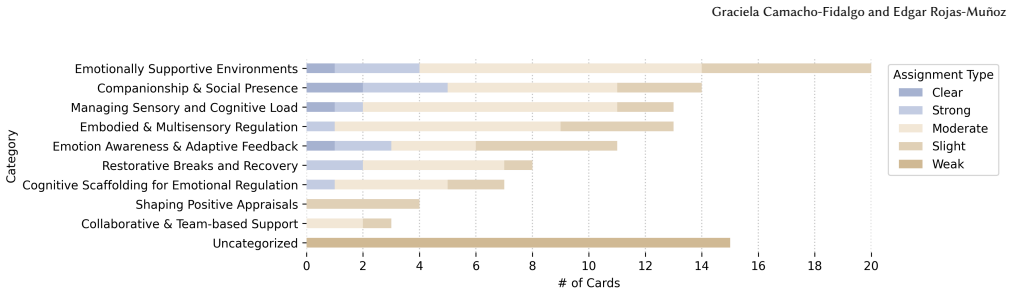
A co-designed repository organizes 106 AR ideas into eight clusters for real-time emotion regulation.
A machine-rendered reading of the paper's core claim, the machinery that carries it, and where it could break.
Core claim
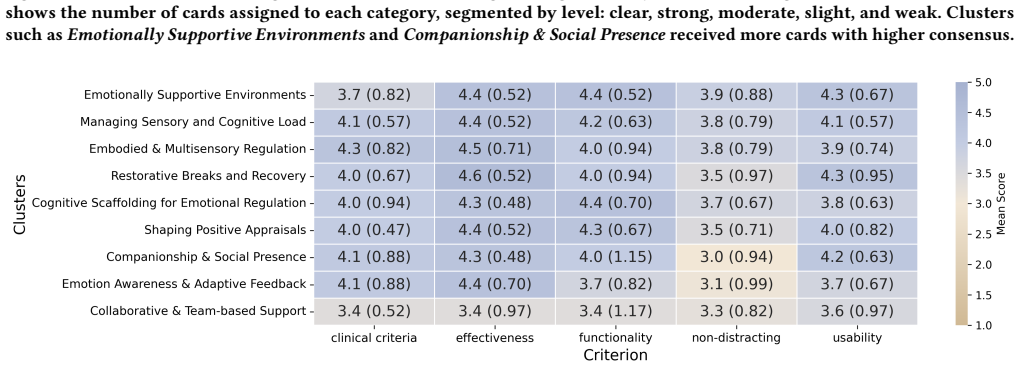
Through a two-phase participatory design process with 40 anxiety-prone individuals and 10 mental health professionals, the authors produced an AR design repository that organizes 106 specific ideas into eight thematic clusters, providing a user- and expert-grounded resource for creating real-time interventions that support emotion regulation without interrupting daily activities.
What carries the argument
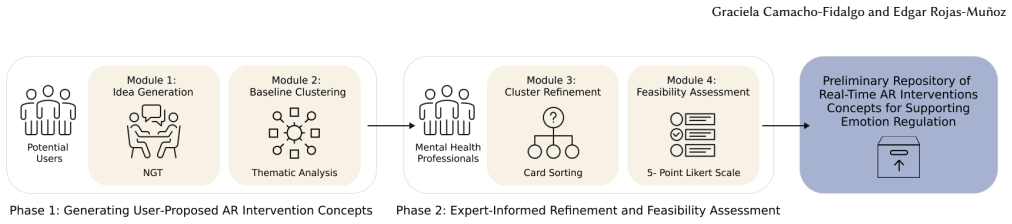
Two-phase participatory design process using the Nominal Group Technique for idea generation followed by professional clustering and feasibility assessment.
If this is right
- AR developers can reference the 106 ideas when building applications for mental health support.
- The eight clusters offer thematic structure to organize and prioritize future design work.
- The repository makes it easier to create interventions that integrate with ongoing activities rather than replacing them.
- Clinical experts gain a shared language for evaluating AR proposals against user-generated needs.
- The co-design method supplies a template for similar repositories in other therapeutic technology areas.
Where Pith is reading between the lines
- If the ideas prove effective in controlled trials, the repository could shorten the time from concept to deployable AR mental health tools.
- The clusters might overlap with or extend existing non-AR emotion regulation techniques, allowing hybrid designs.
- Wider adoption would require checking whether the ideas scale across different anxiety levels or cultural contexts.
- The approach could be adapted to generate design resources for related technologies such as wearable sensors or mobile apps.
Load-bearing premise
Ideas generated by 40 anxiety-prone participants and clustered by 10 professionals are representative and clinically feasible enough to serve as a reusable design resource without further empirical validation.
What would settle it
An experiment that implements and tests multiple ideas from the repository in real-time scenarios with anxiety-prone users and measures no improvement in emotion regulation or low feasibility would falsify the repository's utility.
Figures
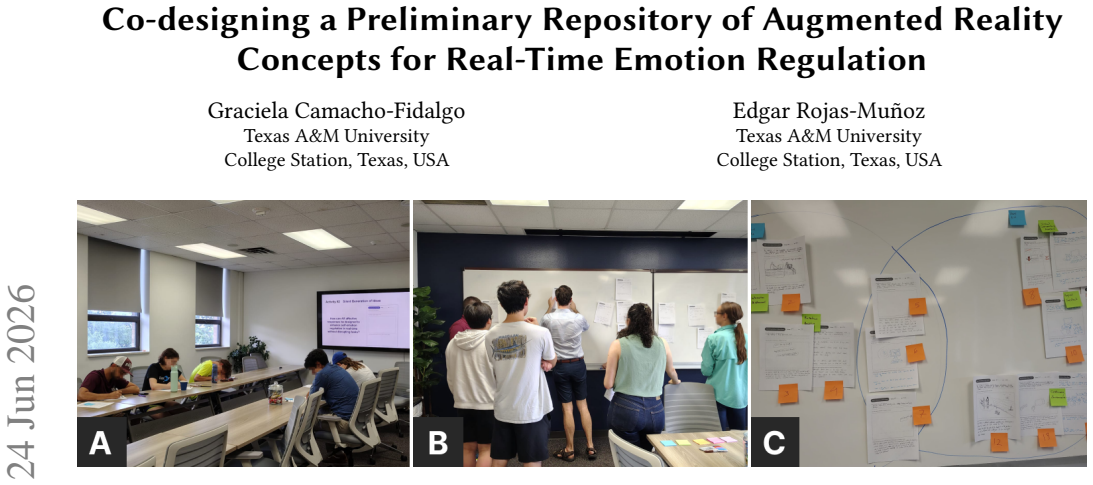
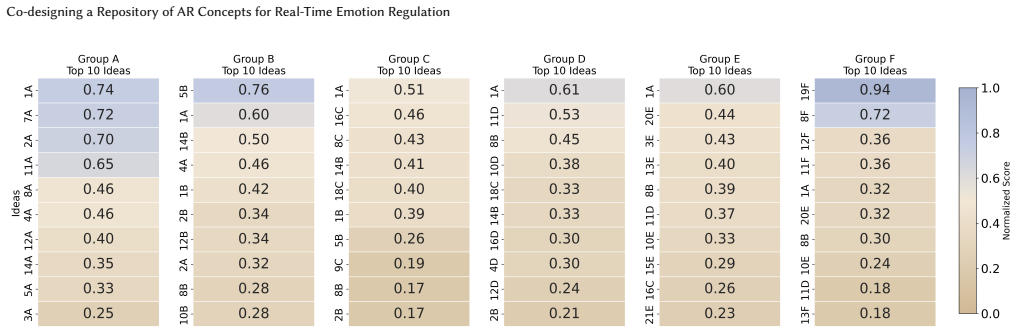
read the original abstract
Augmented Reality (AR) can be a positive therapeutic approach to support mental health and emotion regulation. Although AR techniques for therapeutic support exist, there is no user-centered, expert-informed understanding of how real-time AR designs can support people in emotional distress without disengaging them from their ongoing activities. This lack of reusable design resources hinders the adoption of AR for mental health support. This paper addresses this gap by introducing a co-designed collection of AR interventions describing how this technique can support real-time emotion regulation. The repository was created following a two-phase participatory design process. Phase 1 recruited 40 anxiety-prone individuals and used the Nominal Group Technique to list ideas on how AR affordances could support emotion regulation. Phase 2 recruited 10 mental health professionals to organize these ideas into thematic clusters and assess their clinical feasibility. The resulting AR design repository, grounded in user perspective and clinical expertise, identifies eight thematic clusters and 106 design ideas. This work represents a first step towards the development of seamless real-time AR interventions for mental health.
Editorial analysis
A structured set of objections, weighed in public.
Referee Report
Summary. The paper claims to address the lack of reusable, user-centered AR design resources for real-time emotion regulation by introducing a preliminary repository generated through a two-phase participatory design process. Phase 1 used the Nominal Group Technique with 40 anxiety-prone participants to generate ideas on AR affordances for emotion regulation during ongoing activities. Phase 2 involved 10 mental health professionals who clustered the ideas into eight thematic clusters and assessed clinical feasibility, resulting in a repository of 106 design ideas. The work is explicitly framed as a first step rather than a validated intervention set.
Significance. If the reported process and outputs hold, the paper provides a concrete, grounded starting point for AR design in mental health by combining participant-generated ideas with professional feasibility input. The use of a structured participatory method (NGT followed by expert clustering) is a clear strength, producing an organized set of 106 ideas across eight clusters that future work can build upon or test empirically. This addresses a genuine gap in design resources without overclaiming immediate clinical applicability.
minor comments (3)
- [Abstract] Abstract: The recruitment and screening process for the '40 anxiety-prone individuals' is not described (e.g., self-report scales, clinical thresholds, or diversity metrics), which would strengthen the grounding claim for the generated ideas.
- [Phase 2] Phase 2: The specific criteria or rubric used by the 10 professionals to assess clinical feasibility (and any ideas excluded on that basis) are not detailed, limiting transparency about how the final 106 ideas were selected from the initial set.
- [Results] Results: While eight thematic clusters are mentioned, the main text would benefit from at least one concrete example idea per cluster to illustrate the repository's content without requiring readers to consult supplementary materials.
Simulated Author's Rebuttal
We thank the referee for the positive assessment of the work, the recognition of its significance as a grounded starting point, and the recommendation for minor revision. No major comments were listed in the report.
Circularity Check
No significant circularity
full rationale
The paper reports a two-phase participatory design study that directly produces a descriptive repository (eight thematic clusters, 106 ideas) from external participant input via Nominal Group Technique and professional clustering. No equations, predictions, fitted parameters, or derivation chains exist. The central claim follows immediately from the described method without reduction to self-definition, self-citation, or imported uniqueness. The work is self-contained as a qualitative output grounded in stated external sources.
Axiom & Free-Parameter Ledger
Reference graph
Works this paper leans on
-
[1]
Jonathan S Abramowitz, Brett J Deacon, and Stephen PH Whiteside. 2019. Exposure therapy for anxiety: Principles and practice. Guilford Publications
2019
-
[2]
Nashwan, Radhwan Hussein Ibrahim, Araz Qadir Abdalla, Barzan Mohammed M
Sirwan Khalid Ahmed, Ribwar Arsalan Mohammed, Abdulqadir J. Nashwan, Radhwan Hussein Ibrahim, Araz Qadir Abdalla, Barzan Mohammed M. Ameen, and Renas Mohammed Khdhir. 2025. Using thematic analysis in qualitative research.Journal of Medicine, Surgery, and Public Health6 (2025), 100198. doi:10.1016/j.glmedi.2025.100198
-
[3]
Maria Esther Almaral Martinez, Jose Vicente Berna Martinez, Francisco Ma- cia Perez, Iren Lorenzo Fonseca, and Cinthia Paola Pascual Caceres. 2023. Un- derstanding the importance of animation in human-computer interfaces and its relation to user experience. InProceedings of the 2023 5th International Con- ference on Image, Video and Signal Processing(Sing...
-
[4]
Kholoud Alwashmi, Georg Meyer, Fiona Rowe, and Ryan J. Ward. 2023. En- hancing learning outcomes through multisensory integration: A fMRI study of audio-visual training in virtual reality.NeuroImage285 (2023). doi:10.1016/j. neuroimage.2023.120483
work page doi:10.1016/j 2023
-
[5]
Ronald Azuma, Yohan Baillot, Reinhold Behringer, Steven Feiner, Simon Julier, and Blair MacIntyre. 2002. Recent advances in augmented reality.IEEE computer graphics and applications21, 6 (2002), 34–47
2002
-
[6]
Jeremy N Bailenson, Brian Beams, James Brown, Cyan DeVeaux, Eugy Han, Anna CM Queiroz, Rabindra Ratan, Monique Santoso, Tara Srirangarajan, Yujie Tao, et al. 2024. Seeing the world through digital prisms: Psychological implica- tions of passthrough video usage in mixed reality.APA Technology, Mind, and Behavior(2024)
2024
-
[7]
Çiçek Nur Bakır, Sharif Omar Abbas, Egemen Sever, Aslıhan Özcan Morey, Herdem Aslan Genç, and Tuba Mutluer. 2023. Use of augmented reality in mental health related conditions: A systematic review.Digital health9 (2023), 20552076231203649
2023
-
[8]
Oliver Baus and Stéphane Bouchard. 2014. Moving from virtual reality exposure- based therapy to augmented reality exposure-based therapy: a review.Frontiers in human neuroscience8 (2014), 112
2014
-
[9]
Rosa Ma Baños, Rocío Herrero, and Ma Dolores Vara. 2022. What is the Current and Future Status of Digital Mental Health Interventions?The Spanish Journal of Psychology25 (2022), e5. doi:10.1017/SJP.2022.2
-
[10]
Paul Blanck, Sarah Perleth, Thomas Heidenreich, Paula Kröger, Beate Ditzen, Hinrich Bents, and Johannes Mander. 2018. Effects of mindfulness exercises as Co-designing a Repository of AR Concepts for Real-Time Emotion Regulation stand-alone intervention on symptoms of anxiety and depression: Systematic review and meta-analysis.Behaviour Research and Therap...
-
[11]
Johannes Blum, Christoph Rockstroh, and Anja S. Göritz. 2020. Development and Pilot Test of a Virtual Reality Respiratory Biofeedback Approach.Applied Psychophysiology and Biofeedback45 (2020), 153–163. doi:10.1007/s10484-020- 09468-x
-
[12]
Judith Borghouts, Elizabeth Eikey, Gloria Mark, Cinthia De Leon, Stephen M Schueller, Margaret Schneider, Nicole Stadnick, Kai Zheng, Dana Mukamel, and Dara H Sorkin. 2021. Barriers to and facilitators of user engagement with digital mental health interventions: systematic review.Journal of medical Internet research23, 3 (2021), e24387
2021
-
[13]
Cristina Botella, Juani Bretón-López, Soledad Quero, Rosa Baños, and Azucena García-Palacios. 2010. Treating cockroach phobia with augmented reality. Behavior therapy41, 3 (2010), 401–413
2010
-
[14]
Robert Bowman, Camille Nadal, Kellie Morrissey, Anja Thieme, and Gavin Do- herty. 2023. Using Thematic Analysis in Healthcare HCI at CHI: A Scoping Re- view. InProceedings of the 2023 CHI Conference on Human Factors in Computing Systems(Hamburg, Germany)(CHI ’23). Association for Computing Machinery, New York, NY, USA, Article 491, 18 pages. doi:10.1145/3...
-
[15]
Burton, Alyssa B
Wayne N. Burton, Alyssa B. Schultz, Chin-Yu Chen, and Dee W. Edington
-
[16]
The Association of Worker Productivity and Mental Health: A Re- view of the Literature.International Journal of Workplace Health Manage- ment1, 2 (06 2008), 78–94. arXiv:https://www.emerald.com/ijwhm/article- pdf/1/2/78/1091030/17538350810893883.pdf doi:10.1108/17538350810893883
-
[17]
David Byrne. 2022. A worked example of Braun and Clarke’s approach to reflexive thematic analysis.Quality & Quantity56, 3 (2022), 1391–1412. doi:10. 1007/s11135-021-01182-y
2022
-
[18]
J A Cantrill, B Sibbald, and S Buetow. 2011. The Delphi and nominal group techniques in health services research.International Journal of Pharmacy Practice4, 2 (02 2011), 67–74. arXiv:https://academic.oup.com/ijpp/article- pdf/4/2/67/36448432/j.2042-7174.1996.tb00844.x.pdf doi:10.1111/j.2042-7174. 1996.tb00844.x
-
[19]
Clint G Carlson. 2023. Virtual and augmented simulations in mental health. Current Psychiatry Reports25, 9 (2023), 365–371
2023
-
[20]
S. M. Carpenter and N. A. Roberts. 2025. Precision Emotion and Affective Con- text (PEAC) process model: a theoretical framework for creating the affective circumstances that promote engagement.Frontiers in Psychology16 (2025), 1554099. doi:10.3389/fpsyg.2025.1554099
-
[21]
Chaaya, M
R. Chaaya, M. Sfeir, S. E. Khoury, S. B. Malhab, and M. E. Khoury-Malhame
-
[22]
Adaptive versus maladaptive coping strategies: insight from Lebanese young adults navigating multiple crises.BMC Public Health25, 1 (April 2025),
2025
-
[23]
doi:10.1186/s12889-025-22608-4
-
[24]
P. Chandrashekar. 2018. Do mental health mobile apps work: evidence and rec- ommendations for designing high-efficacy mental health mobile apps.Mhealth 4 (March 2018), 6. doi:10.21037/mhealth.2018.03.02
-
[25]
Omari, Enna Sanghvi, Shibo Lyu, and George A
Mark Shuquan Chen, Qiyue Cai, Deemah I. Omari, Enna Sanghvi, Shibo Lyu, and George A. Bonanno. 2024. Emotion Regulation and Mental Health Across Cultures: A Meta-Analysis Examining the Roles of National Cultures, EIRDness, and Demographics
2024
-
[26]
Yi Fei Cheng, Hang Yin, Yukang Yan, Jan Gugenheimer, and David Lindlbauer
-
[27]
InProceedings of the 2022 CHI Conference on Human Factors in Computing Systems
Towards understanding diminished reality. InProceedings of the 2022 CHI Conference on Human Factors in Computing Systems. 1–16
2022
-
[28]
Alessandra Chinsen, Ashley Berg, Sophie Nielsen, Kate Trewella, Tim J Cronin, Carmen C Pace, Ken C Pang, and Michelle A Tollit. 2025. Co-design method- ologies to develop mental health interventions with young people: a sys- tematic review.The Lancet Child & Adolescent Health9, 6 (2025), 413–425. doi:10.1016/S2352-4642(25)00063-X
-
[29]
Jordan A Conrad. 2024. Digitization and its discontents: the promise and limitations of digital mental health interventions.Journal of Contemporary Psychotherapy54, 3 (2024), 209–215
2024
-
[30]
Christy L Conroy, Gina M Brunetti, Angelos Barmpoutis, and Emily J Fox
-
[31]
In2025 IEEE Conference on Virtual Reality and 3D User Interfaces Abstracts and Workshops (VRW)
Integrated Telehealth and Extended Reality to Enhance Home Exercise Adherence Following Total Hip and Knee Arthroplasty. In2025 IEEE Conference on Virtual Reality and 3D User Interfaces Abstracts and Workshops (VRW). IEEE, 959–964
-
[32]
Shane P Cross and Mario Alvarez-Jimenez. 2024. The digital cumulative com- plexity model: a framework for improving engagement in digital mental health interventions.Frontiers in Psychiatry15 (2024), 1382726
2024
-
[33]
Sinem Şemsioğlu, Pelin Karaturhan, and Asım Evren Yantaç. 2022. EMOTE: An interactive online tool for designing real-time emotional AR visualizations. In13th Augmented Human International Conference(Winnipeg, MB, Canada) (AH2022). Association for Computing Machinery, New York, NY, USA, Article 2, 8 pages. doi:10.1145/3532525.3532527
-
[34]
Jessica Cushnan, Paul McCafferty, and Paul Best. 2024. Clinicians’ perspectives of immersive tools in clinical mental health settings: a systematic scoping review.BMC health services research24, 1 (2024), 1091
2024
-
[35]
Viral Dalal, Yash Doshi, Amey Rane, Bhavya Poddar, Stevina Correia, and Neha Katre. 2024. Revolutionizing Phobia Treatment: The Role of Augmented Reality in Exposure Therapy. In2024 2nd International Conference on Artificial Intelligence Trends and Pattern Recognition (ICAITPR). IEEE, 1–6
2024
-
[36]
Ko de Ruyter. 1996. Focus versus nominal group interviews: a comparative analysis.Marketing Intelligence & Planning14, 6 (11 1996), 44–50. arXiv:https://www.emerald.com/mip/article- pdf/14/6/44/1980520/02634509610131153.pdf doi:10.1108/02634509610131153
-
[37]
Anders Dechsling, Stian Orm, Tamara Kalandadze, Stefan Sütterlin, Roald A Øien, Frederick Shic, and Anders Nordahl-Hansen. 2022. Virtual and augmented reality in social skills interventions for individuals with autism spectrum dis- order: A scoping review.Journal of autism and developmental disorders52, 11 (2022), 4692–4707
2022
-
[38]
André L Delbecq, Andrew H Van de Ven, and David H Gustafson. 1976. Group Techniques for Program Planning: A Guide to Nominal Group and Delphi Processes. 338 pages
1976
-
[39]
K. Denecke, N. Schmid, and S. Nüssli. 2022. Implementation of Cognitive Behavioral Therapy in e–Mental Health Apps: Literature Review.Journal of Medical Internet Research24, 3 (2022), e27791. doi:10.2196/27791
-
[40]
L. B. Dixon, Y. Holoshitz, and I. Nossel. 2016. Treatment engagement of indi- viduals experiencing mental illness: review and update.World Psychiatry15, 1 (Feb. 2016), 13–20. doi:10.1002/wps.20306 Erratum in: World Psychiatry. 2016 Jun;15(2):189. doi: 10.1002/wps.20372
-
[41]
Lisa B Dixon, Yael Holoshitz, and Ilana Nossel. 2016. Treatment engagement of individuals experiencing mental illness: review and update.World psychiatry 15, 1 (2016), 13–20
2016
-
[42]
Gavin Doherty, David Coyle, and Mark Matthews. 2010. Design and evaluation guidelines for mental health technologies.Interacting with computers22, 4 (2010), 243–252
2010
-
[43]
Anna Fang, Hriday Chhabria, Alekhya Maram, and Haiyi Zhu. 2025. Social Simulation for Everyday Self-Care: Design Insights from Leveraging VR, AR, and LLMs for Practicing Stress Relief. InProceedings of the 2025 CHI Conference on Human Factors in Computing Systems (CHI ’25). Association for Computing Machinery, New York, NY, USA, Article 716, 23 pages. doi...
-
[44]
Anna Fang, Hriday Chhabria, Alekhya Maram, and Haiyi Zhu. 2025. Social Simulation for Everyday Self-Care: Design Insights from Leveraging VR, AR, and LLMs for Practicing Stress Relief. InProceedings of the 2025 CHI Conference on Human Factors in Computing Systems. 1–23
2025
-
[45]
Autumn Faulkner and Contributor. 2018. Lucidchart for easy workflow mapping. Serials Review44, 2 (2018), 157–162
2018
-
[46]
Joseph Firth, Rebekah Carney, Michelle Pownall, Paul French, Rebecca Elliott, Jack Cotter, and Alison R Yung. 2017. Challenges in implementing an exercise intervention within residential psychiatric care: A mixed methods study.Mental health and physical activity12 (2017), 141–146
2017
-
[47]
Marie-Hélène Goulet, Laura Dellazizzo, Simon Goyer, Stéphanie Dollé, Alexan- dre Hudon, Kingsada Phraxayavong, Marie Désilets, and Alexandre Dumais
-
[48]
What Are the Ethical Issues Surrounding Extended Reality in Mental Health? A Scoping Review of the Different Perspectives.Behavioral Sciences15, 10 (2025), 1431
2025
-
[49]
Elke Greifeneder and Paulina Bressel. 2022. Hybrid Digital Card Sorting: New Research Technique or Mere Variant?. InInformation for a Better World: Shaping the Global Future, Malte Smits (Ed.). Springer International Publishing, Cham, 50–67
2022
-
[50]
Nichole Harvey and Colin A Holmes. 2012. Nominal group technique: an effective method for obtaining group consensus.International journal of nursing practice18, 2 (2012), 188–194
2012
-
[51]
Arthur Bran Herbener and Malene Flensborg Damholdt. 2025. Are lonely youngsters turning to chatbots for companionship? The relationship be- tween chatbot usage and social connectedness in Danish high-school stu- dents.International Journal of Human-Computer Studies196 (2025), 103409. doi:10.1016/j.ijhcs.2024.103409
-
[52]
Julian Herpertz, Bridget Dwyer, Jacob Taylor, Nils Opel, and John Torous. 2025. Developing a standardized framework for evaluating health apps using natural language processing.Scientific Reports15, 1 (2025), 11775
2025
-
[53]
Olivia Hewitt, Peter E. Langdon, and Michael Larkin. 2025. Using Ex- perience Based Co-Design to Develop a Novel Psychological Interven- tion With People With Intellectual Disabilities and Stakeholders.Jour- nal of Applied Research in Intellectual Disabilities38, 1 (2025), e70022. arXiv:https://onlinelibrary.wiley.com/doi/pdf/10.1111/jar.70022 doi:10.1111...
-
[54]
Hilsenroth and Thomas D
Mark J. Hilsenroth and Thomas D. Cromer. 2007. Clinician Interventions Related to Alliance During the Initial Interview and Psychological Assessment. Psychotherapy: Theory, Research, Practice, Training44, 2 (2007), 205–218. doi:10. 1037/0033-3204.44.2.205
2007
-
[55]
Mark J. Hilsenroth, Elizabeth J. Peters, and Steven J. Ackerman. 2004. The Development of Therapeutic Alliance During Psychological Assessment: Patient and Therapist Perspectives Across Treatment.Journal of Personality Assessment Graciela Camacho-Fidalgo and Edgar Rojas-Muñoz 83, 3 (2004), 332–344. doi:10.1207/s15327752jpa8303_14
-
[56]
Chen Ji and Katherine Isbister. 2022. AR Fidget: Augmented Reality Experiences that Support Emotion Regulation through Fidgeting. InExtended Abstracts of the 2022 CHI Conference on Human Factors in Computing Systems(New Orleans, LA, USA)(CHI EA ’22). Association for Computing Machinery, New York, NY, USA, Article 180, 4 pages. doi:10.1145/3491101.3519874
-
[57]
Yihang Jiang, Will Wang, Tim Scargill, Max Rothman, Jessilyn Dunn, and Maria Gorlatova. 2022. Digital biomarkers reflect stress reduction after augmented reality guided meditation: a feasibility study. InProceedings of the 2022 Workshop on Emerging Devices for Digital Biomarkers. 29–34
2022
-
[58]
Kelly Merrill Jr., Jihyun Kim, and Chad Collins. 2022. AI companions for lonely individuals and the role of social presence.Communication Research Reports39, 2 (2022), 93–103. arXiv:https://doi.org/10.1080/08824096.2022.2045929 doi:10. 1080/08824096.2022.2045929
-
[59]
Reyes Juárez-Ramírez. 2017. User-centered design and adaptive systems: toward improving usability and accessibility.Universal Access in the Information Society 16, 2 (2017), 361–363
2017
-
[60]
Tomas Jurcik, Svetlana Zaremba-Pike, Vladimir Kosonogov, Abdul-Raheem Mohammed, Yulia Krasavtseva, Tadamasa Sawada, Irina Samarina, Nilufar Buranova, Peter Adu, Nikita Sergeev, et al. 2024. The efficacy of augmented reality exposure therapy in the treatment of spider phobia—a randomized controlled trial.Frontiers in Psychology15 (2024), 1214125
2024
-
[61]
Kaisa Kauppi, Heli Hätönen, Clive E Adams, and Maritta Välimäki. 2015. Percep- tions of treatment adherence among people with mental health problems and health care professionals.Journal of advanced nursing71, 4 (2015), 777–788
2015
-
[62]
Karsen N Keech and Patricia G Coberly-Holt. 2021. Journaling for Mental Health. InStrategies and Tactics for Multidisciplinary Writing. IGI Global, 39–44
2021
-
[63]
Huhn Kim. 2010. Effective organization of design guidelines reflecting designer’s design strategies.International Journal of Industrial Ergonomics40, 6 (2010), 669–688. doi:10.1016/j.ergon.2010.08.002
-
[64]
M. Kim, S. Lee, S. Kim, J. I. Heo, S. Lee, Y. B. Shin, C. H. Cho, and D. Jung. 2025. Therapeutic Potential of Social Chatbots in Alleviating Loneliness and Social Anxiety: Quasi-Experimental Mixed Methods Study.Journal of Medical Internet Research27 (2025), e65589. doi:10.2196/65589
-
[65]
Matina Kiourexidou, Andreas Kanavos, Maria Klouvidaki, and Nikos Antonopoulos. 2024. Exploring the role of user experience and interface design communication in augmented reality for education.Multimodal Technologies and Interaction8, 6 (2024), 43
2024
-
[66]
Alexander Konnopka and Hans-Helmut König. 2020. Economic Burden of Anx- iety Disorders: A Systematic Review and Meta-Analysis.PharmacoEconomics 38, 1 (2020), 25–37. doi:10.1007/s40273-019-00849-7
-
[67]
M. Kozubal, A. Szuster, and A. Wielgopolan. 2023. Emotional regulation strate- gies in daily life: the intensity of emotions and regulation choice.Frontiers in Psychology14 (Aug. 2023), 1218694. doi:10.3389/fpsyg.2023.1218694
-
[68]
2018.Content analysis: An introduction to its methodology
Klaus Krippendorff. 2018.Content analysis: An introduction to its methodology. Sage publications
2018
-
[69]
Mohammad Amin Kuhail and Nikhil Sai Santosh Gurram. 2019. TaskDo: A Daily Task Recommender System. In2019 International Conference on Computational Intelligence in Data Science (ICCIDS). 1–5. doi:10.1109/ICCIDS.2019.8862073
-
[70]
H. König, H.-H. König, and A. Konnopka. 2020. The Excess Costs of Depression: A Systematic Review and Meta-Analysis.Epidemiology and Psychiatric Sciences 29 (2020), e30. doi:10.1017/S2045796019000180
-
[71]
Mostafa Langarizadeh, Mohsen S Tabatabaei, Kamran Tavakol, Majid Naghipour, Alireza Rostami, and Fatemeh Moghbeli. 2017. Telemental health care, an effective alternative to conventional mental care: a systematic review.Acta Informatica Medica25, 4 (2017), 240
2017
-
[72]
James Laurie and Ann Blandford. 2016. Making time for mindfulness.Interna- tional journal of medical informatics96 (2016), 38–50
2016
-
[73]
JangHyeon Lee and Lawrence H. Kim. 2025. DiminishAR: Diminishing Vi- sual Distractions via Holographic AR Displays. InProceedings of the 2025 CHI Conference on Human Factors in Computing Systems (CHI ’25). Associ- ation for Computing Machinery, New York, NY, USA, Article 30, 16 pages. doi:10.1145/3706598.3713415
-
[74]
I hear you, I feel you
Yi-Chieh Lee, Naomi Yamashita, Yun Huang, and Wai Fu. 2020. " I hear you, I feel you": encouraging deep self-disclosure through a chatbot. InProceedings of the 2020 CHI conference on human factors in computing systems. 1–12
2020
-
[75]
Jingya Li. 2024. Beyond sight: enhancing augmented reality interactivity with audio-based and non-visual interfaces.Applied Sciences14, 11 (2024), 4881
2024
-
[76]
Lika Haizhou Liu, Xi Lu, Richard Martinez, Dennis Wang, Fannie Liu, Andrés Monroy-Hernández, and Daniel A Epstein. 2022. Mindful garden: supporting reflection on biosignals in a co-located augmented reality mindfulness experi- ence. InCompanion Publication of the 2022 Conference on Computer Supported Cooperative Work and Social Computing. 201–204
2022
-
[77]
Robert M Lundin, Yuhern Yeap, and David B Menkes. 2023. Adverse effects of virtual and augmented reality interventions in psychiatry: systematic review. JMIR mental health10 (2023), e43240
2023
-
[78]
Anabela Marto and Alexandrino Gonçalves. 2024. A scope of presence-related feelings in AR studies.Virtual Reality28, 1 (2024), 18
2024
-
[79]
Sci Rep11(1), 14909 (Jul 2021)
Matteo Marucci, Gianluca di Flumeri, G. Borghini, Nicolina Sciaraffa, M. Scan- dola, E. Pavone, F. Babiloni, V. Betti, and P. Aricó. 2021. The impact of multisen- sory integration and perceptual load in virtual reality settings on performance, workload and presence.Scientific Reports11 (2021). doi:10.1038/s41598-021- 84196-8
-
[80]
Mendes-Santos, F
C. Mendes-Santos, F. Nunes, E. Weiderpass, R. Santana, and G. Andersson
discussion (0)
Sign in with ORCID, Apple, or X to comment. Anyone can read and Pith papers without signing in.