TwoStepDemocracy: Prototyping of self-evolving, democratic, and decentralized systems
Pith reviewed 2026-06-25 20:13 UTC · model grok-4.3
The pith
A peer-to-peer prototype shows decentralized systems can evolve democratically by separating voting from funding.
A machine-rendered reading of the paper's core claim, the machinery that carries it, and where it could break.
Core claim
The TwoStepDemocracy prototype demonstrates that a coordination layer for self-evolving, democratic, and decentralized systems can be built as a peer-to-peer implementation using local storage, signed governance objects, and Bitcoin integration. Users propose and vote on issues to express demand, developers submit solutions for approval, and accepted work can receive voluntary non-custodial funding. The design keeps these steps separate. Performance, scalability, and cost studies across the three areas confirm the technical approach works, though social viability remains untested.
What carries the argument
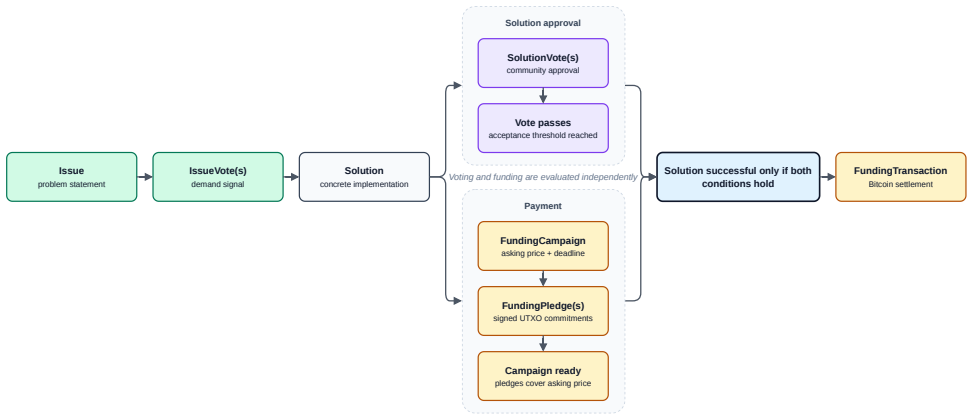
The deliberate separation of demand (issue voting), approval (solution submission), and payment (Bitcoin funding) so that funding never grants extra voting power.
If this is right
- Decentralized systems could update without depending on central platforms or informal maintainer authority.
- Communities could coordinate changes through signed, peer-to-peer governance objects stored locally.
- Bitcoin funding can support development while leaving voting power unchanged.
- Performance and cost metrics for storage, identity, and funding become measurable in such a coordination layer.
- Protocol evolution can occur through explicit demand and approval steps rather than goodwill alone.
Where Pith is reading between the lines
- The same separation mechanism could apply to governance in other peer-to-peer applications beyond software updates.
- Real-world adoption would still require testing whether users actually propose, vote, and fund through the system at scale.
- Integration with additional payment networks might expand funding options without altering the voting separation.
- If social viability holds, similar layers could reduce reliance on external platforms for open-source coordination.
Load-bearing premise
The separation of voting power from funding power will hold in actual implementation and user behavior.
What would settle it
An experiment or user study in which funded participants gain disproportionate influence over which solutions are approved would show the separation does not work as claimed.
Figures

read the original abstract
Decentralised systems are often built to avoid central control, but their evolution almost always depends on centralised platforms, informal maintainer authority, and a surprising amount of unpaid goodwill. To address this uncomfortable mismatch, we introduce TwoStepDemocracy, a technical proof-of-concept for protocol-native software evolution. The prototype combines costly cryptographic identities, peer-to-peer dissemination, issue and solution voting, and Bitcoin-based funding campaigns. Users can express demand by proposing and voting on issues; developers can submit concrete solutions; and accepted work can be linked to voluntary, non-custodial funding. The design deliberately separates demand, approval, and payment. This way, money can support a solution, but it never buys more voting power. The prototype demonstrates that such a coordination layer can be built as a peer-to-peer implementation with local storage, signed governance objects, and Bitcoin integration. We studied performance, scalability, and costs across storage, identity management, and funding. The results show technical feasibility, but not yet social viability. A larger user study is still needed to evaluate whether real communities would, in practice, vote, fund, and coordinate through this mechanism.
Editorial analysis
A structured set of objections, weighed in public.
Referee Report
Summary. The paper introduces TwoStepDemocracy, a prototype for self-evolving, democratic, and decentralized systems. It describes a P2P coordination layer using costly cryptographic identities, peer-to-peer dissemination, voting on issues and solutions, and Bitcoin funding, with separation of demand, approval, and payment. The prototype uses local storage and signed governance objects, and the authors present performance, scalability, and cost studies, concluding technical feasibility but not social viability.
Significance. If the results hold, this work is significant for demonstrating a practical way to enable evolution in decentralized systems without central authority. The explicit separation of funding from voting power is a positive design choice that could prevent plutocracy in governance. The provision of a working prototype and performance study adds to its value as a technical contribution in distributed systems.
minor comments (1)
- [Abstract] The abstract mentions studying performance, scalability, and costs but does not specify the metrics or scale of the experiments; adding a sentence on key results would improve clarity.
Simulated Author's Rebuttal
We thank the referee for the constructive and positive assessment of TwoStepDemocracy, including recognition of its significance for decentralized governance and the recommendation for minor revision. No major comments were provided in the report.
Circularity Check
No significant circularity detected
full rationale
The manuscript is a direct implementation prototype describing a P2P coordination layer using local storage, signed governance objects, and Bitcoin integration. It contains no equations, no fitted parameters, no predictions derived from inputs, and no derivation chain that could reduce to self-definition or self-citation. All claims are bounded to technical feasibility results from the built system, with explicit caveats that social viability requires separate user studies. No load-bearing steps exist that match any of the enumerated circularity patterns.
Axiom & Free-Parameter Ledger
Reference graph
Works this paper leans on
-
[1]
Accessed: 2026-06-08
GitHub.GitHub Copilot is moving to usage-based billing. Accessed: 2026-06-08. Apr. 2026.URL: https: //github.blog/news- insights/company- news/github- copilot-is-moving-to-usage-based-billing/
2026
-
[2]
Ac- cessed: 2026-06-09
Vlad Fedorov.An update on GitHub availability. Ac- cessed: 2026-06-09. Apr. 2026.URL: https://github. blog/news- insights/company- news/an- update- on- github-availability/
2026
-
[3]
Accessed: 2026-06-08
GitHub.Changes to GitHub Copilot Individual plans. Accessed: 2026-06-08. Apr. 2026.URL: https://github. blog / news - insights / company - news / changes - to - github-copilot-individual-plans/
2026
-
[4]
Two Case Studies of Open Source Software De- velopment: Apache and Mozilla
Audris Mockus, Roy T. Fielding, and James D. Herb- sleb. “Two Case Studies of Open Source Software De- velopment: Apache and Mozilla”. In:ACM Transac- tions on Software Engineering and Methodology11.3 (2002), pp. 309–346.ISSN: 1049-331X.DOI: 10.1145/ 567793.567795
arXiv 2002
-
[5]
Chintan Amrit and Jos van Hillegersberg. “Explor- ing the Impact of Socio-Technical Core-Periphery Structures in Open Source Software Development”. In:Journal of Information Technology25.2 (2010), pp. 216–229.DOI: 10.1057/jit.2010.7
-
[6]
Los Alamitos, CA, USA, 2019.DOI: 10.1109/ ESEM
Guilherme Avelino et al.On the Abandonment and Survival of Open Source Projects: An Empirical Inves- tigation. Los Alamitos, CA, USA, 2019.DOI: 10.1109/ ESEM . 2019 . 8870181. eprint: 1906 . 08058 (cs.SE). URL: https://doi.ieeecomputersociety.org/10.1109/ ESEM.2019.8870181
arXiv 2019
-
[7]
Defining Blockchain Gover- nance: A Framework for Analysis and Comparison
Rowan van Pelt et al. “Defining Blockchain Gover- nance: A Framework for Analysis and Comparison”. In:Information Systems Management38.1 (2021), pp. 21–41.DOI: 10.1080/10580530.2020.1720046
-
[8]
The Invisible Politics of Bitcoin: Governance Crisis of a Decentralised Infrastructure
Primavera De Filippi and Benjamin Loveluck. “The Invisible Politics of Bitcoin: Governance Crisis of a Decentralised Infrastructure”. In:Internet Policy Re- view5.3 (2016).DOI: 10.14763/2016.3.427
-
[9]
Blockchain: The Birth of Decentralized Governance
Benito Arru ˜nada and Luis Garicano. “Blockchain: The Birth of Decentralized Governance”. In:Pom- peu Fabra University Economics Working Paper1608 (2018)
2018
-
[10]
R ¨udiger Schollmeier. “A Definition of Peer-to-Peer Networking for the Classification of Peer-to-Peer Ar- chitectures and Applications”. In:Proceedings of the First International Conference on Peer-to-Peer Com- puting. IEEE, 2001, pp. 101–102.DOI: 10.1109/P2P. 2001.990434.URL: https://doi.org/10.1109/P2P.2001. 990434
work page doi:10.1109/p2p 2001
-
[11]
Gonzalo Camarillo.Peer-to-Peer (P2P) Architecture: Definition, Taxonomies, Examples, and Applicability. RFC 5694. Nov. 2009.DOI: 10.17487/RFC5694.URL: https://www.rfc-editor.org/rfc/rfc5694
-
[12]
Epidemic Algorithms for Repli- cated Database Maintenance
Alan Demers et al. “Epidemic Algorithms for Repli- cated Database Maintenance”. In:Proceedings of the Sixth Annual ACM Symposium on Principles of Dis- tributed Computing. ACM, 1987, pp. 1–12.DOI: 10. 1145 /41840 .41841.URL: https :/ / doi. org/ 10. 1145 / 41840.41841
arXiv 1987
-
[13]
Richard Karp et al. “Randomized Rumor Spread- ing”. In:Proceedings of the 41st Annual Symposium on Foundations of Computer Science. IEEE, 2000, pp. 565–574.DOI: 10.1109/SFCS.2000.892324.URL: https://doi.org/10.1109/SFCS.2000.892324
-
[14]
Dimitris Vyzovitis et al.GossipSub: Attack-Resilient Message Propagation in the Filecoin and ETH2.0 Net- works. 2020. eprint: 2007.02754 (cs.NI).URL: https: //arxiv.org/abs/2007.02754
arXiv 2020
-
[15]
libp2p.GossipSub v1.1: Security Extensions to Im- prove on Attack Resilience and Bootstrapping. Ac- cessed: 2026-05-28.URL: https://github.com/libp2p/ specs/blob/master/pubsub/gossipsub/gossipsub-v1.1. md. [16]Digital Signature Standard (DSS). Federal Informa- tion Processing Standards Publication FIPS 186-5. National Institute of Standards and Technology...
-
[16]
RFC 9380
Armando Faz-Hernandez et al.Hashing to Elliptic Curves. RFC 9380. Aug. 2023.DOI: 10 . 17487 / RFC9380.URL: https : / / www . rfc - editor . org / rfc / rfc9380. [18]Digital Identity Guidelines: Authentication and Au- thenticator Management. Special Publication NIST SP 800-63B-4. National Institute of Standards and Tech- nology, 2025.URL: https://pages.nis...
2023
-
[17]
The Sybil Attack
John R. Douceur. “The Sybil Attack”. In:Peer-to-Peer Systems: First International Workshop, IPTPS 2002. Springer, 2002, pp. 251–260.DOI: 10 . 1007 / 3 - 540 - 45748-8 24
2002
-
[18]
Ac- cessed: 2026-05-25
Bitcoin Developer Documentation.Transactions. Ac- cessed: 2026-05-25. 2025.URL: https : / / developer . bitcoin.org/devguide/transactions.html
2026
-
[19]
Accessed: 2026-05-25
Ava Chow.Partially Signed Bitcoin Transaction For- mat. Accessed: 2026-05-25. 2017.URL: https://bips. dev/174/
2026
-
[20]
Mark Erhardt.BIP 3: Updated BIP Process. 2025. URL: https://bips.dev/3/
2025
-
[21]
2025.URL: https://docs.tezos.com/architecture/governance
Tezos.Governance and Self-Amendment. 2025.URL: https://docs.tezos.com/architecture/governance
2025
-
[22]
Analyzing V oting Power in Decentral- ized Governance: Who Controls DAOs?
Robin Fritsch, Marino M ¨uller, and Roger Wat- tenhofer. “Analyzing V oting Power in Decentral- ized Governance: Who Controls DAOs?” In:arXiv preprint arXiv:2204.01176(2022). arXiv: 2204.01176 [cs.CY].URL: https://arxiv.org/abs/2204.01176
arXiv 2022
-
[23]
Binary V oting with Delegable Proxy: An Analysis of Liquid Democracy
Zo ´e Christoff and Davide Grossi. “Binary V oting with Delegable Proxy: An Analysis of Liquid Democracy”. In:arXiv preprint arXiv:1707.08741(2017). arXiv: 1707.08741[cs.GT].URL: https://arxiv.org/abs/ 1707.08741
Pith/arXiv arXiv 2017
-
[24]
Liquid Democ- racy in DPoS Blockchains
Chao Li, Runhua Xu, and Li Duan. “Liquid Democ- racy in DPoS Blockchains”. In:arXiv preprint arXiv:2309.01090(2023). arXiv: 2309 . 01090 [cs.CY].URL: https://arxiv.org/abs/2309.01090
arXiv 2023
-
[25]
Accessed: 2026-05-06
Satoshi Nakamoto.Bitcoin: A Peer-to-Peer Electronic Cash System. Accessed: 2026-05-06. 2008.URL: https: //bitcoin.org/bitcoin.pdf
2026
-
[26]
Accessed: 2026-05-06
Ethereum Foundation.Proof-of-Stake Rewards and Penalties. Accessed: 2026-05-06. 2026.URL: https : / / ethereum . org / developers / docs / consensus - mechanisms/pos/rewards-and-penalties/
2026
-
[27]
Michał Jo ´zwik and Johan Pouwelse.Smart- phoneDemocracy: Privacy-Preserving E-Voting on Decentralized Infrastructure using Novel European Identity. 2025. arXiv: 2507 . 09453[cs.CR].URL: https://arxiv.org/abs/2507.09453
arXiv 2025
-
[28]
European Commission.EU Digital Identity Wallet. Accessed: 2026-05-06. 2026.URL: https : / / ec . europa . eu / digital - building - blocks / sites / spaces / EUDIGITALIDENTITYW ALLET/pages/694487738/ EU+Digital+Identity+Wallet+Home
arXiv 2026
-
[29]
Accessed: 2026-05-06
Human Passport.Human Passport Developer Plat- form. Accessed: 2026-05-06. 2026.URL: https://docs. passport.xyz/
2026
-
[30]
Proof-of-Personhood: Redemoc- ratizing Permissionless Cryptocurrencies
Maria Borge et al. “Proof-of-Personhood: Redemoc- ratizing Permissionless Cryptocurrencies”. In:2017 IEEE European Symposium on Security and Privacy Workshops (EuroS&PW). IEEE, 2017, pp. 23–26.DOI: 10.1109/EuroSPW.2017.46
-
[31]
Divya Siddarth et al. “Who Watches the Watchmen? A Review of Subjective Approaches for Sybil-Resistance in Proof of Personhood Protocols”. In:Frontiers in BlockchainV olume 3 - 2020 (2020).ISSN: 2624-7852. DOI: 10.3389/fbloc.2020.590171.URL: https://www. frontiersin.org/journals/blockchain/articles/10.3389/ fbloc.2020.590171
-
[32]
A Flexible Design for Funding Public Goods
Vitalik Buterin, Zo ¨e Hitzig, and E. Glen Weyl. “A Flexible Design for Funding Public Goods”. In:Man- agement Science65.11 (2019), pp. 5171–5187.DOI: 10.1287/mnsc.2019.3337.URL: https://doi.org/10. 1287/mnsc.2019.3337
-
[33]
Accessed: 2026-05-31
Gitcoin.Quadratic Funding. Accessed: 2026-05-31. 2026.URL: https://gitcoin.co/mechanisms/quadratic- funding
2026
-
[34]
Provision of Public Goods: Fully Implementing the Core through Private Contributions
Mark Bagnoli and Barton L. Lipman. “Provision of Public Goods: Fully Implementing the Core through Private Contributions”. In:The Review of Economic Studies56.4 (1989), pp. 583–601.DOI: 10 . 2307 / 2297502
1989
-
[35]
Mirko Zichichi et al.LikeStarter: A Smart-contract based Social DAO for Crowdfunding. 2019. arXiv: 1905.05560[cs.CY].URL: https://arxiv.org/abs/ 1905.05560
arXiv 2019
-
[36]
Jiayuan Zhou et al. “Studying the Association Between Bountysource Bounties and the Issue-Addressing Likelihood of GitHub Issue Reports”. In:IEEE Transactions on Software Engineering47.12 (2021), pp. 2919–2933.DOI: 10.1109/TSE.2020.2974469
-
[37]
BitTorrent or BitCrunch: Evidence of a Credit Squeeze in BitTorrent?
David Hales et al. “BitTorrent or BitCrunch: Evidence of a Credit Squeeze in BitTorrent?” In:2009 18th IEEE International Workshops on Enabling Technologies: Infrastructures for Collaborative Enterprises. IEEE, 2009, pp. 99–104.DOI: 10.1109/WETICE.2009.22
-
[38]
Self-replicating seedbox servers using programmable money
Matei Dogariu and Johan Pouwelse. “Self-replicating seedbox servers using programmable money”. Forth- coming in the TU Delft Repository. Master’s thesis. Delft, The Netherlands: Delft University of Technol- ogy, 2026.URL: https://repository.tudelft.nl/
2026
-
[39]
https://www.galaxy.com/insights/ research/bitcoin- onchain- fees- utxo
Galaxy Research.Bitcoin Fees Collapse: What On- chain Data Tells Us. https://www.galaxy.com/insights/ research/bitcoin- onchain- fees- utxo. Accessed 2026- 06-20. 2025
2026
-
[40]
https://www.investing.com/crypto/bitcoin/btc- usd- historical-data
Investing.com.BTC/USD Bitfinex Historical Data. https://www.investing.com/crypto/bitcoin/btc- usd- historical-data. Accessed 2026-06-20. 2026
2026
-
[41]
A Blockchain Consensus Protocol with Horizontal Scal- ability
Kelong Cong, Zhijie Ren, and Johan Pouwelse. “A Blockchain Consensus Protocol with Horizontal Scal- ability”. In:2018 IFIP Networking Conference (IFIP Networking) and Workshops. Ed. by Burkhard Stiller. IEEE, 2019, pp. 1–9.DOI: 10.23919/IFIPNetworking. 2018.8696555
-
[42]
Tag-Based Navigation for Peer-to-Peer Wikipedia
Jenneke E. Fokker, Johan A. Pouwelse, and Wray Buntine. “Tag-Based Navigation for Peer-to-Peer Wikipedia”. In:Collaborative Web Tagging Workshop at WWW2006. Edinburgh, United Kingdom, 2006. A Acknowledgement on the use of AI Throughout the research, we used AI tools to challenge, im- prove, and simplify parts of our work. In particular, we used ChatGPT 5 ...
2006
discussion (0)
Sign in with ORCID, Apple, or X to comment. Anyone can read and Pith papers without signing in.