One Terahertz Full-Field Digital Back-Propagation over 3000 km
Pith reviewed 2026-06-25 20:36 UTC · model grok-4.3
The pith
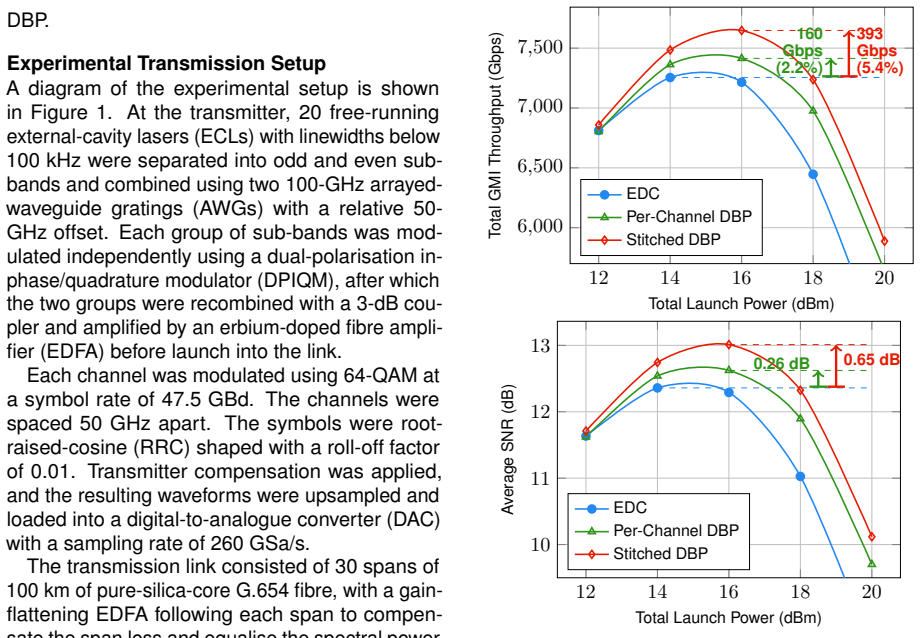
A 1-THz full-field digital back-propagation system achieves 5.4 percent higher throughput than electronic dispersion compensation over 3000 km.
A machine-rendered reading of the paper's core claim, the machinery that carries it, and where it could break.
Core claim
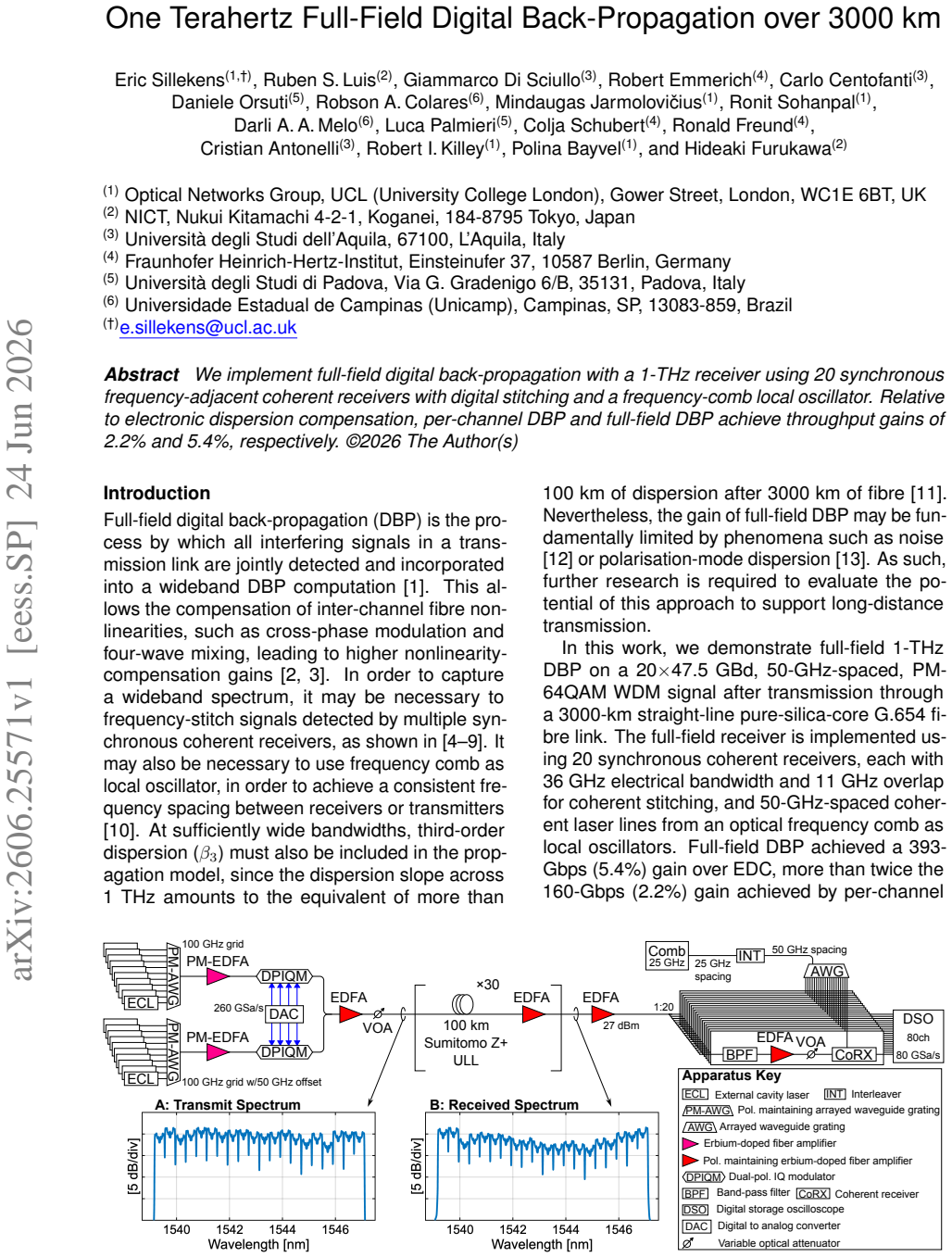
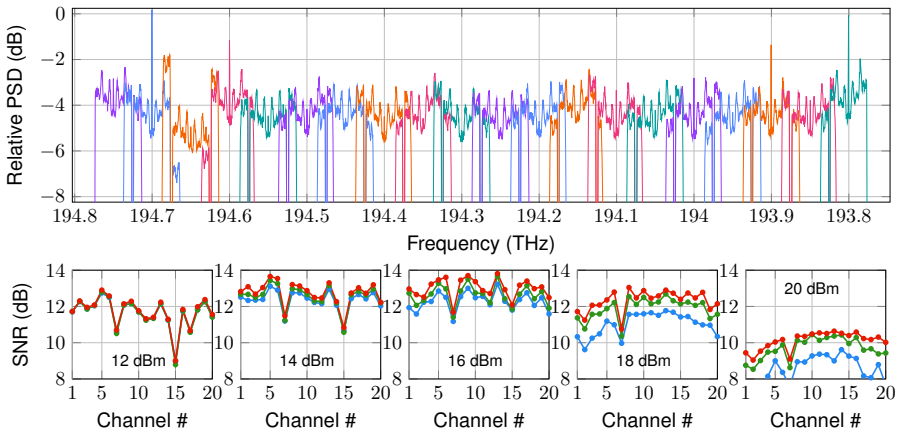
Full-field digital back-propagation applied across a 1 THz bandwidth, obtained by stitching twenty synchronous coherent receivers and using a frequency-comb local oscillator, produces a 5.4 percent throughput gain over electronic dispersion compensation after 3000 km of fiber transmission.
What carries the argument
Full-field digital back-propagation performed on a digitally stitched 1 THz receiver front-end.
If this is right
- Wider optical bandwidths can be compensated for nonlinearity in a single digital step.
- The 2.2 percent gain from per-channel DBP remains available as a lower-complexity alternative.
- Stitched multi-receiver architectures become a practical route to scaling receiver bandwidth beyond single-device limits.
Where Pith is reading between the lines
- The same stitching technique could be tested at 2 THz or higher to check whether the relative gain grows with bandwidth.
- Integration with existing frequency-comb sources in transceivers might allow the approach to move from laboratory to field trials without new laser hardware.
- If stitching overhead remains small, the method could be combined with other nonlinear mitigation techniques to compound capacity improvements.
Load-bearing premise
The digital stitching across the twenty receivers and the frequency-comb local oscillator introduce no impairments large enough to erase the reported DBP gains.
What would settle it
A side-by-side throughput measurement with the same receivers but without digital stitching, or direct quantification of residual phase noise from the frequency comb, would show whether the 5.4 percent gain survives.
Figures
read the original abstract
We implement full-field digital back-propagation with a 1-THz receiver using 20 synchronous frequency-adjacent coherent receivers with digital stitching and a frequency-comb local oscillator. Relative to electronic dispersion compensation, per-channel DBP and full-field DBP achieve throughput gains of 2.2\% and 5.4\%, respectively.
Editorial analysis
A structured set of objections, weighed in public.
Referee Report
Summary. The manuscript reports an experimental demonstration of 1-THz full-field digital back-propagation (DBP) over 3000 km using 20 frequency-adjacent coherent receivers combined via digital stitching and a frequency-comb local oscillator. Relative to electronic dispersion compensation, it claims throughput gains of 2.2% for per-channel DBP and 5.4% for full-field DBP.
Significance. If the reported gains are shown to exceed all stitching and measurement uncertainties, the work would provide concrete evidence that wideband DBP can deliver measurable capacity improvements in long-haul systems at terahertz bandwidths. The multi-receiver architecture itself is a technical milestone, but the small percentage gains make the result sensitive to any unaccounted impairments.
major comments (2)
- [Abstract] Abstract: the headline throughput gains (2.2% and 5.4%) are stated without error bars, confidence intervals, or any description of the number of independent measurements or statistical tests used to establish significance. Because the gains are only a few percent, this omission prevents verification that the improvements exceed experimental variability.
- [Experimental setup] Experimental setup (implied by the 20-receiver description): the paper does not quantify residual impairments after digital stitching (timing skew, phase discontinuity, amplitude ripple, or filter mismatch) or demonstrate that these are either negligible or fully mitigated inside the DBP algorithm. Given that the claimed benefit is only 5.4%, even sub-dB stitching penalties would reverse the result relative to the EDC baseline.
Simulated Author's Rebuttal
We thank the referee for the constructive comments highlighting the need for statistical details on the reported gains and quantification of stitching impairments. We respond to each point below.
read point-by-point responses
-
Referee: [Abstract] Abstract: the headline throughput gains (2.2% and 5.4%) are stated without error bars, confidence intervals, or any description of the number of independent measurements or statistical tests used to establish significance. Because the gains are only a few percent, this omission prevents verification that the improvements exceed experimental variability.
Authors: We agree that the abstract would be strengthened by including error information and measurement details. The gains are derived from throughput calculations based on measured Q-factors across the 1-THz bandwidth in our single experimental configuration. In the revised manuscript we will update the abstract to report the gains together with estimated uncertainties obtained from repeated signal acquisitions and will specify the number of independent trials performed. Expanded statistical details will also be added to the methods section. revision: yes
-
Referee: [Experimental setup] Experimental setup (implied by the 20-receiver description): the paper does not quantify residual impairments after digital stitching (timing skew, phase discontinuity, amplitude ripple, or filter mismatch) or demonstrate that these are either negligible or fully mitigated inside the DBP algorithm. Given that the claimed benefit is only 5.4%, even sub-dB stitching penalties would reverse the result relative to the EDC baseline.
Authors: The digital stitching is performed prior to full-field DBP, and the algorithm operates on the combined wideband signal. We acknowledge that explicit quantification of post-stitching residuals (e.g., timing skew, phase jumps, amplitude ripple) is not provided in the current manuscript. We will add a dedicated characterization subsection with measured values of these impairments and an analysis showing that their residual penalty is substantially smaller than the observed 5.4% gain relative to EDC. revision: yes
Circularity Check
No significant circularity; purely experimental result
full rationale
The paper reports measured throughput gains from an experimental 1-THz full-field DBP implementation over 3000 km using 20 stitched coherent receivers and a frequency-comb LO. No derivation chain, equations, fitted parameters renamed as predictions, or self-citation load-bearing steps exist. Claims rest on direct experimental comparison to EDC baseline, which is externally falsifiable via the reported measurements themselves. This is the standard case of a self-contained empirical result with score 0.
Axiom & Free-Parameter Ledger
Reference graph
Works this paper leans on
-
[1]
Nonlinear Compensation Using Backpropagation for Polarization-Multiplexed Transmission
E. Ip, “Nonlinear Compensation Using Backpropagation for Polarization-Multiplexed Transmission”,Journal of Lightwave Technology, vol. 28, no. 6, pp. 939–951, Mar. 2010.DOI:10.1109/JLT.2010.2040135
-
[2]
On the Limits of Digital Back- Propagation in Fully Loaded WDM Systems
R. Dar and P . J. Winzer, “On the Limits of Digital Back- Propagation in Fully Loaded WDM Systems”,IEEE Pho- tonics Technology Letters, vol. 28, no. 11, pp. 1253– 1256, Jun. 2016.DOI:10.1109/LPT.2016.2522969
-
[3]
Fundamental Limitations of Digital Back Propagation due to Polar- ization Mode Dispersion
K. Goroshko, H. Louchet, and A. Richter, “Fundamental Limitations of Digital Back Propagation due to Polar- ization Mode Dispersion”, inAsia Communications and Photonics Conference 2015, Hong Kong, 2015, ASu3F .5. DOI:10.1364/ACPC.2015.ASu3F.5
-
[4]
N. K. Fontaine, G. Raybon, B. Guan, A. Adamiecki, P . J. Winzer, R. Ryf, A. Konczykowska, F . Jorge, J.-Y . Dupuy, L. L. Buhl, S. Chandrashekhar, R. Delbue, P . Pupalaikis, and A. Sureka, “228-GHz Coherent Receiver using Digi- tal Optical Bandwidth Interleaving and Reception of 214- GBd (856-Gb/s) PDM-QPSK”, inEuropean Conference and Exhibition on Optical...
-
[5]
246 GHz Digitally Stitched Coherent Receiver
K. Shi, E. Sillekens, and B. C. Thomsen, “246 GHz Digitally Stitched Coherent Receiver”, inOptical Fiber Communication Conference, Los Angeles, California, 2017, p. M3D.3.DOI:10.1364/OFC.2017.M3D.3
-
[6]
2.4-thz bandwidth optical coherent receiver based on a photonic crystal mi- crocomb
C. Deakin, J. Zang, X. Chen, D. Che, L. Dallachiesa, B. Stern, N. K. Fontaine, and S. Papp, “2.4-thz bandwidth optical coherent receiver based on a photonic crystal mi- crocomb”, inECOC, Frankfurt, Germany, 2024, pp. 766– 769
2024
-
[7]
Non-sliced optical arbitrary waveform measurement (OAWM) using soliton microcombs
D. Drayss, D. Fang, C. Füllner, G. Lihachev, T. Henauer, Y . Chen, H. Peng, P . Marin-Palomo, T. Zwick, W. Freude, T. J. Kippenberg, S. Randel, and C. Koos, “Non-sliced optical arbitrary waveform measurement (OAWM) using soliton microcombs”,Optica, vol. 10, no. 7, pp. 888–896, Jul. 2023.DOI:10.1364/OPTICA.484200
-
[8]
Optical arbitrary waveform generation (OAWG) using actively phase-stabilized spectral stitching
D. Drayss, D. Fang, A. Sherifaj, H. Peng, C. Füllner, T. Henauer, G. Lihachev, L. Schmitz, T. Harter, W. Freude, S. Randel, T. J. Kippenberg, T. Zwick, and C. Koos, “Optical arbitrary waveform generation (OAWG) using actively phase-stabilized spectral stitching”,Light: Sci- ence & Applications, vol. 14, no. 1, p. 353, Sep. 2025. DOI:10.1038/s41377-025-01937-4
-
[9]
A new twist on low-complexity digital backpropaga- tion
S. Civelli, D. P . Jana, E. Forestieri, and M. Secondini, “A new twist on low-complexity digital backpropaga- tion”,Journal of Lightwave Technology, vol. 43, no. 10, pp. 4679–4692, 2025.DOI:10.1364/JLT.43.004679
-
[10]
On the Impact of Frequency Variation on Nonlinearity Mitigation using Frequency Combs
R. Sohanpal, E. Sillekens, F . M. Ferreira, R. I. Killey, P . Bayvel, and Z. Liu, “On the Impact of Frequency Variation on Nonlinearity Mitigation using Frequency Combs”, inOptical Fiber Communication Conference (OFC) 2023, Optica Publishing Group, 2023, Th1F .3. DOI:10.1364/OFC.2023.Th1F.3
-
[11]
A. A. I. Ali, F . Ferreira, M. Al-Khateeb, D. Charlton, C. Laperle, and A. D. Ellis, “The Impact of Dispersion Slope on Fiber Nonlinearity in Ultra-Wideband Optical Commu- nication System”, in2018 European Conference on Op- tical Communication (ECOC), Rome, Italy: IEEE, 2018. DOI:10.1109/ECOC.2018.8535564
-
[12]
On the limits of digital back-propagation in the presence of transceiver noise
L. Galdino, D. Semrau, D. Lavery, G. Saavedra, C. B. Czegledi, E. Agrell, R. I. Killey, and P . Bayvel, “On the limits of digital back-propagation in the presence of transceiver noise”,Optics Express, vol. 25, no. 4, p. 4564, Feb. 2017.DOI:10.1364/OE.25.004564
-
[13]
Digital backpropagation accounting for polarization-mode dispersion
C. B. Czegledi, G. Liga, D. Lavery, M. Karlsson, E. Agrell, S. J. Savory, and P . Bayvel, “Digital backpropagation accounting for polarization-mode dispersion”,Optics Ex- press, vol. 25, no. 3, pp. 1903–1915, Feb. 2017.DOI: 10.1364/OE.25.001903
-
[14]
Nonlinear pulse propagation in birefrin- gent optical fibers
C. R. Menyuk, “Nonlinear pulse propagation in birefrin- gent optical fibers”,IEEE Journal of Quantum Elec- tronics, vol. 23, no. 2, pp. 174–176, Feb. 1987.DOI: 10.1109/JQE.1987.1073206
-
[15]
Optimization of the split-step fourier method in model- ing optical-fiber communications systems
O. V. Sinkin, R. Holzlohner, J. Zweck, and C. R. Menyuk, “Optimization of the split-step fourier method in model- ing optical-fiber communications systems”,Journal of Lightwave Technology, vol. 21, no. 1, pp. 61–68, Jan. 2003.DOI:10.1109/JLT.2003.808628
-
[16]
DSP for Coherent Single- Carrier Receivers
M. Kuschnerov, F . Hauske, K. Piyawanno, B. Spinnler, M. Alfiad, A. Napoli, and B. Lankl, “DSP for Coherent Single- Carrier Receivers”,Journal of Lightwave Technology, vol. 27, no. 16, pp. 3614–3622, Aug. 2009.DOI: 10 . 1109/JLT.2009.2024963
arXiv 2009
discussion (0)
Sign in with ORCID, Apple, or X to comment. Anyone can read and Pith papers without signing in.