Winding number and circular coloring
Pith reviewed 2026-06-25 20:42 UTC · model grok-4.3
The pith
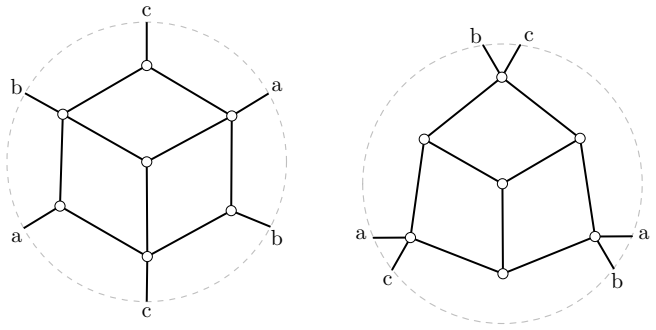
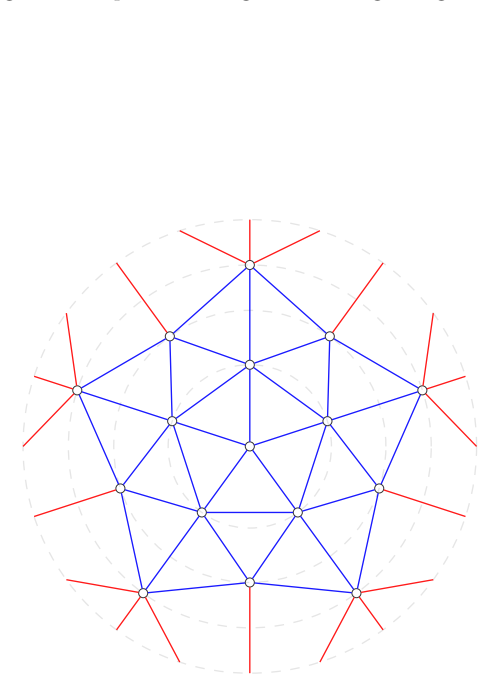
Graphs embedded on the projective plane with every face a 5-cycle have circular chromatic number either 5/2 or at least 3.
A machine-rendered reading of the paper's core claim, the machinery that carries it, and where it could break.
Core claim
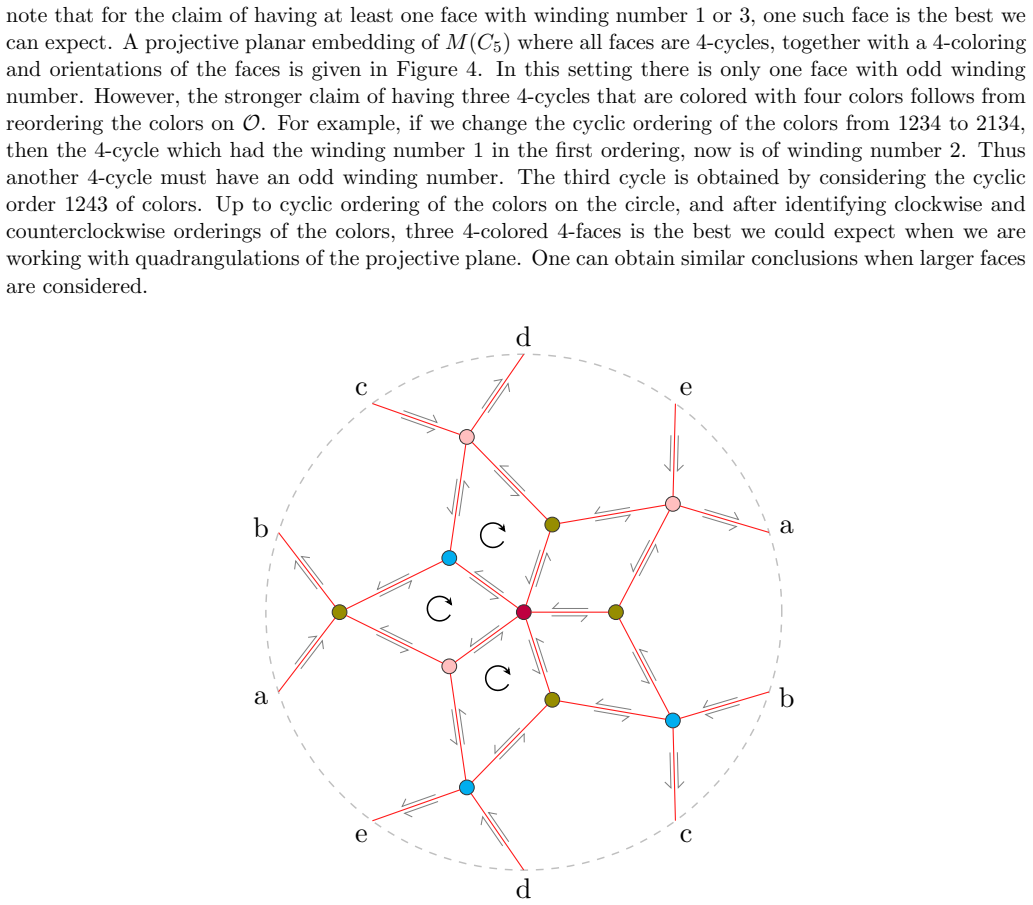
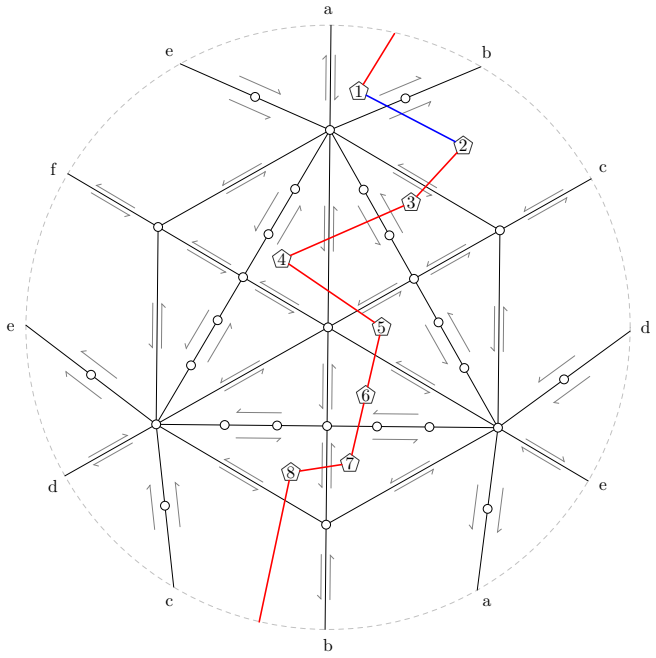
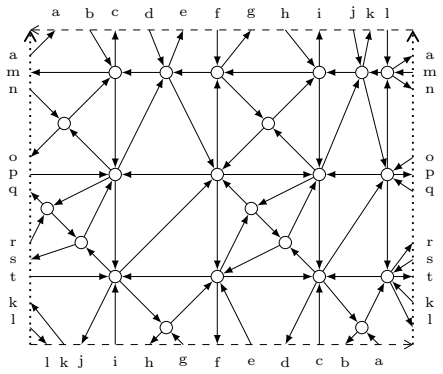
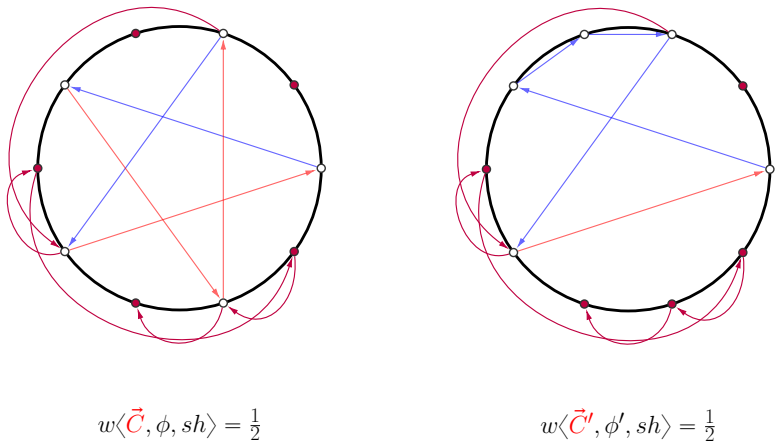
If G is embedded on the projective plane with every face a 5-cycle, then its circular chromatic number is either 5/2 or at least 3, the former holding only if G is Eulerian and every noncontractible facial walk has odd length. The same winding-number argument yields gaps for graphs with any distinguished set of directed even cycles and for other uniform odd face lengths.
What carries the argument
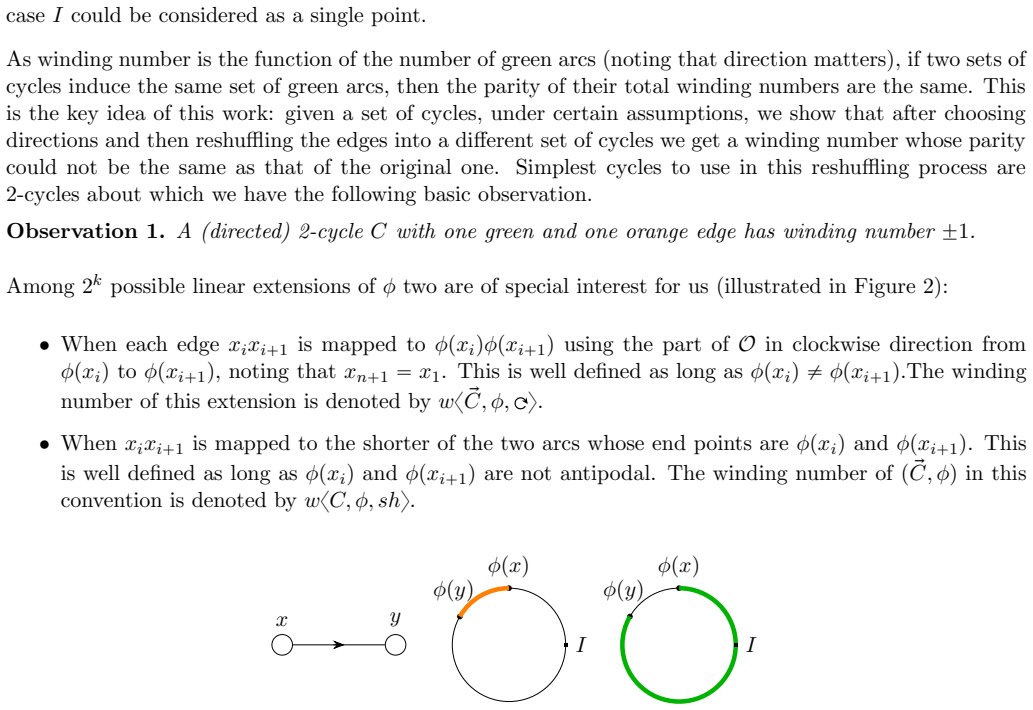
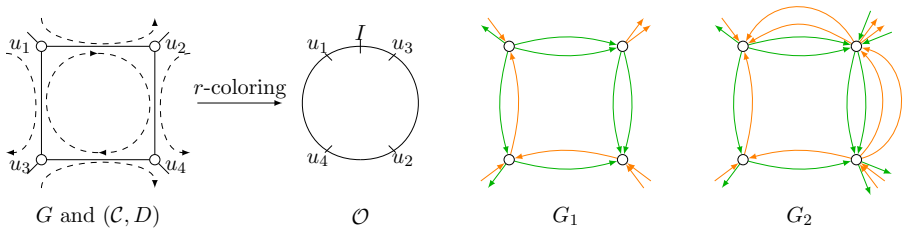
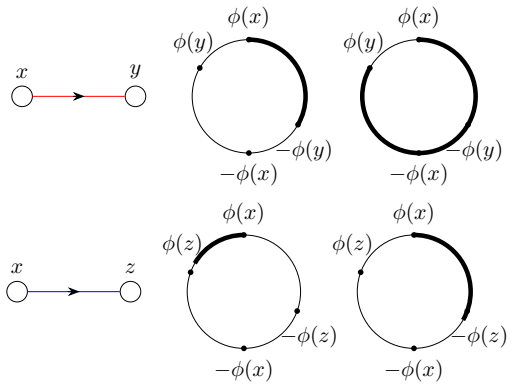
The winding number of a continuous extension of a coloring around each distinguished directed cycle or odd facial walk, which is forced to be an integer.
If this is right
- Even-faced embeddings on surfaces have circular chromatic numbers avoiding the open interval (2,4).
- For (2k+1)-face embeddings on the projective plane the circular chromatic number avoids the interval (k/2,k) under the stated Eulerian and parity conditions.
- The gap method applies directly to any graph equipped with a distinguished collection of directed even cycles.
- The same integer-winding constraint produces analogous gaps when all faces have any fixed odd length.
Where Pith is reading between the lines
- The framework could be applied to embeddings on the torus or Klein bottle to obtain new gap statements.
- The result implies that the ordinary chromatic number is at least 3 for any such 5-face projective-plane graph that fails the Eulerian or odd-walk conditions.
- Explicit constructions of 5-face Eulerian embeddings with odd noncontractible walks would test whether 5/2 is attained.
- The winding-number technique may extend to graphs whose distinguished cycles are not facial.
Load-bearing premise
Any coloring that uses a number of colors inside the forbidden gap interval extends to a continuous map on the surface while keeping the winding number integer on every distinguished cycle.
What would settle it
An explicit 5-face embedding on the projective plane that is not Eulerian or has an even-length noncontractible walk yet possesses a circular chromatic number strictly between 5/2 and 3.
Figures
read the original abstract
In 1996, Youngs proved a surprising theorem that quadrangulations of the projective plane could never have chromatic number exactly 3. This sparked a lot of interest, and the result has been further developed in many directions over the past decades. For example, the result is strengthened by considering the circular chromatic number, which is a real-valued lower bound on the chromatic number. The circular chromatic number of a quadrangulation cannot be in the interval (2,4). This parameter allows a generalization to larger even faces, for which a similar gap exists. In this work, we place these results into a framework based on the notion of winding number using extensions of colorings to continuous mappings. This yields unified and simplified proofs of gaps in the circular chromatic number for graphs with a distinguished set of directed even cycles. This generalizes the setting of graphs embedded on surfaces where every face is even. We further establish an analogous gap phenomenon when all faces are of a given odd length, previously known only in the case of triangulations. For example, we conclude that if G is a graph embedded on the projective plane such that all faces are 5-cycles, then either its circular chromatic number is 5/2 or at least 3, the former being the case only if G is Eulerian and every noncontractible facial walk is of odd length...
Editorial analysis
A structured set of objections, weighed in public.
Referee Report
Summary. The paper develops a topological framework based on winding numbers obtained by extending discrete circular colorings to continuous maps on surfaces. It uses this to give unified proofs of gaps in the circular chromatic number for graphs with distinguished directed even cycles (generalizing quadrangulations and even-face embeddings) and establishes an analogous gap for embeddings where all faces are odd cycles of fixed length. The main new result is that a graph embedded on the projective plane with every face a 5-cycle has circular chromatic number either exactly 5/2 or at least 3, with the former case holding only when the graph is Eulerian and every noncontractible facial walk has odd length.
Significance. If the extension construction is shown to preserve the required integer winding numbers on the distinguished cycles, the work supplies simplified, topology-based proofs of several known gap results and extends the gap phenomenon to odd-face embeddings on surfaces, a setting previously limited to triangulations. The approach is parameter-free and relies on standard winding-number invariants rather than ad-hoc constructions.
major comments (2)
- [the extension construction used in the proof of the 5-cycle projective-plane statement] The continuous-extension step (the construction that produces a map from a discrete (5/2)-coloring to a continuous map on the surface) is load-bearing for the “only if” direction of the projective-plane 5-cycle theorem. The manuscript must explicitly verify that this extension forces the winding number on every noncontractible odd-length facial walk to remain an integer; without that verification the gap argument does not rule out values in (5/2,3).
- [the general odd-face gap theorem] The general framework for odd-length faces invokes the same extension to obtain an integer winding-number obstruction. The argument that the obstruction is forced for every distinguished directed cycle (or odd facial walk) when the coloring value lies in (k/2,(k+1)/2) needs a self-contained lemma showing that any continuous extension compatible with the discrete coloring cannot alter the integrality on those cycles.
minor comments (2)
- Notation for the target circle and the identification of colorings with maps to S^1 should be introduced once and used consistently; the current alternation between interval and circle descriptions is occasionally unclear.
- A short diagram illustrating the extension of a discrete coloring across a single face would help readers follow the winding-number calculation.
Simulated Author's Rebuttal
We thank the referee for the careful and constructive report. The two major comments correctly identify places where the manuscript's treatment of the continuous-extension construction requires additional explicit verification to make the gap arguments fully rigorous. We will revise the paper accordingly.
read point-by-point responses
-
Referee: [the extension construction used in the proof of the 5-cycle projective-plane statement] The continuous-extension step (the construction that produces a map from a discrete (5/2)-coloring to a continuous map on the surface) is load-bearing for the “only if” direction of the projective-plane 5-cycle theorem. The manuscript must explicitly verify that this extension forces the winding number on every noncontractible odd-length facial walk to remain an integer; without that verification the gap argument does not rule out values in (5/2,3).
Authors: We agree that the current write-up does not contain a self-contained verification of integrality preservation for noncontractible odd-length facial walks under the extension map. In the revised manuscript we will insert a new lemma (placed immediately before the projective-plane 5-cycle theorem) that constructs the extension explicitly from the discrete (5/2)-coloring and proves that the induced winding numbers on all noncontractible odd facial walks remain integers. This will close the gap in the “only if” direction. revision: yes
-
Referee: [the general odd-face gap theorem] The general framework for odd-length faces invokes the same extension to obtain an integer winding-number obstruction. The argument that the obstruction is forced for every distinguished directed cycle (or odd facial walk) when the coloring value lies in (k/2,(k+1)/2) needs a self-contained lemma showing that any continuous extension compatible with the discrete coloring cannot alter the integrality on those cycles.
Authors: We concur that a general, self-contained lemma is needed rather than an implicit appeal to the construction. The revision will add a standalone lemma (in the section developing the general odd-face framework) that takes an arbitrary discrete coloring with value in (k/2,(k+1)/2) and any continuous extension compatible with it, and proves that the winding numbers on the distinguished directed cycles (or odd facial walks) remain integers. The lemma will be stated and proved independently of the specific surface or face length, so that it applies uniformly to both the even-cycle and odd-face settings. revision: yes
Circularity Check
No significant circularity; standard topological framework
full rationale
The paper develops a winding-number framework via continuous extensions of discrete colorings to prove circular-chromatic gaps for even-face and odd-face embeddings on surfaces. All load-bearing steps invoke externally defined topological invariants (winding numbers on cycles) and standard extension constructions rather than any parameter fitted inside the paper or any self-referential definition. The central 5/2-vs-3 gap for projective-plane 5-cycle embeddings is derived from these invariants applied to noncontractible walks; no equation or claim reduces by construction to its own inputs, and no load-bearing self-citation chain is present. The derivation remains self-contained against external topological benchmarks.
Axiom & Free-Parameter Ledger
axioms (1)
- domain assumption A proper vertex coloring of a graph embedded on a surface extends to a continuous map whose winding number around each distinguished directed cycle is an integer.
Reference graph
Works this paper leans on
-
[1]
Homomorphisms of binary Cayley graphs.Dis- crete Math., 338(12):2539–2544, 2015
Laurent Beaudou, Reza Naserasr, and Claude Tardif. Homomorphisms of binary Cayley graphs.Dis- crete Math., 338(12):2539–2544, 2015
2015
-
[2]
Coloring-flow duality of embedded graphs.Trans
Matt DeVos, Luis Goddyn, Bojan Mohar, Dirk Vertigan, and Xuding Zhu. Coloring-flow duality of embedded graphs.Trans. Amer. Math. Soc., 357(10):3993–4016, 2005
2005
-
[3]
El-Zahar and N
M. El-Zahar and N. W. Sauer. The chromatic number of the product of two 4-chromatic graphs is 4. Combinatorica, 5:121–126, 1985
1985
-
[4]
The width of quadrangulations of the projective plane.J
Louis Esperet and Matˇ ej Stehl´ ık. The width of quadrangulations of the projective plane.J. Graph Theory, 89(1):76–88, 2018
2018
-
[5]
On graphs with strongly independent color- classes.J
Andr´ as Gy´ arf´ as, Tommy Jensen, and Michael Stiebitz. On graphs with strongly independent color- classes.J. Graph Theory, 46(1):1–14, 2004
2004
-
[6]
P. J. Heawood. On the four colour map theorem.Quart. J., 29:270–285, 1898
-
[7]
Bruce Richter, and Paul Seymour
Joan Hutchinson, R. Bruce Richter, and Paul Seymour. Colouring Eulerian triangulations.J. Comb. Theory, Ser. B, 84(2):225–239, 2002
2002
-
[8]
Small odd cycles in 4-chromatic graphs.J
Tao Jiang. Small odd cycles in 4-chromatic graphs.J. Graph Theory, 37(2):115–117, 2001
2001
-
[9]
Andrea Jim´ enez, Jessica McDonald, Reza Naserasr, Kathryn Nurse, and Daniel A. Quiroz. Balanced chromatic number and hadwiger-like conjectures
-
[10]
Circular flows in mono-directed signed graphs.J
Jiaao Li, Reza Naserasr, Zhouningxin Wang, and Xuding Zhu. Circular flows in mono-directed signed graphs.J. Graph Theory, 106(3):686–710, 2024
2024
-
[11]
Kneser’s conjecture, chromatic number, and homotopy.J
L´ aszl´ o Lov´ asz. Kneser’s conjecture, chromatic number, and homotopy.J. Comb. Theory, Ser. A, 25:319–324, 1978
1978
-
[12]
Coloring Eulerian triangulations of the projective plane.Discrete Math., 244(1-3):339– 343, 2002
Bojan Mohar. Coloring Eulerian triangulations of the projective plane.Discrete Math., 244(1-3):339– 343, 2002. 25
2002
-
[13]
Bojan Mohar and Paul D. Seymour. Coloring locally bipartite graphs on surfaces.J. Comb. Theory, Ser. B, 84(2):301–310, 2002
2002
-
[14]
Baltimore, MD: Johns Hopkins University Press, 2001
Bojan Mohar and Carsten Thomassen.Graphs on surfaces. Baltimore, MD: Johns Hopkins University Press, 2001
2001
-
[15]
Winding number and circular 4-coloring of (signed) graphs
Reza Naserasr. Winding number and circular 4-coloring of (signed) graphs. 2022
2022
-
[16]
Homomorphisms of signed graphs.J
Reza Naserasr, Edita Rollov´ a, and ´Eric Sopena. Homomorphisms of signed graphs.J. Graph Theory, 79(3):178–212, 2015
2015
-
[17]
Homomorphisms of signed graphs: an update
Reza Naserasr, ´Eric Sopena, and Thomas Zaslavsky. Homomorphisms of signed graphs: an update. European J. Combin., 91:Paper No. 103222, 20, 2021
2021
-
[18]
Circular chromatic number of signed graphs
Reza Naserasr, Zhouningxin Wang, and Xuding Zhu. Circular chromatic number of signed graphs. Electron. J. Combin., 28(2):Paper No. 2.44, 40, 2021
2021
-
[19]
Van Ngoc.On graph colorings (Hungarian)
N. Van Ngoc.On graph colorings (Hungarian). Ph.D. Thesis, Hungarian Academy of Sciences, Bu- dapest. 1987
1987
-
[20]
A. Nilli. Short odd cycles in 4-chromatic graphs.J. Graph Theory, 31(2):145–147, 1999
1999
-
[21]
On the chromatic number of cube-like graphs.Discrete Math., 103(3):271–277, 1992
Charles Payan. On the chromatic number of cube-like graphs.Discrete Math., 103(3):271–277, 1992
1992
-
[22]
Michael Stiebitz.Beitr¨ age zur Theorie der f¨ arbungskritischen Graphen. 1985
1985
-
[23]
Color-critical graphs on a fixed surface.J
Carsten Thomassen. Color-critical graphs on a fixed surface.J. Comb. Theory, Ser. B, 70(1):67–100, 1997
1997
-
[24]
4-chromatic graphs with large odd girth
Nguyen Van Ngoc and Zsolt Tuza. 4-chromatic graphs with large odd girth. volume 138, pages 387–392
-
[25]
14th British Combinatorial Conference (Keele, 1993)
1993
-
[26]
An Erdos-Gallai conjecture for signed graphs
Lujia Wang. An Erdos-Gallai conjecture for signed graphs. Preprint, arXiv:2509.07724 [math.CO] (2025), 2025
arXiv 2025
-
[27]
West.Introduction to graph theory
Douglas B. West.Introduction to graph theory. Upper Saddle River, NJ: Prentice Hall, 1996
1996
-
[28]
Dale A. Youngs. 4-chromatic projective graphs.J. Graph Theory, 21(2):219–227, 1996. 26
1996
discussion (0)
Sign in with ORCID, Apple, or X to comment. Anyone can read and Pith papers without signing in.