Imprecise Transition Matrices for Markov Cohort Models: Lower and Upper Expectations with a Practical Health Economic Application
Pith reviewed 2026-06-25 20:28 UTC · model grok-4.3
The pith
Markov cohort models with sets of admissible transition matrices allow exact computation of lower and upper accumulated outcomes via recursive operators.
A machine-rendered reading of the paper's core claim, the machinery that carries it, and where it could break.
Core claim
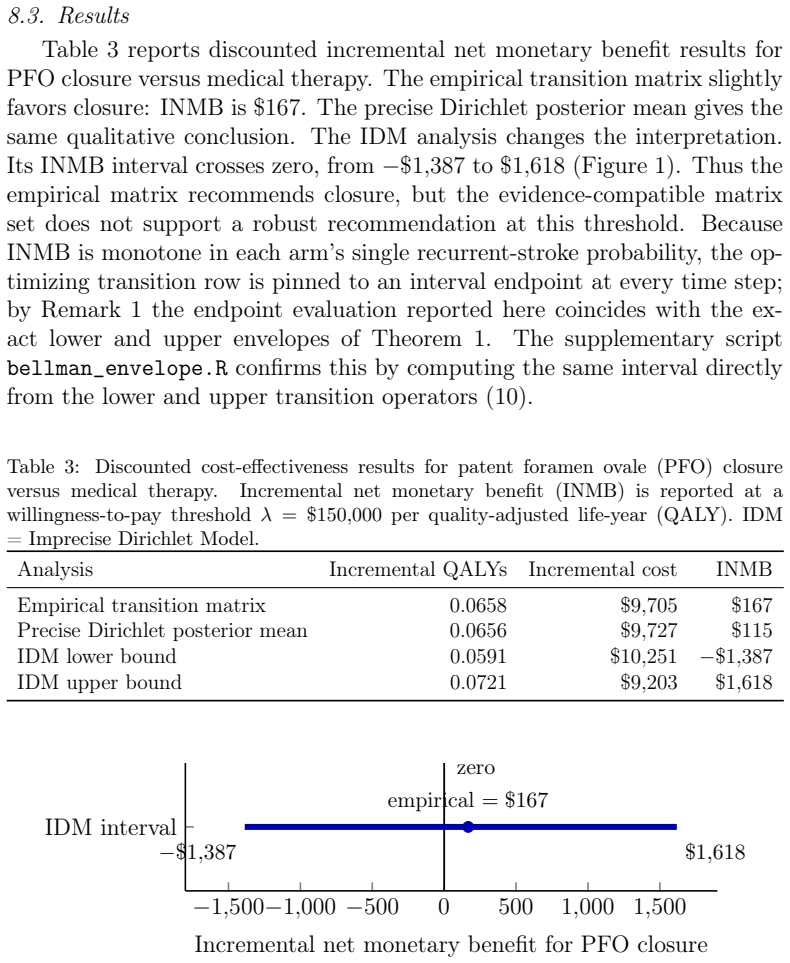
Under non-empty compact separately specified outgoing-row sets, the lower and upper accumulated outcomes are computed exactly by Bellman-style lower and upper transition operators. Multinomial transition counts induce such sets through the Imprecise Dirichlet Model, and the resulting interval for incremental net monetary benefit in the stroke example crosses zero.
What carries the argument
Bellman-style lower and upper transition operators that act on evidence-induced sets of admissible transition matrices.
If this is right
- The lower and upper expectations satisfy an envelope theorem and coherence properties of the lower transition operator.
- Algebraic conditions on the admissible set identify when a single selected matrix produces a non-robust decision.
- The formulation reduces exactly to the classical precise Markov cohort model when the admissible set is a singleton.
- The method supplies both a lower-expectation formulation and a diagnostic for decisions sensitive to unresolved transition probabilities.
Where Pith is reading between the lines
- The same operator construction could be tested on other finite-horizon cohort models to see how often the decision interval changes sign.
- Incorporating additional structural constraints or treatment-effect data directly into the admissible sets would be a direct next step.
- The crossing-zero result in the example suggests the method can flag cases where current evidence is insufficient to support a firm policy choice.
Load-bearing premise
The admissible set of transition matrices is non-empty, compact, and separately specified row by row, and is generated from multinomial counts by the Imprecise Dirichlet Model.
What would settle it
Apply the lower and upper operators to the Imprecise Dirichlet Model sets derived from the transition counts in the patent foramen ovale example and check whether the resulting interval for incremental net monetary benefit actually contains zero.
Figures
read the original abstract
In applied health research, Markov cohort models are built on a precisely specified transition probability matrix. However, in many applications, the available evidence -- transition counts, structural constraints, and treatment-effect data -- identifies a set of admissible matrices rather than one uniquely justified matrix. This paper formulates an imprecise-probability extension in which inference yields lower and upper expectations over an evidence-compatible set of precise Markov cohort models. The contribution differs from existing imprecise Markov-chain work by focusing on finite-horizon cohort trajectories, additive accumulated outcomes, and transition matrices constructed from empirical transition counts. Under non-empty compact separately specified outgoing-row sets, the lower and upper accumulated outcomes are computed exactly by Bellman-style lower and upper transition operators. We prove the envelope theorem, reduction to the classical model, coherence properties of the lower transition operator, and algebraic conditions under which a single selected matrix yields a non-robust decision. We then show how multinomial transition counts induce admissible matrix sets through the Imprecise Dirichlet Model. A real-world cost-effectiveness example of patent foramen ovale closure after cryptogenic stroke illustrates the practical consequence: the empirical transition matrix slightly favors closure, whereas the imprecise analysis yields an incremental net monetary benefit interval crossing zero. The method provides both a rigorous lower-expectation formulation and a practical diagnostic for decisions that depend on transition probabilities not fully resolved by the evidence.
Editorial analysis
A structured set of objections, weighed in public.
Referee Report
Summary. The paper develops an imprecise-probability extension of finite-horizon Markov cohort models for health-economic evaluation. Transition matrices are replaced by credal sets of admissible matrices induced row-wise from multinomial transition counts via the Imprecise Dirichlet Model. Under the maintained assumptions of non-empty, compact, separately specified outgoing-row credal sets, the paper proves that lower and upper expectations of additive accumulated outcomes are obtained exactly by iterating the corresponding lower and upper transition operators (envelope theorem, reduction to the precise case, and coherence of the lower operator). It further derives algebraic conditions under which a single matrix yields a non-robust decision and illustrates the method on a patent-foramen-ovale-closure cost-effectiveness analysis, where the point estimate slightly favors closure while the imprecise interval for incremental net monetary benefit crosses zero.
Significance. If the envelope theorem and coherence results hold, the work supplies a rigorous, computationally tractable route to propagating epistemic uncertainty in transition probabilities through cohort models with additive outcomes. The exact operator iteration, the explicit reduction to the classical model, and the diagnostic for decisions that hinge on unresolved transition probabilities are concrete strengths. The real-data example shows that the framework can alter the robustness assessment of a policy conclusion, which is directly relevant to applied health economics.
minor comments (3)
- [theoretical development of lower/upper operators] The statement of the envelope theorem (presumably in the theoretical section following the operator definitions) would benefit from an explicit display of the induction step that shows the lower accumulated expectation equals the iterated lower operator; the current high-level description leaves the precise inductive hypothesis unclear.
- [IDM construction from multinomial counts] In the IDM construction section, the paper asserts that the row-wise credal sets remain separately specified and compact; a short explicit verification that the lower and upper probability bounds induced by the IDM satisfy the separate-specification condition for the outgoing rows would strengthen the claim.
- [patent foramen ovale closure example] The application section reports that the imprecise INMB interval crosses zero while the empirical matrix does not; tabulating the lower and upper INMB values alongside the precise point estimate and the width of the interval would make the practical consequence easier to assess.
Simulated Author's Rebuttal
We thank the referee for the detailed and positive summary of our paper, the recognition of its contributions regarding the envelope theorem, coherence results, and the practical health-economic application, and the recommendation for minor revision. No specific major comments were listed in the report, so we have no individual points to address point-by-point. We remain available to incorporate any minor suggestions once they are provided.
Circularity Check
No significant circularity identified
full rationale
The derivation relies on standard imprecise-probability concepts (credal sets that are non-empty, compact, and separately specified) and the externally defined Imprecise Dirichlet Model to induce admissible transition matrices from multinomial counts. The central result—that lower/upper finite-horizon accumulated expectations are obtained exactly by iterating lower/upper transition operators—is supported by explicit proofs of the envelope theorem, reduction to the precise case, and coherence properties. These steps are self-contained mathematical arguments that do not reduce the claimed operators or the IDM-induced sets to any fitted parameter or self-citation defined inside the paper. No load-bearing premise collapses to a renaming, ansatz smuggling, or self-referential definition.
Axiom & Free-Parameter Ledger
axioms (2)
- domain assumption The set of admissible transition matrices is non-empty, compact, and separately specified for outgoing rows.
- domain assumption Multinomial transition counts induce admissible matrix sets through the Imprecise Dirichlet Model.
Reference graph
Works this paper leans on
-
[1]
J. R. Beck, S. G. Pauker, The Markov process in medical prognosis, Medical Decision Making 3 (4) (1983) 419–458
1983
-
[2]
F. A. Sonnenberg, J. R. Beck, Markov models in medical decision mak- ing: A practical guide, Medical Decision Making 13 (4) (1993) 322–338
1993
-
[3]
Iskandar, A theoretical foundation for state-transition cohort models in health decision analysis, PLOS ONE 13 (12) (2018) e0205543
R. Iskandar, A theoretical foundation for state-transition cohort models in health decision analysis, PLOS ONE 13 (12) (2018) e0205543
2018
-
[4]
Walley, Statistical Reasoning with Imprecise Probabilities, Chapman and Hall, London, 1991
P. Walley, Statistical Reasoning with Imprecise Probabilities, Chapman and Hall, London, 1991. 25
1991
-
[5]
Augustin, F
T. Augustin, F. P. A. Coolen, G. de Cooman, M. C. M. Troffaes (Eds.), Introduction to Imprecise Probabilities, John Wiley & Sons, Chichester, UK, 2014
2014
-
[6]
M. C. M. Troffaes, G. de Cooman, Lower Previsions, Wiley, Chichester, 2014
2014
-
[7]
de Cooman, F
G. de Cooman, F. Hermans, E. Quaeghebeur, Imprecise Markov chains and their limit behavior, Probability in the Engineering and Informa- tional Sciences 23 (4) (2009) 597–635
2009
-
[8]
Hermans, D
F. Hermans, D. Škulj, Stochastic processes, in: T. Augustin, F. P. A. Coolen, G. de Cooman, M. C. M. Troffaes (Eds.), Introduction to Im- precise Probabilities, John Wiley & Sons, 2014, pp. 258–278
2014
-
[9]
T. Krak, J. De Bock, A. Siebes, Imprecise continuous-time Markov chains, International Journal of Approximate Reasoning 88 (2017) 452– 528
2017
-
[10]
Škulj, Efficient computation of the bounds of continuous time impre- cise Markov chains, Applied Mathematics and Computation 250 (2015) 165–180
D. Škulj, Efficient computation of the bounds of continuous time impre- cise Markov chains, Applied Mathematics and Computation 250 (2015) 165–180
2015
-
[11]
de Cooman, J
G. de Cooman, J. De Bock, S. Lopatatzidis, Imprecise stochastic pro- cesses in discrete time: Global models, imprecise Markov chains, and ergodic theorems, International Journal of Approximate Reasoning 76 (2016) 18–46
2016
-
[12]
T’Joens, J
N. T’Joens, J. De Bock, Average behaviour in discrete-time imprecise Markov chains: A study of weak ergodicity, International Journal of Approximate Reasoning 132 (2021) 181–205
2021
-
[13]
Nilim, L
A. Nilim, L. El Ghaoui, Robust control of Markov decision processes with uncertain transition matrices, Operations Research 53 (5) (2005) 780–798
2005
-
[14]
G. N. Iyengar, Robust dynamic programming, Mathematics of Opera- tions Research 30 (2) (2005) 257–280
2005
-
[15]
Wiesemann, D
W. Wiesemann, D. Kuhn, B. Rustem, Robust Markov decision pro- cesses, Mathematics of Operations Research 38 (1) (2013) 153–183. 26
2013
-
[16]
M. H. Leppert, S. N. Poisson, J. D. Carroll, D. E. Thaler, C. H. Kim, K. D. Orjuela, B. S. Wiggins, M. Berman, C. A. Velez, Cost-effectiveness of patent foramen ovale closure versus medical therapy for secondary stroke prevention, Stroke 49 (2018) 1443–1450
2018
-
[17]
J.-L. Mas, G. Derumeaux, B. Guillon, E. Massardier, H. Hos- seini, L. Mechtouff, C. Arquizan, Y. Béjot, F. Vuillier, O. Detante, C. Guidoux, S. Canaple, C. Vaduva, N. Dequatre-Ponchelle, I. Sibon, P. Garnier, A. Ferrier, S. Timsit, E. Robinet-Borgomano, D. Sablot, J.-C. Lacour, M. Zuber, P. Favrole, J.-F. Pinel, M. Apoil, P. Reiner, G. Leftheriotis, P. Gu...
2017
-
[18]
P. H. Lee, J.-K. Song, J. S. Kim, J. H. Heo, S.-W. Lee, D.-H. Kim, J.-H. Song, D.-W. Kang, S.-W. Kwon, D.-H. Kang, C. W. Lee, M.-K. Hong, J.-J. Kim, S.-J. Park, Cryptogenic stroke and high-risk patent foramen ovale: The DEFENSE-PFO trial, Journal of the American College of Cardiology 71 (2018) 2335–2342. 27
2018
discussion (0)
Sign in with ORCID, Apple, or X to comment. Anyone can read and Pith papers without signing in.