A Distributed Quantum Approximate Optimization Algorithm Simulator for Engineering Design Optimization
Pith reviewed 2026-06-26 01:25 UTC · model grok-4.3
The pith
The distributed QAOA simulator recovers identical optimal bitstrings and costs as monolithic QAOA on engineering QUBO problems including unit commitment.
A machine-rendered reading of the paper's core claim, the machinery that carries it, and where it could break.
Core claim
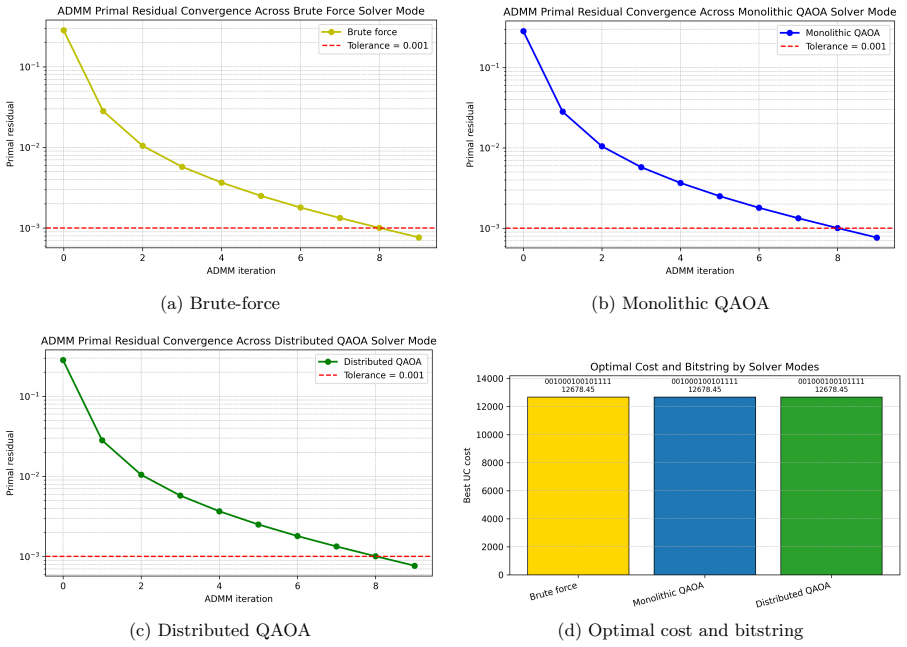
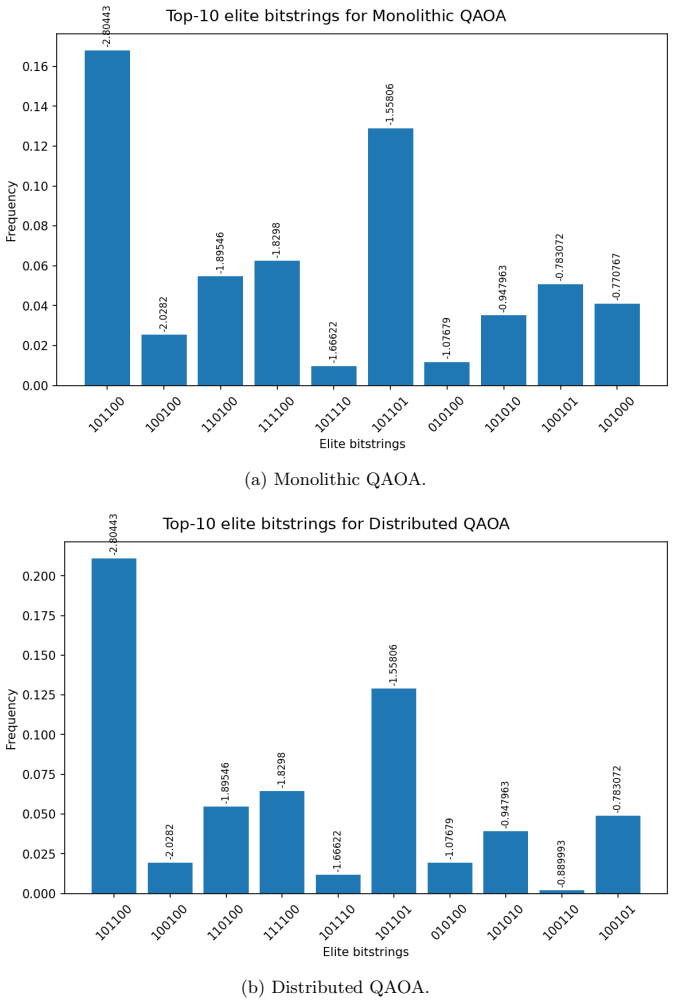
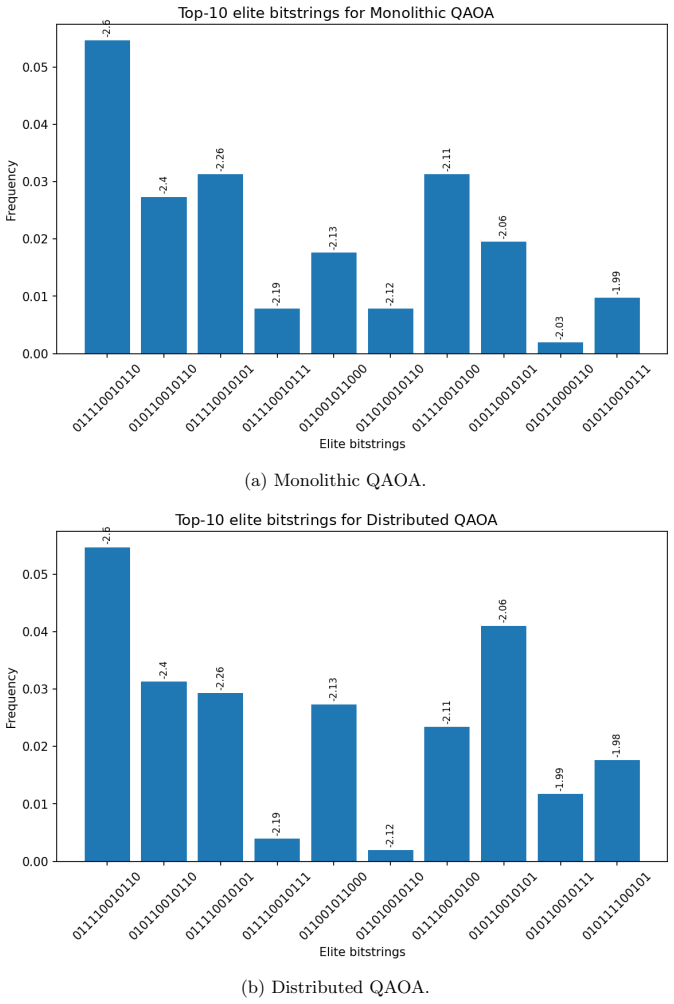
The simulator produces results consistent with classical monolithic QAOA references in terms of optimal bitstrings and costs. In the unit commitment case, brute force, monolithic QAOA, and distributed QAOA recover the same commitment bitstring and operating cost. Across multiple case studies, the simulator produces results consistent with classical monolithic QAOA references in terms of optimal bitstrings and costs.
What carries the argument
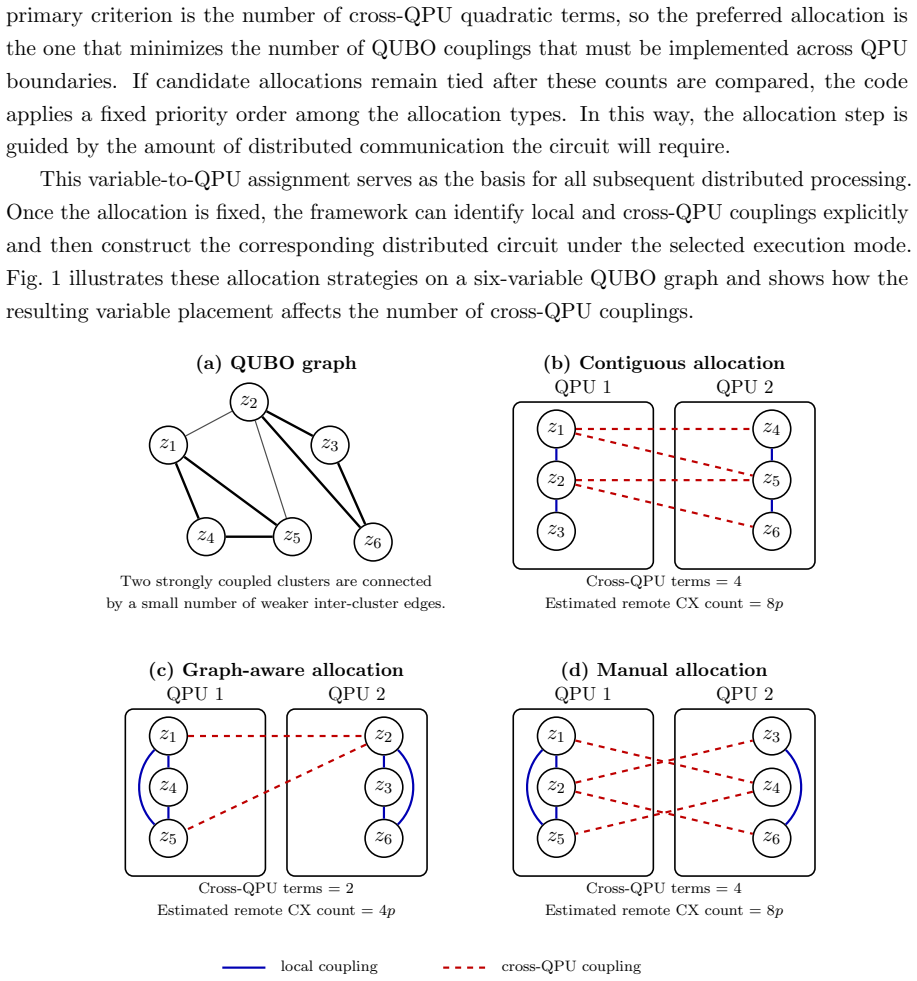
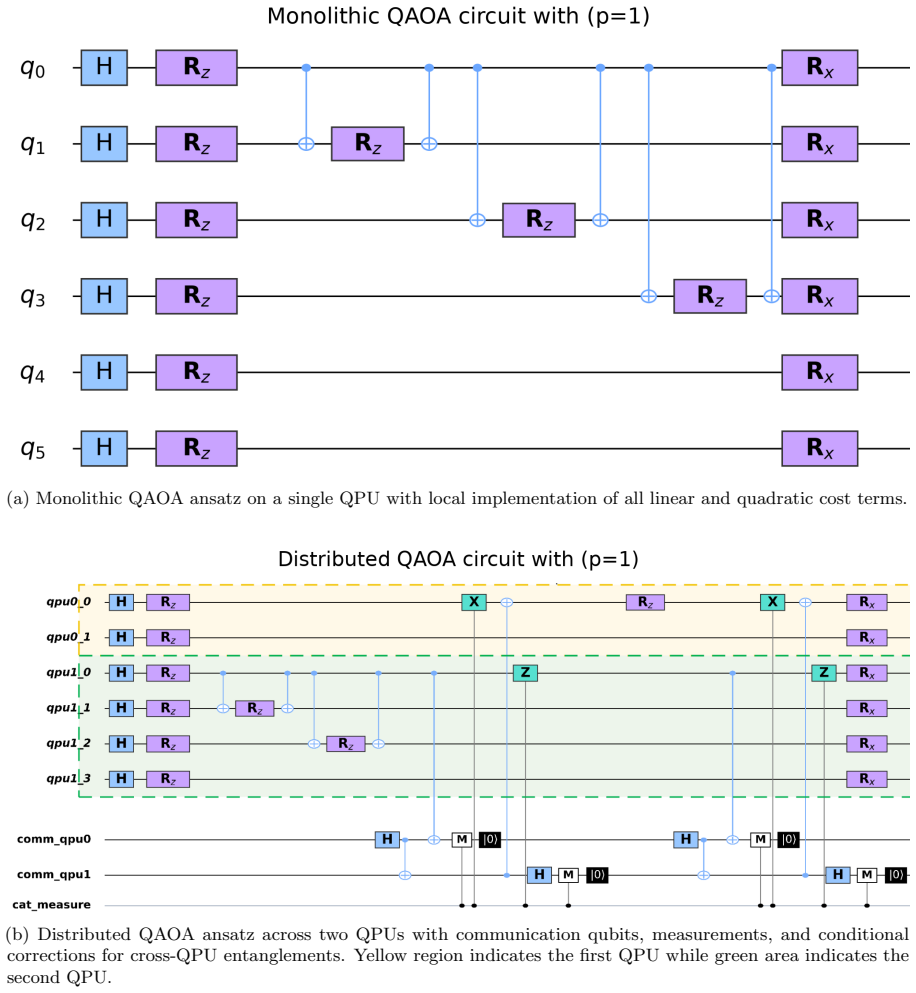
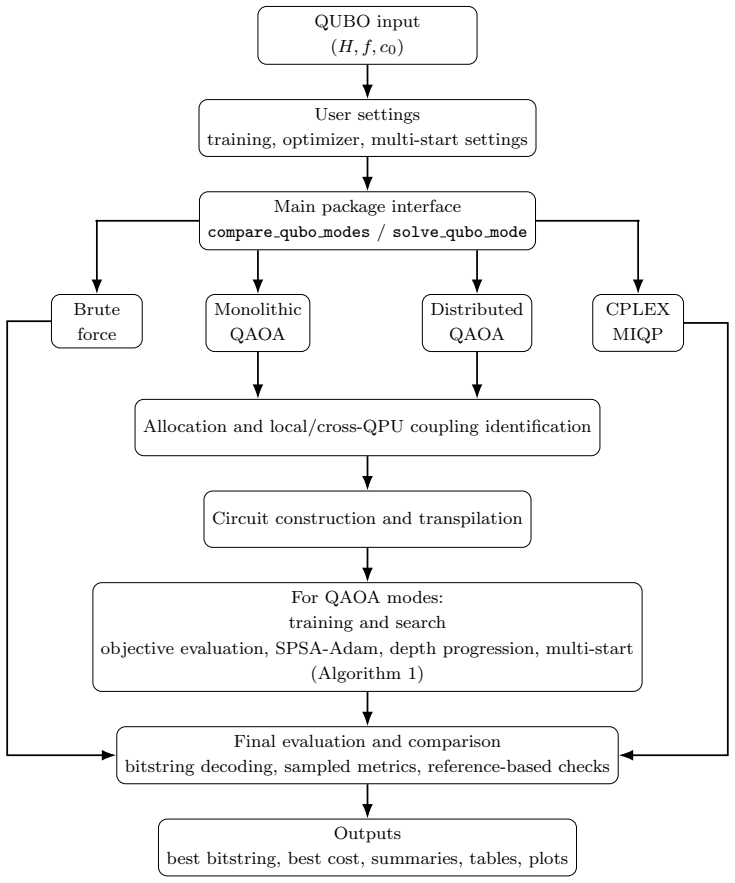
The end-to-end workflow that canonicalizes the QUBO model, maps it to a cost Hamiltonian, allocates variables across QPUs with configurable capacities, identifies local and cross-QPU couplings, and constructs the circuits, supported by runtime optimizations including parameterized circuit reuse, objective reuse at fixed depth, batched evaluations, and parallel multi-start execution.
If this is right
- The same optimal solutions can be obtained whether running QAOA on one processor or distributed across several.
- Runtime can be reduced through circuit reuse and parallel execution in the simulator.
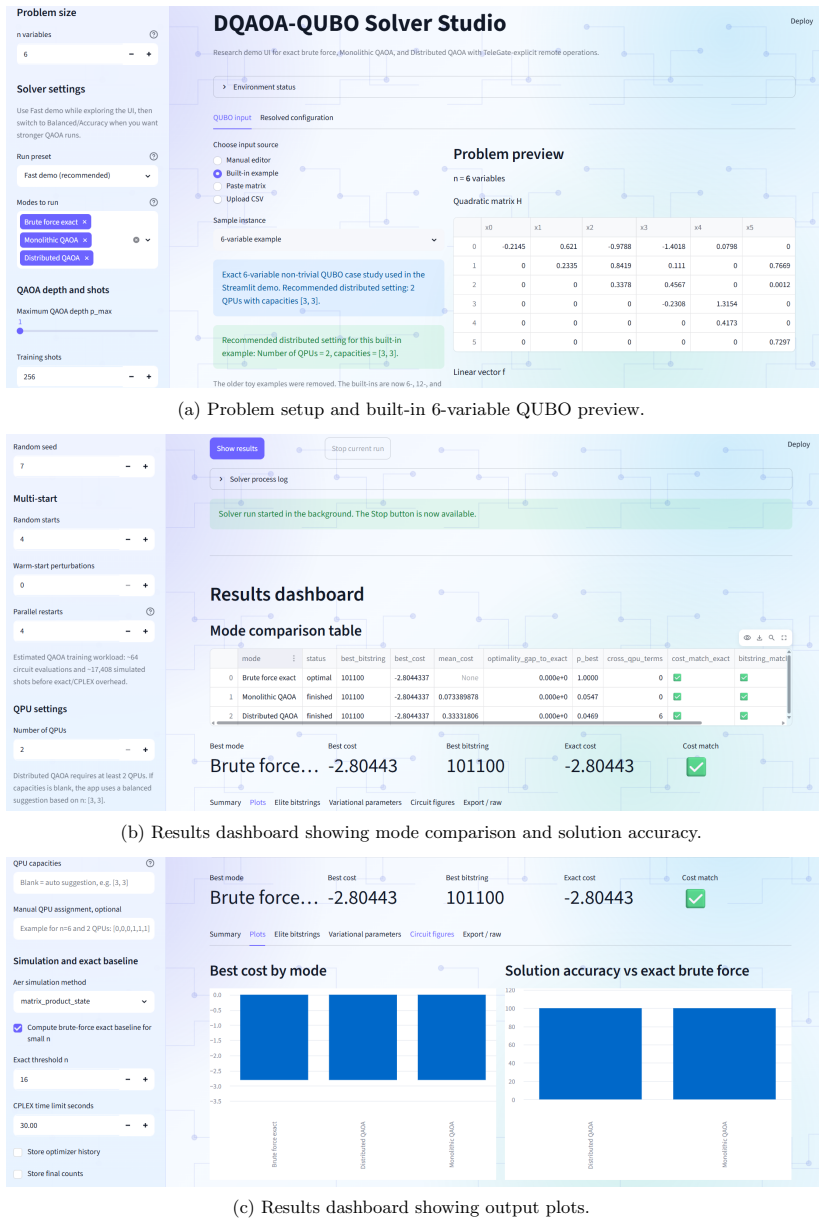
- Researchers can compare monolithic and distributed QAOA modes on the same QUBO instances using the provided GUI.
- The approach applies to power system unit commitment and other engineering decision problems modeled as QUBO.
Where Pith is reading between the lines
- If the variable allocation method avoids quality loss on larger instances, distributed QAOA could handle problems exceeding single-QPU capacity.
- The simulator's open-source nature allows extension to test distribution strategies on noisy intermediate-scale quantum devices.
- Consistent results across modes suggest that cross-QPU couplings can be managed without changing the recovered optima in these cases.
Load-bearing premise
The workflow that canonicalizes the QUBO model, maps it to a cost Hamiltonian, allocates variables across QPUs, and identifies local versus cross-QPU couplings is assumed to preserve solution quality without introducing modeling or allocation errors that would change the recovered bitstring.
What would settle it
Finding a QUBO instance where the distributed QAOA mode returns a different bitstring or higher cost than the monolithic QAOA or brute-force optimum would falsify the claim of consistency.
Figures
read the original abstract
This paper presents a Qiskit-compatible distributed quantum approximate optimization algorithm (DQAOA) simulator for quadratic unconstrained binary optimization (QUBO) problems arising in engineering design and decision applications. The open-source simulator is available through the RAISE LAB website and GitHub repository, with README documentation for installation, input formatting, configurable parameters, and example workflows. The package addresses the need for a reusable simulator that can solve and compare QUBO instances across different QAOA execution modes. It supports monolithic QAOA on a single quantum processing unit (QPU) and distributed QAOA across a user-specified number of QPUs with configurable capacities. The workflow canonicalizes the QUBO model, maps it to a cost Hamiltonian, allocates variables across QPUs, identifies local and cross-QPU couplings, and constructs the corresponding circuits. Runtime optimizations, including parameterized circuit reuse, objective reuse at fixed depth, batched evaluations, and parallel multi-start execution, reduce repeated overhead. A Streamlit graphical user interface is also provided for entering or uploading QUBO instances, configuring solver settings, running selected modes, and visualizing solution-quality metrics without editing Python scripts. The package is demonstrated on standalone QUBO benchmarks and a power generation unit commitment application. In the unit commitment case, brute force, monolithic QAOA, and distributed QAOA recover the same commitment bitstring and operating cost. Across multiple case studies, the simulator produces results consistent with classical monolithic QAOA references in terms of optimal bitstrings and costs. Staged runtime analysis shows substantial runtime reduction across implementation stages, while distributed QAOA remains more demanding because cross-QPU couplings require remote operations.
Editorial analysis
A structured set of objections, weighed in public.
Referee Report
Summary. The paper presents an open-source Qiskit-compatible simulator for distributed QAOA (DQAOA) on QUBO problems from engineering design. The tool supports monolithic QAOA on one QPU and distributed execution across user-specified QPUs, with a workflow that canonicalizes the QUBO, maps it to a cost Hamiltonian, allocates variables, identifies local vs. cross-QPU couplings, and builds circuits. Runtime optimizations (parameterized reuse, batched evaluation, parallel multi-start) and a Streamlit GUI are included. Demonstrations on benchmarks and a unit-commitment instance show that brute force, monolithic QAOA, and distributed QAOA recover identical bitstrings and costs.
Significance. If the reported consistency holds, the simulator supplies a reusable, documented platform for comparing QAOA modes on practical QUBO instances, with open-source code and GUI lowering the barrier for engineering users. The empirical end-to-end checks on concrete instances provide direct evidence that the allocation and cross-QPU handling preserve solution quality on the tested cases.
major comments (1)
- [Abstract and results section] Abstract and unit-commitment demonstration: identical bitstrings and costs are reported across brute force, monolithic QAOA, and distributed QAOA, but no quantitative error bars, iteration counts, convergence statistics, or details on how remote cross-QPU operations were validated are supplied; these would be needed to assess robustness beyond the specific instances shown.
minor comments (1)
- [Workflow description] The description of the variable-allocation step and the criterion used to classify couplings as local or cross-QPU should be expanded with a short pseudocode or explicit rule set so readers can reproduce the partitioning logic.
Simulated Author's Rebuttal
We thank the referee for the constructive review and recommendation for minor revision. We address the single major comment below and will update the manuscript accordingly.
read point-by-point responses
-
Referee: [Abstract and results section] Abstract and unit-commitment demonstration: identical bitstrings and costs are reported across brute force, monolithic QAOA, and distributed QAOA, but no quantitative error bars, iteration counts, convergence statistics, or details on how remote cross-QPU operations were validated are supplied; these would be needed to assess robustness beyond the specific instances shown.
Authors: We agree that additional quantitative details would improve clarity. In the revised manuscript we will report the iteration counts, number of multi-start runs, and any convergence statistics available from the QAOA executions on the unit-commitment instance. Because the simulator returns deterministic bitstrings for fixed parameters and the brute-force reference confirms exact agreement on the tested cases, we will explicitly note that the reported solutions are exact matches rather than statistical averages; this removes the need for error bars on these particular demonstrations. We will also add a short paragraph describing the internal validation steps used to confirm correct handling of remote cross-QPU couplings (bitstring partitioning, remote Pauli-term evaluation, and final cost reconstruction). These changes will appear in the results section and, space permitting, a brief mention in the abstract. revision: yes
Circularity Check
No significant circularity; empirical consistency checks are independent of any fitted or self-referential inputs
full rationale
The paper describes an open-source simulator implementing monolithic and distributed QAOA for QUBO problems, with workflow steps for canonicalization, Hamiltonian mapping, variable allocation, and circuit construction. Central claims rest on direct empirical comparisons: brute force, monolithic QAOA, and distributed QAOA recover identical bitstrings and costs on the unit commitment instance (and similar agreement on other benchmarks). These are end-to-end output matches on concrete instances, not predictions derived from fitted parameters or prior self-citations. No equations reduce by construction to inputs, no ansatzes are smuggled via self-citation, and no uniqueness theorems are invoked. The validation directly tests whether the full workflow preserves solution quality, making the results self-contained against external benchmarks.
Axiom & Free-Parameter Ledger
axioms (2)
- domain assumption The canonical QUBO-to-cost-Hamiltonian mapping preserves the original optimization problem.
- domain assumption Cross-QPU couplings can be handled via remote operations without changing the recovered optimal bitstring.
discussion (0)
Sign in with ORCID, Apple, or X to comment. Anyone can read and Pith papers without signing in.