Incomplete Matrix Regression
Pith reviewed 2026-06-26 01:13 UTC · model grok-4.3
The pith
Incomplete Matrix Regression recovers matrices from partial observations by combining Lasso-regularized covariates with a low-rank latent component.
A machine-rendered reading of the paper's core claim, the machinery that carries it, and where it could break.
Core claim
The authors establish that modeling an incomplete matrix as the sum of intercepts, Lasso-regularized covariate effects, and a low-rank latent component with ridge penalties on the factors for known structures yields a distribution-free completion procedure whose alternating least-squares estimator satisfies non-asymptotic error bounds and delivers competitive out-of-sample accuracy at substantially lower computational cost than existing alternatives.
What carries the argument
The IMR decomposition of the target matrix into covariate effects regularized by Lasso and a low-rank latent component estimated by modular alternating least squares.
If this is right
- Non-asymptotic error bounds are obtained that match standard Lasso and matrix-completion rates.
- The alternating least-squares algorithm is modular and permits inclusion or exclusion of individual components without rederiving updates.
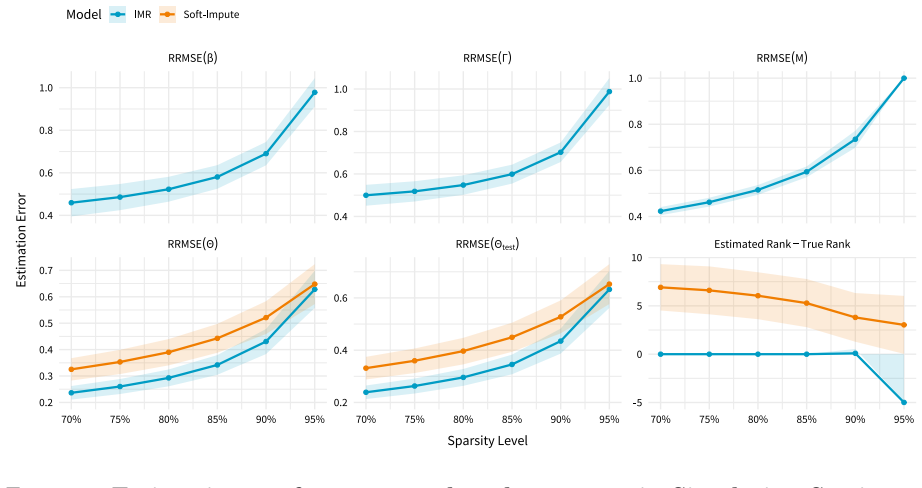
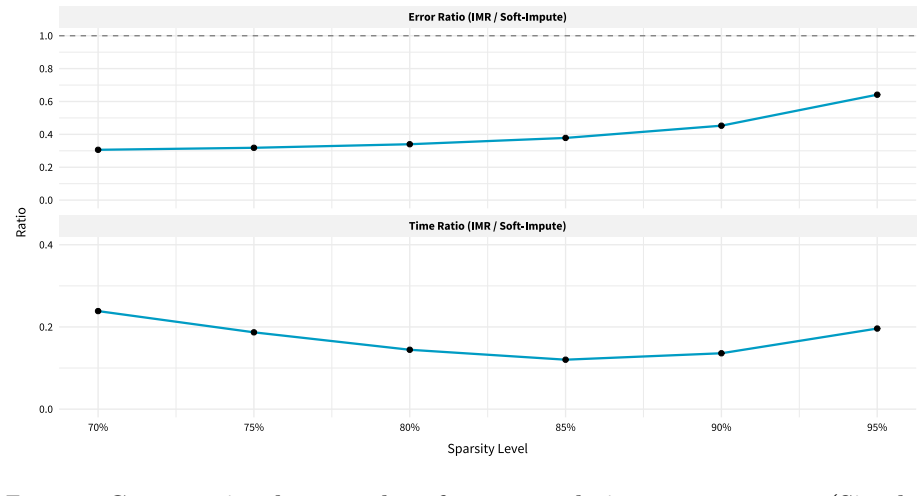
- Simulation studies demonstrate predictive accuracy competitive with more complex methods.
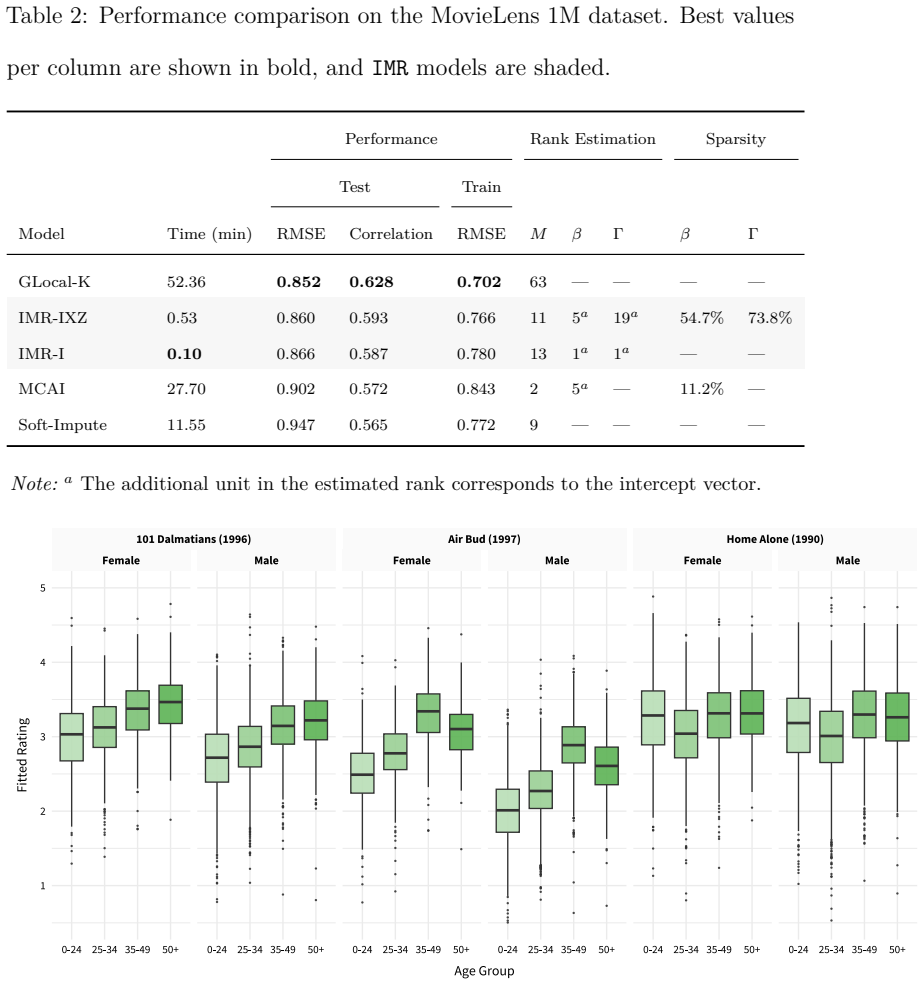
- Two real-data applications confirm practical performance at a small fraction of the computational cost of alternatives.
- An R package implements the full methodology.
Where Pith is reading between the lines
- The modular algorithm structure would allow straightforward substitution of the Lasso with other convex penalties on the covariate coefficients.
- The same decomposition could be applied to matrices observed on networks by replacing the ridge kernel penalties with graph-Laplacian penalties.
- When row and column covariates are high-dimensional, the method's computational advantage would become even more pronounced relative to joint tensor or deep-learning approaches.
Load-bearing premise
The target matrix can be expressed as the sum of intercepts, covariate effects regularized by Lasso, and a low-rank latent component.
What would settle it
A controlled simulation in which the residual matrix after removing covariate effects has no low-rank structure and IMR shows no accuracy gain over a covariate-only model would refute the added value of the latent component.
Figures
read the original abstract
Matrix completion seeks to recover a low-rank matrix from a sparse and noisy subset of its entries. In many applications, such as recommendation systems and urban mobility, the observed matrix is accompanied by auxiliary covariates on its rows and columns and exhibits dependence across them. We propose Incomplete Matrix Regression (IMR), a distribution-free penalized regression framework that integrates such information into matrix completion. The target matrix is modeled as the sum of intercepts, covariate effects regularized by a Lasso penalty, and a low-rank latent component that captures structure unexplained by the covariates. Known similarity structures, such as spatial and temporal kernels, are incorporated through ridge-type penalties on the latent factors. For estimation, we provide a scalable alternating least-squares algorithm whose modular form allows us to include or exclude individual model components without rederiving the updates. We establish non-asymptotic error bounds for both the Lasso and matrix completion estimators that are consistent with standard rates in their respective literature. Through simulation studies and two real-data applications, we demonstrate that the proposed method attains predictive accuracy competitive with more complex methods at a small fraction of their computational cost. The methodology is implemented in the R package IMR.
Editorial analysis
A structured set of objections, weighed in public.
Referee Report
Summary. The manuscript proposes Incomplete Matrix Regression (IMR), a distribution-free penalized regression framework for matrix completion with row/column covariates. The target matrix is modeled as the sum of intercepts, Lasso-regularized covariate effects, and a low-rank latent component (with ridge penalties on latent factors for known similarity structures such as spatial/temporal kernels). Estimation proceeds via a modular alternating least-squares algorithm. Non-asymptotic error bounds are established for the Lasso and matrix-completion components that match standard rates in the respective literatures. Simulations and two real-data applications are used to show competitive predictive accuracy at substantially lower computational cost than more complex alternatives; the method is released as the R package IMR.
Significance. If the empirical claims hold, the work supplies a practical, scalable bridge between Lasso regression and low-rank matrix completion that directly incorporates auxiliary covariates and known similarity kernels. The modular ALS updates are a clear implementation strength, allowing components to be added or removed without re-derivation. The provision of an R package together with simulation and real-data experiments constitutes reproducible evidence of computational and predictive performance.
minor comments (2)
- [Abstract] Abstract, paragraph 2: the modeling decomposition (intercept + Lasso covariates + low-rank latent) is stated without an explicit equation showing how the Lasso penalty on covariate coefficients and the ridge penalties on the latent factors are jointly applied; adding the precise penalized objective would improve clarity.
- The non-asymptotic bounds are asserted to be 'consistent with standard rates,' but the main text should explicitly list the assumptions (e.g., restricted eigenvalue conditions for the Lasso part, incoherence for the low-rank part) under which the combined estimator attains those rates.
Simulated Author's Rebuttal
We thank the referee for the positive summary, significance assessment, and recommendation of minor revision. The recognition of the modular ALS updates, computational advantages, and reproducible R package is appreciated. No specific major comments were provided in the report.
Circularity Check
No significant circularity identified
full rationale
The paper explicitly posits the working model as intercept + Lasso-regularized covariates + low-rank latent component, provides a modular ALS estimation procedure whose updates follow directly from the posited decomposition, and states that its non-asymptotic bounds are merely consistent with (not newly derived from) standard Lasso and matrix-completion rates in the external literature. No load-bearing step reduces by construction to a fitted input, self-citation chain, or renamed ansatz; the central claims concern empirical predictive performance and computational cost rather than a closed theoretical derivation.
Axiom & Free-Parameter Ledger
Reference graph
Works this paper leans on
-
[1]
The Annals of Statistics , volume =
Matrix Estimation by Universal Singular Value Thresholding , author =. The Annals of Statistics , volume =
-
[2]
Accuracy and Stability of Numerical Algorithms , author =
-
[3]
Matrix Completion by Singular Value Thresholding:
Klopp, Olga , year = 2015, month = jan, journal =. Matrix Completion by Singular Value Thresholding:
2015
-
[4]
The Concentration of Measure Phenomenon , author =
-
[5]
Journal of Machine Learning Research , volume =
Spectral Regularization Algorithms for Learning Large Incomplete Matrices , author =. Journal of Machine Learning Research , volume =
-
[6]
Low-Rank Interaction with Sparse Additive Effects Model for Large Data Frames , booktitle =
Robin, Genevi. Low-Rank Interaction with Sparse Additive Effects Model for Large Data Frames , booktitle =
-
[7]
, year = 2019, month = feb, publisher =
Wainwright, Martin J. , year = 2019, month = feb, publisher =. High-Dimensional Statistics: A Non-Asymptotic Viewpoint , shorttitle =
2019
-
[8]
Koltchinskii, Vladimir , year = 2011, month = jul, publisher =. Oracle
2011
-
[9]
doi: 10.1007/s10208-009-9045-5
Exact Matrix Completion via Convex Optimization , author =. Foundations of Computational Mathematics , volume =. doi:10.1007/s10208-009-9045-5 , language =
-
[10]
Transportation Research Part C: Emerging Technologies , volume =
A Nonconvex Low-Rank Tensor Completion Model for Spatiotemporal Traffic Data Imputation , author =. Transportation Research Part C: Emerging Technologies , volume =
-
[11]
Matrix Completion with Noisy Side Information , booktitle =
Chiang, Kai-Yang and Hsieh, Cho-Jui and Dhillon, Inderjit S , year = 2015, volume =. Matrix Completion with Noisy Side Information , booktitle =
2015
-
[12]
Bioinformatics , volume =
Drug Repurposing against Breast Cancer by Integrating Drug-Exposure Expression Profiles and Drug--Drug Links Based on Graph Neural Network , author =. Bioinformatics , volume =
-
[13]
Proceedings of the 30th
Han, Soyeon Caren and Lim, Taejun and Long, Siqu and Burgstaller, Bernd and Poon, Josiah , year = 2021, month = oct, series =. Proceedings of the 30th
2021
-
[14]
and Zadeh, Reza , year = 2015, month = jan, journal =
Hastie, Trevor and Mazumder, Rahul and Lee, Jason D. and Zadeh, Reza , year = 2015, month = jan, journal =. Matrix Completion and Low-Rank
2015
-
[15]
arXiv preprint arXiv:1306.0626 , doi =
Provable Inductive Matrix Completion , author =. arXiv preprint arXiv:1306.0626 , doi =. 1306.0626 , publisher =
-
[16]
Knowledge-Based Systems , volume =
Missing Data Imputation for Traffic Congestion Data Based on Joint Matrix Factorization , author =. Knowledge-Based Systems , volume =
-
[17]
Journal of Machine Learning Research , volume =
Matrix Completion with Covariate Information and Informative Missingness , author =. Journal of Machine Learning Research , volume =
-
[18]
Matrix Completion on Graphs , booktitle =
Kalofolias, Vassilis and Bresson, Xavier and Bronstein, Michael and Vandergheynst, Pierre , year = 2014, language =. Matrix Completion on Graphs , booktitle =
2014
-
[19]
Scalable Spatiotemporally Varying Coefficient Modelling with Bayesian Kernelized Tensor Regression , author =. Bayesian Analysis , volume =. doi:10.1214/24-BA1428 , archiveprefix =. 2109.00046 , primaryclass =
-
[20]
Journal of Multivariate Analysis , series =
Supervised Singular Value Decomposition and Its Asymptotic Properties , author =. Journal of Multivariate Analysis , series =
-
[21]
Statistica Sinica , volume =
Adaptive Estimation in Two-Way Sparse Reduced-Rank Regression , author =. Statistica Sinica , volume =. 26969411 , eprinttype =
-
[22]
Mathematical Programming , volume =
Fixed Point and Bregman Iterative Methods for Matrix Rank Minimization , author =. Mathematical Programming , volume =. doi:10.1007/s10107-009-0306-5 , language =
-
[23]
Journal of the American Statistical Association , volume =
Statistical Inference for Noisy Matrix Completion Incorporating Auxiliary Information , author =. Journal of the American Statistical Association , volume =
-
[24]
Journal of the American Statistical Association , author =
Matrix Completion with Covariate Information , author =. Journal of the American Statistical Association , volume =. doi:10.1080/01621459.2017.1389740 , language =
-
[25]
Journal of Systems Science and Complexity , volume =
Covariate-Assisted Matrix Completion with Multiple Structural Breaks , author =. Journal of Systems Science and Complexity , volume =. doi:10.1007/s11424-023-2342-2 , language =
-
[26]
Drug Repositioning Based on Similarity Constrained Probabilistic Matrix Factorization:
Meng, Yajie and Jin, Min and Tang, Xianfang and Xu, Junlin , year = 2021, month = may, journal =. Drug Repositioning Based on Similarity Constrained Probabilistic Matrix Factorization:
2021
-
[27]
Briefings in Bioinformatics , volume =
A Weighted Bilinear Neural Collaborative Filtering Approach for Drug Repositioning , author =. Briefings in Bioinformatics , volume =
-
[28]
Bioinformatics , volume =
Inductive Matrix Completion for Predicting Gene--Disease Associations , author =. Bioinformatics , volume =
-
[29]
Rennie, Jasson D. M. and Srebro, Nathan , year = 2005, month = aug, series =. Fast Maximum Margin Matrix Factorization for Collaborative Prediction , booktitle =
2005
-
[30]
Bioinformatics (Oxford, England) , volume =
A Network-Based Drug Repurposing Method via Non-Negative Matrix Factorization , author =. Bioinformatics (Oxford, England) , volume =. doi:10.1093/bioinformatics/btab826 , language =
-
[31]
Saxena, Ambrish , year = 2020, month = jun, journal =. Drug Targets for. doi:10.1007/s12038-020-00067-w , language =
-
[32]
Robust Reduced-Rank Regression , author =. Biometrika , volume =. doi:10.1093/biomet/asx032 , language =
-
[33]
Canadian Journal of Statistics , volume =
Noisy Matrix Completion for Longitudinal Data with Subject- and Time-Specific Covariates , author =. Canadian Journal of Statistics , volume =. doi:10.1002/cjs.70002 , copyright =
-
[34]
Sparse Reduced Rank Huber Regression in High Dimensions , author =. Journal of the American Statistical Association , volume =. doi:10.1080/01621459.2022.2050243 , pmid =
-
[35]
PLOS Computational Biology , volume =
Overlap Matrix Completion for Predicting Drug-Associated Indications , author =. PLOS Computational Biology , volume =. doi:10.1371/journal.pcbi.1007541 , language =
-
[36]
Neurocomputing , volume =
Regularized Matrix Completion with Partial Side Information , author =. Neurocomputing , volume =
-
[37]
Signal Transduction and Targeted Therapy , volume =
Artificial Intelligence in Cancer Target Identification and Drug Discovery , author =. Signal Transduction and Targeted Therapy , volume =. doi:10.1038/s41392-022-00994-0 , copyright =
-
[38]
Briefings in Bioinformatics , volume =
Predicting Drug--Disease Associations through Layer Attention Graph Convolutional Network , author =. Briefings in Bioinformatics , volume =
-
[39]
Journal of the American Statistical Association , volume =
Personalized Prediction and Sparsity Pursuit in Latent Factor Models , author =. Journal of the American Statistical Association , volume =. 24739755 , eprinttype =
-
[40]
Inductive Matrix Completion:
Zilber, Pini and Nadler, Boaz , year = 2022, month = jun, pages =. Inductive Matrix Completion:. Proceedings of the 39th
2022
discussion (0)
Sign in with ORCID, Apple, or X to comment. Anyone can read and Pith papers without signing in.