Feasibility-Aware Security-Constrained Unit Commitment via Hybrid Soft Actor-Critic with Quantum-Sampled Features
Pith reviewed 2026-06-26 01:16 UTC · model grok-4.3
The pith
A hybrid RL policy with quantum features proposes limited generator commitments that a standard MILP then recovers into feasible multi-period SCUC solutions.
A machine-rendered reading of the paper's core claim, the machinery that carries it, and where it could break.
Core claim
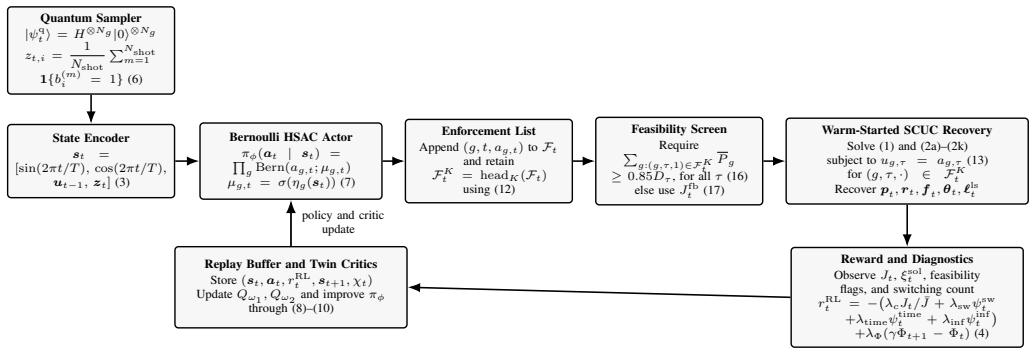
The central claim is that a three-layer architecture—Bernoulli HSAC policy proposing hourly commitments, quantum-sampled auxiliary features augmenting the state, and native SCUC MILP recovering dispatch and security after enforcing only a limited subset of the proposed binaries—yields feasible and near-optimal solutions on standard test systems, with the amount of transmitted commitment information under a fixed enforcement cap governing scalability across the 14-, 57-, and 118-bus cases.
What carries the argument
The limited-enforcement recovery interface that fixes only a capped subset of RL-proposed commitment binaries inside an otherwise standard SCUC MILP while the MILP optimizes all remaining variables under intertemporal constraints.
If this is right
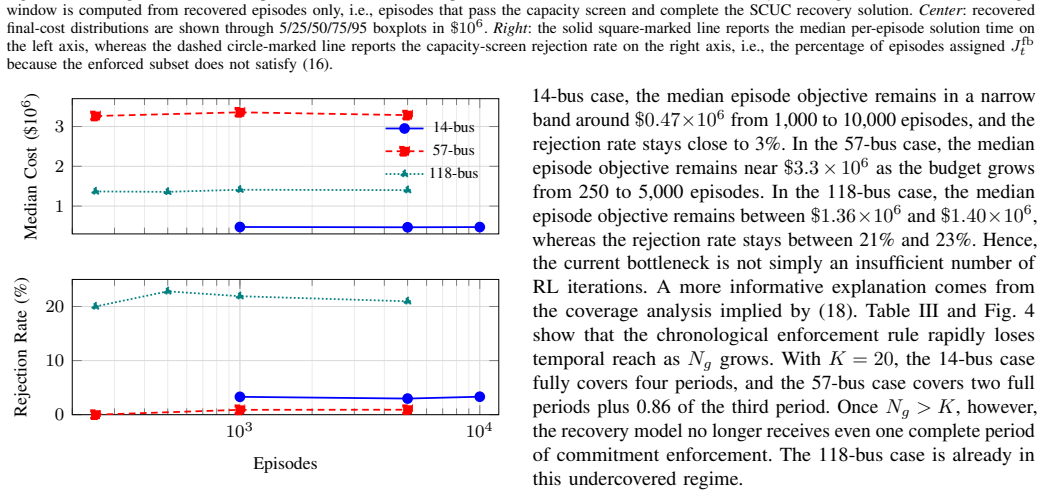
- The 14-bus case produces stable low-cost feasible recoveries.
- The 57-bus case exhibits a very low screen-rejection rate consistent with learned feasibility generalization.
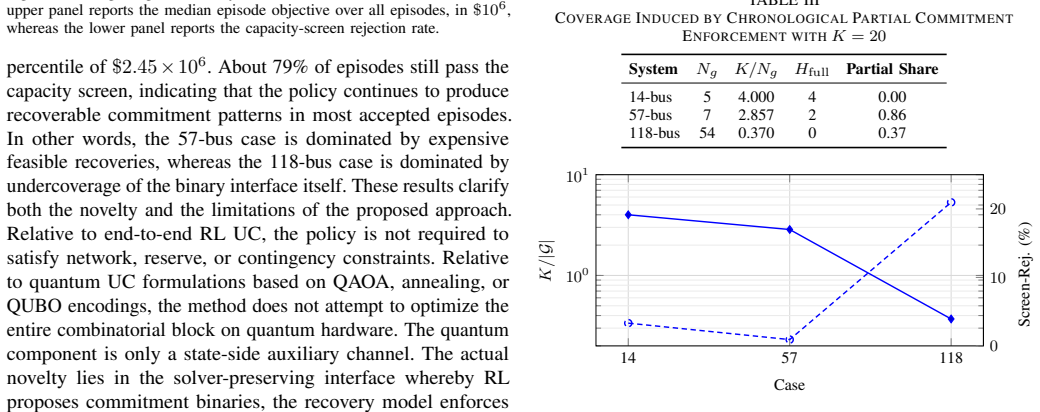
- The 118-bus case encounters a clear coverage bottleneck once the enforcement cap fails to span a complete commitment period.
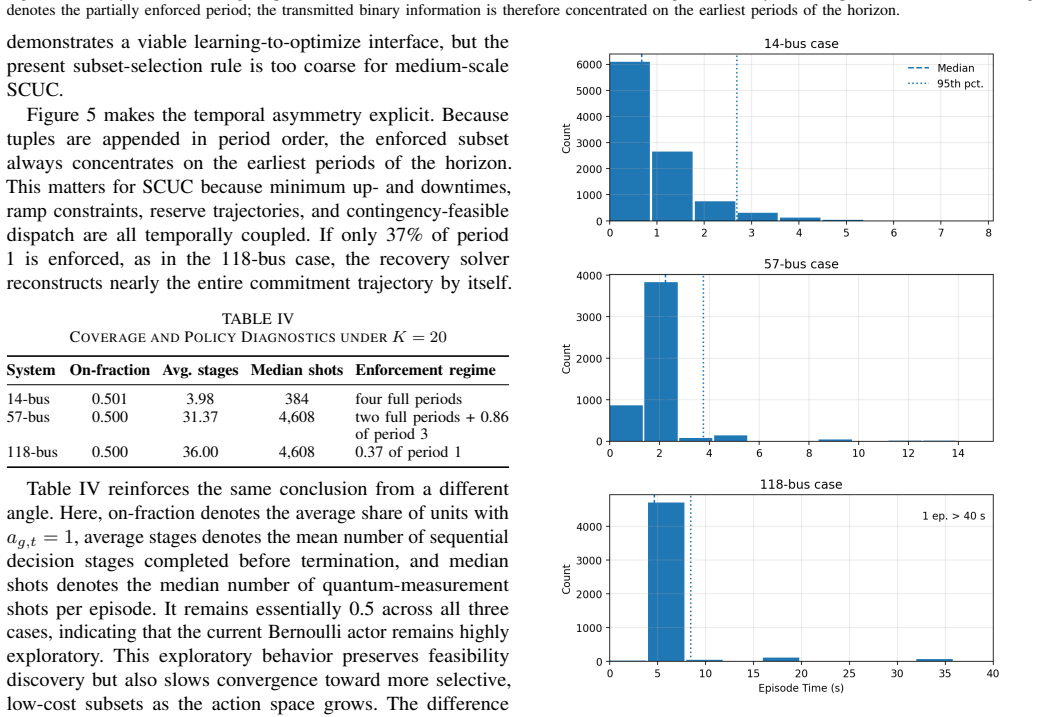
- Runtime traces for accepted 118-bus episodes remain tightly clustered, indicating repeatable recovery patterns.
Where Pith is reading between the lines
- Raising the enforcement cap size in proportion to system scale could remove the coverage bottleneck without altering the underlying MILP solver.
- Ablating the quantum-sampled channel would test whether those features materially improve the policy's ability to propose recoverable commitments.
- The same limited-enforcement pattern could be applied to other multi-period combinatorial scheduling problems that couple binary decisions with continuous optimization.
- Deriving an adaptive cap based on the commitment horizon length would provide a systematic way to maintain full-period coverage as networks grow.
Load-bearing premise
Enforcing only a limited subset of the RL-proposed commitment binaries is sufficient for the MILP to recover feasible and near-optimal solutions across the full multi-period horizon.
What would settle it
Observing a sharp rise in screen-rejection rate or infeasible MILP recoveries on the 118-bus system after the enforcement cap is increased to span an entire commitment period.
Figures


read the original abstract
Security-constrained unit commitment (SCUC) couples binary commitment, economic dispatch, reserves, and network security over a multiperiod horizon, which makes an exact solution expensive at realistic system sizes. This paper proposes a three-layer hybrid framework in which a Bernoulli hybrid soft actor-critic (HSAC) policy proposes hourly commitments, a quantum-sampled auxiliary channel augments the state, and a native SCUC mixed-integer linear program recovers dispatch and security variables after only a limited subset of commitment binaries is enforced. The method is therefore solver-compatible rather than an end-to-end replacement for exact optimization. We formalize the SCUC-to-reinforcement-learning interface, derive the temporal coverage induced by the fixed cap, and conduct representative experiments on the 14-, 57-, and 118-bus cases. The results show stable, low-cost recovery in the 14-bus case; a very low screen-rejection rate in the 57-bus case, consistent with learned feasibility generalization under fixed intertemporal SCUC constraints; and a clear coverage bottleneck in the 118-bus case once the enforcement cap no longer spans a complete commitment period. The 118-bus case runtime traces nevertheless remain tightly clustered for accepted episodes, indicating that the policy still captures a repeatable recovery pattern across most episodes. The study, therefore, identifies the dominant limitation of the current implementation as the amount of useful commitment information that reaches the recovery model under an exploratory Bernoulli actor and a small enforcement cap, and shows how that limitation governs scalability.
Editorial analysis
A structured set of objections, weighed in public.
Referee Report
Summary. The paper proposes a three-layer hybrid framework for security-constrained unit commitment (SCUC) that uses a Bernoulli hybrid soft actor-critic (HSAC) policy to propose hourly commitments, augments the state with quantum-sampled features, and then uses a native SCUC MILP to recover dispatch and security variables after enforcing only a limited subset of the commitment binaries. The authors formalize the SCUC-to-RL interface, derive the temporal coverage from the fixed enforcement cap, and present experiments on 14-, 57-, and 118-bus test cases. The results are described as showing stable low-cost recovery on the 14-bus system, very low screen-rejection on the 57-bus system, and a coverage bottleneck on the 118-bus system due to the enforcement cap not spanning a full commitment period under an exploratory Bernoulli actor. The study concludes that the dominant limitation is the amount of useful commitment information reaching the recovery model.
Significance. If the empirical findings hold, this work is significant in diagnosing a key scalability limitation in hybrid reinforcement learning approaches to large-scale SCUC problems. By explicitly identifying the coverage bottleneck arising from the fixed enforcement cap and exploratory policy, the paper provides a concrete direction for future research on improving temporal information flow in such frameworks. The formalization of the interface and the solver-compatible design (rather than end-to-end replacement) are strengths. However, the absence of detailed quantitative results in the provided description limits the immediate impact.
major comments (1)
- [Abstract] Abstract: The abstract states experimental outcomes on standard test cases and identifies a coverage bottleneck, but supplies no quantitative results, error bars, statistical tests, or method details. Central claims about feasibility generalization and scalability limits rest on unreported evidence, which is load-bearing for assessing the diagnosis of the information bottleneck.
Simulated Author's Rebuttal
We thank the referee for the constructive review and recommendation for major revision. We agree that the abstract would be strengthened by the inclusion of quantitative results to better substantiate the reported outcomes and the diagnosed coverage bottleneck. We will revise the abstract accordingly while preserving its conciseness.
read point-by-point responses
-
Referee: [Abstract] Abstract: The abstract states experimental outcomes on standard test cases and identifies a coverage bottleneck, but supplies no quantitative results, error bars, statistical tests, or method details. Central claims about feasibility generalization and scalability limits rest on unreported evidence, which is load-bearing for assessing the diagnosis of the information bottleneck.
Authors: We acknowledge that the current abstract presents results qualitatively to remain within typical length constraints. We agree this limits immediate verifiability of the claims. In the revised version we will incorporate concise quantitative highlights drawn from the experiments, such as average objective values and variability for the 14-bus case, the screen-rejection rate for the 57-bus case, and explicit coverage or bottleneck indicators for the 118-bus case. This addition will be made without introducing new method details beyond what is already summarized, thereby directly addressing the concern while keeping the abstract focused on the core findings and limitation. revision: yes
Circularity Check
No significant circularity; empirical method with explicit limitation diagnosis
full rationale
The paper describes a hybrid RL-MILP framework for SCUC, formalizes the interface, derives temporal coverage from the fixed enforcement cap (a direct mathematical consequence of the cap size and Bernoulli actor), and reports empirical results on 14/57/118-bus cases that illustrate the coverage bottleneck rather than claiming universal sufficiency. No derivation reduces to fitted parameters by construction, no load-bearing self-citation chain, and no ansatz or uniqueness theorem imported from prior author work. The central contribution is the identification of the information bottleneck under the stated constraints, which is externally falsifiable via the reported runtimes and rejection rates.
Axiom & Free-Parameter Ledger
Reference graph
Works this paper leans on
-
[1]
Security-constrained unit commitment for electricity market: Modeling, solution methods, and future challenges,
Y . Chenet al., “Security-constrained unit commitment for electricity market: Modeling, solution methods, and future challenges,”IEEE Trans. Power Syst., vol. 38, no. 5, pp. 4668–4681, Sep. 2023
2023
-
[2]
Machine learning approaches to the unit commitment problem: Current trends, emerging challenges, and new strategies,
Y . Yang and L. Wu, “Machine learning approaches to the unit commitment problem: Current trends, emerging challenges, and new strategies,”Electr. J., vol. 34, no. 1, Jan.-Feb. 2021, Art. no. 106889
2021
-
[3]
Learning to solve large-scale security-constrained unit commitment problems,
Á. S. Xavier, F. Qiu, and S. Ahmed, “Learning to solve large-scale security-constrained unit commitment problems,”INFORMS J. Comput., vol. 33, no. 2, pp. 739–756, 2021
2021
-
[4]
Is learning for the unit commitment problem a low-hanging fruit?
S. Pineda and J. M. Morales, “Is learning for the unit commitment problem a low-hanging fruit?”Electr. Power Syst. Res., vol. 207, 2022, Art. no. 107851
2022
-
[5]
Deep reinforcement learning explanation-assisted integer variable reduction method for security- constrained unit commitment,
Y . Dai, W. Xu, M. Yan, F. Xue, and J. Zhao, “Deep reinforcement learning explanation-assisted integer variable reduction method for security- constrained unit commitment,”Eng. Appl. Artif. Intell., vol. 144, Mar. 2025, Art. no. 110139
2025
-
[6]
Feasibility-guaranteed machine learning unit commitment: Fuzzy optimization approaches,
B. Venkatesh, M. I. A. Shekeew, and J. Ma, “Feasibility-guaranteed machine learning unit commitment: Fuzzy optimization approaches,” Appl. Energy, vol. 379, Feb. 2025, Art. no. 124923
2025
-
[7]
G. Wang, J. Wu, Y . Weng, and B. Zhang, “Structure-aware commitment re- duction for network-constrained unit commitment with solver-preserving guarantees,”arXiv preprint arXiv:2604.02788, 2026
Pith/arXiv arXiv 2026
-
[8]
Successive fixing for large-scale security-constrained unit commitment using first-order methods,
J. Xionget al., “Successive fixing for large-scale security-constrained unit commitment using first-order methods,”arXiv preprint arXiv:2510.10891, 2025
arXiv 2025
-
[9]
Applying reinforcement learning and tree search to the unit commitment problem,
P. de Mars and A. O’Sullivan, “Applying reinforcement learning and tree search to the unit commitment problem,”Appl. Energy, vol. 302, Nov. 2021, Art. no. 117519
2021
-
[10]
Reinforcement learning and A* search for the unit commitment problem,
P. de Mars and A. O’Sullivan, “Reinforcement learning and A* search for the unit commitment problem,”Energy AI, vol. 9, Aug. 2022, Art. no. 100179
2022
-
[11]
An optimization method- assisted ensemble deep reinforcement learning algorithm to solve unit commitment problems,
J. Qin, Y . Gao, M. A. Bragin, and N. Yu, “An optimization method- assisted ensemble deep reinforcement learning algorithm to solve unit commitment problems,”IEEE Access, vol. 11, pp. 100 125–100 136, 2023
2023
-
[12]
Deep reinforcement learning-assisted convex programming for AC unit commitment and its variants,
A. R. Sayedet al., “Deep reinforcement learning-assisted convex programming for AC unit commitment and its variants,”IEEE Trans. Power Syst., vol. 39, no. 4, pp. 5561–5574, Jul. 2024
2024
-
[13]
Deep reinforcement learning based model-free optimization for unit commitment against wind power uncertainty,
G. Xu, Z. Lin, L. Wu, K. L. Chan, and J. Zhang, “Deep reinforcement learning based model-free optimization for unit commitment against wind power uncertainty,”Int. J. Electr. Power Energy Syst., vol. 155, Jan. 2024, Art. no. 109526
2024
-
[14]
Look-ahead unit commitment with adaptive horizon based on deep reinforcement learning,
J. Yanet al., “Look-ahead unit commitment with adaptive horizon based on deep reinforcement learning,”IEEE Trans. Power Syst., vol. 39, no. 2, pp. 3673–3684, Mar. 2024
2024
-
[15]
Expert knowledge data-driven based actor-critic reinforcement learning framework to solve computationally expensive unit commitment problems with uncertain wind energy,
H. Liang, C. Lin, and A. Pang, “Expert knowledge data-driven based actor-critic reinforcement learning framework to solve computationally expensive unit commitment problems with uncertain wind energy,”Int. J. Electr. Power Energy Syst., vol. 159, Aug. 2024, Art. no. 110033
2024
-
[16]
Graph reinforcement learning with auxiliary temporal-graph convolutional neural network for unit commitment,
W. Lu, Y . Zhang, Y . Zhu, M. Xia, and Z. Han, “Graph reinforcement learning with auxiliary temporal-graph convolutional neural network for unit commitment,”Int. J. Electr. Power Energy Syst., vol. 176, Mar. 2026, Art. no. 111708
2026
-
[17]
Adapting quantum approximation optimization algorithm (QAOA) for unit commitment,
S. Koretskyet al., “Adapting quantum approximation optimization algorithm (QAOA) for unit commitment,” inProc. IEEE Int. Conf. Quantum Comput. Eng. (QCE), 2021, pp. 181–187
2021
-
[18]
Novel resolution of unit commitment problems through quantum surrogate Lagrangian relaxation,
F. Feng, P. Zhang, M. A. Bragin, and Y . Zhou, “Novel resolution of unit commitment problems through quantum surrogate Lagrangian relaxation,” IEEE Trans. Power Syst., vol. 38, no. 3, pp. 2460–2471, May 2023
2023
-
[19]
A fast quantum algorithm for searching the quasi-optimal solutions of unit commitment,
X. Zheng, J. Wang, and M. Yue, “A fast quantum algorithm for searching the quasi-optimal solutions of unit commitment,”IEEE Trans. Power Syst., vol. 39, no. 2, pp. 4755–4758, Mar. 2024
2024
-
[20]
Quantum reinforcement learning based two-stage unit commitment with integration of virtual power plants and renewable energy,
X. Weiet al., “Quantum reinforcement learning based two-stage unit commitment with integration of virtual power plants and renewable energy,”J. Mod. Power Syst. Clean Energy, pp. 1–12, 2026, early access
2026
-
[21]
Qubit-efficient quantum annealing for stochastic unit commitment,
W. Hong, W. Xu, and F. Teng, “Qubit-efficient quantum annealing for stochastic unit commitment,”arXiv preprint arXiv:2502.15917v2, 2026
Pith/arXiv arXiv 2026
-
[22]
A hybrid classical-quantum approach to highly constrained unit commitment problems,
B. Salgado, A. Sequeira, and L. P. Santos, “A hybrid classical-quantum approach to highly constrained unit commitment problems,”arXiv preprint arXiv:2412.11312, 2024
arXiv 2024
-
[23]
Exact quantum algorithm for unit commitment optimization based on partially connected quantum neural networks,
J. Liu, X. Zhou, Z. Zhou, and L. Luo, “Exact quantum algorithm for unit commitment optimization based on partially connected quantum neural networks,”Chin. Phys. B, vol. 34, no. 10, 2025, Art. no. 100303
2025
-
[24]
A new hybrid quantum-classical algorithm for solving the unit commitment problem,
W. Aboumrad, P. R. V . Marthi, S. Debnath, M. Roetteler, and E. Epi- fanovsky, “A new hybrid quantum-classical algorithm for solving the unit commitment problem,” inProc. IEEE Int. Conf. Quantum Comput. Eng. (QCE), 2025, pp. 1905–1915
2025
-
[25]
Distributed quantum generalized Benders decomposition for unit commitment problems,
F. Gaoet al., “Distributed quantum generalized Benders decomposition for unit commitment problems,”Quantum Inf. Process., vol. 24, 2025, Art. no. 376
2025
-
[26]
D 2-UC: A distributed-distributed quantum-classical framework for unit commitment,
M. Hasanzadeh and A. Kargarian, “D 2-UC: A distributed-distributed quantum-classical framework for unit commitment,”arXiv preprint arXiv:2511.03104, 2025
arXiv 2025
-
[27]
A survey on applications of quantum computing for unit commitment,
M. Hasanzadeh and A. Kargarian, “A survey on applications of quantum computing for unit commitment,”arXiv preprint arXiv:2601.01777, 2026
arXiv 2026
-
[28]
Quantum annealing for optimizing unit scheduling in renewable energy systems: Formulation and evaluation,
S. Müller, M. Dukalski, and F. Phillipson, “Quantum annealing for optimizing unit scheduling in renewable energy systems: Formulation and evaluation,”IEEE Trans. Power Syst., vol. 41, no. 2, pp. 836–846, Mar. 2026
2026
-
[29]
Leveraging quantum comput- ing for accelerated classical algorithms in power systems optimization,
R. Barrass, H. Nagarajan, and C. Coffrin, “Leveraging quantum comput- ing for accelerated classical algorithms in power systems optimization,” inIntegration of Constraint Programming, Artificial Intelligence, and Operations Research (CPAIOR), G. Tack, Ed. Cham: Springer Nature Switzerland, 2025, pp. 52–67
2025
-
[30]
UnitCommitment.jl: A Julia/JuMP optimization package for security- constrained unit commitment,
A. S. Xavier, A. M. Kazachkov, O. Yurdakul, J. He, and F. Qiu, “UnitCommitment.jl: A Julia/JuMP optimization package for security- constrained unit commitment,” Zenodo, 2024
2024
-
[31]
Soft actor-critic: Off- policy maximum entropy deep reinforcement learning with a stochastic actor,
T. Haarnoja, A. Zhou, P. Abbeel, and S. Levine, “Soft actor-critic: Off- policy maximum entropy deep reinforcement learning with a stochastic actor,” inProc. 35th Int. Conf. Mach. Learn. (ICML), 2018, pp. 1861– 1870
2018
-
[32]
JuMP 1.0: Recent improvements to a modeling language for mathematical optimization,
M. Lubinet al., “JuMP 1.0: Recent improvements to a modeling language for mathematical optimization,”Math. Program. Comput., vol. 15, pp. 581–589, 2023
2023
discussion (0)
Sign in with ORCID, Apple, or X to comment. Anyone can read and Pith papers without signing in.