Nuclear Isomers and Their Impact on Gamma-Ray Emission in Binary Neutron Star Mergers
Pith reviewed 2026-06-26 00:47 UTC · model grok-4.3
The pith
Nuclear isomers tracked dynamically in r-process networks produce gamma-ray lines detectable at galactic distances from neutron star mergers.
A machine-rendered reading of the paper's core claim, the machinery that carries it, and where it could break.
Core claim
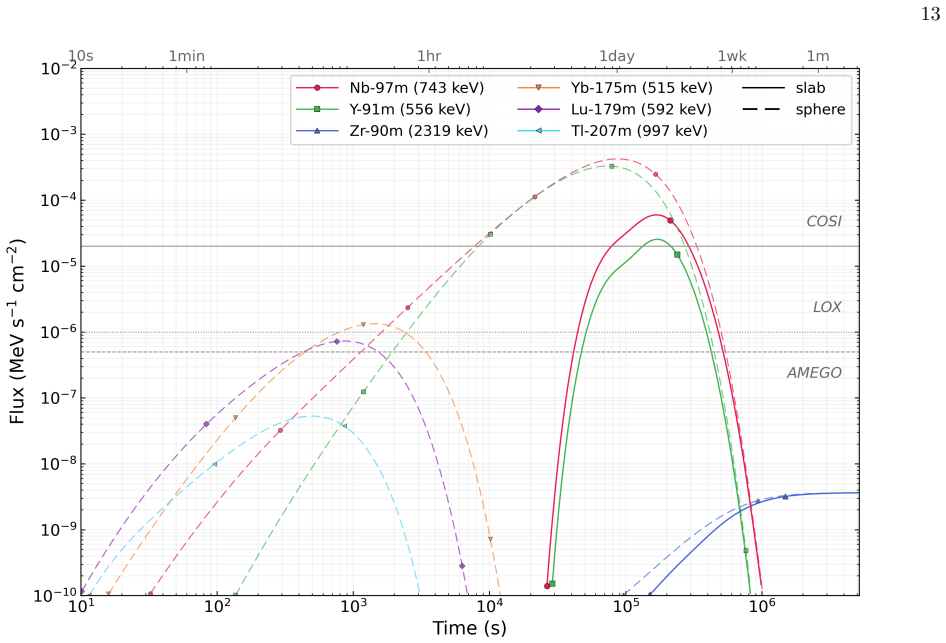
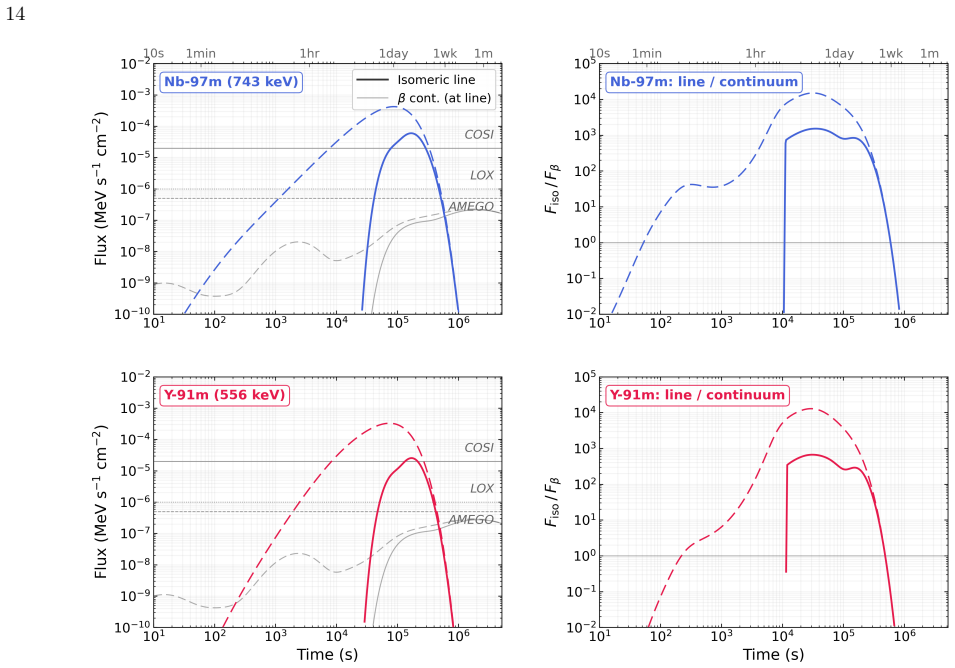
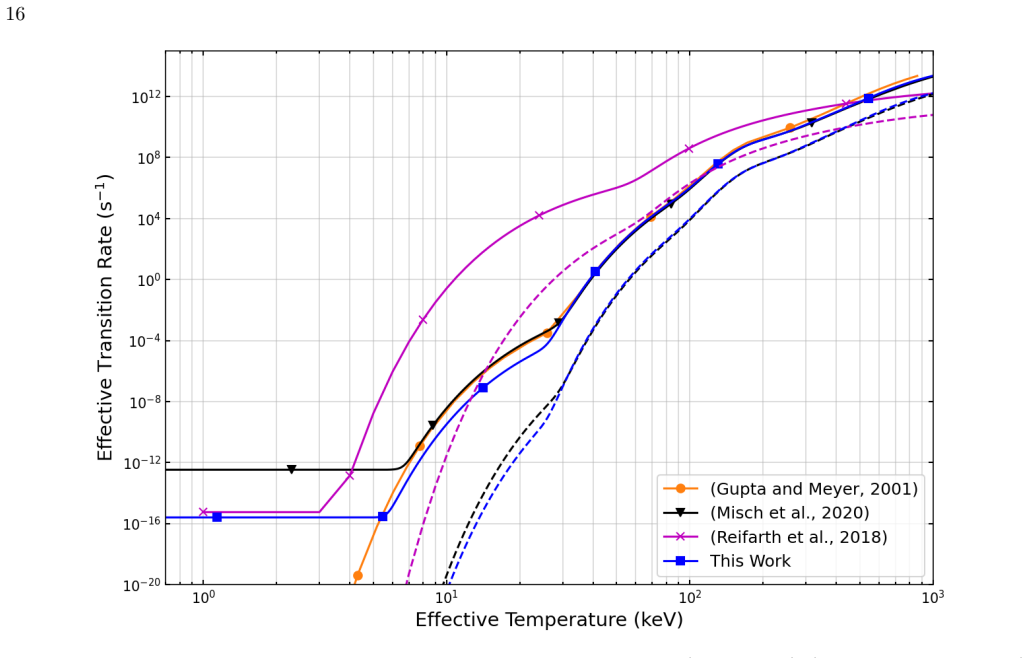
By including nuclear isomers as independent states in the nuclear reaction network with temperature-dependent effective transition rates between ground and isomeric states and beta-feeding probabilities calculated using the nuclear level structure, the gamma-ray flux from isomeric transitions is estimated, finding that the 743.3 keV line of Nb-97m and the 555.6 keV line of Y-91m may be detectable in gamma-ray observatories such as COSI, AMEGO, and LOX at galactic distances.
What carries the argument
Nuclear isomers modeled as independent states in the reaction network with temperature-dependent effective transition rates and beta-feeding probabilities.
If this is right
- Gamma-ray spectra from mergers include contributions from longer-lived isomeric states beyond ground-state decays.
- The 743.3 keV and 555.6 keV lines reach detectable fluxes at galactic distances.
- Robust inclusion of nuclear isomers across more nuclei is required for accurate gamma-ray modeling.
- Careful modeling of the resultant gamma-ray spectroscopy is needed to characterize observational signals.
Where Pith is reading between the lines
- Detection of these lines would confirm the presence of the corresponding r-process nuclei in the merger ejecta.
- Extending the isomer treatment to additional nuclei could reveal more lines or alter the total gamma-ray flux estimate.
- The same dynamic isomer modeling could be applied to other sites of heavy-element nucleosynthesis.
Load-bearing premise
The selected list of nuclei with isomers is representative of the broader set of r-process nuclei that possess isomers.
What would settle it
Non-detection of the 743.3 keV Nb-97m and 555.6 keV Y-91m lines in gamma-ray observations of a galactic-distance binary neutron star merger by COSI, AMEGO, or LOX.
Figures
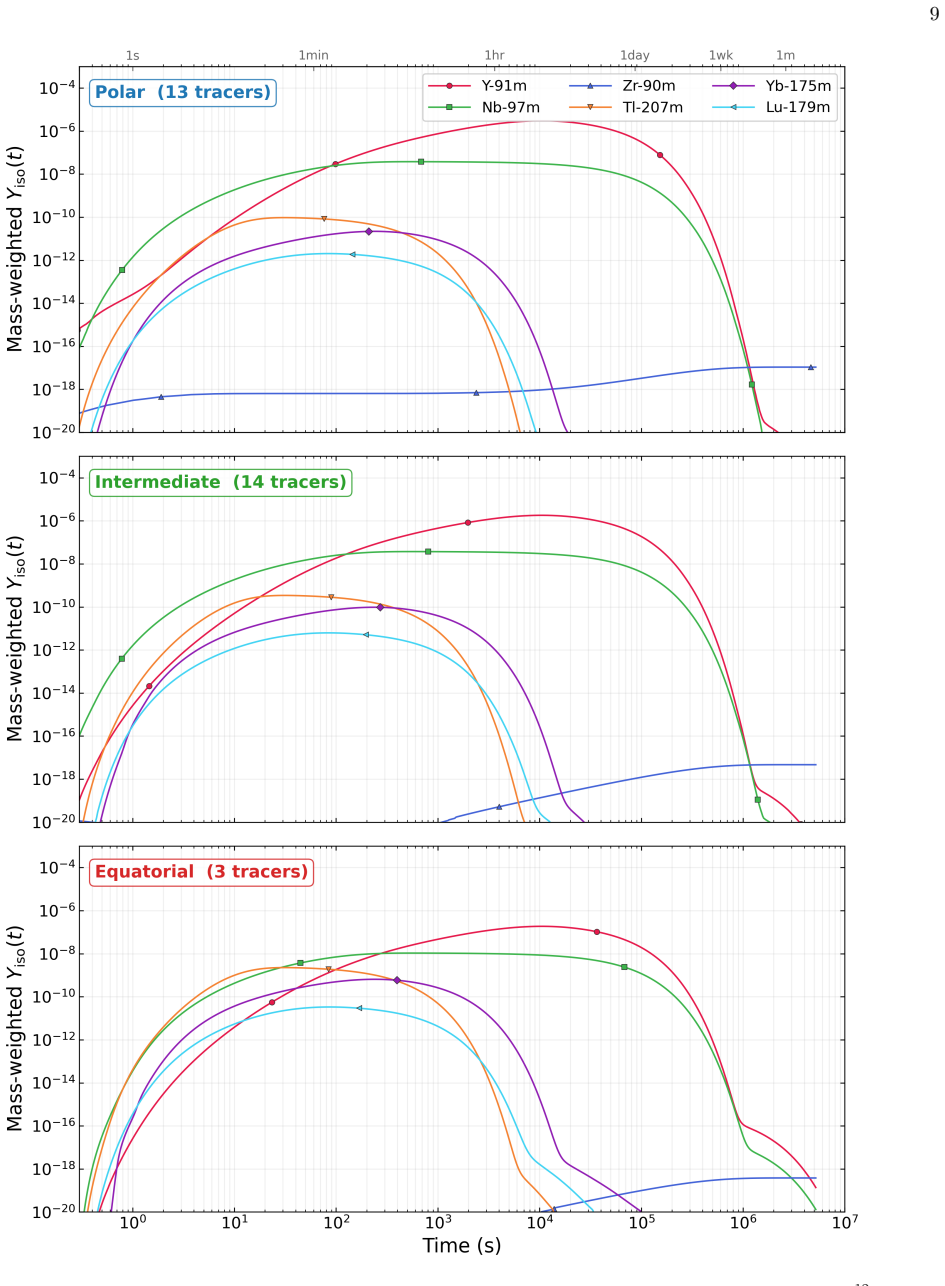
read the original abstract
The multi-messenger observations of GW170817 have provided strong evidence that binary neutron star mergers are a site of heavy-element production through the rapid neutron capture process. The decay of unstable $r$-process nuclei produces a significant number of $\gamma$-rays, which not only power the associated kilonova, but may also be observable in current and future $\gamma$-ray observatories, providing a direct probe of the nuclei synthesized. Current models of the emitted $\gamma$-rays link a nuclear reaction network with individual decay spectra. Typically, only the population of the ground state of the nuclei is tracked in the reaction network, and rapid de-excitation of the daughter nuclei is assumed when calculating the decay spectra. This may not be accurate in nuclei where there are longer-lived, high-energy nuclear isomers. In this work, we relax these assumptions, modeling the dynamic behavior of nuclear isomers for a select list of nuclei. These isomers are included as independent states in the network, with temperature-dependent effective transition rates between ground and isomeric states and $\beta$-feeding probabilities calculated using the nuclear level structure. We estimate the $\gamma$-ray flux from isomeric transitions, finding that the 743.3 keV line of Nb-97m and the 555.6 keV line of Y-91m may be detectable in $\gamma$-ray observatories such as COSI, AMEGO, and LOX at galactic distances. These results, calculated for a small fraction of nuclei with isomers, highlight the need for the robust inclusion of nuclear isomers in nuclear reaction networks, as well as careful modeling of the resultant $\gamma$-ray spectroscopy to characterize observational signals.
Editorial analysis
A structured set of objections, weighed in public.
Referee Report
Summary. The paper extends r-process reaction networks for binary neutron star mergers by treating a select list of nuclear isomers as independent states with temperature-dependent transition rates and β-feeding probabilities derived from nuclear level structure. It computes the resulting γ-ray line fluxes and identifies the 743.3 keV line of Nb-97m and the 555.6 keV line of Y-91m as potentially detectable at galactic distances by instruments such as COSI, AMEGO, and LOX, while noting that the modeled set covers only a small fraction of isomeric nuclei and calling for broader inclusion.
Significance. If the modeling approach proves robust when extended, the work would establish that isomeric states can produce observable γ-ray lines distinct from ground-state decays, offering a new spectroscopic probe of r-process yields in mergers. The explicit call for network expansion is a constructive acknowledgment of current limitations.
major comments (2)
- [Abstract] Abstract: The detectability claim for the 743.3 keV Nb-97m and 555.6 keV Y-91m lines rests on a reaction network that includes only a select list of isomers explicitly described as covering 'a small fraction' of nuclei with isomers. No test is presented showing that the predicted fluxes remain stable or that signal-to-noise is unaffected when additional isomers are incorporated, making the representativeness assumption load-bearing for the central observational result.
- [Abstract] Abstract: No error bars, sensitivity tests, or validation against known isomer populations or decay data are reported for the flux estimates, leaving the quantitative basis for the 'may be detectable' statement unquantified.
minor comments (2)
- The manuscript would benefit from a table or section listing the exact nuclei and isomers included, together with the nuclear data sources used for level structure and transition rates.
- Clarify whether the temperature-dependent effective rates are computed on-the-fly during the network evolution or pre-tabulated, and how this choice affects computational cost and accuracy.
Simulated Author's Rebuttal
We thank the referee for their constructive and insightful comments, which help clarify the limitations of our current modeling approach. We address each major comment below and indicate where revisions will be made to the manuscript.
read point-by-point responses
-
Referee: [Abstract] Abstract: The detectability claim for the 743.3 keV Nb-97m and 555.6 keV Y-91m lines rests on a reaction network that includes only a select list of isomers explicitly described as covering 'a small fraction' of nuclei with isomers. No test is presented showing that the predicted fluxes remain stable or that signal-to-noise is unaffected when additional isomers are incorporated, making the representativeness assumption load-bearing for the central observational result.
Authors: We agree that the representativeness of the select list is an important caveat for the detectability claims. The manuscript already states that the modeled set covers only a small fraction of isomeric nuclei and explicitly calls for broader inclusion. The specific lines identified (743.3 keV from Nb-97m and 555.6 keV from Y-91m) arise directly from the isomers we have included as independent states. We do not claim these fluxes are representative of the full set of isomers; rather, they demonstrate that isomeric transitions can produce distinct observable lines. A full stability test with additional isomers is not feasible at present due to incomplete nuclear data for the full set of r-process nuclei. In the revised manuscript we will expand the abstract and conclusions to more explicitly qualify the detectability statements as applying to the current select list and to note that additional isomers could alter the continuum background without removing the distinct line signatures from the included states. revision: partial
-
Referee: [Abstract] Abstract: No error bars, sensitivity tests, or validation against known isomer populations or decay data are reported for the flux estimates, leaving the quantitative basis for the 'may be detectable' statement unquantified.
Authors: The referee is correct that the current version provides no error bars, sensitivity tests, or direct validation of the flux estimates against independent isomer data. The fluxes are computed from the temperature-dependent rates and β-feeding probabilities derived from the nuclear level structure for the included isomers. In the revised manuscript we will add a dedicated paragraph in the methods or results section discussing the principal sources of uncertainty (nuclear level energies, transition rates, and β-branching ratios) and will qualify the abstract language to reflect that the 'may be detectable' assessment is based on the central values from the present network without quantified uncertainties. A comprehensive sensitivity study and validation against measured isomer populations will be reserved for future work that expands the isomer set. revision: yes
Circularity Check
No significant circularity; derivation uses external nuclear data with explicit scope limitation
full rationale
The paper tracks a select list of isomers as independent states in the reaction network using temperature-dependent rates and beta-feeding from nuclear level structure data. Gamma-ray fluxes for the quoted lines are computed directly from those external inputs. The abstract explicitly states the list covers only a small fraction and calls for broader inclusion, without claiming representativeness or deriving any prediction by fitting to the same data. No self-citation chains, self-definitional loops, or fitted-input-as-prediction steps appear in the provided text. The central claim remains a forward calculation from independent nuclear data, making the work self-contained against external benchmarks.
Axiom & Free-Parameter Ledger
free parameters (1)
- select list of nuclei with isomers
axioms (1)
- domain assumption Nuclear level structure data can be used to compute temperature-dependent effective transition rates and beta-feeding probabilities between ground and isomeric states
Reference graph
Works this paper leans on
-
[1]
Abbott, B. P., Abbott, R., Abbott, T. D., et al. 2017, ApJL, 848, L13, doi: 10.3847/2041-8213/aa920c
-
[2]
Agency, I. A. E. 2009, LiveChart of Nuclides,, https://https://www- nds.iaea.org/relnsd/vcharthtml/VChartHTML.html
2009
-
[3]
2016, ApJ, 829, 110, doi: 10.3847/0004-637X/829/2/110
Barnes, J., Kasen, D., Wu, M.-R., & Mart´ ınez-Pinedo, G. 2016, ApJ, 829, 110, doi: 10.3847/0004-637X/829/2/110
-
[4]
2025, MNRAS, 542, 256, doi: 10.1093/mnras/staf1147
Bernuzzi, S., Magistrelli, F., Jacobi, M., et al. 2025, MNRAS, 542, 256, doi: 10.1093/mnras/staf1147
-
[5]
Blatt, J. M., & Weisskopf, V. F. 1952, Theoretical nuclear physics (New York: Springer), doi: 10.1007/978-1-4612-9959-2
-
[6]
Center, N. N. D. 2004, Evaluated Nuclear Structure Data File,, https://www.nndc.bnl.gov
2004
-
[7]
Chen, M.-H., Hu, R.-C., & Liang, E.-W. 2022, ApJL, 932, L7, doi: 10.3847/2041-8213/ac7470
-
[8]
Chen, M.-H., Li, L.-X., Chen, Q.-H., Hu, R.-C., & Liang, E.-W. 2024a, MNRAS, 529, 1154, doi: 10.1093/mnras/stae475
-
[9]
Chen, M.-H., Li, L.-X., & Liang, E.-W. 2024b, ApJ, 971, 143, doi: 10.3847/1538-4357/ad65ec
-
[10]
Chen, M.-H., Li, L.-X., Lin, D.-B., & Liang, E.-W. 2021, ApJ, 919, 59, doi: 10.3847/1538-4357/ac1267
-
[11]
2023, MNRAS, 518, 5313, doi: 10.1093/mnras/stac3128
Curtis, S., M¨ osta, P., Wu, Z., et al. 2023, MNRAS, 518, 5313, doi: 10.1093/mnras/stac3128
-
[12]
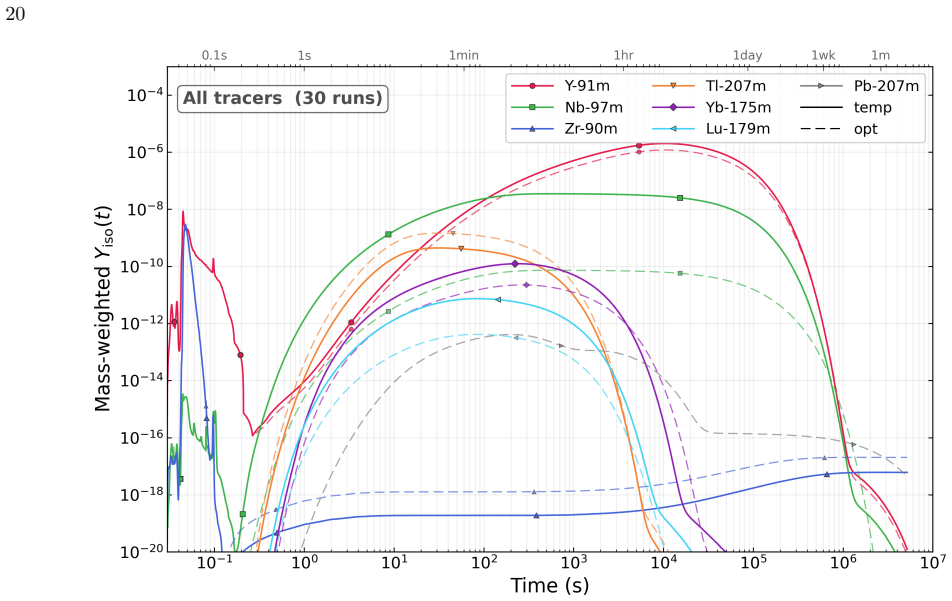
Fujimoto, S.-i., & Hashimoto, M.-a. 2020, MNRAS, 493, L103, doi: 10.1093/mnrasl/slaa016 20 Figure 8.Isomeric abundances for temperature-dependent and optimalβ-feeding treatments. Sustainedβ-fed isomers show treatment-dependent enhancements (Nb-97m) or suppression (Pb-207), while the prompt component remains unchanged
-
[13]
2023, Atomic Data and Nuclear Data Tables, 150, 101546, doi: 10.1016/j.adt.2022.101546
Garg, S., Maheshwari, B., Singh, B., et al. 2023, Atomic Data and Nuclear Data Tables, 150, 101546, doi: 10.1016/j.adt.2022.101546
-
[14]
Gillanders, J. H., Troja, E., Fryer, C. L., et al. 2023, arXiv e-prints, arXiv:2308.00633, doi: 10.48550/arXiv.2308.00633
-
[15]
2017, ApJL, 848, L14, doi: 10.3847/2041-8213/aa8f41
Goldstein, A., Veres, P., Burns, E., et al. 2017, ApJL, 848, L14, doi: 10.3847/2041-8213/aa8f41
-
[16]
Gross, A., Cupp, S., & Mumpower, M. R. 2025a, arXiv e-prints, arXiv:2510.08560, doi: 10.48550/arXiv.2510.08560
work page internal anchor Pith review Pith/arXiv arXiv doi:10.48550/arxiv.2510.08560
-
[17]
Gross, A., Cupp, S., & Mumpower, M. R. 2025b, ApJL, 995, L28, doi: 10.3847/2041-8213/ae2465
-
[18]
Gupta, S. S., & Meyer, B. S. 2001, PhRvC, 64, 025805, doi: 10.1103/PhysRevC.64.025805
-
[19]
Hamilton, M. C. B., & Powell, J. I. 2024, Frontiers in Astronomy and Space Sciences, 11, 1384488, doi: 10.3389/fspas.2024.1384488
-
[20]
2016, MNRAS, 459, 35, doi: 10.1093/mnras/stw404
Hotokezaka, K., Wanajo, S., Tanaka, M., et al. 2016, MNRAS, 459, 35, doi: 10.1093/mnras/stw404
-
[21]
2017, Nature, 551, 80–84, doi: 10.1038/nature24453 10
Ramirez-Ruiz, E. 2017, Nature, 551, 80, doi: 10.1038/nature24453
-
[22]
Kierans, C. A. 2021, in Society of Photo-Optical Instrumentation Engineers (SPIE) Conference Series, Vol. 11444, Society of Photo-Optical Instrumentation Engineers (SPIE) Conference Series, ed. J.-W. A. den
2021
-
[23]
Herder, S. Nikzad, & K. Nakazawa, 1144431, doi: 10.1117/12.2562352
-
[24]
Korobkin, O., Hungerford, A. M., Fryer, C. L., et al. 2020, ApJ, 889, 168, doi: 10.3847/1538-4357/ab64d8
-
[25]
Levan, A. J., Gompertz, B. P., Salafia, O. S., et al. 2024, Nature, 626, 737, doi: 10.1038/s41586-023-06759-1
-
[26]
Longair, M. S. 2011, High Energy Astrophysics (Cambridge University Press)
2011
-
[27]
Mumpower, M. R. 2024, ApJ, 964, 111, doi: 10.3847/1538-4357/ad25ef
-
[28]
Ex Luna, Scientia: The Lunar Occultation eXplorer (LOX)
Miller, R., Ajello, M., Beacom, J. F., et al. 2019, in Bulletin of the American Astronomical Society, Vol. 51, 123, doi: 10.48550/arXiv.1907.07005
work page internal anchor Pith review Pith/arXiv arXiv doi:10.48550/arxiv.1907.07005 2019
-
[29]
Mumpower, M. R. 2021a, ApJS, 252, 2, doi: 10.3847/1538-4365/abc41d
-
[30]
Misch, G. W., Sprouse, T. M., & Mumpower, M. R. 2021b, ApJL, 913, L2, doi: 10.3847/2041-8213/abfb74
-
[31]
Misch, G. W., Sprouse, T. M., Mumpower, M. R., et al. 2021c, Symmetry, 13, 1831, doi: 10.3390/sym13101831 21
-
[32]
R., Jaffke, P., Verriere, M., & Randrup, J
Mumpower, M. R., Jaffke, P., Verriere, M., & Randrup, J. 2020, PhRvC, 101, 054607, doi: 10.1103/PhysRevC.101.054607
-
[33]
Mumpower, M. R., Kawano, T., Sprouse, T. M., et al. 2018, ApJ, 869, 14, doi: 10.3847/1538-4357/aaeaca
-
[34]
Mumpower, M. R., Kawano, T., Ullmann, J. L., Krtiˇ cka, M., & Sprouse, T. M. 2017, PhRvC, 96, 024612, doi: 10.1103/PhysRevC.96.024612
-
[35]
2016, Progress in Particle and Nuclear Physics, 86, 86, doi: 10.1016/j.ppnp.2015.09.001
Aprahamian, A. 2016, Progress in Particle and Nuclear Physics, 86, 86, doi: 10.1016/j.ppnp.2015.09.001
-
[36]
2019, ApJL, 886, L30, doi: 10.3847/2041-8213/ab5794
Nedora, V., Bernuzzi, S., Radice, D., et al. 2019, ApJL, 886, L30, doi: 10.3847/2041-8213/ab5794
-
[37]
Osterbrock, D. E. 1989, Astrophysics of gaseous nebulae and active galactic nuclei (University Science Books)
1989
-
[38]
2017, ApJL, 850, L37, doi: 10.3847/2041-8213/aa9ab9
Perego, A., Radice, D., & Bernuzzi, S. 2017, ApJL, 850, L37, doi: 10.3847/2041-8213/aa9ab9
-
[39]
2017, Nature, 551, 67, doi: 10.1038/nature24298
Pian, E., D’Avanzo, P., Benetti, S., et al. 2017, Nature, 551, 67, doi: 10.1038/nature24298
-
[40]
2018, International Journal of Modern Physics A, 33, 1843011, doi: 10.1142/S0217751X1843011X
Reifarth, R., Fiebiger, S., G¨ obel, K., et al. 2018, International Journal of Modern Physics A, 33, 1843011, doi: 10.1142/S0217751X1843011X
-
[41]
2025, arXiv e-prints, arXiv:2512.23354, doi: 10.48550/arXiv.2512.23354
Singh, P., Stratta, G., Rossi, A., et al. 2025, arXiv e-prints, arXiv:2512.23354, doi: 10.48550/arXiv.2512.23354
-
[42]
Sprouse, T. M., Mumpower, M. R., & Surman, R. 2021, PhRvC, 104, 015803, doi: 10.1103/PhysRevC.104.015803
-
[43]
V., Schneider, C., Jeet, J., & Hudson, E
Tkalya, E. V., Schneider, C., Jeet, J., & Hudson, E. R. 2015, PhRvC, 92, 054324, doi: 10.1103/PhysRevC.92.054324
-
[44]
2022, in 37th International Cosmic Ray Conference, 652, doi: 10.22323/1.395.0652
Tomsick, J., & COSI Collaboration. 2022, in 37th International Cosmic Ray Conference, 652, doi: 10.22323/1.395.0652
-
[45]
2019, in Bulletin of the American Astronomical Society, Vol
Tomsick, J., Zoglauer, A., Sleator, C., et al. 2019, in Bulletin of the American Astronomical Society, Vol. 51, 98, doi: 10.48550/arXiv.1908.04334
-
[46]
2023, PoS, ICRC2023, 745, doi: 10.22323/1.444.0745 5.3
Tomsick, J., Boggs, S., Zoglauer, A., et al. 2024, in 38th International Cosmic Ray Conference, 745, doi: 10.22323/1.444.0745
-
[47]
Tostevin, J. A., & Gade, A. 2021, PhRvC, 103, 054610, doi: 10.1103/PhysRevC.103.054610 van Dommelen, L. 2018, Quantum Mechanics for Engineers,, https://web1.eng.famu.fsu.edu/∼dommelen/ quantum/pdf/index.pdf
-
[48]
Wang, J., Xin, L. P., Qiu, Y. L., et al. 2024, Research in Astronomy and Astrophysics, 24, 115006, doi: 10.1088/1674-4527/ad7fb5
-
[49]
Wang, X. I., Yu, Y.-W., Ren, J., et al. 2024, ApJL, 964, L9, doi: 10.3847/2041-8213/ad2df6
-
[50]
Watson, D., Hansen, C. J., Selsing, J., et al. 2019, Nature, 574, 497, doi: 10.1038/s41586-019-1676-3
discussion (0)
Sign in with ORCID, Apple, or X to comment. Anyone can read and Pith papers without signing in.