Co-Designing Community-Centered AI Education for Adults: A Midwestern Case Study
Pith reviewed 2026-06-26 04:02 UTC · model grok-4.3
The pith
Co-designed AI education for adults shifts concerns from general fears to specific local questions about design and deployment.
A machine-rendered reading of the paper's core claim, the machinery that carries it, and where it could break.
Core claim
Through a co-designed session developed with community partners, we found that concerns about AI persisted but shifted to specific, locally grounded questions about AI design and deployment. We also discuss AI literacy from a community capacity perspective and argue for AI literacy frameworks grounded in local community contexts that strengthen community capacity.
What carries the argument
The co-designed education session with community partners, which surfaces and refines participant concerns about AI in locally relevant terms.
Load-bearing premise
The single co-designed session with 54 participants produced an authentic, unbiased shift in concerns that can be attributed to the education activity rather than researcher presence, partner influence, or social desirability effects.
What would settle it
A follow-up session in the same community without community partner co-design, with pre- and post-measures of concern specificity, to test whether the shift still occurs.
Figures
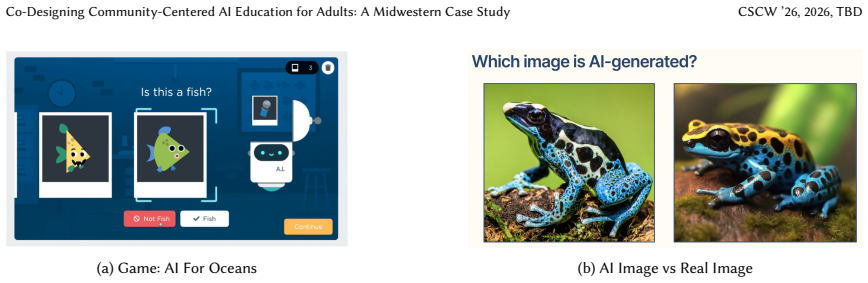
read the original abstract
Artificial Intelligence (AI) education is increasingly important, yet adults outside higher education receive less attention. We report a case study of an AI education session with 54 adults (48 in-person and 6 virtual) in a predominantly African American community on the east side of a major Midwestern city. We ask: "What does AI education for adults outside formal educational systems look like in practice?" and "What does this AI education session reveal about AI literacy at the community level?" Through a co-designed session developed with community partners, we found that concerns about AI persisted but shifted to specific, locally grounded questions about AI design and deployment. We also discuss AI literacy from a community capacity perspective and argue for AI literacy frameworks grounded in local community contexts that strengthen community capacity.
Editorial analysis
A structured set of objections, weighed in public.
Referee Report
Summary. The manuscript reports a case study of a co-designed AI education session involving 54 adults (48 in-person, 6 virtual) in a predominantly African American Midwestern community. Developed with community partners, the session is presented as revealing that general concerns about AI persisted but shifted toward specific, locally grounded questions about AI design and deployment. The authors discuss AI literacy through a community capacity lens and argue for literacy frameworks that are grounded in local community contexts to strengthen capacity.
Significance. If the observations are robustly supported, the work provides a practical example of participatory AI education for adults outside formal systems, particularly in underrepresented communities. It contributes to HCI by illustrating how co-design can surface context-specific concerns and by advancing the case for community-capacity-oriented AI literacy frameworks, which may inform more equitable educational practices.
major comments (2)
- The abstract states findings about concern shifts and community capacity but supplies no description of data collection, coding, or analysis procedures; without these details the central empirical claims cannot be evaluated against the paper's own evidence.
- The single-session design with 54 participants leaves open whether the reported shift in concerns can be attributed to the education activity itself rather than researcher presence, partner influence, or social desirability effects; a methods section addressing these threats to interpretive validity is needed to support the central claim.
Simulated Author's Rebuttal
Thank you for the constructive feedback on our case study manuscript. We appreciate the emphasis on methodological transparency and validity considerations. Below we address each major comment point by point, indicating planned revisions where appropriate.
read point-by-point responses
-
Referee: The abstract states findings about concern shifts and community capacity but supplies no description of data collection, coding, or analysis procedures; without these details the central empirical claims cannot be evaluated against the paper's own evidence.
Authors: We agree that the abstract would benefit from a concise description of the data collection and analysis approach to better contextualize the findings. The full manuscript details the co-design process with community partners, the session format, and how concerns were documented through facilitator notes and group discussions. We will revise the abstract to include a brief statement on the qualitative data collection and thematic analysis procedures. revision: yes
-
Referee: The single-session design with 54 participants leaves open whether the reported shift in concerns can be attributed to the education activity itself rather than researcher presence, partner influence, or social desirability effects; a methods section addressing these threats to interpretive validity is needed to support the central claim.
Authors: We acknowledge that a single-session case study design limits causal attribution and introduces potential threats such as researcher presence and social desirability. As this work is positioned as an exploratory case study of co-designed education in practice rather than a controlled experiment, we will add a dedicated subsection to the methods describing these threats and our mitigation strategies, including community partner involvement in facilitation and use of open-ended discussion formats. We will also expand the limitations section to discuss implications for interpretive validity. revision: yes
Circularity Check
No significant circularity
full rationale
The paper is a qualitative case study of a single co-designed AI education session with 54 adults. Its claims consist of reported observations about shifts in participant concerns and an interpretive argument for community-capacity-based AI literacy frameworks. No equations, fitted parameters, derivations, predictions, or formal models appear anywhere in the text. The central findings are presented as direct outcomes of the session data rather than reductions of any prior quantities defined by the authors, and no self-citation chains are used to justify load-bearing steps.
Axiom & Free-Parameter Ledger
axioms (1)
- domain assumption Participant responses in a co-designed community session can be treated as reliable indicators of authentic local concerns about AI.
Reference graph
Works this paper leans on
-
[1]
Foriest, Jordan Taylor, Kyle Pittman, Sarah Gilbert, and Michael Ann DeVito
Leah Hope Ajmani, Jasmine C. Foriest, Jordan Taylor, Kyle Pittman, Sarah Gilbert, and Michael Ann DeVito. 2024. Whose Knowledge is Valued? Epistemic Injustice in CSCW Applications.Proc. ACM Hum.-Comput. Interact.8, CSCW2 (Nov. 2024), 523:1–523:28. https://doi.org/10.1145/3687062
-
[2]
Omaima Almatrafi, Aditya Johri, and Hyuna Lee. 2024. A systematic review of AI literacy conceptualization, constructs, and implementation and assessment efforts (2019–2023).Computers and Education Open6 (June 2024), 100173. https://doi.org/10.1016/j.caeo.2024.100173
-
[3]
Robert J. Chaskin. 2001. Building Community Capacity: A Definitional Framework and Case Studies from a Comprehensive Community Initiative. Urban Affairs Review36, 3 (Jan. 2001), 291–323. https://doi.org/10.1177/10780870122184876
-
[4]
Marios Constantinides and Daniele Quercia. 2025. AI, Jobs, and the Automation Trap: Where Is HCI?. InProceedings of the 4th Annual Symposium on Human-Computer Interaction for Work (CHIWORK ’25). Association for Computing Machinery, New York, NY, USA, 1–8. https://doi.org/10.1145/ 3729176.3729191
arXiv 2025
-
[5]
Yngve Dahl, Kshitij Sharma, and Dag Svanæs. 2025. Facilitation Skills in Participatory Design. InProceedings of the 2025 CHI Conference on Human Factors in Computing Systems (CHI ’25). Association for Computing Machinery, New York, NY, USA, 1–13. https://doi.org/10.1145/3706598.3713658
-
[6]
Tawanna R Dillahunt. 2025. The Development of a New Measure for Community Digital Capacity.Proc. ACM Hum.-Comput. Interact.9, 2, Article 27 (2025), 30 pages
2025
-
[7]
Tawanna R Dillahunt, Kerby Shedden, Mila Ekaterina Filipof, Soyoung Lee, Mustafa Naseem, Kentaro Toyama, and Julie Hui. 2024. Toward a measure of collective digital capacity: An exploratory analysis. InExtended abstracts of the 2024 CHI conference on human factors in computing systems (Chi ea ’24). Association for Computing Machinery, New York, NY, USA, 3...
-
[8]
Sanjana Gautam, Xiaolong Zhang, and Mary Beth Rosson. 2024. Towards Dynamic Learning: A Framework for Simulating Adaptive Learning Systems. InCompanion Publication of the 2024 Conference on Computer-Supported Cooperative Work and Social Computing (CSCW Companion ’24). Association for Computing Machinery, New York, NY, USA, 603–608. https://doi.org/10.1145...
-
[9]
Divya Gupta, Jaspreet Kaur, and Simarjeet Kaur. 2024. Transforming Healthcare through Machine Learning: A Revolution in Patient Care. In Proceedings of the 5th International Conference on Information Management & Machine Intelligence (ICIMMI ’23). Association for Computing Machinery, New York, NY, USA, 1–4. https://doi.org/10.1145/3647444.3647842
-
[10]
I was able to give her the confidence
Julie Hui, Kristin Seefeldt, Lutalo Sanifu, Christie Baer, Jeanette Szomstein, and Tawanna R Dillahunt. 2024. “I was able to give her the confidence”: Reciprocal capacity building in a community-based program for digital engagement. InProceedings of the CHI conference on human factors in computing systems (Chi ’24). Association for Computing Machinery, Ne...
-
[11]
We need to avail ourselves of [GenAI] to enhance knowledge distribution
Eunhye Grace Ko, Shaini Nanayakkara, and Earl W Huff. 2025. "We need to avail ourselves of [GenAI] to enhance knowledge distribution": Empowering Older Adults through GenAI Literacy. InProceedings of the Extended Abstracts of the CHI Conference on Human Factors in Computing Systems (CHI EA ’25). Association for Computing Machinery, New York, NY, USA, 1–7....
-
[12]
Matthias Carl Laupichler, Alexandra Aster, Jana Schirch, and Tobias Raupach. 2022. Artificial intelligence literacy in higher and adult education: A scoping literature review.Computers and Education: Artificial Intelligence3 (Jan. 2022), 100101. https://doi.org/10.1016/j.caeai.2022.100101
-
[13]
Soyoung Lee, Julie Hui, and Tawanna R. Dillahunt. 2025. Sociocultural Factors in Digital Skills Learning: A Community-Based Intervention Among U.S. Public Housing Adults.Proc. ACM Hum.-Comput. Interact.9, 2 (May 2025), CSCW172:1–CSCW172:26. https://doi.org/10.1145/3711070
-
[14]
Davy Tsz Kit Ng, Jac Ka Lok Leung, Kai Wah Samuel Chu, and Maggie Shen Qiao. 2021. AI Literacy: Definition, Teaching, Evaluation and Ethical Issues.Proceedings of the Association for Information Science and Technology58, 1 (2021), 504–509. https://doi.org/10.1002/pra2.487 _eprint: https://asistdl.onlinelibrary.wiley.com/doi/pdf/10.1002/pra2.487
-
[15]
Davy Tsz Kit Ng, Jac Ka Lok Leung, Samuel Kai Wah Chu, and Maggie Shen Qiao. 2021. Conceptualizing AI literacy: An exploratory review. Computers and Education: Artificial Intelligence2 (Jan. 2021), 100041. https://doi.org/10.1016/j.caeai.2021.100041
-
[16]
Yim Register and Amy J. Ko. 2020. Learning Machine Learning with Personal Data Helps Stakeholders Ground Advocacy Arguments in Model Mechanics. InProceedings of the 2020 ACM Conference on International Computing Education Research (ICER ’20). Association for Computing Machinery, New York, NY, USA, 67–78. https://doi.org/10.1145/3372782.3406252
-
[17]
Gisela Reyes-Cruz, Velvet Spors, Michael Muller, Marianela Ciolfi Felice, Shaowen Bardzell, Rua Mae Williams, Karin Hansson, and Ivana Feldfeber
-
[18]
Resisting AI Solutionism: Where Do We Go From Here?. InProceedings of the Extended Abstracts of the CHI Conference on Human Factors in Computing Systems (CHI EA ’25). Association for Computing Machinery, New York, NY, USA, 1–6. https://doi.org/10.1145/3706599.3706732 7 CSCW ’26, 2026, TBD Lyu, et al
-
[19]
Jeremy Roschelle, Elizabeth A. McLaughlin, and Kenneth R. Koedinger. 2025. Beyond Benchmarks: Responsible AI in Education Needs Learning Sciences.Commun. ACM68, 12 (Nov. 2025), 37–39. https://doi.org/10.1145/3747174
-
[20]
KangJie Tang, Eugene, Tianqi Song, Zicheng Zhu, Jingshu Li, and Yi-Chieh Lee. 2025. AI Literacy Education for Older Adults: Motivations, Challenges and Preferences. InProceedings of the Extended Abstracts of the CHI Conference on Human Factors in Computing Systems. ACM, Yokohama Japan, 1–15. https://doi.org/10.1145/3706599.3720033 8
discussion (0)
Sign in with ORCID, Apple, or X to comment. Anyone can read and Pith papers without signing in.