Binary Dipolar Condensates of Dysprosium Isotopes with Tunable Spatial Order
Pith reviewed 2026-06-26 02:58 UTC · model grok-4.3
The pith
Binary dysprosium condensates undergo an interaction-driven transition that reconfigures their interface from core-shell to side-by-side geometries.
A machine-rendered reading of the paper's core claim, the machinery that carries it, and where it could break.
Core claim
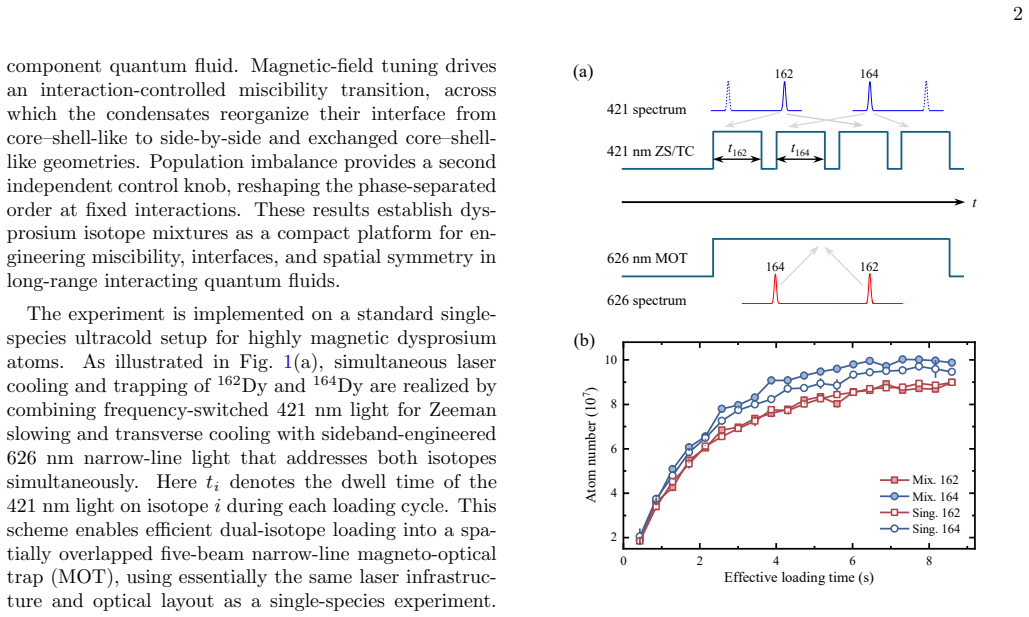
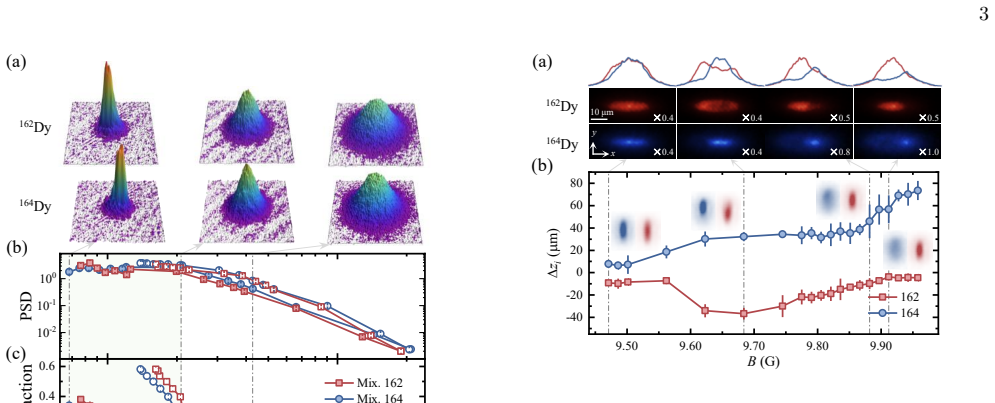
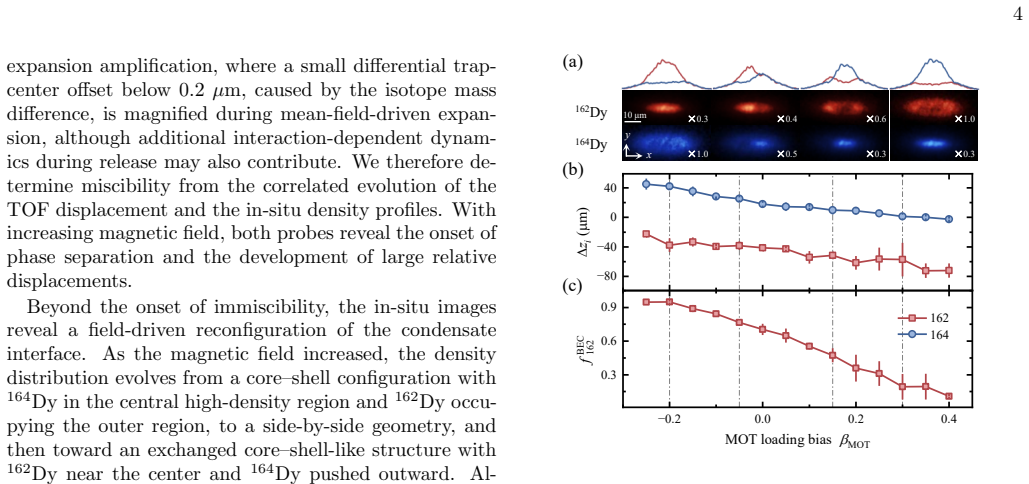
We realize binary Bose–Einstein condensates of the highly magnetic isotopes 162Dy and 164Dy in a technically minimal, single-species-like apparatus. Their nearly identical single-particle properties yield naturally matched trapping potentials, while dense intra- and inter-species Feshbach spectra provide strong interaction tunability. We use this platform to drive an interaction-controlled miscibility transition of a dipolar binary condensate, accompanied by a reconfiguration of the condensate interface from core–shell-like to side-by-side and exchanged core–shell-like geometries. At fixed interactions, population imbalance provides a second control knob by reshaping the effective mean-field
What carries the argument
Binary dipolar condensate of 162Dy and 164Dy isotopes, with intra- and inter-species Feshbach resonances providing the interaction tuning that controls miscibility and interface geometry.
If this is right
- Interaction tuning produces a miscibility transition that reconfigures the condensate interface among core-shell, side-by-side, and exchanged core-shell geometries.
- Population imbalance continuously tunes the phase-separated order by altering effective mean-field pressures.
- Dysprosium isotope mixtures form a compact platform for engineering miscibility, interfaces, and spatial order in dipolar quantum matter.
- The system connects directly to coupled density-spin physics and binary supersolidity.
Where Pith is reading between the lines
- The minimal apparatus could simplify extension to other pairs of magnetic isotopes for similar interface studies.
- The tunable density-spin coupling may open routes to phases that combine phase separation with supersolid order.
- Population imbalance as a control knob suggests experiments that map the full phase diagram at fixed interaction strength.
Load-bearing premise
The two dysprosium isotopes possess sufficiently dense and accessible Feshbach resonances that permit strong interaction tuning while staying inside the mean-field regime with only minimal losses.
What would settle it
Imaging of in-situ density distributions that either shows or fails to show the predicted sequence of interface shapes when the magnetic field is scanned across the relevant Feshbach resonances.
Figures
read the original abstract
Dipolar quantum mixtures provide a unique route to interaction-driven many-body phases, where long-range anisotropic interactions intertwine the density, spin and spatial order. Here we realize binary Bose--Einstein condensates of the highly magnetic isotopes $^{162}$Dy and $^{164}$Dy in a technically minimal, single-species-like apparatus. Their nearly identical single-particle properties yield naturally matched trapping potentials, while dense intra- and inter-species Feshbach spectra provide strong interaction tunability. We use this platform to drive an interaction-controlled miscibility transition of a dipolar binary condensate, accompanied by a reconfiguration of the condensate interface from core--shell-like to side-by-side and exchanged core--shell-like geometries. At fixed interactions, population imbalance provides a second control knob by reshaping the effective mean-field pressures and continuously tuning the phase-separated order. These results establish dysprosium isotope mixtures as a compact platform for engineering miscibility, interfaces, and spatial order in dipolar quantum matter, with direct connections to coupled density--spin physics and binary supersolidity.
Editorial analysis
A structured set of objections, weighed in public.
Referee Report
Summary. The manuscript reports the experimental realization of binary Bose-Einstein condensates of the dysprosium isotopes ^{162}Dy and ^{164}Dy in a single-species-like apparatus. The authors exploit dense intra- and inter-species Feshbach spectra to tune interactions and demonstrate an interaction-controlled miscibility transition accompanied by reconfiguration of the condensate interface from core-shell-like to side-by-side and exchanged core-shell-like geometries. At fixed interactions, population imbalance is used as a second control parameter to reshape mean-field pressures and tune the phase-separated order.
Significance. If the results hold, this establishes dysprosium isotope mixtures as a compact platform for tunable miscibility and spatial order in dipolar quantum matter, with connections to coupled density-spin physics and binary supersolidity. The nearly identical single-particle properties simplify trapping and the dense Feshbach spectra enable strong interaction control without requiring multiple species-specific setups.
major comments (1)
- [Abstract and Feshbach spectra paragraph] Abstract and Feshbach spectra paragraph: The central claim requires that intra- and inter-species scattering lengths can be tuned across the miscibility transition while remaining deep in the mean-field regime with negligible losses. The manuscript does not report lifetime measurements or loss-rate bounds at the specific B-fields used for the core-shell to side-by-side reconfiguration, leaving open whether the observed density profiles reflect equilibrium geometries or loss-induced non-equilibrium dynamics.
Simulated Author's Rebuttal
We thank the referee for their careful reading of the manuscript and for identifying a point that strengthens the central claim. We address the concern regarding lifetime measurements below.
read point-by-point responses
-
Referee: [Abstract and Feshbach spectra paragraph] Abstract and Feshbach spectra paragraph: The central claim requires that intra- and inter-species scattering lengths can be tuned across the miscibility transition while remaining deep in the mean-field regime with negligible losses. The manuscript does not report lifetime measurements or loss-rate bounds at the specific B-fields used for the core-shell to side-by-side reconfiguration, leaving open whether the observed density profiles reflect equilibrium geometries or loss-induced non-equilibrium dynamics.
Authors: We agree that quantitative lifetime data at the precise B-fields employed for the reconfiguration would directly support the assertion that the observed geometries are equilibrium mean-field states. The present manuscript infers negligible losses from the absence of detectable atom number decay over the experimental hold times and from the reproducibility of the imaged density profiles. To address the referee's point explicitly, we will add new measurements of condensate lifetimes and loss rates at the relevant magnetic fields in the revised manuscript. These data will provide upper bounds on inelastic loss coefficients and confirm that three-body losses remain negligible across the explored interaction range. revision: yes
Circularity Check
No circularity: experimental realization with no derivations or fitted predictions
full rationale
The paper is an experimental report on realizing binary BECs of 162Dy and 164Dy and observing an interaction-driven miscibility transition via Feshbach tuning. No mathematical derivations, equations, or predictions are presented that could reduce to inputs by construction. The central claims rest on direct experimental observations and standard mean-field interpretation of density profiles, without self-citation load-bearing steps, ansatz smuggling, or renaming of known results. The work is self-contained against external benchmarks as a platform demonstration.
Axiom & Free-Parameter Ledger
Reference graph
Works this paper leans on
-
[1]
Lahaye, C
T. Lahaye, C. Menotti, L. Santos, M. Lewenstein, and T. Pfau, Rep. Prog. Phys.72, 126401 (2009)
2009
-
[2]
B¨ ottcher, J
F. B¨ ottcher, J. N. Schmidt, J. Hertkorn, K. S. Ng, S. D. Graham, M. Guo, T. Langen, and T. Pfau, Rep. Prog. Phys. , 84, 012403 (2021)
2021
-
[3]
Chomaz, I
L. Chomaz, I. Ferrier-Barbut, F. Ferlaino, B. Laburthe- Tolra, B. L. Lev, and T. Pfau, Rep. Prog. Phys.86, 026401 (2023)
2023
-
[4]
Kadau, M
H. Kadau, M. Schmitt, M. Wenzel, C. Wink, T. Maier, I. Ferrier-Barbut, and T. Pfau, Nature530, 194 (2016)
2016
-
[5]
Schmitt, M
M. Schmitt, M. Wenzel, F. B¨ ottcher, I. Ferrier-Barbut, and T. Pfau, Nature539, 259 (2016)
2016
-
[6]
Ferrier-Barbut, H
I. Ferrier-Barbut, H. Kadau, M. Schmitt, M. Wenzel, and T. Pfau, Phys. Rev. Lett.116, 215301 (2016)
2016
-
[7]
Petter, G
D. Petter, G. Natale, R. M. Van Bijnen, A. Patscheider, M. J. Mark, L. Chomaz, and F. Ferlaino, Phys. Rev. Lett. 122, 183401 (2019)
2019
-
[8]
Hertkorn, J
J. Hertkorn, J. N. Schmidt, F. Bottcher, M. Guo, M. Schmidt, K. S. Ng, S. D. Graham, H. P. Buchler, T. Langen, M. Zwierlein, and T. Pfau, Phys. Rev. X11, 011037 (2021)
2021
-
[9]
Tanzi, E
L. Tanzi, E. Lucioni, F. Fam` a, J. Catani, A. Fioretti, C. Gabbanini, R. N. Bisset, L. Santos, and G. Modugno, Phys. Rev. Lett.122, 130405 (2019)
2019
-
[10]
B¨ ottcher, M
F. B¨ ottcher, M. Wenzel, J. N. Schmidt, M. Guo, T. Lan- gen, I. Ferrier-Barbut, T. Pfau, R. Bomb´ ın, J. S´ anchez- Baena, J. Boronat, and F. Mazzanti, Phys. Rev. Res.1, 033088 (2019)
2019
-
[11]
Chomaz, D
L. Chomaz, D. Petter, P. Ilzh¨ ofer, G. Natale, A. Traut- mann, C. Politi, G. Durastante, R. M. Van Bijnen, A. Patscheider, M. Sohmen, M. J. Mark, and F. Ferlaino, Phys. Rev. X9, 021012 (2019)
2019
-
[12]
M. Guo, F. B¨ ottcher, J. Hertkorn, J. N. Schmidt, M. Wenzel, H. P. B¨ uchler, T. Langen, and T. Pfau, Na- ture574, 386 (2019)
2019
-
[13]
Tanzi, S
L. Tanzi, S. M. Roccuzzo, E. Lucioni, F. Fam` a, A. Fioretti, C. Gabbanini, G. Modugno, A. Recati, and S. Stringari, Nature574, 382 (2019)
2019
-
[14]
Natale, R
G. Natale, R. M. Van Bijnen, A. Patscheider, D. Petter, M. J. Mark, L. Chomaz, and F. Ferlaino, Phys. Rev. Lett. 123, 050402 (2019)
2019
-
[15]
Sohmen, C
M. Sohmen, C. Politi, L. Klaus, L. Chomaz, M. J. Mark, M. A. Norcia, and F. Ferlaino, Phys. Rev. Lett.126, 233401 (2021)
2021
-
[16]
W. Kao, K. Y. Li, K. Y. Lin, S. Gopalakrishnan, and B. L. Lev, Science (80-. ).371, 296 (2021)
2021
-
[17]
K. Yang, Y. Zhang, K. Y. Li, K. Y. Lin, S. Gopalakrish- nan, M. Rigol, and B. L. Lev, Science (80-. ).385, 1063 (2024)
2024
-
[18]
L. Su, A. Douglas, M. Szurek, R. Groth, S. F. Ozturk, A. Krahn, A. H. H´ ebert, G. A. Phelps, S. Ebadi, S. Dick- erson, F. Ferlaino, O. Markovi´ c, and M. Greiner, Nature 622, 724 (2023)
2023
-
[19]
D. S. Hall, M. R. Matthews, J. R. Ensher, C. E. Wieman, and E. A. Cornell, Phys. Rev. Lett.81, 1539 (1998)
1998
-
[20]
S. B. Papp, J. M. Pino, and C. E. Wieman, Phys. Rev. Lett.101, 040402 (2008)
2008
-
[21]
S. Tojo, Y. Taguchi, Y. Masuyama, T. Hayashi, H. Saito, and T. Hirano, Phys. Rev. A82, 033609 (2010)
2010
-
[22]
Schirotzek, C.-H
A. Schirotzek, C.-H. Wu, A. Sommer, and M. W. Zwier- lein, Phys. Rev. Lett.102, 230402 (2009)
2009
-
[23]
N. B. Jørgensen, L. Wacker, K. T. Skalmstang, M. M. Parish, J. Levinsen, R. S. Christensen, G. M. Bruun, and J. J. Arlt, Phys. Rev. Lett.117, 055302 (2016)
2016
-
[24]
B. J. DeSalvo, K. Patel, G. Cai, and C. Chin, Nature 568, 61 (2019)
2019
-
[25]
H. Edri, B. Raz, N. Matzliah, N. Davidson, and R. Ozeri, Phys. Rev. Lett.124, 163401 (2020)
2020
-
[26]
R. M. Wilson, C. Ticknor, J. L. Bohn, and E. Timmer- mans, Phys. Rev. A86, 1 (2012)
2012
-
[27]
A.-c. Lee, D. Baillie, and P. B. Blakie, Phys. Rev. Res. 4, 33153 (2022)
2022
-
[28]
Saito, Y
H. Saito, Y. Kawaguchi, and M. Ueda, Phys. Rev. Lett. 102, 230403 (2009)
2009
-
[29]
J. C. Smith, D. Baillie, and P. B. Blakie, Phys. Rev. Lett. 126, 25302 (2021)
2021
-
[30]
R. N. Bisset, L. A. Ardila, and L. Santos, Phys. Rev. Lett.126, 25301 (2021)
2021
-
[31]
Bland, E
T. Bland, E. Poli, L. A. Ardila, L. Santos, F. Ferlaino, and R. N. Bisset, Phys. Rev. A106, 1 (2022)
2022
-
[32]
Halder, S
S. Halder, S. Das, and S. Majumder, Phys. Rev. A107, 6 63303 (2023)
2023
-
[33]
S. Li, U. N. Le, and H. Saito, Phys. Rev. A105, L061302 (2022)
2022
-
[34]
Scheiermann, L
D. Scheiermann, L. A. Ardila, T. Bland, R. N. Bisset, and L. Santos, Phys. Rev. A107, L021302 (2023)
2023
-
[35]
Kirkby, A
W. Kirkby, A. C. Lee, D. Baillie, T. Bland, F. Ferlaino, P. B. Blakie, and R. N. Bisset, Phys. Rev. Lett.133, 103401 (2024)
2024
-
[36]
Scheiermann, A
D. Scheiermann, A. Gallem´ ı, and L. Santos, Phys. Rev. A111, 33310 (2025)
2025
-
[37]
Trautmann, P
A. Trautmann, P. Ilzh¨ ofer, G. Durastante, C. Politi, M. Sohmen, M. J. Mark, and F. Ferlaino, Phys. Rev. Lett.121, 213601 (2018)
2018
-
[38]
Durastante, C
G. Durastante, C. Politi, M. Sohmen, P. Ilzh¨ ofer, M. J. Mark, M. A. Norcia, and F. Ferlaino, Phys. Rev. A102, 033330 (2020)
2020
-
[39]
Politi, A
C. Politi, A. Trautmann, P. Ilzh¨ ofer, G. Durastante, M. J. Mark, M. Modugno, and F. Ferlaino, Phys. Rev. A105, 1 (2022)
2022
-
[40]
Barral, M
P. Barral, M. Cantara, L. Du, W. Lunden, J. de Hond, A. O. Jamison, and W. Ketterle, Nat. Commun.15, 3566 (2024)
2024
-
[41]
Lecomte, A
M. Lecomte, A. Journeaux, J. Veschambre, J. Dalibard, and R. Lopes, Phys. Rev. Lett.134, 13402 (2025)
2025
-
[42]
See Supplemental Material for additional details
-
[43]
Ilzh¨ ofer, G
P. Ilzh¨ ofer, G. Durastante, A. Patscheider, A. Traut- mann, M. J. Mark, and F. Ferlaino, Phys. Rev. A97, 023633 (2017)
2017
-
[44]
Z. J. et al, manuscript in preparation. 7 SUPPLEMENT AR Y MA TERIAL Experimental setup and dual-isotope laser cooling The experiment is performed on a newly constructed dysprosium apparatus that retains the standard laser-cooling and optical-trapping architecture used for single-species dysprosium experiments. The sequence consists of Zeeman slowing, tran...
discussion (0)
Sign in with ORCID, Apple, or X to comment. Anyone can read and Pith papers without signing in.