Fast Estimation for Forest Matrix of Signed Graphs
Pith reviewed 2026-06-26 02:21 UTC · model grok-4.3
The pith
Signed forest matrix theorem links generalized spanning converging forests to the matrix and enables linear-time algorithms for signed graphs
A machine-rendered reading of the paper's core claim, the machinery that carries it, and where it could break.
Core claim
The signed forest matrix theorem establishes the relationship between generalized spanning converging forests and the forest matrix. Based on this result, the GSCF algorithm, built on a variant of loop-erased random walks, generates generalized spanning converging forests in expected O(n) time. The FMDE and FMDE+ sampling algorithms then estimate the diagonal of the forest matrix, both with time complexity O(ln) where l is the number of samples. These procedures achieve high estimation accuracy on various signed graphs and scale to instances with over twenty million nodes.
What carries the argument
The signed forest matrix theorem, which establishes the relationship between generalized spanning converging forests and the forest matrix entries
If this is right
- Forest matrix estimation becomes feasible for signed graphs with millions of nodes
- The methods deliver high accuracy on tested signed graphs from network applications
- Computational time improves significantly over prior approaches that do not handle signed edges
- The algorithms apply directly to modeling tasks in social opinion dynamics
- Generation of generalized spanning converging forests occurs in expected linear time
Where Pith is reading between the lines
- The sampling approach might extend to estimating off-diagonal entries of the forest matrix without changing the core generation step
- Linear-time forest generation could support repeated queries on evolving signed networks that were previously too slow to analyze
- If the distributional invariance holds, the same loop-erased walk variant may apply to other matrix functions defined via forests on signed graphs
- The scaling results suggest the method could handle even larger instances once memory for the graph representation is addressed
- keywords:[
Load-bearing premise
The variant of loop-erased random walks extends directly to signed graphs while preserving the exact distributional properties needed for the theorem to yield unbiased or consistent estimates of the forest matrix entries
What would settle it
Exact computation of the forest matrix diagonal on a small signed graph followed by comparison to repeated FMDE estimates; consistent mismatch beyond sampling error bounds would falsify the unbiasedness claim
Figures

read the original abstract
The forest matrix of a signed graph plays an important role in network science and social opinion dynamics, yet existing algorithms are mainly designed for unsigned graphs and are difficult to extend to signed graphs. In this paper, we study the problem of efficiently estimating the forest matrix of signed graphs with n nodes and introduce the signed forest matrix theorem, which establishes the relationship between generalized spanning converging forests and the forest matrix. Based on this result, we propose a novel algorithm GSCF, built on a variant of loop-erased random walks, to generate generalized spanning converging forests in expected O(n) time. We further develop two sampling algorithms, FMDE and FMDE+, for estimating the diagonal of the forest matrix, both with time complexity O(ln), where l is the number of samples. Extensive experiments on various signed graphs show that our methods achieve high estimation accuracy, significantly improve computational efficiency, and scale to graphs with over twenty million nodes. Our source code is publicly available on https://github.com/HaoxinSun98/SignedForestDiagonal.
Editorial analysis
A structured set of objections, weighed in public.
Referee Report
Summary. The manuscript introduces a signed forest matrix theorem relating entries of the forest matrix to (weighted) probabilities over generalized spanning converging forests in signed graphs. It proposes the GSCF algorithm, which uses a variant of loop-erased random walks to sample such forests in expected O(n) time, and develops the FMDE and FMDE+ sampling estimators for the diagonal entries with O(ln) time complexity (l samples). Experiments on signed graphs up to 20M nodes report high accuracy and improved efficiency over prior methods; source code is released.
Significance. If the sampling procedure exactly matches the measure required by the theorem, the work would enable scalable estimation of forest matrices for large signed graphs arising in opinion dynamics and network science. The public code release is a positive factor for reproducibility.
major comments (1)
- [Abstract (GSCF description)] Abstract (GSCF and FMDE descriptions): the claim that GSCF produces forests whose distribution exactly matches the signed forest matrix theorem (i.e., probability proportional to the product of signed edge weights) is load-bearing for unbiasedness of the O(ln) estimators. The manuscript must demonstrate that the signed-edge variant of loop-erased random walks preserves the required transition probabilities and erasure conditioning; negative weights can alter both, and no argument or proof is visible in the provided material.
Simulated Author's Rebuttal
We thank the referee for the careful review and for recognizing the potential impact of our work on scalable signed graph analysis. We address the single major comment below.
read point-by-point responses
-
Referee: [Abstract (GSCF description)] Abstract (GSCF and FMDE descriptions): the claim that GSCF produces forests whose distribution exactly matches the signed forest matrix theorem (i.e., probability proportional to the product of signed edge weights) is load-bearing for unbiasedness of the O(ln) estimators. The manuscript must demonstrate that the signed-edge variant of loop-erased random walks preserves the required transition probabilities and erasure conditioning; negative weights can alter both, and no argument or proof is visible in the provided material.
Authors: We agree that an explicit demonstration is required to confirm that the GSCF sampling distribution exactly matches the measure in the signed forest matrix theorem, which underpins the unbiasedness of the FMDE/FMDE+ estimators. The theorem itself appears in Section 3, and Section 4 describes GSCF as a signed variant of loop-erased random walks. However, the manuscript does not contain a dedicated argument or proof addressing how negative edge weights affect transition probabilities and the erasure conditioning. In the revised version we will insert a new subsection (immediately following the algorithm description) that supplies a rigorous proof of correctness for the signed case, showing that the required probabilities are preserved. revision: yes
Circularity Check
No circularity: derivation chain is self-contained
full rationale
The paper introduces the signed forest matrix theorem as establishing a relationship between generalized spanning converging forests and the forest matrix entries, then builds GSCF on a variant of loop-erased random walks claimed to generate samples from the induced distribution in expected O(n) time, followed by FMDE/FMDE+ estimators for the diagonal in O(ln) time. No equation or step reduces by construction to a fitted parameter renamed as a prediction, no self-citation chain is load-bearing for the central theorem or sampling correctness, and no ansatz or uniqueness result is smuggled in via prior author work. The claims rest on the theorem's derivation and the sampling algorithm preserving the exact weighted measure, which are presented as independent content rather than tautological to the inputs.
Axiom & Free-Parameter Ledger
free parameters (1)
- l (number of samples)
axioms (1)
- domain assumption Loop-erased random walk properties extend to signed graphs while preserving the exact connection to the forest matrix
Reference graph
Works this paper leans on
-
[1]
and Gaudilli`ere, A
Avena, L. and Gaudilli`ere, A. Two applications of random spanning forests.Journal of Theoretical Probability, 31 (4):1975–2004,
1975
-
[2]
Chebotarev, P. Y . and Shamis, E. Matrix-forest theorems. ArXiv, abs/math/0602575,
-
[3]
Opinion maximization in social networks
Gionis, A., Terzi, E., and Tsaparas, P. Opinion maximization in social networks. InProceedings of the 2013 SIAM International Conference on Data Mining, pp. 387–395. SIAM,
2013
-
[4]
Efficient person- alized pagerank computation: A spanning forests sam- pling based approach
9 Fast Estimation for Forest Matrix of Signed Graphs Liao, M., Li, R.-H., Dai, Q., and Wang, G. Efficient person- alized pagerank computation: A spanning forests sam- pling based approach. InProceedings of the 2022 In- ternational Conference on Management of Data, SIG- MOD/PODS ’22, pp. 2048–2061, New York, NY , USA,
2022
-
[5]
Sublinear-time opinion estimation in the friedkin–johnsen model
Neumann, S., Dong, Y ., and Peng, P. Sublinear-time opinion estimation in the friedkin–johnsen model. InProceedings of the ACM on Web Conference 2024, pp. 2563–2571,
2024
-
[6]
Y ., Amblard, P.-O., Barthelme, S., and Tremblay, N
Pilavci, Y . Y ., Amblard, P.-O., Barthelme, S., and Tremblay, N. Variance reduction for inverse trace estimation via ran- dom spanning forests.arXiv preprint arXiv:2206.07421,
-
[7]
and Adhikari, B
Singh, R. and Adhikari, B. Measuring the balance of signed networks and its application to sign prediction.Journal of Statistical Mechanics: Theory and Experiment, 2017 (6):063302,
2017
-
[8]
and Zhang, Z
Sun, H. and Zhang, Z. Efficient computation for diagonal of forest matrix via variance-reduced forest sampling. InProceedings of the ACM Web Conference 2024, pp. 792–802,
2024
-
[9]
New approximation algorithms for forest closeness centrality–for individual vertices and vertex groups
van der Grinten, A., Angriman, E., Predari, M., and Mey- erhenke, H. New approximation algorithms for forest closeness centrality–for individual vertices and vertex groups. InProceedings of the 2021 SIAM International Conference on Data Mining, pp. 136–144. SIAM,
2021
-
[10]
Searching for polarization in signed graphs: a local spectral approach
Xiao, H., Ordozgoiti, B., and Gionis, A. Searching for polarization in signed graphs: a local spectral approach. InProceedings of The Web Conference 2020, pp. 362– 372,
2020
-
[11]
Fast evaluation for relevant quantities of opinion dynamics
Xu, W., Bao, Q., and Zhang, Z. Fast evaluation for relevant quantities of opinion dynamics. InProceedings of the Web Conference 2021, pp. 2037–2045. ACM,
2021
-
[12]
LetbL be the matrix D−A + +A −, which is the Laplacian matrix of an unsigned directed graphbG= (V, E,bw) , where bwij =|w ij|= 1
(18) After summing the expected number of visits for all nodes, we obtain:Pn i=1 E(hi)≤trace((I+D−A ++A−)−1(I+D)). LetbL be the matrix D−A + +A −, which is the Laplacian matrix of an unsigned directed graphbG= (V, E,bw) , where bwij =|w ij|= 1 . The entry at row i and column j ofbL is denoted by lij. We have lii =d i and lij = 0 or −1. Furthermore, the su...
2023
-
[13]
Our experiments are conducted on a diverse range of networks, with node counts ranging from 2,539 to over 23 million and edge counts from 12,969 to 112 million
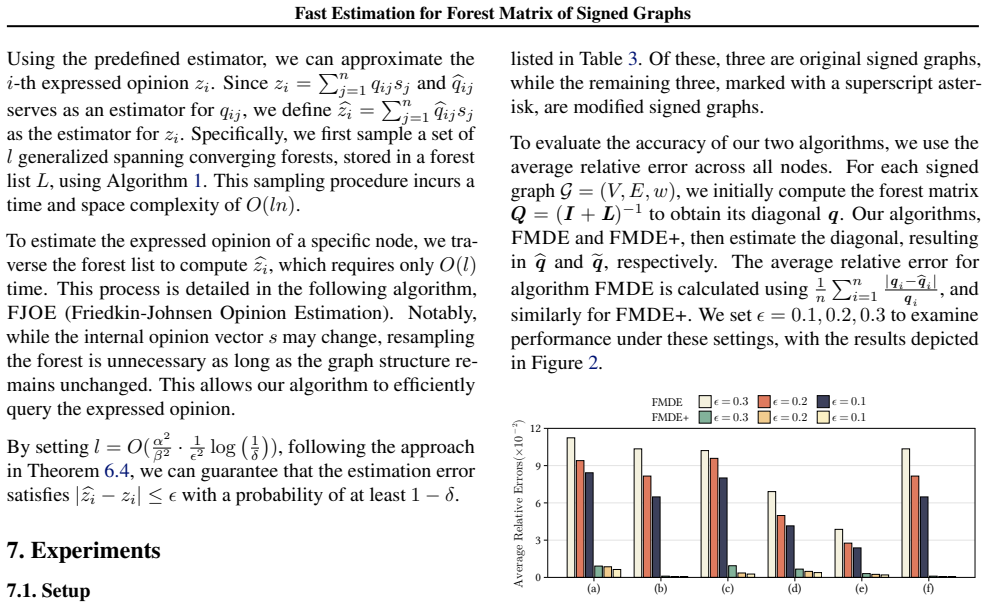
and SNAP (Leskovec & Sosiˇc, 2016). Our experiments are conducted on a diverse range of networks, with node counts ranging from 2,539 to over 23 million and edge counts from 12,969 to 112 million. Details of these datasets are presented in Table 3, which includes six small graphs along with six medium and large-sized graphs. We utilize both original signe...
2016
discussion (0)
Sign in with ORCID, Apple, or X to comment. Anyone can read and Pith papers without signing in.