MPE-Adam: Multi-Population Evolutionary Optimization with Adam Refinement for QAOA
Pith reviewed 2026-06-26 02:02 UTC · model grok-4.3
The pith
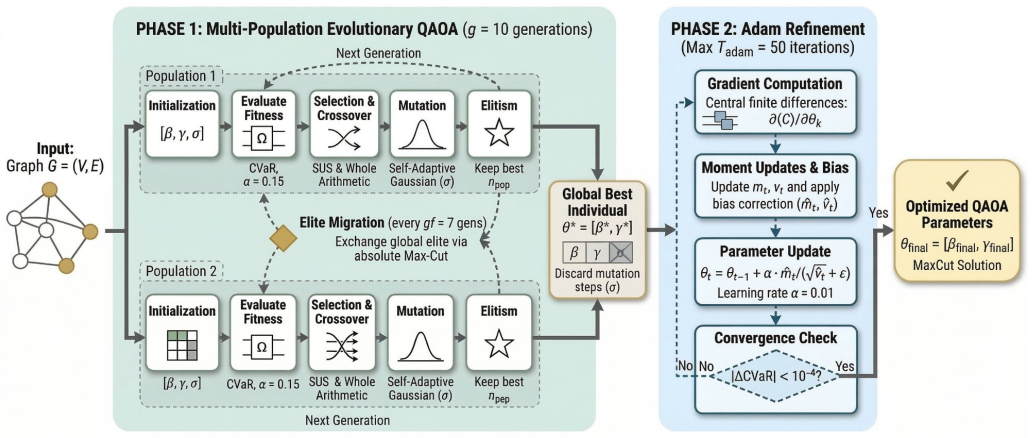
MPE-Adam combines multi-population evolutionary search with Adam refinement to raise QAOA approximation ratios and cut variance on small MaxCut instances.
A machine-rendered reading of the paper's core claim, the machinery that carries it, and where it could break.
Core claim
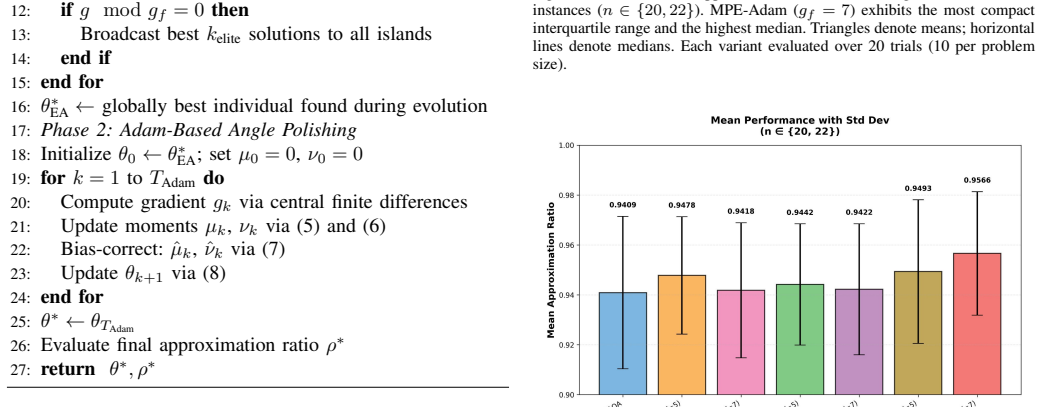
MPE-Adam integrates multi-population evolutionary search for global exploration with Adam-based gradient refinement for local convergence. On MaxCut instances generated from random 3-regular graphs with up to 22 nodes, the method produces higher approximation ratios and lower variance than evolutionary-only and SPSA-based baselines, with the improvements reaching statistical significance.
What carries the argument
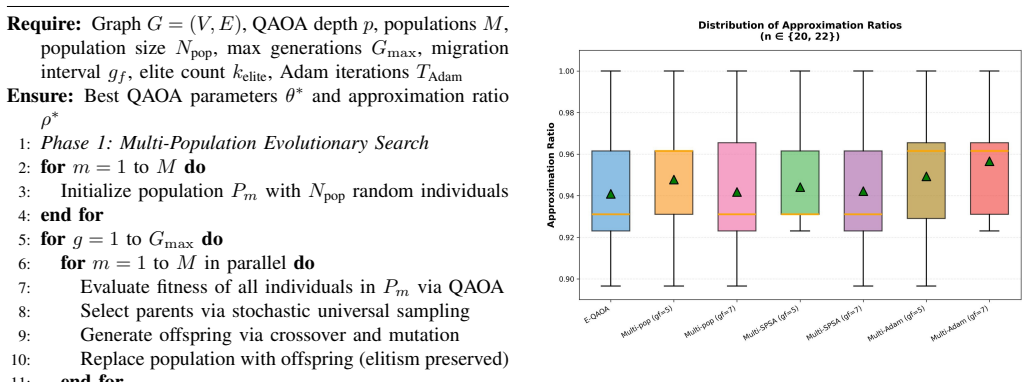
The MPE-Adam hybrid framework, which sequences multi-population evolutionary optimization for broad parameter-space coverage followed by Adam refinement for precise local improvement.
If this is right
- QAOA reaches measurably better solution quality on the tested MaxCut instances.
- Optimization variance decreases, producing more consistent outcomes across repeated runs.
- Multi-stage optimizers can be inserted as modular components in quantum software pipelines.
- Structured separation of global and local search provides a concrete alternative to single-stage methods for variational quantum algorithms.
Where Pith is reading between the lines
- The same staged structure could be tried on other variational quantum algorithms that face noisy high-dimensional parameter spaces.
- Whether the observed gains survive on graphs larger than 22 nodes or with different edge densities remains to be checked.
- Swapping in alternative global or local optimizers within the same modular skeleton might produce further gains on particular problem classes.
Load-bearing premise
The performance gains measured on random 3-regular graphs of at most 22 nodes will continue on other sizes and structures, and the evolutionary and Adam stages will combine without creating interference inside the hybrid loop.
What would settle it
A set of controlled runs on MaxCut instances from 3-regular graphs with 30 or more nodes in which MPE-Adam shows no statistically significant advantage in approximation ratio or variance over the same baselines.
Figures
read the original abstract
Parameter optimization is a central bottleneck in variational quantum algorithms such as the Quantum Approximate Optimization Algorithm (QAOA). The classical optimizer must navigate a high-dimensional, non-convex parameter space under measurement noise. From a quantum software perspective, this process forms a multi-stage workflow: global exploration of the parameter space followed by local refinement within the hybrid quantum-classical loop. Most existing approaches, however, employ single-stage optimizers that do not separate these roles, which limits the use of complementary strategies. We propose MPE-Adam, a hybrid optimization framework that integrates multi-population evolutionary search for global exploration with Adam-based gradient refinement for local convergence. The method is structured as a modular component suitable for quantum software pipelines. We evaluate MPE-Adam on MaxCut instances generated from random 3-regular graphs with up to 22 nodes. The results show that MPE-Adam achieves higher approximation ratios and lower variance than evolutionary-only and SPSA-based baselines, with statistically significant improvements. These findings indicate that structured multi-stage optimization improves both solution quality and software-level flexibility in quantum applications.
Editorial analysis
A structured set of objections, weighed in public.
Referee Report
Summary. The paper proposes MPE-Adam, a hybrid optimization framework for QAOA that integrates multi-population evolutionary search for global parameter exploration with Adam-based gradient refinement for local convergence. It evaluates the method on MaxCut instances from random 3-regular graphs with up to 22 nodes and claims higher approximation ratios, lower variance, and statistically significant improvements over evolutionary-only and SPSA baselines.
Significance. If the empirical performance gains hold under rigorous verification, the work would demonstrate the value of explicitly separating global and local optimization stages in variational quantum algorithms, providing both improved solution quality on small instances and a modular component for quantum software pipelines. The multi-stage design addresses a recognized workflow limitation in existing single-stage optimizers.
major comments (1)
- [Abstract and Results] Abstract and results section: the claim of 'statistically significant improvements' is central to the contribution yet provides no description of experimental design details, including number of independent runs, random seeds, specific statistical tests (e.g., t-test or Wilcoxon), variance estimation method, or multiple-comparison corrections. This absence prevents verification that the data support the significance assertion and directly undermines the soundness of the primary empirical claim.
minor comments (2)
- [Section 3] Section 3: the description of how the evolutionary and Adam stages interface within the hybrid quantum-classical loop could be expanded with a pseudocode or workflow diagram to clarify potential interference points.
- [Experimental Setup] The manuscript would benefit from explicit discussion of why the tested graph sizes (up to 22 nodes) were chosen and any scaling considerations, even if generalization is not claimed.
Simulated Author's Rebuttal
We thank the referee for highlighting the need for greater transparency in our statistical reporting. This is a valid concern that we will fully address in revision.
read point-by-point responses
-
Referee: [Abstract and Results] Abstract and results section: the claim of 'statistically significant improvements' is central to the contribution yet provides no description of experimental design details, including number of independent runs, random seeds, specific statistical tests (e.g., t-test or Wilcoxon), variance estimation method, or multiple-comparison corrections. This absence prevents verification that the data support the significance assertion and directly undermines the soundness of the primary empirical claim.
Authors: We agree that the current manuscript omits critical details required to substantiate the statistical significance claims. In the revised version we will insert a new subsection (e.g., Section 4.3) that explicitly states: (i) the number of independent runs performed for each optimizer and graph instance, (ii) the random seeds employed to ensure reproducibility, (iii) the exact statistical tests used (paired t-test or Wilcoxon signed-rank test, as appropriate), (iv) the method of variance estimation, and (v) any multiple-comparison correction applied. We will also report the resulting p-values and effect sizes. These additions will allow independent verification of the reported improvements without altering the underlying experimental data or conclusions. revision: yes
Circularity Check
No circularity; empirical performance claims rest on direct experimental comparisons
full rationale
The paper's central claim is an empirical result: MPE-Adam yields higher approximation ratios and lower variance than named baselines (evolutionary-only and SPSA) on MaxCut instances from random 3-regular graphs up to 22 nodes, with statistical significance. No derivation chain, fitted-parameter-as-prediction, self-definitional equations, or load-bearing self-citations are present in the abstract or described workflow. The method is presented as a modular hybrid optimizer whose performance is measured externally against independent baselines; the integration of evolutionary search and Adam is described at the algorithmic level without reducing to its own outputs by construction. This is self-contained experimental evidence.
Axiom & Free-Parameter Ledger
Reference graph
Works this paper leans on
-
[1]
A quantum approximate optimization algorithm,
E. Farhi, J. Goldstone, and S. Gutmann, “A quantum approximate optimization algorithm,”arXiv preprint arXiv:1411.4028, 2014
Pith/arXiv arXiv 2014
-
[2]
Quantum approximate optimization algorithm: Performance, mechanism, and im- plementation on near-term devices,
L. Zhou, S.-T. Wang, S. Choi, H. Pichler, and M. D. Lukin, “Quantum approximate optimization algorithm: Performance, mechanism, and im- plementation on near-term devices,”Physical Review X, vol. 10, no. 2, p. 021067, 2020
2020
-
[3]
A review on quantum approximate optimization algorithm and its variants,
K. Blekos, D. Brand, A. Ceschini, C.-H. Chou, R.-H. Li, K. Pandya, and A. Summer, “A review on quantum approximate optimization algorithm and its variants,”Physics Reports, vol. 1068, pp. 1–66, 2024
2024
-
[4]
The theory of variational hybrid quantum-classical algorithms,
J. R. McClean, J. Romero, R. Babbush, and A. Aspuru-Guzik, “The theory of variational hybrid quantum-classical algorithms,”New Journal of Physics, vol. 18, no. 2, p. 023023, 2016
2016
-
[5]
Barren plateaus in quantum neural network training landscapes,
J. R. McClean, S. Boixo, V . N. Smelyanskiy, R. Babbush, and H. Neven, “Barren plateaus in quantum neural network training landscapes,”Nature Communications, vol. 9, no. 1, p. 4812, 2018
2018
-
[6]
Barren plateaus in variational quantum computing,
M. Larocca, S. Thanasilp, S. Wang, K. Sharma, J. Biamonte, P. J. Coles, L. Cincio, J. R. McClean, Z. Holmes, and M. Cerezo, “Barren plateaus in variational quantum computing,”Nature Reviews Physics, vol. 7, no. 4, pp. 174–189, 2025
2025
-
[7]
QAOA for Max-Cut requires hundreds of qubits for quantum speed-up,
G. G. Guerreschi and A. Y . Matsuura, “QAOA for Max-Cut requires hundreds of qubits for quantum speed-up,”Scientific Reports, vol. 9, no. 1, p. 6903, 2019
2019
-
[8]
A direct search optimization method that models the objective and constraint functions by linear interpolation,
M. J. D. Powell, “A direct search optimization method that models the objective and constraint functions by linear interpolation,” inAdvances in Optimization and Numerical Analysis. Springer, 1994, pp. 51–67
1994
-
[9]
Adam: A method for stochastic optimization,
D. P. Kingma and J. Ba, “Adam: A method for stochastic optimization,” arXiv preprint arXiv:1412.6980, 2015
Pith/arXiv arXiv 2015
-
[10]
Multivariate stochastic approximation using a simultaneous perturbation gradient approximation,
J. C. Spall, “Multivariate stochastic approximation using a simultaneous perturbation gradient approximation,”IEEE Transactions on Automatic Control, vol. 37, no. 3, pp. 332–341, 1992
1992
-
[11]
Toward a linear-ramp QAOA protocol: evidence of a scaling advantage in solving some com- binatorial optimization problems,
J. A. Monta ˜nez-Barrera and K. Michielsen, “Toward a linear-ramp QAOA protocol: evidence of a scaling advantage in solving some com- binatorial optimization problems,”npj Quantum Information, vol. 11, p. 131, 2025
2025
-
[12]
Evolving a multi-population evolutionary-QAOA on distributed QPUs,
F. Schiavello, E. Altamura, I. Tavernelli, S. Mensa, and B. Symons, “Evolving a multi-population evolutionary-QAOA on distributed QPUs,” in2025 IEEE International Conference on Quantum Computing and Engineering (QCE), vol. 1. IEEE, 2025, pp. 11–19
2025
-
[13]
Evaluating mutation techniques in genetic- algorithm-based quantum circuit synthesis,
M. K ¨olle, T. Bintener, M. Zorn, G. Stenzel, L. S ¨unkel, T. Gabor, and C. Linnhoff-Popien, “Evaluating mutation techniques in genetic- algorithm-based quantum circuit synthesis,” inProceedings of the Ge- netic and Evolutionary Computation Conference, 2025, pp. 907–915
2025
-
[14]
Quantum island mapping: Optimizing multi- circuit execution in quantum processors,
J. Alvarado-Valiente, J. Romero-Alvarez, J. Casco-Seco, E. Moguel, and J. Garcia-Alonso, “Quantum island mapping: Optimizing multi- circuit execution in quantum processors,” in2025 IEEE International Conference on Quantum Computing and Engineering (QCE), vol. 1. IEEE, 2025, pp. 791–796
2025
-
[15]
Quantum gate control pulse optimization based on the Adam algorithm,
M. Yang, F. Yue, B. Lu, H. Zhao, G. Ma, and L. Wang, “Quantum gate control pulse optimization based on the Adam algorithm,”Quantum Information Processing, vol. 24, no. 6, p. 175, 2025
2025
-
[16]
J. Gacon, C. Zoufal, G. Carleo, and S. Woerner, “An empirical comparison of optimizers for quantum machine learning with SPSA- approximated gradients,”arXiv preprint arXiv:2305.00224, 2023
arXiv 2023
-
[17]
From the quantum approximate optimization algorithm to a quantum alternating operator ansatz,
S. Hadfield, Z. Wang, B. O’Gorman, E. G. Rieffel, D. Venturelli, and R. Biswas, “From the quantum approximate optimization algorithm to a quantum alternating operator ansatz,”Algorithms, vol. 12, no. 2, p. 34, 2019
2019
-
[18]
Obstacles to variational quantum optimization from symmetry protection,
S. Bravyi, A. Kliesch, R. K ¨onig, and E. Tang, “Obstacles to variational quantum optimization from symmetry protection,”Physical Review Letters, vol. 125, no. 26, p. 260505, 2020
2020
-
[19]
Multi-angle quantum approximate optimization algorithm,
R. Herrman, P. C. Lotshaw, J. Ostrowski, T. S. Humble, and G. Siopsis, “Multi-angle quantum approximate optimization algorithm,”Scientific Reports, vol. 12, no. 1, p. 6781, 2022
2022
-
[20]
The effect of classical optimizers and ansatz depth on QAOA performance in noisy devices,
A. Pellow-Jarman, S. McFarthing, I. Sinayskiy, D. K. Park, A. Pillay, and F. Petruccione, “The effect of classical optimizers and ansatz depth on QAOA performance in noisy devices,”Scientific Reports, vol. 14, no. 1, p. 16011, 2024
2024
-
[21]
PID controller for PMSM speed control based on improved quantum genetic algorithm optimization,
H. Wang, S. Xu, and H. Hu, “PID controller for PMSM speed control based on improved quantum genetic algorithm optimization,”IEEE Access, vol. 11, pp. 61 091–61 102, 2023
2023
-
[22]
Improving variational quantum optimization using CVaR,
P. K. Barkoutsos, G. Nannicini, A. Robert, I. Tavernelli, and S. Woerner, “Improving variational quantum optimization using CVaR,”Quantum, vol. 4, p. 256, 2020
2020
-
[23]
Evidence of scaling advantage for the quantum approximate optimization algorithm on a classically intractable problem,
R. Shaydulin, C. Li, S. Chakrabarti, M. DeCross, D. Herman, N. Kumar et al., “Evidence of scaling advantage for the quantum approximate optimization algorithm on a classically intractable problem,”Science Advances, vol. 10, no. 22, p. eadm6761, 2024
2024
-
[24]
Improved approximation algo- rithms for maximum cut and satisfiability problems using semidefinite programming,
M. X. Goemans and D. P. Williamson, “Improved approximation algo- rithms for maximum cut and satisfiability problems using semidefinite programming,”Journal of the ACM, vol. 42, no. 6, pp. 1115–1145, 1995
1995
-
[25]
B ¨ack,Evolutionary Algorithms in Theory and Practice: Evolution Strategies, Evolutionary Programming, Genetic Algorithms
T. B ¨ack,Evolutionary Algorithms in Theory and Practice: Evolution Strategies, Evolutionary Programming, Genetic Algorithms. Oxford University Press, 1996
1996
discussion (0)
Sign in with ORCID, Apple, or X to comment. Anyone can read and Pith papers without signing in.