A framework for drift transformations of multidimensional diffusion processes with applications to Wiener and Ornstein--Uhlenbeck dynamics
Pith reviewed 2026-06-29 00:36 UTC · model grok-4.3
The pith
A weight function solving a PDE defines drift transformations that produce new multidimensional diffusions with product-form transition densities.
A machine-rendered reading of the paper's core claim, the machinery that carries it, and where it could break.
Core claim
The authors establish that for multidimensional diffusions, a drift transformation defined via a weight function w, obtained as the solution to a partial differential equation, yields a new process whose transition p.d.f. can be written as the product of the original transition p.d.f. and the weight function. This holds under general conditions given by SDEs, and leads to closed-form relations for properties such as stochastic ordering and behavior under Poissonian resetting. Explicit constructions are given for transformations of the Wiener process and the Ornstein-Uhlenbeck process in one and two dimensions.
What carries the argument
The weight function w solving a partial differential equation, which determines the drift change and enforces the product-form relation between the transition densities of the original and transformed processes.
Load-bearing premise
The weight function w must exist as the solution of a suitable partial differential equation to ensure the transformed process is a valid diffusion with tractable transition densities.
What would settle it
A calculation showing that the transition density of a transformed two-dimensional Wiener process does not equal the product of the original density and the weight function would disprove the framework.
Figures
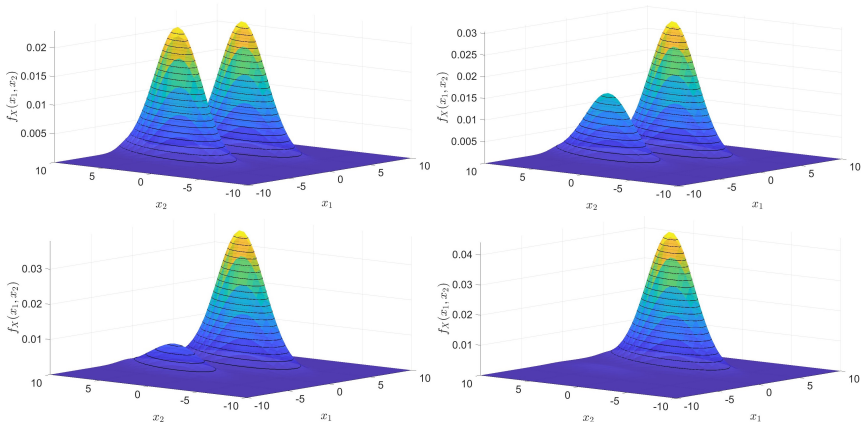
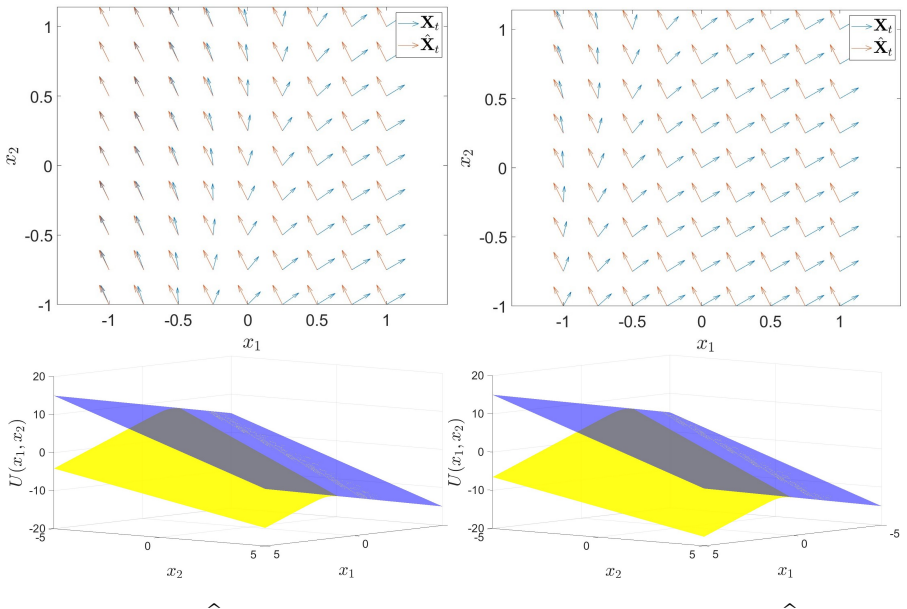
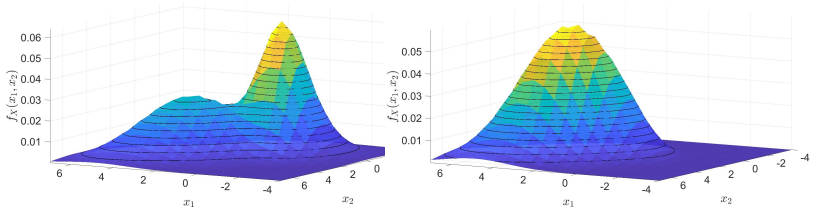
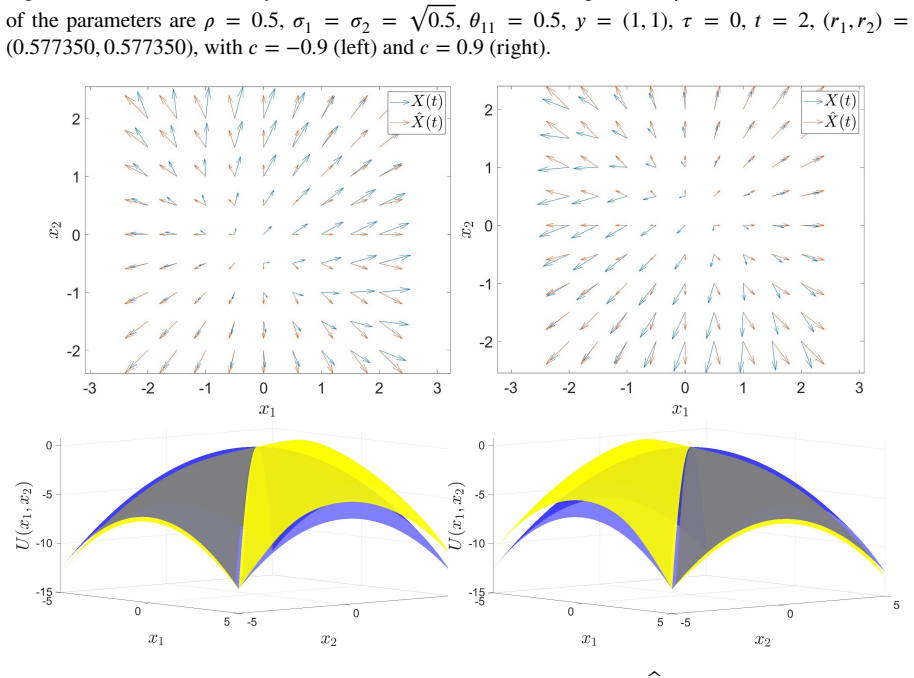
read the original abstract
We investigate a class of drift-based transformations between multidimensional diffusion processes. The approach allows to construct a new process whose transition probability density function (p.d.f.)\ can be expressed in a product form involving the p.d.f.\ of the original diffusion. The framework is formulated in terms of stochastic differential equations providing general conditions under which the transformed p.d.f.\ remains analytically tractable in the multidimensional setting. The transformation is defined through a weight function $w$, derived as the solution of a suitable partial differential equation. Also, specific forms of $w$ yield certain mixture representations of the transformed p.d.f., which also leads to identify a bimodal feature. We establish closed-form relations between the original and transformed diffusions focusing on features such as stochastic ordering, Poissonian resetting, and diffusions in potential fields. The analysis of the usual stochastic order highlights how the transformation can substantially alter the probabilistic behavior of the process. Furthermore, the product-form relation is shown to persist under Poisson-paced resets, allowing for explicit stationary distributions in certain cases. Two fundamental case studies are presented, based on transformations of the Wiener and Ornstein-Uhlenbeck processes, for which explicit expressions of the weight function, potential function, and transition densities are derived. Special attention is given to the two-dimensional setting, where symmetry properties and absorbing boundaries are explored, providing further insight into the structure and behavior of the transformed diffusions.
Editorial analysis
A structured set of objections, weighed in public.
Referee Report
Summary. The manuscript develops a drift transformation framework for multidimensional diffusion processes. A weight function w is defined as the solution to a PDE such that the transition density of the transformed process factors as a product involving the original density. General conditions are formulated via SDEs; explicit closed-form expressions for w, the potential, and the densities are derived for the Wiener and Ornstein-Uhlenbeck processes (including symmetric 2D cases with absorbing boundaries). The paper also treats stochastic ordering, Poisson resets (with persistence of the product form and explicit stationary distributions), and mixture representations that can produce bimodality.
Significance. If the derivations hold, the framework supplies a systematic, checkable route to new analytically tractable multidimensional diffusions from standard ones. The parameter-free explicit expressions for the Wiener and OU cases, together with direct verification against the Kolmogorov equations and the preservation of the product form under resets, are concrete strengths that make the results falsifiable and potentially useful for applications.
minor comments (3)
- [§2] The PDE satisfied by w is central yet introduced only after the SDE formulation; moving its statement to the beginning of §2 would improve readability.
- [§4.2] In the 2D OU example the symmetry assumptions and boundary conditions are stated but the explicit form of the transformed density is not written out; adding the formula would make the product representation immediate to check.
- [§3.1] The claim that the transformation 'substantially alters the probabilistic behavior' is illustrated only for the usual stochastic order; a brief numerical check or plot for the Wiener case would strengthen the point without lengthening the paper.
Simulated Author's Rebuttal
We thank the referee for the careful reading of the manuscript and the positive assessment, including the recommendation for minor revision. The referee's summary correctly identifies the core elements of the drift transformation framework, the explicit constructions for Wiener and Ornstein-Uhlenbeck processes, and the preservation of the product form under Poisson resets.
Circularity Check
No significant circularity detected
full rationale
The paper constructs a drift transformation via a weight function w solving a PDE, yielding product-form transition densities for the transformed diffusion. Explicit closed-form solutions are derived for Wiener and Ornstein-Uhlenbeck cases (including 2D with boundaries) and verified to satisfy the Kolmogorov forward/backward equations directly. These steps are parameter-free, self-contained within the SDE/PDE framework, and do not reduce to fitted quantities or self-citations. No load-bearing premise relies on prior author work as an unverified uniqueness theorem, nor does any 'prediction' equate to its input by construction. The framework remains independently checkable against the original diffusion's density.
Axiom & Free-Parameter Ledger
Reference graph
Works this paper leans on
-
[1]
T. Boege, M. Drton, B. Hollering, S. Lumpp, P. Misra, D. Schkoda, Conditional independence in stationary distributions of diffusions. Stoch. Proc. Appl. 184(C) (2025). https://doi.org/10.1016/j.spa.2025.104604
-
[2]
Markovian Maximal Coupling of Markov Processes
B. Böttcher, Markovian maximal coupling of Markov processes (2017). https://doi.org/10.48550/arXiv.1710.09654
work page internal anchor Pith review Pith/arXiv arXiv doi:10.48550/arxiv.1710.09654 2017
-
[3]
Celletti, From perturbative methods to machine learning techniques in space science, Boll
A. Celletti, From perturbative methods to machine learning techniques in space science, Boll. Unione Mat. Ital. 18 (2025) 149–166. https://doi.org/10.1007/s40574-024-00422-x
-
[4]
M.F. Chen, S.F. Li, Coupling methods for multidimensional diffusion processes, Ann. Probab. 17 (1989) 151-177. https://doi.org/10.1214/aop/1176991501
-
[5]
https://doi.org/10.1007/978-3-031-85160-5
S.Chewi,J.Niles-Weed,P.Rigollet,StatisticalOptimalTransport,Lect.NotesMath.,SpringerCham,2025. https://doi.org/10.1007/978-3-031-85160-5
-
[6]
A.Comtet,F.Cornu,G.Schehr,Last-passagetimeforlineardiffusionsandapplicationtotheemptyingtime of a box, J. Stat. Phys. 181 (2020) 1565–1602. https://doi.org/10.1007/s10955-020-02637-6
-
[7]
P. Del Moral, D. Villemonais, Exponential mixing properties for time inhomogeneous diffusion processes with killing, Bernoulli 24 (2018) 1010–1032. https://doi.org/10.3150/16-BEJ845
-
[8]
S. Dharmaraja, A. Di Crescenzo, V. Giorno, A.G. Nobile, A continuous-time Ehrenfest model with catastrophes and its jump-diffusion approximation. J. Stat. Phys. 161 (2015) 326–345. https://doi.org/10.1007/s10955-015-1336-4
-
[9]
A. Di Crescenzo, V. Giorno, A.G. Nobile, Analysis of reflected diffusions via an exponential time-based transformation, J. Stat. Phys. 163 (2016) 1425–1453. https://doi.org/10.1007/s10955-016-1525-9
-
[10]
A. Di Crescenzo, V. Giorno, A.G. Nobile, L.M. Ricciardi, On a symmetry-based constructive approach to probability densities for two-dimensional diffusion processes, J. Appl. Probab. 32 (1995) 316-336. https://doi.org/10.2307/3215291
-
[11]
A. Di Crescenzo, V. Giorno, A.G. Nobile, S. Spina, First-exit-time problems for two-dimensional Wiener and Ornstein-Uhlenbeck processes through time-varying ellipses, Stochastics 96 (2024) 696-727. https://doi.org/10.1080/17442508.2024.2315274
-
[12]
A. Di Crescenzo, B. Martinucci, On a symmetric, nonlinear birth-death process with bimodal transition probabilities, Symmetry 1 (2009) 201-214. https://doi.org/10.3390/sym1020201
-
[13]
M. Evans, S. Majumdar. Diffusion with stochastic resetting. Physical Review Letters 106 (2011) 160601. 10.1103/PhysRevLett.106.160601
-
[14]
J.L. Forman, M. Sørensen, A transformation approach to modelling multi-modal diffusions, J. Stat. Plan. Inference 146 (2014) 56–69. https://doi.org/10.1016/j.jspi.2013.09.013
-
[15]
Gardiner, Handbook of Stochastic Methods for Physics, Chemistry and the Natural Sciences, Vol
C.W. Gardiner, Handbook of Stochastic Methods for Physics, Chemistry and the Natural Sciences, Vol. 13, Springer-Verlag, Berlin, 2004
2004
-
[16]
V. Giorno, A.G. Nobile, On the construction of a special class of time-inhomogeneous diffusion processes, J. Stat. Phys. 177 (2019) 299–323. https://doi.org/10.1007/s10955-019-02369-2 36
-
[17]
Giorno, A.G
V. Giorno, A.G. Nobile, E. Pirozzi, L. Ricciardi, On the construction of first-passage-time densities for diffusion processes, Sci. Math. Jpn. 64 (2006)
2006
-
[18]
V. Giorno, A. G. Nobile, S. Spina, On some time non-homogeneous queueing systems with catastrophes. Appl. Math. Comput. 245 (2014) 220–234. https://doi.org/10.1016/j.amc.2014.07.076
-
[19]
https://doi.org/10.1214/20-EJS1708
E.Gobet,U.Stazhynski,Parametricinferencefordiffusionsobservedatstoppingtimes,Electron.J.Stat.14 (2020) 2098–2122. https://doi.org/10.1214/20-EJS1708
-
[20]
Gradshteyn, I.M
I.S. Gradshteyn, I.M. Ryzhik, Table of Integrals, Series, and Products, Academic Press, 2007
2007
-
[21]
I. Grigorescu, M. Kang, Ergodic properties of multidimensional Brownian Motion with rebirth, Electron. J. Probab. 12 (2007) 1299–1322. https://doi.org/10.1214/EJP.v12-450
-
[22]
S. Herrmann, P. Imkeller, D. Peithmann, Transition times and stochastic resonance for multidimensional diffusions with time periodic drift: a large deviations approach, Ann. Appl. Probab. 16 (2006) 1851–1892. https://doi.org/10.1214/105051606000000385
-
[23]
M.O.Hongler,R.Filliger,P.Blanchard,Solublemodelsfordynamicsdrivenbysuper-diffusivenoise.Phys. A: Stat. Mech. Appl. 370 (2006) 301-315. https://doi.org/10.1016/j.physa.2006.02.036
-
[24]
Iyengar, Hitting lines with two-dimensional Brownian motion, SIAM J
S. Iyengar, Hitting lines with two-dimensional Brownian motion, SIAM J. Appl. Math. 45 (1985) 983–989. https://doi.org/10.1137/0145060
-
[25]
J. Jacod, Parametric inference for discretely observed non-ergodic diffusions, Bernoulli 12 (2006) 383–401. https://doi.org/10.3150/bj/1151525127
-
[26]
P. Johnson, J.L. Pedersen, G. Peskir, C. Zucca (2022) Detecting the presence of a random drift in Brownian motion, Stoch. Proc. Appl. 150 (2022) 1068–1090. https://doi.org/10.1016/j.spa.2021.05.006
-
[27]
S. Kusuoka, H. Takahashi, Y. Tamura, Recurrence and transience properties of multi-dimensional diffusion processes in selfsimilar and semi-selfsimilar random environments, Electron. Commun. Probab. 22 (2017) 1–11. https://doi.org/10.1214/16-ECP36
-
[28]
H. Lavenant, S. Zhang, Y.H. Kim, G. Schiebinger, Toward a mathematical theory of trajectory inference, Ann. Appl. Probab. 34(1A) (2024), 428-500. https://doi.org/10.1214/23-AAP1969
-
[30]
C.Li,Maximum-likelihoodestimationfordiffusionprocessesviaclosed-formdensityexpansions,Ann.Stat. 41 (2013) 1350-1380. https://doi.org/10.1214/13-AOS1118
-
[31]
Y. Li, M. Tao, S. Wang, Essential barrier height and a probabilistic approach in characterizing potential landscape, Stoch. Process. Appl. 190 (2025) 104763. https://doi.org/10.1016/j.spa.2025.104763
-
[32]
H.Maatouk,X.Bay.AnewrejectionsamplingmethodfortruncatedmultivariateGaussianrandomvariables restricted to convex sets. In: Cools, R., Nuyens, D. (eds) Monte Carlo and Quasi-Monte Carlo Methods. Springer Proc. Math. Stat. (2016), vol 163. Springer, Cham. https://doi.org/10.1007/978-3-319-33507-0
-
[33]
M. Magdziarz, K. Taźbierski Stochastic representation of processes with resetting. Physical Review E. 106 (2022), https://doi.org/10.1103/PhysRevE.106.014147
-
[34]
R.A. Maller, G. Müller, A. Szimayer, Ornstein–Uhlenbeck processes and extensions, in: T. Mikosch, et al. (Eds.), Handbook of Financial Time Series, Springer, Berlin, Heidelberg, 2009, pp. 493–512. https://doi.org/10.1007/978-3-540-71297-8
-
[35]
https://doi.org/10.1007/BF00340014 37
M.Nagasawa,TransformationsofdiffusionandSchrödingerprocesses.Probab.Th.Rel.Fields82,109–136 (1989). https://doi.org/10.1007/BF00340014 37
-
[36]
F. Nielsen, K. Okamura, On the𝑓-divergences between densities of a multivariate location or scale family, Stat. Comput. 34 (2024) 60. https://doi.org/10.1007/s11222-023-10373-6
-
[37]
A. Oga, Y. Koike, Drift estimation for a multi-dimensional diffusion process using deep neural networks, Stoch. Processes Appl. 170 (2024) 104240. https://doi.org/10.48550/arXiv.2112.13332
-
[38]
https://link.springer.com/book/10.1007/978-1-4939-1323-7
G.A.Pavliotis,StochasticProcessesandApplications.DiffusionProcesses,theFokker-PlanckandLangevin Equations, Springer, 2014. https://link.springer.com/book/10.1007/978-1-4939-1323-7
-
[39]
Pitt, Positively correlated normal variables are associated, Ann
L.D. Pitt, Positively correlated normal variables are associated, Ann. Probab. 10(2) (1982), 496-499. https://doi.org/10.1214/aop/1176993872
-
[40]
Ricciardi, On the transformation of diffusion processes into the Wiener process, J
L.M. Ricciardi, On the transformation of diffusion processes into the Wiener process, J. Math. Anal. Appl. 54 (1976) 185–199. https://doi.org/10.1016/0022-247X(76)90244-4
-
[41]
L.M. Ricciardi, A. Di Crescenzo, V. Giorno, A.G. Nobile, An outline of theoretical and algorithmic ap- proaches to first passage time problems with applications to biological models, Math. Japon. 50 (1999) 247–322. https://www.researchgate.net/publication/268054855
-
[42]
M. Shaked, J.G. Shanthikumar, Stochastic Orders. Springer, New York, 2007. https://doi.org/10.1007/978- 0-387-34675-5
-
[43]
D.Trevisan,Well-posednessofmultidimensionaldiffusionprocesseswithweaklydifferentiablecoefficients, Electron. J. Probab. 21 (2016) 1–41. https://doi.org/10.1214/16-EJP4453
-
[44]
Q.N. Vuong, S. Bedbur, U. Kamps, Distances between models of generalized order statistics, J. Multiv. Analysis 118 (2013) 24–36. http://dx.doi.org/10.1016/j.jmva.2013.03.010
-
[45]
J. Wang, C. Lin, Y. Liu, R. Xu, Z. Dou, X. Long, H. Guo, T. Komura, W. Wang, and X. Li, PDT: point distribution transformation with diffusion models. In Proceedings of SIGGRAPH 78 (2025) 1–11. https://doi.org/10.1145/3721238.3730717
-
[46]
F.Xiao,Z.Su,H.Zheng,S.Wang,Modelingofouterradiationbeltelectronsbymultidimensionaldiffusion process, J. Geophys. Res. 114 (2009) A03201. https:/doi.org/10.1029/2008JA013580 38
discussion (0)
Sign in with ORCID, Apple, or X to comment. Anyone can read and Pith papers without signing in.