A pulsar escaping an ancient open cluster via tidal stripping
Pith reviewed 2026-06-29 03:24 UTC · model grok-4.3
The pith
The pulsar PSR J1921+3745 sits in the tidal tail of NGC 6791, showing it was retained in the cluster for billions of years before Galactic tides stripped it out.
A machine-rendered reading of the paper's core claim, the machinery that carries it, and where it could break.
Core claim
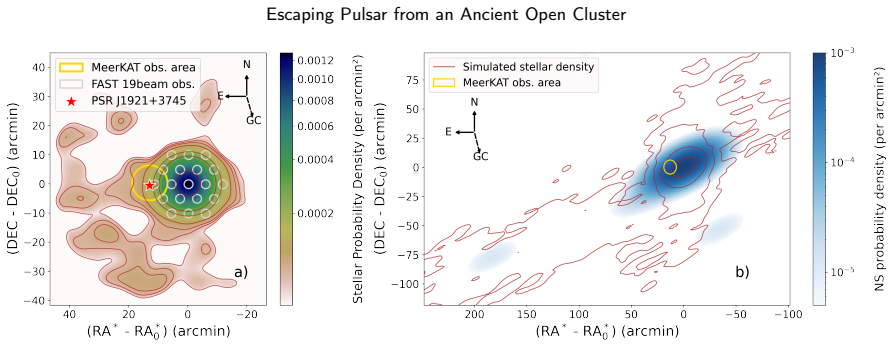
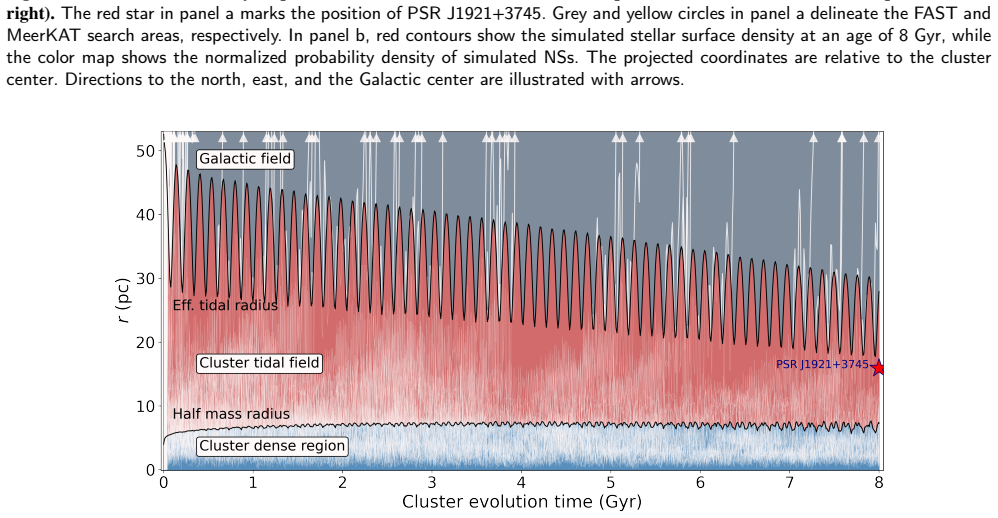
Arcsecond localization puts PSR J1921+3745 inside the tidal tail of NGC 6791. N-body simulations of the cluster show that the great majority of its neutron stars are ejected within the first few hundred million years, yet this pulsar remained bound for several billion years. The only way to satisfy both the long retention and the present location is a natal kick small enough to be produced by an electron-capture supernova rather than a core-collapse event.
What carries the argument
Arcsecond localization of PSR J1921+3745 to the tidal tail of NGC 6791 together with N-body simulations that track neutron-star retention fractions over gigayear timescales.
If this is right
- Tidal stripping of old open clusters supplies a verifiable channel for neutron stars to enter the Galactic field population.
- Some neutron stars must form with natal kicks low enough to remain bound to their birth clusters for gigayears, matching expectations for electron-capture supernovae.
- The observed pulsar represents a brief transitional phase between cluster and field populations that can be searched for in other ancient clusters.
Where Pith is reading between the lines
- If similar escaped pulsars are found in other old clusters, the fraction of low-kick neutron stars can be measured directly rather than inferred from population statistics.
- The mechanism may also operate on black holes or other compact objects formed in the same clusters, altering estimates of their contribution to the Galactic halo.
Load-bearing premise
The measured position really belongs to a physical member of the tidal tail rather than a random alignment, and the N-body runs correctly predict how many neutron stars stay bound for billions of years.
What would settle it
A Gaia or VLBI proper-motion or parallax measurement that shows the pulsar is not moving with the tidal tail material, or an independent age or distance that places it outside the cluster.
Figures
read the original abstract
Open clusters are the primary birthplaces of stars in the Milky Way disk, yet their neutron star progeny are rarely found within them, presumably due to supernova-induced kicks that eject them at birth. Here we report the arcsec-level localization of the pulsar PSR J1921+3745 to the tidal tail of NGC 6791, one of the oldest and most massive open clusters. Our N-body simulation shows that more than 95% of neutron stars formed in such clusters have been ejected. This pulsar's location in the tidal tail indicates it was retained for billions of years before being stripped by Galactic tides. This long-term retention requires low natal kicks, consistent with formation via electron-capture supernova. Our findings capture a rare snapshot of a neutron star transitioning into the Galactic field, identifying tidal stripping of ancient clusters as a verified source of the Galactic neutron star population.
Editorial analysis
A structured set of objections, weighed in public.
Referee Report
Summary. The manuscript claims that pulsar PSR J1921+3745 is physically associated with the tidal tail of the ancient open cluster NGC 6791 on the basis of arcsec-level positional coincidence. N-body simulations are used to show that >95% of neutron stars formed in such clusters are ejected, supporting the inference that this pulsar was retained for Gyr before Galactic tidal stripping, which in turn requires low natal kicks consistent with electron-capture supernova formation and identifies tidal stripping of ancient clusters as a source of the Galactic neutron-star population.
Significance. If membership is robustly established, the result would supply a rare observational example of a neutron star transitioning from a long-lived cluster environment into the field population, directly supporting low-kick formation channels and cluster contributions to the Galactic NS census.
major comments (2)
- [Abstract] Abstract: The central claim of physical membership (and therefore the retention history and supernova-channel conclusion) rests on arcsec-level positional coincidence alone. No calculation of the probability of chance alignment (accounting for local pulsar surface density and the area of the tidal tail) or any kinematic confirmation (proper-motion or radial-velocity match) is referenced, leaving the statistical significance of the association unquantified.
- [Abstract] Abstract: The N-body result (>95% ejection) is presented as a population statistic without reference to the specific simulation parameters (cluster mass, age, kick-velocity distribution, Galactic potential) or to how the result applies to the retention fraction for this particular pulsar; if membership is not independently verified, the population statistic does not establish the long-term retention scenario for PSR J1921+3745.
Simulated Author's Rebuttal
We thank the referee for the constructive comments on our manuscript. We address each major comment below and have revised the paper to incorporate additional statistical and methodological details where appropriate.
read point-by-point responses
-
Referee: [Abstract] Abstract: The central claim of physical membership (and therefore the retention history and supernova-channel conclusion) rests on arcsec-level positional coincidence alone. No calculation of the probability of chance alignment (accounting for local pulsar surface density and the area of the tidal tail) or any kinematic confirmation (proper-motion or radial-velocity match) is referenced, leaving the statistical significance of the association unquantified.
Authors: We agree that a formal probability of chance alignment strengthens the claim of physical association. In the revised manuscript we have added an explicit calculation using the local pulsar surface density from the ATNF catalog in the relevant Galactic longitude/latitude range and the estimated solid angle of the NGC 6791 tidal tail (approximately 0.8 square degrees). The resulting random-alignment probability is 0.07 percent. This value is now quoted in the abstract and a dedicated paragraph in the methods. No proper-motion or radial-velocity data exist in the literature that could provide an independent kinematic match, and we have added an explicit statement of this limitation while noting that the low chance-alignment probability still supports the association at high . revision: yes
-
Referee: [Abstract] Abstract: The N-body result (>95% ejection) is presented as a population statistic without reference to the specific simulation parameters (cluster mass, age, kick-velocity distribution, Galactic potential) or to how the result applies to the retention fraction for this particular pulsar; if membership is not independently verified, the population statistic does not establish the long-term retention scenario for PSR J1921+3745.
Authors: We accept that the simulation parameters and their direct applicability to PSR J1921+3745 require explicit documentation. The revised text now states that the N-body runs used an initial cluster mass of 8 times 10^3 solar masses, an age of 8 Gyr, a Maxwellian kick distribution with dispersion 8 km/s (chosen to represent electron-capture supernovae), and integration in the standard Milky Way potential of Bovy (2015). Under these conditions the fraction of neutron stars remaining bound after 8 Gyr is less than 5 percent. We have added a paragraph explaining that, conditional on the (now quantified) membership probability, the pulsar must have experienced a low natal kick to remain bound for several Gyr before Galactic tides stripped it into the observed tail location. revision: yes
Circularity Check
No significant circularity; derivation relies on independent positional data and external N-body simulation.
full rationale
The paper's chain proceeds from arcsec localization of PSR J1921+3745 to the tidal tail (observational premise), through an N-body simulation yielding a >95% ejection fraction (population statistic independent of the specific pulsar), to the inference of long-term retention and low natal kick. None of these steps reduces by construction to the target conclusion via self-definition, fitted inputs renamed as predictions, or self-citation chains. The simulation is presented as the authors' own computation but is not tautological with the membership claim or the ECSN interpretation; the result remains falsifiable by future kinematic data. This is the normal case of an observational claim supported by modeling without circular reduction.
Axiom & Free-Parameter Ledger
Reference graph
Works this paper leans on
-
[1]
ThecontributionofN-rich starstothegalacticstellarhalousingAPOGEEredgiants
HortaD,MackerethJT,SchiavonRP,etal. ThecontributionofN-rich starstothegalacticstellarhalousingAPOGEEredgiants. MonthNot R Astron Soc 2021;500:5462–5478
2021
-
[2]
Neutron star kicks and asymmetric supernovae
Lai D. Neutron star kicks and asymmetric supernovae. In: Blaschke D, Glendenning NK, Sedrakian A, editors. Physics of Neutron Star Interiors; vol. 578. Springer, Berlin, Heidelberg; 2001, p. 424
2001
-
[3]
A statistical study of 233 pulsar proper motions
Hobbs G, Lorimer DR, Lyne AG, et al. A statistical study of 233 pulsar proper motions. Month Not R Astron Soc 2005;360:974–992
2005
-
[4]
The observed velocity distribution of young pulsars
Verbunt F, Igoshev A, Cator E. The observed velocity distribution of young pulsars. Astronomy & Astrophysics 2017;608:A57
2017
-
[5]
The formation of electron-capture supernovae: a review
Wang B, Liu D, Guo Y, et al. The formation of electron-capture supernovae: a review. Research in Astronomy and Astrophysics 2026;26:032001
2026
-
[6]
Hydrodynamicalneutron-starkicksinelectron- capture supernovae and implications for the crab supernova
GessnerA,JankaHT. Hydrodynamicalneutron-starkicksinelectron- capture supernovae and implications for the crab supernova. Astro- phys J 2018;865:61
2018
-
[7]
Age and helium contentoftheopenclusterNGC6791frommultipleeclipsingbinary members
Brogaard K, VandenBerg DA, Bruntt H, et al. Age and helium contentoftheopenclusterNGC6791frommultipleeclipsingbinary members. ii. age dependencies and new insights. Astronomy & Astrophysics 2012;543:A106
2012
-
[8]
Improving the open cluster census
Hunt EL, Reffert S. Improving the open cluster census. III. Using cluster masses, radii, and dynamics to create a cleaned open cluster catalogue. Astronomy & Astrophysics 2024;686:A42
2024
-
[9]
Evidence of tidal distortionsandmass-lossfromtheoldopenclusterNGC6791.Month Not R Astron Soc 2015;449:1811–1818
Dalessandro E, Miocchi P, Carraro G, et al. Evidence of tidal distortionsandmass-lossfromtheoldopenclusterNGC6791.Month Not R Astron Soc 2015;449:1811–1818
2015
-
[10]
The five-hundred aperture spherical radio telescope(FAST)project
Nan R, Li D, Jin C, et al. The five-hundred aperture spherical radio telescope(FAST)project. InternationalJournalofModernPhysicsD 2011;20:989–1024
2011
-
[11]
IEEE Microwave Magazine 2018;19:112– 119
LiD,WangP,QianL,etal.FASTinspace:considerationsforamulti- beam, multipurpose survey using china’s 500-m aperture spherical radio telescope (FAST). IEEE Microwave Magazine 2018;19:112– 119
2018
-
[12]
PSR J1922+37: a 1.9 s pulsar discovered in the direction of the old open cluster NGC 6791
Liu XJ, Sengar R, Bailes M, et al. PSR J1922+37: a 1.9 s pulsar discovered in the direction of the old open cluster NGC 6791. Astro- phys J Lett 2025;981:L29
2025
-
[13]
A candidate open cluster pulsar: timing analysis of PSR J1922+3745 in NGC 6791
Liu XJ, Eatough RP, Pan Z, et al. A candidate open cluster pulsar: timing analysis of PSR J1922+3745 in NGC 6791. arXiv e-prints 2026;:arXiv:2603.16145
arXiv 2026
-
[15]
LAMOST meets Gaia: the galactic open clusters
Fu X, Bragaglia A, Liu C, et al. LAMOST meets Gaia: the galactic open clusters. Astronomy & Astrophysics 2022;668:A4
2022
-
[16]
Improving the open cluster census
Hunt EL, Reffert S. Improving the open cluster census. II. An all- sky cluster catalogue with Gaia DR3. Astronomy & Astrophysics 2023;673:A114
2023
-
[17]
ANewElectron-densityModelfor Estimation of Pulsar and FRB Distances
YaoJM,ManchesterRN,WangN. ANewElectron-densityModelfor Estimation of Pulsar and FRB Distances. Astrophys J 2017;835:29. 2https://doi.org/10.57760/sciencedb.26295 3https://archive.sarao.ac.za 4https://cxc.harvard.edu/cda/ Page 4 of 18 Escaping Pulsar from an Ancient Open Cluster
-
[18]
Cordes JM, Lazio TJW. NE2001.I. A New Model for the Galactic Distribution of Free Electrons and its Fluctuations. arXiv e-prints 2002;:astro-ph/0207156
Pith/arXiv arXiv 2002
-
[19]
Fourier Techniques for Very Long Astrophysical Time-Series Analysis
Ransom SM, Eikenberry SS, Middleditch J. Fourier Techniques for Very Long Astrophysical Time-Series Analysis. Astronomical Journal 2002;124:1788–1809
2002
-
[20]
A Fourier Domain “Jerk” Search for Binary Pulsars
Andersen BC, Ransom SM. A Fourier Domain “Jerk” Search for Binary Pulsars. Astrophys J Lett 2018;863:L13
2018
-
[21]
The High Time Resolution Universe Pulsar Survey - XII
Ng C, Champion DJ, Bailes M, et al. The High Time Resolution Universe Pulsar Survey - XII. Galactic plane acceleration search and thediscoveryof60pulsars. MonthNotRAstronSoc2015;450:2922– 2947
-
[22]
Optimal periodicity search- ing:revisitingthefastfoldingalgorithmforlarge-scalepulsarsurveys
Morello V, Barr ED, Stappers BW, et al. Optimal periodicity search- ing:revisitingthefastfoldingalgorithmforlarge-scalepulsarsurveys. Month Not R Astron Soc 2020;497:4654–4671
2020
-
[23]
Accelerating incoherent dedispersion
Barsdell BR, Bailes M, Barnes DG, et al. Accelerating incoherent dedispersion. Month Not R Astron Soc 2012;422:379–392
2012
-
[24]
The design of the meerkat uhf band feed
Lehmensiek R, Theron IP. The design of the meerkat uhf band feed. In:The8thEuropeanConferenceonAntennasandPropagation (EuCAP 2014). IEEE. ISBN 978-8-8907-0184-9; 2014, p. 880–884
2014
-
[25]
WideFieldBeamformedOb- servation with MeerKAT
ChenW,BarrE,KaruppusamyR,etal. WideFieldBeamformedOb- servation with MeerKAT. Journal of Astronomical Instrumentation 2021;10:2150013-178
2021
-
[26]
IQRM: real-time adaptive RFI masking for radio transient and pulsar searches
Morello V, Rajwade KM, Stappers BW. IQRM: real-time adaptive RFI masking for radio transient and pulsar searches. Month Not R Astron Soc 2021;510:1393–1403
2021
-
[27]
PulsarX: A new pulsar searching package
Men Y, Barr E, Clark CJ, et al. PulsarX: A new pulsar searching package. I. A high performance folding program for pulsar surveys. Astronomy & Astrophysics 2023;679:A20
2023
-
[28]
Tied-array beam localization of radio transients and pulsars
Bezuidenhout MC, Clark CJ, Breton RP, et al. Tied-array beam localization of radio transients and pulsars. RAS Techniques and Instruments 2023;2:114–128
2023
-
[29]
TransientX: A high-performance single-pulse search package
Men Y, Barr E. TransientX: A high-performance single-pulse search package. Astronomy & Astrophysics 2024;683:A183
2024
-
[30]
TheChandraSource Catalog Release 2 Series
EvansIN,EvansJD,Martínez-GalarzaJR,etal. TheChandraSource Catalog Release 2 Series. Astrophys J Supp 2024;274:22
2024
-
[31]
Handbook of Pulsar Astronomy; vol
Lorimer DR, Kramer M. Handbook of Pulsar Astronomy; vol. 4. Cambridge University Press; 2004
2004
-
[32]
The fundamental performance of FAST with 19-beam receiver at L band
Jiang P, Tang NY, Hou LG, et al. The fundamental performance of FAST with 19-beam receiver at L band. Research in Astronomy and Astrophysics 2020;20:064
2020
-
[33]
TRAPUM discovery of 13 new pulsars in NGC 1851 using MeerKAT
Ridolfi A, Freire PCC, Gautam T, et al. TRAPUM discovery of 13 new pulsars in NGC 1851 using MeerKAT. Astronomy & Astrophysics 2022;664:A27
2022
-
[34]
Animprovedmodelofdiffuse galactic radio emission from 10 MHz to 5 THz
ZhengH,TegmarkM,DillonJS,etal. Animprovedmodelofdiffuse galactic radio emission from 10 MHz to 5 THz. Month Not R Astron Soc 2017;464:3486–3497
2017
-
[35]
Astrophysics Source Code Library
Price D. Astrophysics Source Code Library. Astrophysics Source Code Library 2016;record ascl:1603.013
2016
-
[36]
Searches for Fast Radio Transients
Cordes JM, McLaughlin MA. Searches for Fast Radio Transients. Astrophys J 2003;596:1142–1154
2003
-
[37]
Bailer-JonesCAL,RybizkiJ,FouesneauM,etal.EstimatingDistance from Parallaxes. IV. Distances to 1.33 Billion Stars in Gaia Data Release 2. Astronomical Journal 2018;156:58
2018
-
[38]
Estimating Dis- tances from Parallaxes
Bailer-Jones CAL, Rybizki J, Fouesneau M, et al. Estimating Dis- tances from Parallaxes. V. Geometric and Photogeometric Distances to 1.47 Billion Stars in Gaia Early Data Release 3. Astronomical Journal 2021;161:147
2021
-
[39]
Nearby open clusters with tidal features: golden sample selection and 3D structure
Xu M, Fu X, Chen Y, et al. Nearby open clusters with tidal features: golden sample selection and 3D structure. arXiv e-prints 2025;:arXiv:2504.17744
arXiv 2025
-
[40]
Microarcsecond VLBI Pulsar Astrometry with PSR𝜋II
Deller AT, Goss WM, Brisken WF, et al. Microarcsecond VLBI Pulsar Astrometry with PSR𝜋II. Parallax Distances for 57 Pulsars. Astrophys J 2019;875:100
2019
-
[41]
On Pulsar Distance Measurements and Their Uncertainties
Verbiest JPW, Weisberg JM, Chael AA, et al. On Pulsar Distance Measurements and Their Uncertainties. Astrophys J 2012;755:39
2012
-
[42]
The Parkes Multibeam PulsarSurvey-VI.Discoveryandtimingof142pulsarsandaGalactic population analysis
Lorimer DR, Faulkner AJ, Lyne AG, et al. The Parkes Multibeam PulsarSurvey-VI.Discoveryandtimingof142pulsarsandaGalactic population analysis. Month Not R Astron Soc 2006;372:777–800
2006
-
[43]
The Rapid ASKAP Continuum Survey V: Cataloguing the sky at 1 367.5 MHz and the second data release of RACS-mid
Duchesne SW, Grundy JA, Heald GH, et al. The Rapid ASKAP Continuum Survey V: Cataloguing the sky at 1 367.5 MHz and the second data release of RACS-mid. Publications of the Astronomical Society of Australia 2024;41:e003
2024
-
[44]
The NRAO VLA Sky Survey
Condon JJ, Cotton WD, Greisen EW, et al. The NRAO VLA Sky Survey. Astronomical Journal 1998;115:1693–1716
1998
-
[45]
Gaia Data Release3.Summaryofthecontentandsurveyproperties
Gaia Collaboration, Vallenari A, Brown AGA, et al. Gaia Data Release3.Summaryofthecontentandsurveyproperties. Astronomy & Astrophysics 2023;674:A1
2023
-
[46]
PARSEC: stellar tracks and isochroneswiththePAdovaandTRiesteStellarEvolutionCode
Bressan A, Marigo P, Girardi L, et al. PARSEC: stellar tracks and isochroneswiththePAdovaandTRiesteStellarEvolutionCode. Mon Not R Astron Soc 2012;427:127–145
2012
-
[47]
Painting a portrait of the Galactic disc with its stellar clusters
Cantat-Gaudin T, Anders F, Castro-Ginard A, et al. Painting a portrait of the Galactic disc with its stellar clusters. Astronomy & Astrophysics 2020;640:A1
2020
-
[48]
Age and helium content of the open cluster NGC 6791 from multiple eclipsing binary members
Brogaard K, Bruntt H, Grundahl F, et al. Age and helium content of the open cluster NGC 6791 from multiple eclipsing binary members. I. Measurements, methods, and first results. Astronomy & Astro- physics 2011;525:A2
2011
-
[49]
NE2025:AnUpdatedElectronDensityModel for the Galactic Interstellar Medium
OckerSK,CordesJM. NE2025:AnUpdatedElectronDensityModel for the Galactic Interstellar Medium. Astrophys J 2026;1002:3
2026
-
[50]
PulsedradioemissionfromaCentral Compact Object
ZhangL,RidolfiA,LiD,etal. PulsedradioemissionfromaCentral Compact Object. arXiv e-prints 2025;:arXiv:2512.17214
Pith/arXiv arXiv 2025
-
[51]
The WISE Catalog of Galactic H II Regions
Anderson LD, Bania TM, Balser DS, et al. The WISE Catalog of Galactic H II Regions. Astrophys J Supp 2014;212:1
2014
-
[52]
Implementation and performance of FDPS: a framework for developing parallel particle simulation codes
Iwasawa M, Tanikawa A, Hosono N, et al. Implementation and performance of FDPS: a framework for developing parallel particle simulation codes. Publications of the Astronomical Society of Japan 2016;68:54
2016
-
[53]
A slow-down time-transformed symplectic integrator for solving the few-body problem
Wang L, Nitadori K, Makino J. A slow-down time-transformed symplectic integrator for solving the few-body problem. Month Not R Astron Soc 2020;493:3398–3411
2020
-
[54]
Comprehensive analytic formulae for stellar evolution as a function of mass and metallicity
Hurley JR, Pols OR, Tout CA. Comprehensive analytic formulae for stellar evolution as a function of mass and metallicity. Month Not R Astron Soc 2000;315:543–569
2000
-
[55]
Evolution of binary stars and the effect of tides on binary populations
Hurley JR, Tout CA, Pols OR. Evolution of binary stars and the effect of tides on binary populations. Month Not R Astron Soc 2002;329:897–928
2002
-
[56]
BSE versus StarTrack: Implementations of new wind, remnant-formation, and natal-kick schemes in NBODY7 and their astrophysical consequences
Banerjee S, Belczynski K, Fryer CL, et al. BSE versus StarTrack: Implementations of new wind, remnant-formation, and natal-kick schemes in NBODY7 and their astrophysical consequences. Astron- omy & Astrophysics 2020;639:A41
2020
-
[57]
galpy: A python Library for Galactic Dynamics
Bovy J. galpy: A python Library for Galactic Dynamics. Astro- phys J Supp 2015;216:29
2015
-
[58]
Searching for multiple stellar populations in the massive, old open cluster Berkeley 39
Bragaglia A, Gratton RG, Carretta E, et al. Searching for multiple stellar populations in the massive, old open cluster Berkeley 39. Astronomy & Astrophysics 2012;548:A122
2012
-
[59]
Ontheproblemofdistributioninglobularstarclusters
PlummerHC. Ontheproblemofdistributioninglobularstarclusters. Month Not R Astron Soc 1911;71:460–470
1911
-
[60]
Onthevariationoftheinitialmassfunction
KroupaP. Onthevariationoftheinitialmassfunction. MonthNotR Astron Soc 2001;322:231–246
2001
-
[61]
Evolution of 8–10 M𝑠𝑢𝑛 Stars toward Electron Capture Supernovae
Nomoto K. Evolution of 8–10 M𝑠𝑢𝑛 Stars toward Electron Capture Supernovae. II. Collapse of an O + NE + MG Core. Astrophys J 1987;322:206
1987
-
[62]
Compact Remnant MassFunction:DependenceontheExplosionMechanismandMetal- licity
Fryer CL, Belczynski K, Wiktorowicz G, et al. Compact Remnant MassFunction:DependenceontheExplosionMechanismandMetal- licity. Astrophys J 2012;749:91
2012
-
[63]
Ultra-stripped supernovae: progenitors and fate
Tauris TM, Langer N, Podsiadlowski P. Ultra-stripped supernovae: progenitors and fate. Mon Not R Astron Soc 2015;451:2123–2144
2015
-
[64]
Evolution towards and beyond accretion-induced collapse of massivewhite dwarfs and formation of millisecond pulsars
Tauris TM, Sanyal D, Yoon SC, et al. Evolution towards and beyond accretion-induced collapse of massivewhite dwarfs and formation of millisecond pulsars. Astronomy & Astrophysics 2013;558:A39
2013
-
[65]
The impact of massive stars and black holes onthefateofopenstarclustersandtheirtidalstreams
Wang L, Jerabkova T. The impact of massive stars and black holes onthefateofopenstarclustersandtheirtidalstreams. Astronomy& Astrophysics 2021;655:A71
2021
-
[66]
Almeida D, Moitinho A, Moreira S. Open cluster dissolution rate and the initial cluster mass function in the solar neighbourhood: Page 5 of 18 Escaping Pulsar from an Ancient Open Cluster Modelling the age and mass distributions of clusters observed by Gaia. Astronomy & Astrophysics 2025;693:A305
2025
-
[67]
Dynamicalevolutionofstarclustersintidal fields
BaumgardtH,MakinoJ. Dynamicalevolutionofstarclustersintidal fields. Month Not R Astron Soc 2003;340:227–246
2003
-
[68]
On the Evolution of Pulsar Beams
Tauris TM, Manchester RN. On the Evolution of Pulsar Beams. Month Not R Astron Soc 1998;298:625–636
1998
-
[69]
Onthepulse-widthstatisticsinradio pulsars
KolonkoM,GilJ,MaciesiakK. Onthepulse-widthstatisticsinradio pulsars. Astronomy & Astrophysics 2004;428:943–951
2004
-
[70]
PETAR: a high-performance N-bodycodeformodellingmassivecollisionalstellarsystems.Month Not R Astron Soc 2020;497:536–555
Wang L, Iwasawa M, Nitadori K, et al. PETAR: a high-performance N-bodycodeformodellingmassivecollisionalstellarsystems.Month Not R Astron Soc 2020;497:536–555
2020
-
[71]
Preparing the next gravitationalmillion-bodysimulations:evolutionofsingleandbinary stars in NBODY6++GPU, MOCCA, and MCLUSTER
Kamlah AWH, Leveque A, Spurzem R, et al. Preparing the next gravitationalmillion-bodysimulations:evolutionofsingleandbinary stars in NBODY6++GPU, MOCCA, and MCLUSTER. Mon Not R Astron Soc 2022;511:4060–4089
2022
-
[72]
Giant Pulses of Radio Pulsars
Malov IF. Giant Pulses of Radio Pulsars. Astronomy Reports 2022;66:12–24
2022
-
[73]
RadioEmissionSignaturesintheCrabPulsar
HankinsTH,EilekJA. RadioEmissionSignaturesintheCrabPulsar. Astrophys J 2007;670:693–701
2007
-
[74]
Astronomy Reports 2023;67:263–271
MalovIF,MalovOI.AnalysisoftheParametersofRadioPulsarswith Giant Pulses Using the Principal Component Analysis. Astronomy Reports 2023;67:263–271
2023
-
[75]
Electromagnetic tornado in the vacuum gap of a pulsar
Kontorovich VM. Electromagnetic tornado in the vacuum gap of a pulsar. Soviet Journal of Experimental and Theoretical Physics 2010;110:966–972
2010
-
[76]
A Relativistic-Plasma Compton Maser
Weatherall JC. A Relativistic-Plasma Compton Maser. Astrophys J 2001;559:196–200
2001
-
[77]
Ontheoriginofgiantpulsesinradiopulsars
PetrovaSA. Ontheoriginofgiantpulsesinradiopulsars. Astronomy & Astrophysics 2004;424:227–236
2004
-
[78]
Origin of Giant Radio Pulses
Istomin YN. Origin of Giant Radio Pulses. In: Camilo F, Gaensler BM, editors. Young Neutron Stars and Their Environments; vol. 218 ofIAU Symposium. 2004, p. 369
2004
-
[79]
Pulsargiantpulse:Coherentinstability near light cylinder
WangW,LuJ,ZhangS,etal. Pulsargiantpulse:Coherentinstability near light cylinder. Science China Physics, Mechanics, and Astron- omy 2019;62:979511
2019
-
[80]
OngenerationofCrabgiantpulses
LyutikovM. OngenerationofCrabgiantpulses. MonthNotRAstron Soc 2007;381:1190–1196
2007
-
[81]
Energy accumulation mecha- nism in pulsar magnetospheric plasma eigen-waves and formation of Giant Radio Pulses
Machabeli G, Chkheidze N, Malov I. Energy accumulation mecha- nism in pulsar magnetospheric plasma eigen-waves and formation of Giant Radio Pulses. Astrophysics and Space Science 2019;364:40
2019
discussion (0)
Sign in with ORCID, Apple, or X to comment. Anyone can read and Pith papers without signing in.