Methods for Uncertainty Representation in Risk Management: A Comparative Review and Decision-Oriented Framework
Pith reviewed 2026-06-29 02:19 UTC · model grok-4.3
The pith
A review of 370 publications classifies uncertainty representation in risk management into five methodological families.
A machine-rendered reading of the paper's core claim, the machinery that carries it, and where it could break.
Core claim
Based on a systematic literature review of 370 publications, the identified approaches are classified into five methodological families: probabilistic methods, evidence-based and fuzzy-logic approaches, qualitative elicitation techniques, graphical and visual representations, and hybrid frameworks. Probabilistic methods remain predominant due to their quantitative rigor, whereas fuzzy and evidence-based approaches are particularly suited to addressing vagueness and epistemic uncertainty. Qualitative and graphical approaches enhance interpretive understanding and support transparent communication of uncertainty.
What carries the argument
The five-family classification of uncertainty representation methods derived from the review of 370 publications, which serves to compare their theoretical foundations and practical applications in risk management.
If this is right
- Probabilistic methods offer quantitative rigor suitable for many risk scenarios.
- Fuzzy and evidence-based methods address vagueness and epistemic uncertainty effectively.
- Qualitative and graphical methods improve understanding and communication of uncertainty.
- Hybrid frameworks combine strengths but require further development.
- Practical integration of these methods into operational risk management is currently limited.
Where Pith is reading between the lines
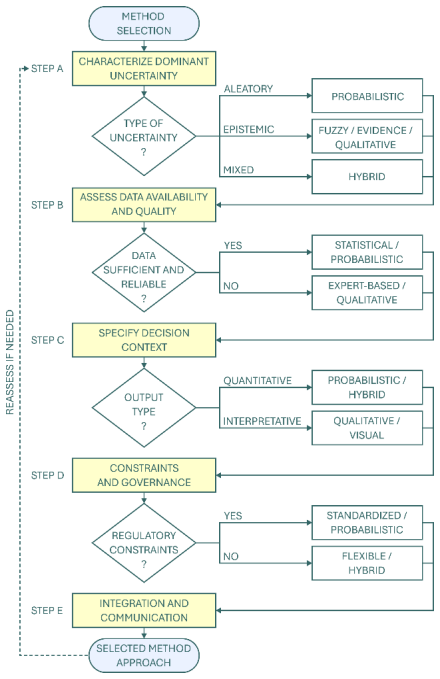
- Risk managers in new domains could use the classification to select methods matching their uncertainty type.
- Future tools might integrate visualization techniques to make uncertainty more accessible to non-experts.
- The emphasis on hybrids suggests research into combining probabilistic and fuzzy elements for better coverage of mixed uncertainty.
- Domains like finance or engineering safety could test the framework for method selection in practice.
Load-bearing premise
The 370 publications reviewed form a representative sample of the literature and the five-family classification captures the main approaches without major omissions.
What would settle it
A new literature search or expert survey identifying many approaches that do not fit into the five families or showing that probabilistic methods are not predominant in certain subfields would challenge the classification and analysis.
Figures
read the original abstract
The consideration of uncertainty is a central but frequently inadequately addressed component of risk management. A systematic treatment of uncertainty is essential for ensuring the quality and traceability of decision-making processes, particularly in complex and safety-critical environments. This review systematically analyzes how established risk management approaches conceptualize and represent uncertainty in both their theoretical foundations and practical applications. Based on a systematic literature review of 370 publications, the identified approaches are classified into five methodological families. These include probabilistic methods, evidence-based and fuzzy-logic approaches, qualitative elicitation techniques, graphical and visual representations and hybrid frameworks. The analysis shows that probabilistic methods remain predominant due to their quantitative rigor, whereas fuzzy and evidence-based approaches are particularly suited to addressing vagueness and epistemic uncertainty. Qualitative and graphical approaches are found to enhance interpretive understanding and support the transparent communication of uncertainty. Despite these developments, the analysis indicates that the practical integration of these approaches into operational risk management remains limited in many domains. The findings highlight the need for more structured guidance in method selection and suggest that future research would benefit from further development of hybrid approaches and visualization techniques.
Editorial analysis
A structured set of objections, weighed in public.
Referee Report
Summary. The paper presents a comparative review of uncertainty representation methods in risk management, drawing on a systematic literature review of 370 publications. It proposes a classification into five methodological families (probabilistic methods; evidence-based and fuzzy-logic approaches; qualitative elicitation techniques; graphical and visual representations; hybrid frameworks) and analyzes their theoretical foundations, practical applications, predominance, and suitability for different uncertainty types. The central findings are that probabilistic methods remain predominant due to quantitative rigor, fuzzy/evidence-based approaches suit vagueness and epistemic uncertainty, qualitative/graphical methods aid communication, and practical integration remains limited, with a call for more hybrid approaches and a decision-oriented framework.
Significance. If the review methodology and taxonomy are robust, the work provides a structured synthesis that could help risk managers select appropriate uncertainty representations, especially in safety-critical domains. It usefully distinguishes method strengths by uncertainty type and identifies gaps in operational adoption, which may inform both practice and future research on hybrids and visualization. The decision-oriented framing adds potential practical value beyond pure taxonomy.
major comments (1)
- [Abstract / Methods (literature review description)] The central claims rest on the systematic review of 370 publications and the five-family taxonomy being representative, exhaustive, and non-overlapping. However, the manuscript provides no details on the search protocol (databases, query strings, date ranges), inclusion/exclusion criteria, screening process, or classification procedure (e.g., inter-rater agreement, handling of hybrid papers, or validation against omissions). This directly affects verifiability of the predominance finding and suitability assessments; see the abstract and any methods section describing the review.
minor comments (1)
- [Abstract] The title references a 'Decision-Oriented Framework' but the abstract and provided text do not specify its structure, decision criteria, or how it maps the five families to practical selection; clarifying this would strengthen the contribution.
Simulated Author's Rebuttal
We thank the referee for their constructive comments, which highlight an important area for improving the transparency of our work. We address the major comment below.
read point-by-point responses
-
Referee: [Abstract / Methods (literature review description)] The central claims rest on the systematic review of 370 publications and the five-family taxonomy being representative, exhaustive, and non-overlapping. However, the manuscript provides no details on the search protocol (databases, query strings, date ranges), inclusion/exclusion criteria, screening process, or classification procedure (e.g., inter-rater agreement, handling of hybrid papers, or validation against omissions). This directly affects verifiability of the predominance finding and suitability assessments; see the abstract and any methods section describing the review.
Authors: We agree that the absence of a detailed description of the systematic review methodology limits the verifiability of our findings. In the revised manuscript we will add a dedicated Methods section that specifies the databases searched, the query strings and date ranges employed, the inclusion/exclusion criteria, the screening process, and the classification procedure. The section will also explain how hybrid papers were assigned to families and any steps taken to assess classification consistency. These additions will directly support the claims regarding predominance and suitability. revision: yes
Circularity Check
No circularity: literature synthesis with no derivations or self-referential reductions.
full rationale
This is a systematic literature review classifying 370 external publications into five methodological families. No equations, predictions, fitted parameters, or first-principles derivations exist that could reduce to the paper's own inputs by construction. Central claims (predominance of probabilistic methods, suitability of fuzzy/evidence-based approaches) rest on analysis of cited external sources rather than self-definition, self-citation load-bearing, or renaming of known results. Absence of explicit search-protocol details is a methodological limitation but does not create circularity under the enumerated patterns, as the paper makes no internal predictive or definitional claims that loop back on themselves.
Axiom & Free-Parameter Ledger
Reference graph
Works this paper leans on
-
[1]
Literature review of methods for representing uncertainty
Zio E, Pedroni N. Literature review of methods for representing uncertainty. Toulouse, France: Cahiers de la Sécurité Industrielle, Foundation for an Industrial Safety Culture; 2013
2013
-
[2]
Aven T, Zio E. Some considerations on the treatment of uncertainties in risk assessment for practical decision making. Reliability Engineering & System Safety 2011;96:64–74. https://doi.org/10.1016/j.ress.2010.06.001
-
[3]
Washington, D.C.: National Academies Press; 2013
Environmental Decisions in the Face of Uncertainty. Washington, D.C.: National Academies Press; 2013. https://doi.org/10.17226/12568
-
[4]
Srikrishnan V, Lafferty DC, Wong TE, Lamontagne JR, Quinn JD, Sharma S, et al. Uncertainty Analysis in Multi-Sector Systems: Considerations for Risk Analysis, Projection, and Planning for Complex Systems. Earth’s Future 2022;10:e2021EF002644. https://doi.org/10.1029/2021EF002644
-
[5]
Dealing with Uncertainty: A Survey of Theories and Practices
Li Y, Chen J, Feng L. Dealing with Uncertainty: A Survey of Theories and Practices. IEEE Transactions on Knowledge and Data Engineering 2013;25:2463–82. https://doi.org/10.1109/TKDE.2012.179
-
[6]
A Survey on Uncertainty Reasoning and Quantification for Decision Making: Belief Theory Meets Deep Learning
Guo Z, Wan Z, Zhang Q, Zhao X, Chen F, Cho J-H, et al. A Survey on Uncertainty Reasoning and Quantification for Decision Making: Belief Theory Meets Deep Learning
-
[7]
https://doi.org/10.48550/arXiv.2206.05675
-
[8]
Risk-Adaptive Approaches to Stochastic Optimization: A Survey
Royset JO. Risk-Adaptive Approaches to Stochastic Optimization: A Survey. SIAM Rev 2025;67:3–70. https://doi.org/10.1137/22M1538946
-
[9]
A survey of contextual optimization methods for decision-making under uncertainty
Sadana U, Chenreddy A, Delage E, Forel A, Frejinger E, Vidal T. A survey of contextual optimization methods for decision-making under uncertainty. European Journal of Operational Research 2025;320:271–89. https://doi.org/10.1016/j.ejor.2024.03.020
-
[10]
Quantification of margins and uncertainties: Conceptual and computational basis
Helton JC. Quantification of margins and uncertainties: Conceptual and computational basis. Reliability Engineering & System Safety 2011;96:976–1013. https://doi.org/10.1016/j.ress.2011.03.017
-
[11]
A Methodology For Performing Global Uncertainty And Sensitivity Analysis In Systems Biology
Marino S, Hogue IB, Ray CJ, Kirschner DE. A Methodology For Performing Global Uncertainty And Sensitivity Analysis In Systems Biology. J Theor Biol 2008;254:178–96. https://doi.org/10.1016/j.jtbi.2008.04.011
-
[12]
Aleatory and epistemic uncertainty in reliability analysis: An engineering perspective
Li P-P, Valdebenito MA, Dang C, Beer M, Faes MGR. Aleatory and epistemic uncertainty in reliability analysis: An engineering perspective. Structural Safety 2026;119:102666. https://doi.org/10.1016/j.strusafe.2025.102666
-
[13]
Barghi B, Shadrokh sikari S. Qualitative and quantitative project risk assessment using a hybrid PMBOK model developed under uncertainty conditions. Heliyon 2020;6:e03097. https://doi.org/10.1016/j.heliyon.2019.e03097
-
[14]
Arunraj NS, Mandal S, Maiti J. Modeling uncertainty in risk assessment: An integrated approach with fuzzy set theory and Monte Carlo simulation. Accident Analysis & Prevention 2013;55:242–55. https://doi.org/10.1016/j.aap.2013.03.007
-
[15]
Khodabakhshian A, Re Cecconi F, Lopez Droguett E. Probabilistic risk identification and assessment model for construction projects using elicitation based bayesian network. ITcon 2025;30:185–212. https://doi.org/10.36680/j.itcon.2025.009
-
[16]
A COMPREHENSIVE REVIEW ON THE APPLICATION OF FUZZY LOGIC IN RISK ANALYSIS
James S, Renjith VR. A COMPREHENSIVE REVIEW ON THE APPLICATION OF FUZZY LOGIC IN RISK ANALYSIS. International Journal of Computer Applications 2024;186:16–38. https://doi.org/10.5120/ijca2024924254
-
[17]
Coping with Complexity, Uncertainty and Ambiguity in Risk Governance: A Synthesis
Renn O, Klinke A, van Asselt M. Coping with Complexity, Uncertainty and Ambiguity in Risk Governance: A Synthesis. Ambio 2011;40:231–46. https://doi.org/10.1007/s13280- 010-0134-0
-
[18]
Guidance on Uncertainty Analysis in Scientific Assessments
Committee ES, Benford D, Halldorsson T, Jeger MJ, Knutsen HK, More S, et al. Guidance on Uncertainty Analysis in Scientific Assessments. EFSA Journal 2018;16:e05123. https://doi.org/10.2903/j.efsa.2018.5123
-
[19]
The principles and methods behind EFSA’s Guidance on Uncertainty Analysis in Scientific Assessment
Committee ES, Benford D, Halldorsson T, Jeger MJ, Knutsen HK, More S, et al. The principles and methods behind EFSA’s Guidance on Uncertainty Analysis in Scientific Assessment. EFSA Journal 2018;16:e05122. https://doi.org/10.2903/j.efsa.2018.5122
-
[20]
Grimm SE, Pouwels X, Ramaekers BLT, Wijnen B, Knies S, Grutters J, et al. Development and Validation of the TRansparent Uncertainty ASsessmenT (TRUST) Tool for Assessing Uncertainties in Health Economic Decision Models. Pharmacoeconomics 2020;38:205–16. https://doi.org/10.1007/s40273-019-00855-9
-
[21]
Foundational Issues in Risk Assessment and Risk Management
Aven T, Zio E. Foundational Issues in Risk Assessment and Risk Management. Risk Analysis 2014;34:1164–72. https://doi.org/10.1111/risa.12132
-
[22]
The Science of Risk Analysis: Foundation and Practice
Aven T. The Science of Risk Analysis: Foundation and Practice. 1st ed. Routledge; 2019. https://doi.org/10.4324/9780429029189
-
[23]
Risk Governance: Coping With Uncertainty in a Complex World
Renn O. Risk Governance: Coping With Uncertainty in a Complex World. 2008. https://doi.org/10.1007/978-1-4020-6799-0
-
[24]
Bevan LD. The ambiguities of uncertainty: A review of uncertainty frameworks relevant to the assessment of environmental change. Futures 2022;137:102919. https://doi.org/10.1016/j.futures.2022.102919
-
[25]
Distinguishing Two Dimensions of Uncertainty 2011
Fox CR, Ülkümen G. Distinguishing Two Dimensions of Uncertainty 2011. https://doi.org/10.2139/ssrn.3695311
-
[26]
Aleatoric or epistemic? Does it matter? Structural Safety 2009;31:105–12
Der Kiureghian A, Ditlevsen OD. Aleatoric or epistemic? Does it matter? Structural Safety 2009;31:105–12. https://doi.org/10.1016/j.strusafe.2008.06.020
-
[27]
Aleatory and epistemic uncertainties can completely derail medical research results
Indrayan A. Aleatory and epistemic uncertainties can completely derail medical research results. J Postgrad Med 2020;66:94–8. https://doi.org/10.4103/jpgm.JPGM_585_19
-
[28]
Risk, uncertainty, ignorance and myopia: Their managerial implications for B2B firms
Oehmen J, Locatelli G, Wied M, Willumsen P. Risk, uncertainty, ignorance and myopia: Their managerial implications for B2B firms. Industrial Marketing Management 2020;88:330–8. https://doi.org/10.1016/j.indmarman.2020.05.018
-
[29]
Toward a Commonly Shared Public Policy Perspective for Analyzing Risk Coping Strategies
Li Y, Taeihagh A, de Jong M, Klinke A. Toward a Commonly Shared Public Policy Perspective for Analyzing Risk Coping Strategies. Risk Anal 2021;41:519–32. https://doi.org/10.1111/risa.13505
-
[30]
Stirling A. Risk, precaution and science: towards a more constructive policy debate: Talking point on the precautionary principle. EMBO Reports 2007;8:309–15. https://doi.org/10.1038/sj.embor.7400953
-
[31]
Investor Behavior Under Epistemic vs
Walters DJ, Ülkümen G, Tannenbaum D, Erner C, Fox CR. Investor Behavior Under Epistemic vs. Aleatory Uncertainty. Management Science 2023;69:2761–77. https://doi.org/10.1287/mnsc.2022.4489
-
[32]
Computational Methods For Reliability And Risk Analysis
Zio E. Computational Methods For Reliability And Risk Analysis. World Scientific Publishing Company; 2009
2009
-
[33]
Mitigating versus Managing Epistemic and Aleatory Uncertainty
Packard MD, Clark BB. Mitigating versus Managing Epistemic and Aleatory Uncertainty. AMR 2020;45:872–6. https://doi.org/10.5465/amr.2020.0266
-
[34]
Uncertainty characterization in risk analysis for decision-making practice
Zio E, Pedroni N. Uncertainty characterization in risk analysis for decision-making practice. 2012
2012
-
[35]
How to embrace uncertainty in participatory climate change risk management—A roadmap
Döll P, Romero‐Lankao P. How to embrace uncertainty in participatory climate change risk management—A roadmap. Earth’s Future 2017;5:18–36. https://doi.org/10.1002/2016EF000411
-
[36]
Review of Statistical Reasoning with Imprecise Probabilities
Hand DJ. Review of Statistical Reasoning with Imprecise Probabilities. Journal of the Royal Statistical Society Series C (Applied Statistics) 1993;42:237–8. https://doi.org/10.2307/2347427
-
[37]
Introduction to Imprecise Probabilities
Augustin T, Coolen FPA, de Cooman G, Troffaes MCM. Introduction to Imprecise Probabilities. Chichester, U.K.: Wiley; 2014. https://doi.org/10.1002/9781118763117
-
[38]
Ben-Haim Y. Info-Gap Decision Theory (IG). In: Marchau VAWJ, Walker WE, Bloemen PJTM, Popper SW, editors. Decision Making under Deep Uncertainty: From Theory to Practice, Cham: Springer International Publishing; 2019, p. 93–115. https://doi.org/10.1007/978-3-030-05252-2_5
-
[39]
Shaping the Next One Hundred Years: New Methods for Quantitative, Long-Term Policy Analysis
Lempert RJ, Popper SW, Bankes SC. Shaping the Next One Hundred Years: New Methods for Quantitative, Long-Term Policy Analysis. 2003
2003
-
[40]
What is risk? Risk Analysis, John Wiley & Sons, Ltd; 2015, p. 13–27. https://doi.org/10.1002/9781119057819.ch2
-
[41]
What is a risk analysis? Risk Analysis, John Wiley & Sons, Ltd; 2015, p. 1–12. https://doi.org/10.1002/9781119057819.ch1
-
[42]
Probabilistic risk analysis: foundations and methods
Bedford T, Cooke R. Probabilistic risk analysis: foundations and methods. 3. printing. Cambridge: Cambridge University Press; 2004
2004
-
[43]
On The Quantitative Definition of Risk
Kaplan S, Garrick BJ. On The Quantitative Definition of Risk. Risk Analysis 1981;1:11–
1981
-
[44]
https://doi.org/10.1111/j.1539-6924.1981.tb01350.x
-
[45]
Simulation and the Monte Carlo Method
Rubinstein RY, Kroese DP. Simulation and the Monte Carlo Method. 1st ed. Wiley; 2016. https://doi.org/10.1002/9781118631980
-
[46]
Li Z, Zhu X, Liao S, Yin J, Gao K, Liu X. Integrating Bayesian Network and Cloud Model to Probabilistic Risk Assessment of Maritime Collision Accidents in China’s Coastal Port Waters. Journal of Marine Science and Engineering 2024;12:2113. https://doi.org/10.3390/jmse12122113
-
[47]
Hybrid Bayesian Networks for Reliability Assessment of Infrastructure Systems
Zwirglmaier K, Chan J, Papaioannou I, Song J, Straub D. Hybrid Bayesian Networks for Reliability Assessment of Infrastructure Systems. ASCE-ASME Journal of Risk and Uncertainty in Engineering Systems, Part A: Civil Engineering 2024;10:04024019. https://doi.org/10.1061/AJRUA6.RUENG-1005
-
[48]
Fault Tree Handbook 1981
Vesely WE, Goldberg FF, Roberts NH, Haasl DF. Fault Tree Handbook 1981
1981
-
[49]
Risk Analysis, John Wiley & Sons, Ltd; 2015, p
The risk analysis process: risk assessment. Risk Analysis, John Wiley & Sons, Ltd; 2015, p. 38–48. https://doi.org/10.1002/9781119057819.ch4
-
[50]
Risk Analysis, John Wiley & Sons, Ltd; 2015, p
The risk analysis process: risk treatment. Risk Analysis, John Wiley & Sons, Ltd; 2015, p. 49–54. https://doi.org/10.1002/9781119057819.ch5
-
[51]
Risk Analysis, John Wiley & Sons, Ltd; 2015, p
The risk analysis process: planning. Risk Analysis, John Wiley & Sons, Ltd; 2015, p. 28–
2015
-
[52]
https://doi.org/10.1002/9781119057819.ch3
-
[53]
Quantifying Aleatoric and Epistemic Uncertainty with Proper Scoring Rules 2024
Hofman P, Sale Y, Hüllermeier E. Quantifying Aleatoric and Epistemic Uncertainty with Proper Scoring Rules 2024. https://doi.org/10.48550/arXiv.2404.12215
-
[54]
Apostolakis G. How Useful Is Quantitative Risk Assessment? Risk Analysis : An Official Publication of the Society for Risk Analysis 2004;24:515–20. https://doi.org/10.1111/j.0272-4332.2004.00455.x
-
[55]
Uncertainty Quantification in Industrial Risk Assessment for Practical Decision-making
Olivier-Maget N, De Barnier T, Bourgeois F, Gabas N. Uncertainty Quantification in Industrial Risk Assessment for Practical Decision-making. Chemical Engineering Transactions 2025;116:469–74. https://doi.org/10.3303/CET25116079
-
[56]
Confidence in Probabilistic Risk Assessment
Zanetti L. Confidence in Probabilistic Risk Assessment. Philosophy of Science 2024;91:702–20. https://doi.org/10.1017/psa.2023.158
-
[57]
Xu Y, Reniers G, Yang M, Yuan S, Chen C. Uncertainties and their treatment in the quantitative risk assessment of domino effects: Classification and review. Process Safety and Environmental Protection 2023;172:971–85. https://doi.org/10.1016/j.psep.2023.02.082
-
[58]
Meng Z, Zhao J, Chen G, Yang D. Hybrid uncertainty propagation and reliability analysis using direct probability integral method and exponential convex model. Reliability Engineering & System Safety 2022;228:108803. https://doi.org/10.1016/j.ress.2022.108803
-
[59]
A general framework for quantifying uncertainty at scale
Farcaş I-G, Merlo G, Jenko F. A general framework for quantifying uncertainty at scale. Commun Eng 2022;1:43. https://doi.org/10.1038/s44172-022-00045-0
-
[60]
Bakker H, Dunke F, Nickel S. A structuring review on multi-stage optimization under uncertainty: Aligning concepts from theory and practice. Omega 2020;96:102080. https://doi.org/10.1016/j.omega.2019.06.006
-
[61]
A Review of Stochastic Programming Methods for Optimization of Process Systems Under Uncertainty
Li C, Grossmann IE. A Review of Stochastic Programming Methods for Optimization of Process Systems Under Uncertainty. Front Chem Eng 2021;2. https://doi.org/10.3389/fceng.2020.622241
-
[62]
A Modular Dynamic Probabilistic Risk Assessment Framework for Electric Grid Cybersecurity
Diao X, Zhao Y, Li R, Chakhchoukh Y, Johnson B, Le Blanc K, et al. A Modular Dynamic Probabilistic Risk Assessment Framework for Electric Grid Cybersecurity. Engineering Reports 2025;7:e70377. https://doi.org/10.1002/eng2.70377
-
[63]
PROBABILISTIC RISK ASSESSMENT (PRA) FOR ARTEMIS AND FUTURE SPACE EXPLORATION PROGRAMS
Lane K, Nilvarna A, Abbey GWS, Kezirian MT. PROBABILISTIC RISK ASSESSMENT (PRA) FOR ARTEMIS AND FUTURE SPACE EXPLORATION PROGRAMS. Acta Astronautica 2025. https://doi.org/10.1016/j.actaastro.2025.06.045
-
[64]
Farag AS, Chandran P, Afzali A, Smith C. Developing a Probabilistic Risk Assessment Framework for Sodium-Cooled Thermal Reactors: Addressing Unique Challenges and Uncertainties: 19th International Conference on Probabilistic Safety Assessment and Analysis, 2025. https://doi.org/10.13182/PSA2025-47493
-
[65]
An Overview of Data Quality Frameworks
Cichy C, Rass S. An Overview of Data Quality Frameworks. IEEE Access 2019;7:24634–
2019
-
[66]
https://doi.org/10.1109/ACCESS.2019.2899751
-
[67]
AI-DRIVEN OPTIMIZATION AND RISK MODELING IN STRATEGIC ECONOMIC ZONE DEVELOPMENT FOR MID-SIZED ECONOMIES: A REVIEW APPROACH
Jahid M. AI-DRIVEN OPTIMIZATION AND RISK MODELING IN STRATEGIC ECONOMIC ZONE DEVELOPMENT FOR MID-SIZED ECONOMIES: A REVIEW APPROACH. International Journal of Scientific Interdisciplinary Research 2025;6:185–
2025
-
[68]
https://doi.org/10.63125/31wna449
-
[69]
Sahlin U, Helle I, Perepolkin D. “This Is What We Don’t Know”: Treating Epistemic Uncertainty in Bayesian Networks for Risk Assessment. Integrated Environmental Assessment and Management 2021;17:221–32. https://doi.org/10.1002/ieam.4367
-
[70]
Jia X, Hou W, Papadimitriou C. Hierarchical Bayesian Modeling for Uncertainty Quantification and Reliability Updating using Data 2024. https://doi.org/10.48550/arXiv.2412.20416
-
[71]
Zadeh LA. Fuzzy sets. Information and Control 1965;8:338–53. https://doi.org/10.1016/S0019-9958(65)90241-X
-
[72]
A Mathematical Theory of Evidence
Shafer G. A Mathematical Theory of Evidence. Princeton University Press; 1976. https://doi.org/10.2307/j.ctv10vm1qb
-
[73]
Upper and Lower Probabilities Induced by a Multivalued Mapping
Dempster AP. Upper and Lower Probabilities Induced by a Multivalued Mapping. The Annals of Mathematical Statistics 1967;38:325–39. https://doi.org/10.1214/aoms/1177698950
-
[74]
On Bayesian Trust and Risk Forecasting for Compound Systems, IEEE Computer Society; 2013, p
Rass S, Kurowski S. On Bayesian Trust and Risk Forecasting for Compound Systems, IEEE Computer Society; 2013, p. 69–82. https://doi.org/10.1109/IMF.2013.13
-
[75]
Fuzzy Logic and Probability Applications: Bridging the gap
Ross TJ, Booker JM, Parkinson WJ. Fuzzy Logic and Probability Applications: Bridging the gap. ASA SIAM; 2002
2002
-
[76]
Fuzzy sets as a basis for a theory of possibility
Zadeh LA. Fuzzy sets as a basis for a theory of possibility. Fuzzy Sets and Systems 1978;1:3–28. https://doi.org/10.1016/0165-0114(78)90029-5
-
[77]
Possibility Theory: An Approach to Computerized Processing of Uncertainty
Dubois D, Prade H. Possibility Theory: An Approach to Computerized Processing of Uncertainty. Plenum Press; 1988
1988
-
[78]
Uncertainty: A Guide to Dealing with Uncertainty in Quantitative Risk and Policy Analysis
Morgan MG, Henrion M. Uncertainty: A Guide to Dealing with Uncertainty in Quantitative Risk and Policy Analysis. 1st ed., Cambridge University Press; 1990. https://doi.org/10.1017/CBO9780511840609
-
[79]
Experts in uncertainty: Opinion and subjective probability in science
Cooke RM. Experts in uncertainty: Opinion and subjective probability in science. New York, NY, US: Oxford University Press; 1991
1991
-
[80]
Uncertain Judgements: Eliciting Experts’ Probabilities, John Wiley & Sons, Ltd; 2006, p
The Elicitation of Probabilities. Uncertain Judgements: Eliciting Experts’ Probabilities, John Wiley & Sons, Ltd; 2006, p. 61–96. https://doi.org/10.1002/0470033312.ch4
discussion (0)
Sign in with ORCID, Apple, or X to comment. Anyone can read and Pith papers without signing in.