Multivariate Statistical Analysis of Low Mass Ratio Contact Binaries: Definition, Dynamical Stability, and Parameter Relationships
Pith reviewed 2026-06-29 02:48 UTC · model grok-4.3
The pith
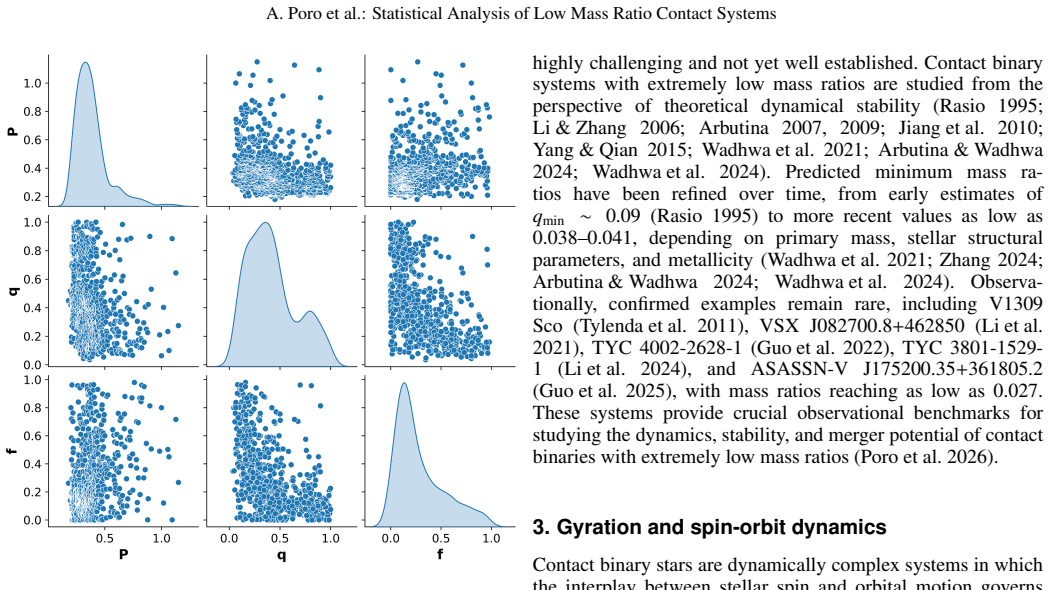
Contact binaries with mass ratios below roughly 0.27 form a distinct class defined by an empirical threshold from 818 systems.
A machine-rendered reading of the paper's core claim, the machinery that carries it, and where it could break.
Core claim
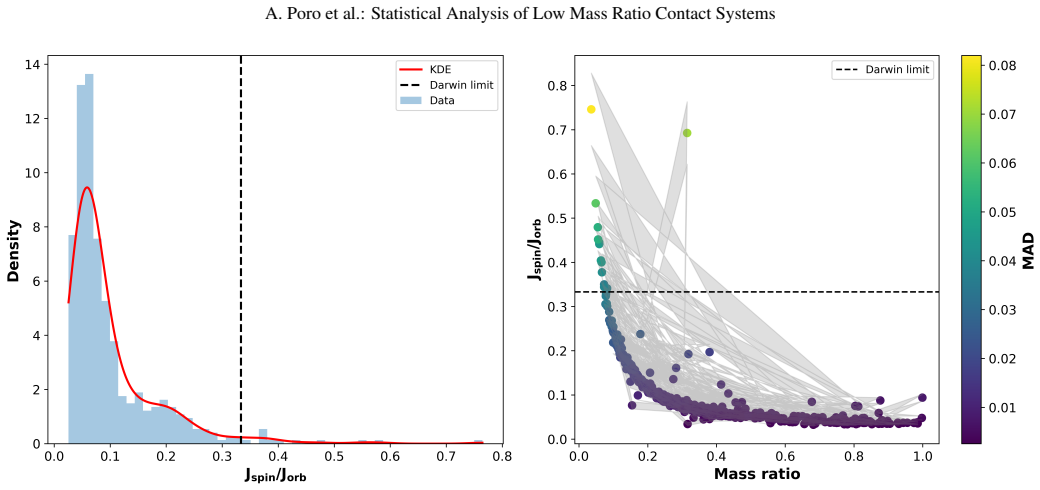
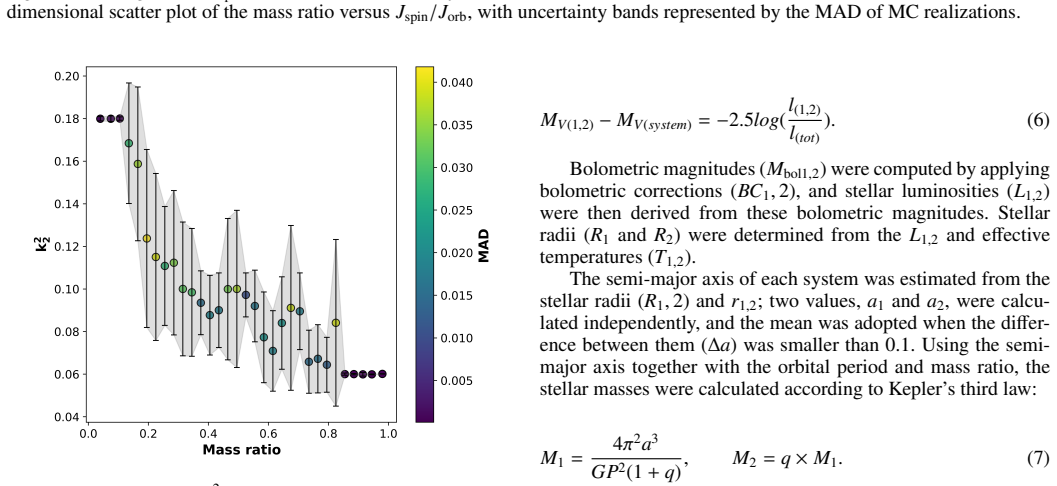
Based on an analysis of 818 contact binaries, the study establishes an empirical threshold of q ≈ 0.27 to identify low mass ratio systems. A Monte Carlo analysis of squared gyration radii finds that k1 stays nearly constant while k2 and the spin-to-orbital angular momentum ratio decrease slightly with rising mass ratio. A dedicated sample of 115 low mass ratio contact binaries yields absolute parameters from Gaia DR3 data, from which empirical parameter relationships are derived for future reference.
What carries the argument
The empirical mass ratio threshold q ≈ 0.27 derived from statistical examination of a large contact binary sample, used to select and characterize low mass ratio systems for stability and relation studies.
If this is right
- Low mass ratio systems identified by q below 0.27 can be grouped separately for rotational stability evaluations.
- The secondary star's gyration radius plays a growing role in the overall angular momentum balance as mass ratio decreases.
- The derived empirical relations supply reference values for modeling the structure and evolution of these binaries.
- The compiled datasets act as benchmarks for testing stability criteria and evolutionary models.
Where Pith is reading between the lines
- If the threshold proves robust, large sky surveys could use it as a quick filter to flag candidate systems for merger risk monitoring.
- The parameter relations might allow rough estimates of masses or radii from limited photometry alone in future catalogs.
- Reanalysis with newer, higher-precision mass ratio data from ongoing surveys could test whether the 0.27 boundary stays sharp.
Load-bearing premise
The collection of 818 contact binaries represents the overall population without major biases, and the mass ratio values taken from the literature are accurate enough to mark a clear dividing line.
What would settle it
Discovery of many contact binaries with mass ratios below 0.27 that display stability properties and parameter trends matching those above the threshold, or many above 0.27 that match the low-ratio group.
Figures




read the original abstract
This study explores multiple aspects of W Ursae Majoris (W UMa) contact binary systems with low mass ratios, providing empirical insights into their definition, structure, rotational stability, and parameter relationships. We first examined the range of mass ratios that characterize these systems and, based on an analysis of 818 contact binaries, established an empirical threshold of $q \approx 0.27$ to identify low mass ratio systems. To investigate rotational stability, we conducted a Monte Carlo analysis of the squared gyration radii ($k_1^2$ and $k_2^2$) and assessed the resulting spin-to-orbital angular momentum ratio ($J_\mathrm{spin}/J_\mathrm{orb}$), finding that while $k_1$ remains nearly constant, $k_2$ and $J_\mathrm{spin}/J_\mathrm{orb}$ decrease slightly with increasing mass ratio, emphasizing the role of the secondary star's internal structure. Moreover, we compiled a dedicated sample of 115 low mass ratio contact binaries and estimated their absolute parameters using Gaia DR3 parallaxes. From this dataset, we derived empirical parameter relationships for low mass ratio systems, which provide a useful reference for future observational and theoretical studies. The resulting datasets and statistical summaries offer benchmarks for modeling, stability evaluation, and evolutionary studies of W UMa-type binaries with low mass ratios.
Editorial analysis
A structured set of objections, weighed in public.
Referee Report
Summary. The paper analyzes 818 contact binaries to derive an empirical mass-ratio threshold q ≈ 0.27 separating low-mass-ratio W UMa systems, performs Monte Carlo simulations on squared gyration radii k1² and k2² to assess rotational stability via J_spin/J_orb, and compiles a subsample of 115 low-q systems with Gaia DR3 absolute parameters to obtain empirical parameter relations.
Significance. If the threshold and relations prove robust, the work supplies observational benchmarks for stability modeling and evolutionary studies of contact binaries. The scale of the 818-system sample and the use of Gaia DR3 parallaxes for absolute-parameter estimation are concrete strengths that could aid future theoretical comparisons.
major comments (2)
- [Section defining the q ≈ 0.27 threshold] The central claim that q ≈ 0.27 is the empirical boundary (abstract and the section defining low-mass-ratio systems) rests on literature photometric mass ratios for the 818 systems. The manuscript provides no quantitative assessment of typical uncertainties, degeneracies between q, fill-out factor and temperature ratio, or possible systematic offsets in those literature values, all of which are known to be acute for low-q solutions. This directly affects whether the reported threshold is a population feature or an artifact of measurement quality.
- [Data and sample section] No analysis of sample completeness or selection biases is presented for the 818-system compilation. If systems with well-constrained (typically higher-q) light-curve solutions are over-represented, the apparent cutoff at 0.27 could be shifted or sharpened by observational selection rather than intrinsic astrophysics.
minor comments (3)
- [Threshold determination subsection] Clarify the exact statistical procedure (histogram binning, cumulative distribution, or clustering method) used to arrive at the numerical value 0.27 rather than a nearby round number.
- [Rotational stability Monte Carlo section] The Monte Carlo description should state the number of realizations, the prior distributions adopted for k1² and k2², and how uncertainties in the input masses and radii were propagated.
- [Empirical relations figures] Figure captions for the parameter-relation plots should include the number of points, the fitted functional form, and the rms scatter.
Simulated Author's Rebuttal
We thank the referee for the constructive comments on the robustness of the q threshold and sample selection. We address each point below and will revise the manuscript to add appropriate caveats and discussion.
read point-by-point responses
-
Referee: [Section defining the q ≈ 0.27 threshold] The central claim that q ≈ 0.27 is the empirical boundary (abstract and the section defining low-mass-ratio systems) rests on literature photometric mass ratios for the 818 systems. The manuscript provides no quantitative assessment of typical uncertainties, degeneracies between q, fill-out factor and temperature ratio, or possible systematic offsets in those literature values, all of which are known to be acute for low-q solutions. This directly affects whether the reported threshold is a population feature or an artifact of measurement quality.
Authors: We acknowledge that photometric mass-ratio solutions, especially at low q, are subject to degeneracies with fill-out factor and temperature ratio, and that literature values carry typical uncertainties of order 0.02–0.05. Our threshold is defined empirically from the observed distribution in the 818-system compilation; the sharp drop below q ≈ 0.27 is visible in the histogram regardless of individual error bars. In the revised version we will add a dedicated paragraph in the threshold section that summarizes representative uncertainties reported in the source papers and notes that the boundary is an observational feature of the current literature sample rather than a fully bias-corrected physical limit. revision: partial
-
Referee: [Data and sample section] No analysis of sample completeness or selection biases is presented for the 818-system compilation. If systems with well-constrained (typically higher-q) light-curve solutions are over-represented, the apparent cutoff at 0.27 could be shifted or sharpened by observational selection rather than intrinsic astrophysics.
Authors: The referee is correct that the heterogeneous literature compilation may favor systems with higher-quality or more easily modeled light curves, which tend to have higher q. A full completeness analysis would require survey selection functions and publication-bias modeling that lie outside the scope of this empirical study. We will expand the sample-description section to state explicitly that the q ≈ 0.27 cutoff reflects the point below which few published solutions exist, and to caution that observational selection may influence the apparent sharpness of the boundary. revision: partial
Circularity Check
Empirical threshold and relations derived from data; minor self-citation not load-bearing
full rationale
The paper's central results—an empirical q≈0.27 threshold from 818 systems and parameter relationships from 115 low-q systems—are obtained via direct statistical analysis of literature and Gaia data. No derivation chain reduces by construction to fitted inputs, self-defined quantities, or self-citation as the sole justification. Any prior binary work references are peripheral and do not carry the load-bearing claims.
Axiom & Free-Parameter Ledger
free parameters (1)
- q_threshold =
0.27
axioms (2)
- domain assumption Mass ratios reported in the literature for contact binaries are accurate enough to support a statistically meaningful threshold.
- domain assumption Gaia DR3 parallaxes yield reliable distances for absolute parameter estimation in contact binaries.
Reference graph
Works this paper leans on
-
[1]
2007, MNRAS, 377, 4,
Arbutina, B. 2007, MNRAS, 377, 4,
2007
-
[2]
2009, MNRAS, 394, 1,
Arbutina, B. 2009, MNRAS, 394, 1,
2009
-
[3]
& Wadhwa, S
Arbutina, B. & Wadhwa, S. 2024, Serbian Astronomical Journal, 208,
2024
-
[4]
2004, A&A, 424,
Claret, A. 2004, A&A, 424,
2004
-
[5]
& Gimenez, A
Claret, A. & Gimenez, A. 1993, A&A, 277,
1993
-
[6]
2006, ISBN 0521855578, Cambridge, UK: Cambridge University Press
Eggleton, P. 2006, ISBN 0521855578, Cambridge, UK: Cambridge University Press. Eker, Z., Demircan, O., Bilir, S., et al. 2006, MNRAS, 373, 4,
2006
-
[7]
2000, A&AS, 141,
Girardi, L., Bressan, A., Bertelli, G., et al. 2000, A&AS, 141,
2000
-
[8]
2022, MNRAS, 517, 2,
Guo, D.-F., Li, K., Liu, F., et al. 2022, MNRAS, 517, 2,
2022
-
[9]
2025, AJ, 170, 2,
Guo, D.-F., Li, K., Liu, F., et al. 2025, AJ, 170, 2,
2025
-
[10]
1980, A&A, 92, 1-2,
Hut, P. 1980, A&A, 92, 1-2,
1980
-
[11]
2010, MNRAS, 405, 4,
Jiang, D., Han, Z., Wang, J., et al. 2010, MNRAS, 405, 4,
2010
-
[12]
2021, ApJS, 254, 1,
Latkovi´c, O., ˇCeki, A., & Lazarevi´c, S. 2021, ApJS, 254, 1,
2021
-
[13]
2021, ApJ, 922, 2,
Li, K., Xia, Q.-Q., Kim, C.-H., et al. 2021, ApJ, 922, 2,
2021
-
[14]
2024, A&A, 692, L4
Li, K., Gao, X., Guo, D.-F., et al. 2024, A&A, 692, L4. Li, L. & Zhang, F. 2006, MNRAS, 369, 4,
2024
-
[15]
Lucy, L. B. 1968, ApJ, 151,
1968
-
[16]
Lucy, L. B. 1976, ApJ, 205,
1976
-
[17]
O’Connell, D. J. K. 1951, Publications of the Riverview College Observatory, 2, 6,
1951
-
[18]
& Pejcha, O
Pešta, M. & Pejcha, O. 2023, A&A, 672, A176. Poro, A., Sarabi, S., Zamanpour, S., et al. 2022, MNRAS, 510, 4,
2023
-
[19]
2024, New A, 110, 102227
Poro, A., Hedayatjoo, M., Nastaran, M., et al. 2024, New A, 110, 102227. Poro, A., Jahangiri, E., Sarvari, E., et al. 2025, MNRAS, 538, 3,
2024
-
[20]
Poro, A., Paki, E., Alicavus, F., and Michel, R. 2026, ApJ, arXiv:2601.00232. Qian, S. 2001, MNRAS, 328, 2,
work page internal anchor Pith review Pith/arXiv arXiv 2026
-
[21]
Rasio, F. A. 1995, ApJ, 444, L41. Robertson, J. A. & Eggleton, P. P. 1977, MNRAS, 179,
1995
-
[22]
Rucinski, S. M. 2001, AJ, 122, 2,
2001
-
[23]
Shu, F. H. & Lubow, S. H. 1981, ARA&A, 19,
1981
-
[24]
2011, Acta Astron., 61, 2,
St˛ epie´n, K. 2011, Acta Astron., 61, 2,
2011
-
[25]
2011, A&A, 528, A114
Tylenda, R., Hajduk, M., Kami´nski, T., et al. 2011, A&A, 528, A114. Wadhwa, S. S., De Horta, A., Filipovi´c, M. D., et al. 2021, MNRAS, 501, 1,
2011
-
[26]
F., 1976, ApJ, 209,
Webbink R. F., 1976, ApJ, 209,
1976
-
[27]
S., Landin, N
Wadhwa, S. S., Landin, N. R., Kosti´c, P., et al. 2024, MNRAS, 527, 1,
2024
-
[28]
& Eggleton, P
Yakut, K. & Eggleton, P. P. 2005, ApJ, 629, 2,
2005
-
[29]
& Qian, S.-B
Yang, Y .-G. & Qian, S.-B. 2015, AJ, 150, 3,
2015
-
[30]
2024, Scientific Reports, 14, 13011
Zhang, X.-D. 2024, Scientific Reports, 14, 13011. Zhang, X.-D. & Qian, S.-B. 2020, MNRAS, 497, 3,
2024
-
[31]
Zhou D.-Q., Leung K.-C., 1990, ApJ, 355,
1990
discussion (0)
Sign in with ORCID, Apple, or X to comment. Anyone can read and Pith papers without signing in.