MathModDB: A Database for Mathematical Models
Pith reviewed 2026-06-29 02:11 UTC · model grok-4.3
The pith
MathModDB turns scattered mathematical models into a searchable knowledge graph.
A machine-rendered reading of the paper's core claim, the machinery that carries it, and where it could break.
Core claim
MathModDB is presented as a publicly available service that offers a curated knowledge graph for mathematical models, allowing researchers to access formulas, quantities, assumptions, and model variants in a unified way, as illustrated by an electric discharge modeling use case.
What carries the argument
The MathModDB knowledge graph, which encodes mathematical models and their components for search and retrieval.
If this is right
- Researchers gain the ability to query for models matching specific criteria rather than relying on publication searches.
- Model variants and their underlying assumptions become more transparent and comparable.
- The database supports integration with tools for documenting and using models in research workflows.
Where Pith is reading between the lines
- Connecting this graph to experimental data sources could allow validation of models against real-world observations.
- Over time, the graph might reveal patterns in how models are adapted across different scientific domains.
- Automated recommendation systems for models could be built on top of such a structure.
Load-bearing premise
That the ontology from prior work can represent the full range of mathematical models needed by researchers in different fields.
What would settle it
A test search for models of a common phenomenon returns no entries or misses key published variants that should be included.
Figures

read the original abstract
When researchers need a mathematical model for a research problem, they face a fragmented landscape: relevant formulas, quantities, assumptions, and model variants are scattered across publications and domain-specific conventions. The Mathematical Models Database (MathModDB) addresses this challenge by providing a curated knowledge graph for mathematical models, deployed on the MaRDI Portal as part of the German National Research Data Infrastructure (NFDI). Building on ontology designs presented in earlier work, this paper focuses on MathModDB as a publicly available service. It addresses researchers who use mathematical models in their work -- whether in applied mathematics, engineering, or the natural sciences. We describe its deployment on the Wikibase-powered MaRDI Portal, report on its current scale, and demonstrate its practical use through a walkthrough of an electric discharge modeling use case from plasma physics. We further discuss the ecosystem around MathModDB, including its connection to the MathAlgoDB knowledge graph for numerical algorithms and the MaRDMO documentation tool.
Editorial analysis
A structured set of objections, weighed in public.
Referee Report
Summary. The manuscript presents MathModDB as a curated knowledge graph for mathematical models deployed on the MaRDI Portal (Wikibase-based) as part of NFDI. Building on prior ontology work, the paper describes the deployment, reports the current scale of the database, demonstrates practical use via a plasma-physics electric-discharge modeling walkthrough, and discusses ecosystem connections to MathAlgoDB and MaRDMO.
Significance. If the curation and validation processes prove robust and the service sees adoption, MathModDB could meaningfully reduce fragmentation for researchers in applied mathematics, engineering, and natural sciences by offering structured access to models, assumptions, and variants. The explicit deployment on an established NFDI portal and linkage to related tools (MathAlgoDB, MaRDMO) are concrete strengths that support reusability and integration within the research-data infrastructure.
major comments (2)
- [Deployment and scale sections] The sections on deployment and scale report the current size of the knowledge graph but provide no information on curation criteria, model-selection process, or validation/error-handling procedures. These details are load-bearing for the central claim that MathModDB supplies a reliably 'curated' resource capable of meeting practical researcher needs.
- [Use-case walkthrough section] The electric-discharge use-case walkthrough illustrates functionality yet omits concrete query examples, retrieval steps, or comparison metrics against conventional literature search, limiting the ability to evaluate the claimed practical utility.
minor comments (2)
- The abstract would benefit from an explicit statement of the current number of models or entities to convey scale immediately.
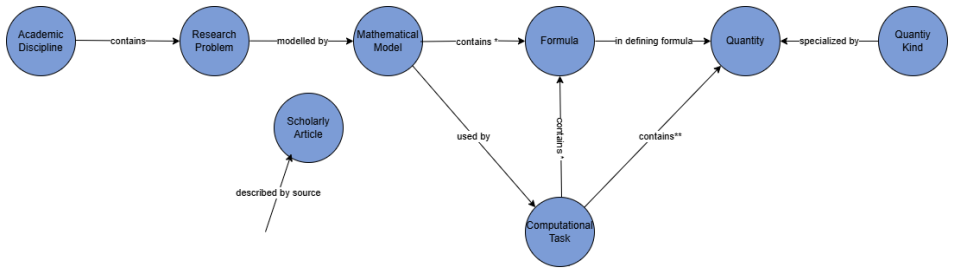
- A concise table or diagram summarizing the core ontology classes and relations (even if drawn from prior work) would improve self-containment without lengthening the text.
Simulated Author's Rebuttal
We thank the referee for the constructive review and the recommendation for minor revision. We address each major comment below and will revise the manuscript accordingly.
read point-by-point responses
-
Referee: [Deployment and scale sections] The sections on deployment and scale report the current size of the knowledge graph but provide no information on curation criteria, model-selection process, or validation/error-handling procedures. These details are load-bearing for the central claim that MathModDB supplies a reliably 'curated' resource capable of meeting practical researcher needs.
Authors: We agree that details on curation criteria, model selection, and validation/error-handling are necessary to support the claim of a reliably curated resource. The manuscript emphasizes deployment on the MaRDI Portal and current scale while referencing prior ontology work; however, the operational curation workflow was not included. In revision we will add a concise subsection to the deployment section that describes the model-selection process from peer-reviewed literature, the role of domain-expert validation, and basic error-handling procedures used during population of the plasma-physics content. This addition will be limited to factual description of existing practice and will not alter the paper's scope. revision: yes
-
Referee: [Use-case walkthrough section] The electric-discharge use-case walkthrough illustrates functionality yet omits concrete query examples, retrieval steps, or comparison metrics against conventional literature search, limiting the ability to evaluate the claimed practical utility.
Authors: We accept that the walkthrough would be more informative with explicit query examples and retrieval steps. The section currently provides a narrative of the modeling workflow. We will revise it to insert two short SPARQL query examples (one for model variants and one for linked assumptions), the corresponding retrieval steps on the MaRDI Portal interface, and a brief qualitative contrast with conventional literature search that highlights structured access to variants and assumptions. No new data or experiments are required; the examples will be drawn from the existing use-case content. revision: yes
Circularity Check
No significant circularity
full rationale
The manuscript is a service-description paper whose content consists of deployment details for MathModDB on the MaRDI Portal, scale reporting, an illustrative use-case walkthrough, and references to prior ontology work. No derivations, theorems, quantitative predictions, or fitted parameters are asserted; the central claims are factual statements about the existence and functionality of the deployed knowledge graph. Because there is no derivation chain to inspect, no load-bearing step reduces to a self-citation, definition, or fitted input by construction.
Axiom & Free-Parameter Ledger
Reference graph
Works this paper leans on
-
[1]
Kohlhase.OMDoc – An open Markup Format for Mathematical Documents [Version 1.2], volume 4180 ofLNAI
M. Kohlhase.OMDoc – An open Markup Format for Mathematical Documents [Version 1.2], volume 4180 ofLNAI. Springer Verlag, 2006
2006
-
[2]
Elizarov, A
A. Elizarov, A. Kirillovich, E. Lipachev, and O. Nevzorova. Digital ecosystem OntoMath: Mathe- matical knowledge analytics and management. InData Analytics and Management in Data Intensive Domains: XVIII International Conference, DAMDID/RCDL 2016, Ershovo, Moscow, Russia, October 11-14, 2016, Revised Selected Papers 18, pages 33–46. Springer, 2017
2016
-
[3]
Vrande ˇci´c and M
D. Vrande ˇci´c and M. Krötzsch. Wikidata: A Free Collaborative Knowledgebase.Communications of the ACM, 57:78–85, 2014
2014
-
[4]
Snytnikov, B
A. Snytnikov, B. Glinskiy, G. Zagorulko, and Y . Zagorulko. Ontological Approach to Formalization of Knowledge in Computational Plasma Physics.Journal of Physics: Conference Series, 1640:012013, 2020
2020
-
[5]
Inizan, V
O. Inizan, V . Fromion, A. Goelzer, F. Saïs, and D. Symeonidou. An Ontology to structure Biological Data: The Contribution of Mathematical Models. InResearch Conference on Metadata and Semantics Research, pages 57–64. Springer, 2021
2021
-
[6]
MaRDI: Mathematical Research Data Initiative Proposal
The MaRDI consortium. MaRDI: Mathematical Research Data Initiative Proposal. Zenodo, 2022
2022
-
[7]
National Research Data Infrastructure Germany (NFDI).https://www.nfdi.de/, 2026
NFDI. National Research Data Infrastructure Germany (NFDI).https://www.nfdi.de/, 2026. Accessed: 2026-04-17
2026
-
[8]
Mathematical research data.Proceedings in Applied Mathematics and Mechanics, 16:959–960, 2016
Thomas Koprucki, Karsten Tabelow, and Ilka Kleinod. Mathematical research data.Proceedings in Applied Mathematics and Mechanics, 16:959–960, 2016
2016
-
[9]
Thomas Koprucki and Karsten Tabelow. Mathematical models: A research data category? In Gert- Martin Greuel, Thorsten Koch, Peter Paule, and Andrew Sommese, editors,Mathematical Software – ICMS 2016: 5th International Conference, Berlin, Germany, July 11–14, 2016, Proceedings, number 9725 in Lecture Notes in Computer Science, pages 423–428. Springer Intern...
2016
-
[10]
M. D. Wilkinson, M. Dumontier, I. J. Aalbersberg, G. Appleton, M. Axton, A. Baak, N. Blomberg, J.-W. Boiten, L. B. da Silva Santos, P. E. Bourne, et al. The FAIR guiding principles for scientific data management and stewardship.Scientific Data, 3:1–9, 2016
2016
-
[11]
Schembera, F
B. Schembera, F. Wübbeling, T. Koprucki, C. Biedinger, M. Reidelbach, B. Schmidt, D. Göddeke, and J. Fiedler. Building Ontologies and Knowledge Graphs for Mathematics and its Applications. In Proceedings of the Conference on Research Data Infrastructure, 2023
2023
-
[12]
Schembera, F
B. Schembera, F. Wübbeling, H. Kleikamp, C. Biedinger, J. Fiedler, M. Reidelbach, A. Shehu, B. Schmidt, T. Koprucki, D. Iglezakis, and D. Göddeke. Ontologies for Models and Algorithms in Applied Mathematics and Related Disciplines. In E. Garoufallou and F. Sartori, editors,Metadata and Semantic Research, pages 161–168, Cham, 2024. Springer Nature Switzerland
2024
-
[13]
Schembera, F
B. Schembera, F. Wübbeling, H. Kleikamp, B. Schmidt, A. Shehu, M. Reidelbach, C. Biedinger, J. Fiedler, T. Koprucki, D. Iglezakis, and D. Göddeke. Towards a Knowledge Graph for Models and Algorithms in Applied Mathematics. In M. Sfakakis, E. Garoufallou, M. Damigos, A. Salaba, and C. Papatheodorou, editors,Metadata and Semantic Research, pages 95–109, Cha...
2025
-
[14]
Schembera, F
B. Schembera, F. Wübbeling, A. Shehu, C. Biedinger, J. Fiedler, M. Reidelbach, B. Schmidt, E. Ferrer, and T. Koprucki. FAIR Representation of Mathematical Research Data: MathModDB and MathAl- goDB as Knowledge Graphs for Mathematical Models and Numerical Algorithms. In2nd Conference on Research Data Infrastructure (CoRDI), 2025
2025
-
[15]
MaRDI Portal.https://portal.mardi4nfdi.de/wiki/ MathModDB, 2026
The MaRDI consortium. MaRDI Portal.https://portal.mardi4nfdi.de/wiki/ MathModDB, 2026. [Online; accessed 17-April-2026]
2026
-
[16]
Schubotz, E
M. Schubotz, E. Ferrer, J. Stegmüller, D. Mietchen, O. Teschke, L. Pusch, and T. O. F. Conrad. Bravo MaRDI: a wikibase powered knowledge graph on mathematics. InProc. ISWC 2023, 2023
2023
-
[17]
Reidelbach
M. Reidelbach. MaRDMO: Future gateway to FAIR mathematical data. InE-Science-Tage 2025: Research Data Management: Challenges in a Changing World, pages 40–53. heiBOOKS, 2025
2025
-
[18]
Reidelbach
M. Reidelbach. MaRDMO-Questionnaire v2.2.3, 2026
2026
-
[19]
Reidelbach
M. Reidelbach. MaRDMO-Plugin v0.5.1, 2026
2026
-
[20]
Schembera, A
B. Schembera, A. Shehu, B. Schmidt, C. Biedinger, J. Fiedler, M. Reidelbach, and T. Koprucki. MaRDI4NFDI/MathModDB: v1.0.0. Zenodo, 2025
2025
-
[21]
Mathematical Models as Research Data via Flexiformal Theory Graphs
Michael Kohlhase, Thomas Koprucki, Dennis Müller, and Karsten Tabelow. Mathematical Models as Research Data via Flexiformal Theory Graphs. In Herman Geuvers, Matthew England, Osman Hasan, Florian Rabe, and Olaf Teschke, editors,Intelligent Computer Mathematics.CICM 2017, volume 10383 ofLecture Notes in Artificial Intelligence and Lecture Notes in Computer...
2017
-
[22]
Koprucki, M
T. Koprucki, M. Kohlhase, K. Tabelow, D. Müller, and F. Rabe. Model Pathway Diagrams for the Representation of Mathematical Models.Optical and Quantum Electronics, 50:70, 2018
2018
-
[23]
QUDT; Quantities, Units, Dimensions and Types.https://doi.org/10
FAIRsharing.org. QUDT; Quantities, Units, Dimensions and Types.https://doi.org/10. 25504/FAIRsharing.d3pqw7, 2026. [Online; accessed 20-April-2026]. 9
2026
-
[24]
Wübbeling, H
F. Wübbeling, H. Kleikamp, S. Rave, R. Fritze, and C. Himpe. MaRDI4NFDI/MathAlgoDB: v1.0.2. Zenodo, 2025
2025
-
[25]
A. P. Jovanovi ´c, D. Loffhagen, and M. M. Becker. Introduction and verification of FEDM, an open- source FEniCS-based discharge modelling code.Plasma Sources Science and Technology, 32:044003, 2023
2023
-
[26]
Engelhardt, H
C. Engelhardt, H. Enke, J. Klar, J. Ludwig, and H. Neuroth. Research data management organiser. In Proceedings of the 14th International Conference on Digital Preservation, pages 25–29, 2017
2017
-
[27]
Reidelbach
M. Reidelbach. MaRDMO: FAIR documentation of in-silico research. InProceedings in Applied Mathematics and Mechanics, 2026. These proceedings
2026
- [28]
-
[29]
Zapilko, R
B. Zapilko, R. Baum, M. Elhossary, F. Limani, D. Mietchen, L. Rossenova, T. Sauerwein, M. Schubotz, R. Shigapov, and K. U. Förstner. KGI4NFDI and TS4NFDI: A natural fit for applying semantic web technologies in practice. Zenodo, 2025. 10
2025
discussion (0)
Sign in with ORCID, Apple, or X to comment. Anyone can read and Pith papers without signing in.