Insurance risk models in a heterogeneous time-dependent population: scaling limits and ruin probabilities
Pith reviewed 2026-06-29 03:13 UTC · model grok-4.3
The pith
Linking claims to stochastic population dynamics from epidemics produces scaling limits and ruin probability bounds for heterogeneous insurance portfolios.
A machine-rendered reading of the paper's core claim, the machinery that carries it, and where it could break.
Core claim
The central claim is that actuarial risk models can be built by directly coupling the claim arrival and size processes to a general stochastic population dynamics model that generates time-dependent heterogeneity; this produces interacting subpopulations with distinct claim characteristics, admits both collective and individual representations, yields scaling limits, and permits derivation of bounds and approximations for ruin probabilities, with explicit SIS-epidemic illustrations for different risk-process classes.
What carries the argument
Direct linkage of the claim process to an underlying general stochastic population dynamics model that generates interacting subpopulations with distinct claim frequencies and severities.
If this is right
- Scaling limits supply tractable large-portfolio approximations when population composition changes over time.
- Ruin-probability bounds and approximations become available for risk assessment under epidemic-driven heterogeneity.
- Individual-level models allow explicit tracking of how shifts between risk classes affect aggregate claims.
- SIS applications demonstrate how contagion alters insurer solvency across standard risk-process families.
Where Pith is reading between the lines
- The same coupling technique could be applied to other compartmental epidemic models such as SIR to study different patterns of risk-profile evolution.
- The scaling limits may enable efficient Monte-Carlo or fluid approximations for very large insurance books subject to health-status dynamics.
- Analogous constructions could link claim processes to other time-inhomogeneous population models arising in credit or longevity risk.
Load-bearing premise
The claim process can be coupled directly and tractably to the stochastic population dynamics in a manner that still permits explicit scaling limits and ruin-probability bounds.
What would settle it
A numerical simulation of an SIS population process with assigned claim rates per compartment, followed by Monte-Carlo estimation of finite-horizon ruin probabilities, that shows the derived bounds are violated for large portfolio sizes.
Figures
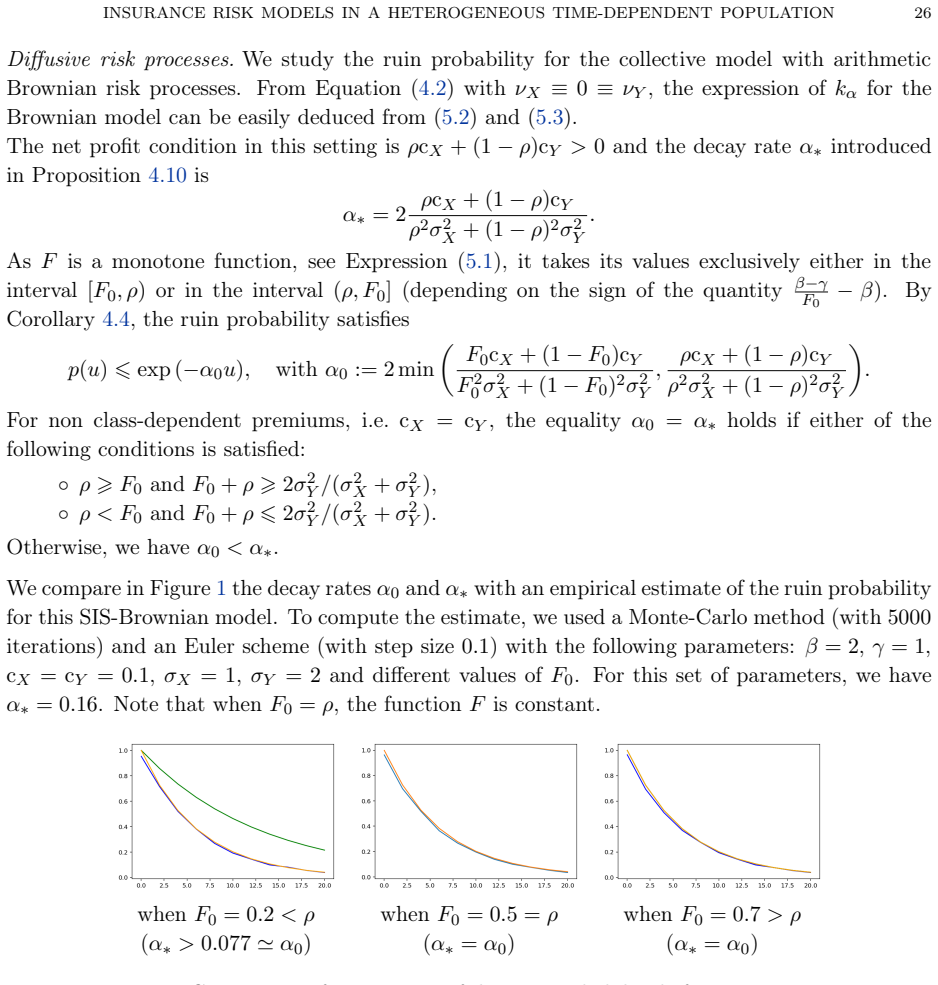
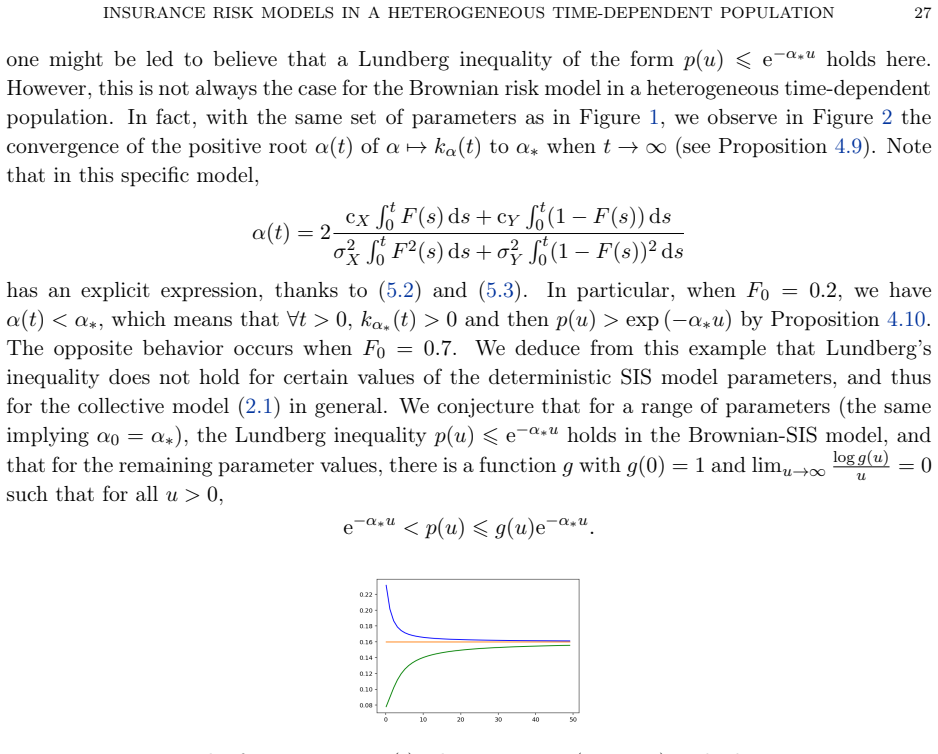
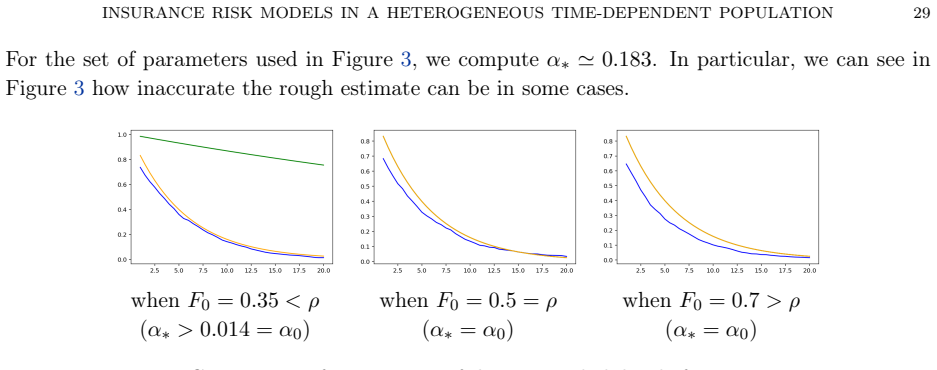
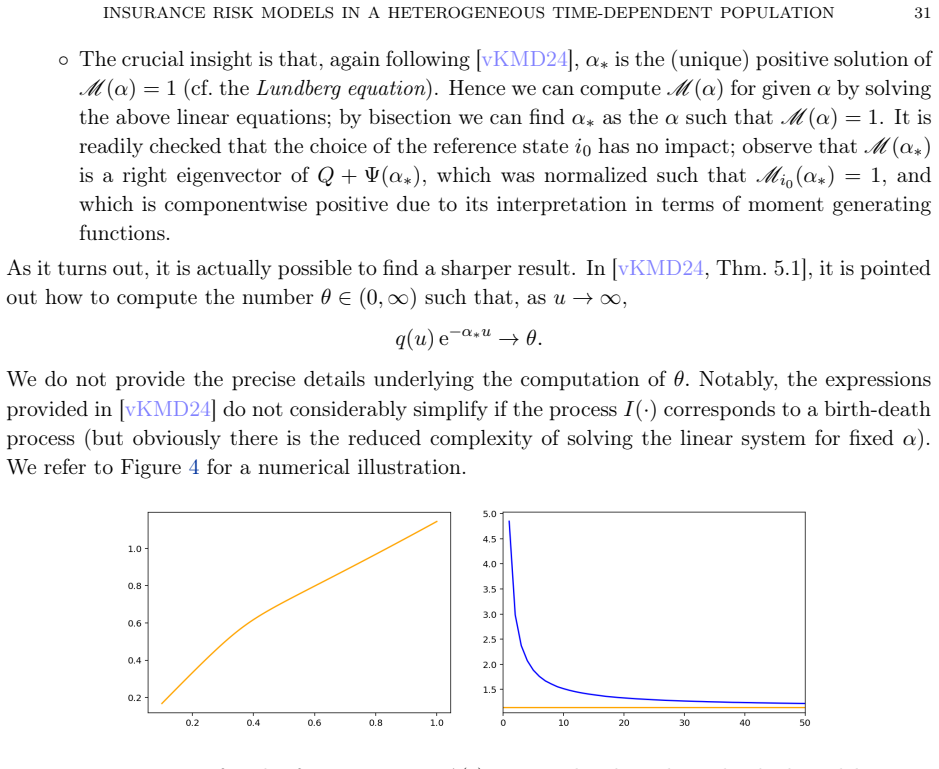
read the original abstract
Epidemic dynamics introduce time-varying heterogeneity into insured populations, as individuals' risk profiles depend on their evolving health status, thereby challenging classical insurance models based on homogeneity. Motivated by this phenomenon, we develop in this paper actuarial risk models in which the claim process is directly linked to an underlying general stochastic population dynamics, resulting in interacting subpopulations with different claim frequencies and severities. We propose both collective and individual modeling frameworks that track the changing composition of the insured population and its impact on aggregate claims. For these models, we derive scaling limits and provide bounds and approximations for ruin probabilities, offering tractable tools for risk assessment. Applications in an SIS context are detailed for different classes of risk processes, thereby contributing to a better understanding of how contagion-driven changes in population structure affect insurer solvency and supporting more realistic modeling of insurance portfolios in the presence of epidemic risk.
Editorial analysis
A structured set of objections, weighed in public.
Referee Report
Summary. The paper constructs collective and individual insurance risk models in which the claim arrival and severity processes are coupled to a general stochastic population process exhibiting time-dependent heterogeneity (e.g., via SIS epidemic dynamics). Subpopulations are partitioned by health/risk status, each with distinct claim intensities. Scaling limits (fluid or diffusion) are derived for the resulting measure-valued processes, and explicit bounds or approximations for finite- and infinite-time ruin probabilities are obtained for several classes of risk processes.
Significance. If the coupling and limit derivations hold, the work supplies tractable analytic tools for solvency assessment under contagion-driven population heterogeneity, extending classical homogeneous risk models to epidemic settings. The explicit ruin bounds and scaling results, when verified, constitute a concrete advance for actuarial modeling of portfolios exposed to time-varying risk profiles.
major comments (2)
- [§3] §3 (collective model): the statement that the aggregate claim process converges to a deterministic fluid limit under the stated scaling appears to rely on a standard law of large numbers for the population measure; however, the interaction term between subpopulations (Eq. (3.4)) introduces a non-Lipschitz drift when the infection rate is state-dependent. A rigorous justification that the limit equation remains well-posed is required, or the convergence claim must be weakened.
- [§4.2] §4.2 (ruin probability bounds): the upper bound (4.7) is obtained by comparison with a homogeneous Poisson process whose intensity is the supremum of the time-dependent intensity. This bound is valid but may be loose when the SIS process spends long periods near the disease-free equilibrium; the paper should quantify the gap or provide a matching lower bound under the same scaling.
minor comments (3)
- [§2] Notation for the measure-valued population process is introduced in §2 but reused with different normalizations in §3 and §5; a single consistent definition (including the scaling parameter n) would improve readability.
- [Figure 2] Figure 2 (SIS trajectory and ruin probability surface) lacks axis labels for the time and population-size coordinates; the caption should also state the parameter values used for the simulation.
- [§5] The individual-risk-model section (§5) refers to 'standard results' for the ruin probability of a renewal risk process without citing the precise theorem or book used; a short reference would clarify the starting point.
Simulated Author's Rebuttal
We thank the referee for the careful reading and constructive comments on our manuscript. We address the two major comments point by point below.
read point-by-point responses
-
Referee: [§3] §3 (collective model): the statement that the aggregate claim process converges to a deterministic fluid limit under the stated scaling appears to rely on a standard law of large numbers for the population measure; however, the interaction term between subpopulations (Eq. (3.4)) introduces a non-Lipschitz drift when the infection rate is state-dependent. A rigorous justification that the limit equation remains well-posed is required, or the convergence claim must be weakened.
Authors: We appreciate the referee highlighting this technical point. The fluid limit derivation in §3 relies on standard convergence results for measure-valued processes under bounded continuous rates, which hold in our SIS setting. However, we agree that an explicit discussion of well-posedness for the limiting equation is warranted given the state-dependent interaction. In the revised manuscript we will add a short paragraph in §3 justifying uniqueness of the limit ODE via boundedness of the infection rate (ensuring local Lipschitz continuity in the weak topology). This is a partial revision: the convergence statement stands, but its justification will be made explicit. revision: partial
-
Referee: [§4.2] §4.2 (ruin probability bounds): the upper bound (4.7) is obtained by comparison with a homogeneous Poisson process whose intensity is the supremum of the time-dependent intensity. This bound is valid but may be loose when the SIS process spends long periods near the disease-free equilibrium; the paper should quantify the gap or provide a matching lower bound under the same scaling.
Authors: The referee is correct that the comparison bound using the supremum intensity can be conservative when the epidemic process lingers near the disease-free equilibrium. We will strengthen the presentation by adding, in the revised §4.2, both a quantitative estimate of the gap (via the occupation time near equilibrium) and a matching lower bound obtained by restricting to the infimum intensity over intervals where the SIS process is bounded away from zero. This addition keeps the same scaling and directly addresses the looseness concern. revision: yes
Circularity Check
No significant circularity detected
full rationale
The paper constructs collective and individual risk models by coupling a claim process to a general stochastic population process with time-dependent heterogeneity (e.g., via SIS epidemic dynamics), then derives scaling limits for the resulting measure-valued processes and supplies ruin-probability bounds. No self-definitional steps, fitted inputs renamed as predictions, or load-bearing self-citations appear in the provided material; the scaling limits are presented as applications of standard fluid/diffusion theorems to the coupled processes, and the SIS case is treated as an illustrative application rather than the sole justification. The derivation chain therefore remains self-contained against external benchmarks and does not reduce to its inputs by construction.
Axiom & Free-Parameter Ledger
Reference graph
Works this paper leans on
-
[1]
Alili, Larbi and Patie, Pierre , TITLE =. J. Theoret. Probab. , FJOURNAL =. 2010 , NUMBER =
2010
-
[2]
Alili, Larbi and Patie, Pierre , TITLE =. Proc. Amer. Math. Soc. , FJOURNAL =. 2014 , NUMBER =. doi:10.1090/S0002-9939-2014-12194-0 , URL =
-
[3]
Applebaum, David , TITLE =. 2009 , PAGES =. doi:10.1017/CBO9780511809781 , URL =
-
[4]
Asmussen, S. Ruin probabilities , SERIES =. 2010 , PAGES =. doi:10.1142/9789814282536 , URL =
-
[5]
Applied probability and queues , SERIES =
Asmussen, S. Applied probability and queues , SERIES =. 2003 , PAGES =
2003
-
[6]
Pandemics: Insurance and Social Protection , isbn =
Boado Penas, Carmen and Eisenberg, Julia and Sahin, Sule , year =. Pandemics: Insurance and Social Protection , isbn =
-
[7]
Botvich and Nicholas G
Dmitri D. Botvich and Nicholas G. Duffield , title =. Queueing Systems , volume =. 1995 , doi =
1995
-
[8]
2004 , PAGES =
Cont, Rama and Tankov, Peter , TITLE =. 2004 , PAGES =
2004
-
[9]
Chaumont, Lo\"ic and Pellas, Thomas , TITLE =. Electron. J. Probab. , FJOURNAL =. 2023 , PAGES =. doi:10.1214/23-ejp942 , URL =
-
[10]
David C. M. Dickson , title =. 2017 , isbn =
2017
-
[11]
Methodology and Computing in Applied Probability , volume =
Ton Dieker and Michel Mandjes , title =. Methodology and Computing in Applied Probability , volume =. 2011 , doi =
2011
-
[12]
Duflo, Marie , TITLE =. 1997 , PAGES =. doi:10.1007/978-3-662-12880-0 , URL =
-
[13]
Duffield, Nicholas G. and O'Connell, Neil , TITLE =. Math. Proc. Cambridge Philos. Soc. , FJOURNAL =. 1995 , NUMBER =. doi:10.1017/S0305004100073709 , URL =
-
[14]
2011 , publisher=
Probability and. 2011 , publisher=
2011
-
[15]
Feng, Runhuan and Garrido, Jose , TITLE =. N. Am. Actuar. J. , FJOURNAL =. 2011 , NUMBER =. doi:10.1080/10920277.2011.10597612 , URL =
-
[16]
G\= hman, I. \=I. and Skorohod, A. V. , TITLE =. 1972 , PAGES =
1972
-
[17]
Herrmann, Samuel and Tanr\'e, Etienne , TITLE =. SIAM J. Sci. Comput. , FJOURNAL =. 2016 , NUMBER =
2016
-
[18]
2011 , address =
Ivanovs, Jevgenijs , title =. 2011 , address =
2011
-
[19]
Scandinavian Actuarial Journal , volume =
Lucas van Kreveld and Michel Mandjes and Jan-Pieter Dorsman , title =. Scandinavian Actuarial Journal , volume =. 2024 , doi =
2024
-
[20]
Stochastic Systems , volume =
van Kreveld, Lucas and Mandjes, Michel and Dorsman, Jan-Pieter , title =. Stochastic Systems , volume =. 2022 , doi =
2022
-
[21]
Andreas E. Kyprianou , title =. 2014 , publisher =. doi:10.1007/978-3-642-37632-0 , url =
-
[22]
Conditional strong law of large number , author=. Int. J. Pure Appl. Math , volume=
-
[23]
and Weiss, Neil A
McDonald, John N. and Weiss, Neil A. , TITLE =. 1999 , PAGES =
1999
-
[24]
Ji, Lanpeng and Zhang, Chunsheng , TITLE =. J. Comput. Appl. Math. , FJOURNAL =. 2010 , NUMBER =. doi:10.1016/j.cam.2009.11.004 , URL =
-
[25]
Proceedings of the royal society of london
A contribution to the mathematical theory of epidemics , author=. Proceedings of the royal society of london. Series A, Containing papers of a mathematical and physical character , volume=. 1927 , publisher=
1927
-
[26]
, TITLE =
Kurtz, Thomas G. , TITLE =. Biological growth and spread (. 1980 , ISBN =
1980
-
[27]
Lef\`. On the risk of ruin in a. Methodol. Comput. Appl. Probab. , FJOURNAL =. 2022 , NUMBER =. doi:10.1007/s11009-021-09924-z , URL =
-
[28]
Ruin problems for epidemic insurance , JOURNAL =
Lef\`. Ruin problems for epidemic insurance , JOURNAL =. 2021 , NUMBER =. doi:10.1017/apr.2020.66 , URL =
-
[29]
Ruin probabilities for two classes of risk processes , JOURNAL =
Li, Shuanming and Garrido, Jos\'. Ruin probabilities for two classes of risk processes , JOURNAL =. 2005 , NUMBER =. doi:10.2143/AST.35.1.583166 , URL =
-
[30]
Palmowski, Zbigniew and Vatamidou, Eleni , TITLE =. Stoch. Models , FJOURNAL =. 2020 , NUMBER =. doi:10.1080/15326349.2020.1717344 , URL =
-
[31]
, TITLE =
Protter, Philip E. , TITLE =. 2004 , PAGES =
2004
-
[32]
Hanspeter Schmidli , title =. 2017 , publisher =. doi:10.1007/978-3-319-72005-0 , isbn =
-
[33]
1999 , Publisher =
Daniel. 1999 , Publisher =
1999
-
[34]
Williams, David , TITLE =. 1991 , PAGES =. doi:10.1017/CBO9780511813658 , URL =
-
[35]
Ruin probabilities for a risk model with two classes of risk processes , volume =
Wu, Xueyuan , year =. Ruin probabilities for a risk model with two classes of risk processes , volume =
discussion (0)
Sign in with ORCID, Apple, or X to comment. Anyone can read and Pith papers without signing in.