A Unified Model for the Emission of Supernova-Associated Fast X-ray Transients: Case Studies of EP240414a, EP250108a, and GRB~171205A
Pith reviewed 2026-06-29 02:39 UTC · model grok-4.3
The pith
A magnetar jet and wind explain the phased emissions seen in supernova-associated fast X-ray transients.
A machine-rendered reading of the paper's core claim, the machinery that carries it, and where it could break.
Core claim
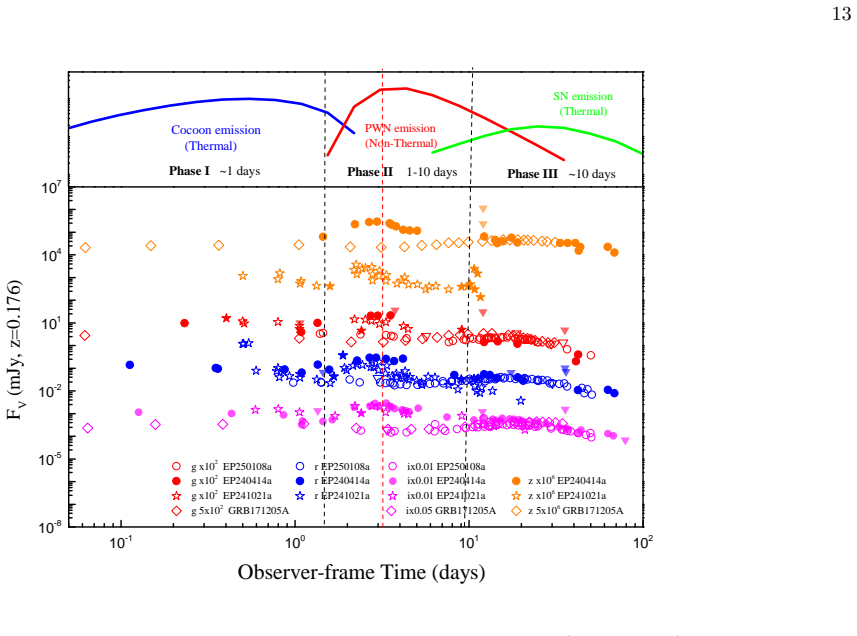
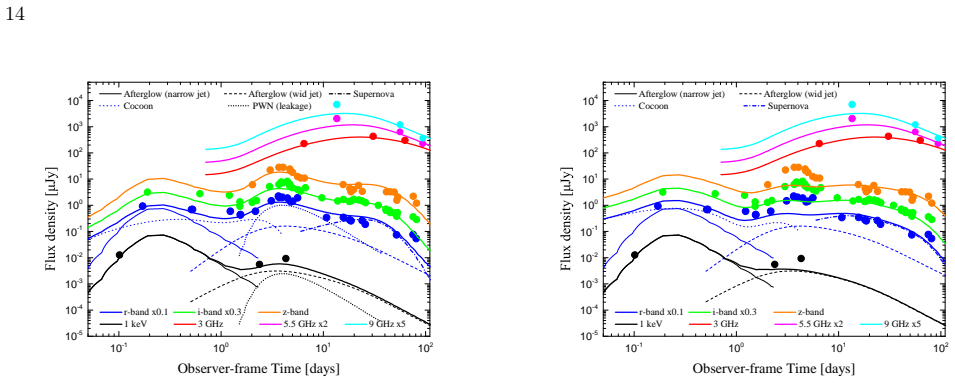
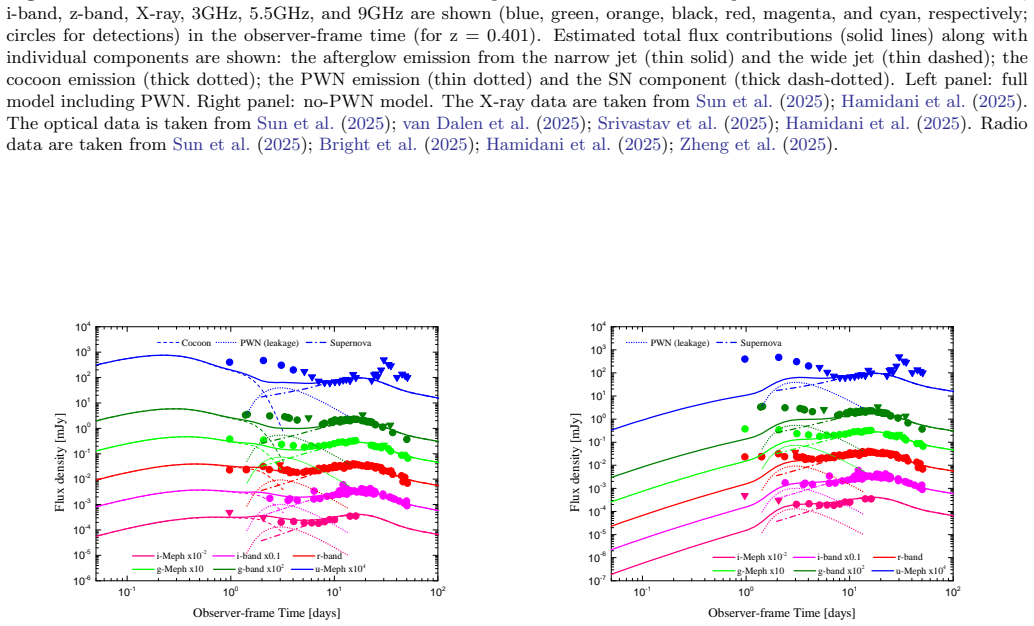
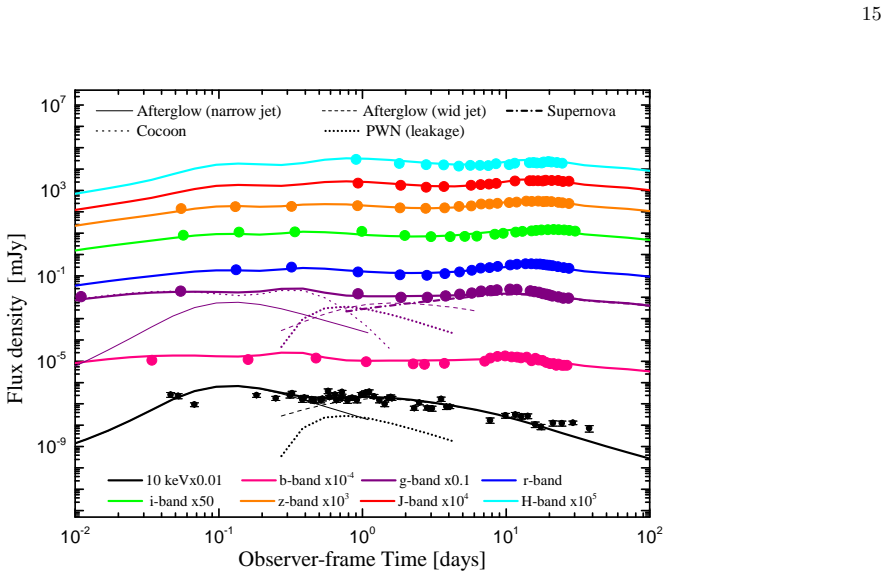
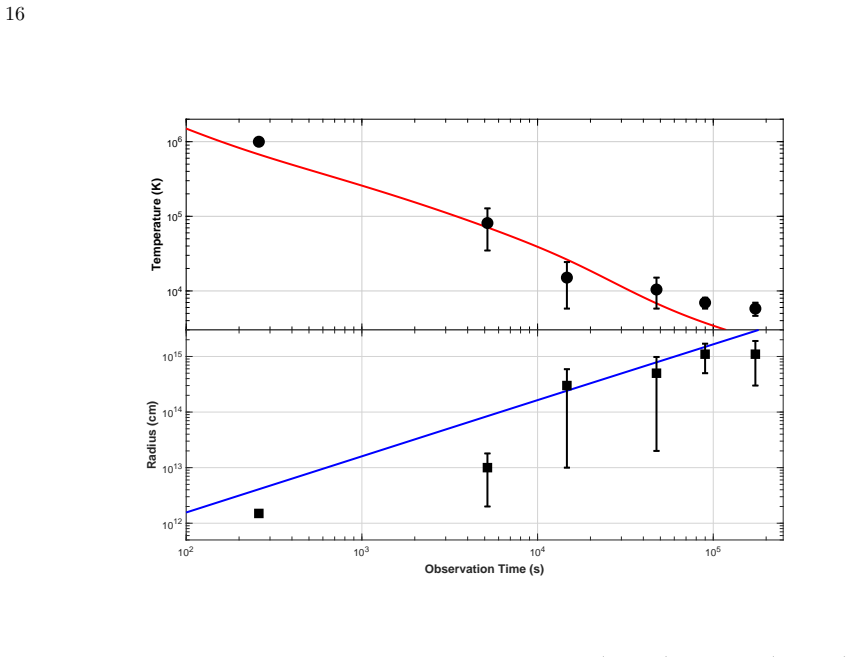
In this model, a rapidly spinning magnetar generates a collimated Poynting flux-dominated jet and an isotropic wind. The jet propagates through the stellar envelope generating a hot cocoon. A pulsar wind nebula forms from the interaction of the wind and the ejecta. As the cocoon becomes transparent, PWN emission escapes. This explains early thermal emission from the cocoon, mid-term non-thermal from the PWN, late-term from SNe and magnetar, and X-ray afterglows from the structured jet.
What carries the argument
The rapidly spinning magnetar that produces both a collimated Poynting-flux jet and an isotropic wind, leading to cocoon and pulsar wind nebula formation.
Load-bearing premise
The central engine is a rapidly spinning magnetar that simultaneously produces a collimated Poynting-flux jet and an isotropic wind whose interaction with the ejecta forms a PWN.
What would settle it
An observation of an FXT associated with a supernova showing no magnetar-like spin-down signatures or mismatched emission component timings would falsify the unification.
Figures
read the original abstract
The Einstein Probe (EP) has detected several Fast X-ray Transients (FXTs) associated with broad-lined Type Ic supernovae (SNe), including EP240414a and EP250108a. The observations reveal common features among these FXTs, but the corresponding physical origin remains debated. By comparing the FXTs with low-luminosity gamma-ray bursts (e.g., GRB 171205A), we propose a unified model that explains the common features in these events. In this model, a rapidly spinning magnetar generates a collimated Poynting flux-dominated jet and an isotropic wind. As the jet propagates through the stellar envelope, it generates a hot cocoon. In addition, a pulsar wind nebula (PWN) is formed during the interaction of the wind and the ejecta. As the surrounding cocoon gradually becomes transparent, the emission from the PWN escapes and is observed. This model provides a unified explanation for the observations: (1) Early thermal emission originates from the cocoon; (2) Mid-term non-thermal emission comes from the PWN; (3) Late-term emission originates from SNe driven by $^{56}$Ni radioactive decay and magnetar. (4) The X-ray afterglows originate from the structured jet. Our research thus provides a natural explanation for the observed thermal-to-nonthermal evolution in such FXTs and reveals their shared physical origin with some GRB-SNe.
Editorial analysis
A structured set of objections, weighed in public.
Referee Report
Summary. The paper proposes a unified physical model for supernova-associated fast X-ray transients (FXTs) including EP240414a, EP250108a, and GRB 171205A. A rapidly spinning magnetar is posited to launch both a collimated Poynting-flux jet (producing a hot cocoon and structured-jet afterglow) and an isotropic wind that forms a pulsar wind nebula (PWN) via interaction with the ejecta. The model partitions the observed emission by epoch: early thermal from the cocoon, mid-term non-thermal from the PWN once the cocoon becomes transparent, late-term from 56Ni decay plus magnetar-powered SN, thereby explaining the thermal-to-nonthermal evolution and linking these events to low-luminosity GRB-SNe.
Significance. If the timing predictions can be shown to follow from a single set of ejecta and engine parameters, the model would offer a coherent framework connecting FXTs, low-luminosity GRBs, and engine-driven SNe. The manuscript currently supplies no quantitative light-curve or spectral fits, error bars, or direct comparison of model predictions to the cited events, so the significance cannot yet be assessed.
major comments (1)
- [Abstract / Model Description] Abstract and model description: the central claim requires that PWN non-thermal emission becomes observable precisely when cocoon optical depth falls below ~1. No explicit optical-depth or radiative-transfer calculation is reported that derives cocoon mass, velocity, and density profile from the same ejecta parameters used for the SN light-curve fit, combined with frequency-dependent opacity, to predict the transparency epoch for each of the three events. Without this step the component assignment remains a post-hoc partitioning.
Simulated Author's Rebuttal
We thank the referee for their careful reading and constructive feedback. We agree that the central claim of the model requires a quantitative demonstration that the PWN emission becomes visible at the epoch when the cocoon optical depth drops below unity, derived self-consistently from the same ejecta parameters. We will revise the manuscript to address this.
read point-by-point responses
-
Referee: [Abstract / Model Description] Abstract and model description: the central claim requires that PWN non-thermal emission becomes observable precisely when cocoon optical depth falls below ~1. No explicit optical-depth or radiative-transfer calculation is reported that derives cocoon mass, velocity, and density profile from the same ejecta parameters used for the SN light-curve fit, combined with frequency-dependent opacity, to predict the transparency epoch for each of the three events. Without this step the component assignment remains a post-hoc partitioning.
Authors: We acknowledge that the present manuscript does not contain the requested explicit optical-depth or radiative-transfer calculation. The model description is currently conceptual, with component assignments motivated by the observed thermal-to-nonthermal transition but not yet derived from a single set of ejecta parameters. In the revised manuscript we will add a dedicated section that (i) adopts the cocoon mass, velocity, and density profile already used for the SN light-curve modeling, (ii) computes the frequency-dependent optical depth as a function of time for each of the three events, and (iii) demonstrates that the predicted transparency epoch coincides with the observed onset of the non-thermal PWN component. This will replace the current post-hoc partitioning with a quantitative prediction. revision: yes
Circularity Check
No significant circularity detected in model construction
full rationale
The paper proposes a phenomenological unified model that assigns specific physical components (cocoon for early thermal, PWN for mid-term non-thermal, 56Ni/magnetar for late, structured jet for afterglow) to observed emission phases in the three events. This assignment follows directly from the model's definition rather than from any derived prediction that reduces to fitted inputs or self-citations by construction. No equations, parameter-fitting procedures, or load-bearing self-citations are exhibited in the provided text that would make the claimed explanations equivalent to the inputs. The framework is self-contained as a modeling choice and does not invoke uniqueness theorems or ansatzes from prior author work to force the result.
Axiom & Free-Parameter Ledger
Reference graph
Works this paper leans on
-
[1]
2025, ApJ, 978, 52, doi: 10.3847/1538-4357/ad93b4
Ai, S., Gao, H., & Zhang, B. 2025, ApJ, 978, 52, doi: 10.3847/1538-4357/ad93b4
-
[2]
2022, MNRAS, 516, 2614, doi: 10.1093/mnras/stac2380
Ai, S., Zhang, B., & Zhu, Z. 2022, MNRAS, 516, 2614, doi: 10.1093/mnras/stac2380
-
[3]
Arnett, W. D. 1982, ApJ, 253, 785, doi: 10.1086/159681
-
[4]
Berger, E., Kulkarni, S. R., Pooley, G., et al. 2003, Nature, 426, 154, doi: 10.1038/nature01998
-
[5]
S., Carotenuto, F., Fender, R., et al
Bright, J. S., Carotenuto, F., Fender, R., et al. 2025, ApJ, 981, 48, doi: 10.3847/1538-4357/adaaef
-
[6]
2011a, ApJL, 739, L55, doi: 10.1088/2041-8205/739/2/L55
Bromberg, O., Nakar, E., & Piran, T. 2011a, ApJL, 739, L55, doi: 10.1088/2041-8205/739/2/L55
-
[7]
2011b, ApJ, 740, 100, doi: 10.1088/0004-637X/740/2/100
Bromberg, O., Nakar, E., Piran, T., & Sari, R. 2011b, ApJ, 740, 100, doi: 10.1088/0004-637X/740/2/100
-
[8]
2016, MNRAS, 456, 1739, doi: 10.1093/mnras/stv2591
Bromberg, O., & Tchekhovskoy, A. 2016, MNRAS, 456, 1739, doi: 10.1093/mnras/stv2591
-
[9]
Quataert, E. 2012, MNRAS, 419, 1537, doi: 10.1111/j.1365-2966.2011.19810.x
-
[10]
2025, arXiv e-prints, arXiv:2503.14588, doi: 10.48550/arXiv.2503.14588
Busmann, M., O’Connor, B., Sommer, J., et al. 2025, arXiv e-prints, arXiv:2503.14588, doi: 10.48550/arXiv.2503.14588
-
[11]
SNIa light curves and radioactive decay
Cappellaro, E., Mazzali, P. A., Benetti, S., et al. 1997, A&A, 328, 203, doi: 10.48550/arXiv.astro-ph/9707016
work page internal anchor Pith review Pith/arXiv arXiv doi:10.48550/arxiv.astro-ph/9707016 1997
-
[12]
Chatzopoulos, E., Wheeler, J. C., & Vinko, J. 2009, ApJ, 704, 1251, doi: 10.1088/0004-637X/704/2/1251 —. 2012, ApJ, 746, 121, doi: 10.1088/0004-637X/746/2/121
-
[13]
Colgate, S. A., & McKee, C. 1969, ApJ, 157, 623, doi: 10.1086/150102
-
[14]
Colgate, S. A., Petschek, A. G., & Kriese, J. T. 1980, ApJL, 237, L81, doi: 10.1086/183239
-
[15]
Dai, Z. G., & Gou, L. J. 2001, ApJ, 552, 72, doi: 10.1086/320463 De Colle, F., Kumar, P., & Hoeflich, P. 2022, MNRAS, 512, 3627, doi: 10.1093/mnras/stac742
-
[16]
Drout, M. R., Soderberg, A. M., Mazzali, P. A., et al. 2013, ApJ, 774, 58, doi: 10.1088/0004-637X/774/1/58
-
[17]
C., Quataert, E., & MacFadyen, A
Duffell, P. C., Quataert, E., & MacFadyen, A. I. 2015, ApJ, 813, 64, doi: 10.1088/0004-637X/813/1/64
-
[18]
Eyles-Ferris, R. A. J., Jonker, P. G., Levan, A. J., et al. 2025, arXiv e-prints, arXiv:2504.08886, doi: 10.48550/arXiv.2504.08886
-
[19]
2024, arXiv e-prints, arXiv:2411.11503, doi: 10.48550/arXiv.2411.11503
Finneran, G., Cotter, L., & Martin-Carrillo, A. 2024, arXiv e-prints, arXiv:2411.11503, doi: 10.48550/arXiv.2411.11503
-
[20]
2013, emcee: The MCMC Hammer, Astrophysics Source Code Library, record ascl:1303.002
Foreman-Mackey, D., Conley, A., Meierjurgen Farr, W., et al. 2013, emcee: The MCMC Hammer, Astrophysics Source Code Library, record ascl:1303.002. http://ascl.net/1303.002
2013
-
[21]
Galama, T. J., Vreeswijk, P. M., van Paradijs, J., et al. 1998, Nature, 395, 670, doi: 10.1038/27150
-
[22]
Gelfand, J. D., Slane, P. O., & Temim, T. 2015, ApJ, 807, 30, doi: 10.1088/0004-637X/807/1/30
-
[23]
2025, arXiv e-prints, arXiv:2505.05444, doi: 10.48550/arXiv.2505.05444
Gianfagna, G., Piro, L., Bruni, G., et al. 2025, arXiv e-prints, arXiv:2505.05444, doi: 10.48550/arXiv.2505.05444
-
[24]
2022, MNRAS, 517, 1640, doi: 10.1093/mnras/stac2699
Gottlieb, O., & Nakar, E. 2022, MNRAS, 517, 1640, doi: 10.1093/mnras/stac2699
-
[25]
2021, MNRAS, 500, 3511, doi: 10.1093/mnras/staa3501
Gottlieb, O., Nakar, E., & Bromberg, O. 2021, MNRAS, 500, 3511, doi: 10.1093/mnras/staa3501
-
[26]
2018a, MNRAS, 473, 576, doi: 10.1093/mnras/stx2357
Gottlieb, O., Nakar, E., & Piran, T. 2018a, MNRAS, 473, 576, doi: 10.1093/mnras/stx2357
-
[27]
2018b, MNRAS, 479, 588, doi: 10.1093/mnras/sty1462
Gottlieb, O., Nakar, E., Piran, T., & Hotokezaka, K. 2018b, MNRAS, 479, 588, doi: 10.1093/mnras/sty1462
-
[28]
2021, MNRAS, 500, 627, doi: 10.1093/mnras/staa3276
Hamidani, H., & Ioka, K. 2021, MNRAS, 500, 627, doi: 10.1093/mnras/staa3276
-
[29]
2025, ApJL, 986, L4, doi: 10.3847/2041-8213/add99d
Hamidani, H., Sato, Y., Kashiyama, K., et al. 2025, ApJL, 986, L4, doi: 10.3847/2041-8213/add99d
-
[30]
Hattori, S., Straal, S. M., Zhang, E., et al. 2020, ApJ, 904, 32, doi: 10.3847/1538-4357/abba32
-
[31]
2003, Nature, 423, 847, doi: 10.1038/nature01750
Hjorth, J., Sollerman, J., Møller, P., et al. 2003, Nature, 423, 847, doi: 10.1038/nature01750
-
[32]
1999, MNRAS, 309, 447, doi: 10.1046/j.1365-8711.1999.02853.x
Huang, Y. F., Dai, Z. G., & Lu, T. 1999, MNRAS, 309, 513, doi: 10.1046/j.1365-8711.1999.02887.x
-
[33]
Huang, Y. F., Wu, X. F., Dai, Z. G., Ma, H. T., & Lu, T. 2004, ApJ, 605, 300, doi: 10.1086/382202
-
[34]
2019, Nature, 565, 324, doi: 10.1038/s41586-018-0826-3
Izzo, L., de Ugarte Postigo, A., Maeda, K., et al. 2019, Nature, 565, 324, doi: 10.1038/s41586-018-0826-3
-
[35]
2010, ApJ, 717, 245, doi: 10.1088/0004-637X/717/1/245
Kasen, D., & Bildsten, L. 2010, ApJ, 717, 245, doi: 10.1088/0004-637X/717/1/245
-
[36]
2018, MNRAS, 473, L121, doi: 10.1093/mnrasl/slx175
Kathirgamaraju, A., Barniol Duran, R., & Giannios, D. 2018, MNRAS, 473, L121, doi: 10.1093/mnrasl/slx175
-
[37]
Kotera, K., Phinney, E. S., & Olinto, A. V. 2013, MNRAS, 432, 3228, doi: 10.1093/mnras/stt680
-
[38]
Kouveliotou, C., Meegan, C. A., Fishman, G. J., et al. 1993, ApJL, 413, L101, doi: 10.1086/186969
-
[39]
Kumar, A., Pandey, S. B., Gupta, R., et al. 2022, NewA, 97, 101889, doi: 10.1016/j.newast.2022.101889
-
[40]
Lazzati, D., & Begelman, M. C. 2005, ApJ, 629, 903, doi: 10.1086/430877
-
[41]
Li, W. X., Zhu, Z. P., Zou, X. Z., et al. 2025, arXiv e-prints, arXiv:2504.17034, doi: 10.48550/arXiv.2504.17034
-
[42]
2024a, ApJ, 960, 17, doi: 10.3847/1538-4357/ad08bc
Li, Y.-F., Lin, D.-B., Ren, J., et al. 2024a, ApJ, 960, 17, doi: 10.3847/1538-4357/ad08bc
-
[43]
2024b, ApJ, 976, 113, doi: 10.3847/1538-4357/ad81f4
Li, Y.-F., Lin, D.-B., Zhou, L., et al. 2024b, ApJ, 976, 113, doi: 10.3847/1538-4357/ad81f4
-
[44]
2022, ApJ, 931, 90, doi: 10.3847/1538-4357/ac69db 21
Lian, J.-S., Wang, S.-Q., Gan, W.-P., Li, J.-Y., & Liang, E.-W. 2022, ApJ, 931, 90, doi: 10.3847/1538-4357/ac69db 21
-
[45]
MacFadyen, A. I., & Woosley, S. E. 1999, ApJ, 524, 262, doi: 10.1086/307790
work page internal anchor Pith review doi:10.1086/307790 1999
-
[46]
Maeda, K., Mazzali, P. A., Deng, J., et al. 2003, ApJ, 593, 931, doi: 10.1086/376591
-
[47]
Margalit, B., Metzger, B. D., Thompson, T. A., Nicholl, M., & Sukhbold, T. 2018, MNRAS, 475, 2659, doi: 10.1093/mnras/sty013
-
[48]
2018, ApJ, 861, 55, doi: 10.3847/1538-4357/aac4a8
Matsumoto, T., Ioka, K., Kisaka, S., & Nakar, E. 2018, ApJ, 861, 55, doi: 10.3847/1538-4357/aac4a8
-
[49]
Matzner, C. D. 2003, MNRAS, 345, 575, doi: 10.1046/j.1365-8711.2003.06969.x M´ esz´ aros, P., & Rees, M. J. 1997, ApJ, 476, 232, doi: 10.1086/303625
-
[50]
2015, ApJ, 805, 82, doi: 10.1088/0004-637X/805/1/82
Murase, K., Kashiyama, K., Kiuchi, K., & Bartos, I. 2015, ApJ, 805, 82, doi: 10.1088/0004-637X/805/1/82
-
[51]
2016, MNRAS, 461, 1498, doi: 10.1093/mnras/stw1328
Murase, K., Kashiyama, K., & M´ esz´ aros, P. 2016, MNRAS, 461, 1498, doi: 10.1093/mnras/stw1328
-
[52]
2014, ApJL, 784, L28, doi: 10.1088/2041-8205/784/2/L28
Nagakura, H., Hotokezaka, K., Sekiguchi, Y., Shibata, M., & Ioka, K. 2014, ApJL, 784, L28, doi: 10.1088/2041-8205/784/2/L28
-
[53]
2017, ApJ, 834, 28, doi: 10.3847/1538-4357/834/1/28
Nakar, E., & Piran, T. 2017, ApJ, 834, 28, doi: 10.3847/1538-4357/834/1/28
-
[54]
2017, ApJ, 850, 55, doi: 10.3847/1538-4357/aa9334
Nicholl, M., Guillochon, J., & Berger, E. 2017, ApJ, 850, 55, doi: 10.3847/1538-4357/aa9334
-
[55]
Piro, A. L., & Kollmeier, J. A. 2018, ApJ, 855, 103, doi: 10.3847/1538-4357/aaaab3
-
[56]
2017, MNRAS, 464, 3568, doi: 10.1093/mnras/stw1942
Prajs, S., Sullivan, M., Smith, M., et al. 2017, MNRAS, 464, 3568, doi: 10.1093/mnras/stw1942
-
[57]
2024, GRB Coordinates Network, 37852, 1
Pugliese, G., Xu, D., Izzo, L., et al. 2024, GRB Coordinates Network, 37852, 1
2024
-
[58]
Rastinejad, J. C., Levan, A. J., Jonker, P. G., et al. 2025, arXiv e-prints, arXiv:2504.08889, doi: 10.48550/arXiv.2504.08889
-
[59]
2019, ApJ, 885, 60, doi: 10.3847/1538-4357/ab4188 Roman Aguilar, L
Ren, J., Lin, D.-B., Zhang, L.-L., et al. 2019, ApJ, 885, 60, doi: 10.3847/1538-4357/ab4188 Roman Aguilar, L. M., & Bersten, M. C. 2025, A&A, 702, L18, doi: 10.1051/0004-6361/202556610
-
[60]
1998, ApJL, 497, L17, doi: 10.1086/311269
Sari, R., Piran, T., & Narayan, R. 1998, ApJL, 497, L17, doi: 10.1086/311269
-
[61]
Sheth, K., Frail, D. A., White, S., et al. 2003, ApJL, 595, L33, doi: 10.1086/378933
-
[62]
2011, ApJ, 741, 39, doi: 10.1088/0004-637X/741/1/39
Sironi, L., & Spitkovsky, A. 2011, ApJ, 741, 39, doi: 10.1088/0004-637X/741/1/39
-
[63]
P., Hamidani, H., Schroeder, G., et al
Srinivasaragavan, G. P., Hamidani, H., Schroeder, G., et al. 2025, arXiv e-prints, arXiv:2504.17516, doi: 10.48550/arXiv.2504.17516
-
[64]
Srivastav, S., Chen, T. W., Gillanders, J. H., et al. 2025, ApJL, 978, L21, doi: 10.3847/2041-8213/ad9c75
-
[65]
Z., Matheson, T., Garnavich, P
Stanek, K. Z., Matheson, T., Garnavich, P. M., et al. 2003, ApJL, 591, L17, doi: 10.1086/376976
-
[66]
2017, ApJ, 835, 7, doi: 10.3847/1538-4357/835/1/7
Sun, H., Zhang, B., & Gao, H. 2017, ApJ, 835, 7, doi: 10.3847/1538-4357/835/1/7
-
[67]
Sun, H., Li, W. X., Liu, L. D., et al. 2025, Nature Astronomy, doi: 10.1038/s41550-025-02571-1
-
[68]
Sutherland, P. G., & Wheeler, J. C. 1984, ApJ, 280, 282, doi: 10.1086/161995
-
[69]
Tanaka, S. J., & Takahara, F. 2010, ApJ, 715, 1248, doi: 10.1088/0004-637X/715/2/1248 —. 2013, MNRAS, 429, 2945, doi: 10.1093/mnras/sts528
-
[70]
Thompson, T. A., Chang, P., & Quataert, E. 2004, ApJ, 611, 380, doi: 10.1086/421969
-
[71]
F., Cillis, A., Mart´ ın, J., & de O˜ na Wilhelmi, E
Torres, D. F., Cillis, A., Mart´ ın, J., & de O˜ na Wilhelmi, E. 2014, Journal of High Energy Astrophysics, 1, 31, doi: 10.1016/j.jheap.2014.02.001
-
[72]
Usov, V. V. 1992, Nature, 357, 472, doi: 10.1038/357472a0 van Dalen, J. N. D., Levan, A. J., Jonker, P. G., et al. 2025, ApJL, 982, L47, doi: 10.3847/2041-8213/adbc7e
-
[73]
Wang, S. Q., Wang, L. J., Dai, Z. G., & Wu, X. F. 2015a, ApJ, 799, 107, doi: 10.1088/0004-637X/799/1/107 —. 2015b, ApJ, 807, 147, doi: 10.1088/0004-637X/807/2/147
-
[74]
C., Yi, I., H¨ oflich, P., & Wang, L
Wheeler, J. C., Yi, I., H¨ oflich, P., & Wang, L. 2000, ApJ, 537, 810, doi: 10.1086/309055
-
[75]
Woosley, S. E. 2010, ApJL, 719, L204, doi: 10.1088/2041-8205/719/2/L204
-
[76]
2022, Universe, 8, 633, doi: 10.3390/universe8120633
Wu, G.-L., Yu, Y.-W., & Li, S.-Z. 2022, Universe, 8, 633, doi: 10.3390/universe8120633
-
[77]
2025, arXiv e-prints, arXiv:2505.12491, doi: 10.48550/arXiv.2505.12491
Wu, G.-L., Yu, Y.-W., Liu, L.-D., et al. 2025, arXiv e-prints, arXiv:2505.12491, doi: 10.48550/arXiv.2505.12491
-
[78]
2025, arXiv e-prints, arXiv:2505.07665, doi: 10.48550/arXiv.2505.07665
Xinwen, S., Lei, Y., Haonan, Y., et al. 2025, arXiv e-prints, arXiv:2505.07665, doi: 10.48550/arXiv.2505.07665
-
[79]
Condon, J. J. 2000, AJ, 120, 2950, doi: 10.1086/316842
-
[80]
2025, arXiv e-prints, arXiv:2505.08781, doi: 10.48550/arXiv.2505.08781
Yadav, M., Troja, E., Ricci, R., et al. 2025, arXiv e-prints, arXiv:2505.08781, doi: 10.48550/arXiv.2505.08781
discussion (0)
Sign in with ORCID, Apple, or X to comment. Anyone can read and Pith papers without signing in.