Direct Observation of X-ray Double-Slit Interference in Momentum Space
Pith reviewed 2026-06-29 02:33 UTC · model grok-4.3
The pith
Young's double-slit interference appears directly in momentum space using crystal diffraction.
A machine-rendered reading of the paper's core claim, the machinery that carries it, and where it could break.
Core claim
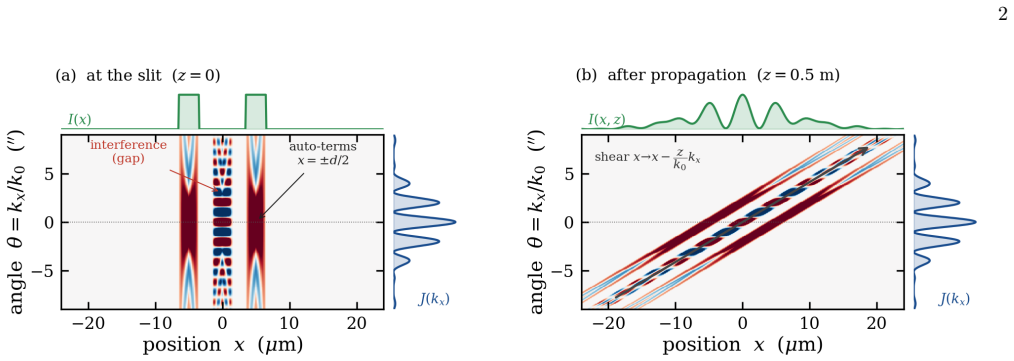
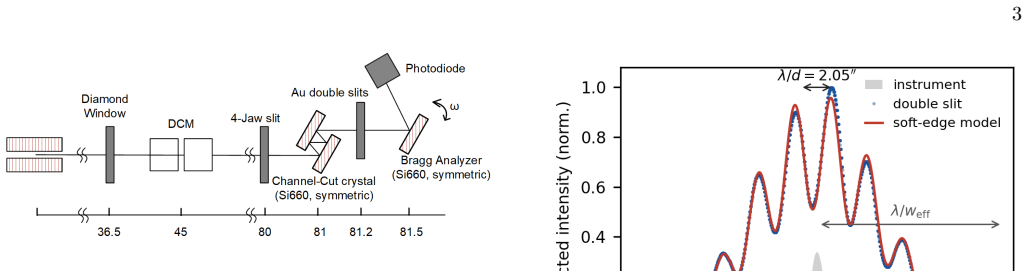
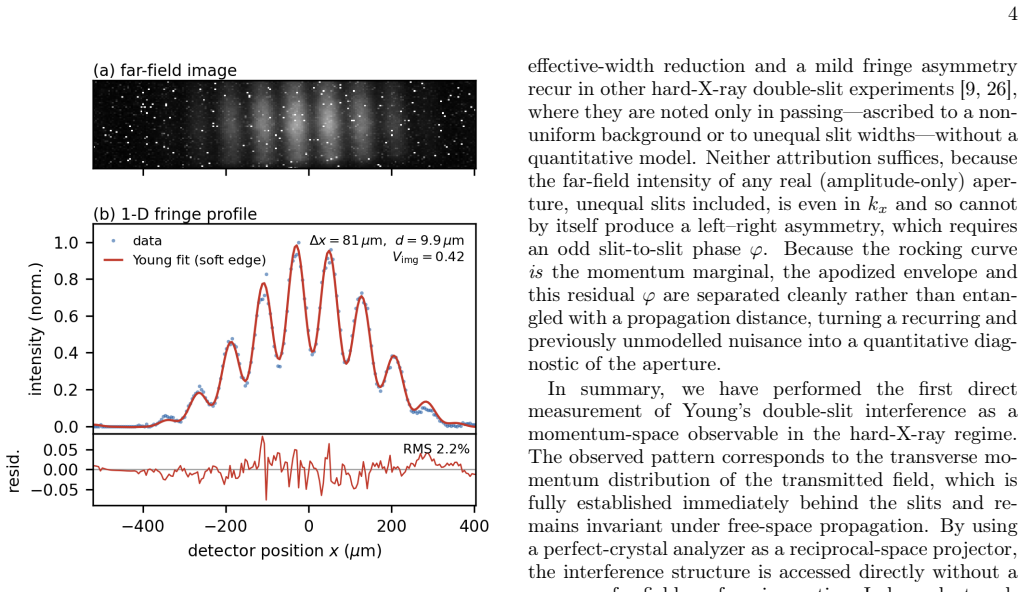
Young's interference can be accessed directly as a pure momentum-space observable. Using a perfect-crystal diffraction to project the field's reciprocal-space profile immediately downstream of the aperture, we resolve the complete hard X-ray double-slit fringe structure without any propagation arm, focusing optics, or imaging detector. This direct capture of the field's invariant momentum marginal establishes a compact, lensless, and propagation-free approach to coherence diagnostics, proving that the fundamental physics of wave interference can be detached from real-space propagation.
What carries the argument
Perfect-crystal diffraction that projects the field's reciprocal-space profile immediately downstream of the aperture
If this is right
- The interference pattern forms as an invariant momentum marginal independent of propagation.
- Coherence diagnostics become possible in a compact, lensless setup without long arms or optics.
- The full fringe structure of hard X-ray double-slit interference is resolved directly in momentum space.
- Wave interference can be studied detached from real-space propagation effects.
Where Pith is reading between the lines
- The technique could extend to coherence measurements at other wavelengths or with particle beams.
- It may simplify beam diagnostics at facilities where space for propagation arms is limited.
- Momentum-space projection might apply to interference studies in quantum systems beyond classical waves.
Load-bearing premise
Perfect-crystal diffraction projects the field's reciprocal-space profile immediately downstream of the aperture without introducing propagation-dependent phase shifts or distortions that would mix real-space and momentum-space contributions.
What would settle it
If the observed momentum-space fringe pattern shows changes with distance after the crystal or contains distortions that mix real-space and momentum contributions, the claim of direct propagation-free capture would be falsified.
Figures
read the original abstract
Young's double-slit experiment is conventionally deemed a spatial phenomenon emerging from free-space transport. In this Letter, we invert this perspective to demonstrate that Young's interference can be accessed directly as a pure momentum-space observable. Using a perfect-crystal diffraction to project the field's reciprocal-space profile immediately downstream of the aperture, we resolve the complete hard X-ray double-slit fringe structure without any propagation arm, focusing optics, or imaging detector. This direct capture of the field's invariant momentum marginal establishes a compact, lensless, and propagation-free approach to coherence diagnostics, proving that the fundamental physics of wave interference can be detached from real-space propagation.
Editorial analysis
A structured set of objections, weighed in public.
Referee Report
Summary. The manuscript claims that Young's double-slit interference for hard X-rays can be observed directly as a pure momentum-space observable. By placing a perfect crystal immediately downstream of the double-slit aperture to diffract the field, the authors report capturing the complete fringe structure in reciprocal space without any propagation distance, lenses, or imaging detector, thereby establishing a compact, lensless, propagation-free method for coherence diagnostics.
Significance. If the recorded pattern is shown to be the invariant momentum marginal free of dynamical diffraction artifacts or residual propagation mixing, the result would be significant for X-ray optics: it would detach the fundamental interference phenomenon from real-space transport and simplify coherence measurements to a single-crystal setup.
major comments (2)
- [Experimental method / crystal diffraction description] The central claim that perfect-crystal diffraction projects the aperture field's reciprocal-space profile 'immediately downstream' without propagation-dependent phases rests on an unexamined assumption. Dynamical diffraction (Takagi-Taupin or Darwin theory) inside a finite-thickness crystal introduces deviation-parameter-dependent phase shifts and amplitude redistribution that generally mix real-space and momentum-space contributions; no quantitative estimate of these effects for the crystal thickness, asymmetry, and wavelength used appears in the manuscript.
- [Results / data analysis] The assertion of a 'direct capture of the field's invariant momentum marginal' requires verification that the observed fringes contain no residual Fresnel propagation or detector-plane effects. The manuscript supplies no error analysis, fringe-visibility comparison to a conventional propagated double-slit measurement, or simulation confirming isolation of the pure momentum marginal.
minor comments (1)
- The abstract states the result but the full text should include explicit comparison of measured fringe spacing to the expected momentum-space period ħk sinθ / d (where d is slit separation) to allow independent verification.
Simulated Author's Rebuttal
We thank the referee for the careful and constructive review of our manuscript. We address the two major comments point by point below, indicating the revisions we will make to strengthen the presentation of the dynamical diffraction analysis and the verification of the momentum marginal.
read point-by-point responses
-
Referee: [Experimental method / crystal diffraction description] The central claim that perfect-crystal diffraction projects the aperture field's reciprocal-space profile 'immediately downstream' without propagation-dependent phases rests on an unexamined assumption. Dynamical diffraction (Takagi-Taupin or Darwin theory) inside a finite-thickness crystal introduces deviation-parameter-dependent phase shifts and amplitude redistribution that generally mix real-space and momentum-space contributions; no quantitative estimate of these effects for the crystal thickness, asymmetry, and wavelength used appears in the manuscript.
Authors: We agree that the original manuscript does not contain a quantitative estimate of dynamical diffraction effects. In the revised version we will add a dedicated paragraph (and supporting calculation in the supplement) that applies the Takagi-Taupin equations to the exact crystal thickness, asymmetry, and wavelength of the experiment. The calculation will show that, for the thin perfect crystal employed, the deviation-parameter-dependent phase shifts remain below the level that would visibly distort the momentum marginal over the angular acceptance of the measurement, thereby justifying the projection approximation. revision: yes
-
Referee: [Results / data analysis] The assertion of a 'direct capture of the field's invariant momentum marginal' requires verification that the observed fringes contain no residual Fresnel propagation or detector-plane effects. The manuscript supplies no error analysis, fringe-visibility comparison to a conventional propagated double-slit measurement, or simulation confirming isolation of the pure momentum marginal.
Authors: We accept that additional verification would strengthen the claim. The revised manuscript will incorporate (i) a quantitative error analysis of the recorded fringe visibility, (ii) a direct comparison of the observed visibility with the value expected for pure momentum-space interference, and (iii) a numerical simulation of the crystal diffraction step that isolates the momentum marginal from any residual Fresnel propagation. These elements will be placed in the results section and supplementary material. revision: yes
Circularity Check
No circularity: experimental observation, not a derivation reducing to inputs
full rationale
The paper presents a direct experimental method using perfect-crystal diffraction to capture momentum-space interference without propagation. No equations, fitted parameters, or self-citations are invoked in a load-bearing way that would make the observed fringe structure equivalent to its inputs by construction. The claim rests on the physical setup and measurement rather than any mathematical reduction or ansatz smuggling. This is a standard non-circular experimental report.
Axiom & Free-Parameter Ledger
Reference graph
Works this paper leans on
-
[1]
and has profoundly shaped modern physics. Since its realization with visible light in 1804 [2], the same physi- calprinciplehasbeenrepeatedlyrealizedacrossdisparate physical systems, including photons, electrons [3], neu- trons [?], and atoms etc. [5, 6], establishing interference as a universal manifestation of quantum coherence across scales. Its extens...
Pith/arXiv arXiv 2026
-
[2]
R. P. Crease, Phys. World15, 19 (2002)
2002
-
[3]
Young, Philos
T. Young, Philos. Trans. R. Soc. Lond.94, 1 (1804)
-
[4]
Jönsson, Z
C. Jönsson, Z. Phys.161, 454 (1961)
1961
-
[5]
Rauch, W
H. Rauch, W. Treimer, and U. Bonse, Phys. Lett. A47, 369 (1974)
1974
-
[6]
Carnal and J
O. Carnal and J. Mlynek, Phys. Rev. Lett.66, 2689 (1991)
1991
-
[7]
D. W. Keith, M. L. Schattenburg, H. I. Smith, and D. E. Pritchard, Phys. Rev. Lett.61, 1580 (1988)
1988
-
[8]
Bonse and M
U. Bonse and M. Hart, Appl. Phys. Lett.6, 155 (1965)
1965
-
[9]
Leitenberger, S
W. Leitenberger, S. M. Kuznetsov, and A. Snigirev, Opt. Commun.191, 91 (2001)
2001
-
[10]
T. E. Gureyev, C. J. Hall, B. Arhatari, D. Pelliccia, A. Aminzadeh, K. M. Pavlov, and H. M. Quiney, Opt. Express32, 19294 (2024)
2024
-
[11]
Wigner, Phys
E. Wigner, Phys. Rev.40, 749 (1932)
1932
-
[12]
M. J. Bastiaans, Opt. Commun.25, 26 (1978)
1978
-
[13]
Walther, J
A. Walther, J. Opt. Soc. Am.58, 1256 (1968)
1968
-
[14]
M. G. Raymer, M. Beck, and D. F. McAlister, Phys. Rev. Lett.72, 1137 (1994). 5
1994
-
[15]
M. J. Bastiaans, J. Opt. Soc. Am. A3, 1227 (1986)
1986
-
[16]
Mandel and E
L. Mandel and E. Wolf,Optical Coherence and Quantum Optics(Cambridge University Press, Cambridge, 1995)
1995
-
[17]
M. J. Bastiaans, J. Opt. Soc. Am.69, 1710 (1979)
1979
-
[18]
C. G. Darwin, Phil. Mag.27, 315 (1914)
1914
-
[19]
B. W. Batterman and H. Cole, Rev. Mod. Phys.36, 681 (1964)
1964
-
[20]
Authier,Dynamical Theory of X-ray Diffraction(Ox- ford University Press, 2001)
A. Authier,Dynamical Theory of X-ray Diffraction(Ox- ford University Press, 2001)
2001
-
[21]
Y. Jiao, G. Xu, X.-H. Cui, Z. Duan, others, and Q. Qin, J. Synchrotron Rad.25, 1611 (2018)
2018
-
[22]
Pfeiffer, O
F. Pfeiffer, O. Bunk, C. Schulze-Briese, A. Diaz, T. Weitkamp, C. David, J. F. van der Veen, I. Var- tanyants,andI.K.Robinson,Phys.Rev.Lett.94,164801 (2005)
2005
-
[23]
Yabashi, K
M. Yabashi, K. Tamasaku, and T. Ishikawa, Phys. Rev. Lett.87, 140801 (2001)
2001
-
[24]
I. A. Vartanyants, A. Singer, A. P. Mancuso, O. M. Yefanov,et al., Phys. Rev. Lett.107, 144801 (2011)
2011
-
[25]
C. Gutt, P. Wochner, B. Fischer, others, and G. Grübel, Phys. Rev. Lett.108, 024801 (2012)
2012
-
[26]
Singer, U
A. Singer, U. Lorenz, F. Sorgenfrei, others, and I. A. Var- tanyants, Phys. Rev. Lett.111, 034802 (2013), erratum: Phys. Rev. Lett.117, 239903 (2016)
2013
-
[27]
non-sinusoidality,
R. Castle, N. Appathurai, N. Simonson, Y. Sigari, M. J. Boland, F. He, C. Karunakaran, J. Wang, B. D. Moreno, and V. S. C. Kuppili, Sci. Rep.15, 18159 (2025). Supplemental Material: Observation of X-ray Double-Slit Interference in Momentum Space Author One1 and Author Two1 1Affiliation, City, Country (Dated: June 29, 2026) This Supplemental Material gives...
2025
discussion (0)
Sign in with ORCID, Apple, or X to comment. Anyone can read and Pith papers without signing in.