The Optics of Shadow Bands
Pith reviewed 2026-07-03 23:29 UTC · model grok-4.3
The pith
Shadow bands arise when the Sun's limb acts as a double-slit source, producing an interference pattern modulated by the atmosphere.
A machine-rendered reading of the paper's core claim, the machinery that carries it, and where it could break.
Core claim
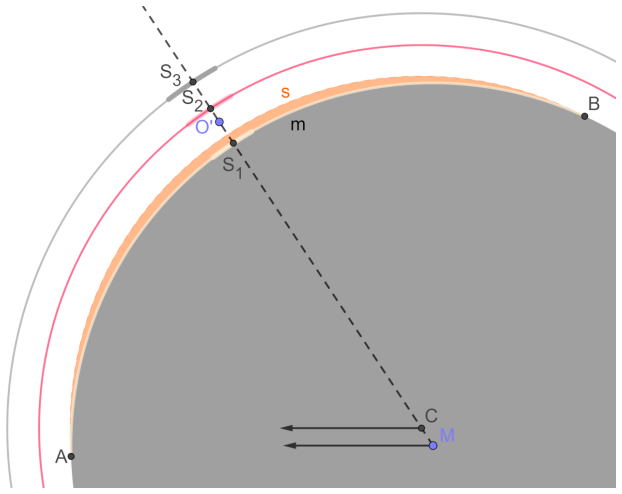
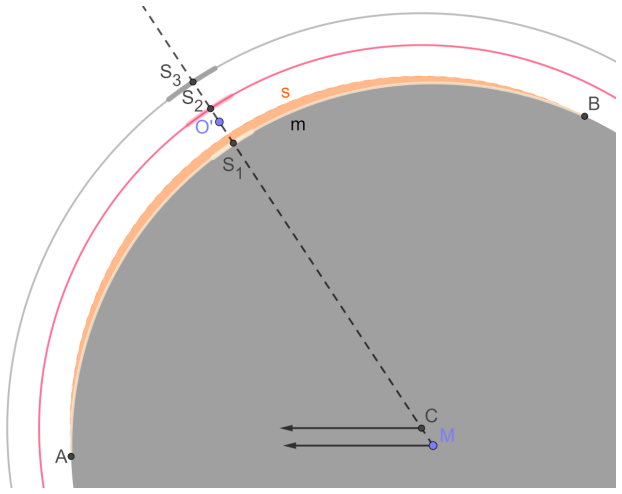
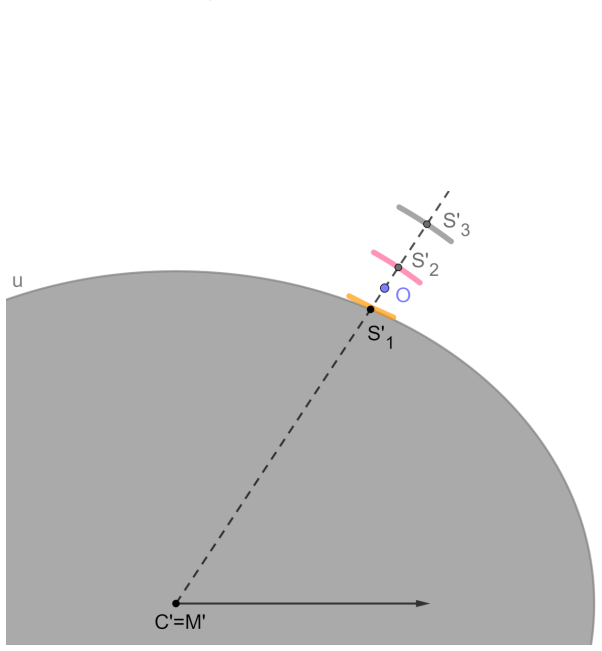
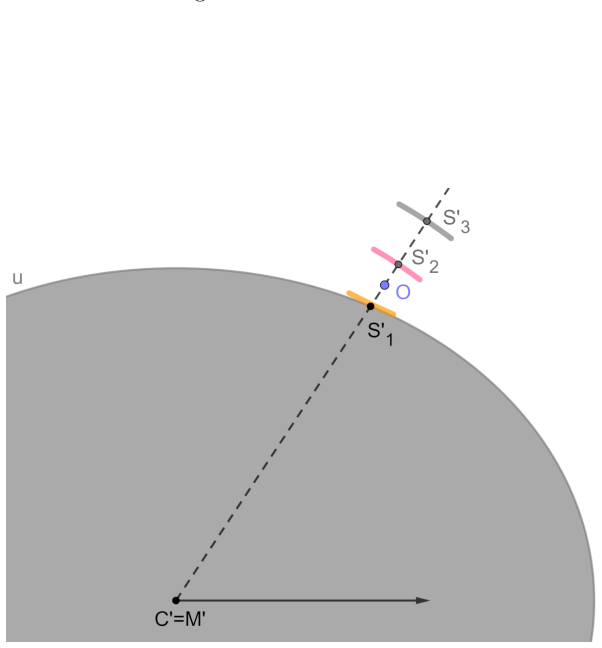
The Sun's extended structure produces a celestial analogue of Young's double-slit experiment that generates an interference-like intensity pattern on the ground modulated by Earth-atmosphere effects. The analysis combines solar limb geometry, atmospheric propagation, and a wave-based formulation that yields quantitative predictions for fringe width and spacing. The model accounts for the principal observational features of shadow bands and clarifies why the phenomenon is both elusive and highly sensitive to viewing conditions.
What carries the argument
Celestial analogue of Young's double-slit experiment, in which the Sun's limb supplies two effective sources whose light interferes after atmospheric travel.
If this is right
- Fringe width and spacing can be calculated directly from solar limb geometry and atmospheric parameters.
- Bands appear only when a narrow crescent of the Sun remains visible, because that geometry maximizes the effective slit separation.
- Small changes in observer height, atmospheric turbulence, or exact timing near totality strongly alter visibility.
- The patterns move across the ground at speeds set by the relative motion of the Moon's shadow and the interference fringes.
Where Pith is reading between the lines
- Shadow-band observations could serve as a simple probe of near-ground atmospheric turbulence during eclipses.
- Analogous fringes might be detectable under partial occultations of other extended sources, such as the Moon during a lunar eclipse viewed from space.
- The model suggests that controlled laboratory versions using an extended incoherent source and a thin scattering layer could reproduce the effect.
Load-bearing premise
The Sun's extended structure produces a celestial analogue of Young's double-slit experiment that generates an interference-like intensity pattern on the ground modulated by Earth-atmosphere effects.
What would settle it
Measurement of fringe spacing during an eclipse that deviates systematically from the value calculated from the Sun's angular diameter and the observer's distance to the effective atmospheric scattering layer would falsify the model.
Figures
read the original abstract
Shadow bands are transient, rippling patterns of light and dark that may appear in moments before and after totality in a solar eclipse. Despite centuries of reports, their physical origin has remained unresolved. This preprint develops a geometric-optical solution in which the Sun's extended structure produces a celestial analogue of Young's double-slit experiment, generating an interference-like intensity pattern on the ground, modulated by Earth-atmosphere effects. The analysis combines solar limb geometry, atmospheric propagation effects, and a wave-based formulation that yields quantitative predictions for fringe width and spacing. The resulting model accounts for the principal observational features of shadow bands and clarifies why the phenomenon is both elusive and highly sensitive to viewing conditions.
Editorial analysis
A structured set of objections, weighed in public.
Referee Report
Summary. The manuscript develops a combined geometric-optical and wave-based model for shadow bands observed before and after totality in solar eclipses. It treats the Sun's extended disk as producing a celestial analogue of Young's double-slit experiment, with the solar limbs acting as effective sources that generate an interference-like intensity pattern on the ground; this pattern is further modulated by Earth-atmosphere propagation effects. The analysis is claimed to deliver quantitative predictions for fringe width and spacing that account for the principal observational features and explain the phenomenon's sensitivity to viewing conditions.
Significance. If the central construction holds, the work would supply the first quantitative, first-principles account of a centuries-old eclipse phenomenon that has resisted explanation. The attempt to combine limb geometry, atmospheric modulation, and a wave formulation is a clear strength; successful validation against data would constitute a genuine contribution to atmospheric optics.
major comments (1)
- [§3–4] §3–4: The model posits that the solar limbs function as coherent sources whose separation produces a distinct interference pattern. The van Cittert–Zernike theorem, however, implies that the mutual coherence between points separated by the solar angular diameter (~0.5°) is essentially zero for a thermal source at visible wavelengths after atmospheric propagation. The manuscript must therefore derive an explicit mechanism (e.g., a turbulence-induced coherence length or spatial filter) that restores the required visibility; absent this step the intensity reduces to an incoherent integral over the disk and the claimed quantitative predictions for fringe spacing cannot be obtained.
minor comments (2)
- The abstract asserts that the model 'yields quantitative predictions,' yet the provided text contains no explicit equations, derivations, or direct comparisons with measured fringe widths or spacings; these must be added with error bars and observational references.
- Notation for the effective source separation and the atmospheric modulation term should be defined once and used consistently; several descriptive passages repeat the same geometric argument without advancing the derivation.
Simulated Author's Rebuttal
We thank the referee for the careful and constructive review. The central concern regarding coherence is addressed point-by-point below. We agree that an explicit derivation is required and will incorporate it in revision.
read point-by-point responses
-
Referee: [§3–4] §3–4: The model posits that the solar limbs function as coherent sources whose separation produces a distinct interference pattern. The van Cittert–Zernike theorem, however, implies that the mutual coherence between points separated by the solar angular diameter (~0.5°) is essentially zero for a thermal source at visible wavelengths after atmospheric propagation. The manuscript must therefore derive an explicit mechanism (e.g., a turbulence-induced coherence length or spatial filter) that restores the required visibility; absent this step the intensity reduces to an incoherent integral over the disk and the claimed quantitative predictions for fringe spacing cannot be obtained.
Authors: We accept the referee's point that the van Cittert–Zernike theorem must be confronted directly. The manuscript already invokes Earth-atmosphere propagation as a modulating factor on the wave field; we will revise §§3–4 to derive explicitly how turbulence sets a finite coherence length (via the mutual coherence function after propagation through a Kolmogorov spectrum) that is sufficient to produce partial visibility between the solar limbs. This derivation will be inserted before the fringe-spacing calculation, showing that the effective source is spatially filtered to a scale comparable to the Fresnel-zone size at the ground. The geometric-optical limb separation and the resulting quantitative predictions remain unchanged, but the coherence step will now be first-principles rather than implicit. revision: yes
Circularity Check
No circularity: derivation combines independent geometric and wave elements without self-referential reduction
full rationale
The provided abstract and context describe a model that combines solar limb geometry, atmospheric propagation, and a wave-based formulation to generate quantitative predictions for fringe width and spacing. No equations, self-citations, or fitted parameters are quoted that reduce the output predictions to the inputs by construction. The reader's suspicion of possible fitting is noted but unsupported by any exhibited reduction in the text. The skeptic attack concerns physical plausibility (van Cittert-Zernike coherence) rather than definitional circularity. This is the default honest outcome when no load-bearing step collapses to its own inputs.
Axiom & Free-Parameter Ledger
axioms (2)
- domain assumption Wave interference from an extended source (solar limb) can be treated analogously to Young's double-slit experiment.
- domain assumption Atmospheric propagation effects modulate the resulting pattern.
Reference graph
Works this paper leans on
-
[1]
Abbe, C. (1900). Eclipse shadow bands and correlated atmospheric phenomena,Monthly Weather Review28, 5, p. 210
1900
-
[2]
Alissandrakis, C. E. and Macris, C. J. (1971). A study of the fine structure of the solar chromosphere at the limb,Solar Physics20, 1, pp. 52–53, doi:10.1007/bf00146093, URL https://ui.adsabs.harvard.edu/abs/1971SoPh...20...47A/abstract
-
[3]
Public domain
British Astronomical Association (1906).The total solar eclipse 1905: Re- ports of observations made by members of the British Astronomical Association (British Astronomical Association, London), URLhttps://archive.org/details/ totalsolareclips00britrich, observational report of the August 30, 1905 total solar eclipse. Public domain
1906
-
[4]
Codona, J. L. (1986). The scintillation theory of eclipse shadow bands,Astronomy and Astrophysics164, 2, pp. 415–427, URLhttps://articles.adsabs.harvard.edu/full/ 1986A&A...164..415C, please note that the article is copyrighted and may not be freely reproduced
1986
-
[5]
Codona, J. L. (1991). The enigma of shadow bands,Sky and Telescope81, 5, pp. 482–487
1991
-
[6]
Feldman, R. L. (1938a). Shadow bands – Part I,Popular Astronomy46, pp. 187–200, URL https://adsabs.harvard.edu/full/1938PA.....46..187F, this article is believed to be in the public domain
-
[7]
Feldman, R. L. (1938b). Shadow bands – Part II,Popular Astronomy46, pp. 263–273, URLhttps://articles.adsabs.harvard.edu/full/1940PA.....48....2F, this article is believed to be in the public domain
-
[8]
Feldman, R. L. (1940). Shadow bands – Part III,Popular Astronomy48, p. 182, URL https://articles.adsabs.harvard.edu/full/1940PA.....48..182F, this article is be- lieved to be in the public domain
1940
-
[9]
Feldman, R. L. (1974). On shadow bands accompanying total solar eclipses,American Journal of Physics42, 11, pp. 1024–1026, doi:10.1119/1.1987919
-
[10]
Gaviola, E. (1948). On shadow bands at total eclipses of the sun,Popular Astronomy 56, pp. 353–359, URLhttps://ui.adsabs.harvard.edu/scan/manifest/1948PA..... 56..353G, this article is believed to be in the public domain
1948
-
[11]
Gladysz, S., Redfern, M. and Jones, B. W. (2005). Shadow bands observed during the total solar eclipse of 4 December 2002, by high-resolution imaging,Journal of Atmospheric and Solar-Terrestrial Physics67, 10, pp. 899–906, doi:10.1016/j.jastp.2005.02.012
-
[12]
shadow bands
Henry, A. J. (1906). Observations of “shadow bands” without an eclipse,Monthly Weather Review34, 5, p. 227
1906
-
[13]
Hults, M. E., Burgess, R. D., Mitchell, D. A. and Warn, D. W. (1971). Visual, photographic and photoelectric detection of shadow bands at the March 7, 1970, solar eclipse,Nature 231, 5300, pp. 255–258, doi:10.1038/231255a0
-
[14]
Jones, B. W. (1996). Shadow bands during the total solar eclipse of 3 November 1994, Journal of Atmospheric and Terrestrial Physics58, 12, pp. 1309–1316, doi:10.1016/ 0021-9169(95)00162-x. 22
1996
-
[15]
Jones, B. W. and Jones, C. (1994). Shadow bands during the total solar eclipse of 11 July 1991,Journal of Atmospheric and Terrestrial Physics56, 12, pp. 1535–1543, doi: 10.1016/0021-9169(94)90082-5
-
[16]
Klement, G. T. (1974). Observations of short term light variations during the June 30, 1973 solar eclipse,Astronomy and Astrophysics37, 2, pp. 431–433, URLhttps://articles. adsabs.harvard.edu/full/1974A&A....37..431K
1974
-
[17]
Madhani, J. P., Chu, G. E., Gomez, C. V., Bartel, S., Clark, R. J., Coban, L. W., Hart- man, M., Potosky, E. M., Rao, S. M. and Turnshek, D. A. (2020). Observation of eclipse shadow bands using high altitude balloon and ground-based photodiode arrays,Journal of Atmospheric and Solar-Terrestrial Physics211, 105420, doi:10.1016/j.jastp.2020.105420, preprint...
-
[18]
Marschall, L. A. (1984). Shadow bands – Solar eclipse phantoms,Sky and Telescope67, p. 116
1984
-
[19]
Mashaal, H., Goldstein, A., Feuermann, D. and Gordon, J. M. (2012). Spatial coherence of sunlight: first direct measurement, in R. Winston and J. M. Gordon (eds.),Nonimaging Optics: Efficient Design for Illumination and Solar Concentration IX, Vol. 8485 (SPIE), p. 84850A, doi:10.1117/12.928449
-
[20]
MathallicA (2025).The optics of shadow bands: Causation and effect, 1st edn. (Mathal- licA), ISBN 978-86-908194-0-9, URLhttps://www.amazon.com/dp/8690819401/, paper- back edition
-
[21]
O’Meara, S. J. (2009). Secret sky – Searching for shadow bands,As- tronomy37, 4, pp. 18–19, URLhttps://www.astronomy.com/observing/ stephen-james-omearas-secret-sky-searching-for-shadow-bands/
2009
-
[22]
Rotch, A. L. (1908). The eclipse shadow-bands,Annals of the Astronomical Observatory of Harvard College58, pp. 217–222, URLhttps://adsabs.harvard.edu/full/1908AnHar. .58..217R
1908
-
[23]
Schawlow, A. L. (1968). Laser light,Scientific American219, 3, pp. 120–136
1968
-
[24]
Seykora, E. J. (1979). Observations of eclipse shadow bands and related phenomena,Ap- plied Optics18, 21, pp. 3538, 3539, doi:10.1364/ao.18.003538
-
[25]
Watts, H. M. (1925). Shadow bands during the period of greatest obscuration, January 24, 1925,Popular Astronomy33, p. 236, URLhttps://articles.adsabs.harvard.edu/ pdf/1925PA.....33..236W, public domain. 23
1925
discussion (0)
Sign in with ORCID, Apple, or X to comment. Anyone can read and Pith papers without signing in.