Constructor-Theoretic Optical Time: Delay, Phase, and Fisher Distinguishability as Physical Tasks
Pith reviewed 2026-06-30 01:02 UTC · model grok-4.3
The pith
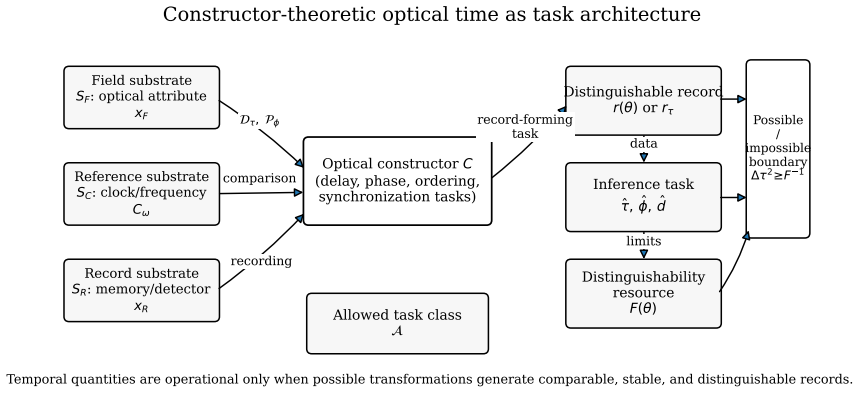
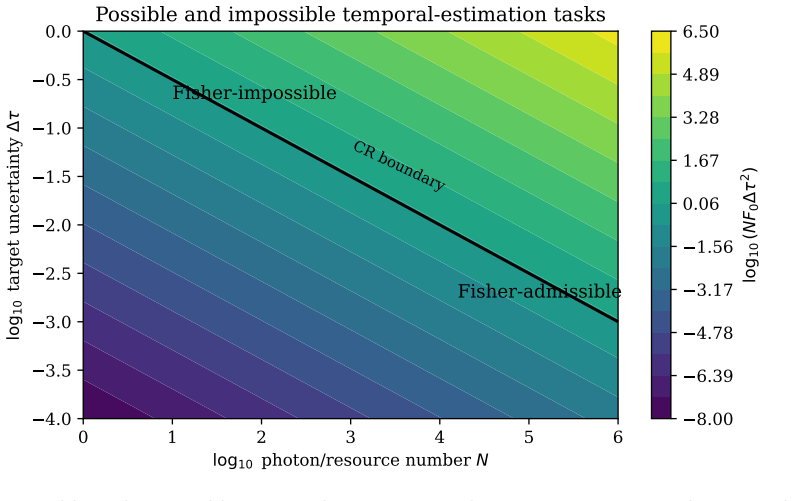
No constructor can estimate an optical delay with variance below the inverse Fisher information for any given substrate, detector, and resource set.
A machine-rendered reading of the paper's core claim, the machinery that carries it, and where it could break.
Core claim
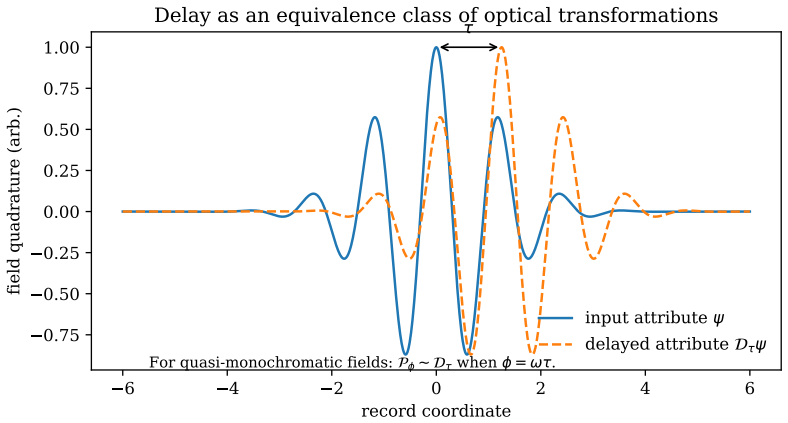
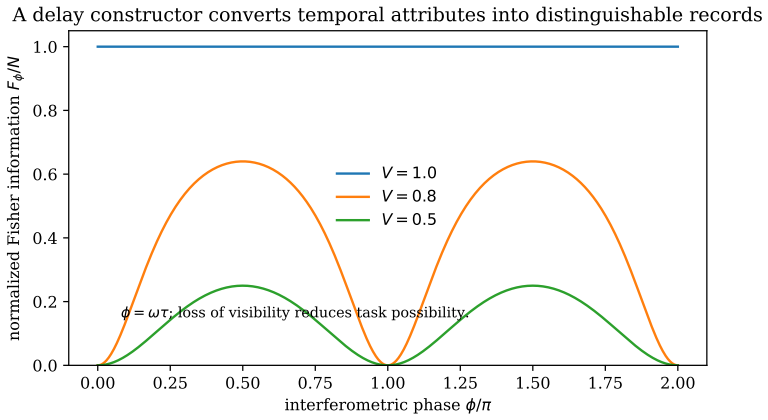
Delay is defined operationally by comparison and record-forming tasks, phase acquires temporal meaning only through a reference-dependent equivalence, and the Fisher information associated with delay estimation functions as a distinguishability resource. Consequently, for any fixed optical substrate, reference, detector, photon budget, bandwidth, visibility, and noise model, no constructor is capable of estimating a delay to a variance smaller than the reciprocal of that Fisher information.
What carries the argument
The phase-delay equivalence relation together with the interpretation of Fisher information as the resource that sets the boundary between possible and impossible delay-estimation tasks.
If this is right
- Interferometric setups cannot beat the Cramer-Rao limit on delay variance for the chosen parameters.
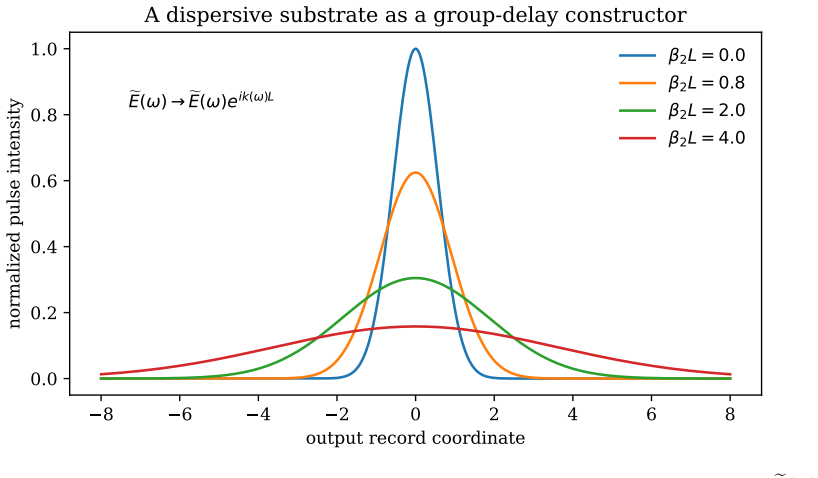
- Dispersive propagation appears as a sequence of phase-delay tasks whose records are constrained by the same bound.
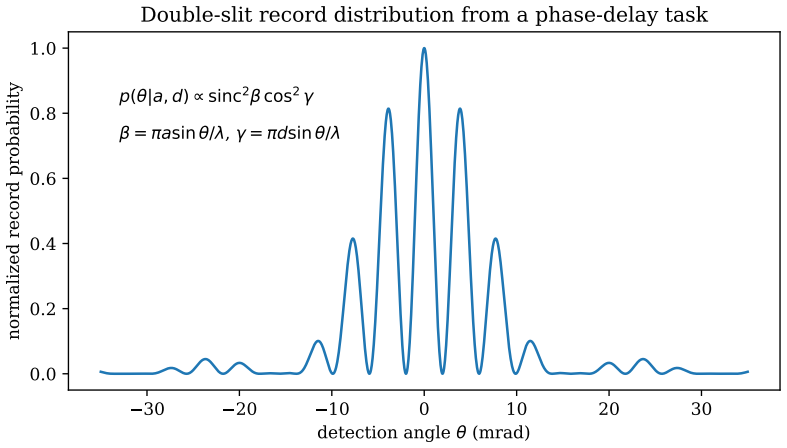
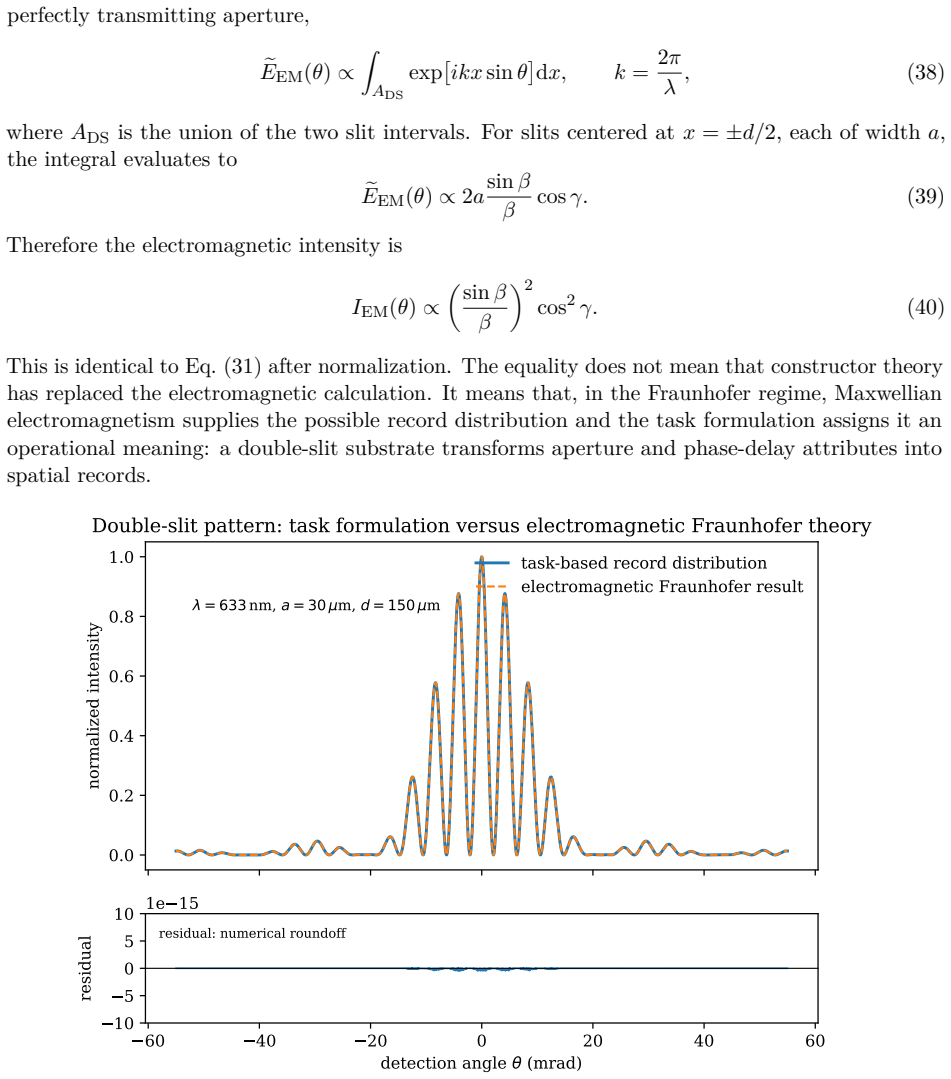
- The double-slit Fraunhofer pattern emerges directly as the record distribution produced by a phase-delay task.
- Temporal ordering and synchronization become subject to the same task-based analysis without a primitive time coordinate.
Where Pith is reading between the lines
- The same task-impossibility language could be applied to synchronization tasks between distant optical systems.
- Resource accounting in the framework might yield new bounds for multi-photon or entangled-light delay estimation.
- Reorganizing Maxwellian optics this way could clarify which detector configurations are ruled out by distinguishability alone.
Load-bearing premise
Delay, phase, temporal ordering, synchronization, and detector records can be adequately described as physical tasks without invoking a primitive time parameter.
What would settle it
An experimental realization of a delay estimation task whose achieved variance falls below the inverse of the computed Fisher information, under the exact substrate, reference, detector, photon budget, bandwidth, visibility, and noise conditions specified by the model, would falsify the impossibility claim.
Figures
read the original abstract
We develop a constructor-theoretic formulation of optical time in which delay, phase, temporal ordering, synchronization, and detector records are described as physical tasks rather than as consequences of a primitive time parameter. An optical delay is treated as an operational attribute defined by comparison and record-forming tasks, while phase becomes temporal only through a reference-dependent phase-delay equivalence relation. Within this framework, the Fisher information associated with delay estimation is interpreted as a distinguishability resource, and the Cramer-Rao bound becomes a task-impossibility statement: for a specified optical substrate, reference, detector, photon budget, bandwidth, visibility, and noise model, no constructor can estimate a delay with variance below the inverse Fisher information. We illustrate the approach using interferometric delay estimation, dispersive group-delay propagation, and double-slit diffraction, where the standard Fraunhofer pattern is recovered as a record distribution generated by a phase-delay task. The framework does not replace Maxwellian optics; it reorganizes optical dynamics as a means of determining which temporal tasks are physically possible or impossible.
Editorial analysis
A structured set of objections, weighed in public.
Referee Report
Summary. The paper develops a constructor-theoretic formulation of optical time in which delay, phase, temporal ordering, synchronization, and detector records are described as physical tasks rather than consequences of a primitive time parameter. An optical delay is treated as an operational attribute defined by comparison and record-forming tasks, while phase becomes temporal only through a reference-dependent phase-delay equivalence relation. The Fisher information is interpreted as a distinguishability resource, and the Cramér-Rao bound is recast as a task-impossibility statement for specified optical substrates, references, detectors, photon budgets, bandwidths, visibilities, and noise models. The framework is illustrated with interferometric delay estimation, dispersive group-delay propagation, and double-slit diffraction, where the standard Fraunhofer pattern is recovered as a record distribution generated by a phase-delay task. The approach reorganizes optical dynamics to determine which temporal tasks are physically possible or impossible without replacing Maxwellian optics.
Significance. If the framework holds, it offers a conceptual reorganization of temporal concepts in optics as constructor-theoretic tasks, potentially useful for foundational questions about physical realizability. However, since the manuscript recovers existing results such as the Fraunhofer pattern and the Cramér-Rao bound without generating new predictions, parameter-free derivations, or falsifiable tests beyond standard quantum optics, its significance remains primarily interpretive rather than transformative. No machine-checked proofs or reproducible code are provided.
major comments (1)
- Abstract: The claims that the framework recovers the Fraunhofer pattern as a record distribution from a phase-delay task and reinterprets the Cramér-Rao bound as a task-impossibility statement are presented without detailed derivations, explicit calculations, error analysis, or side-by-side comparisons to conventional quantum-optics results. This absence is load-bearing because the central claim is that the reorganization is consistent with and recovers standard results; without the derivations, consistency cannot be verified.
minor comments (1)
- The phase-delay equivalence relation is introduced as an axiom but lacks a formal equation or explicit construction showing how it avoids presupposing temporal ordering, which would improve clarity of the framework's foundations.
Simulated Author's Rebuttal
We thank the referee for their careful reading of the manuscript. We respond to the single major comment below.
read point-by-point responses
-
Referee: Abstract: The claims that the framework recovers the Fraunhofer pattern as a record distribution from a phase-delay task and reinterprets the Cramér-Rao bound as a task-impossibility statement are presented without detailed derivations, explicit calculations, error analysis, or side-by-side comparisons to conventional quantum-optics results. This absence is load-bearing because the central claim is that the reorganization is consistent with and recovers standard results; without the derivations, consistency cannot be verified.
Authors: The abstract is a concise summary, as is conventional. The full derivations, explicit calculations, error analyses, and side-by-side comparisons to standard quantum-optics results are contained in the body of the manuscript. Section II derives the reinterpretation of the Cramér-Rao bound as a task-impossibility statement for the specified optical substrate, reference, detector, photon budget, bandwidth, visibility, and noise model, with the Fisher information treated as a distinguishability resource. Sections III and IV provide the explicit calculations and comparisons for interferometric delay estimation and dispersive group-delay propagation. Section V constructs the phase-delay task for double-slit diffraction and recovers the standard Fraunhofer pattern as the resulting record distribution, including direct comparison to the conventional derivation. These sections supply the verifications of consistency requested. revision: no
Circularity Check
No significant circularity; interpretive reframing of standard results
full rationale
The paper presents a constructor-theoretic reorganization of optical tasks (delay estimation, phase-delay equivalence) that recovers standard results such as the Fraunhofer pattern and the Cramér-Rao bound as an impossibility statement. The central claim is therefore an interpretive reframing rather than a derivation that alters predictions or requires new assumptions beyond those already present in quantum optics. No internal inconsistency or hidden circularity is evident from the stated scope, and the framework explicitly states it does not replace Maxwellian optics.
Axiom & Free-Parameter Ledger
axioms (2)
- domain assumption Physical laws can be expressed in terms of possible and impossible tasks (constructor theory).
- ad hoc to paper A reference-dependent phase-delay equivalence relation can be defined to make phase temporal.
invented entities (1)
-
phase-delay equivalence relation
no independent evidence
Reference graph
Works this paper leans on
-
[1]
Evolution without evolution: Dynamics described by stationary observables,
D. N. Page and W. K. Wootters, “Evolution without evolution: Dynamics described by stationary observables,”Physical Review D27, 2885–2892 (1983)
1983
-
[2]
Forget Time,
C. Rovelli, “Forget Time,”Foundations of Physics41, 1475–1490 (2011). 15
2011
-
[3]
Quantum Limitations of the Measurement of Space-Time Distances,
H. Salecker and E. P. Wigner, “Quantum Limitations of the Measurement of Space-Time Distances,”Physical Review109, 571–577 (1958)
1958
-
[4]
Constructor Theory,
D. Deutsch, “Constructor Theory,”Synthese190, 4331–4359 (2013)
2013
-
[5]
Constructor Theory of Information,
D. Deutsch and C. Marletto, “Constructor Theory of Information,”Proceedings of the Royal Society A471, 20140540 (2015)
2015
-
[6]
D. Deutsch and C. Marletto, “Constructor Theory of Time,” arXiv:2505.08692 (2025), version 3 (2026)
Pith/arXiv arXiv 2025
-
[7]
C. Marletto, D. Deutsch, and V. Vedral, “Tests of Constructor Theory,” arXiv:2606.07352 (2026)
Pith/arXiv arXiv 2026
-
[8]
Marletto,The Science of Can and Can’t: A Physicist’s Journey through the Land of Counterfactuals(Viking, 2021)
C. Marletto,The Science of Can and Can’t: A Physicist’s Journey through the Land of Counterfactuals(Viking, 2021)
2021
-
[9]
On the Mathematical Foundations of Theoretical Statistics,
R. A. Fisher, “On the Mathematical Foundations of Theoretical Statistics,”Philosophical Transactions of the Royal Society A222, 309–368 (1922)
1922
-
[10]
Cramer,Mathematical Methods of Statistics(Princeton University Press, 1946)
H. Cramer,Mathematical Methods of Statistics(Princeton University Press, 1946)
1946
-
[11]
Information and the Accuracy Attainable in the Estimation of Statistical Parame- ters,
C. R. Rao, “Information and the Accuracy Attainable in the Estimation of Statistical Parame- ters,”Bulletin of the Calcutta Mathematical Society37, 81–91 (1945)
1945
-
[12]
C. W. Helstrom,Quantum Detection and Estimation Theory(Academic Press, 1976)
1976
-
[13]
Statistical Distance and the Geometry of Quantum States,
S. L. Braunstein and C. M. Caves, “Statistical Distance and the Geometry of Quantum States,” Physical Review Letters72, 3439–3443 (1994)
1994
-
[14]
Quantum Metrology,
V. Giovannetti, S. Lloyd, and L. Maccone, “Quantum Metrology,”Physical Review Letters96, 010401 (2006)
2006
-
[15]
Quantum Estimation for Quantum Technology,
M. G. A. Paris, “Quantum Estimation for Quantum Technology,”International Journal of Quantum Information7, 125–137 (2009)
2009
-
[16]
J. W. Goodman,Introduction to Fourier Optics, 3rd ed. (Roberts and Company, 2005)
2005
-
[17]
Born and E
M. Born and E. Wolf,Principles of Optics, 7th ed. (Cambridge University Press, 1999)
1999
-
[18]
Mandel and E
L. Mandel and E. Wolf,Optical Coherence and Quantum Optics(Cambridge University Press, 1995)
1995
-
[19]
B. E. A. Saleh and M. C. Teich,Fundamentals of Photonics, 3rd ed. (Wiley, 2019)
2019
-
[20]
Fisher Information Theory for Parameter Estimation in Single Molecule Microscopy,
J. Chao, E. S. Ward, and R. J. Ober, “Fisher Information Theory for Parameter Estimation in Single Molecule Microscopy,”Journal of the Optical Society of America A33, B36–B57 (2016)
2016
-
[21]
Quantum Theory of Superresolution for Two Incoherent Optical Point Sources,
M. Tsang, R. Nair, and X.-M. Lu, “Quantum Theory of Superresolution for Two Incoherent Optical Point Sources,”Physical Review X6, 031033 (2016)
2016
-
[22]
The Time-Energy Uncertainty Relation,
P. Busch, “The Time-Energy Uncertainty Relation,” inTime in Quantum Mechanics, 2nd ed. (Springer, 2008), pp. 73–105
2008
-
[23]
J. A. Stratton,Electromagnetic Theory(McGraw-Hill, 1941)
1941
-
[24]
J. D. Jackson,Classical Electrodynamics, 3rd ed. (Wiley, 1999). 16
1999
discussion (0)
Sign in with ORCID, Apple, or X to comment. Anyone can read and Pith papers without signing in.