An Adaptive Fast Algorithm for Periodic Coulomb Lattice Sums in Arbitrary Unit Cells
Pith reviewed 2026-06-30 00:28 UTC · model grok-4.3
The pith
An extension of the dual-space multilevel kernel-splitting method evaluates periodic Coulomb lattice sums in arbitrary unit cells with O(N) complexity for fixed cell shape.
A machine-rendered reading of the paper's core claim, the machinery that carries it, and where it could break.
Core claim
The algorithm extends the DMK framework to periodic settings by replacing the single-cube root with a rectangular grid consisting of an inner block plus halo of image cubes, allowing the five-step Ewald-style procedure to evaluate the smooth top-level periodic kernel while correctly handling conditional convergence for arbitrary oblique and triclinic cells.
What carries the argument
the root grid of an inner block plus halo of image cubes together with the five-step Ewald-style procedure (spreading, FFT, diagonal scaling, inverse FFT, interpolation) applied to the smooth top-level periodic kernel
If this is right
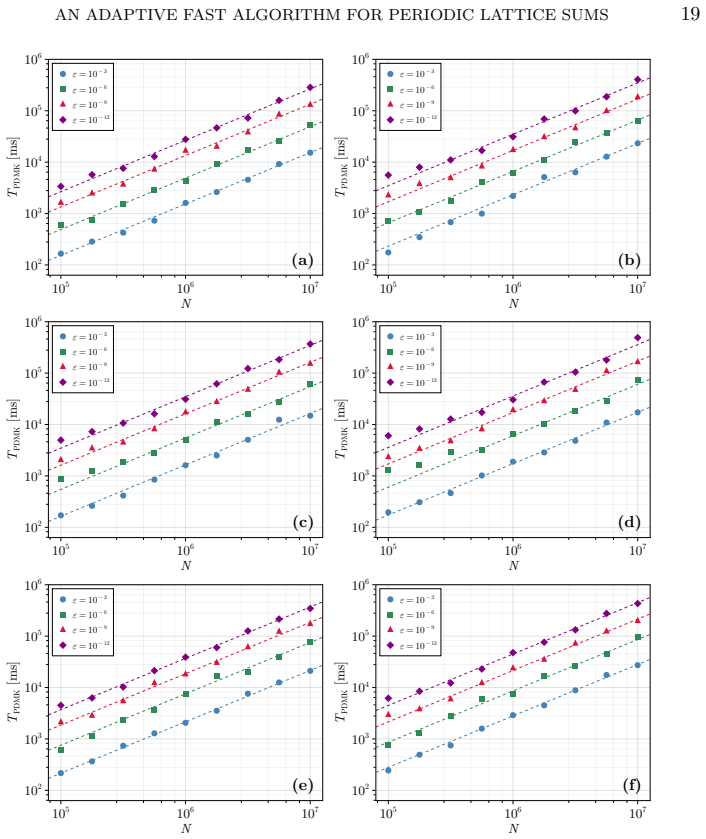
- The method achieves linear complexity O(N) once cell shape is fixed.
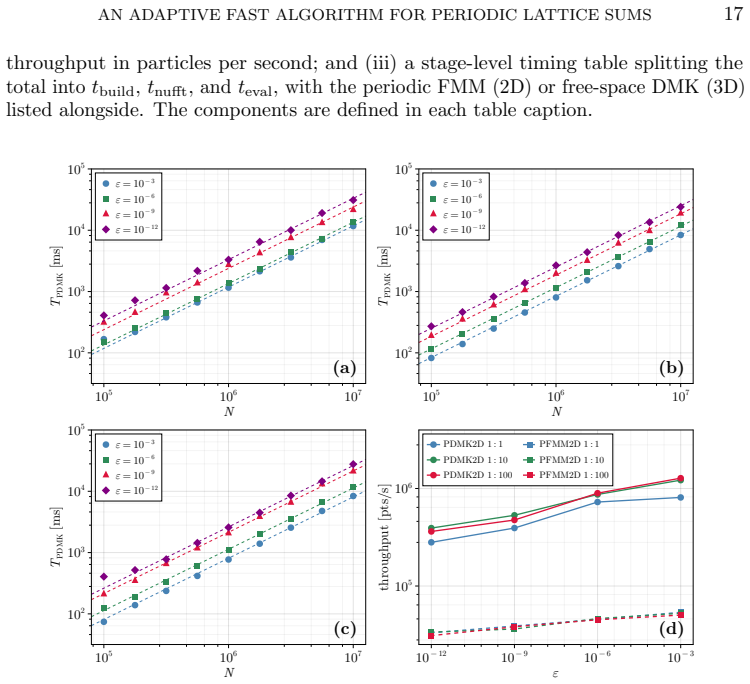
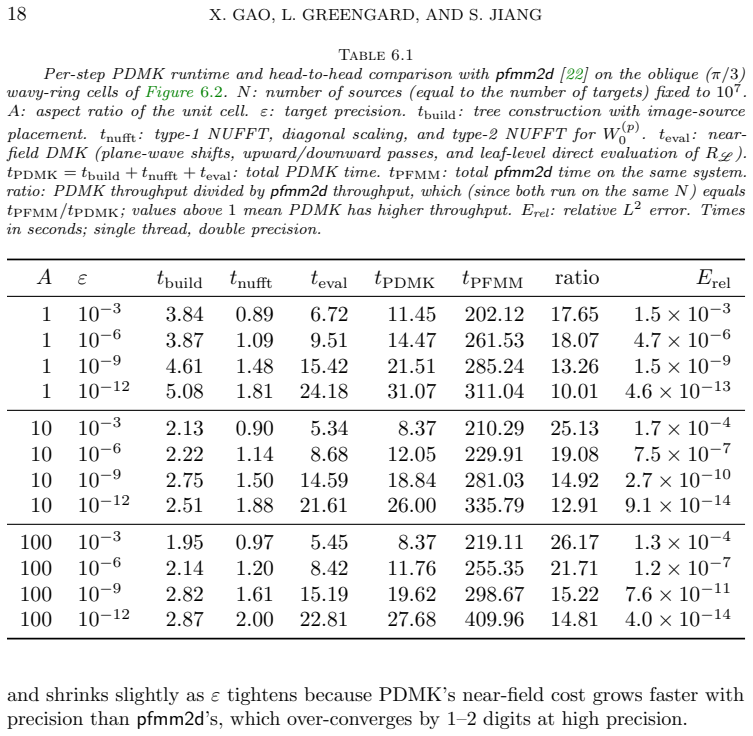
- In two dimensions the algorithm is typically an order of magnitude faster than the periodic fast multipole method across particle counts and precisions on nonuniform distributions.
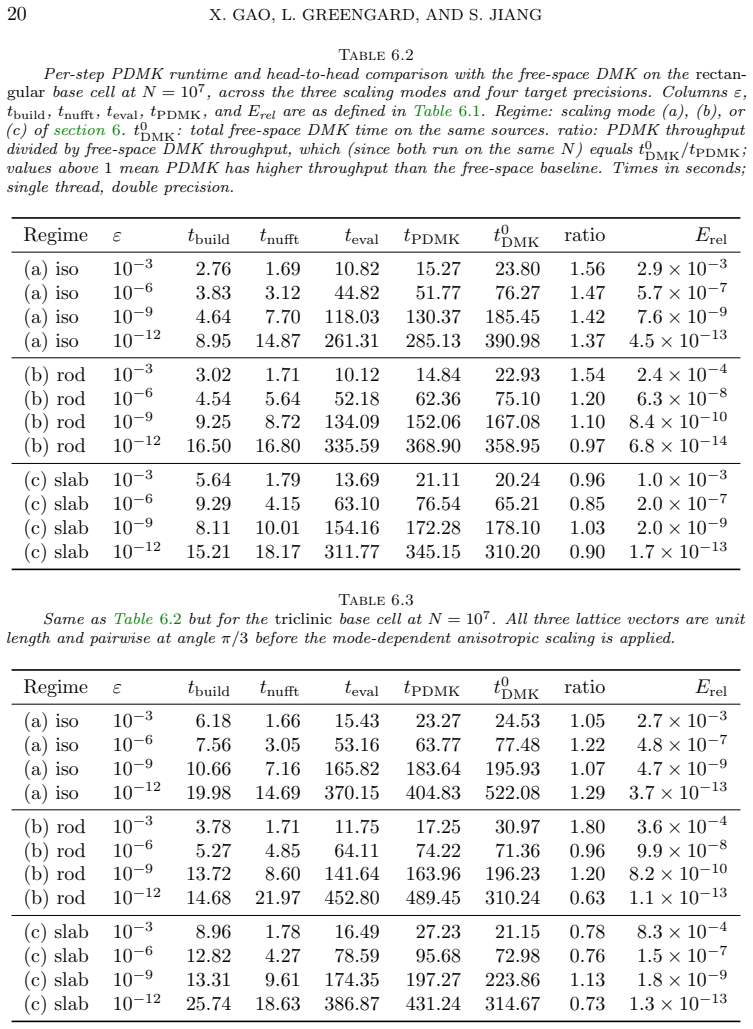
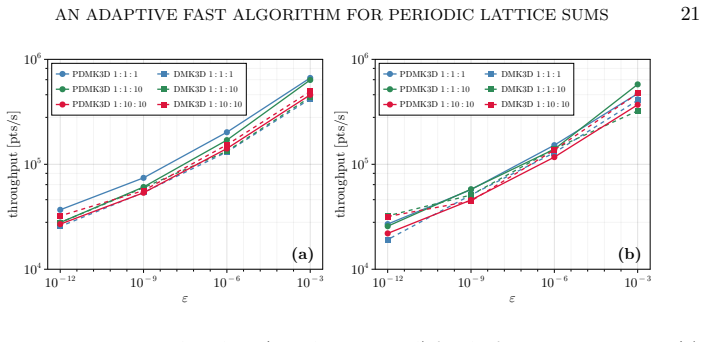
- In three dimensions the algorithm often matches the speed of free-space DMK on the same sources even for triclinic cells.
- The approach works for both oblique and triclinic cells without requiring orthogonality.
Where Pith is reading between the lines
- The halo-grid construction may allow similar periodic extensions for other conditionally convergent kernels beyond Coulomb.
- The separation of the top-level periodic term into an FFT-based Ewald step could simplify implementation of adaptive periodic solvers in existing DMK codebases.
- Performance on cells with even larger aspect ratios remains open but the reported results up to ratio 17 suggest the method scales with cell geometry in a controlled way.
Load-bearing premise
The five-step Ewald procedure applied to the smooth periodic kernel on the halo grid correctly resolves conditional convergence for arbitrary cell shapes.
What would settle it
Numerical comparison of the computed lattice sums against independently verified reference values for a triclinic cell with edge-length ratio near 17 and highly nonuniform particle placement at successively higher target precisions.
Figures
read the original abstract
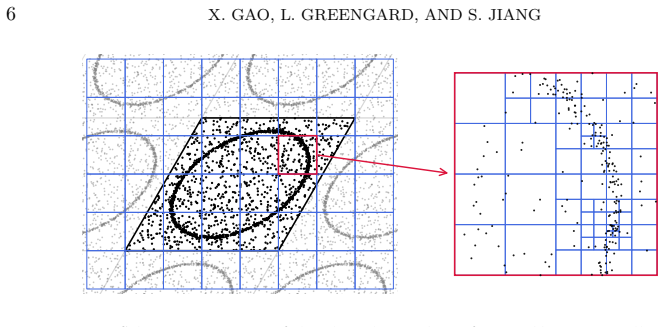
We present a fast algorithm for evaluating conditionally convergent Coulomb lattice sums, governed by the Laplace equation with periodic boundary conditions on arbitrary unit cells (oblique in 2D, triclinic in 3D) and arbitrary particle distributions. The algorithm extends the dual-space multilevel kernel-splitting (DMK) framework to this context. The root of the adaptive tree is now a rectangular grid of cubes consisting of an inner block covering the unit cell and a surrounding halo of image cubes, rather than a single cube, and the smooth top-level periodic kernel -- the only term that requires the consideration of conditional convergence issues -- is evaluated by the ``five-step procedure" used in fast Ewald summation: spreading, fast Fourier transform (FFT), diagonal scaling, inverse FFT, and interpolation. The resulting complexity is $O(N)$ for fixed cell shape. Benchmarked against the periodic fast multipole method on highly nonuniform source distributions, our 2D algorithm is roughly an order of magnitude faster across particle counts and target precisions; in three dimensions, it is often as fast as the free-space DMK on the same sources, even for triclinic cells with edge-length ratios up to roughly $17$.
Editorial analysis
A structured set of objections, weighed in public.
Referee Report
Summary. The manuscript extends the dual-space multilevel kernel-splitting (DMK) framework to conditionally convergent periodic Coulomb lattice sums over arbitrary oblique (2D) and triclinic (3D) unit cells. The root level is replaced by a rectangular grid of cubes consisting of an inner block plus halo of image cubes; the smooth top-level periodic kernel is evaluated via the five-step Ewald procedure (spreading, FFT, diagonal scaling, inverse FFT, interpolation). The resulting method has O(N) complexity for fixed cell shape and is reported to be roughly an order of magnitude faster than the periodic fast multipole method in 2D and often as fast as free-space DMK in 3D, even for cells with edge-length ratios up to ~17.
Significance. If the conditional-convergence handling is correct, the algorithm supplies a practical, adaptive O(N) tool for lattice sums in general geometries that is faster than existing periodic FMM implementations on nonuniform distributions. The extension of DMK to periodic settings with arbitrary cells is a clear technical contribution; reproducible benchmarks on highly nonuniform sources further strengthen the practical value.
major comments (2)
- [Abstract / root-grid and five-step procedure description] The central claim that the five-step Ewald procedure on the rectangular halo-augmented root grid correctly resolves conditional convergence for arbitrary triclinic cells (abstract) requires that the diagonal scaling operator incorporate the precise reciprocal-lattice vectors of the skewed cell. The manuscript must supply the explicit form of this operator and demonstrate that the Cartesian FFT grid plus halo summation produces no residual O(1) shape-dependent term; without this derivation or a targeted numerical test on a known conditionally convergent sum, the correctness for non-orthogonal cells remains unverified.
- [Benchmark section] The reported performance (order-of-magnitude speedup in 2D; parity with free-space DMK in 3D for edge ratios ~17) is load-bearing on the periodic kernel evaluation being both accurate and free of conditional-convergence artifacts. The benchmarks should therefore include explicit error-vs-N and error-vs-precision tables for at least one triclinic cell with large aspect ratio, together with a comparison against a reference Ewald summation that uses the exact reciprocal lattice.
Simulated Author's Rebuttal
We thank the referee for the thoughtful and detailed comments. We address each major point below and have revised the manuscript to strengthen the presentation of the conditional-convergence handling and to expand the numerical verification.
read point-by-point responses
-
Referee: [Abstract / root-grid and five-step procedure description] The central claim that the five-step Ewald procedure on the rectangular halo-augmented root grid correctly resolves conditional convergence for arbitrary triclinic cells (abstract) requires that the diagonal scaling operator incorporate the precise reciprocal-lattice vectors of the skewed cell. The manuscript must supply the explicit form of this operator and demonstrate that the Cartesian FFT grid plus halo summation produces no residual O(1) shape-dependent term; without this derivation or a targeted numerical test on a known conditionally convergent sum, the correctness for non-orthogonal cells remains unverified.
Authors: We agree that an explicit derivation of the scaling operator would improve clarity. The five-step procedure is the standard fast Ewald method, in which the diagonal scaling in Fourier space is performed at the reciprocal-lattice vectors of the (possibly triclinic) unit cell; the rectangular Cartesian FFT grid is used only for the smooth kernel on the halo-augmented domain, while the reciprocal vectors enter solely through the scaling factor. The halo ensures that the periodic images are captured without introducing an additional shape-dependent O(1) term beyond what the Ewald splitting already cancels. To address the request directly we will insert a short derivation subsection and a targeted numerical test on a known conditionally convergent sum (e.g., the Madelung constant of a non-orthogonal lattice). revision: yes
-
Referee: [Benchmark section] The reported performance (order-of-magnitude speedup in 2D; parity with free-space DMK in 3D for edge ratios ~17) is load-bearing on the periodic kernel evaluation being both accurate and free of conditional-convergence artifacts. The benchmarks should therefore include explicit error-vs-N and error-vs-precision tables for at least one triclinic cell with large aspect ratio, together with a comparison against a reference Ewald summation that uses the exact reciprocal lattice.
Authors: We accept that additional verification tables would strengthen the claims. We will augment the benchmark section with error-versus-N and error-versus-precision tables for at least one triclinic cell with edge-length ratio approximately 17, each entry compared against a reference Ewald summation that employs the exact reciprocal-lattice vectors of that cell. These tables will be placed alongside the existing performance data. revision: yes
Circularity Check
No circularity; derivation extends DMK independently via standard Ewald steps on halo grid
full rationale
The paper's core algorithm applies the established five-step Ewald procedure (spreading/FFT/scaling/iFFT/interpolation) to the smooth top-level periodic kernel on a rectangular inner-block-plus-halo grid. This is presented as a direct adaptation for arbitrary oblique/triclinic cells without any reduction of the conditional-convergence claim to a fitted parameter, self-defined quantity, or load-bearing self-citation chain. Prior DMK work is cited for the free-space baseline but the periodic extension introduces independent grid and halo choices whose correctness is asserted via the standard Ewald construction rather than derived from the present paper's own inputs. No equations equate a prediction to its own fit, and the O(N) claim follows from the multilevel structure without circular renaming or uniqueness imports.
Axiom & Free-Parameter Ledger
axioms (1)
- domain assumption The five-step spreading-FFT-scaling-iFFT-interpolation procedure correctly handles the conditionally convergent smooth periodic kernel for arbitrary unit cells.
Reference graph
Works this paper leans on
-
[1]
af Klinteberg, L
L. af Klinteberg, L. Greengard, S. Jiang, and A.-K. Tornberg,Fast summation of Stokes potentials using a new kernel-splitting in the DMK framework, J. Comput. Phys., 559 (2026), p. 114892
2026
-
[2]
A. H. Barnett et al.,Non-uniform fast Fourier transform library of types1,2,3in dimensions 1,2,3. https://github.com/flatironinstitute/finufft, 2018
2018
-
[3]
Exponential of Semicircle
A. H. Barnett, J. Magland, and L. Af Klinteberg,A Parallel Nonuniform Fast Fourier Transform Library Based on an “Exponential of Semicircle” Kernel, SIAM J. Sci. Comput., 41 (2019), pp. C479–C504
2019
-
[4]
C. L. Berman and L. Greengard,A renormalization method for the evaluation of lattice sums, J. Math. Phys., 35 (1994), pp. 6036–6048
1994
-
[5]
Blackwell, L
R. Blackwell, L. Greengard, S. Jiang, and D. Malhotra,DMK Software Library. https: 22X. GAO, L. GREENGARD, AND S. JIANG //github.com/flatironinstitute/dmk, 2025
2025
-
[6]
Darden, D
T. Darden, D. York, and L. Pedersen,Particle mesh Ewald: an N·log (N)method for Ewald sums in large systems, J. Chem. Phys., 98 (1993), pp. 10089–10092
1993
-
[7]
Dutt and V
A. Dutt and V. Rokhlin,Fast Fourier transforms for nonequispaced data, SIAM J. Sci. Comput., 14 (1993), pp. 1368–1393
1993
-
[8]
Dutt and V
A. Dutt and V. Rokhlin,Fast Fourier transforms for nonequispaced data. II, Appl. Comput. Harmon. Anal., 2 (1995), pp. 85–100
1995
-
[9]
Essmann, L
U. Essmann, L. Perera, M. L. Berkowitz, T. Darden, H. Lee, and L. G. Pedersen,A smooth particle mesh Ewald method, J. Chem. Phys., 103 (1995), pp. 8577–8593
1995
-
[10]
Frigo and S
M. Frigo and S. G. Johnson,The design and implementation of FFTW3, Proc. IEEE, 93 (2005), pp. 216–231
2005
-
[11]
Gao and S
X. Gao and S. Jiang,PeriodicDMK: A fast periodic Coulomb solver using dual-space multilevel kernel splitting. https://github.com/xuanzhaogao/PeriodicDMK, 2026
2026
-
[12]
X. Gao, S. Jiang, J. Liang, Z. Xu, and Q. Zhou,A fast spectral sum-of-Gaussians method for electrostatic summation in quasi-2D systems, Numer. Math., 158 (2026), pp. 533–585
2026
-
[13]
Greengard and J.-Y
L. Greengard and J.-Y. Lee,Accelerating the nonuniform fast Fourier transform, SIAM Rev., 46 (2004), pp. 443–454
2004
-
[14]
Greengard and V
L. Greengard and V. Rokhlin,A fast algorithm for particle simulations, J. Comput. Phys., 73 (1987), pp. 325–348
1987
-
[15]
L. F. Greengard,Rapid evaluation of potential fields in particle systems, PhD thesis, Yale University, New Haven, CT (USA), 1987
1987
-
[16]
R. W. Hockney and J. W. Eastwood,Computer Simulation Using Particles, CRC Press, 1988
1988
-
[17]
Jiang and L
S. Jiang and L. Greengard,A dual-space multilevel kernel-splitting framework for discrete and continuous convolution, Comm. Pure Appl. Math., 78 (2025), pp. 1086–1143
2025
-
[18]
Fast summation on rectangular cuboids with arbitrary periodicity in the DMK framework
D. Krantz, L. af Klinteberg, and A.-K. Tornberg,Fast summation on rectangular cuboids with arbitrary periodicity in the DMK framework, arXiv preprint arXiv:2606.27134, (2026)
work page internal anchor Pith review Pith/arXiv arXiv 2026
-
[19]
H. J. Landau and H. O. Pollak,Prolate spheroidal wave functions, Fourier analysis and uncertainty –II, Bell Syst. Tech. J., 40 (1961), pp. 65–84
1961
-
[20]
J. Liang, L. Lu, A. Barnett, L. Greengard, and S. Jiang,Accelerating molecular dynamics simulations using fast Ewald summation with prolates, Nature Commun., (2026), https: //doi.org/10.1038/s41467-026-73232-8
-
[21]
Lindbo and A.-K
D. Lindbo and A.-K. Tornberg,Spectral accuracy in fast Ewald-based methods for particle simulations, J. Comput. Phys., 230 (2011), pp. 8744–8761
2011
-
[22]
R. Pei, T. Askham, L. Greengard, and S. Jiang,A fast method for imposing periodic boundary conditions on arbitrarily-shaped lattices in two dimensions, J. Comput. Phys., 474 (2023), p. 111792
2023
-
[23]
D. S. Shamshirgar, J. Bagge, and A.-K. Tornberg,Fast Ewald summation for electrostatic potentials with arbitrary periodicity, J. Chem. Phys., 154 (2021), p. 164109
2021
-
[24]
Slepian and H
D. Slepian and H. O. Pollak,Prolate spheroidal wave functions, Fourier analysis and uncertainty – I, Bell Syst. Tech. J., 40 (1961), pp. 43–63
1961
-
[25]
Sundar, R
H. Sundar, R. S. Sampath, and G. Biros,Bottom-up construction and 2:1 balance refinement of linear octrees in parallel, SIAM J. Sci. Comput., 30 (2008), pp. 2675–2708
2008
-
[26]
Yan and M
W. Yan and M. Shelley,Flexibly imposing periodicity in kernel independent FMM: a multipole- to-local operator approach, J. Comput. Phys., 355 (2018), pp. 214–232
2018
-
[27]
L. Ying, G. Biros, and D. Zorin,A kernel-independent adaptive fast multipole algorithm in two and three dimensions, J. Comput. Phys., 196 (2004), pp. 591–626
2004
discussion (0)
Sign in with ORCID, Apple, or X to comment. Anyone can read and Pith papers without signing in.